Domina Conceptos Médicos

Estudia para la escuela de medicina y tus examenes con Lecturio.

Malrotación Intestinal

La malrotación intestinal es una anomalía congénita que resulta de la falla del tracto gastrointestinal para experimentar una rotación normal alrededor de los LOS Neisseria vasos mesentéricos durante el desarrollo embriológico. Esta afección puede resultar en EN Erythema nodosum is an immune-mediated panniculitis (inflammation of the subcutaneous fat) caused by a type IV (delayed-type) hypersensitivity reaction. It commonly manifests in young women as tender, erythematous nodules on the shins. Erythema Nodosum varios patrones anatómicos caracterizados por una localización y fijación anómala de los LOS Neisseria intestinos de la cavidad abdominal. Estas anomalías pueden ser clínicamente silenciosas o presentarse con una serie de complicaciones, la más catastrófica de las cuales es el vólvulo del intestino medio. La malrotación intestinal generalmente se presenta en EN Erythema nodosum is an immune-mediated panniculitis (inflammation of the subcutaneous fat) caused by a type IV (delayed-type) hypersensitivity reaction. It commonly manifests in young women as tender, erythematous nodules on the shins. Erythema Nodosum la infancia como un inicio agudo de vómitos biliosos. El diagnóstico definitivo se establece con el tránsito esofagogastroduodenal y el tratamiento es la cirugía de emergencia.

Last updated: Dec 15, 2025

Editorial responsibility: Stanley Oiseth, Lindsay Jones, Evelin Maza

Descripción General

Definición

La malrotación intestinal es una falla del tracto gastrointestinal para experimentar una rotación normal alrededor de los LOS Neisseria vasos mesentéricos durante la embriogénesis.

Epidemiología

  • La malrotación asintomática está presente en EN Erythema nodosum is an immune-mediated panniculitis (inflammation of the subcutaneous fat) caused by a type IV (delayed-type) hypersensitivity reaction. It commonly manifests in young women as tender, erythematous nodules on the shins. Erythema Nodosum ~ 1 de cada 500 nacimientos.
  • La malrotación sintomática (vólvulo del intestino medio) ocurre en EN Erythema nodosum is an immune-mediated panniculitis (inflammation of the subcutaneous fat) caused by a type IV (delayed-type) hypersensitivity reaction. It commonly manifests in young women as tender, erythematous nodules on the shins. Erythema Nodosum 1:6 000 recién nacidos.
  • El 30% se presentará al AL Amyloidosis 1er mes y el 58% a 1 año de vida.
  • Niños = Niñas
  • Hasta un 62% tendrá otra anomalía congénita:
    • Hernia Hernia Protrusion of tissue, structure, or part of an organ through the bone, muscular tissue, or the membrane by which it is normally contained. Hernia may involve tissues such as the abdominal wall or the respiratory diaphragm. Hernias may be internal, external, congenital, or acquired. Abdominal Hernias diafragmática congénita (la más común)
    • Cardiopatía congénita
    • Onfalocele
    • Gastrosquisis
    • Atresia Atresia Hypoplastic Left Heart Syndrome (HLHS) intestinal/esofágica/biliar
    • Malformaciones anorrectales
    • Divertículo de Meckel

Etiología

  • Fallo de la rotación normal de 270° en EN Erythema nodosum is an immune-mediated panniculitis (inflammation of the subcutaneous fat) caused by a type IV (delayed-type) hypersensitivity reaction. It commonly manifests in young women as tender, erythematous nodules on the shins. Erythema Nodosum sentido contrario a las manecillas del reloj del tracto gastrointestinal durante la 4ta–8va semana del desarrollo embriológico alrededor del eje mesentérico superior.
  • Dando como resultado adherencias intestinales y posiciones anatómicas anormales
  • Puede resultar un espectro de anomalías rotacionales.

Fisiopatología

La malrotación representa un espectro de anomalías rotacionales. Las 2 anomalías más comunes son la no rotación completa y la rotación incompleta.
No rotación completa

  • El intestino delgado está a la derecha y el colon Colon The large intestines constitute the last portion of the digestive system. The large intestine consists of the cecum, appendix, colon (with ascending, transverse, descending, and sigmoid segments), rectum, and anal canal. The primary function of the colon is to remove water and compact the stool prior to expulsion from the body via the rectum and anal canal. Colon, Cecum, and Appendix: Anatomy a la izquierda.
  • Si el mesenterio tiene una base estrecha, la torsión en EN Erythema nodosum is an immune-mediated panniculitis (inflammation of the subcutaneous fat) caused by a type IV (delayed-type) hypersensitivity reaction. It commonly manifests in young women as tender, erythematous nodules on the shins. Erythema Nodosum el sentido de las manecillas del reloj puede provocar un vólvulo del intestino medio.
  • Cuando la base mesentérica es ancha, no hay un alto riesgo de vólvulo.

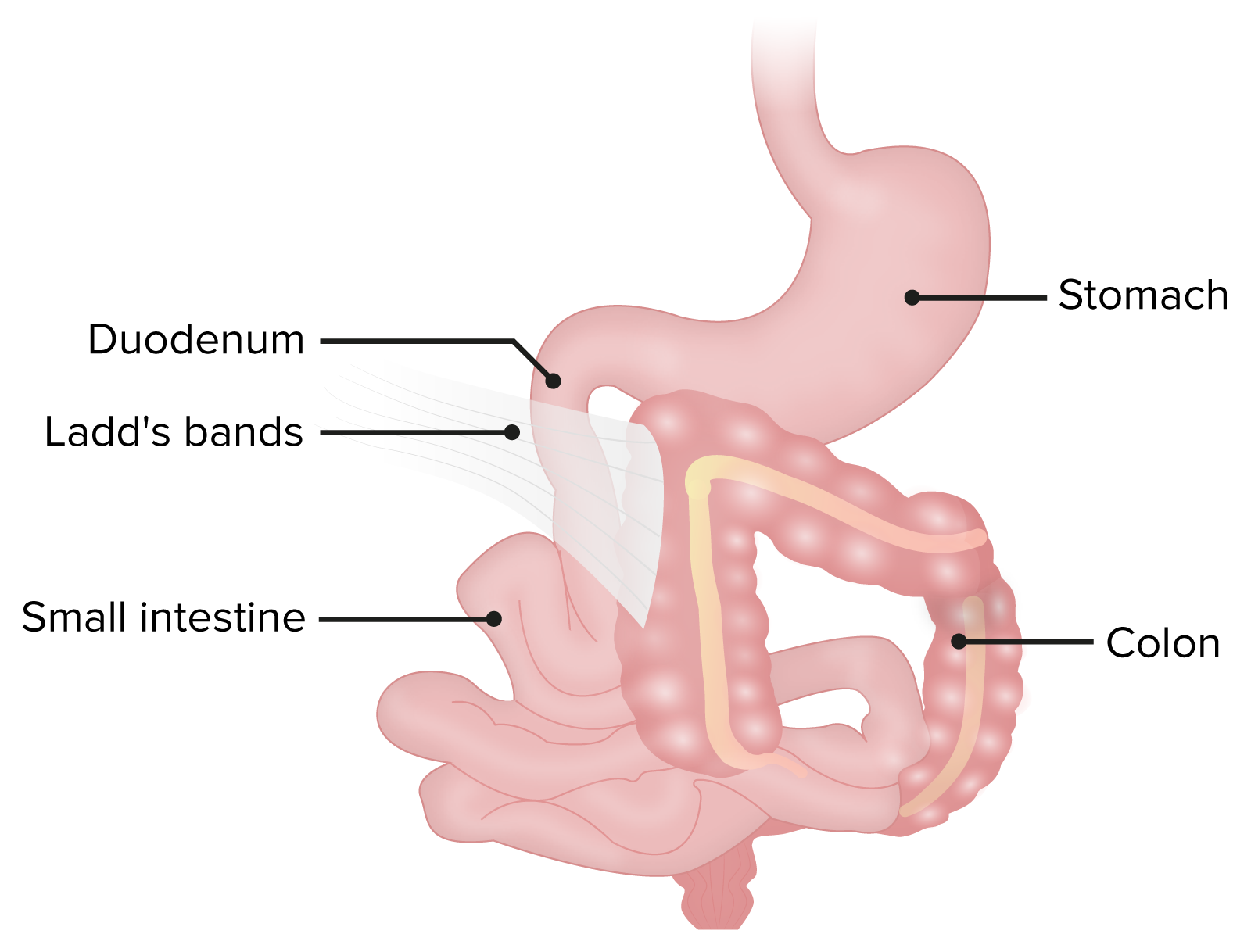
Rotación incompleta

  • El ciego se encuentra en EN Erythema nodosum is an immune-mediated panniculitis (inflammation of the subcutaneous fat) caused by a type IV (delayed-type) hypersensitivity reaction. It commonly manifests in young women as tender, erythematous nodules on the shins. Erythema Nodosum la parte media superior del abdomen.
  • Ciego fijado a la pared abdominal lateral derecha con bandas de Ladd (adherencias peritoneales).
  • Las bandas de Ladd atraviesan el duodeno y pueden causar compresión extrínseca.
  • Esta configuración también puede resultar en EN Erythema nodosum is an immune-mediated panniculitis (inflammation of the subcutaneous fat) caused by a type IV (delayed-type) hypersensitivity reaction. It commonly manifests in young women as tender, erythematous nodules on the shins. Erythema Nodosum un vólvulo del intestino medio, así como en EN Erythema nodosum is an immune-mediated panniculitis (inflammation of the subcutaneous fat) caused by a type IV (delayed-type) hypersensitivity reaction. It commonly manifests in young women as tender, erythematous nodules on the shins. Erythema Nodosum hernias internas.

Vólvulo del intestino medio

  • Torsión del mesenterio del intestino delgado malrotado
  • Se producirá una obstrucción del intestino delgado e isquemia.
  • La presentación aguda en EN Erythema nodosum is an immune-mediated panniculitis (inflammation of the subcutaneous fat) caused by a type IV (delayed-type) hypersensitivity reaction. It commonly manifests in young women as tender, erythematous nodules on the shins. Erythema Nodosum los LOS Neisseria lactantes resulta en EN Erythema nodosum is an immune-mediated panniculitis (inflammation of the subcutaneous fat) caused by a type IV (delayed-type) hypersensitivity reaction. It commonly manifests in young women as tender, erythematous nodules on the shins. Erythema Nodosum una emergencia quirúrgica, pero los LOS Neisseria casos crónicos/subagudos también pueden ocurrir en EN Erythema nodosum is an immune-mediated panniculitis (inflammation of the subcutaneous fat) caused by a type IV (delayed-type) hypersensitivity reaction. It commonly manifests in young women as tender, erythematous nodules on the shins. Erythema Nodosum personas mayores.

Presentación Clínica

Malrotación (sin vólvulo)

  • Mayormente asintomática
  • Obstrucción duodenal (por las bandas de Ladd):
    • Vómitos biliosos en EN Erythema nodosum is an immune-mediated panniculitis (inflammation of the subcutaneous fat) caused by a type IV (delayed-type) hypersensitivity reaction. It commonly manifests in young women as tender, erythematous nodules on the shins. Erythema Nodosum chorro
    • A veces no bilioso, si se obstruye proximalmente a la ampolla de Vater

Vólvulo del intestino medio

  • Lactantes y niños pequeños:
    • Vómito bilioso
    • Distensión/sensibilidad abdominal: variable Variable Variables represent information about something that can change. The design of the measurement scales, or of the methods for obtaining information, will determine the data gathered and the characteristics of that data. As a result, a variable can be qualitative or quantitative, and may be further classified into subgroups. Types of Variables
    • Signos tardíos (que indican isquemia intestinal):
      • Hematoquecia o hemorragia rectal
      • Hematemesis Hematemesis Vomiting of blood that is either fresh bright red, or older ‘coffee-ground’ in character. It generally indicates bleeding of the upper gastrointestinal tract. Mallory-Weiss Syndrome (Mallory-Weiss Tear)
      • Hipotensión
      • Piel pálida con diaforesis
      • Taquicardia
  • Niños mayores/adultos:
    • Inicio insidioso
    • Dolor Dolor Inflammation abdominal intermitente y vómitos (biliosos o no biliosos)
    • Falta de aumento de peso debido a la malabsorción
    • Diarrea crónica

Hernias internas

  • También puede presentarse con dolor Dolor Inflammation/vómitos abdominales intermitentes
  • Estreñimiento intermitente
  • El diagnóstico a menudo se pasa por alto/se retrasa

Diagnóstico

Antecedentes

  • Inicio agudo de vómitos biliosos en EN Erythema nodosum is an immune-mediated panniculitis (inflammation of the subcutaneous fat) caused by a type IV (delayed-type) hypersensitivity reaction. It commonly manifests in young women as tender, erythematous nodules on the shins. Erythema Nodosum lactantes
  • Niños mayores:
    • Retraso en EN Erythema nodosum is an immune-mediated panniculitis (inflammation of the subcutaneous fat) caused by a type IV (delayed-type) hypersensitivity reaction. It commonly manifests in young women as tender, erythematous nodules on the shins. Erythema Nodosum el crecimiento/no ganan peso
    • Dolor Dolor Inflammation abdominal crónico/vómitos/diarrea
    • Inicio agudo de dolor Dolor Inflammation abdominal y vómitos

Examen físico

  • Sensibilidad abdominal (puede ser difícil de provocar en EN Erythema nodosum is an immune-mediated panniculitis (inflammation of the subcutaneous fat) caused by a type IV (delayed-type) hypersensitivity reaction. It commonly manifests in young women as tender, erythematous nodules on the shins. Erythema Nodosum los LOS Neisseria lactantes)
  • Distensión abdominal ( variable Variable Variables represent information about something that can change. The design of the measurement scales, or of the methods for obtaining information, will determine the data gathered and the characteristics of that data. As a result, a variable can be qualitative or quantitative, and may be further classified into subgroups. Types of Variables)
  • Signos de angustia en EN Erythema nodosum is an immune-mediated panniculitis (inflammation of the subcutaneous fat) caused by a type IV (delayed-type) hypersensitivity reaction. It commonly manifests in young women as tender, erythematous nodules on the shins. Erythema Nodosum lactantes:
    • Llanto
    • Taquipnea
    • Levantamiento de rodillas hacia el abdomen
  • Signos de deshidratación
    • Membranas mucosas secas
    • Fontanelas hundidas
  • Letargo
  • Signos tardíos que indican isquemia/perforación:
    • Peritonitis Peritonitis Inflammation of the peritoneum lining the abdominal cavity as the result of infectious, autoimmune, or chemical processes. Primary peritonitis is due to infection of the peritoneal cavity via hematogenous or lymphatic spread and without intra-abdominal source. Secondary peritonitis arises from the abdominal cavity itself through rupture or abscess of intra-abdominal organs. Penetrating Abdominal Injury/abdomen rígido
    • Hematoquecia
    • Fiebre
    • Taquicardia/hipotensión

Estudios de laboratorio

  • Inespecíficos
  • Hemograma
    • Leucocitosis
    • Anemia Anemia Anemia is a condition in which individuals have low Hb levels, which can arise from various causes. Anemia is accompanied by a reduced number of RBCs and may manifest with fatigue, shortness of breath, pallor, and weakness. Subtypes are classified by the size of RBCs, chronicity, and etiology. Anemia: Overview and Types ( en EN Erythema nodosum is an immune-mediated panniculitis (inflammation of the subcutaneous fat) caused by a type IV (delayed-type) hypersensitivity reaction. It commonly manifests in young women as tender, erythematous nodules on the shins. Erythema Nodosum casos crónicos)
  • Química sanguínea:
    • Alcalosis por contracción, anomalías electrolíticas por vómitos
    • Acidosis Acidosis A pathologic condition of acid accumulation or depletion of base in the body. The two main types are respiratory acidosis and metabolic acidosis, due to metabolic acid build up. Respiratory Acidosis, lactato elevado: signos de isquemia intestinal

Imagenología

Solo debe realizarse en EN Erythema nodosum is an immune-mediated panniculitis (inflammation of the subcutaneous fat) caused by a type IV (delayed-type) hypersensitivity reaction. It commonly manifests in young women as tender, erythematous nodules on the shins. Erythema Nodosum pacientes estables. Los LOS Neisseria pacientes con inestabilidad hemodinámica/ sepsis Sepsis Systemic inflammatory response syndrome with a proven or suspected infectious etiology. When sepsis is associated with organ dysfunction distant from the site of infection, it is called severe sepsis. When sepsis is accompanied by hypotension despite adequate fluid infusion, it is called septic shock. Sepsis and Septic Shock/ peritonitis Peritonitis Inflammation of the peritoneum lining the abdominal cavity as the result of infectious, autoimmune, or chemical processes. Primary peritonitis is due to infection of the peritoneal cavity via hematogenous or lymphatic spread and without intra-abdominal source. Secondary peritonitis arises from the abdominal cavity itself through rupture or abscess of intra-abdominal organs. Penetrating Abdominal Injury deben proceder a cirugía de emergencia.

Radiografía del abdomen:

  • Debe realizarse para descartar la perforación en EN Erythema nodosum is an immune-mediated panniculitis (inflammation of the subcutaneous fat) caused by a type IV (delayed-type) hypersensitivity reaction. It commonly manifests in young women as tender, erythematous nodules on the shins. Erythema Nodosum lactantes
  • Puede mostrar signo de la doble burbuja (obstrucción duodenal)

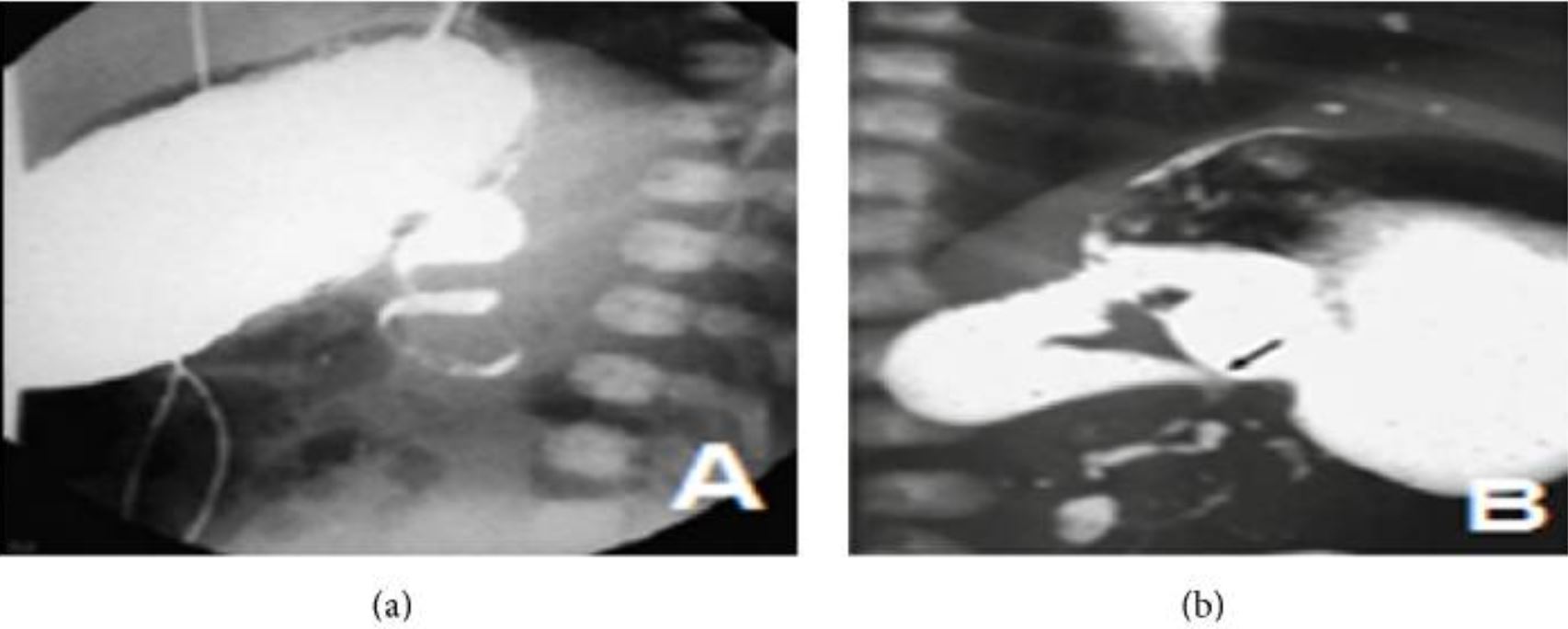
Tránsito esofagogastroduodenal:

  • Estándar de oro en EN Erythema nodosum is an immune-mediated panniculitis (inflammation of the subcutaneous fat) caused by a type IV (delayed-type) hypersensitivity reaction. It commonly manifests in young women as tender, erythematous nodules on the shins. Erythema Nodosum pacientes hemodinámicamente estables
  • El segmento duodenoyeyunal (ligamento de Treitz) está a la derecha de la línea media.
  • El duodeno tiene apariencia de “sacacorchos” (indica vólvulo).
  • Duodeno dilatado en EN Erythema nodosum is an immune-mediated panniculitis (inflammation of the subcutaneous fat) caused by a type IV (delayed-type) hypersensitivity reaction. It commonly manifests in young women as tender, erythematous nodules on the shins. Erythema Nodosum casos de compresión extrínseca o vólvulo.

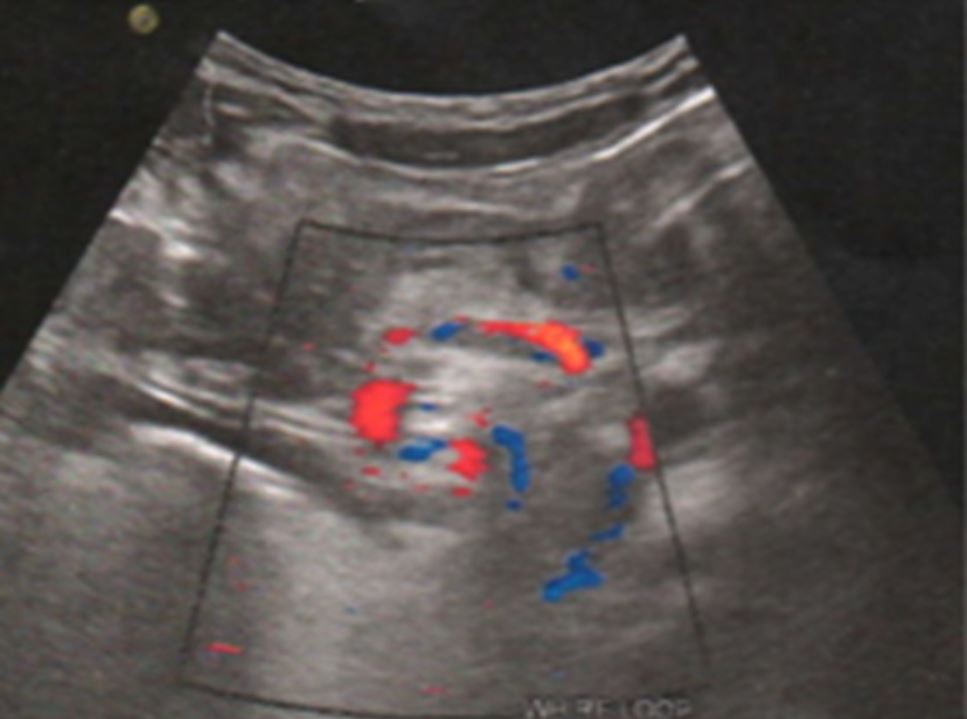
Ultrasonido:

  • La torsión de la vena mesentérica superior y el mesenterio alrededor de la arteria mesentérica superior se conoce como el signo del “remolino”.
  • Relación arteria/vena mesentérica superior anormal
  • Posición anormal de la 3ra porción del duodeno
  • Duodeno dilatado
  • El ultrasonido normal no descarta la malrotación.

Tratamiento

Tratamiento preoperatorio

  • Reanimación con líquidos/corrección de electrolitos
  • Nils per os (nada por boca)
  • Antibióticos intravenosos para cubrir la flora intestinal
  • Inserción de sonda nasogástrica para descompresión gástrica

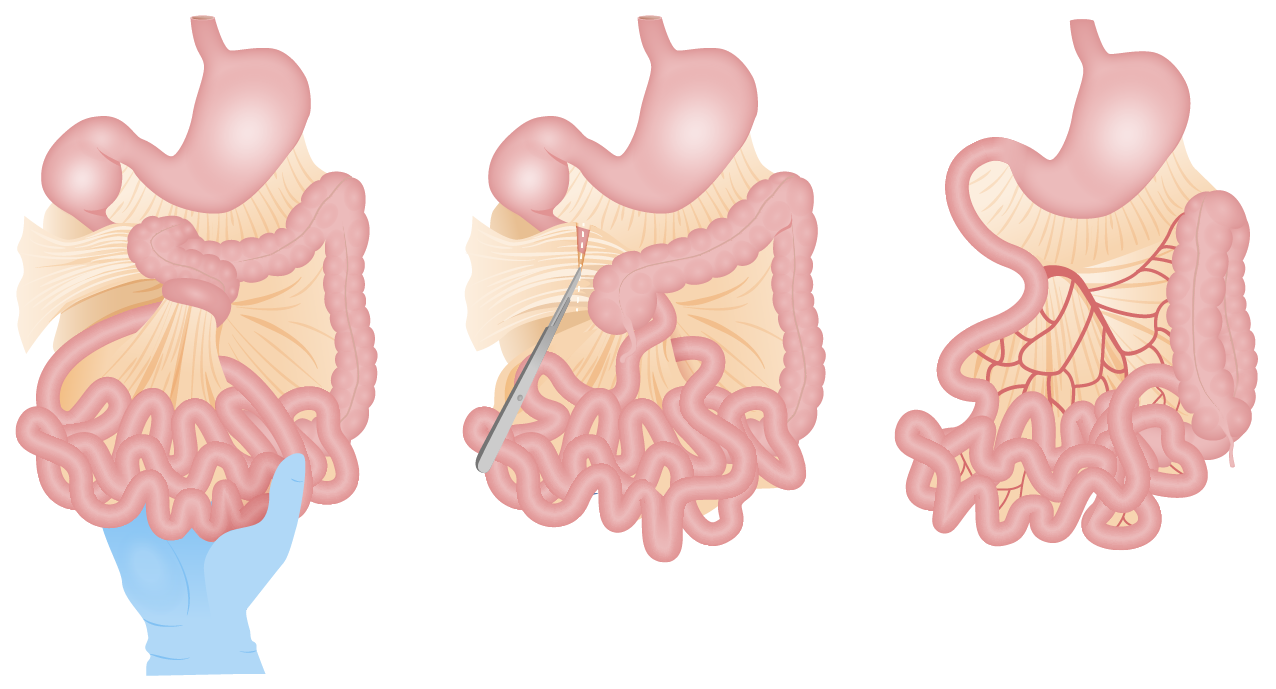
Procedimiento de Ladd

Laparotomía de emergencia:

  • Realizado para todos los LOS Neisseria casos de vólvulo del intestino medio.
  • El procedimiento consta de:
    • Reducción en EN Erythema nodosum is an immune-mediated panniculitis (inflammation of the subcutaneous fat) caused by a type IV (delayed-type) hypersensitivity reaction. It commonly manifests in young women as tender, erythematous nodules on the shins. Erythema Nodosum sentido contrario a las manecillas del reloj del vólvulo del intestino medio
    • División de bandas de Ladd
    • Ensanchamiento del mesenterio (abrir el mesenterio doblado como un libro y dividir las adherencias congénitas)
    • Colocar el colon Colon The large intestines constitute the last portion of the digestive system. The large intestine consists of the cecum, appendix, colon (with ascending, transverse, descending, and sigmoid segments), rectum, and anal canal. The primary function of the colon is to remove water and compact the stool prior to expulsion from the body via the rectum and anal canal. Colon, Cecum, and Appendix: Anatomy en EN Erythema nodosum is an immune-mediated panniculitis (inflammation of the subcutaneous fat) caused by a type IV (delayed-type) hypersensitivity reaction. It commonly manifests in young women as tender, erythematous nodules on the shins. Erythema Nodosum el lado izquierdo y todo el intestino delgado en EN Erythema nodosum is an immune-mediated panniculitis (inflammation of the subcutaneous fat) caused by a type IV (delayed-type) hypersensitivity reaction. It commonly manifests in young women as tender, erythematous nodules on the shins. Erythema Nodosum el lado derecho para prevenir cualquier recurrencia futura del vólvulo
    • Apendicectomía
    • Resección de cualquier intestino necrótico si está presente, posiblemente con creación de un estoma

Procedimiento de Ladd electivo/profiláctico:
  • Debe realizarse en EN Erythema nodosum is an immune-mediated panniculitis (inflammation of the subcutaneous fat) caused by a type IV (delayed-type) hypersensitivity reaction. It commonly manifests in young women as tender, erythematous nodules on the shins. Erythema Nodosum casos de malrotación intestinal asintomática o detectada de forma fortuita
  • Puede realizarse por vía laparoscópica en EN Erythema nodosum is an immune-mediated panniculitis (inflammation of the subcutaneous fat) caused by a type IV (delayed-type) hypersensitivity reaction. It commonly manifests in young women as tender, erythematous nodules on the shins. Erythema Nodosum ausencia de vólvulo
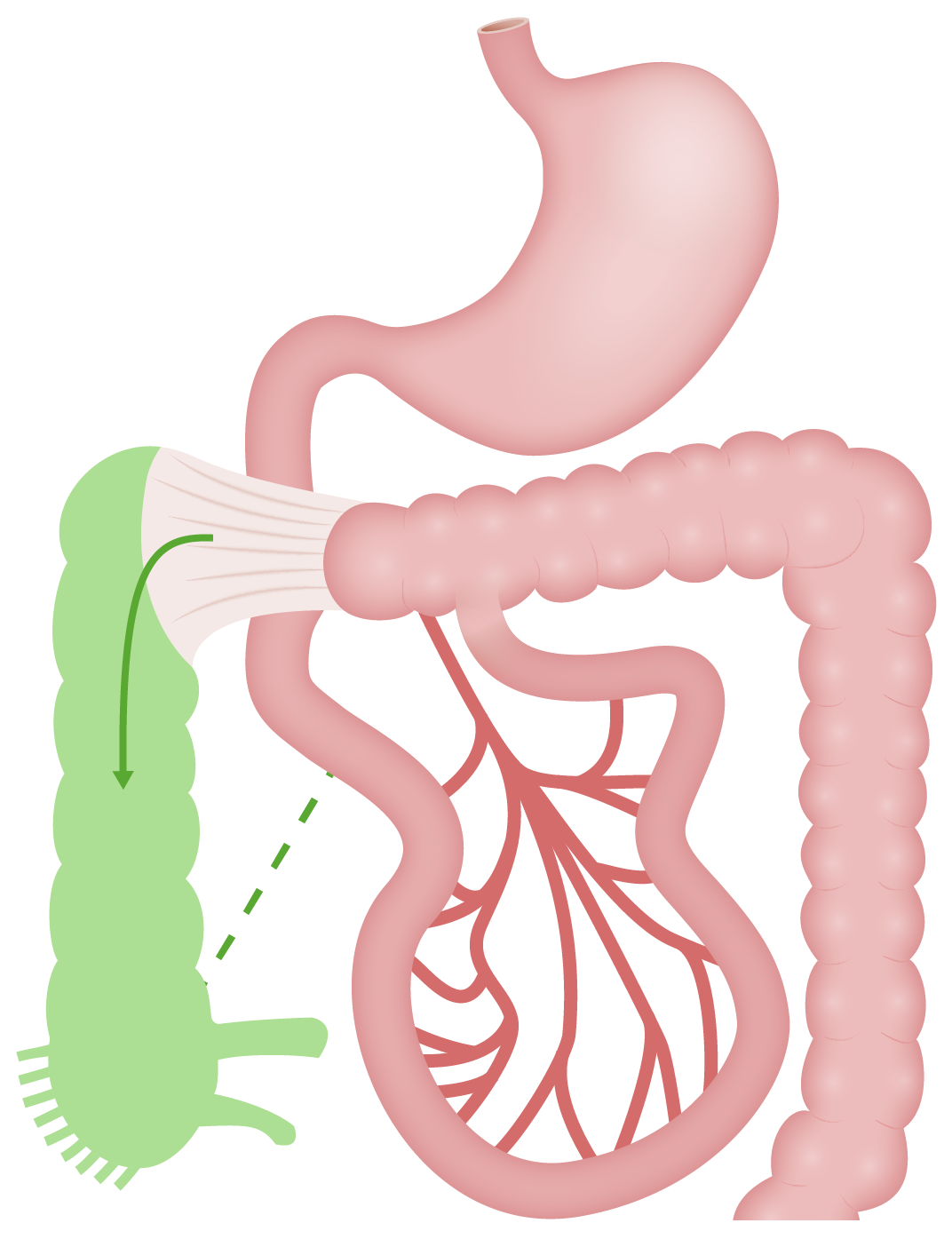
Procedimiento de Ladd

Procedimiento de Ladd:
Desvío del intestino y división de las bandas de Ladd. El intestino delgado se coloca a la derecha y el colon a la izquierda del abdomen.

Imagen by Lecturio.

Pronóstico

  • Mortalidad global después de la cirugía: 3%–9%
  • La mortalidad es cercana al AL Amyloidosis 0% para los LOS Neisseria niños por lo demás sanos sin isquemia, pero la tasa de mortalidad puede aumentar si hay:
    • Necrosis Necrosis The death of cells in an organ or tissue due to disease, injury or failure of the blood supply. Ischemic Cell Damage intestinal
    • Prematuridad
    • Anomalías congénitas asociadas
  • Riesgo de vólvulo recurrente: 2%–8%
  • Si es necesario resecar un segmento grande del intestino delgado debido a la necrosis Necrosis The death of cells in an organ or tissue due to disease, injury or failure of the blood supply. Ischemic Cell Damage, puede producirse el síndrome de intestino corto.

Diagnóstico Diferencial

  • Atresia Atresia Hypoplastic Left Heart Syndrome (HLHS) y estenosis duodenal: una afección congénita en EN Erythema nodosum is an immune-mediated panniculitis (inflammation of the subcutaneous fat) caused by a type IV (delayed-type) hypersensitivity reaction. It commonly manifests in young women as tender, erythematous nodules on the shins. Erythema Nodosum la que hay una ausencia de luz duodenal normal. Esta afección puede presentarse con vómitos recurrentes, intolerancia alimentaria y retraso del crecimiento. La radiografía de abdomen muestra un signo característico de la doble burbuja y un intestino distal sin gas. El tratamiento se basa en EN Erythema nodosum is an immune-mediated panniculitis (inflammation of the subcutaneous fat) caused by a type IV (delayed-type) hypersensitivity reaction. It commonly manifests in young women as tender, erythematous nodules on the shins. Erythema Nodosum la corrección quirúrgica.
  • Estenosis hipertrófica del píloro: una hipertrofia del músculo del esfínter pilórico en EN Erythema nodosum is an immune-mediated panniculitis (inflammation of the subcutaneous fat) caused by a type IV (delayed-type) hypersensitivity reaction. It commonly manifests in young women as tender, erythematous nodules on the shins. Erythema Nodosum lactantes. Esta afección se presenta después de las 1eras 3 semanas de vida con vómitos no biliosos en EN Erythema nodosum is an immune-mediated panniculitis (inflammation of the subcutaneous fat) caused by a type IV (delayed-type) hypersensitivity reaction. It commonly manifests in young women as tender, erythematous nodules on the shins. Erythema Nodosum proyectil. El diagnóstico se realiza mediante ultrasonido y el tratamiento es una piloromiotomía quirúrgica.
  • Intususcepción: una afección en EN Erythema nodosum is an immune-mediated panniculitis (inflammation of the subcutaneous fat) caused by a type IV (delayed-type) hypersensitivity reaction. It commonly manifests in young women as tender, erythematous nodules on the shins. Erythema Nodosum la que 1 parte del intestino se introduce dentro de otra como un telescopio, lo que generalmente resulta en EN Erythema nodosum is an immune-mediated panniculitis (inflammation of the subcutaneous fat) caused by a type IV (delayed-type) hypersensitivity reaction. It commonly manifests in young women as tender, erythematous nodules on the shins. Erythema Nodosum una obstrucción intestinal. Los LOS Neisseria pacientes se presentan con dolor Dolor Inflammation abdominal tipo cólico, vómitos y, a veces, heces con sangre (o gelatina de grosella). El diagnóstico en EN Erythema nodosum is an immune-mediated panniculitis (inflammation of the subcutaneous fat) caused by a type IV (delayed-type) hypersensitivity reaction. It commonly manifests in young women as tender, erythematous nodules on the shins. Erythema Nodosum niños se establece con frecuencia mediante el ultrasonido. El tratamiento en EN Erythema nodosum is an immune-mediated panniculitis (inflammation of the subcutaneous fat) caused by a type IV (delayed-type) hypersensitivity reaction. It commonly manifests in young women as tender, erythematous nodules on the shins. Erythema Nodosum niños generalmente implica una reducción no operatoria con un enema, y la cirugía se reserva para los LOS Neisseria casos complicados.

Referencias

  1. Bensard D.D. (2023). Intestinal Malrotation. Medscape. Retrieved March 27, 2025, from https://emedicine.medscape.com/article/930313-overview
  2. Brandt M.L. (2025). Intestinal malrotation in children. UpToDate. Retrieved March 27, 2025, from https://www.uptodate.com/contents/intestinal-malrotation-in-children

¡Crea tu cuenta gratis o inicia una sesión para seguir leyendo!

Regístrate ahora y obtén acceso gratuito a Lecturio con páginas de concepto, videos médicos y cuestionarios para tu educación médica.

User Reviews

Que tengas una sesión de estudio alegre y navideña 🎁 Ahorra 50% en todos los planes >>

Details