Domina Conceptos Médicos

Estudia para la escuela de medicina y tus examenes con Lecturio.

Región Femoral y sus Hernias: Anatomía

La hernia Hernia Protrusion of tissue, structure, or part of an organ through the bone, muscular tissue, or the membrane by which it is normally contained. Hernia may involve tissues such as the abdominal wall or the respiratory diaphragm. Hernias may be internal, external, congenital, or acquired. Abdominal Hernias femoral es un tipo poco común de hernia Hernia Protrusion of tissue, structure, or part of an organ through the bone, muscular tissue, or the membrane by which it is normally contained. Hernia may involve tissues such as the abdominal wall or the respiratory diaphragm. Hernias may be internal, external, congenital, or acquired. Abdominal Hernias inguinal en EN Erythema nodosum is an immune-mediated panniculitis (inflammation of the subcutaneous fat) caused by a type IV (delayed-type) hypersensitivity reaction. It commonly manifests in young women as tender, erythematous nodules on the shins. Erythema Nodosum la que el contenido intraabdominal se hernia Hernia Protrusion of tissue, structure, or part of an organ through the bone, muscular tissue, or the membrane by which it is normally contained. Hernia may involve tissues such as the abdominal wall or the respiratory diaphragm. Hernias may be internal, external, congenital, or acquired. Abdominal Hernias por debajo del ligamento inguinal y a través del anillo femoral hacia el canal femoral. Más frecuentes en EN Erythema nodosum is an immune-mediated panniculitis (inflammation of the subcutaneous fat) caused by a type IV (delayed-type) hypersensitivity reaction. It commonly manifests in young women as tender, erythematous nodules on the shins. Erythema Nodosum adultos que en EN Erythema nodosum is an immune-mediated panniculitis (inflammation of the subcutaneous fat) caused by a type IV (delayed-type) hypersensitivity reaction. It commonly manifests in young women as tender, erythematous nodules on the shins. Erythema Nodosum niños, las hernias femorales suelen presentarse con una inflamación que sobresale en EN Erythema nodosum is an immune-mediated panniculitis (inflammation of the subcutaneous fat) caused by a type IV (delayed-type) hypersensitivity reaction. It commonly manifests in young women as tender, erythematous nodules on the shins. Erythema Nodosum el triángulo femoral (inferior al AL Amyloidosis ligamento inguinal y medial a la vena femoral). Aunque son infrecuentes, las hernias femorales se asocian con frecuencia a complicaciones  secundarias al AL Amyloidosis tamaño reducido del canal, que conducen al AL Amyloidosis encarcelamiento  y/o a la estrangulación de la hernia Hernia Protrusion of tissue, structure, or part of an organ through the bone, muscular tissue, or the membrane by which it is normally contained. Hernia may involve tissues such as the abdominal wall or the respiratory diaphragm. Hernias may be internal, external, congenital, or acquired. Abdominal Hernias.

Last updated: Dec 15, 2025

Editorial responsibility: Stanley Oiseth, Lindsay Jones, Evelin Maza

Anatomía

Anillo femoral

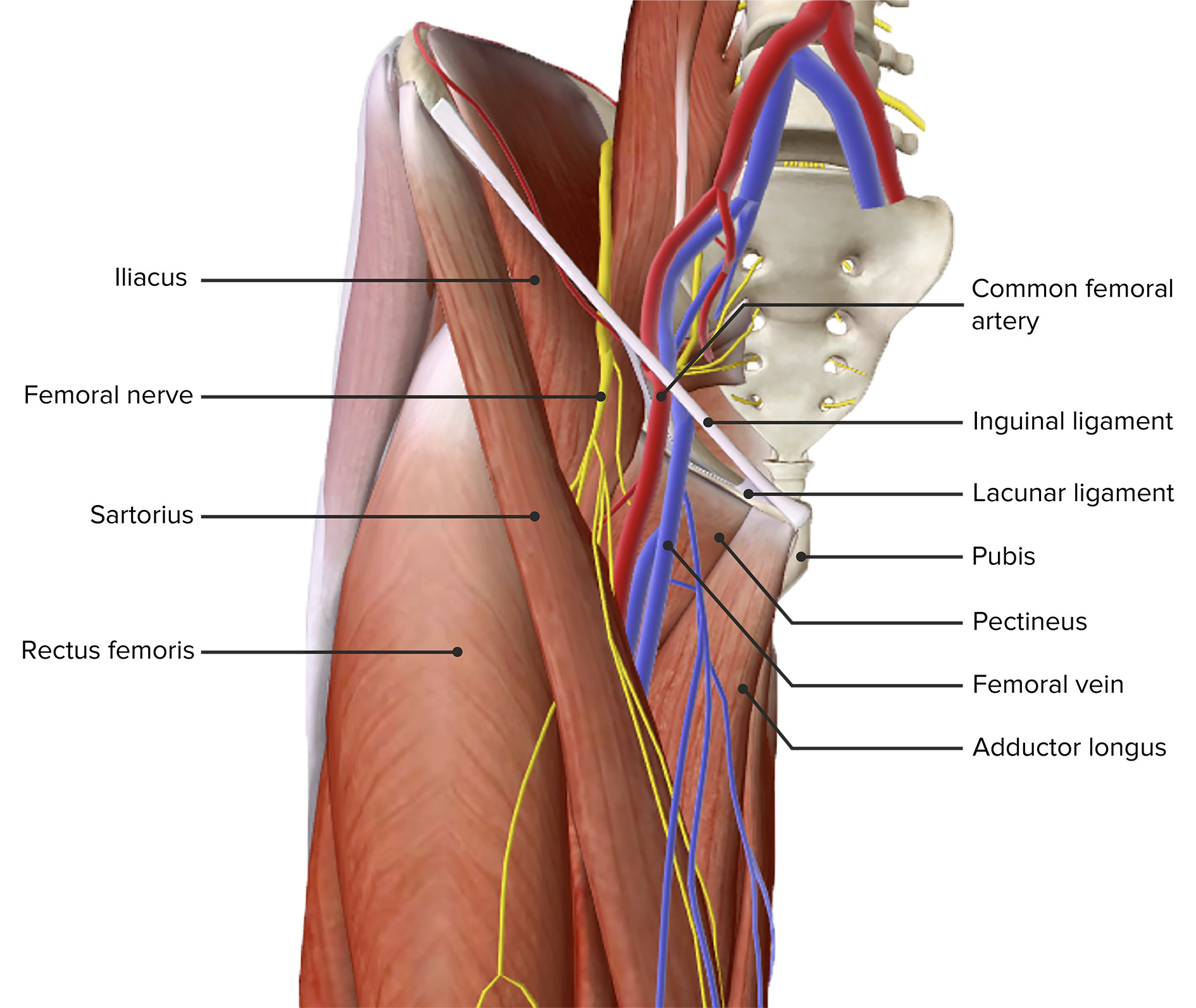
El anillo femoral es la apertura proximal o abdominal/pélvica del canal femoral.

Límites:
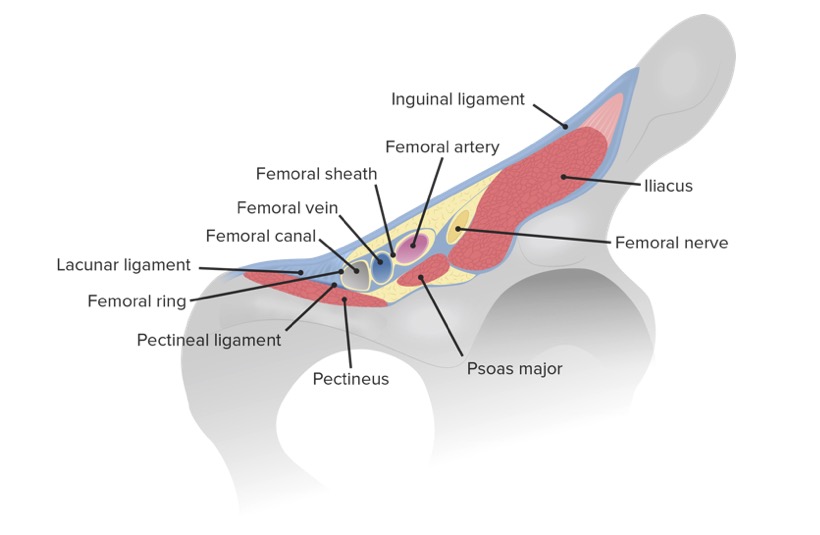
  • Anterior: ligamento inguinal
  • Posterior: ligamento y músculo pectíneo
  • Medial: ligamento lacunar
  • Lateral: borde medial de la vena femoral
Anillo femoral

Límites del anillo y del canal femoral en relación con los vasos y el nervio femoral

Imagen por Lecturio.

Canal femoral

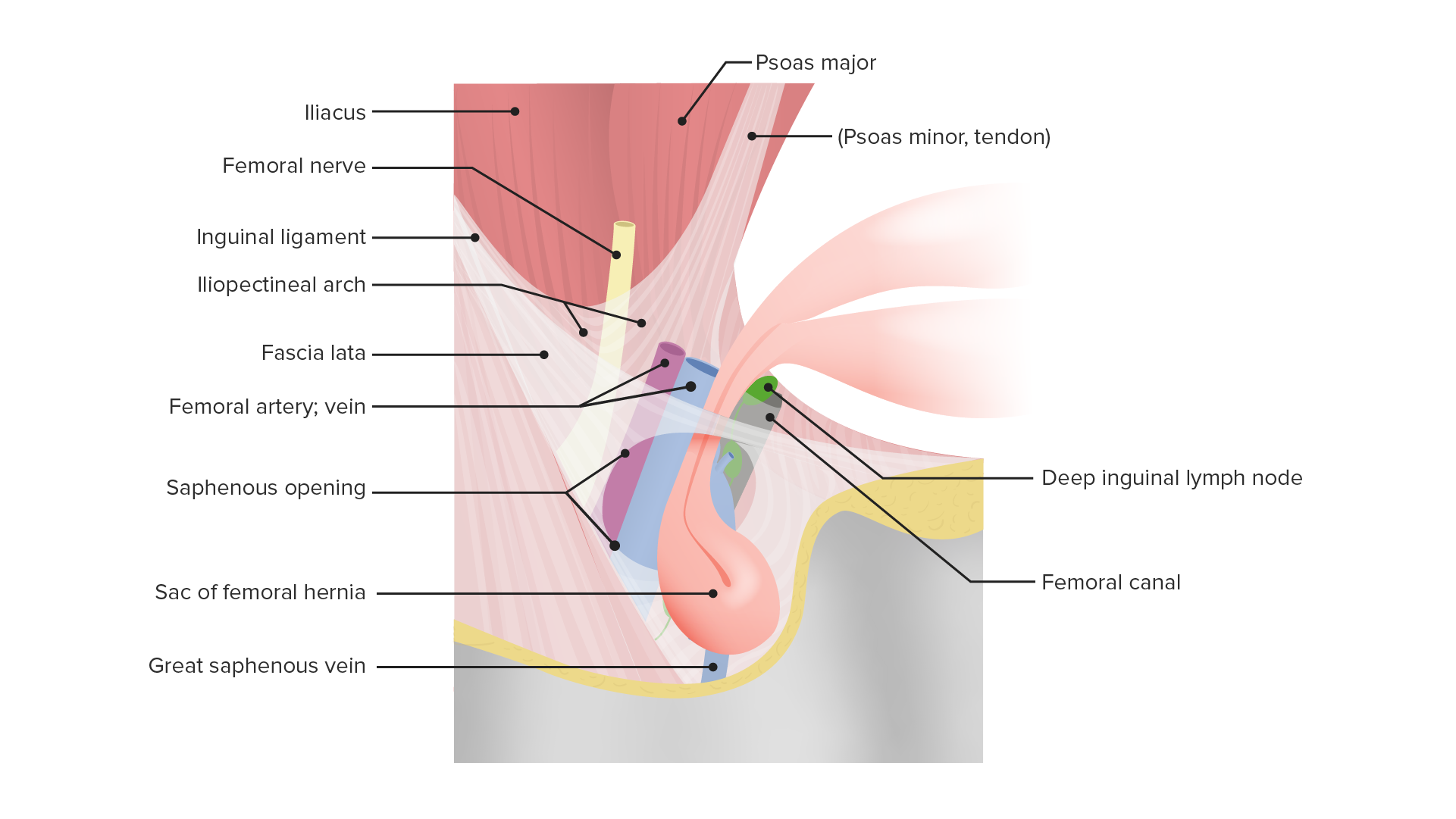
El canal femoral es un espacio cilíndrico que constituye el compartimento medial encerrado en EN Erythema nodosum is an immune-mediated panniculitis (inflammation of the subcutaneous fat) caused by a type IV (delayed-type) hypersensitivity reaction. It commonly manifests in young women as tender, erythematous nodules on the shins. Erythema Nodosum la vaina femoral.
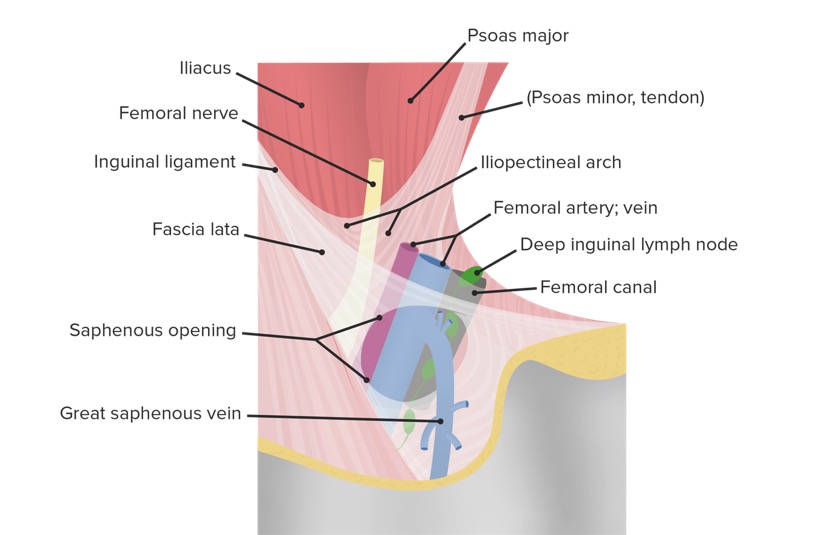
  • Mismos límites que el anillo femoral
  • Se extiende 1-2 cm dentro del muslo
  • Contiene tejido conectivo laxo, vasos linfáticos y ganglios linfáticos
  • La vaina femoral es una fascia Fascia Layers of connective tissue of variable thickness. The superficial fascia is found immediately below the skin; the deep fascia invests muscles, nerves, and other organs. Cellulitis que encierra el contenido del triángulo femoral (excepto el nervio femoral), cada uno dentro de su propio compartimento.
Canal femoral

Imagen detallada del triángulo femoral que muestra la ubicación del canal femoral en relación con las estructuras vecinas de la cara interna del muslo

Imagen por Lecturio.

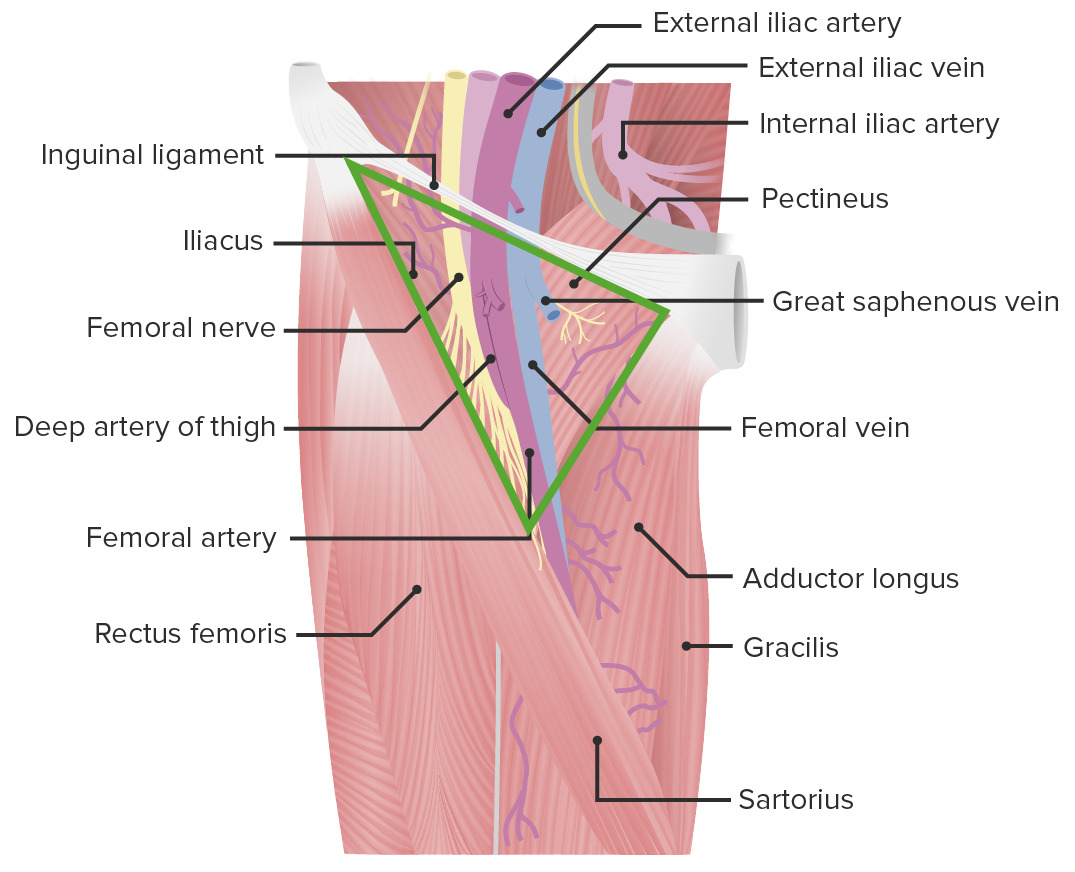
Triángulo femoral

El triángulo femoral está situado en EN Erythema nodosum is an immune-mediated panniculitis (inflammation of the subcutaneous fat) caused by a type IV (delayed-type) hypersensitivity reaction. It commonly manifests in young women as tender, erythematous nodules on the shins. Erythema Nodosum la cara medial de la parte anterior del muslo.
  • Límites:
    • Lateral: músculo sartorio
    • Medial: músculo aductor largo
    • Superior (base): ligamento inguinal
    • Vértice: continuo con el canal aductor
    • Suelo: el pectíneo y aductor corto medialmente, e iliopsoas lateralmente
    • Techo: fascia lata Fascia lata Femoral Region and Hernias: Anatomy, fascia Fascia Layers of connective tissue of variable thickness. The superficial fascia is found immediately below the skin; the deep fascia invests muscles, nerves, and other organs. Cellulitis superficial y piel
      • La fascia lata Fascia lata Femoral Region and Hernias: Anatomy recubre el triángulo femoral; la abertura de la safena aquí permite la entrada de los LOS Neisseria vasos linfáticos y de la vena safena mayor; la hernia Hernia Protrusion of tissue, structure, or part of an organ through the bone, muscular tissue, or the membrane by which it is normally contained. Hernia may involve tissues such as the abdominal wall or the respiratory diaphragm. Hernias may be internal, external, congenital, or acquired. Abdominal Hernias femoral protruye por esta abertura

Hernia Hernia Protrusion of tissue, structure, or part of an organ through the bone, muscular tissue, or the membrane by which it is normally contained. Hernia may involve tissues such as the abdominal wall or the respiratory diaphragm. Hernias may be internal, external, congenital, or acquired. Abdominal Hernias femoral

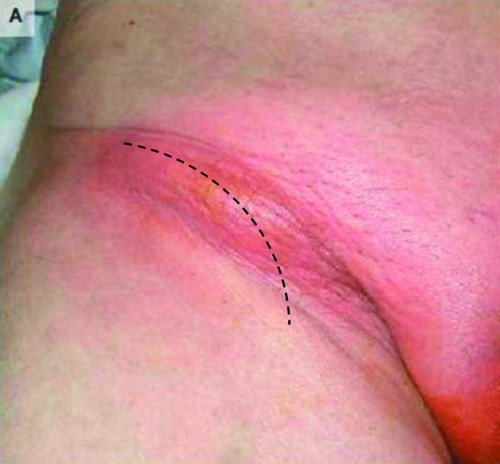
La hernia Hernia Protrusion of tissue, structure, or part of an organ through the bone, muscular tissue, or the membrane by which it is normally contained. Hernia may involve tissues such as the abdominal wall or the respiratory diaphragm. Hernias may be internal, external, congenital, or acquired. Abdominal Hernias femoral es la protrusión del contenido intraabdominal por debajo del ligamento inguinal, a través del anillo femoral y hacia el canal femoral, produciendo un “bulto” o inflamación en EN Erythema nodosum is an immune-mediated panniculitis (inflammation of the subcutaneous fat) caused by a type IV (delayed-type) hypersensitivity reaction. It commonly manifests in young women as tender, erythematous nodules on the shins. Erythema Nodosum el triángulo femoral.
Hernia femoral

Acercamiento del triángulo femoral que muestra la localización de una hernia femoral

Imagen por Lecturio.

Mnemotecnia

Para recordar los LOS Neisseria bordes del triángulo femoral-SAIL ( en EN Erythema nodosum is an immune-mediated panniculitis (inflammation of the subcutaneous fat) caused by a type IV (delayed-type) hypersensitivity reaction. It commonly manifests in young women as tender, erythematous nodules on the shins. Erythema Nodosum inglés):
  • S: Sartorius muscle (músculo sartorio)
  • A: Adductor longus muscle (músculo aductor largo)
  • IL: Inguinal Ligament (ligamento inguinal)

Para recordar el contenido del triángulo femoral (de lateral a medial)-NAVEL ( en EN Erythema nodosum is an immune-mediated panniculitis (inflammation of the subcutaneous fat) caused by a type IV (delayed-type) hypersensitivity reaction. It commonly manifests in young women as tender, erythematous nodules on the shins. Erythema Nodosum inglés):

  • N: femoral Nerve (nervio femoral)
  • A: femoral Artery (arteria femoral)
  • V: femoral V ein EIN Atypical hyperplasia Endometrial Hyperplasia and Endometrial Cancer (vena femoral)
  • E: Empty space (canal femoral)
  • L: deep inguinal Lymph nodes (ganglios linfáticos inguinales profundos)

Related videos

Epidemiología y Etiología

Epidemiología

  • Es más frecuente en EN Erythema nodosum is an immune-mediated panniculitis (inflammation of the subcutaneous fat) caused by a type IV (delayed-type) hypersensitivity reaction. It commonly manifests in young women as tender, erythematous nodules on the shins. Erythema Nodosum las mujeres, con una relación mujer-hombre de 3:1
  • Representa < 5% de todas las hernias

Etiología

  • Cualquier condición que aumente la presión intraabdominal y agrande/debilite las estructuras ligamentosas de la pelvis Pelvis The pelvis consists of the bony pelvic girdle, the muscular and ligamentous pelvic floor, and the pelvic cavity, which contains viscera, vessels, and multiple nerves and muscles. The pelvic girdle, composed of 2 “hip” bones and the sacrum, is a ring-like bony structure of the axial skeleton that links the vertebral column with the lower extremities. Pelvis: Anatomy (e.g., el anillo femoral)
  • Factores de riesgo:
    • Aumento de la presión intraabdominal
      • Obesidad
      • Estreñimiento
      • Tos TOS Thoracic outlet syndrome (TOS) is a broad term used for a spectrum of syndromes related to the general region of the thoracic outlet, which involves the compression or irritation of elements of the brachial plexus, subclavian artery, or subclavian vein. Thoracic Outlet Syndrome crónica
      • Emesis recurrente, regular Regular Insulin, o violenta (e.g., trastorno alimentario)
      • Hipertrofia prostática (provoca esfuerzo durante la micción)
    • Agrandamiento/debilitamiento del anillo femoral
      • Género femenino ( pelvis Pelvis The pelvis consists of the bony pelvic girdle, the muscular and ligamentous pelvic floor, and the pelvic cavity, which contains viscera, vessels, and multiple nerves and muscles. The pelvic girdle, composed of 2 “hip” bones and the sacrum, is a ring-like bony structure of the axial skeleton that links the vertebral column with the lower extremities. Pelvis: Anatomy más ancha)
      • Edad avanzada
      • Multiparidad
      • Reparación quirúrgica previa de hernias inguinales

Presentación Clínica

  • Inflamación o “bulto” subcutáneo en EN Erythema nodosum is an immune-mediated panniculitis (inflammation of the subcutaneous fat) caused by a type IV (delayed-type) hypersensitivity reaction. It commonly manifests in young women as tender, erythematous nodules on the shins. Erythema Nodosum la ingle que puede o no ser doloroso
  • Situada inferior al AL Amyloidosis ligamento inguinal y medial a la vena femoral
  • La inflamación o “bulto” se agranda con maniobras de Valsalva

Tipos de hernias femorales

Según la localización y el contenido de la protrusión, se han descrito varios subtipos de hernias femorales:
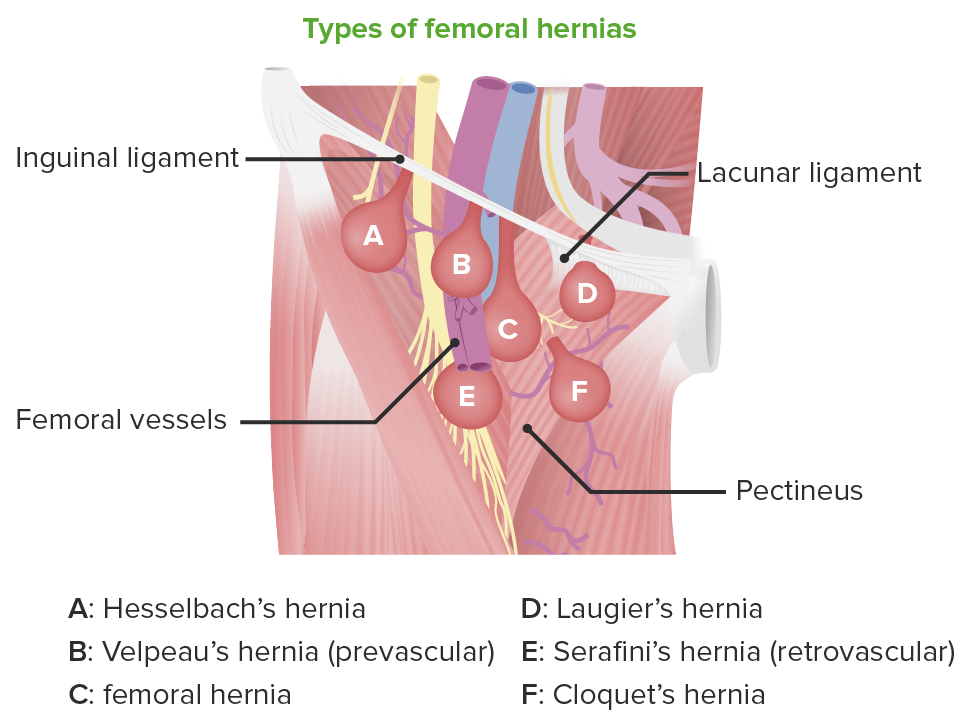
  • Hernia Hernia Protrusion of tissue, structure, or part of an organ through the bone, muscular tissue, or the membrane by which it is normally contained. Hernia may involve tissues such as the abdominal wall or the respiratory diaphragm. Hernias may be internal, external, congenital, or acquired. Abdominal Hernias de Serafini: el saco herniario se encuentra detrás de los LOS Neisseria vasos femorales.
  • Hernia Hernia Protrusion of tissue, structure, or part of an organ through the bone, muscular tissue, or the membrane by which it is normally contained. Hernia may involve tissues such as the abdominal wall or the respiratory diaphragm. Hernias may be internal, external, congenital, or acquired. Abdominal Hernias de Velpeau (o prevascular): el saco herniario se encuentra delante de los LOS Neisseria vasos femorales, lo que puede llevar a confundir este tipo con un aneurisma femoral.
  • Hernia Hernia Protrusion of tissue, structure, or part of an organ through the bone, muscular tissue, or the membrane by which it is normally contained. Hernia may involve tissues such as the abdominal wall or the respiratory diaphragm. Hernias may be internal, external, congenital, or acquired. Abdominal Hernias de Laugier: el saco herniario atraviesa el ligamento lacunar o el ligamento pectíneo de Cooper.
  • Hernia Hernia Protrusion of tissue, structure, or part of an organ through the bone, muscular tissue, or the membrane by which it is normally contained. Hernia may involve tissues such as the abdominal wall or the respiratory diaphragm. Hernias may be internal, external, congenital, or acquired. Abdominal Hernias de Hesselbach: el cuello del saco se encuentra lateral a los LOS Neisseria vasos femorales.
  • Hernia Hernia Protrusion of tissue, structure, or part of an organ through the bone, muscular tissue, or the membrane by which it is normally contained. Hernia may involve tissues such as the abdominal wall or the respiratory diaphragm. Hernias may be internal, external, congenital, or acquired. Abdominal Hernias de Cloquet: el saco herniario desciende en EN Erythema nodosum is an immune-mediated panniculitis (inflammation of the subcutaneous fat) caused by a type IV (delayed-type) hypersensitivity reaction. It commonly manifests in young women as tender, erythematous nodules on the shins. Erythema Nodosum profundidad hasta los LOS Neisseria vasos femorales a través de la fascia Fascia Layers of connective tissue of variable thickness. The superficial fascia is found immediately below the skin; the deep fascia invests muscles, nerves, and other organs. Cellulitis pectínea.
  • Hernia Hernia Protrusion of tissue, structure, or part of an organ through the bone, muscular tissue, or the membrane by which it is normally contained. Hernia may involve tissues such as the abdominal wall or the respiratory diaphragm. Hernias may be internal, external, congenital, or acquired. Abdominal Hernias de Garengeot: el contenido de la hernia Hernia Protrusion of tissue, structure, or part of an organ through the bone, muscular tissue, or the membrane by which it is normally contained. Hernia may involve tissues such as the abdominal wall or the respiratory diaphragm. Hernias may be internal, external, congenital, or acquired. Abdominal Hernias incluye el apéndice vermiforme, que a menudo conduce al AL Amyloidosis encarcelamiento de la hernia Hernia Protrusion of tissue, structure, or part of an organ through the bone, muscular tissue, or the membrane by which it is normally contained. Hernia may involve tissues such as the abdominal wall or the respiratory diaphragm. Hernias may be internal, external, congenital, or acquired. Abdominal Hernias y requiere una apendicectomía como parte de la reparación quirúrgica.
Subtipos de hernias femorales

Tipos de hernias femorales

Imagen por Lecturio.

Complicaciones

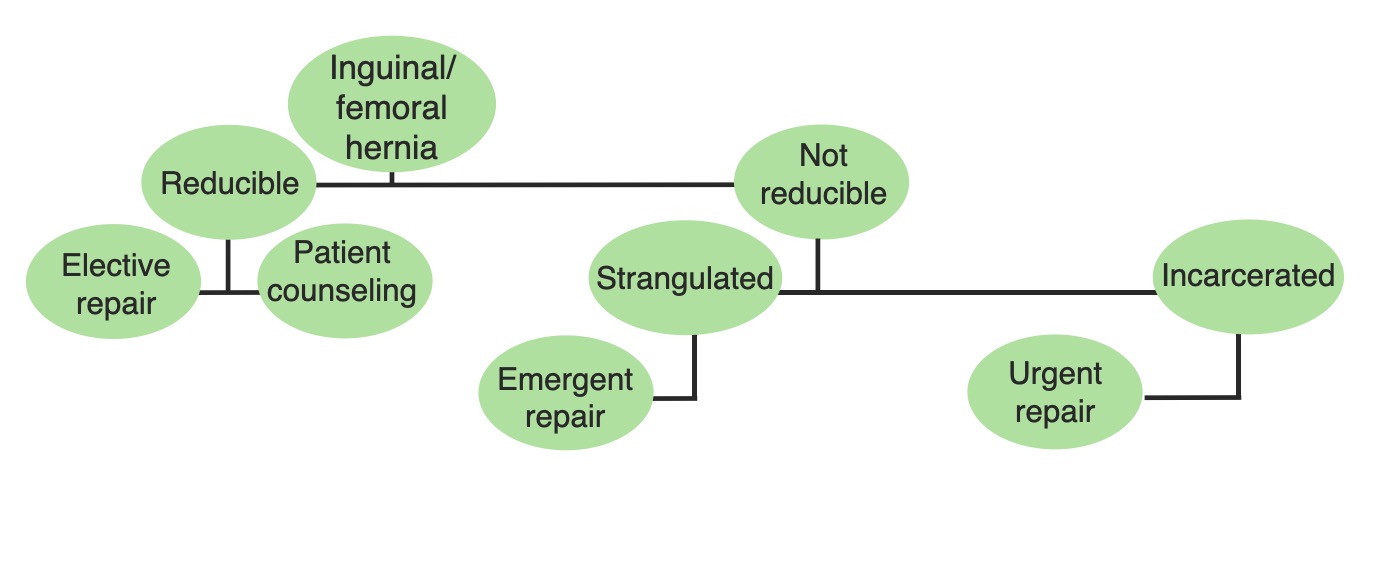
  • Encarcelamiento: La hernia Hernia Protrusion of tissue, structure, or part of an organ through the bone, muscular tissue, or the membrane by which it is normally contained. Hernia may involve tissues such as the abdominal wall or the respiratory diaphragm. Hernias may be internal, external, congenital, or acquired. Abdominal Hernias se vuelve irreducible.
  • Estrangulación: La constricción por el anillo femoral obstruye parcial o totalmente la irrigación sanguínea al AL Amyloidosis segmento herniado del intestino, lo que provoca necrosis Necrosis The death of cells in an organ or tissue due to disease, injury or failure of the blood supply. Ischemic Cell Damage isquémica. Manifestaciones clínicas de la estrangulación:
    • Signos cardinales de inflamación (eritema, inflamación, dolor Dolor Inflammation, calor Calor Inflammation al AL Amyloidosis tacto)
    • Náuseas, vomito y dolor Dolor Inflammation abdominal severo
    • Signos de obstrucción intestinal mecánica ( dolor Dolor Inflammation abdominal tipo cólico, náuseas, vomito fecal o bilioso, estreñimiento, distensión abdominal)
    • Signos de peritonitis Peritonitis Inflammation of the peritoneum lining the abdominal cavity as the result of infectious, autoimmune, or chemical processes. Primary peritonitis is due to infection of the peritoneal cavity via hematogenous or lymphatic spread and without intra-abdominal source. Secondary peritonitis arises from the abdominal cavity itself through rupture or abscess of intra-abdominal organs. Penetrating Abdominal Injury, seguidos de íleo paralítico (debido a perforación intestinal)

Diagnóstico y Tratamiento

Diagnóstico

  • Principalmente es un diagnóstico clínico
  • Si la palpación es difícil (e.g., en EN Erythema nodosum is an immune-mediated panniculitis (inflammation of the subcutaneous fat) caused by a type IV (delayed-type) hypersensitivity reaction. It commonly manifests in young women as tender, erythematous nodules on the shins. Erythema Nodosum caso de obesidad), el diagnóstico puede confirmarse mediante un ultrasonido, una tomografía computarizada o una resonancia magnética de la zona inguinal, que mostrará signos de obstrucción del intestino delgado.

Diagnósticos diferenciales

  • Hernia Hernia Protrusion of tissue, structure, or part of an organ through the bone, muscular tissue, or the membrane by which it is normally contained. Hernia may involve tissues such as the abdominal wall or the respiratory diaphragm. Hernias may be internal, external, congenital, or acquired. Abdominal Hernias inguinal
  • Ganglio linfático femoral inflamado
  • Aneurisma de la arteria femoral
  • Dilatación de la vena safena
  • Absceso del músculo psoas

Tratamiento

  • Debido al AL Amyloidosis alto riesgo de complicaciones por el tamaño reducido del canal/anillo, todas las hernias femorales deben ser reparadas quirúrgicamente.
  • Hernias no complicadas: reparación quirúrgica electiva temprana con hernioplastia con malla
  • Hernias complicadas: herniorrafia en EN Erythema nodosum is an immune-mediated panniculitis (inflammation of the subcutaneous fat) caused by a type IV (delayed-type) hypersensitivity reaction. It commonly manifests in young women as tender, erythematous nodules on the shins. Erythema Nodosum las 4 horas siguientes al AL Amyloidosis inicio de los LOS Neisseria síntomas para evitar la isquemia y la necrosis Necrosis The death of cells in an organ or tissue due to disease, injury or failure of the blood supply. Ischemic Cell Damage intestinal

Relevancia Clínica

Acceso vascular femoral: la arteria y vena femoral son fácilmente accesibles dentro del triángulo femoral para los LOS Neisseria procedimientos invasivos.

Las siguientes afecciones se incluyen en EN Erythema nodosum is an immune-mediated panniculitis (inflammation of the subcutaneous fat) caused by a type IV (delayed-type) hypersensitivity reaction. It commonly manifests in young women as tender, erythematous nodules on the shins. Erythema Nodosum los LOS Neisseria diagnósticos diferenciales de las hernias femorales:

  • Hernias inguinales: protrusión del contenido intraabdominal a través del anillo inguinal profundo, produciendo una hernia Hernia Protrusion of tissue, structure, or part of an organ through the bone, muscular tissue, or the membrane by which it is normally contained. Hernia may involve tissues such as the abdominal wall or the respiratory diaphragm. Hernias may be internal, external, congenital, or acquired. Abdominal Hernias inguinal indirecta, o a través de una debilidad en EN Erythema nodosum is an immune-mediated panniculitis (inflammation of the subcutaneous fat) caused by a type IV (delayed-type) hypersensitivity reaction. It commonly manifests in young women as tender, erythematous nodules on the shins. Erythema Nodosum la pared posterior del canal inguinal, produciendo una hernia Hernia Protrusion of tissue, structure, or part of an organ through the bone, muscular tissue, or the membrane by which it is normally contained. Hernia may involve tissues such as the abdominal wall or the respiratory diaphragm. Hernias may be internal, external, congenital, or acquired. Abdominal Hernias inguinal directa. Se presenta con manifestaciones clínicas similares a las de la hernia Hernia Protrusion of tissue, structure, or part of an organ through the bone, muscular tissue, or the membrane by which it is normally contained. Hernia may involve tissues such as the abdominal wall or the respiratory diaphragm. Hernias may be internal, external, congenital, or acquired. Abdominal Hernias femoral; sin embargo, las hernias inguinales se localizan por encima del ligamento inguinal. En EN Erythema nodosum is an immune-mediated panniculitis (inflammation of the subcutaneous fat) caused by a type IV (delayed-type) hypersensitivity reaction. It commonly manifests in young women as tender, erythematous nodules on the shins. Erythema Nodosum algunos casos, los LOS Neisseria dos tipos pueden ser indistinguibles durante el examen físico.
  • Aneurisma de la arteria femoral: dilatación arterial causada por la debilidad de la pared de la arteria femoral, situada en EN Erythema nodosum is an immune-mediated panniculitis (inflammation of the subcutaneous fat) caused by a type IV (delayed-type) hypersensitivity reaction. It commonly manifests in young women as tender, erythematous nodules on the shins. Erythema Nodosum la cara medial del muslo. El aneurisma de la arteria femoral es el segundo aneurisma periférico más frecuente. Puede presentarse como una inflamación indolora y pulsátil, con una vibración palpable y un soplo continuo en EN Erythema nodosum is an immune-mediated panniculitis (inflammation of the subcutaneous fat) caused by a type IV (delayed-type) hypersensitivity reaction. It commonly manifests in young women as tender, erythematous nodules on the shins. Erythema Nodosum el punto medio de la ingle. Los LOS Neisseria aneurismas femorales pueden romperse, lo que puede provocar una hemorragia incontrolable y potencialmente mortal.

Referencias

  1. Drake, R.L., Vogl, A.W., & Mitchell, A.W.M. (2014). Gray’s Anatomy for Students (3rd ed.). Philadelphia, PA: Churchill Livingstone.
  2. Goethals, A., Azmat, C.E., & Adams, C.T. (2020). Femoral Hernia. NCBI/StatPearls Publishing LLC. https://www.ncbi.nlm.nih.gov/books/NBK535449/

¡Crea tu cuenta gratis o inicia una sesión para seguir leyendo!

Regístrate ahora y obtén acceso gratuito a Lecturio con páginas de concepto, videos médicos y cuestionarios para tu educación médica.

User Reviews

Que tengas una sesión de estudio alegre y navideña 🎁 Ahorra 50% en todos los planes >>

Details