
Domina Conceptos Médicos

Estudia para la escuela de medicina y tus examenes con Lecturio.

Hiperprolactinemia

La hiperprolactinemia es una condición caracterizada por niveles elevados de la hormona prolactina (PRL) en EN Erythema nodosum is an immune-mediated panniculitis (inflammation of the subcutaneous fat) caused by a type IV (delayed-type) hypersensitivity reaction. It commonly manifests in young women as tender, erythematous nodules on the shins. Erythema Nodosum la sangre. La hormona PRL es segregada por la hipófisis anterior y es responsable del desarrollo de las mamas y de la lactancia. Son muchos los LOS Neisseria factores que contribuyen al AL Amyloidosis desarrollo de la hiperprolactinemia. La causa más común son los LOS Neisseria adenomas hipofisarios secretores de PRL (prolactinomas). El diagnóstico se realiza mediante pruebas hormonales para descartar otras enfermedades endocrinas y los LOS Neisseria estudios de imagen son confirmatorios. Los LOS Neisseria agonistas de la dopamina son los LOS Neisseria medicamentos de primera línea para el tratamiento. Los LOS Neisseria casos refractarios requieren cirugía y posiblemente radioterapia.

Last updated: Jan 28, 2026

Editorial responsibility: Stanley Oiseth, Lindsay Jones, Evelin Maza

Descripción General

Definición

Hiperprolactinemia significa niveles anormalmente elevados de prolactina (PRL) en EN Erythema nodosum is an immune-mediated panniculitis (inflammation of the subcutaneous fat) caused by a type IV (delayed-type) hypersensitivity reaction. It commonly manifests in young women as tender, erythematous nodules on the shins. Erythema Nodosum la sangre.

Niveles normales de PRL (pueden variar según el laboratorio):
  • < 23,5–25 ng/mL o μg/L para las mujeres no embarazadas
  • 80–400 ng/mL o μg/L para las mujeres embarazadas
  • < 20–21,5 ng/mL o μg/L para los LOS Neisseria hombres

Epidemiología

  • Ocurre en EN Erythema nodosum is an immune-mediated panniculitis (inflammation of the subcutaneous fat) caused by a type IV (delayed-type) hypersensitivity reaction. It commonly manifests in young women as tender, erythematous nodules on the shins. Erythema Nodosum < 1% de la población general
  • La forma más común de hipersecreción hormonal hipofisaria (hiperpituitarismo) tanto en EN Erythema nodosum is an immune-mediated panniculitis (inflammation of the subcutaneous fat) caused by a type IV (delayed-type) hypersensitivity reaction. It commonly manifests in young women as tender, erythematous nodules on the shins. Erythema Nodosum hombres como en EN Erythema nodosum is an immune-mediated panniculitis (inflammation of the subcutaneous fat) caused by a type IV (delayed-type) hypersensitivity reaction. It commonly manifests in young women as tender, erythematous nodules on the shins. Erythema Nodosum mujeres
  • Significativamente más común en EN Erythema nodosum is an immune-mediated panniculitis (inflammation of the subcutaneous fat) caused by a type IV (delayed-type) hypersensitivity reaction. It commonly manifests in young women as tender, erythematous nodules on the shins. Erythema Nodosum mujeres

Etiología

  • Causas fisiológicas:
    • Embarazo (más común):
      • Durante el embarazo, los LOS Neisseria niveles de PRL aumentan, pero están regulados por los LOS Neisseria estrógenos y la progesterona.
      • Después del parto, los LOS Neisseria niveles de PRL disminuirán sin la estimulación del pezón.
    • Estimulación del pezón (a través de la lactancia materna/succión)
    • Estrés
    • Sueño ( los LOS Neisseria niveles vuelven a la normalidad una hora después de despertarse)
  • Causas patológicas:
    • Prolactinomas:
      • Adenomas hipofisarios secretores de PRL causados por una expansión monoclonal de las células lactotropas
      • La mayoría de los LOS Neisseria casos son esporádicos; una pequeña minoría está asociada con el síndrome MEN1 MEN1 A form of multiple endocrine neoplasia that is characterized by the combined occurrence of tumors in the parathyroid glands, the pituitary gland, and the pancreatic islets. The resulting clinical signs include hyperparathyroidism; hypercalcemia; hyperprolactinemia; cushing disease; gastrinoma; and zollinger-ellison syndrome. This disease is due to loss-of-function of the men1 gene, a tumor suppressor gene on chromosome 11 (locus: 11q13). Multiple Endocrine Neoplasia.
      • Causa aproximadamente el 50% de los LOS Neisseria casos de sin embarazo
    • Hipotiroidismo primario: Los LOS Neisseria niveles bajos de hormonas tiroideas provocan un aumento compensatorio de la hormona liberadora de tirotropina (TRH), una hormona liberadora de PRL.
    • Causas medicamentosas:
      • Cualquier medicamento que inhiba la secreción de dopamina o bloquee los LOS Neisseria receptores de dopamina, porque la dopamina inhibe la secreción de PRL
      • Más comúnmente, antidepresivos y antipsicóticos
    • Trastornos del hipotálamo o de la región hipotálamo-hipofisaria: como tumores del hipotálamo (craneofaringioma), traumatismos craneales, cirugía o adenomas hipofisarios no secretores de PRL
    • Traumatismo torácico: desencadena el arco reflejo de succión
    • Insuficiencia renal crónica:
      • Produce un aumento de los LOS Neisseria niveles de PRL por una disminución de la eliminación urinaria de la hormona
      • El estado urémico también estimula la liberación de PRL.
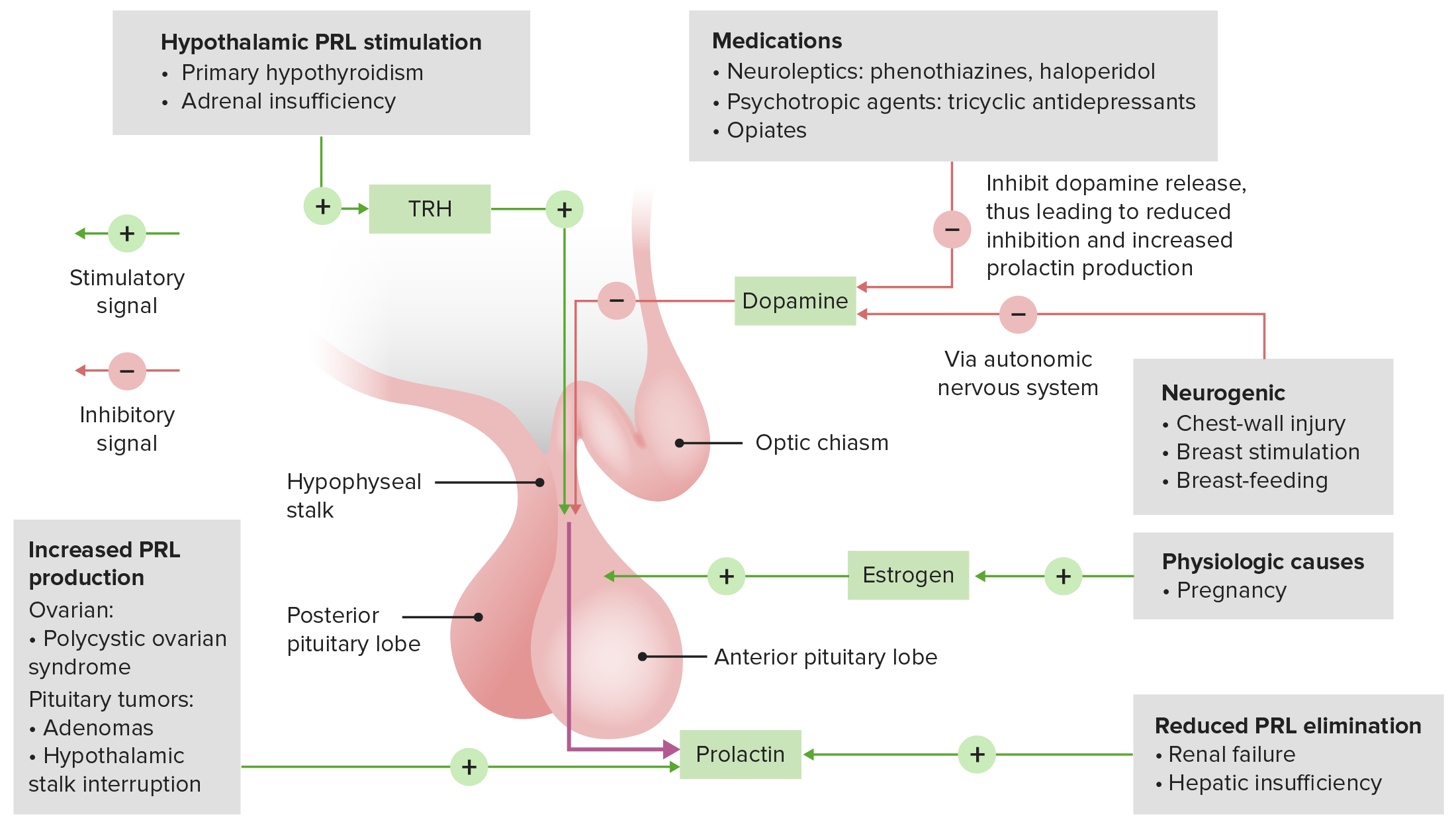
Causas de la hiperprolactinemia y eje de retroalimentación

Las causas de la hiperprolactinemia en relación con el eje de retroalimentación regulador de la secreción de la hormona prolactina

Imagen por Lecturio.

Fisiopatología

Funciones y efectos de la PRL

  • Crecimiento y desarrollo de las glándulas mamarias durante el embarazo
  • Producción de leche materna
  • Amenorrea de la lactancia (falta de menstruación durante la lactancia)
  • Disminución del deseo sexual y de la función reproductiva

Regulación de la PRL

  • Secretada por la hipófisis anterior (células lactotropas)
  • La dopamina inhibe la secreción de PRL.
  • La TRH y el estrógeno estimulan la secreción de PRL.
  • También es estimulada por el sueño, el ejercicio, el embarazo y el estrés
  • El aumento de los LOS Neisseria niveles de PRL inhibe la hormona liberadora de gonadotropina (GnRH, por sus siglas en EN Erythema nodosum is an immune-mediated panniculitis (inflammation of the subcutaneous fat) caused by a type IV (delayed-type) hypersensitivity reaction. It commonly manifests in young women as tender, erythematous nodules on the shins. Erythema Nodosum inglés) → disminución de la hormona luteinizante ( LH LH A major gonadotropin secreted by the adenohypophysis. Luteinizing hormone regulates steroid production by the interstitial cells of the testis and the ovary. The preovulatory luteinizing hormone surge in females induces ovulation, and subsequent luteinization of the follicle. Luteinizing hormone consists of two noncovalently linked subunits, alpha and beta. Within a species, the alpha subunit is common in the three pituitary glycoprotein hormones (TSH, LH, and FSH), but the beta subunit is unique and confers its biological specificity. Menstrual Cycle, por sus siglas en EN Erythema nodosum is an immune-mediated panniculitis (inflammation of the subcutaneous fat) caused by a type IV (delayed-type) hypersensitivity reaction. It commonly manifests in young women as tender, erythematous nodules on the shins. Erythema Nodosum inglés) y de la hormona foliculoestimulante ( FSH FSH A major gonadotropin secreted by the adenohypophysis. Follicle-stimulating hormone stimulates gametogenesis and the supporting cells such as the ovarian granulosa cells, the testicular sertoli cells, and leydig cells. Fsh consists of two noncovalently linked subunits, alpha and beta. Within a species, the alpha subunit is common in the three pituitary glycoprotein hormones (TSH, LH, and FSH), but the beta subunit is unique and confers its biological specificity. Menstrual Cycle, por sus siglas en EN Erythema nodosum is an immune-mediated panniculitis (inflammation of the subcutaneous fat) caused by a type IV (delayed-type) hypersensitivity reaction. It commonly manifests in young women as tender, erythematous nodules on the shins. Erythema Nodosum inglés) → disminución de los LOS Neisseria estrógenos → cese de la ovulación y de la menstruación
Diagrama de prolactina

El eje de retroalimentación reguladora de la PRL: Obsérvese que la TRH tiene un efecto estimulante sobre la PRL; sin embargo, la dopamina es el principal regulador de la secreción de PRL.

Imagen por Lecturio.

Fisiopatología

Aumento excesivo y prolongado de los LOS Neisseria niveles de PRL → supresión de GnRH → niveles más bajos de LH LH A major gonadotropin secreted by the adenohypophysis. Luteinizing hormone regulates steroid production by the interstitial cells of the testis and the ovary. The preovulatory luteinizing hormone surge in females induces ovulation, and subsequent luteinization of the follicle. Luteinizing hormone consists of two noncovalently linked subunits, alpha and beta. Within a species, the alpha subunit is common in the three pituitary glycoprotein hormones (TSH, LH, and FSH), but the beta subunit is unique and confers its biological specificity. Menstrual Cycle, FSH FSH A major gonadotropin secreted by the adenohypophysis. Follicle-stimulating hormone stimulates gametogenesis and the supporting cells such as the ovarian granulosa cells, the testicular sertoli cells, and leydig cells. Fsh consists of two noncovalently linked subunits, alpha and beta. Within a species, the alpha subunit is common in the three pituitary glycoprotein hormones (TSH, LH, and FSH), but the beta subunit is unique and confers its biological specificity. Menstrual Cycle → estrógeno y testosterona crónicamente bajos → hipogonadismo hipogonadotrópico.
Presentación Clínica

  • Varía según el grado de aumento y la causa
  • Puede ser asintomático (especialmente en EN Erythema nodosum is an immune-mediated panniculitis (inflammation of the subcutaneous fat) caused by a type IV (delayed-type) hypersensitivity reaction. It commonly manifests in young women as tender, erythematous nodules on the shins. Erythema Nodosum mujeres posmenopáusicas)
  • En EN Erythema nodosum is an immune-mediated panniculitis (inflammation of the subcutaneous fat) caused by a type IV (delayed-type) hypersensitivity reaction. It commonly manifests in young women as tender, erythematous nodules on the shins. Erythema Nodosum los LOS Neisseria hombres y las mujeres premenopáusicas, la hiperprolactinemia se presenta como hipogonadismo:
    • Infertilidad por cese de la ovulación
    • Amenorrea (falta de menstruación) o sangrado menstrual irregular
    • Galactorrea (secreción de leche por los LOS Neisseria pezones en EN Erythema nodosum is an immune-mediated panniculitis (inflammation of the subcutaneous fat) caused by a type IV (delayed-type) hypersensitivity reaction. It commonly manifests in young women as tender, erythematous nodules on the shins. Erythema Nodosum hombres o mujeres no lactantes)
    • Disminución de la libido
    • Osteoporosis Osteoporosis Osteoporosis refers to a decrease in bone mass and density leading to an increased number of fractures. There are 2 forms of osteoporosis: primary, which is commonly postmenopausal or senile; and secondary, which is a manifestation of immobilization, underlying medical disorders, or long-term use of certain medications. Osteoporosis
    • Disfunción eréctil y ginecomastia en EN Erythema nodosum is an immune-mediated panniculitis (inflammation of the subcutaneous fat) caused by a type IV (delayed-type) hypersensitivity reaction. It commonly manifests in young women as tender, erythematous nodules on the shins. Erythema Nodosum los LOS Neisseria hombres
  • Los LOS Neisseria tumores de gran tamaño se pueden presentar con cefalea y problemas visuales.

Diagnóstico y Tratamiento

Algoritmo diagnóstico

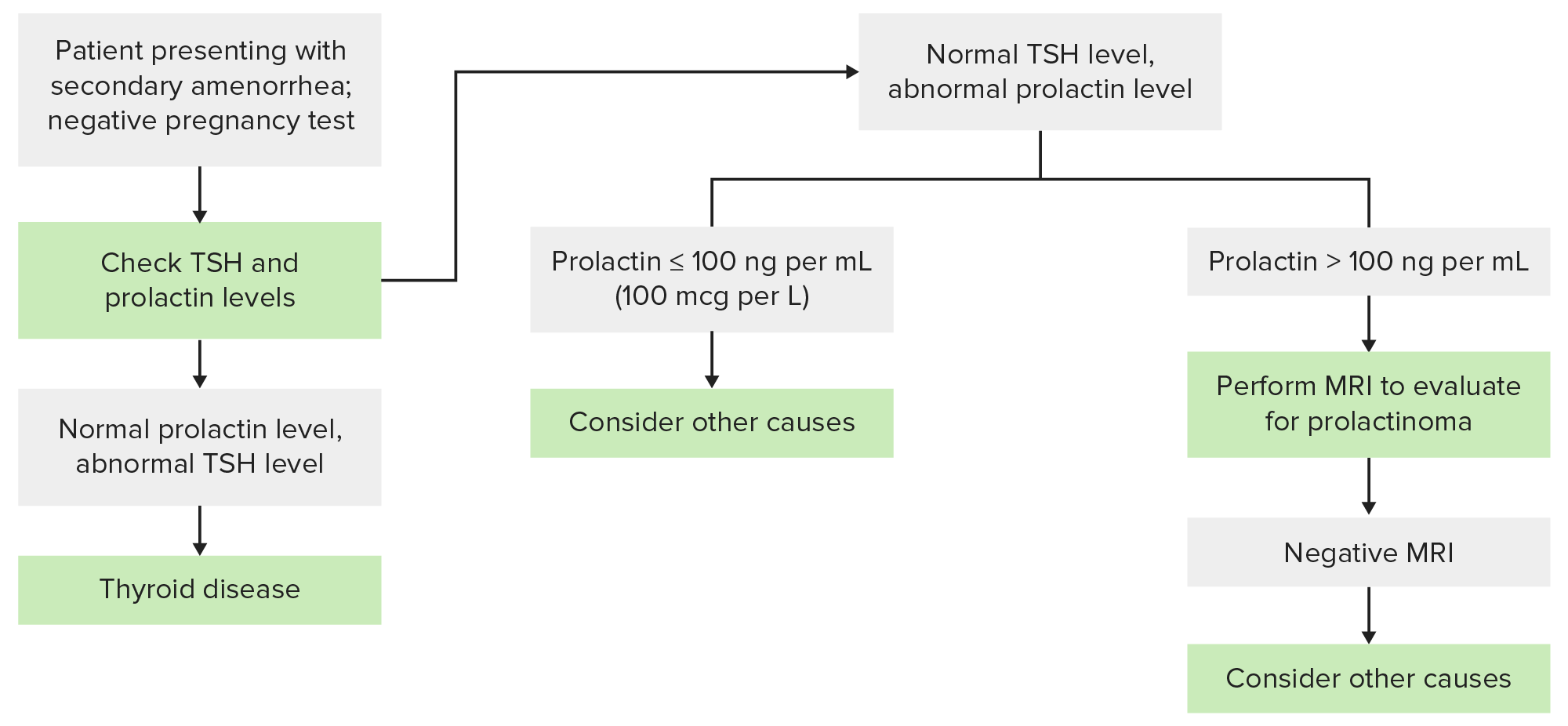
Algoritmo de diagnóstico de la hiperprolactinemia

Algoritmo diagnóstico a seguir para una paciente que presenta amenorrea secundaria

Imagen por Lecturio.
Pruebas de laboratorio

  • Prueba de embarazo para descartar el embarazo en EN Erythema nodosum is an immune-mediated panniculitis (inflammation of the subcutaneous fat) caused by a type IV (delayed-type) hypersensitivity reaction. It commonly manifests in young women as tender, erythematous nodules on the shins. Erythema Nodosum mujeres premenopáusicas
  • Mediciones repetidas de los LOS Neisseria niveles de PRL para confirmar la hiperprolactinemia (nivel de PRL > 200 ng/ml en EN Erythema nodosum is an immune-mediated panniculitis (inflammation of the subcutaneous fat) caused by a type IV (delayed-type) hypersensitivity reaction. It commonly manifests in young women as tender, erythematous nodules on the shins. Erythema Nodosum un hombre o mujer no embarazada → prolactinoma Prolactinoma A pituitary adenoma which secretes prolactin, leading to hyperprolactinemia. Clinical manifestations include amenorrhea; galactorrhea; impotence; headache; visual disturbances; and cerebrospinal fluid rhinorrhea. Hyperprolactinemia)
  • Deben medirse los LOS Neisseria niveles de TSH para descartar el hipotiroidismo (PRL < 100 ng/mL).
  • Pruebas de campo visual para evaluar las complicaciones
  • Los LOS Neisseria niveles de FSH FSH A major gonadotropin secreted by the adenohypophysis. Follicle-stimulating hormone stimulates gametogenesis and the supporting cells such as the ovarian granulosa cells, the testicular sertoli cells, and leydig cells. Fsh consists of two noncovalently linked subunits, alpha and beta. Within a species, the alpha subunit is common in the three pituitary glycoprotein hormones (TSH, LH, and FSH), but the beta subunit is unique and confers its biological specificity. Menstrual Cycle, LH LH A major gonadotropin secreted by the adenohypophysis. Luteinizing hormone regulates steroid production by the interstitial cells of the testis and the ovary. The preovulatory luteinizing hormone surge in females induces ovulation, and subsequent luteinization of the follicle. Luteinizing hormone consists of two noncovalently linked subunits, alpha and beta. Within a species, the alpha subunit is common in the three pituitary glycoprotein hormones (TSH, LH, and FSH), but the beta subunit is unique and confers its biological specificity. Menstrual Cycle, testosterona y estrógeno disminuirán.

Imagenología

  • La resonancia magnética (RM) es el estudio de elección para identificar o confirmar las masas hipofisarias.
  • Especialmente útil en EN Erythema nodosum is an immune-mediated panniculitis (inflammation of the subcutaneous fat) caused by a type IV (delayed-type) hypersensitivity reaction. It commonly manifests in young women as tender, erythematous nodules on the shins. Erythema Nodosum casos con antecedentes de traumatismos craneales, cefaleas y problemas visuales
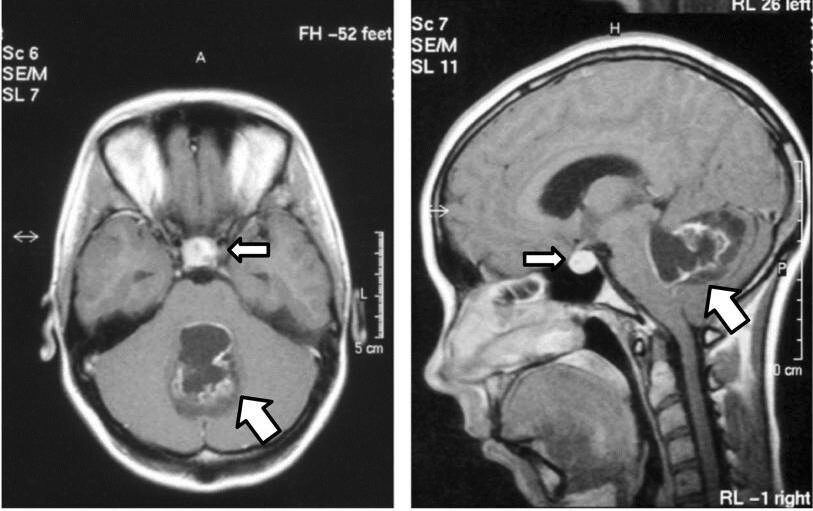
Prolactinoma

Imágenes de resonancia magnética axial (izquierda) y sagital (derecha) de un prolactinoma (flecha fina)

Imagen: “Prolactinoma” por Tajana Tešan Tomić et al. Licencia: CC BY 4.0, editado por Lecturio.

Tratamiento

  • 1ra línea: agonistas de la dopamina para suprimir la secreción de PRL
  • Debe abordarse la causa subyacente:
    • Interrupción de la medicación en EN Erythema nodosum is an immune-mediated panniculitis (inflammation of the subcutaneous fat) caused by a type IV (delayed-type) hypersensitivity reaction. It commonly manifests in young women as tender, erythematous nodules on the shins. Erythema Nodosum los LOS Neisseria casos inducidos por medicamentos
    • Se puede requerir de una cirugía en EN Erythema nodosum is an immune-mediated panniculitis (inflammation of the subcutaneous fat) caused by a type IV (delayed-type) hypersensitivity reaction. It commonly manifests in young women as tender, erythematous nodules on the shins. Erythema Nodosum el caso de los LOS Neisseria adenomas hipofisarios.
    • Tratamiento médico del hipotiroidismo primario
    • Diálisis o trasplante renal en EN Erythema nodosum is an immune-mediated panniculitis (inflammation of the subcutaneous fat) caused by a type IV (delayed-type) hypersensitivity reaction. It commonly manifests in young women as tender, erythematous nodules on the shins. Erythema Nodosum caso de insuficiencia renal crónica
  • Si la terapia médica fracasa, es necesaria la cirugía transesfenoidal con radiación postoperatoria.
  • Los LOS Neisseria prolactinomas pequeños con síntomas mínimos deben ser seguidos con niveles seriados de PRL y tomografía computarizada (TC)/RM anualmente.

Relevancia Clínica

En EN Erythema nodosum is an immune-mediated panniculitis (inflammation of the subcutaneous fat) caused by a type IV (delayed-type) hypersensitivity reaction. It commonly manifests in young women as tender, erythematous nodules on the shins. Erythema Nodosum caso de hiperprolactinemia deben descartarse las siguientes condiciones

  • Hipotiroidismo: deficiencia de las hormonas T3 T3 A T3 thyroid hormone normally synthesized and secreted by the thyroid gland in much smaller quantities than thyroxine (T4). Most T3 is derived from peripheral monodeiodination of T4 at the 5′ position of the outer ring of the iodothyronine nucleus. The hormone finally delivered and used by the tissues is mainly t3. Thyroid Hormones y T4 T4 The major hormone derived from the thyroid gland. Thyroxine is synthesized via the iodination of tyrosines (monoiodotyrosine) and the coupling of iodotyrosines (diiodotyrosine) in the thyroglobulin. Thyroxine is released from thyroglobulin by proteolysis and secreted into the blood. Thyroxine is peripherally deiodinated to form triiodothyronine which exerts a broad spectrum of stimulatory effects on cell metabolism. Thyroid Hormones. Se presentará con niveles elevados de TSH y niveles moderadamente aumentados de PRL.
  • Insuficiencia renal crónica: pérdida progresiva de la función renal. Se presentará con síndrome urémico en EN Erythema nodosum is an immune-mediated panniculitis (inflammation of the subcutaneous fat) caused by a type IV (delayed-type) hypersensitivity reaction. It commonly manifests in young women as tender, erythematous nodules on the shins. Erythema Nodosum pacientes sometidos a diálisis.
  • Gigantismo/acromegalia: exceso de producción de la hormona del crecimiento por la hipófisis, debido a un adenoma somatotropo. El tumor Tumor Inflammation producirá un aumento de PRL a través de la inhibición de la regulación desde el hipotálamo.
  • Prolactinomas: tumores de la hipófisis anterior que segregan PRL. Los LOS Neisseria prolactinomas se presentan con los LOS Neisseria típicos signos y síntomas de niveles elevados de PRL, que suelen ser superiores a 200 ng/ml. Una RM identifica la ubicación y el tamaño del tumor Tumor Inflammation.
  • Adenomas hipofisarios: tumores que pueden secretar PRL u otras hormonas hipofisarias (hormona del crecimiento (GH, por sus siglas en EN Erythema nodosum is an immune-mediated panniculitis (inflammation of the subcutaneous fat) caused by a type IV (delayed-type) hypersensitivity reaction. It commonly manifests in young women as tender, erythematous nodules on the shins. Erythema Nodosum inglés) u hormona adrenocorticotrópica (ACTH, por sus siglas en EN Erythema nodosum is an immune-mediated panniculitis (inflammation of the subcutaneous fat) caused by a type IV (delayed-type) hypersensitivity reaction. It commonly manifests in young women as tender, erythematous nodules on the shins. Erythema Nodosum inglés)). Los LOS Neisseria adenomas hipofisarios pueden alterar el eje hipotálamo-hipófisis, afectando a la inhibición de la liberación de PRL. Una RM confirmará el diagnóstico.

Referencias

  1. Kasper, Fauci, Hauser, Longo, Jameson, & Loscalzo. (2015). Harrison’s Principles of Internal Medicine (19th ed., pp. 2266-2267).
  2. Kumar, V., Abbas, A.K., & Aster, J. (2014). Robbins Basic Pathology (9th ed., pp. 719-720).
  3. Snyder, P.J. (2024, Nov 12). Causes of hyperprolactinemia. UpToDate. Accessed Jan 28, 2026, from https://www.uptodate.com/contents/causes-of-hyperprolactinemia.
  4. Snyder, P.J. (2025, Oct 28). Clinical manifestations and evaluation of hyperprolactinemia. UpToDate. Accessed Jan 28, 2026, from https://www.uptodate.com/contents/clinical-manifestations-and-evaluation-of-hyperprolactinemia.
  5. Snyder, P.J. (2025, Apr 03). Management of hyperprolactinemia. UpToDate. Accessed Jan 28, 2026, from https://www.uptodate.com/contents/management-of-hyperprolactinemia.

¡Crea tu cuenta gratis o inicia una sesión para seguir leyendo!

Regístrate ahora y obtén acceso gratuito a Lecturio con páginas de concepto, videos médicos y cuestionarios para tu educación médica.

User Reviews

Details