Domina Conceptos Médicos

Estudia para la escuela de medicina y tus examenes con Lecturio.

Herencia Ligada al Sexo

La herencia ligada al AL Amyloidosis sexo es una forma de herencia mendeliana. El término describe rasgos que se heredan a través del cromosoma X o Y. Para la transmisión recesiva ligada al AL Amyloidosis cromosoma X, el alelo es recesivo y se transporta en EN Erythema nodosum is an immune-mediated panniculitis (inflammation of the subcutaneous fat) caused by a type IV (delayed-type) hypersensitivity reaction. It commonly manifests in young women as tender, erythematous nodules on the shins. Erythema Nodosum el cromosoma X. Los LOS Neisseria hombres tienen más probabilidades de expresar trastornos recesivos ligados al AL Amyloidosis cromosoma X porque poseen solo 1 cromosoma X. Para la transmisión dominante ligada al AL Amyloidosis cromosoma X, el alelo es dominante y se transporta en EN Erythema nodosum is an immune-mediated panniculitis (inflammation of the subcutaneous fat) caused by a type IV (delayed-type) hypersensitivity reaction. It commonly manifests in young women as tender, erythematous nodules on the shins. Erythema Nodosum el cromosoma X. Debido a esto, solo se requiere 1 copia del alelo de la enfermedad para la expresión fenotípica. Los LOS Neisseria trastornos dominantes ligados al AL Amyloidosis cromosoma X son menos comunes que los LOS Neisseria trastornos recesivos ligados al AL Amyloidosis cromosoma X.

Last updated: Jul 1, 2022

Editorial responsibility: Stanley Oiseth, Lindsay Jones, Evelin Maza

Definición

La herencia ligada al AL Amyloidosis sexo ocurre cuando los LOS Neisseria rasgos genéticos se heredan en EN Erythema nodosum is an immune-mediated panniculitis (inflammation of the subcutaneous fat) caused by a type IV (delayed-type) hypersensitivity reaction. It commonly manifests in young women as tender, erythematous nodules on the shins. Erythema Nodosum el cromosoma X o Y. Hay 2 principales modos de herencia ligados al AL Amyloidosis sexo: recesivo ligado al AL Amyloidosis cromosoma X y dominante ligado al AL Amyloidosis cromosoma X.

Herencia recesiva ligada al AL Amyloidosis X:

  • Mujeres:
    • Tanto los LOS Neisseria cromosomas X maternos como los LOS Neisseria paternos deben verse afectados para expresar el rasgo.
    • A menudo portadores de rasgos recesivos ligados al AL Amyloidosis cromosoma X
    • La expresión de rasgos recesivos ligados al AL Amyloidosis X puede ocurrir si:
      • La mujer hereda un alelo afectado de los LOS Neisseria cromosomas X maternos y paternos.
      • La mujer portadora tiene una inactivación no aleatoria del cromosoma X sano.
  • Hombres:
    • Afectados con más frecuencia que las mujeres (solo 1 cromosoma X)
    • La herencia de hombre a hombre es imposible (el padre transmite solo el cromosoma Y al AL Amyloidosis hijo).

Herencia dominante ligada al AL Amyloidosis X:

  • Muy rara
  • Los LOS Neisseria hombres y las mujeres tienen la misma probabilidad de expresar el rasgo.
  • Mujeres:
    • La herencia puede ser del cromosoma X materno o paterno.
    • Por lo general, presentación fenotípica menos grave en EN Erythema nodosum is an immune-mediated panniculitis (inflammation of the subcutaneous fat) caused by a type IV (delayed-type) hypersensitivity reaction. It commonly manifests in young women as tender, erythematous nodules on the shins. Erythema Nodosum mujeres debido al AL Amyloidosis segundo cromosoma X

Herencia y Enfermedades Recesivas Ligadas al Cromosoma X

Herencia recesiva ligada al AL Amyloidosis X

Los LOS Neisseria hijos de un padre no afectado y una madre heterocigota (portadora) tienen los LOS Neisseria siguientes riesgos:

  • Descendencia masculina: 50% de riesgo de enfermedad
  • Descendencia femenina: 0% de riesgo de enfermedad y 50% de riesgo de ser portador
Tabla: Riesgo de hijos de padre no afectado y madre heterocigota (portadora)
Padre no afectado
x y
Madre heterocigota (portadora) x xx (mujer no afectada) xy (hombre no afectado)
x xx (mujer portadora) xy (hombre afectado)
x⁣: cromosoma X afectado; x: cromosoma x no afectado; y: cromosoma Y no afectado

Los LOS Neisseria hijos de un padre afectado y una madre heterocigota (portadora) tienen los LOS Neisseria siguientes riesgos:

  • Descendencia masculina: 50% de riesgo de enfermedad
  • Descendencia femenina: cromosoma afectado siempre transmitido → 50% de riesgo de enfermedad y 50% de riesgo de ser portador
Tabla: Riesgo de hijos de padre afectado y madre heterocigota (portadora)
Padre hemicigóticamente afectado
x y
Madre heterocigota (portadora) x xx (mujer portadora) xy (hombre no afectado)
x xx (mujer afectada) xy (hombre afectado)
x⁣: cromosoma X afectado; x: cromosoma x no afectado; y: cromosoma Y no afectado

Los LOS Neisseria hijos de un padre afectado y una madre no afectada tienen los LOS Neisseria siguientes riesgos:

  • Descendencia masculina: 0% riesgo de enfermedad
  • Descendencia femenina: cromosoma afectado del padre siempre transmitido → 100% de riesgo de ser portador, pero 0% de riesgo de enfermedad
Tabla: Riesgo de hijos de padre afectado y madre no afectada
Padre hemicigóticamente afectado
x y
Madre no afectada x xx (mujer portadora) xy (hombre no afectado)
x xx (mujer portadora) xy (hombre no afectado)
x: cromosoma X afectado; x: cromosoma x no afectado; y: cromosoma Y no afectado

Los LOS Neisseria hijos de un padre afectado hemicigoto y una madre homocigota (afectada) tienen los LOS Neisseria siguientes riesgos:

  • Descendencia masculina: 100% afectado
  • Descendencia femenina: 100% afectada
Tabla: Riesgo de hijos de padre afectado hemicigoto y madre homocigota (afectada)
Padre hemicigóticamente afectado
x y
Madre homocigotamente afectada x xx (mujer afectada) xy (hombre afectado)
x xx (mujer afectada) xy (hombre afectado)
x: cromosoma X afectado; x: cromosoma x no afectado; y: cromosoma Y no afectado

Enfermedades recesivas ligadas al AL Amyloidosis X

  • Ceguera al AL Amyloidosis color rojo-verde: también conocida como daltonismo. El daltonismo rojo-verde es un rasgo común en EN Erythema nodosum is an immune-mediated panniculitis (inflammation of the subcutaneous fat) caused by a type IV (delayed-type) hypersensitivity reaction. It commonly manifests in young women as tender, erythematous nodules on the shins. Erythema Nodosum los LOS Neisseria humanos que resulta en EN Erythema nodosum is an immune-mediated panniculitis (inflammation of the subcutaneous fat) caused by a type IV (delayed-type) hypersensitivity reaction. It commonly manifests in young women as tender, erythematous nodules on the shins. Erythema Nodosum la confusión de verde y rojo. Alrededor de 56 genes Genes A category of nucleic acid sequences that function as units of heredity and which code for the basic instructions for the development, reproduction, and maintenance of organisms. DNA Types and Structure diferentes se han asociado con causar daltonismo cuando mutan, no todos los LOS Neisseria cuales están ubicados en EN Erythema nodosum is an immune-mediated panniculitis (inflammation of the subcutaneous fat) caused by a type IV (delayed-type) hypersensitivity reaction. It commonly manifests in young women as tender, erythematous nodules on the shins. Erythema Nodosum el cromosoma X. El daltonismo rojo-verde puede estar presente desde el nacimiento o desarrollarse más adelante en EN Erythema nodosum is an immune-mediated panniculitis (inflammation of the subcutaneous fat) caused by a type IV (delayed-type) hypersensitivity reaction. It commonly manifests in young women as tender, erythematous nodules on the shins. Erythema Nodosum la vida. Alrededor del 8% de los LOS Neisseria hombres, pero solo el 0,4% de las mujeres, tienen algún tipo de daltonismo.
  • Hemofilia A: trastorno de la coagulación de la sangre causado por mutaciones en EN Erythema nodosum is an immune-mediated panniculitis (inflammation of the subcutaneous fat) caused by a type IV (delayed-type) hypersensitivity reaction. It commonly manifests in young women as tender, erythematous nodules on the shins. Erythema Nodosum el gen F8, lo que resulta en EN Erythema nodosum is an immune-mediated panniculitis (inflammation of the subcutaneous fat) caused by a type IV (delayed-type) hypersensitivity reaction. It commonly manifests in young women as tender, erythematous nodules on the shins. Erythema Nodosum una deficiencia del factor VIII Factor VIII Factor VIII of blood coagulation. Antihemophilic factor that is part of the factor viii/von Willebrand factor complex. Factor VIII is produced in the liver and acts in the intrinsic pathway of blood coagulation. It serves as a cofactor in factor X activation and this action is markedly enhanced by small amounts of thrombin. Hemostasis. Incluso las mujeres heterocigotas pueden tener síntomas leves de hemofilia. El tratamiento incluye terapia de reemplazo de factor VIII Factor VIII Factor VIII of blood coagulation. Antihemophilic factor that is part of the factor viii/von Willebrand factor complex. Factor VIII is produced in the liver and acts in the intrinsic pathway of blood coagulation. It serves as a cofactor in factor X activation and this action is markedly enhanced by small amounts of thrombin. Hemostasis y desmopresina.
  • Hemofilia B: trastorno de la coagulación de la sangre causado por mutaciones en EN Erythema nodosum is an immune-mediated panniculitis (inflammation of the subcutaneous fat) caused by a type IV (delayed-type) hypersensitivity reaction. It commonly manifests in young women as tender, erythematous nodules on the shins. Erythema Nodosum el gen F9, que resulta en EN Erythema nodosum is an immune-mediated panniculitis (inflammation of the subcutaneous fat) caused by a type IV (delayed-type) hypersensitivity reaction. It commonly manifests in young women as tender, erythematous nodules on the shins. Erythema Nodosum una deficiencia del factor IX Factor IX Storage-stable blood coagulation factor acting in the intrinsic pathway of blood coagulation. Its activated form, ixa, forms a complex with factor VIII and calcium on platelet factor 3 to activate factor X to Xa. Hemostasis. El tratamiento es principalmente por terapia de reemplazo de factor IX Factor IX Storage-stable blood coagulation factor acting in the intrinsic pathway of blood coagulation. Its activated form, ixa, forms a complex with factor VIII and calcium on platelet factor 3 to activate factor X to Xa. Hemostasis.
  • Distrofia muscular de Duchenne: causada por mutaciones en EN Erythema nodosum is an immune-mediated panniculitis (inflammation of the subcutaneous fat) caused by a type IV (delayed-type) hypersensitivity reaction. It commonly manifests in young women as tender, erythematous nodules on the shins. Erythema Nodosum el gen DMD DMD Duchenne muscular dystrophy (DMD) is an X-linked recessive genetic disorder that is caused by a mutation in the dmd gene. The mutation leads to the production of abnormal dystrophin, resulting in muscle-fiber destruction and replacement with fatty or fibrous tissue. Duchenne Muscular Dystrophy. La distrofia muscular de Duchenne se caracteriza por debilidad y degeneración muscular rápidamente progresiva, que comienza en EN Erythema nodosum is an immune-mediated panniculitis (inflammation of the subcutaneous fat) caused by a type IV (delayed-type) hypersensitivity reaction. It commonly manifests in young women as tender, erythematous nodules on the shins. Erythema Nodosum los LOS Neisseria grupos musculares proximales en EN Erythema nodosum is an immune-mediated panniculitis (inflammation of the subcutaneous fat) caused by a type IV (delayed-type) hypersensitivity reaction. It commonly manifests in young women as tender, erythematous nodules on the shins. Erythema Nodosum la primera infancia. El tratamiento es sintomático e incluye fisioterapia, inyecciones de esteroides para mejorar la fuerza muscular, dispositivos de respiración asistida y trasplante de corazón.
  • Distrofia muscular de Becker: también causada por mutaciones en EN Erythema nodosum is an immune-mediated panniculitis (inflammation of the subcutaneous fat) caused by a type IV (delayed-type) hypersensitivity reaction. It commonly manifests in young women as tender, erythematous nodules on the shins. Erythema Nodosum el gen DMD DMD Duchenne muscular dystrophy (DMD) is an X-linked recessive genetic disorder that is caused by a mutation in the dmd gene. The mutation leads to the production of abnormal dystrophin, resulting in muscle-fiber destruction and replacement with fatty or fibrous tissue. Duchenne Muscular Dystrophy. La distrofia muscular de Becker se presenta de manera similar a la distrofia muscular de Duchenne, pero tiene un inicio más tardío y un curso clínico más leve.
  • Ictiosis ligada al AL Amyloidosis cromosoma X: afección de la piel causada por una mutación o deleción en EN Erythema nodosum is an immune-mediated panniculitis (inflammation of the subcutaneous fat) caused by a type IV (delayed-type) hypersensitivity reaction. It commonly manifests in young women as tender, erythematous nodules on the shins. Erythema Nodosum el gen STS. Esta mutación o eliminación da como resultado una descamación difusa de la piel debido a una tasa lenta de desprendimiento de las células de la piel que se desarrollan en EN Erythema nodosum is an immune-mediated panniculitis (inflammation of the subcutaneous fat) caused by a type IV (delayed-type) hypersensitivity reaction. It commonly manifests in young women as tender, erythematous nodules on the shins. Erythema Nodosum las 1ras semanas de vida. El tratamiento es sintomático con alfa-hidroxiácidos, aceites de baño lubricantes y emolientes.
  • Agammaglobulinemia ligada al AL Amyloidosis X: tipo de inmunodeficiencia primaria causada por mutaciones en EN Erythema nodosum is an immune-mediated panniculitis (inflammation of the subcutaneous fat) caused by a type IV (delayed-type) hypersensitivity reaction. It commonly manifests in young women as tender, erythematous nodules on the shins. Erythema Nodosum el gen BTK. Los LOS Neisseria individuos afectados desarrollan infecciones bacterianas recurrentes en EN Erythema nodosum is an immune-mediated panniculitis (inflammation of the subcutaneous fat) caused by a type IV (delayed-type) hypersensitivity reaction. It commonly manifests in young women as tender, erythematous nodules on the shins. Erythema Nodosum etapas tempranas de la vida debido a la ausencia de células B maduras. Además, es posible que estas personas no tengan amígdalas ni adenoides.
  • Deficiencia de glucosa-6-fosfato deshidrogenasa: anemia Anemia Anemia is a condition in which individuals have low Hb levels, which can arise from various causes. Anemia is accompanied by a reduced number of RBCs and may manifest with fatigue, shortness of breath, pallor, and weakness. Subtypes are classified by the size of RBCs, chronicity, and etiology. Anemia: Overview and Types hemolítica no inmune debida a mutaciones en EN Erythema nodosum is an immune-mediated panniculitis (inflammation of the subcutaneous fat) caused by a type IV (delayed-type) hypersensitivity reaction. It commonly manifests in young women as tender, erythematous nodules on the shins. Erythema Nodosum el gen G6PD G6PD Pentose Phosphate Pathway. La hemólisis tiende a ocurrir como consecuencia de una infección o exposición a ciertos medicamentos, productos químicos o alimentos. El trastorno se asocia con ictericia neonatal, cuerpos de Heinz en EN Erythema nodosum is an immune-mediated panniculitis (inflammation of the subcutaneous fat) caused by a type IV (delayed-type) hypersensitivity reaction. It commonly manifests in young women as tender, erythematous nodules on the shins. Erythema Nodosum el frotis periférico y mayor susceptibilidad a las infecciones debido a la deficiencia de nicotinamida adenina dinucleótido fosfato en EN Erythema nodosum is an immune-mediated panniculitis (inflammation of the subcutaneous fat) caused by a type IV (delayed-type) hypersensitivity reaction. It commonly manifests in young women as tender, erythematous nodules on the shins. Erythema Nodosum los LOS Neisseria fagocitos.
Patterns of X-linked recessive inheritance

Patrones de herencia recesiva ligada al X:
Tanto el cromosoma X materno como el paterno deben estar afectados para que las mujeres expresen el rasgo. Las mujeres suelen ser portadoras del rasgo recesivo ligado al X. Con un solo cromosoma X, los hombres se ven afectados con más frecuencia que las mujeres. La herencia de hombre a hombre es imposible porque un padre sólo puede transmitir un cromosoma Y a un hijo.
Nota: Algunos portadores pueden estar ligeramente afectados debido a la inactivación sesgada del cromosoma X.

Imagen por Lecturio.

Herencia y Enfermedades Dominantes Ligadas al Cromosoma X

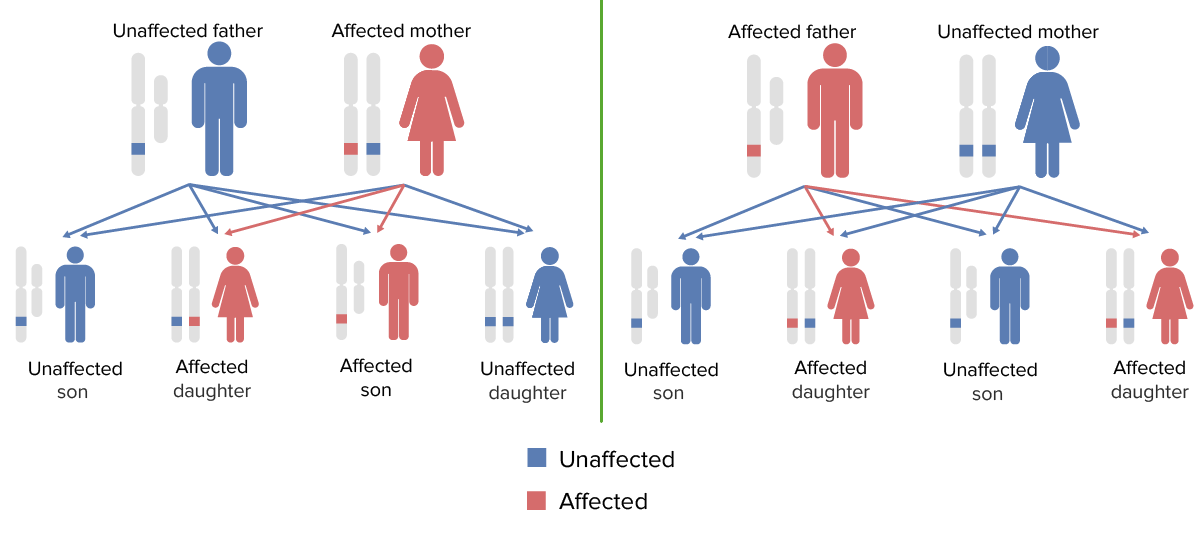
Herencia dominante ligada al AL Amyloidosis X

Los LOS Neisseria hijos de un padre hemicigoto (no afectado) y una madre heterocigota (afectada) tienen los LOS Neisseria siguientes riesgos:

  • Descendencia masculina: 50% de riesgo de enfermedad
  • Descendencia femenina: 50% de riesgo de enfermedad
Tabla: Riesgo de hijos de padre hemicigoto (no afectado) y madre heterocigota (afectada)
Padre no afectado
x y
Madre heterocigotamente afectada x xx (mujer no afectada) xy (hombre no afectado)
X Xx (mujer afectada) Xy (hombre afectado)
X: cromosoma X afectado; x: cromosoma x no afectado; y: cromosoma Y no afectado

Los LOS Neisseria hijos de un padre hemicigoto (no afectado) y una madre homocigota (afectada) tienen los LOS Neisseria siguientes riesgos:

  • Descendencia masculina: 100% de riesgo de enfermedad
  • Descendencia femenina: 100% de riesgo de enfermedad
Tabla: Riesgo de hijos de padre hemicigoto (no afectado) y madre homocigota (afectada)
Padre no afectado
x y
Madre homocigotamente afectada X Xx (mujer afectada) Xy (hombre afectado)
X Xx (mujer afectada) Xy (hombre afectado)
X: cromosoma X afectado; x: cromosoma x no afectado; y: cromosoma Y no afectado

Los LOS Neisseria hijos de un padre hemicigótico (afectado) y una madre heterocigótica (afectada) tienen los LOS Neisseria siguientes riesgos:

  • Descendencia masculina: 50% de riesgo de enfermedad
  • Descendencia femenina: 100% de riesgo de enfermedad
Tabla: Riesgo de hijos de padre hemicigótico (afectado) y madre heterocigótica (afectada)
Padre hemicigóticamente afectado
X y
Madre heterocigotamente afectada X XX (mujer afectada) Xy (hombre afectado)
x Xx (mujer afectada) xy (hombre no afectado)
X: cromosoma X afectado; x: cromosoma x no afectado; y: cromosoma Y no afectado

Los LOS Neisseria hijos de un padre hemicigoto (afectado) y una madre homocigota (no afectada) tienen los LOS Neisseria siguientes riesgos:

  • Descendencia masculina: 0% riesgo de enfermedad
  • Descendencia femenina: 100% de riesgo de enfermedad
Tabla: Riesgo de hijos de padre hemicigótico (afectado) y madre homocigótica (no afectada)
Padre hemicigóticamente afectado
X y
Madre no afectada x Xx (mujer afectada) xy (hombre no afectado)
x Xx (mujer afectada) xy (hombre no afectado)
X: cromosoma X afectado; x: cromosoma x no afectado; y: cromosoma Y no afectado

Enfermedades dominantes ligadas al AL Amyloidosis cromosoma X

  • Raquitismo hipofosfatémico: afección caracterizada por una reabsorción reducida de fosfato, más comúnmente causada por mutaciones en EN Erythema nodosum is an immune-mediated panniculitis (inflammation of the subcutaneous fat) caused by a type IV (delayed-type) hypersensitivity reaction. It commonly manifests in young women as tender, erythematous nodules on the shins. Erythema Nodosum el gen PHEX PHEX A membrane-bound metalloendopeptidase that may play a role in the degradation or activation of a variety of peptide hormones and intercellular signaling peptides and proteins. Genetic mutations that result in loss of function of this protein are a cause of hypophosphatemic rickets, X-linked dominant. X-linked Hypophosphatemic Rickets. Los LOS Neisseria síntomas tienden a variar significativamente entre los LOS Neisseria individuos afectados. Las formas graves pueden causar piernas arqueadas y otras deformidades óseas, dolor Dolor Inflammation óseo y articular y crecimiento óseo deficiente.
  • Síndrome de Rett: trastorno del neurodesarrollo causado por mutaciones en EN Erythema nodosum is an immune-mediated panniculitis (inflammation of the subcutaneous fat) caused by a type IV (delayed-type) hypersensitivity reaction. It commonly manifests in young women as tender, erythematous nodules on the shins. Erythema Nodosum el gen MECP2 y que afecta casi exclusivamente a mujeres. La mayoría de los LOS Neisseria casos de síndrome de Rett son causados por mutaciones de novo y los LOS Neisseria hombres afectados tienden a morir poco después del nacimiento. El síndrome de Rett se caracteriza por un desarrollo inicial normal seguido de la pérdida de hitos del desarrollo, movimientos estereotípicos de las manos, convulsiones y anomalías en EN Erythema nodosum is an immune-mediated panniculitis (inflammation of the subcutaneous fat) caused by a type IV (delayed-type) hypersensitivity reaction. It commonly manifests in young women as tender, erythematous nodules on the shins. Erythema Nodosum la marcha. El tratamiento es puramente sintomático e incluye fisioterapia y anticonvulsivos.
  • Síndrome de Alport: trastorno renal genético común causado por mutaciones en EN Erythema nodosum is an immune-mediated panniculitis (inflammation of the subcutaneous fat) caused by a type IV (delayed-type) hypersensitivity reaction. It commonly manifests in young women as tender, erythematous nodules on the shins. Erythema Nodosum COL4A5, COL4A4 y COL4A3. Estas mutaciones dan como resultado colágeno tipo IV defectuoso que conduce a enfermedad glomerular, anomalías oculares y pérdida auditiva neurosensorial. El tratamiento incluye control estricto de la presión arterial, audífonos y trasplante de riñón.
  • Síndrome X frágil: afección causada por mutaciones en EN Erythema nodosum is an immune-mediated panniculitis (inflammation of the subcutaneous fat) caused by a type IV (delayed-type) hypersensitivity reaction. It commonly manifests in young women as tender, erythematous nodules on the shins. Erythema Nodosum el gen FMR1 que conduce a una discapacidad intelectual de leve a moderada. Las características físicas típicas incluyen una cara alargada y estrecha, orejas grandes, dedos flexibles y testículos grandes. Otros síntomas son problemas con las interacciones sociales, retraso en EN Erythema nodosum is an immune-mediated panniculitis (inflammation of the subcutaneous fat) caused by a type IV (delayed-type) hypersensitivity reaction. It commonly manifests in young women as tender, erythematous nodules on the shins. Erythema Nodosum el desarrollo del habla, hiperactividad y convulsiones. El tratamiento es puramente sintomático.
Patterns of X-linked dominant inheritance

Patrones de herencia dominante ligada al X (un modo de herencia muy raro):
Los hombres y las mujeres tienen la misma probabilidad de expresar el rasgo.
Nota: Algunos trastornos dominantes ligados al cromosoma X son letales desde el punto de vista embrionario en los varones; la mayoría afectan a las mujeres de forma menos grave.

Imagen por Lecturio.

Referencias

  1. Raby, B. (2021). Inheritance patterns of monogenic disorders (Mendelian and non-Mendelian). UpToDate. Retrieved June 11, 2021, from https://www.uptodate.com/contents/inheritance-patterns-of-monogenic-disorders-mendelian-and-non-mendelian
  2. Van Esch, H. (2021). Fragile X syndrome: clinical features and diagnosis in children and adolescents. UpToDate. Retrieved June 26, 2021, from https://www.uptodate.com/contents/fragile-x-syndrome-clinical-features-and-diagnosis-in-children-and-adolescents
  3. Kashtan, C. (2021). Clinical manifestation, diagnosis, and treatment of Alport syndrome (hereditary nephritis). UpToDate. Retrieved June 26, 2021, from https://www.uptodate.com/contents/clinical-manifestations-diagnosis-and-treatment-of-alport-syndrome-hereditary-nephritis
  4. Schultz, R., Glaze, D. (2021). Rett syndrome: genetics, clinical features, and diagnosis. UpToDate. Retrieved June 26, 2021, from https://www.uptodate.com/contents/rett-syndrome-genetics-clinical-features-and-diagnosis
  5. Scheinman, S., Carpenter, T., Drezner, M. (2021). Hereditary hypophosphatemic rickets and tumor-induced osteomalacia. UpToDate. Retrieved June 26, 2021, from https://www.uptodate.com/contents/hereditary-hypophosphatemic-rickets-and-tumor-induced-osteomalacia
  6. Darras, B. (2021). Duchenne and Becker muscular dystrophy: clinical features and diagnosis. UpToDate. Retrieved June 26, 2021, from https://www.uptodate.com/contents/duchenne-and-becker-muscular-dystrophy-clinical-features-and-diagnosis
  7. Hand, J. (2021). Recessive X-linked ichthyosis. UpToDate. Retrieved June 26, 2021, from https://www.uptodate.com/contents/recessive-x-linked-ichthyosis
  8. Hernandex-Trujilo, V. (2021). Agammaglobulinemia. UpToDate. Retrieved June 26, 2021, from https://www.uptodate.com/contents/agammaglobulinemia
  9. Raby, B. A. (2023). Inheritance patterns of monogenic disorders: Mendelian and non-mendelian. In A. Slavotinek (Ed.). UpToDate. https://www.uptodate.com/contents/inheritance-patterns-of-monogenic-disorders-mendelian-and-non-mendelian
  10. NIH, Genetic and Rare Diseases Information Center. (n.a.) Hemophilia A. Retrieved September 5, 2021, from https://rarediseases.info.nih.gov/diseases/6591/hemophilia-a

¡Crea tu cuenta gratis o inicia una sesión para seguir leyendo!

Regístrate ahora y obtén acceso gratuito a Lecturio con páginas de concepto, videos médicos y cuestionarios para tu educación médica.

User Reviews

Details