
El golpe de calor Calor Inflammation es una enfermedad que se caracteriza por una temperatura corporal central superior a los LOS Neisseria 40°C (104°F) con síntomas neurológicos concomitantes que incluyen ataxia Ataxia Impairment of the ability to perform smoothly coordinated voluntary movements. This condition may affect the limbs, trunk, eyes, pharynx, larynx, and other structures. Ataxia may result from impaired sensory or motor function. Sensory ataxia may result from posterior column injury or peripheral nerve diseases. Motor ataxia may be associated with cerebellar diseases; cerebral cortex diseases; thalamic diseases; basal ganglia diseases; injury to the red nucleus; and other conditions. Ataxia-telangiectasia, convulsiones y/o delirio. El golpe de calor Calor Inflammation generalmente se debe a la incapacidad del organismo para regular Regular Insulin su temperatura cuando se ve VE Ventilation: Mechanics of Breathing sometido a una elevada carga de calor Calor Inflammation. La enfermedad puede clasificarse como de esfuerzo o clásica. El tratamiento implica la estabilización de emergencia, el enfriamiento y los LOS Neisseria cuidados de soporte. El reconocimiento y la intervención tempranos son importantes para prevenir complicaciones o falla orgánica.
Last updated: Dec 15, 2025
El golpe de calor Calor Inflammation es una enfermedad causada por la incapacidad del cuerpo para mantener la homeostasis Homeostasis The processes whereby the internal environment of an organism tends to remain balanced and stable. Cell Injury and Death de la temperatura. El golpe de calor Calor Inflammation se caracteriza por temperaturas corporales que se aproximan y superan los LOS Neisseria 40ºC (104ºF) y síntomas neurológicos que incluyen convulsiones, delirio y ataxia Ataxia Impairment of the ability to perform smoothly coordinated voluntary movements. This condition may affect the limbs, trunk, eyes, pharynx, larynx, and other structures. Ataxia may result from impaired sensory or motor function. Sensory ataxia may result from posterior column injury or peripheral nerve diseases. Motor ataxia may be associated with cerebellar diseases; cerebral cortex diseases; thalamic diseases; basal ganglia diseases; injury to the red nucleus; and other conditions. Ataxia-telangiectasia.
La incidencia en EN Erythema nodosum is an immune-mediated panniculitis (inflammation of the subcutaneous fat) caused by a type IV (delayed-type) hypersensitivity reaction. It commonly manifests in young women as tender, erythematous nodules on the shins. Erythema Nodosum Estados Unidos es difícil de determinar debido a la falta de reportes:
Factores de riesgo para el golpe de calor Calor Inflammation:
El golpe de calor Calor Inflammation puede dividirse en EN Erythema nodosum is an immune-mediated panniculitis (inflammation of the subcutaneous fat) caused by a type IV (delayed-type) hypersensitivity reaction. It commonly manifests in young women as tender, erythematous nodules on the shins. Erythema Nodosum función de su etiología como clásico o de esfuerzo.
| Golpe de calor Calor Inflammation clásico | Golpe de calor Calor Inflammation de esfuerzo | |
|---|---|---|
| Edad | Ancianos | Jóvenes |
| Estado de salud | Debilitados con enfermedades crónicas | Saludable |
| Factores predisponentes | Medicamentos, vivienda inadecuada | Competición atlética, entrenamiento |
| Ocurrencia | Durante olas de calor Calor Inflammation | Esporádicamente |
| Piel | Anhidrosis | Diaforesis |
| Glucosa | Normal | Baja |
| Acidosis Acidosis A pathologic condition of acid accumulation or depletion of base in the body. The two main types are respiratory acidosis and metabolic acidosis, due to metabolic acid build up. Respiratory Acidosis láctica | Ausente | Suele ser grave |
| Coagulopatía | Leve | Grave, CID |
| Renales | Oliguria Oliguria Decreased urine output that is below the normal range. Oliguria can be defined as urine output of less than or equal to 0. 5 or 1 ml/kg/hr depending on the age. Renal Potassium Regulation | Insuficiencia renal aguda |
| Rabdomiólisis | Ausente o leve | Suele ser grave |
En EN Erythema nodosum is an immune-mediated panniculitis (inflammation of the subcutaneous fat) caused by a type IV (delayed-type) hypersensitivity reaction. It commonly manifests in young women as tender, erythematous nodules on the shins. Erythema Nodosum condiciones normales, el cuerpo puede termorregularse de forma extremadamente eficiente (experimentando un cambio de 1°C (1,8°F) en EN Erythema nodosum is an immune-mediated panniculitis (inflammation of the subcutaneous fat) caused by a type IV (delayed-type) hypersensitivity reaction. It commonly manifests in young women as tender, erythematous nodules on the shins. Erythema Nodosum la temperatura central por cada cambio de 25–30°C (45–54°F) en EN Erythema nodosum is an immune-mediated panniculitis (inflammation of the subcutaneous fat) caused by a type IV (delayed-type) hypersensitivity reaction. It commonly manifests in young women as tender, erythematous nodules on the shins. Erythema Nodosum la temperatura ambiental). El golpe de calor Calor Inflammation es el producto de un fallo en EN Erythema nodosum is an immune-mediated panniculitis (inflammation of the subcutaneous fat) caused by a type IV (delayed-type) hypersensitivity reaction. It commonly manifests in young women as tender, erythematous nodules on the shins. Erythema Nodosum la termorregulación.
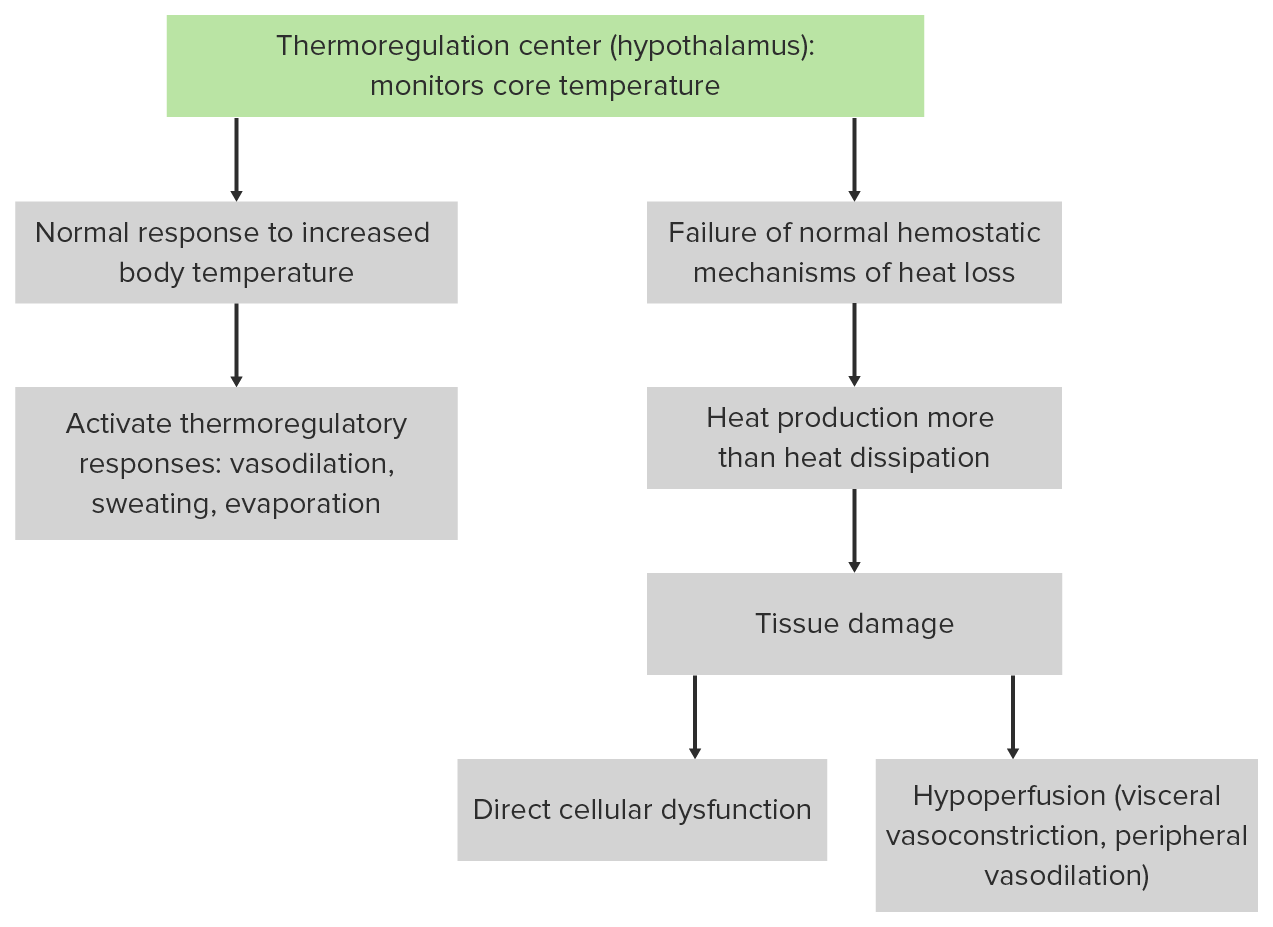
Fisiopatología del golpe de calor
Imagen por Lecturio.Las pruebas de laboratorio sirven para controlar la progresión de los LOS Neisseria síntomas y la curación.
La morbilidad y la mortalidad están directamente relacionadas con la duración de la elevación de la temperatura central.