Domina Conceptos Médicos

Estudia para la escuela de medicina y tus examenes con Lecturio.

Enfermedad del Hígado Graso No Alcohólico

La enfermedad del hígado graso no alcohólico es un espectro de patologías hepáticas que surgen debido a la acumulación de triglicéridos en EN Erythema nodosum is an immune-mediated panniculitis (inflammation of the subcutaneous fat) caused by a type IV (delayed-type) hypersensitivity reaction. It commonly manifests in young women as tender, erythematous nodules on the shins. Erythema Nodosum los LOS Neisseria hepatocitos. Los LOS Neisseria factores de riesgo incluyen diabetes Diabetes Diabetes mellitus (DM) is a metabolic disease characterized by hyperglycemia and dysfunction of the regulation of glucose metabolism by insulin. Type 1 DM is diagnosed mostly in children and young adults as the result of autoimmune destruction of β cells in the pancreas and the resulting lack of insulin. Type 2 DM has a significant association with obesity and is characterized by insulin resistance. Diabetes Mellitus mellitus, resistencia a la insulina, obesidad e hipertensión, entre otros. La enfermedad del hígado graso no alcohólico varía desde el hígado graso o la esteatosis hepática, pero puede conducir a la esteatohepatitis no alcohólica, que presenta depósitos de grasa e inflamación. La lesión hepática progresiva y la fibrosis Fibrosis Any pathological condition where fibrous connective tissue invades any organ, usually as a consequence of inflammation or other injury. Bronchiolitis Obliterans se convierten de manera irreversible en EN Erythema nodosum is an immune-mediated panniculitis (inflammation of the subcutaneous fat) caused by a type IV (delayed-type) hypersensitivity reaction. It commonly manifests in young women as tender, erythematous nodules on the shins. Erythema Nodosum cirrosis y, posiblemente, en EN Erythema nodosum is an immune-mediated panniculitis (inflammation of the subcutaneous fat) caused by a type IV (delayed-type) hypersensitivity reaction. It commonly manifests in young women as tender, erythematous nodules on the shins. Erythema Nodosum cáncer hepático primario. Los LOS Neisseria pacientes suelen estar asintomáticos, pero pueden presentar hepatomegalia y molestias en EN Erythema nodosum is an immune-mediated panniculitis (inflammation of the subcutaneous fat) caused by a type IV (delayed-type) hypersensitivity reaction. It commonly manifests in young women as tender, erythematous nodules on the shins. Erythema Nodosum el cuadrante superior derecho. Aunque la biopsia hepática es el estándar de oro de diagnóstico, el diagnóstico también se puede establecer mediante los LOS Neisseria antecedentes, imagenología y pruebas de laboratorio. El pilar del tratamiento son las modificaciones del estilo de vida (pérdida de peso y ejercicio) con control de las comorbilidades asociadas.

Last updated: Dec 15, 2025

Editorial responsibility: Stanley Oiseth, Lindsay Jones, Evelin Maza

Definición

El hígado graso se subdivide en EN Erythema nodosum is an immune-mediated panniculitis (inflammation of the subcutaneous fat) caused by a type IV (delayed-type) hypersensitivity reaction. It commonly manifests in young women as tender, erythematous nodules on the shins. Erythema Nodosum tipo alcohólico o no alcohólico.

Enfermedad del hígado graso no alcohólico:
  • Enfermedad hepática crónica caracterizada por esteatosis (acumulación de triglicéridos dentro de los LOS Neisseria hepatocitos), con o sin inflamación y fibrosis Fibrosis Any pathological condition where fibrous connective tissue invades any organ, usually as a consequence of inflammation or other injury. Bronchiolitis Obliterans
  • Sin antecedentes de aumento del consumo de alcohol (definido como > 1 bebida/día para mujeres o > 2 bebidas/día en EN Erythema nodosum is an immune-mediated panniculitis (inflammation of the subcutaneous fat) caused by a type IV (delayed-type) hypersensitivity reaction. It commonly manifests in young women as tender, erythematous nodules on the shins. Erythema Nodosum hombres)
  • Tipos de enfermedad del hígado graso no alcohólico:
    • Hígado graso no alcohólico: esteatosis hepática (> 5% de los LOS Neisseria hepatocitos) sin inflamación
    • Esteatohepatitis no alcohólica:
      • Características: esteatosis hepática con inflamación lobulillar y hepatocitos balonizados
      • Patología similar a la esteatohepatitis alcohólica, pero los LOS Neisseria pacientes no tienen un consumo significativo de alcohol

Epidemiología y Etiología

Epidemiología

  • La enfermedad del hígado graso no alcohólico es la causa más común de enfermedad hepática crónica en EN Erythema nodosum is an immune-mediated panniculitis (inflammation of the subcutaneous fat) caused by a type IV (delayed-type) hypersensitivity reaction. It commonly manifests in young women as tender, erythematous nodules on the shins. Erythema Nodosum los LOS Neisseria Estados Unidos.
  • Afecta al AL Amyloidosis 25% de los LOS Neisseria adultos
  • Pacientes diagnosticados en EN Erythema nodosum is an immune-mediated panniculitis (inflammation of the subcutaneous fat) caused by a type IV (delayed-type) hypersensitivity reaction. It commonly manifests in young women as tender, erythematous nodules on the shins. Erythema Nodosum su mayoría entre los LOS Neisseria 40 y 50 años
  • Prevalencia más alta en EN Erythema nodosum is an immune-mediated panniculitis (inflammation of the subcutaneous fat) caused by a type IV (delayed-type) hypersensitivity reaction. It commonly manifests in young women as tender, erythematous nodules on the shins. Erythema Nodosum hispanoamericanos (50%)
  • Cuando se desarrolla cirrosis, la incidencia de cáncer de hígado es de hasta un 3%.

Etiología

  • Factores de riesgo:
    • Síndrome metabólico
    • Obesidad central
    • Diabetes Diabetes Diabetes mellitus (DM) is a metabolic disease characterized by hyperglycemia and dysfunction of the regulation of glucose metabolism by insulin. Type 1 DM is diagnosed mostly in children and young adults as the result of autoimmune destruction of β cells in the pancreas and the resulting lack of insulin. Type 2 DM has a significant association with obesity and is characterized by insulin resistance. Diabetes Mellitus mellitus tipo 2 ( DM DM Diabetes mellitus (DM) is a metabolic disease characterized by hyperglycemia and dysfunction of the regulation of glucose metabolism by insulin. Type 1 DM is diagnosed mostly in children and young adults as the result of autoimmune destruction of β cells in the pancreas and the resulting lack of insulin. Type 2 DM has a significant association with obesity and is characterized by insulin resistance. Diabetes Mellitus)
    • Hipertensión
    • Hipertrigliceridemia
    • Rápida pérdida o aumento de peso
    • Hipotiroidismo
    • Síndrome de ovario poliquístico
    • Endocrinopatías (e.g., síndrome de Cushing)
  • Medicamentos: amiodarona, glucocorticoides, doxiciclina, medicamentos antirretrovirales

Fisiopatología

Fisiopatología de la enfermedad del hígado graso no alcohólico

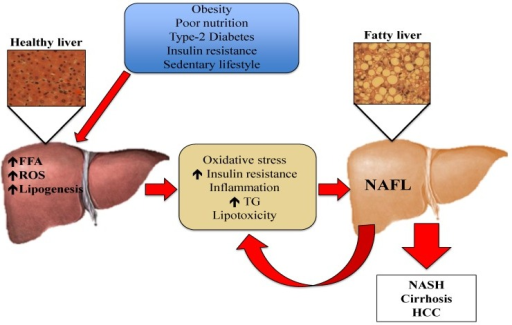
  1. Los LOS Neisseria factores de riesgo (↑ resistencia a la insulina, DM DM Diabetes mellitus (DM) is a metabolic disease characterized by hyperglycemia and dysfunction of the regulation of glucose metabolism by insulin. Type 1 DM is diagnosed mostly in children and young adults as the result of autoimmune destruction of β cells in the pancreas and the resulting lack of insulin. Type 2 DM has a significant association with obesity and is characterized by insulin resistance. Diabetes Mellitus, obesidad, sedentarismo) contribuyen a la acumulación de lípidos:
    • Aumento del suministro de grasa (de una dieta rica en EN Erythema nodosum is an immune-mediated panniculitis (inflammation of the subcutaneous fat) caused by a type IV (delayed-type) hypersensitivity reaction. It commonly manifests in young women as tender, erythematous nodules on the shins. Erythema Nodosum grasas y lipólisis adiposa)
    • Disminución de la exportación de grasa (↓ secreción de lipoproteínas de muy baja densidad)
    • Disminución de la beta-oxidación de ácidos grasos libres
    • Aumento de la lipogénesis de novo
  2. Los LOS Neisseria procesos conducen a ↑ síntesis de triglicéridos y ↑ captación hepática de ácidos grasos.
  3. La acumulación de ácidos grasos libres y subproductos (e.g., especies reactivas de oxígeno) daña los LOS Neisseria hepatocitos por estrés oxidativo → lipotoxicidad (daño celular y muerte como resultado de intermediarios lipídicos)
  4. Las células lesionadas y moribundas inducen respuestas inmunitarias (citoquinas y células inflamatorias) para reparar y reemplazar los LOS Neisseria hepatocitos.

Hígado graso no alcohólico

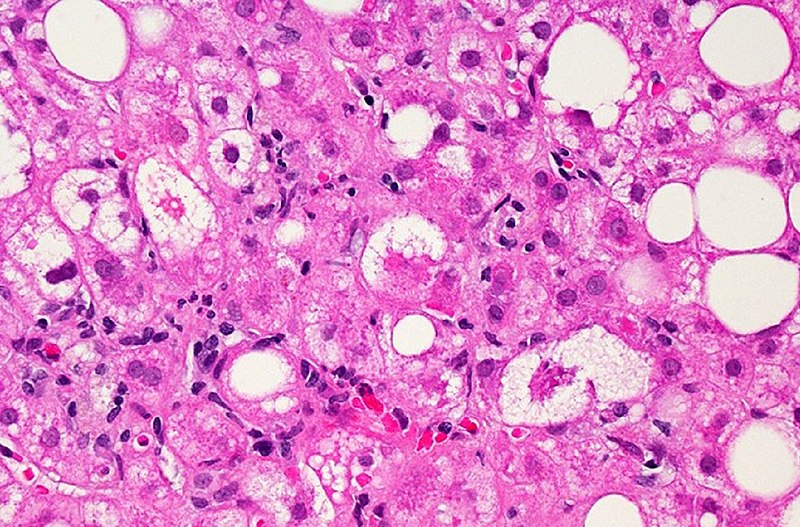
  • Acumulación de grasa (generalmente hepatoesteatosis macrovesicular)
  • Gotas de grasa grandes o gotas de grasa más pequeñas en EN Erythema nodosum is an immune-mediated panniculitis (inflammation of the subcutaneous fat) caused by a type IV (delayed-type) hypersensitivity reaction. It commonly manifests in young women as tender, erythematous nodules on the shins. Erythema Nodosum el citoplasma del hepatocito, empujando el núcleo hacia la periferia abultando las células
  • Condición reversible

Esteatohepatitis no alcohólica

  • Manifestación morfológica de lipotoxicidad
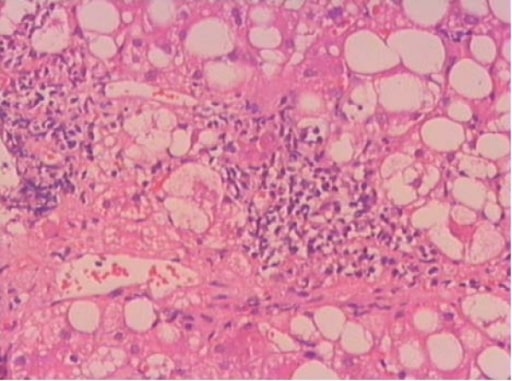
  • Hepatocitos balonizados e inflamación (respuesta de cicatrización de heridas a la lesión hepatocelular)
  • Con intervención, la esteatohepatitis no alcohólica es reversible, pero como la recuperación depende de la extensión del daño, los LOS Neisseria resultados varían.

Resultados potenciales

Si la progresión no se revierte, la enfermedad del hígado graso no alcohólico conduce a esteatohepatitis no alcohólica. Con más daño hepático, la cirrosis y el carcinoma hepático (ambos irreversibles) se pueden convertir en EN Erythema nodosum is an immune-mediated panniculitis (inflammation of the subcutaneous fat) caused by a type IV (delayed-type) hypersensitivity reaction. It commonly manifests in young women as tender, erythematous nodules on the shins. Erythema Nodosum resultados potenciales:
  • Cirrosis: la cicatrización y reparación ineficaces producen fibrosis Fibrosis Any pathological condition where fibrous connective tissue invades any organ, usually as a consequence of inflammation or other injury. Bronchiolitis Obliterans y cicatrización.
  • Carcinoma hepatocelular: el proceso de reparación y regeneración produce transformación maligna.
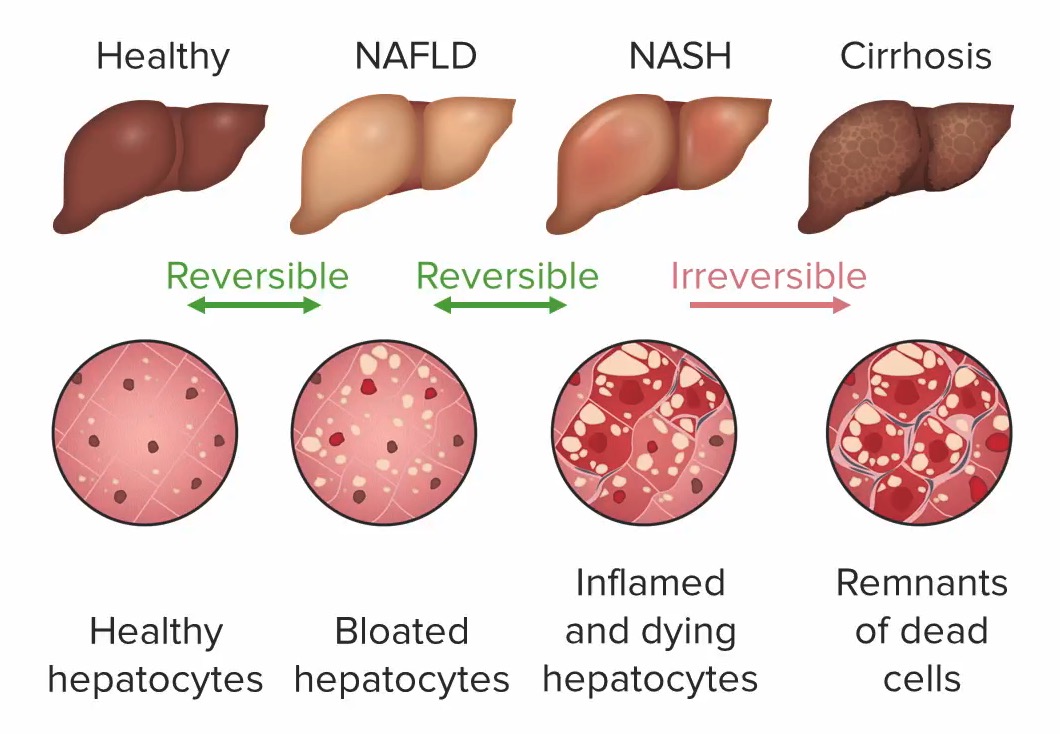
Progresión de la enfermedad hepática.

Progresión de la enfermedad hepática por esteatosis:
1: Hepatocitos sanos: sin daño hepático
2: Hepatocitos abultados con esteatosis (distendidos por gotitas de grasa), sin inflamación: enfermedad del hígado graso no alcohólico/esteatosis (todavía reversible)
3: Hepatocitos inflamados y moribundos, con posible fibrosis: esteatohepatitis no alcohólica (todavía reversible)
4: Células muertas: cirrosis (daño hepático irreversible)

Imagen por Lecturio.

Presentación Clínica

Síntomas

  • A menudo asintomático
  • Fatiga, malestar
  • Molestias en EN Erythema nodosum is an immune-mediated panniculitis (inflammation of the subcutaneous fat) caused by a type IV (delayed-type) hypersensitivity reaction. It commonly manifests in young women as tender, erythematous nodules on the shins. Erythema Nodosum el cuadrante superior derecho

Signos

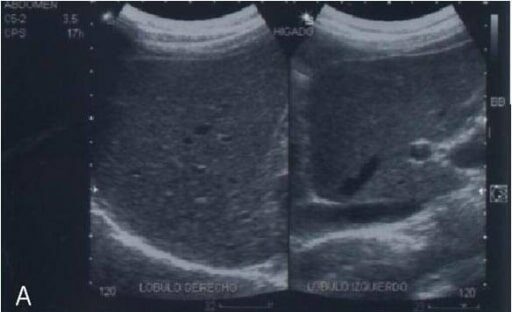
  • Hallazgo incidental de pruebas de función hepática anormales o esteatosis hepática en EN Erythema nodosum is an immune-mediated panniculitis (inflammation of the subcutaneous fat) caused by a type IV (delayed-type) hypersensitivity reaction. It commonly manifests in young women as tender, erythematous nodules on the shins. Erythema Nodosum el ultrasonido
  • Hepatomegalia
  • La progresión de la enfermedad a cirrosis se presenta con telangiectasias Telangiectasias Ataxia-telangiectasia, eritema palmar, hepatoesplenomegalia y ascitis.

Diagnóstico

  • Antecedentes y hallazgos clínicos:
    • Sin consumo alcohólico significativo
    • Sin enfermedad hepática crónica coexistente
    • Ninguna otra causa de esteatosis hepática
    • Presencia de esteatosis hepática por imagenología o biopsia
  • Biopsia hepática:
    • La mejor prueba diagnóstica pero raramente realizada
    • Se hace HACE Altitude Sickness si el diagnóstico no está claro
    • Distingue enfermedad del hígado graso no alcohólica de esteatohepatitis no alcohólica y detecta cirrosis (que aumenta el riesgo de carcinoma hepatocelular)
  • Ultrasonido: textura ecogénica del hígado (debido a la infiltración grasa)
  • Pruebas de laboratorio:
    • ↑ Aspartato aminotransferasa ( AST AST Enzymes of the transferase class that catalyze the conversion of l-aspartate and 2-ketoglutarate to oxaloacetate and l-glutamate. Liver Function Tests), alanina aminotransferasa ( ALT ALT An enzyme that catalyzes the conversion of l-alanine and 2-oxoglutarate to pyruvate and l-glutamate. Liver Function Tests), pero pueden encontrarse normales
    • A menudo con un nivel anormal de ferritina
    • ↑ Niveles séricos de triglicéridos/colesterol
  • Pruebas para descartar otras causas de hepatitis crónica:
    • Enfermedad hepática alcohólica
    • Hepatitis viral
    • Enfermedad de Wilson
    • Hepatitis autoinmune
    • Hemocromatosis

Tratamiento

Consideraciones generales para reducir el daño hepático

  • Evitar el consumo excesivo de alcohol y tabaco.
  • Actualizar las vacunas (para hepatitis A Hepatitis A Hepatitis A is caused by the hepatitis A virus (HAV), a nonenveloped virus of the Picornaviridae family with single-stranded RNA. HAV causes an acute, highly contagious hepatitis with unspecific prodromal symptoms such as fever and malaise followed by jaundice and elevated liver transaminases. Hepatitis A Virus y B), incluidas las recomendaciones estándar.

Monitoreo de la enfermedad del hígado graso no alcohólico

  • Monitorizar las pruebas de función hepática (el empeoramiento y/o el cambio en EN Erythema nodosum is an immune-mediated panniculitis (inflammation of the subcutaneous fat) caused by a type IV (delayed-type) hypersensitivity reaction. It commonly manifests in young women as tender, erythematous nodules on the shins. Erythema Nodosum el estado clínico justifican una evaluación adicional).
  • Esteatohepatitis no alcohólica comprobada por biopsia:
    • Monitorizar la fibrosis Fibrosis Any pathological condition where fibrous connective tissue invades any organ, usually as a consequence of inflammation or other injury. Bronchiolitis Obliterans.
    • Las opciones incluyen marcadores de fibrosis Fibrosis Any pathological condition where fibrous connective tissue invades any organ, usually as a consequence of inflammation or other injury. Bronchiolitis Obliterans sérica y elastografía transitoria controlada por vibración (mide la fibrosis Fibrosis Any pathological condition where fibrous connective tissue invades any organ, usually as a consequence of inflammation or other injury. Bronchiolitis Obliterans en EN Erythema nodosum is an immune-mediated panniculitis (inflammation of the subcutaneous fat) caused by a type IV (delayed-type) hypersensitivity reaction. It commonly manifests in young women as tender, erythematous nodules on the shins. Erythema Nodosum función de la rigidez del hígado).
  • Enfermedad del hígado graso no alcohólico-cirrosis: tamizaje de carcinoma hepatocelular.

Tratamiento de la enfermedad del hígado graso no alcohólico

  • No hay terapias farmacológicas específicas
  • Cambios en EN Erythema nodosum is an immune-mediated panniculitis (inflammation of the subcutaneous fat) caused by a type IV (delayed-type) hypersensitivity reaction. It commonly manifests in young women as tender, erythematous nodules on the shins. Erythema Nodosum el estilo de vida para la reducción del hígado graso:
    • Pérdida de peso gradual, promedio de 0,5 a 1 kg/semana (la pérdida de peso rápida puede empeorar la enfermedad hepática)
    • Trate de perder al AL Amyloidosis menos 5%–10% del peso corporal.
    • Ejercicio moderado
  • Control de comorbilidades (e.g., diabetes Diabetes Diabetes mellitus (DM) is a metabolic disease characterized by hyperglycemia and dysfunction of the regulation of glucose metabolism by insulin. Type 1 DM is diagnosed mostly in children and young adults as the result of autoimmune destruction of β cells in the pancreas and the resulting lack of insulin. Type 2 DM has a significant association with obesity and is characterized by insulin resistance. Diabetes Mellitus, dislipidemia)
  • El uso de vitamina E en EN Erythema nodosum is an immune-mediated panniculitis (inflammation of the subcutaneous fat) caused by a type IV (delayed-type) hypersensitivity reaction. It commonly manifests in young women as tender, erythematous nodules on the shins. Erythema Nodosum esteatohepatitis no alcohólica puede beneficiar a pacientes no diabéticos, pero debe evitarse en EN Erythema nodosum is an immune-mediated panniculitis (inflammation of the subcutaneous fat) caused by a type IV (delayed-type) hypersensitivity reaction. It commonly manifests in young women as tender, erythematous nodules on the shins. Erythema Nodosum aquellos con cáncer de próstata (↑ riesgo).
  • Pacientes con enfermedad hepática en EN Erythema nodosum is an immune-mediated panniculitis (inflammation of the subcutaneous fat) caused by a type IV (delayed-type) hypersensitivity reaction. It commonly manifests in young women as tender, erythematous nodules on the shins. Erythema Nodosum etapa terminal: considerar el trasplante de hígado.

Diagnóstico Diferencial

  • Hepatitis vírica: infección por un virus Virus Viruses are infectious, obligate intracellular parasites composed of a nucleic acid core surrounded by a protein capsid. Viruses can be either naked (non-enveloped) or enveloped. The classification of viruses is complex and based on many factors, including type and structure of the nucleoid and capsid, the presence of an envelope, the replication cycle, and the host range. Virology que provoca una enfermedad hepática aguda. Se presenta con ictericia y fiebre con hepatomegalia, y la elevación de las transaminasas suele ser mayor que en EN Erythema nodosum is an immune-mediated panniculitis (inflammation of the subcutaneous fat) caused by a type IV (delayed-type) hypersensitivity reaction. It commonly manifests in young women as tender, erythematous nodules on the shins. Erythema Nodosum la enfermedad del hígado graso no alcohólico. Se puede establecer una mayor diferenciación mediante la detección de antígenos y anticuerpos virales en EN Erythema nodosum is an immune-mediated panniculitis (inflammation of the subcutaneous fat) caused by a type IV (delayed-type) hypersensitivity reaction. It commonly manifests in young women as tender, erythematous nodules on the shins. Erythema Nodosum el suero. El tratamiento se basa en EN Erythema nodosum is an immune-mediated panniculitis (inflammation of the subcutaneous fat) caused by a type IV (delayed-type) hypersensitivity reaction. It commonly manifests in young women as tender, erythematous nodules on the shins. Erythema Nodosum la causa y, para ciertos tipos, se puede prevenir mediante la vacunación.
  • Hepatitis autoinmune: insuficiencia hepática aguda que se presenta con fatiga, ictericia, hepatomegalia y sensibilidad en EN Erythema nodosum is an immune-mediated panniculitis (inflammation of the subcutaneous fat) caused by a type IV (delayed-type) hypersensitivity reaction. It commonly manifests in young women as tender, erythematous nodules on the shins. Erythema Nodosum el cuadrante superior derecho. La hepatitis inducida por medicamentos debe descartarse mediante los LOS Neisseria antecedentes y la evaluación de laboratorio. La presencia del anticuerpo anti-músculo liso es un fuerte indicador de hepatitis autoinmune. El tratamiento es con inmunosupresores.
  • Enfermedad hepática alcohólica: insuficiencia hepática asociada al AL Amyloidosis consumo crónico significativo de alcohol. Presenta resultados de laboratorio similares (elevación de transaminasas) y hallazgos patológicos de esteatohepatitis. Los LOS Neisseria antecedentes característicos (abuso de alcohol) típicamente ayudan a diferenciar la hepatopatía alcohólica de la enfermedad del hígado graso no alcohólica. El tratamiento es la suspensión del alcohol.
  • Otras causas de hepatitis (inducida por medicamentos): se presenta después de la ingestión de un medicamento hepatotóxico con ictericia, hepatomegalia y molestias en EN Erythema nodosum is an immune-mediated panniculitis (inflammation of the subcutaneous fat) caused by a type IV (delayed-type) hypersensitivity reaction. It commonly manifests in young women as tender, erythematous nodules on the shins. Erythema Nodosum el cuadrante superior derecho. La lesión puede ser hepatocelular (transaminasas elevadas) y/o colestásica (fosfatasa alcalina elevada). El tratamiento consiste en EN Erythema nodosum is an immune-mediated panniculitis (inflammation of the subcutaneous fat) caused by a type IV (delayed-type) hypersensitivity reaction. It commonly manifests in young women as tender, erythematous nodules on the shins. Erythema Nodosum la eliminación del medicamento causante.

Referencias

  1. Abdelmalek M.F., & Diehl, A. (2018). Nonalcoholic fatty liver diseases and nonalcoholic steatohepatitis. Jameson J, & Fauci A.S., & Kasper D.L., & Hauser, S.L., & Longo, D.L., & Loscalzo, J.(Eds.), Harrison’s Principles of Internal Medicine, 20e. McGraw-Hill. 
  2. Chopra, S. Lai, M. (2020) Management of nonalcoholic fatty liver disease in adults. UpToDate. Retrieved 10 Nov 2020, from https://www.uptodate.com/contents/management-of-nonalcoholic-fatty-liver-disease-in-adults
  3. Friedman L.S. (2021). Nonalcoholic fatty liver disease. Papadakis M.A., & McPhee S.J., & Rabow M.W.(Eds.), Current Medical Diagnosis & Treatment 2021. McGraw-Hill.
  4. Sheth, S. (2020). Epidemiology, clinical features, and diagnosis of nonalcoholic fatty liver disease in adults. UpToDate. Chopra, S, Lindor, K and Robson, K. (Eds). Retrieved 12 Nov, 2020, from https://www.uptodate.com/contents/epidemiology-clinical-features-and-diagnosis-of-nonalcoholic-fatty-liver-disease-in-adults?search=Fatty%20Liver%20Disease&source=search_result&selectedTitle=1~150&usage_type=default&display_rank=1#H3
  5. Takahashi, Y.,Fukusato, T. (2014) Histopathology of nonalcoholic fatty liver disease/nonalcoholic steatohepatitis. World J Gastroenterol. 20(42): 15539–15548.
  6. Tendler, D. (2020) Pathogenesis of nonalcoholic fatty liver disease.  Lindor, K., Robson, K. (Eds.) Uptodate. Retrieved 10 Nov, 2020, from https://www.uptodate.com/contents/pathogenesis-of-nonalcoholic-fatty-liver-disease

¡Crea tu cuenta gratis o inicia una sesión para seguir leyendo!

Regístrate ahora y obtén acceso gratuito a Lecturio con páginas de concepto, videos médicos y cuestionarios para tu educación médica.

User Reviews

Que tengas una sesión de estudio alegre y navideña 🎁 Ahorra 50% en todos los planes >>

Details