
Domina Conceptos Médicos

Estudia para la escuela de medicina y tus examenes con Lecturio.

Deficiencia de Mieloperoxidasa

La deficiencia de mieloperoxidasa es un trastorno hereditario o adquirido causado por mutaciones en EN Erythema nodosum is an immune-mediated panniculitis (inflammation of the subcutaneous fat) caused by a type IV (delayed-type) hypersensitivity reaction. It commonly manifests in young women as tender, erythematous nodules on the shins. Erythema Nodosum el gen MPO MPO Acute Myeloid Leukemia en EN Erythema nodosum is an immune-mediated panniculitis (inflammation of the subcutaneous fat) caused by a type IV (delayed-type) hypersensitivity reaction. It commonly manifests in young women as tender, erythematous nodules on the shins. Erythema Nodosum el cromosoma 17, que conduce a una deficiencia de mieloperoxidasa en EN Erythema nodosum is an immune-mediated panniculitis (inflammation of the subcutaneous fat) caused by a type IV (delayed-type) hypersensitivity reaction. It commonly manifests in young women as tender, erythematous nodules on the shins. Erythema Nodosum neutrófilos y monocitos. Esta deficiencia perjudica particularmente la destrucción de patógenos en EN Erythema nodosum is an immune-mediated panniculitis (inflammation of the subcutaneous fat) caused by a type IV (delayed-type) hypersensitivity reaction. It commonly manifests in young women as tender, erythematous nodules on the shins. Erythema Nodosum los LOS Neisseria fagolisosomas. Si bien la mayoría de los LOS Neisseria pacientes son asintomáticos y no sufren una mayor frecuencia de infecciones, un grupo minoritario ( en EN Erythema nodosum is an immune-mediated panniculitis (inflammation of the subcutaneous fat) caused by a type IV (delayed-type) hypersensitivity reaction. It commonly manifests in young women as tender, erythematous nodules on the shins. Erythema Nodosum particular, los LOS Neisseria pacientes diabéticos) pueden desarrollar infecciones fúngicas graves. La tinción histoquímica de neutrófilos para mieloperoxidasa puede proporcionar el diagnóstico. No existe un tratamiento específico para la deficiencia de mieloperoxidasa y no está indicada la antibioticoterapia profiláctica.

Last updated: Dec 15, 2025

Editorial responsibility: Stanley Oiseth, Lindsay Jones, Evelin Maza

Epidemiología y Etiología

Epidemiología

  • La deficiencia de mieloperoxidasa es el trastorno fagocitario primario más común.
  • Incidencia:
    • 1 en EN Erythema nodosum is an immune-mediated panniculitis (inflammation of the subcutaneous fat) caused by a type IV (delayed-type) hypersensitivity reaction. It commonly manifests in young women as tender, erythematous nodules on the shins. Erythema Nodosum 2000–4 000 personas en EN Erythema nodosum is an immune-mediated panniculitis (inflammation of the subcutaneous fat) caused by a type IV (delayed-type) hypersensitivity reaction. It commonly manifests in young women as tender, erythematous nodules on the shins. Erythema Nodosum los LOS Neisseria Estados Unidos
    • 1 en EN Erythema nodosum is an immune-mediated panniculitis (inflammation of the subcutaneous fat) caused by a type IV (delayed-type) hypersensitivity reaction. It commonly manifests in young women as tender, erythematous nodules on the shins. Erythema Nodosum 55,000 personas en EN Erythema nodosum is an immune-mediated panniculitis (inflammation of the subcutaneous fat) caused by a type IV (delayed-type) hypersensitivity reaction. It commonly manifests in young women as tender, erythematous nodules on the shins. Erythema Nodosum Japón
  • Morbilidad:
    • La infección grave ocurre en EN Erythema nodosum is an immune-mediated panniculitis (inflammation of the subcutaneous fat) caused by a type IV (delayed-type) hypersensitivity reaction. It commonly manifests in young women as tender, erythematous nodules on the shins. Erythema Nodosum < 5% de los LOS Neisseria casos
    • Generalmente, las infecciones ocurren solo en EN Erythema nodosum is an immune-mediated panniculitis (inflammation of the subcutaneous fat) caused by a type IV (delayed-type) hypersensitivity reaction. It commonly manifests in young women as tender, erythematous nodules on the shins. Erythema Nodosum pacientes con diabetes Diabetes Diabetes mellitus (DM) is a metabolic disease characterized by hyperglycemia and dysfunction of the regulation of glucose metabolism by insulin. Type 1 DM is diagnosed mostly in children and young adults as the result of autoimmune destruction of β cells in the pancreas and the resulting lack of insulin. Type 2 DM has a significant association with obesity and is characterized by insulin resistance. Diabetes Mellitus mellitus o infección por el virus Virus Viruses are infectious, obligate intracellular parasites composed of a nucleic acid core surrounded by a protein capsid. Viruses can be either naked (non-enveloped) or enveloped. The classification of viruses is complex and based on many factors, including type and structure of the nucleoid and capsid, the presence of an envelope, the replication cycle, and the host range. Virology de la inmunodeficiencia humana (VIH) concomitante.

Etiología

Mutación genética:

  • Gen MPO MPO Acute Myeloid Leukemia : 17q22-23
  • Función mieloperoxidasa normal: enzima que genera ácido hipocloroso en EN Erythema nodosum is an immune-mediated panniculitis (inflammation of the subcutaneous fat) caused by a type IV (delayed-type) hypersensitivity reaction. It commonly manifests in young women as tender, erythematous nodules on the shins. Erythema Nodosum neutrófilos y monocitos

Deficiencia primaria de mieloperoxidasa:

  • Forma más común
  • Trastorno autosómico recesivo con expresión y penetrancia variables
  • La mayoría de los LOS Neisseria pacientes son heterocigotos compuestos, con diferentes mutaciones en EN Erythema nodosum is an immune-mediated panniculitis (inflammation of the subcutaneous fat) caused by a type IV (delayed-type) hypersensitivity reaction. It commonly manifests in young women as tender, erythematous nodules on the shins. Erythema Nodosum cada alelo.
  • Las mutaciones más comunes incluyen R569W, Y173C, M251T, G501S y R499C, y una deleción de 14 bases Bases Usually a hydroxide of lithium, sodium, potassium, rubidium or cesium, but also the carbonates of these metals, ammonia, and the amines. Acid-Base Balance (D14) dentro del exón 9

Deficiencia adquirida (secundaria) de mieloperoxidasa:

  • Menos común
  • Puede surgir de mutaciones somáticas
  • Afecta solo a una proporción de los LOS Neisseria neutrófilos
  • Transitoria (se resuelve con la mejora de la causa subyacente)
  • Causas:
    • Diabetes Diabetes Diabetes mellitus (DM) is a metabolic disease characterized by hyperglycemia and dysfunction of the regulation of glucose metabolism by insulin. Type 1 DM is diagnosed mostly in children and young adults as the result of autoimmune destruction of β cells in the pancreas and the resulting lack of insulin. Type 2 DM has a significant association with obesity and is characterized by insulin resistance. Diabetes Mellitus mellitus
    • Embarazo
    • Deficiencia de hierro
    • Trasplante renal
    • Enfermedades trombóticas
    • Envenenamiento por plomo
    • Ictericia obstructiva
    • Tumores y trastornos hematológicos
    • Infecciones graves
    • Medicamentos citotóxicos y antiinflamatorios

Fisiopatología y Presentación Clínica

Fisiopatología

Los LOS Neisseria neutrófilos son la primera línea de defensa contra los LOS Neisseria patógenos:

  • Durante la fagocitosis, los LOS Neisseria neutrófilos experimentan un estallido respiratorio.
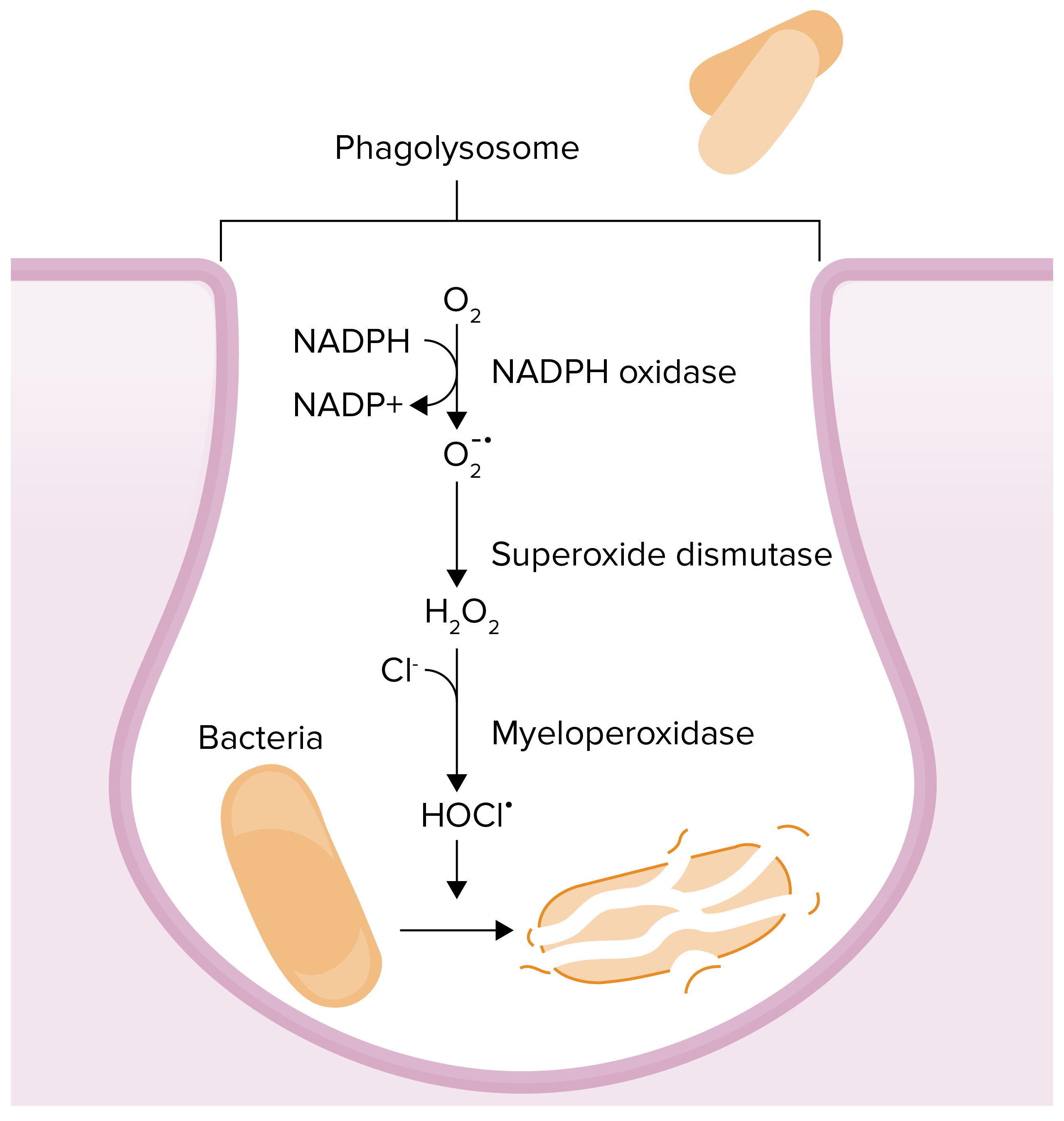
  • Activación de la nicotinamida adenosina dinucleótido fosfato oxidasa y superóxido dismutasa → producción de superóxido, peróxido de hidrógeno y otras especies reactivas de oxígeno
  • La mieloperoxidasa convierte el peróxido de hidrógeno en EN Erythema nodosum is an immune-mediated panniculitis (inflammation of the subcutaneous fat) caused by a type IV (delayed-type) hypersensitivity reaction. It commonly manifests in young women as tender, erythematous nodules on the shins. Erythema Nodosum ácido hipocloroso (amplifica la toxicidad de las especies reactivas de oxígeno)
  • Patógenos eliminados en EN Erythema nodosum is an immune-mediated panniculitis (inflammation of the subcutaneous fat) caused by a type IV (delayed-type) hypersensitivity reaction. It commonly manifests in young women as tender, erythematous nodules on the shins. Erythema Nodosum el fagolisosoma

Neutrófilos deficientes en EN Erythema nodosum is an immune-mediated panniculitis (inflammation of the subcutaneous fat) caused by a type IV (delayed-type) hypersensitivity reaction. It commonly manifests in young women as tender, erythematous nodules on the shins. Erythema Nodosum mieloperoxidasa:
  • Tienen una capacidad variable Variable Variables represent information about something that can change. The design of the measurement scales, or of the methods for obtaining information, will determine the data gathered and the characteristics of that data. As a result, a variable can be qualitative or quantitative, and may be further classified into subgroups. Types of Variables para matar bacterias.
  • Son incapaces de matar ciertos hongos:
    • Candida albicans Candida albicans A unicellular budding fungus which is the principal pathogenic species causing candidiasis (moniliasis). Candida/Candidiasis
    • C. krusei
    • C. stellatoidea
    • C. tropicalis
Diagrama de estallido respiratorio

Reacciones químicas que ocurren en los fagolisosomas en un esfuerzo por matar un patógeno:
La deficiencia de mieloperoxidasa da como resultado una incapacidad para convertir el peróxido de hidrógeno en ácido hipocloroso.

Imagen por Lecturio.

Presentación clínica

  • La mayoría de los LOS Neisseria individuos son asintomáticos y no presentan una mayor frecuencia de infecciones.
  • Las infecciones graves son poco frecuentes (< 5 % de los LOS Neisseria pacientes):
    • Por lo general debido a Candida Candida Candida is a genus of dimorphic, opportunistic fungi. Candida albicans is part of the normal human flora and is the most common cause of candidiasis. The clinical presentation varies and can include localized mucocutaneous infections (e.g., oropharyngeal, esophageal, intertriginous, and vulvovaginal candidiasis) and invasive disease (e.g., candidemia, intraabdominal abscess, pericarditis, and meningitis). Candida/Candidiasis
    • Mayor riesgo con diabetes Diabetes Diabetes mellitus (DM) is a metabolic disease characterized by hyperglycemia and dysfunction of the regulation of glucose metabolism by insulin. Type 1 DM is diagnosed mostly in children and young adults as the result of autoimmune destruction of β cells in the pancreas and the resulting lack of insulin. Type 2 DM has a significant association with obesity and is characterized by insulin resistance. Diabetes Mellitus mellitus, malignidad o infección por VIH

Diagnóstico y Tratamiento

Diagnóstico

  • Tinción histoquímica:
    • Realizado en EN Erythema nodosum is an immune-mediated panniculitis (inflammation of the subcutaneous fat) caused by a type IV (delayed-type) hypersensitivity reaction. It commonly manifests in young women as tender, erythematous nodules on the shins. Erythema Nodosum un frotis de sangre
    • Los LOS Neisseria neutrófilos carecerán de mieloperoxidasa (normalmente vistos como gránulos azurofílicos).
  • Inmunohistoquímica
  • La citometría de flujo mide los LOS Neisseria intermediarios de las especies reactivas de oxígeno.

Tratamiento

Debido a que la mayoría de los LOS Neisseria pacientes son asintomáticos, no se requiere un tratamiento específico para la deficiencia de mieloperoxidasa.

  • Los LOS Neisseria antibióticos profilácticos no están indicados.
  • Tratamiento rápido y agresivo de infecciones, particularmente en EN Erythema nodosum is an immune-mediated panniculitis (inflammation of the subcutaneous fat) caused by a type IV (delayed-type) hypersensitivity reaction. It commonly manifests in young women as tender, erythematous nodules on the shins. Erythema Nodosum pacientes con diabetes Diabetes Diabetes mellitus (DM) is a metabolic disease characterized by hyperglycemia and dysfunction of the regulation of glucose metabolism by insulin. Type 1 DM is diagnosed mostly in children and young adults as the result of autoimmune destruction of β cells in the pancreas and the resulting lack of insulin. Type 2 DM has a significant association with obesity and is characterized by insulin resistance. Diabetes Mellitus.
  • Evitar el uso innecesario o prolongado de antibióticos o esteroides (↑ riesgo de infecciones fúngicas).

Diagnóstico Diferencial

  • Deficiencia en EN Erythema nodosum is an immune-mediated panniculitis (inflammation of the subcutaneous fat) caused by a type IV (delayed-type) hypersensitivity reaction. It commonly manifests in young women as tender, erythematous nodules on the shins. Erythema Nodosum la adhesión de leucocitos tipo 1: condición hereditaria que da como resultado una falta de expresión de CD18 CD18 Cell-surface glycoprotein beta-chains that are non-covalently linked to specific alpha-chains of the cd11 family of leukocyte-adhesion molecules (receptors, leukocyte-adhesion). A defect in the gene encoding cd18 causes leukocyte-adhesion deficiency syndrome. Leukocyte Adhesion Deficiency Type 1 en EN Erythema nodosum is an immune-mediated panniculitis (inflammation of the subcutaneous fat) caused by a type IV (delayed-type) hypersensitivity reaction. It commonly manifests in young women as tender, erythematous nodules on the shins. Erythema Nodosum los LOS Neisseria neutrófilos. Esta deficiencia conduce a una disminución de la capacidad de los LOS Neisseria neutrófilos para migrar desde los LOS Neisseria vasos sanguíneos. Los LOS Neisseria pacientes con esta afección tendrán infecciones recurrentes, retraso en EN Erythema nodosum is an immune-mediated panniculitis (inflammation of the subcutaneous fat) caused by a type IV (delayed-type) hypersensitivity reaction. It commonly manifests in young women as tender, erythematous nodules on the shins. Erythema Nodosum la cicatrización de heridas y un recuento elevado de neutrófilos. La deficiencia de adhesión de leucocitos tipo 1 no está asociada con el albinismo oculocutáneo. El diagnóstico se confirma con citometría de flujo que demuestra una deficiencia en EN Erythema nodosum is an immune-mediated panniculitis (inflammation of the subcutaneous fat) caused by a type IV (delayed-type) hypersensitivity reaction. It commonly manifests in young women as tender, erythematous nodules on the shins. Erythema Nodosum CD18 CD18 Cell-surface glycoprotein beta-chains that are non-covalently linked to specific alpha-chains of the cd11 family of leukocyte-adhesion molecules (receptors, leukocyte-adhesion). A defect in the gene encoding cd18 causes leukocyte-adhesion deficiency syndrome. Leukocyte Adhesion Deficiency Type 1. El trasplante de células madre hematopoyéticas es el tratamiento de elección.
  • Enfermedad granulomatosa crónica: consecuencia de células fagocíticas defectuosas. Los LOS Neisseria pacientes con esta enfermedad tendrán infecciones recurrentes, abscesos y lesiones granulomatosas en EN Erythema nodosum is an immune-mediated panniculitis (inflammation of the subcutaneous fat) caused by a type IV (delayed-type) hypersensitivity reaction. It commonly manifests in young women as tender, erythematous nodules on the shins. Erythema Nodosum múltiples órganos. Puede observarse hipergammaglobulinemia. El diagnóstico se realiza con pruebas de función de neutrófilos para la producción de superóxido. La profilaxis antimicrobiana, el interferón gama, la transfusión de granulocitos y el trasplante de células madre hematopoyéticas son posibles opciones de tratamiento.
  • Neutropenia Neutropenia Neutrophils are an important component of the immune system and play a significant role in the eradication of infections. Low numbers of circulating neutrophils, referred to as neutropenia, predispose the body to recurrent infections or sepsis, though patients can also be asymptomatic. Neutropenia congénita severa: rara enfermedad resultante de mutaciones genéticas que afectan la mielopoyesis. Esta condición se manifiesta en EN Erythema nodosum is an immune-mediated panniculitis (inflammation of the subcutaneous fat) caused by a type IV (delayed-type) hypersensitivity reaction. It commonly manifests in young women as tender, erythematous nodules on the shins. Erythema Nodosum la infancia con infecciones bacterianas potencialmente mortales. La neutropenia Neutropenia Neutrophils are an important component of the immune system and play a significant role in the eradication of infections. Low numbers of circulating neutrophils, referred to as neutropenia, predispose the body to recurrent infections or sepsis, though patients can also be asymptomatic. Neutropenia se encuentra en EN Erythema nodosum is an immune-mediated panniculitis (inflammation of the subcutaneous fat) caused by a type IV (delayed-type) hypersensitivity reaction. It commonly manifests in young women as tender, erythematous nodules on the shins. Erythema Nodosum la evaluación de laboratorio, a menudo con un recuento elevado de monocitos. Una biopsia de médula ósea también ayudará en EN Erythema nodosum is an immune-mediated panniculitis (inflammation of the subcutaneous fat) caused by a type IV (delayed-type) hypersensitivity reaction. It commonly manifests in young women as tender, erythematous nodules on the shins. Erythema Nodosum el diagnóstico. El tratamiento incluye el factor estimulante de colonias de granulocitos y el trasplante de células madre hematopoyéticas.
  • Síndrome de Chediak-Higashi: trastorno autosómico recesivo causado por mutaciones que afectan a una proteína reguladora del tráfico lisosomal. Esta proteína juega un papel crucial en EN Erythema nodosum is an immune-mediated panniculitis (inflammation of the subcutaneous fat) caused by a type IV (delayed-type) hypersensitivity reaction. It commonly manifests in young women as tender, erythematous nodules on the shins. Erythema Nodosum la incapacidad de los LOS Neisseria neutrófilos para matar los LOS Neisseria microbios fagocitados. Los LOS Neisseria pacientes con síndrome de Chediak-Higashi presentan infecciones piógenas recurrentes, sangrado y hematomas de aparición fácil y manifestaciones neurológicas. Este síndrome también se asocia con albinismo oculocutáneo. El diagnóstico se realiza mediante el análisis de frotis de sangre o de médula ósea del paciente y pruebas genéticas. El tratamiento de elección es el trasplante alogénico de células hematopoyéticas.
  • Síndrome de hiper IgE IgE An immunoglobulin associated with mast cells. Overexpression has been associated with allergic hypersensitivity. Immunoglobulins: Types and Functions: enfermedad hereditaria de tipo inmunodeficiencia primaria caracterizada por abscesos cutáneos recurrentes, neumonía con neumatocele y dermatitis Dermatitis Any inflammation of the skin. Atopic Dermatitis (Eczema) eccematosa. El diagnóstico se realiza al AL Amyloidosis encontrar niveles elevados de IgE IgE An immunoglobulin associated with mast cells. Overexpression has been associated with allergic hypersensitivity. Immunoglobulins: Types and Functions en EN Erythema nodosum is an immune-mediated panniculitis (inflammation of the subcutaneous fat) caused by a type IV (delayed-type) hypersensitivity reaction. It commonly manifests in young women as tender, erythematous nodules on the shins. Erythema Nodosum suero y puede confirmarse con pruebas genéticas. El tratamiento incluye antibióticos profilácticos e interferón gama para infecciones graves.

Referencias

  1. Marciano, B.E., Zerbe, C.S., Holland, S.M. (2023). Myeloperoxidase deficiency and other enzymatic WBC defects causing immunodeficiency. In TePas, E. (Ed.), UpToDate. Retrieved November 8, 2024, from https://www.uptodate.com/contents/myeloperoxidase-deficiency-and-other-enzymatic-wbc-defects-causing-immunodeficiency
  2. Pahwa, R., Modi, P., Jialal, I. (2023). Myeloperoxidase deficiency. [online] StatPearls. Retrieved November 8, 2024, from https://www.ncbi.nlm.nih.gov/books/NBK470278/
  3. Romano, M., Dri, P., Da Dalt, L., Patriarca, P., Baralle, F. E. (1997). Biochemical and molecular characterization of hereditary myeloperoxidase deficiency. Blood90(10), 4126–4134. Retrieved November 8, 2024, from https://pubmed.ncbi.nlm.nih.gov/9354683/

¡Crea tu cuenta gratis o inicia una sesión para seguir leyendo!

Regístrate ahora y obtén acceso gratuito a Lecturio con páginas de concepto, videos médicos y cuestionarios para tu educación médica.

User Reviews

Que tengas una sesión de estudio alegre y navideña 🎁 Ahorra 50% en todos los planes >>

Details