
Domina Conceptos Médicos

Estudia para la escuela de medicina y tus examenes con Lecturio.

Colangitis Biliar Primaria

La colangitis biliar primaria es una enfermedad crónica que resulta en EN Erythema nodosum is an immune-mediated panniculitis (inflammation of the subcutaneous fat) caused by a type IV (delayed-type) hypersensitivity reaction. It commonly manifests in young women as tender, erythematous nodules on the shins. Erythema Nodosum la destrucción autoinmune de los LOS Neisseria conductos biliares intrahepáticos. La presentación típica es la de una mujer de mediana edad con prurito, fatiga y dolor Dolor Inflammation abdominal en EN Erythema nodosum is an immune-mediated panniculitis (inflammation of the subcutaneous fat) caused by a type IV (delayed-type) hypersensitivity reaction. It commonly manifests in young women as tender, erythematous nodules on the shins. Erythema Nodosum el cuadrante superior derecho. Las enzimas hepáticas elevadas y los LOS Neisseria anticuerpos antimitocondriales establecen el diagnóstico. El tratamiento médico incluye el ácido ursodesoxicólico como tratamiento de 1ra línea y para el manejo de los LOS Neisseria síntomas.. El tratamiento definitivo es el trasplante hepático, que se realiza en EN Erythema nodosum is an immune-mediated panniculitis (inflammation of the subcutaneous fat) caused by a type IV (delayed-type) hypersensitivity reaction. It commonly manifests in young women as tender, erythematous nodules on the shins. Erythema Nodosum estadios tardíos (cirrosis).

Last updated: Feb 4, 2023
Editorial responsibility: Stanley Oiseth, Lindsay Jones, Evelin Maza

Descripción General

Epidemiología

  • Más prevalente en EN Erythema nodosum is an immune-mediated panniculitis (inflammation of the subcutaneous fat) caused by a type IV (delayed-type) hypersensitivity reaction. It commonly manifests in young women as tender, erythematous nodules on the shins. Erythema Nodosum mujeres que en EN Erythema nodosum is an immune-mediated panniculitis (inflammation of the subcutaneous fat) caused by a type IV (delayed-type) hypersensitivity reaction. It commonly manifests in young women as tender, erythematous nodules on the shins. Erythema Nodosum hombres
  • Prevalencia más alta en EN Erythema nodosum is an immune-mediated panniculitis (inflammation of the subcutaneous fat) caused by a type IV (delayed-type) hypersensitivity reaction. It commonly manifests in young women as tender, erythematous nodules on the shins. Erythema Nodosum Europa y América del Norte
  • Se diagnostica con más frecuencia entre la 4ta y la 6ta década de la vida
  • La colangitis biliar primaria representa < 1% de los LOS Neisseria trasplantes de hígado en EN Erythema nodosum is an immune-mediated panniculitis (inflammation of the subcutaneous fat) caused by a type IV (delayed-type) hypersensitivity reaction. It commonly manifests in young women as tender, erythematous nodules on the shins. Erythema Nodosum los LOS Neisseria Estados Unidos.

Etiología

  • Hay una presunta etiología autoinmune.
  • Asociada con:
    • Síndrome de Sjogren
    • Esclerodermia
    • Síndrome CREST ( calcinosis Calcinosis Pathologic deposition of calcium salts in tissues. Scleroderma, fenómeno de Raynaud, dismotilidad esofágica, esclerodactilia y telangiectasia Telangiectasia Permanent dilation of preexisting blood vessels creating small focal red lesions, most commonly in the skin or mucous membranes. It is characterized by the prominence of skin blood vessels, such as vascular spiders. Chronic Venous Insufficiency)
    • Artritis reumatoide
    • Tiroiditis de Hashimoto
  • Posible riesgo genético
  • Los LOS Neisseria pacientes tienen una incidencia ↑ de infecciones del tracto urinario por gram-negativos.

Fisiopatología

  • El mecanismo exacto no se conoce.
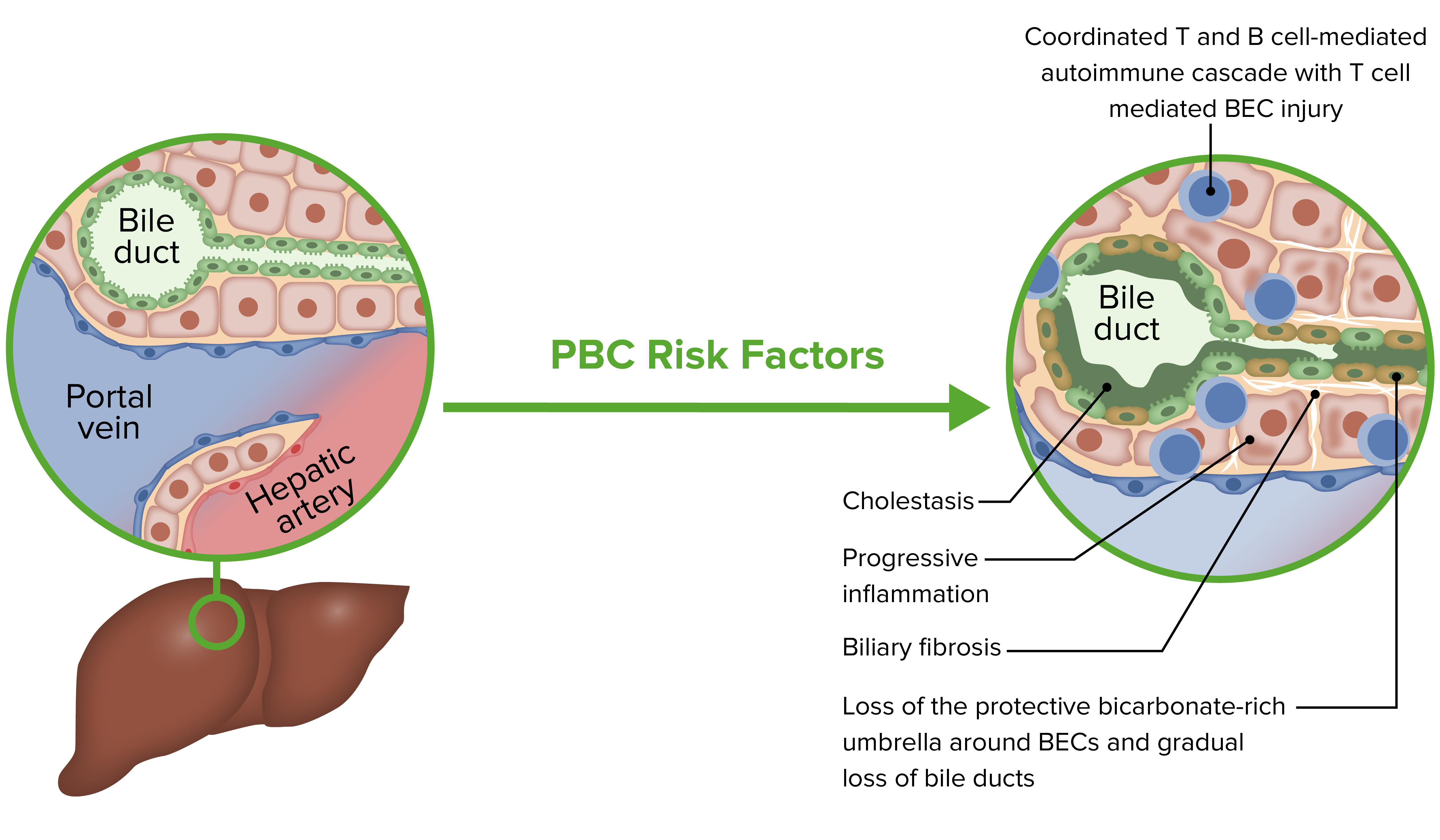
  • Enfermedad hepática crónica y progresiva → colestasis y destrucción autoinmune de los LOS Neisseria conductos biliares intrahepáticos → fibrosis Fibrosis Any pathological condition where fibrous connective tissue invades any organ, usually as a consequence of inflammation or other injury. Bronchiolitis Obliterans portal y periportal gradual → cirrosis hepática e hipertensión portal → insuficiencia hepática
Pathophysiology of primary biliary cholangitis (PBC)

Fisiopatología de la colangitis biliar primaria:
Un factor de riesgo o un factor desencadenante puede dar lugar a una respuesta coordinada mediada por células T y B, que da lugar a una lesión de las células epiteliales biliares, colestasis y fibrosis.

Imagen por Lecturio.

Presentación Clínica

La colangitis biliar primaria tiene una amplia gama de síntomas. La afección suele ser asintomática en EN Erythema nodosum is an immune-mediated panniculitis (inflammation of the subcutaneous fat) caused by a type IV (delayed-type) hypersensitivity reaction. It commonly manifests in young women as tender, erythematous nodules on the shins. Erythema Nodosum la fase inicial y presenta síntomas de cirrosis descompensada en EN Erythema nodosum is an immune-mediated panniculitis (inflammation of the subcutaneous fat) caused by a type IV (delayed-type) hypersensitivity reaction. It commonly manifests in young women as tender, erythematous nodules on the shins. Erythema Nodosum la fase tardía.
  • Presentación aguda:
    • Prurito
    • Fatiga
  • Presentación crónica:
    • Hepatomegalia +/- esplenomegalia
    • Ictericia
    • Melanosis Melanosis Disorders of increased melanin pigmentation that develop without preceding inflammatory disease. Primary Biliary Cholangitis (oscurecimiento de la piel)
    • Xantomas (depósitos de colesterol graso debajo de la piel) y xantelasma (xantomas alrededor de los LOS Neisseria párpados)
  • Etapa final:
    • Insuficiencia hepatocelular (cirrosis)
    • Hipertensión portal (ascitis, hemorragia varicosa, etc ETC The electron transport chain (ETC) sends electrons through a series of proteins, which generate an electrochemical proton gradient that produces energy in the form of adenosine triphosphate (ATP). Electron Transport Chain (ETC).)
  • Alta incidencia de osteoporosis Osteoporosis Osteoporosis refers to a decrease in bone mass and density leading to an increased number of fractures. There are 2 forms of osteoporosis: primary, which is commonly postmenopausal or senile; and secondary, which is a manifestation of immobilization, underlying medical disorders, or long-term use of certain medications. Osteoporosis por deficiencia de vitamina D
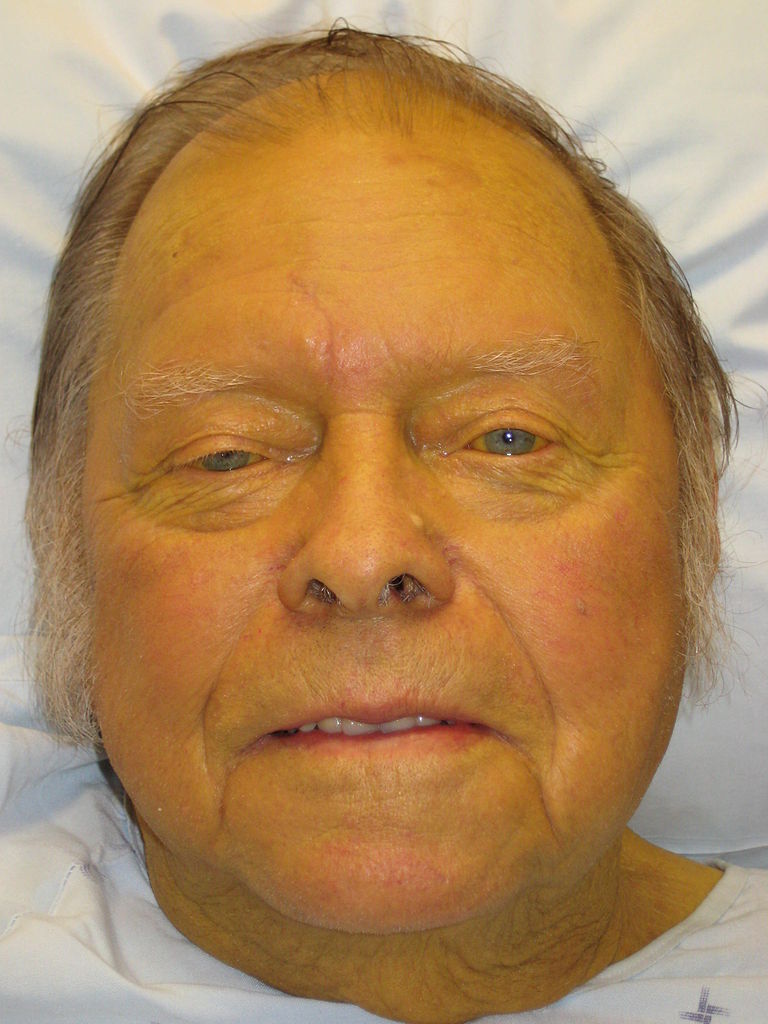
Ictericia

Ictericia: coloración amarilla de la piel debido a la deposición de bilirrubina

Imagen: “Jaundice08” por James Heilman, MD. Licencia: CC BY 3.0
Diagnóstico y Tratamiento

Diagnóstico

  • Análisis de sangre:
    • Los LOS Neisseria anticuerpos antimitocondriales son diagnósticos (> 95% de especificidad y sensibilidad)
    • Transaminasas: aspartato aminotransferasa ( AST AST Enzymes of the transferase class that catalyze the conversion of l-aspartate and 2-ketoglutarate to oxaloacetate and l-glutamate. Liver Function Tests) y alanina aminotransferasa ( ALT ALT An enzyme that catalyzes the conversion of l-alanine and 2-oxoglutarate to pyruvate and l-glutamate. Liver Function Tests) están ligeramente
    • ↑ Fosfatasa alcalina
    • ↑ Bilirrubina conjugada
    • ↑ Gamma-glutamil transferasa
  • Biopsia hepática:
    • No requerida → puede confirmar el diagnóstico
    • Más útil para la estadificación (indicador pronóstico)
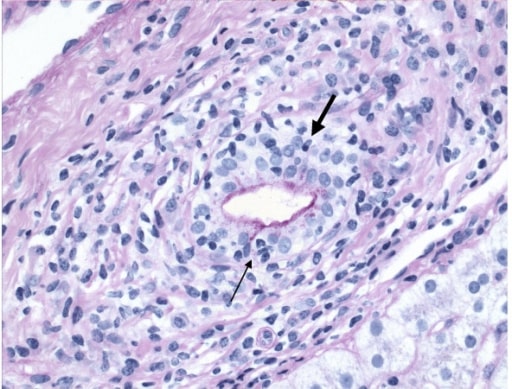
Cirrosis biliar primaria

Cirrosis biliar primaria, que demuestra colangitis destructiva crónica no supurativa: se muestra la infiltración de linfocitos (flecha) y células plasmáticas (flecha gruesa) en el conducto biliar.

Imagen: “Primary biliary cirrhosis” por Department of Medicine, Toronto Western Hospital (University Health Network/University of Toronto), Toronto, Ontario, Canada. Licencia: CC BY 2.0

Tratamiento

  • El trasplante hepático es el único tratamiento definitivo.
  • Agente de 1ra línea: ácido ursodesoxicólico ( ursodiol Ursodiol An epimer of chenodeoxycholic acid. It is a mammalian bile acid found first in the bear and is apparently either a precursor or a product of chenodeoxycholate. Its administration changes the composition of bile and may dissolve gallstones. It is used as a cholagogue and choleretic. Primary Biliary Cholangitis)
    • Hasta el 40% de los LOS Neisseria pacientes no responden.
    • Alternativa: ácido obeticólico
  • La colestiramina se puede usar para el prurito y la hipercolesterolemia.
  • Suplementos de calcio y vitamina D para baja densidad ósea
  • Bisfosfonatos son administrados para la osteoporosis Osteoporosis Osteoporosis refers to a decrease in bone mass and density leading to an increased number of fractures. There are 2 forms of osteoporosis: primary, which is commonly postmenopausal or senile; and secondary, which is a manifestation of immobilization, underlying medical disorders, or long-term use of certain medications. Osteoporosis severa

Diagnóstico Diferencial

  • Colangitis esclerosante primaria: enfermedad inflamatoria de los LOS Neisseria conductos biliares que provoca el estrechamiento del árbol biliar debido a la cicatrización. Asociada a colitis Colitis Inflammation of the colon section of the large intestine, usually with symptoms such as diarrhea (often with blood and mucus), abdominal pain, and fever. Pseudomembranous Colitis ulcerosa. Los LOS Neisseria pacientes presentan fatiga, prurito e ictericia. El diagnóstico es por colangiopancreatografía por resonancia magnética y el tratamiento es sintomático. El tratamiento definitivo es el trasplante hepático en EN Erythema nodosum is an immune-mediated panniculitis (inflammation of the subcutaneous fat) caused by a type IV (delayed-type) hypersensitivity reaction. It commonly manifests in young women as tender, erythematous nodules on the shins. Erythema Nodosum estadios tardíos (cirrosis).
  • Obstrucción del conducto biliar: obstrucción del sistema biliar que también cursa con ictericia y aumento de laboratorios de colestasis. El inicio agudo de la ictericia, dolor Dolor Inflammation en EN Erythema nodosum is an immune-mediated panniculitis (inflammation of the subcutaneous fat) caused by a type IV (delayed-type) hypersensitivity reaction. It commonly manifests in young women as tender, erythematous nodules on the shins. Erythema Nodosum el cuadrante superior derecho y una mayor elevación de las aminotransferasas ayudan a diferenciar la afección de la colangitis biliar primaria. Se puede hacer una diferenciación adicional mediante ultrasonido o colangiopancreatografía por resonancia magnética. Las obstrucciones biliares tienen muchas causas, incluidos cálculos biliares y tumores. El tratamiento se basa en EN Erythema nodosum is an immune-mediated panniculitis (inflammation of the subcutaneous fat) caused by a type IV (delayed-type) hypersensitivity reaction. It commonly manifests in young women as tender, erythematous nodules on the shins. Erythema Nodosum la etiología.
  • Hepatitis autoinmune: inflamación del hígado que se produce cuando el sistema inmunitario del organismo se vuelve contra las células hepáticas. La presentación clínica va VA Ventilation: Mechanics of Breathing desde lo asintomático hasta los LOS Neisseria síntomas de insuficiencia hepática aguda. Se diagnostica mediante pruebas de anticuerpos séricos contra el músculo liso y biopsia hepática. El tratamiento es con corticosteroides y azatioprina. Con un tratamiento temprano, el pronóstico es favorable. Si no se trata, la mitad de los LOS Neisseria pacientes mueren en EN Erythema nodosum is an immune-mediated panniculitis (inflammation of the subcutaneous fat) caused by a type IV (delayed-type) hypersensitivity reaction. It commonly manifests in young women as tender, erythematous nodules on the shins. Erythema Nodosum los LOS Neisseria primeros años.

Referencias

  1. Poupon, R. (2025). Clinical manifestations, diagnosis, and prognosis of primary biliary cholangitis. UpToDate. Retrieved August 5, 2025, from https://www.uptodate.com/contents/clinical-manifestations-diagnosis-and-prognosis-of-primary-biliary-cholangitis
  2. Gonzalez, R. S., & Washington, K. (2018). Primary Biliary Cholangitis and Autoimmune Hepatitis. Surgical pathology clinics, 11(2), 329–349. https://doi.org/10.1016/j.path.2018.02.010
  3. Floreani, A., & Mangini, C. (2018). Primary biliary cholangitis: Old and novel therapy. European journal of internal medicine, 47, 1–5. https://doi.org/10.1016/j.ejim.2017.06.020
  4. Gulamhusein, A. F., & Hirschfield, G. M. (2018). Pathophysiology of primary biliary cholangitis. Best practice & research. Clinical gastroenterology, 34-35, 17–25. https://doi.org/10.1016/j.bpg.2018.05.012
  5. Yang, M. Y., Kim, J. M., Kim, G. W., Kim, H. S., Kim, B. S., Kim, M. B., & Ko, H. C. (2017). Xanthoma Striatum Palmare in a Patient of Primary Biliary Cirrhosis with Autoimmune Hepatitis. Annals of dermatology, 29(3), 358–359. https://doi.org/10.5021/ad.2017.29.3.358

¡Crea tu cuenta gratis o inicia una sesión para seguir leyendo!

Regístrate ahora y obtén acceso gratuito a Lecturio con páginas de concepto, videos médicos y cuestionarios para tu educación médica.

User Reviews

Details