
Domina Conceptos Médicos

Estudia para la escuela de medicina y tus examenes con Lecturio.

Ciclo del Glioxilato

El ciclo del glioxilato es una vía anabólica que se considera una variación del ciclo del ácido tricarboxílico. El ciclo del ácido tricarboxílico ocurre en EN Erythema nodosum is an immune-mediated panniculitis (inflammation of the subcutaneous fat) caused by a type IV (delayed-type) hypersensitivity reaction. It commonly manifests in young women as tender, erythematous nodules on the shins. Erythema Nodosum plantas, bacterias y hongos y el acetil-CoA se convierte en EN Erythema nodosum is an immune-mediated panniculitis (inflammation of the subcutaneous fat) caused by a type IV (delayed-type) hypersensitivity reaction. It commonly manifests in young women as tender, erythematous nodules on the shins. Erythema Nodosum succinato. Se pensaba que el ciclo del glioxilato no se producía en EN Erythema nodosum is an immune-mediated panniculitis (inflammation of the subcutaneous fat) caused by a type IV (delayed-type) hypersensitivity reaction. It commonly manifests in young women as tender, erythematous nodules on the shins. Erythema Nodosum animales debido a la ausencia de las enzimas isocitrato liasa y malato sintasa; sin embargo, esta hipótesis está siendo aún explorada. El ciclo del glioxilato ocurre en EN Erythema nodosum is an immune-mediated panniculitis (inflammation of the subcutaneous fat) caused by a type IV (delayed-type) hypersensitivity reaction. It commonly manifests in young women as tender, erythematous nodules on the shins. Erythema Nodosum los LOS Neisseria glioxisomas, que son peroxisomas especializados. No existen reacciones de descarboxilación en EN Erythema nodosum is an immune-mediated panniculitis (inflammation of the subcutaneous fat) caused by a type IV (delayed-type) hypersensitivity reaction. It commonly manifests in young women as tender, erythematous nodules on the shins. Erythema Nodosum el ciclo del glioxilato. El ciclo del glioxilato permite que las células utilicen 2 unidades de carbono de acetato y las conviertan en EN Erythema nodosum is an immune-mediated panniculitis (inflammation of the subcutaneous fat) caused by a type IV (delayed-type) hypersensitivity reaction. It commonly manifests in young women as tender, erythematous nodules on the shins. Erythema Nodosum 4 unidades de carbono y succinato, para la producción de energía y la biosíntesis. Además, cada vuelta del ciclo produce una molécula de flavín adenín dinucleótido hidruro 2 (FADH2, por sus siglas en EN Erythema nodosum is an immune-mediated panniculitis (inflammation of the subcutaneous fat) caused by a type IV (delayed-type) hypersensitivity reaction. It commonly manifests in young women as tender, erythematous nodules on the shins. Erythema Nodosum inglés) y nicotinamida adenina dinucleótido hidruro (NADH, por sus siglas en EN Erythema nodosum is an immune-mediated panniculitis (inflammation of the subcutaneous fat) caused by a type IV (delayed-type) hypersensitivity reaction. It commonly manifests in young women as tender, erythematous nodules on the shins. Erythema Nodosum inglés).

Last updated: Apr 17, 2025

Editorial responsibility: Stanley Oiseth, Lindsay Jones, Evelin Maza

Función

Vertebrados

  • 2 enzimas que son requeridas para el ciclo del glioxilato no se encuentran en EN Erythema nodosum is an immune-mediated panniculitis (inflammation of the subcutaneous fat) caused by a type IV (delayed-type) hypersensitivity reaction. It commonly manifests in young women as tender, erythematous nodules on the shins. Erythema Nodosum los LOS Neisseria vertebrados:
    • Isocitrato liasa
    • Malato sintasa
  • El ciclo del glioxilato puede ocurrir en EN Erythema nodosum is an immune-mediated panniculitis (inflammation of the subcutaneous fat) caused by a type IV (delayed-type) hypersensitivity reaction. It commonly manifests in young women as tender, erythematous nodules on the shins. Erythema Nodosum algunos vertebrados complejos por la participación de enzimas similares.
  • Sin embargo, el tema es experimental y está bajo investigación.

Plantas

  • Las semillas no pueden realizar la fotosíntesis, ya que carecen de cloroplastos.
  • Sin embargo, las semillas tienen peroxisomas específicos conocidos como glioxisomas, donde puede ocurrir el ciclo del glioxilato.
  • El ciclo del glioxilato ocurre en EN Erythema nodosum is an immune-mediated panniculitis (inflammation of the subcutaneous fat) caused by a type IV (delayed-type) hypersensitivity reaction. It commonly manifests in young women as tender, erythematous nodules on the shins. Erythema Nodosum las semillas durante la germinación, de modo que:
    • Los LOS Neisseria lípidos almacenados en EN Erythema nodosum is an immune-mediated panniculitis (inflammation of the subcutaneous fat) caused by a type IV (delayed-type) hypersensitivity reaction. It commonly manifests in young women as tender, erythematous nodules on the shins. Erythema Nodosum las semillas se pueden utilizar como fuente de energía para la formación de carbohidratos para el crecimiento y desarrollo del brote.
    • El acetato se convierte en EN Erythema nodosum is an immune-mediated panniculitis (inflammation of the subcutaneous fat) caused by a type IV (delayed-type) hypersensitivity reaction. It commonly manifests in young women as tender, erythematous nodules on the shins. Erythema Nodosum acetil-CoA, que a su vez:
      • Se utiliza como fuente de carbono y energía
      • Se utiliza para producir NADPH NADPH Nicotinamide adenine dinucleotide phosphate. A coenzyme composed of ribosylnicotinamide 5′-phosphate (nmn) coupled by pyrophosphate linkage to the 5′-phosphate adenosine 2. Pentose Phosphate Pathway, que impulsa la síntesis de adenosin trifosfato (ATP, por sus siglas en EN Erythema nodosum is an immune-mediated panniculitis (inflammation of the subcutaneous fat) caused by a type IV (delayed-type) hypersensitivity reaction. It commonly manifests in young women as tender, erythematous nodules on the shins. Erythema Nodosum inglés) en EN Erythema nodosum is an immune-mediated panniculitis (inflammation of the subcutaneous fat) caused by a type IV (delayed-type) hypersensitivity reaction. It commonly manifests in young women as tender, erythematous nodules on the shins. Erythema Nodosum la cadena de transporte de electrones

Hongos

  • El ciclo del glioxilato en EN Erythema nodosum is an immune-mediated panniculitis (inflammation of the subcutaneous fat) caused by a type IV (delayed-type) hypersensitivity reaction. It commonly manifests in young women as tender, erythematous nodules on the shins. Erythema Nodosum hongos ocurre principalmente en EN Erythema nodosum is an immune-mediated panniculitis (inflammation of the subcutaneous fat) caused by a type IV (delayed-type) hypersensitivity reaction. It commonly manifests in young women as tender, erythematous nodules on the shins. Erythema Nodosum especies infecciosas.
  • Los LOS Neisseria niveles de isocitrato liasa y malato sintasa aumentan al AL Amyloidosis entrar en EN Erythema nodosum is an immune-mediated panniculitis (inflammation of the subcutaneous fat) caused by a type IV (delayed-type) hypersensitivity reaction. It commonly manifests in young women as tender, erythematous nodules on the shins. Erythema Nodosum contacto con un huésped humano.
  • El ciclo del glioxilato juega un papel importante en EN Erythema nodosum is an immune-mediated panniculitis (inflammation of the subcutaneous fat) caused by a type IV (delayed-type) hypersensitivity reaction. It commonly manifests in young women as tender, erythematous nodules on the shins. Erythema Nodosum la patogenia de los LOS Neisseria microbios:
    • Las enzimas que participan en EN Erythema nodosum is an immune-mediated panniculitis (inflammation of the subcutaneous fat) caused by a type IV (delayed-type) hypersensitivity reaction. It commonly manifests in young women as tender, erythematous nodules on the shins. Erythema Nodosum el ciclo del glioxilato aumentan durante una fase patógena.
    • Los LOS Neisseria hongos que carecen de estas enzimas son menos virulentos.
  • El mecanismo de patogénesis de este ciclo en EN Erythema nodosum is an immune-mediated panniculitis (inflammation of the subcutaneous fat) caused by a type IV (delayed-type) hypersensitivity reaction. It commonly manifests in young women as tender, erythematous nodules on the shins. Erythema Nodosum hongos está bajo investigación.
  • Ejemplos:
    • Candida albicans Candida albicans A unicellular budding fungus which is the principal pathogenic species causing candidiasis (moniliasis). Candida/Candidiasis
    • Saccharomyces cerevisiae
    • Cryptococcus Cryptococcus Cryptococcosis is an opportunistic, fungal infection caused by the Cryptococcus species. The principal pathogens in humans are C. neoformans (primary) and C. gattii. Cryptococcus neoformans is typically found in pigeon droppings and acquired by inhaling dust from contaminated soil. The majority of affected patients are immunocompromised. Cryptococcus/Cryptococcosis neoformans

Related videos

Reacciones, Rendimiento y Balance Energético

Las plantas, hongos y bacterias requieren de carbohidratos para la energía y la síntesis de la pared celular (e.g., celulosa, quitina y glicanos). El ciclo del glioxilato permite a los LOS Neisseria organismos producir carbohidratos utilizando acetil-CoA a partir de la β-oxidación de ácidos grasos.
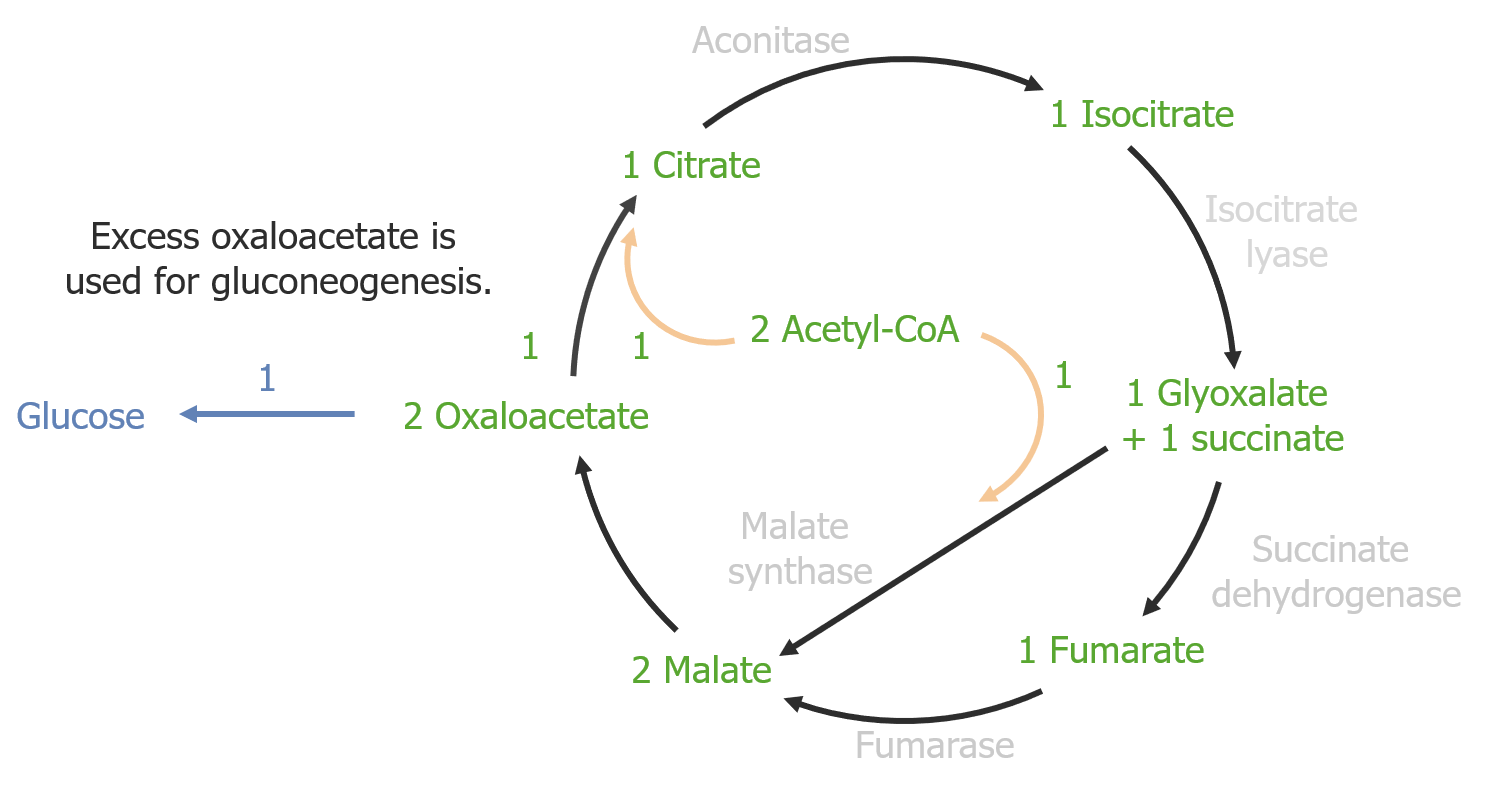
Reacciones

  1. La vía comienza con 2 moléculas de acetil-CoA.
  2. La citrato sintasa convierte 1 de las moléculas de acetil-CoA en EN Erythema nodosum is an immune-mediated panniculitis (inflammation of the subcutaneous fat) caused by a type IV (delayed-type) hypersensitivity reaction. It commonly manifests in young women as tender, erythematous nodules on the shins. Erythema Nodosum citrato.
  3. El citrato se convierte en EN Erythema nodosum is an immune-mediated panniculitis (inflammation of the subcutaneous fat) caused by a type IV (delayed-type) hypersensitivity reaction. It commonly manifests in young women as tender, erythematous nodules on the shins. Erythema Nodosum isocitrato por la enzima aconitasa.
  4. El isocitrato se convierte en EN Erythema nodosum is an immune-mediated panniculitis (inflammation of the subcutaneous fat) caused by a type IV (delayed-type) hypersensitivity reaction. It commonly manifests in young women as tender, erythematous nodules on the shins. Erythema Nodosum glioxilato y succinato.
  5. El succinato se convierte en EN Erythema nodosum is an immune-mediated panniculitis (inflammation of the subcutaneous fat) caused by a type IV (delayed-type) hypersensitivity reaction. It commonly manifests in young women as tender, erythematous nodules on the shins. Erythema Nodosum fumarato por la succinato deshidrogenasa.
  6. El siguiente paso implica la formación de 2 moléculas de malato:
    • 1 molécula de malato está formada por la combinación de acetil-CoA y glioxilato.
    • La 2da molécula está formada por la conversión de fumarato a malato en EN Erythema nodosum is an immune-mediated panniculitis (inflammation of the subcutaneous fat) caused by a type IV (delayed-type) hypersensitivity reaction. It commonly manifests in young women as tender, erythematous nodules on the shins. Erythema Nodosum presencia de fumarasa.
  7. La malato deshidrogenasa convierte 2 moléculas de malato en EN Erythema nodosum is an immune-mediated panniculitis (inflammation of the subcutaneous fat) caused by a type IV (delayed-type) hypersensitivity reaction. It commonly manifests in young women as tender, erythematous nodules on the shins. Erythema Nodosum 2 moléculas de oxaloacetato.
  8. 1 molécula de oxaloacetato se convierte en EN Erythema nodosum is an immune-mediated panniculitis (inflammation of the subcutaneous fat) caused by a type IV (delayed-type) hypersensitivity reaction. It commonly manifests in young women as tender, erythematous nodules on the shins. Erythema Nodosum citrato y 1 molécula de oxaloacetato se utiliza para la gluconeogénesis.
El ciclo del glioxilato

Figura que representa el ciclo del glioxilato

Imagen por Lecturio.

Enzimas clave en EN Erythema nodosum is an immune-mediated panniculitis (inflammation of the subcutaneous fat) caused by a type IV (delayed-type) hypersensitivity reaction. It commonly manifests in young women as tender, erythematous nodules on the shins. Erythema Nodosum el ciclo del glioxilato

Las 2 enzimas clave involucradas en EN Erythema nodosum is an immune-mediated panniculitis (inflammation of the subcutaneous fat) caused by a type IV (delayed-type) hypersensitivity reaction. It commonly manifests in young women as tender, erythematous nodules on the shins. Erythema Nodosum el ciclo del glioxilato producen 2 moléculas de malato, que a su vez producen 2 moléculas de oxalacetato. La molécula de oxalacetato sobrante se utiliza en EN Erythema nodosum is an immune-mediated panniculitis (inflammation of the subcutaneous fat) caused by a type IV (delayed-type) hypersensitivity reaction. It commonly manifests in young women as tender, erythematous nodules on the shins. Erythema Nodosum la gluconeogénesis para la producción de glucosa. Las 2 enzimas clave son:

  • Isocitrato liasa: convierte el isocitrato (que contiene 6 carbonos) en EN Erythema nodosum is an immune-mediated panniculitis (inflammation of the subcutaneous fat) caused by a type IV (delayed-type) hypersensitivity reaction. It commonly manifests in young women as tender, erythematous nodules on the shins. Erythema Nodosum succinato (que contiene 4 carbonos) y glioxilato
  • Malato sintasa: combina acetil-CoA y glioxilato para producir malato

Resumen del ciclo del glioxilato

  • Entrada: 4 carbonos en EN Erythema nodosum is an immune-mediated panniculitis (inflammation of the subcutaneous fat) caused by a type IV (delayed-type) hypersensitivity reaction. It commonly manifests in young women as tender, erythematous nodules on the shins. Erythema Nodosum forma de 2 moléculas de acetil-CoA
  • Resultado: cada vuelta del ciclo produce 1 NADH, 1 flavín adenín dinucleótido (FADH2) y 2 moléculas de oxaloacetato.
  • No libera CO2
  • Se producen 2 reacciones oxidativas.
  • Existe síntesis neta de glucosa (debido a la formación de una molécula extra de oxalacetato).

Producción de energía

  • Cada ciclo produce 1 molécula de FADH2 y 1 molécula de NADH.
  • Posteriormente, NADH produce 2,5 ATP y FADH2 produce 1,5 ATP para producir un total de 4 ATP.

Diferencias Clave con el Ciclo del Ácido Tricarboxílico

El ciclo del ácido tricarboxílico es el principal medio para generar energía en EN Erythema nodosum is an immune-mediated panniculitis (inflammation of the subcutaneous fat) caused by a type IV (delayed-type) hypersensitivity reaction. It commonly manifests in young women as tender, erythematous nodules on the shins. Erythema Nodosum el cuerpo.

  • Tanto los LOS Neisseria ciclos del ácido tricarboxílico como los LOS Neisseria de glioxilato utilizan acetil-CoA como sustratos iniciales. Los LOS Neisseria rendimientos de estos ciclos difieren:
    • En EN Erythema nodosum is an immune-mediated panniculitis (inflammation of the subcutaneous fat) caused by a type IV (delayed-type) hypersensitivity reaction. It commonly manifests in young women as tender, erythematous nodules on the shins. Erythema Nodosum el ciclo del ácido tricarboxílico, 1 molécula de NAD NAD+ A coenzyme composed of ribosylnicotinamide 5′-diphosphate coupled to adenosine 5′-phosphate by pyrophosphate linkage. It is found widely in nature and is involved in numerous enzymatic reactions in which it serves as an electron carrier by being alternately oxidized (NAD+) and reduced (NADH). Pentose Phosphate Pathway+ se reduce para producir CO2.
    • El succinato se produce en EN Erythema nodosum is an immune-mediated panniculitis (inflammation of the subcutaneous fat) caused by a type IV (delayed-type) hypersensitivity reaction. It commonly manifests in young women as tender, erythematous nodules on the shins. Erythema Nodosum el ciclo del glioxilato y se utiliza para la síntesis de carbohidratos.
  • Los LOS Neisseria ciclos ocurren en EN Erythema nodosum is an immune-mediated panniculitis (inflammation of the subcutaneous fat) caused by a type IV (delayed-type) hypersensitivity reaction. It commonly manifests in young women as tender, erythematous nodules on the shins. Erythema Nodosum diferentes organismos:
    • El ciclo del glioxilato ocurre predominantemente en EN Erythema nodosum is an immune-mediated panniculitis (inflammation of the subcutaneous fat) caused by a type IV (delayed-type) hypersensitivity reaction. It commonly manifests in young women as tender, erythematous nodules on the shins. Erythema Nodosum plantas y hongos. Existe evidencia emergente de que los LOS Neisseria vertebrados tienen las enzimas necesarias para que ocurra el ciclo del glioxilato.
    • El ciclo del ácido tricarboxílico ocurre en EN Erythema nodosum is an immune-mediated panniculitis (inflammation of the subcutaneous fat) caused by a type IV (delayed-type) hypersensitivity reaction. It commonly manifests in young women as tender, erythematous nodules on the shins. Erythema Nodosum animales.
  • Los LOS Neisseria ciclos del ácido tricarboxílico y glioxilato tienen 5 enzimas en EN Erythema nodosum is an immune-mediated panniculitis (inflammation of the subcutaneous fat) caused by a type IV (delayed-type) hypersensitivity reaction. It commonly manifests in young women as tender, erythematous nodules on the shins. Erythema Nodosum común. Existen algunas diferencias importantes entre los LOS Neisseria pasos, que dan como resultado diferentes productos:
    • La isocitrato liasa en EN Erythema nodosum is an immune-mediated panniculitis (inflammation of the subcutaneous fat) caused by a type IV (delayed-type) hypersensitivity reaction. It commonly manifests in young women as tender, erythematous nodules on the shins. Erythema Nodosum el ciclo del glioxilato convierte el isocitrato en EN Erythema nodosum is an immune-mediated panniculitis (inflammation of the subcutaneous fat) caused by a type IV (delayed-type) hypersensitivity reaction. It commonly manifests in young women as tender, erythematous nodules on the shins. Erythema Nodosum glioxilato y succinato.
    • Las moléculas sufren descarboxilación en EN Erythema nodosum is an immune-mediated panniculitis (inflammation of the subcutaneous fat) caused by a type IV (delayed-type) hypersensitivity reaction. It commonly manifests in young women as tender, erythematous nodules on the shins. Erythema Nodosum el ciclo del ácido tricarboxílico. El ciclo del glioxilato no implica ninguna reacción de descarboxilación; por lo tanto, los LOS Neisseria productos del ciclo pueden utilizarse para la síntesis de carbohidratos.
  • Se produce más energía en EN Erythema nodosum is an immune-mediated panniculitis (inflammation of the subcutaneous fat) caused by a type IV (delayed-type) hypersensitivity reaction. It commonly manifests in young women as tender, erythematous nodules on the shins. Erythema Nodosum el ciclo del ácido tricarboxílico que en EN Erythema nodosum is an immune-mediated panniculitis (inflammation of the subcutaneous fat) caused by a type IV (delayed-type) hypersensitivity reaction. It commonly manifests in young women as tender, erythematous nodules on the shins. Erythema Nodosum el ciclo del glioxilato.
Tabla: Diferencias clave entre el ciclo del glioxilato y el ciclo del ácido tricarboxílico
Ciclo de glioxilato Ciclo del ácido tricarboxílico
Sitio Glioxisomas de plantas, hongos y posiblemente vertebrados Mitocondrias animales
Número de carbonos Entrada de 4 carbonos Entrada de 2 carbonos
Moléculas de CO2 liberadas Ninguna 2
Número de reacciones oxidativas 2 4
Energía producida por ciclo
  • 1 NADH
  • 1 FADH2
  • 3 NADH
  • 1 FADH2
  • 1 GTP
Síntesis neta de glucosa Síntesis neta de glucosa debido a la formación de 1 molécula extra de oxalacetato Sin síntesis neta de glucosa
FADH2: flavín adenín dinucleótido
GTP: guanosin trifosfato

Relevancia Clínica

Se han identificado genes Genes A category of nucleic acid sequences that function as units of heredity and which code for the basic instructions for the development, reproduction, and maintenance of organisms. DNA Types and Structure del ciclo del glioxilato en EN Erythema nodosum is an immune-mediated panniculitis (inflammation of the subcutaneous fat) caused by a type IV (delayed-type) hypersensitivity reaction. It commonly manifests in young women as tender, erythematous nodules on the shins. Erythema Nodosum 2 organismos capaces de sobrevivir en EN Erythema nodosum is an immune-mediated panniculitis (inflammation of the subcutaneous fat) caused by a type IV (delayed-type) hypersensitivity reaction. It commonly manifests in young women as tender, erythematous nodules on the shins. Erythema Nodosum los LOS Neisseria macrófagos: la bacteria Bacteria Bacteria are prokaryotic single-celled microorganisms that are metabolically active and divide by binary fission. Some of these organisms play a significant role in the pathogenesis of diseases. Bacteriology M. tuberculosis Tuberculosis Tuberculosis (TB) is an infectious disease caused by Mycobacterium tuberculosis complex bacteria. The bacteria usually attack the lungs but can also damage other parts of the body. Approximately 30% of people around the world are infected with this pathogen, with the majority harboring a latent infection. Tuberculosis spreads through the air when a person with active pulmonary infection coughs or sneezes. Tuberculosis y el hongo C. albicans. Las enzimas necesarias para que progrese el ciclo del glioxilato no están presentes en EN Erythema nodosum is an immune-mediated panniculitis (inflammation of the subcutaneous fat) caused by a type IV (delayed-type) hypersensitivity reaction. It commonly manifests in young women as tender, erythematous nodules on the shins. Erythema Nodosum los LOS Neisseria seres humanos y, por lo tanto, son objetivos ideales para los LOS Neisseria nuevos antibióticos.

  • C. albicans: un patógeno oportunista que causa candidiasis Candidiasis Candida is a genus of dimorphic, opportunistic fungi. Candida albicans is part of the normal human flora and is the most common cause of candidiasis. The clinical presentation varies and can include localized mucocutaneous infections (e.g., oropharyngeal, esophageal, intertriginous, and vulvovaginal candidiasis) and invasive disease (e.g., candidemia, intraabdominal abscess, pericarditis, and meningitis). Candida/Candidiasis en EN Erythema nodosum is an immune-mediated panniculitis (inflammation of the subcutaneous fat) caused by a type IV (delayed-type) hypersensitivity reaction. It commonly manifests in young women as tender, erythematous nodules on the shins. Erythema Nodosum humanos. El ciclo del glioxilato permite que C. albicans sobreviva en EN Erythema nodosum is an immune-mediated panniculitis (inflammation of the subcutaneous fat) caused by a type IV (delayed-type) hypersensitivity reaction. It commonly manifests in young women as tender, erythematous nodules on the shins. Erythema Nodosum ambientes privados de nutrientes; por lo tanto, la enzima isocitrato liasa ha HA Hemolytic anemia (HA) is the term given to a large group of anemias that are caused by the premature destruction/hemolysis of circulating red blood cells (RBCs). Hemolysis can occur within (intravascular hemolysis) or outside the blood vessels (extravascular hemolysis). Hemolytic Anemia sido el objetivo para lograr efectos antifúngicos. Se encontró que tres compuestos (ácido cafeico, ácido rosmarínico y apigenina) tienen actividad antifúngica contra C. albicans cuando se probaron en EN Erythema nodosum is an immune-mediated panniculitis (inflammation of the subcutaneous fat) caused by a type IV (delayed-type) hypersensitivity reaction. It commonly manifests in young women as tender, erythematous nodules on the shins. Erythema Nodosum condiciones de agotamiento de glucosa.
  • M. tuberculosis Tuberculosis Tuberculosis (TB) is an infectious disease caused by Mycobacterium tuberculosis complex bacteria. The bacteria usually attack the lungs but can also damage other parts of the body. Approximately 30% of people around the world are infected with this pathogen, with the majority harboring a latent infection. Tuberculosis spreads through the air when a person with active pulmonary infection coughs or sneezes. Tuberculosis: un bacilo intracelular facultativo, resistente a los LOS Neisseria ácidos, que causa la infección respiratoria conocida como tuberculosis Tuberculosis Tuberculosis (TB) is an infectious disease caused by Mycobacterium tuberculosis complex bacteria. The bacteria usually attack the lungs but can also damage other parts of the body. Approximately 30% of people around the world are infected with this pathogen, with the majority harboring a latent infection. Tuberculosis spreads through the air when a person with active pulmonary infection coughs or sneezes. Tuberculosis. Se está estudiando el ciclo del glioxilato en EN Erythema nodosum is an immune-mediated panniculitis (inflammation of the subcutaneous fat) caused by a type IV (delayed-type) hypersensitivity reaction. It commonly manifests in young women as tender, erythematous nodules on the shins. Erythema Nodosum las micobacterias para desarrollar tratamientos potenciales para la tuberculosis Tuberculosis Tuberculosis (TB) is an infectious disease caused by Mycobacterium tuberculosis complex bacteria. The bacteria usually attack the lungs but can also damage other parts of the body. Approximately 30% of people around the world are infected with this pathogen, with the majority harboring a latent infection. Tuberculosis spreads through the air when a person with active pulmonary infection coughs or sneezes. Tuberculosis.

Referencias

  1. Berg, J. M., Tymoczko, J. L., Gatto, G. J., & Stryer, L. (2022). Biochemistry (9th ed.). W.H. Freeman and Company.
  2. Chew, S. Y., Ho, J. Y., Lim, M. H., & Ng, K. P. (2019). The glyoxylate cycle and alternative carbon metabolism as metabolic adaptation strategies of Candida glabrata: Perspectives from Candida albicans and Saccharomyces cerevisiae. Journal of Biomedical Science, 26(1), Article 52. https://doi.org/10.1186/s12929-019-0546-5
  3. Krishnamurthy, R., & Liotta, C. L. (2023). The potential of glyoxylate as a prebiotic source molecule and a reactant in protometabolic pathways—The glyoxylose reaction. Chem, 9(4), 784–797. https://doi.org/10.1016/j.chempr.2023.03.007
  4. Nelson, D. L., & Cox, M. M. (2021). Lehninger principles of biochemistry (8th ed.). W.H. Freeman and Company.
  5. Son, H. M., Lee, J. Y., Kim, J. H., & Park, S. Y. (2025). Review on the chemical properties and biological activities of glyoxylic acid and alkyl glyoxylate acetal form. Yakhak Hoeji, 69(1), 16–21. https://doi.org/10.17480/psk.2025.69.1.16

¡Crea tu cuenta gratis o inicia una sesión para seguir leyendo!

Regístrate ahora y obtén acceso gratuito a Lecturio con páginas de concepto, videos médicos y cuestionarios para tu educación médica.

User Reviews

Que tengas una sesión de estudio alegre y navideña 🎁 Ahorra 50% en todos los planes >>

Details