


Tipos e Estrutura de DNA

A molécula de DNA DNA A deoxyribonucleotide polymer that is the primary genetic material of all cells. Eukaryotic and prokaryotic organisms normally contain DNA in a double-stranded state, yet several important biological processes transiently involve single-stranded regions. DNA, which consists of a polysugar-phosphate backbone possessing projections of purines (adenine and guanine) and pyrimidines (thymine and cytosine), forms a double helix that is held together by hydrogen bonds between these purines and pyrimidines (adenine to thymine and guanine to cytosine). DNA Types and Structure é o repositório da informação genética hereditária. Nos humanos, o DNA DNA A deoxyribonucleotide polymer that is the primary genetic material of all cells. Eukaryotic and prokaryotic organisms normally contain DNA in a double-stranded state, yet several important biological processes transiently involve single-stranded regions. DNA, which consists of a polysugar-phosphate backbone possessing projections of purines (adenine and guanine) and pyrimidines (thymine and cytosine), forms a double helix that is held together by hydrogen bonds between these purines and pyrimidines (adenine to thymine and guanine to cytosine). DNA Types and Structure está contido em 23 pares de cromossomos dentro do núcleo. A molécula fornece o modelo básico para a replicação da informação genética, transcrição de RNA RNA A polynucleotide consisting essentially of chains with a repeating backbone of phosphate and ribose units to which nitrogenous bases are attached. RNA is unique among biological macromolecules in that it can encode genetic information, serve as an abundant structural component of cells, and also possesses catalytic activity. RNA Types and Structure e biossíntese de proteínas para promover a função e a sobrevivência celular.

Last updated: Dec 15, 2025

Editorial responsibility: Stanley Oiseth, Lindsay Jones, Evelin Maza

Estrutura do DNA

O DNA DNA A deoxyribonucleotide polymer that is the primary genetic material of all cells. Eukaryotic and prokaryotic organisms normally contain DNA in a double-stranded state, yet several important biological processes transiently involve single-stranded regions. DNA, which consists of a polysugar-phosphate backbone possessing projections of purines (adenine and guanine) and pyrimidines (thymine and cytosine), forms a double helix that is held together by hydrogen bonds between these purines and pyrimidines (adenine to thymine and guanine to cytosine). DNA Types and Structure material hereditário é um polímero de nucleotídeo de fita dupla:
  • Organização do DNA DNA A deoxyribonucleotide polymer that is the primary genetic material of all cells. Eukaryotic and prokaryotic organisms normally contain DNA in a double-stranded state, yet several important biological processes transiently involve single-stranded regions. DNA, which consists of a polysugar-phosphate backbone possessing projections of purines (adenine and guanine) and pyrimidines (thymine and cytosine), forms a double helix that is held together by hydrogen bonds between these purines and pyrimidines (adenine to thymine and guanine to cytosine). DNA Types and Structure:
    • Nas células eucarióticas, o DNA DNA A deoxyribonucleotide polymer that is the primary genetic material of all cells. Eukaryotic and prokaryotic organisms normally contain DNA in a double-stranded state, yet several important biological processes transiently involve single-stranded regions. DNA, which consists of a polysugar-phosphate backbone possessing projections of purines (adenine and guanine) and pyrimidines (thymine and cytosine), forms a double helix that is held together by hydrogen bonds between these purines and pyrimidines (adenine to thymine and guanine to cytosine). DNA Types and Structure pode ser encontrado no núcleo da célula e nas mitocôndrias :
      • O cromossomo é a unidade organizadora do DNA DNA A deoxyribonucleotide polymer that is the primary genetic material of all cells. Eukaryotic and prokaryotic organisms normally contain DNA in a double-stranded state, yet several important biological processes transiently involve single-stranded regions. DNA, which consists of a polysugar-phosphate backbone possessing projections of purines (adenine and guanine) and pyrimidines (thymine and cytosine), forms a double helix that is held together by hydrogen bonds between these purines and pyrimidines (adenine to thymine and guanine to cytosine). DNA Types and Structure.
      • Em humanos: 46 cromossomos homólogos (23 pares)
      • Informações de codificação contidas em segmentos de cromossomos chamados genes Genes A category of nucleic acid sequences that function as units of heredity and which code for the basic instructions for the development, reproduction, and maintenance of organisms. DNA Types and Structure
    • Nos procariontes, o DNA DNA A deoxyribonucleotide polymer that is the primary genetic material of all cells. Eukaryotic and prokaryotic organisms normally contain DNA in a double-stranded state, yet several important biological processes transiently involve single-stranded regions. DNA, which consists of a polysugar-phosphate backbone possessing projections of purines (adenine and guanine) and pyrimidines (thymine and cytosine), forms a double helix that is held together by hydrogen bonds between these purines and pyrimidines (adenine to thymine and guanine to cytosine). DNA Types and Structure está no citoplasma como um plasmídeo ou cromossomo.
  • Estrutura do DNA DNA A deoxyribonucleotide polymer that is the primary genetic material of all cells. Eukaryotic and prokaryotic organisms normally contain DNA in a double-stranded state, yet several important biological processes transiently involve single-stranded regions. DNA, which consists of a polysugar-phosphate backbone possessing projections of purines (adenine and guanine) and pyrimidines (thymine and cytosine), forms a double helix that is held together by hydrogen bonds between these purines and pyrimidines (adenine to thymine and guanine to cytosine). DNA Types and Structure:
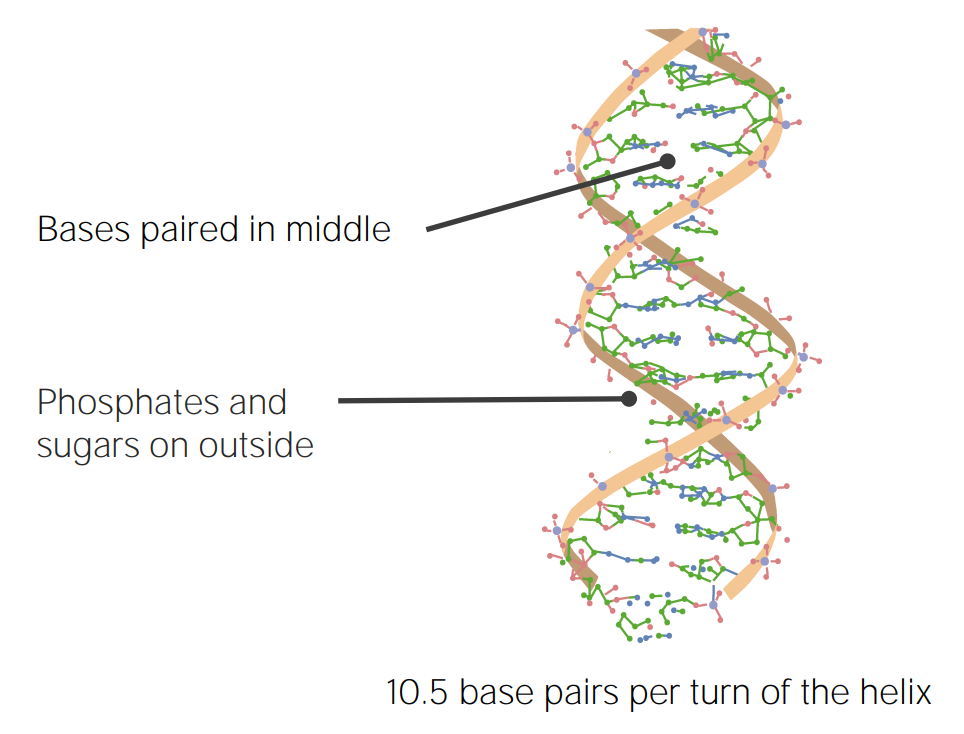
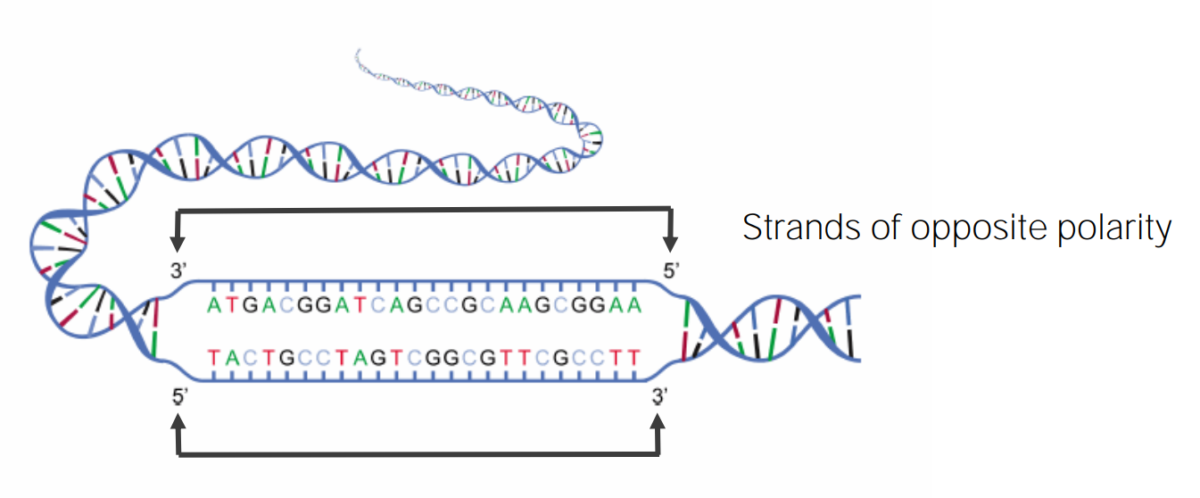
    • 2 fitas antiparalelas (polaridade oposta) formando uma dupla hélice: 10,5 pares de bases Bases Usually a hydroxide of lithium, sodium, potassium, rubidium or cesium, but also the carbonates of these metals, ammonia, and the amines. Acid-Base Balance por volta da hélice
    • Esqueleto de aç
    • ucar-osfato carregado negativamente
    • As cadeias complementares mantêm-se unidas por:
      • Pontes de hidrogénio
      • Forças de van der Waals
      • Interações hidrofóbicas entre os pares de bases Bases Usually a hydroxide of lithium, sodium, potassium, rubidium or cesium, but also the carbonates of these metals, ammonia, and the amines. Acid-Base Balance
    • Extremidade livre de carbono 5’–3’em cada cadeia
    • Descrito por James Watson e Francis Crick (vencedores do Prémio Nobel da Fisiologia e Medicina em 1962)
    • O trabalho de Rosalind Franklin com cristalografia de raio-X foi essencial para a descoberta da estrutura do DNA DNA A deoxyribonucleotide polymer that is the primary genetic material of all cells. Eukaryotic and prokaryotic organisms normally contain DNA in a double-stranded state, yet several important biological processes transiently involve single-stranded regions. DNA, which consists of a polysugar-phosphate backbone possessing projections of purines (adenine and guanine) and pyrimidines (thymine and cytosine), forms a double helix that is held together by hydrogen bonds between these purines and pyrimidines (adenine to thymine and guanine to cytosine). DNA Types and Structure.
  • Os nucleotídeos são os monômeros que compõem o DNA DNA A deoxyribonucleotide polymer that is the primary genetic material of all cells. Eukaryotic and prokaryotic organisms normally contain DNA in a double-stranded state, yet several important biological processes transiently involve single-stranded regions. DNA, which consists of a polysugar-phosphate backbone possessing projections of purines (adenine and guanine) and pyrimidines (thymine and cytosine), forms a double helix that is held together by hydrogen bonds between these purines and pyrimidines (adenine to thymine and guanine to cytosine). DNA Types and Structure:
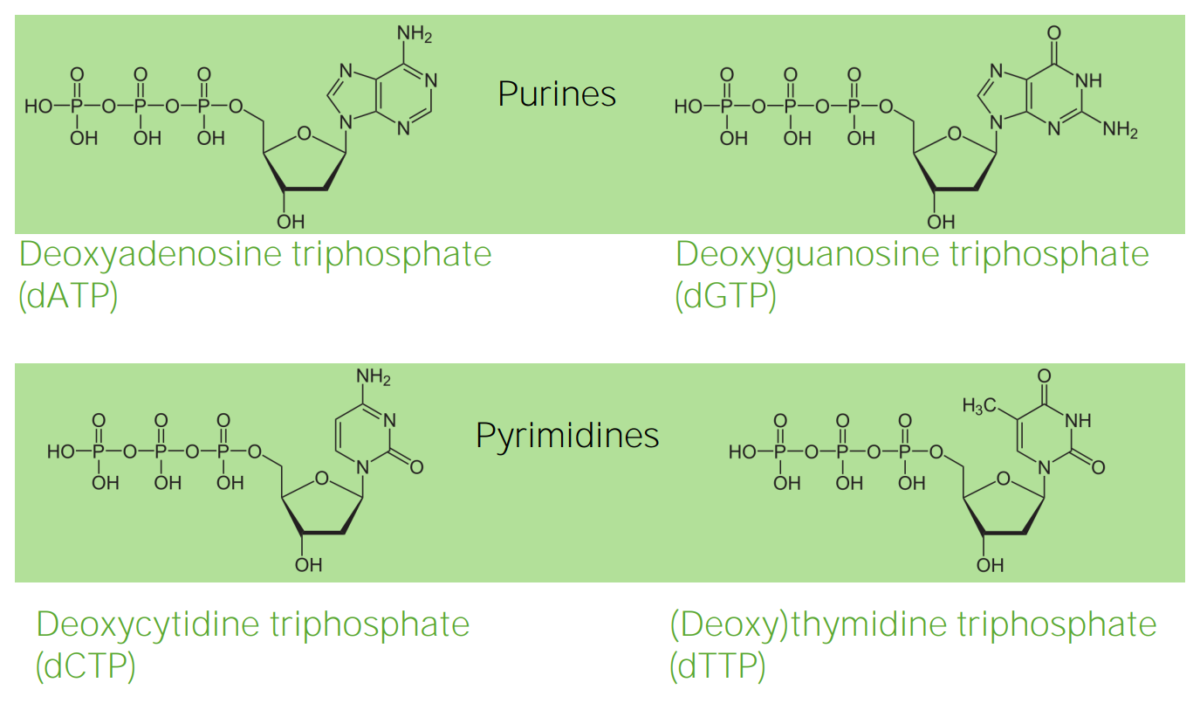
    • Nucleotídeos no DNA DNA A deoxyribonucleotide polymer that is the primary genetic material of all cells. Eukaryotic and prokaryotic organisms normally contain DNA in a double-stranded state, yet several important biological processes transiently involve single-stranded regions. DNA, which consists of a polysugar-phosphate backbone possessing projections of purines (adenine and guanine) and pyrimidines (thymine and cytosine), forms a double helix that is held together by hydrogen bonds between these purines and pyrimidines (adenine to thymine and guanine to cytosine). DNA Types and Structure (desoxirribonucleotídeos):
      • Trifosfato de desoxiadenosina (dATP)
      • Trifosfato de desoxiguanosina (dGTP)
      • Trifosfato de desoxicitidina (dCTP)
      • Trifosfato de desoxitimidina (dTTP)
    • Os nucleotídeos estão ligados através de ligações fosfodiéster 3′-5′:
      • A energia para a síntese vem da liberação de 2 fosfatos (dATP → desoxiadenosina monofosfato (dAMP)).
      • A síntese ocorre na direção 5’–3”.
      • Purinas emparelham com pirimidinas:
        • Adenina (purina) ↔ timina (pirimidina)
        • Guanina (purina) ↔ citosina (pirimidina)

Organização e Embalagem de DNA no Núcleo Celular

  • No núcleo, o DNA DNA A deoxyribonucleotide polymer that is the primary genetic material of all cells. Eukaryotic and prokaryotic organisms normally contain DNA in a double-stranded state, yet several important biological processes transiently involve single-stranded regions. DNA, which consists of a polysugar-phosphate backbone possessing projections of purines (adenine and guanine) and pyrimidines (thymine and cytosine), forms a double helix that is held together by hydrogen bonds between these purines and pyrimidines (adenine to thymine and guanine to cytosine). DNA Types and Structure é condensado em cromossomos por proteínas nucléicas.
  • Ordem de condensação do DNA DNA A deoxyribonucleotide polymer that is the primary genetic material of all cells. Eukaryotic and prokaryotic organisms normally contain DNA in a double-stranded state, yet several important biological processes transiently involve single-stranded regions. DNA, which consists of a polysugar-phosphate backbone possessing projections of purines (adenine and guanine) and pyrimidines (thymine and cytosine), forms a double helix that is held together by hydrogen bonds between these purines and pyrimidines (adenine to thymine and guanine to cytosine). DNA Types and Structure: DNA DNA A deoxyribonucleotide polymer that is the primary genetic material of all cells. Eukaryotic and prokaryotic organisms normally contain DNA in a double-stranded state, yet several important biological processes transiently involve single-stranded regions. DNA, which consists of a polysugar-phosphate backbone possessing projections of purines (adenine and guanine) and pyrimidines (thymine and cytosine), forms a double helix that is held together by hydrogen bonds between these purines and pyrimidines (adenine to thymine and guanine to cytosine). DNA Types and Structure de fita dupla (dsDNA) → nucleossomos → fita solenóide → alças de cromatina → cromossomos
    • O dsDNA carregado negativamente é enrolado em octâmeros de histonas carregados positivamente para formar nucleossomos.
    • As histonas sofrem modificações, que afetam o acesso ao DNA DNA A deoxyribonucleotide polymer that is the primary genetic material of all cells. Eukaryotic and prokaryotic organisms normally contain DNA in a double-stranded state, yet several important biological processes transiently involve single-stranded regions. DNA, which consists of a polysugar-phosphate backbone possessing projections of purines (adenine and guanine) and pyrimidines (thymine and cytosine), forms a double helix that is held together by hydrogen bonds between these purines and pyrimidines (adenine to thymine and guanine to cytosine). DNA Types and Structure e, portanto, a transcrição (TX):
      • Acetilação (aumenta TX)
      • Metilação (aumenta ou diminui TX, epigenética → hereditária)
      • Fosforilação (aumenta ou diminui TX)
      • Ubiquitilação
      • ADP-ribosilação
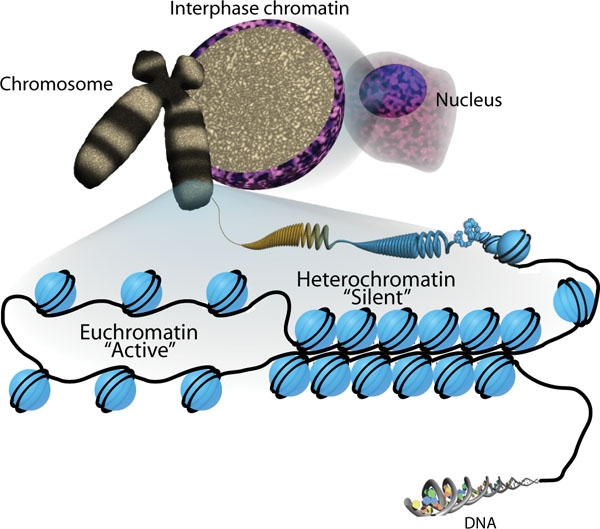
  • Formas de cromatina:
    • Eucromatina (forma descondensada): transcricionalmente ativa
    • Heterocromatina (forma condensada): transcricionalmente inativa
Embalagem de DNA e os dois estados da cromatina

Embalagem do DNA e os 2 estados da cromatina:
Eucromatina (ativa) onde o DNA está sendo replicado ou transcrito; e heterocromatina (silenciosa), onde o DNA não está sendo replicado ou transcrito.

Imagem: “The basic unit of chromatin organization is the nucleosome, which comprises 147 bp of DNA wrapped ar”” por Sha, K. e Boyer, LA Licença: CC BY 3.0

DNA Mitocondrial

  • O DNA DNA A deoxyribonucleotide polymer that is the primary genetic material of all cells. Eukaryotic and prokaryotic organisms normally contain DNA in a double-stranded state, yet several important biological processes transiently involve single-stranded regions. DNA, which consists of a polysugar-phosphate backbone possessing projections of purines (adenine and guanine) and pyrimidines (thymine and cytosine), forms a double helix that is held together by hydrogen bonds between these purines and pyrimidines (adenine to thymine and guanine to cytosine). DNA Types and Structure mitocondrial ( mtDNA mtDNA Double-stranded DNA of mitochondria. In eukaryotes, the mitochondrial genome is circular and codes for ribosomal rnas, transfer rnas, and about 10 proteins. DNA Types and Structure) representa 1% do DNA DNA A deoxyribonucleotide polymer that is the primary genetic material of all cells. Eukaryotic and prokaryotic organisms normally contain DNA in a double-stranded state, yet several important biological processes transiently involve single-stranded regions. DNA, which consists of a polysugar-phosphate backbone possessing projections of purines (adenine and guanine) and pyrimidines (thymine and cytosine), forms a double helix that is held together by hydrogen bonds between these purines and pyrimidines (adenine to thymine and guanine to cytosine). DNA Types and Structure celular.
  • Apenas herdado da mãe (herança não mendeliana)
  • Características do mtDNA mtDNA Double-stranded DNA of mitochondria. In eukaryotes, the mitochondrial genome is circular and codes for ribosomal rnas, transfer rnas, and about 10 proteins. DNA Types and Structure humano:
    • Circular, de fita dupla, composta por fitas pesadas (H) e leves (L)
    • Contém 16.569 pares de bases Bases Usually a hydroxide of lithium, sodium, potassium, rubidium or cesium, but also the carbonates of these metals, ammonia, and the amines. Acid-Base Balance
    • Codifica RNAs ribossômicos, tRNAs e subunidades de proteínas necessárias para a fosforilação oxidativa (produção de ATP)
    • Alta taxa de mutação (5 a 10 vezes maior que a do DNA DNA A deoxyribonucleotide polymer that is the primary genetic material of all cells. Eukaryotic and prokaryotic organisms normally contain DNA in a double-stranded state, yet several important biological processes transiently involve single-stranded regions. DNA, which consists of a polysugar-phosphate backbone possessing projections of purines (adenine and guanine) and pyrimidines (thymine and cytosine), forms a double helix that is held together by hydrogen bonds between these purines and pyrimidines (adenine to thymine and guanine to cytosine). DNA Types and Structure nuclear)
  • A presença de mtDNA mtDNA Double-stranded DNA of mitochondria. In eukaryotes, the mitochondrial genome is circular and codes for ribosomal rnas, transfer rnas, and about 10 proteins. DNA Types and Structure levou à teoria da endossimbiose:
    • Mitocôndria
    • Outrora microorganismos procariotas livres
    • Endocitados por células hospedeiras, tornando-se organelos
    • DNA DNA A deoxyribonucleotide polymer that is the primary genetic material of all cells. Eukaryotic and prokaryotic organisms normally contain DNA in a double-stranded state, yet several important biological processes transiently involve single-stranded regions. DNA, which consists of a polysugar-phosphate backbone possessing projections of purines (adenine and guanine) and pyrimidines (thymine and cytosine), forms a double helix that is held together by hydrogen bonds between these purines and pyrimidines (adenine to thymine and guanine to cytosine). DNA Types and Structure circular
    • Replicação por fissão binária

Relevância Clínica

  • Miopatias mitocondriais: causadas por doenças mitocondriais onde as fibras musculares “vermelhos irregulares” são observadas por biópsia. A miopatia assemelha-se ao acúmulo de glicogênio e lipídios neutros, que podem estar correlacionados com uma reatividade aumentada para succinato desidrogenase e uma reatividade diminuída para citocromo c oxidase Oxidase Neisseria. Ambas as mutações do DNA DNA A deoxyribonucleotide polymer that is the primary genetic material of all cells. Eukaryotic and prokaryotic organisms normally contain DNA in a double-stranded state, yet several important biological processes transiently involve single-stranded regions. DNA, which consists of a polysugar-phosphate backbone possessing projections of purines (adenine and guanine) and pyrimidines (thymine and cytosine), forms a double helix that is held together by hydrogen bonds between these purines and pyrimidines (adenine to thymine and guanine to cytosine). DNA Types and Structure mitocondrial e nuclear estão subjacentes à miopatia mitocondrial.
  • Mutações genéticas: erros no DNA DNA A deoxyribonucleotide polymer that is the primary genetic material of all cells. Eukaryotic and prokaryotic organisms normally contain DNA in a double-stranded state, yet several important biological processes transiently involve single-stranded regions. DNA, which consists of a polysugar-phosphate backbone possessing projections of purines (adenine and guanine) and pyrimidines (thymine and cytosine), forms a double helix that is held together by hydrogen bonds between these purines and pyrimidines (adenine to thymine and guanine to cytosine). DNA Types and Structure que às vezes causam função anormal da proteína. Existem vários tipos de categorias e subcategorias de mutações, incluindo mutações cromossômicas, pontuais, de deslocamento de quadro e de expansão. As mutações pontuais incluem mutações missense, nonsense, simples e silenciosas.

Referências

  1. Alberts, B., Heald, R., Johnson, A., Morgan, D., Raff, M., Roberts, K., Walter, P., & Wilson, J. (2022). Molecular biology of the cell (7th ed.). W.W. Norton & Company.
  2. Huang, R., & Zhou, P.-K. (2021). DNA damage repair: Historical perspectives, mechanistic pathways and clinical translation for targeted cancer therapy. Signal Transduction and Targeted Therapy, 6(1), 1–35. https://doi.org/10.1038/s41392-021-00648-7
  3. Jumper, J., Evans, R., Pritzel, A. et al. Highly accurate protein structure prediction with AlphaFold. Nature 596, 583–589 (2021). https://doi.org/10.1038/s41586-021-03819-2
  4. Kopinski, P. K., Park, H. J., Tainer, J. A., & Kim, S. H. (2021). Mitochondrial DNA variation and cancer. Nature Reviews Cancer, 21(7), 431–445. https://doi.org/10.1038/s41568-021-00358-w
  5. Lien, D. (2025). The role of DNA nanotechnology in medical sensing. Analytical Methods, 17(5), 1148–1159. https://doi.org/10.1039/D4AY01803F
  6. McKie, S. J., Neuman, K. C., & Maxwell, A. (2021). DNA topoisomerases: Advances in understanding of cellular roles and multi-protein complexes via structure–function analysis. BioEssays, 43(4), 2000286. https://doi.org/10.1002/bies.202000286
  7. Petermann, E., González-Buendía, M., & Cortez, D. (2022). Sources, resolution and physiological relevance of R-loops and RNA–DNA hybrids. Nature Reviews Molecular Cell Biology, 23(8), 521–540. https://doi.org/10.1038/s41580-022-00474-x
  8. Stoccoro, A., & Coppedè, F. (2021). Mitochondrial DNA methylation and human diseases. International Journal of Molecular Sciences, 22(9), 4594. https://doi.org/10.3390/ijms22094594
  9. Tunyasuvunakool, K., Adler, J., Wu, Z., Green, T., Zielinski, M., Žídek, A., … & Hassabis, D. (2021). Highly accurate protein structure prediction for the human proteome. Nature, 596(7873), 590–596. https://doi.org/10.1038/s41586-021-03828-1
  10. Wang, G., & Vasquez, K. M. (2023). Dynamic alternative DNA structures in biology and disease. Nature Reviews Genetics, 24(4), 211–234. https://doi.org/10.1038/s41576-022-00539-9
  11. Zhang, X., Li, Y., & Zhao, Q. (2022). Identification of the new type of G-quadruplex with multiple vacant sites in human telomeric DNA. CCS Chemistry, 4(9), 3023–3035. https://doi.org/10.31635/ccschem.021.202101436

Crie sua conta gratuita ou faça login para continuar lendo!

Cadastre-se agora e tenha acesso grátis ao Lecturio, com páginas de conceitos, vídeos de medicina e questões para sua educação médica.

Aprende mais com a Lecturio:

Multiple devices displaying human anatomy and health education content.

Complementa o teu estudo da faculdade com o companheiro de estudo tudo-em-um da Lecturio, através de métodos de ensino baseados em evidência.

Estuda onde quiseres

Two iPhones display medical education apps, one showing anatomy, the other Bookmatcher.

A Lecturio Medical complementa o teu estudo através de métodos de ensino baseados em evidência, vídeos de palestras, perguntas e muito mais – tudo combinado num só lugar e fácil de usar.

User Reviews

Have a holly, jolly study session 🎁 Save 50% on all plans now >>

Que tengas una sesión de estudio alegre y navideña 🎁 Ahorra 50% en todos los planes >>

Details