


Retinopatia Hipertensiva

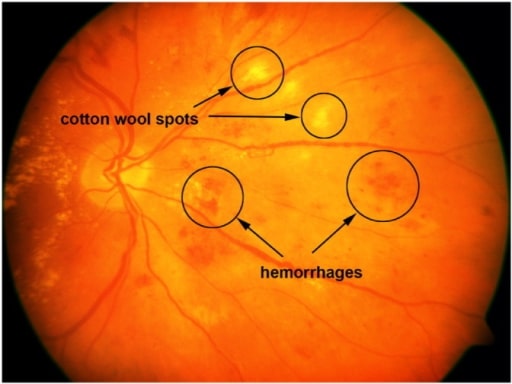
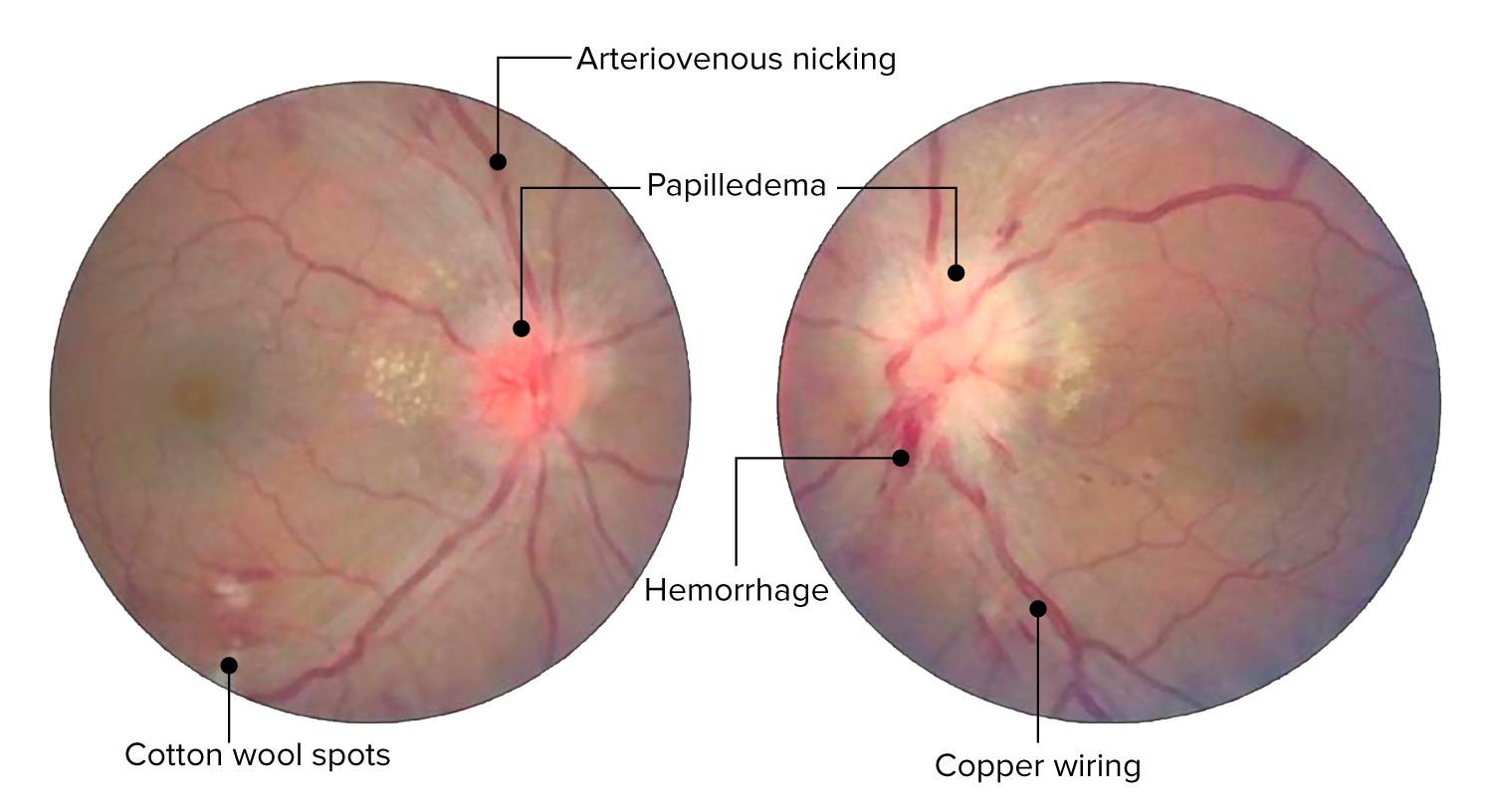
A hipertensão pode resultar em várias complicações a nível ocular, das quais a retinopatia é a situação clínica mais MAIS Androgen Insensitivity Syndrome comum. Retinopatia hipertensiva consiste no desenvolvimento de alterações vasculares na retina Retina The ten-layered nervous tissue membrane of the eye. It is continuous with the optic nerve and receives images of external objects and transmits visual impulses to the brain. Its outer surface is in contact with the choroid and the inner surface with the vitreous body. The outermost layer is pigmented, whereas the inner nine layers are transparent. Eye: Anatomy como resultado direto da hipertensão arterial. Na hipertensão arterial aguda, a resposta primária das arteríolas da retina Retina The ten-layered nervous tissue membrane of the eye. It is continuous with the optic nerve and receives images of external objects and transmits visual impulses to the brain. Its outer surface is in contact with the choroid and the inner surface with the vitreous body. The outermost layer is pigmented, whereas the inner nine layers are transparent. Eye: Anatomy é a vasoconstrição. Na hipertensão arterial crónica, a arteriosclerose afeta a vasculatura da retina Retina The ten-layered nervous tissue membrane of the eye. It is continuous with the optic nerve and receives images of external objects and transmits visual impulses to the brain. Its outer surface is in contact with the choroid and the inner surface with the vitreous body. The outermost layer is pigmented, whereas the inner nine layers are transparent. Eye: Anatomy. Ocorrem lesões na parede endotelial e surgem vários sinais da doença, incluindo a presença de hemorragias, manchas algodonosas e exsudados. Nos casos de hipertensão arterial descontrolada, pode ser observado papiledema. O tratamento é direcionado para o controlo da hipertensão arterial. Os doentes com retinopatia hipertensiva grave têm um risco aumentado de doença arterial coronária e acidente vascular cerebral; portanto, a deteção e o tratamento da hipertensão arterial é fundamental.

Last updated: Dec 15, 2025

Editorial responsibility: Stanley Oiseth, Lindsay Jones, Evelin Maza

Descrição Geral

Definição

Retinopatia hipertensiva:

  • Caracterizada por alterações e lesões da microvasculatura da retina Retina The ten-layered nervous tissue membrane of the eye. It is continuous with the optic nerve and receives images of external objects and transmits visual impulses to the brain. Its outer surface is in contact with the choroid and the inner surface with the vitreous body. The outermost layer is pigmented, whereas the inner nine layers are transparent. Eye: Anatomy resultantes de hipertensão arterial.
  • Resultado de aumento agudo da pressão arterial e/ou hipertensão arterial crónica

Hipertensão arterial:

Níveis de pressão arterial Pressão arterial sistólica Pressão arterial diastólica
Tensão arterial elevada 120-129 mm Hg E <80 mm Hg
Hipertensão arterial estadio 1 130-139 mm Hg OU 80-89 mm Hg
Hipertensão estadio 2 ≥ 140 mm Hg OU ≥ 90 mm Hg

Epidemiologia

  • Nos Estados Unidos:
    • A hipertensão arterial afeta ⅓ dos adultos.
    • A prevalência de retinopatia hipertensiva varia entre 2%-17% em pacientes não diabéticos
  • Menos de 45 anos: homens > mulheres
  • Mais MAIS Androgen Insensitivity Syndrome de 65 anos de idade: mulheres > homens
  • Maior prevalência nos afro-americanos e em pessoas de ascendência chinesa
  • Associado a um risco aumentado de AVC e doença arterial coronária

Fisiopatologia

Fase vasoconstritiva

  • Os mecanismos de autorregulação respondem a aumentos agudos da pressão arterial.
  • Aumento da pressão arterial → aumento da pressão intraluminal
  • No sentido de reduzir o fluxo, ocorre vasoespasmo e vasoconstrição (constrição arteriolar generalizada da retina Retina The ten-layered nervous tissue membrane of the eye. It is continuous with the optic nerve and receives images of external objects and transmits visual impulses to the brain. Its outer surface is in contact with the choroid and the inner surface with the vitreous body. The outermost layer is pigmented, whereas the inner nine layers are transparent. Eye: Anatomy).
  • Vasos com aterosclerose: alguns segmentos não conseguem aumentar o tónus vascular e, portanto, ocorre constrição segmentar(estreitamento arteriolar focal).

Fase esclerótica

  • A hipertensão crónica leva a alterações estruturais na parede dos vasos:
    • Espessamento da camada intima
    • Hiperplasia medial
    • Degeneração hialina da parede arteriolar
  • Alterações:
    • Constrição arteriolar severa
    • Acentuação do reflexo de luz arteriolar na parede do vaso opacificado(fios de prata efios de cobre)
    • A arteríola aumentada atravessa, comprime e estreita uma vênula (cruzamento arteriovenoso).

Fase exsudativa

  • As fases não são necessariamente sequenciais.
  • As alterações exsudativas podem ocorrer de forma aguda sem a fase esclerótica (que resulta de pressão arterial cronicamente elevada).
  • As mudanças incluem:
    • A hipertensão não controlada altera a barreira sangue retina Retina The ten-layered nervous tissue membrane of the eye. It is continuous with the optic nerve and receives images of external objects and transmits visual impulses to the brain. Its outer surface is in contact with the choroid and the inner surface with the vitreous body. The outermost layer is pigmented, whereas the inner nine layers are transparent. Eye: Anatomy e causa danos na parede endotelial e necrose do tecido muscular liso.
    • O sangue e os produtos do plasma Plasma The residual portion of blood that is left after removal of blood cells by centrifugation without prior blood coagulation. Transfusion Products saem para a parede do vaso, obliterando o lúmen vascular.
  • Os achados incluem:
    • Hemorragia dos vasos nas fibras nervosas superficiais(hemorragias em forma de chama de vela)
    • Hemorragia na camada interna da retina Retina The ten-layered nervous tissue membrane of the eye. It is continuous with the optic nerve and receives images of external objects and transmits visual impulses to the brain. Its outer surface is in contact with the choroid and the inner surface with the vitreous body. The outermost layer is pigmented, whereas the inner nine layers are transparent. Eye: Anatomy(hemorragias em pontos)
    • Isquemia da retina Retina The ten-layered nervous tissue membrane of the eye. It is continuous with the optic nerve and receives images of external objects and transmits visual impulses to the brain. Its outer surface is in contact with the choroid and the inner surface with the vitreous body. The outermost layer is pigmented, whereas the inner nine layers are transparent. Eye: Anatomy → microinfartes das fibras nervosas, que se apresentam como opacificações (manchas algodonosas)
    • Derrame e acumulação de resíduos lipídicos na área(exsudados duros)
    • Fraqueza da parede do vaso (microaneurismas)

Hipertensão maligna

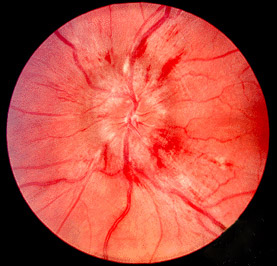
  • Hipertensão → aumento da pressão intracraniana → edema Edema Edema is a condition in which excess serous fluid accumulates in the body cavity or interstitial space of connective tissues. Edema is a symptom observed in several medical conditions. It can be categorized into 2 types, namely, peripheral (in the extremities) and internal (in an organ or body cavity). Edema do disco ótico (papiledema)
  • As alterações coroideias ocorrem devido à má perfusão:
    • Atrofia do epitélio pigmentar da retina Retina The ten-layered nervous tissue membrane of the eye. It is continuous with the optic nerve and receives images of external objects and transmits visual impulses to the brain. Its outer surface is in contact with the choroid and the inner surface with the vitreous body. The outermost layer is pigmented, whereas the inner nine layers are transparent. Eye: Anatomy (EPR): formação de lesões pigmentadas com um halo esbranquiçado (manchas de Elschnig)
    • Isquemia na coroide que se manifesta como lesões hiperpigmentadas em linha (estrias de Siegrist)
    • Descolamento do epitélio pigmentar da retina Retina The ten-layered nervous tissue membrane of the eye. It is continuous with the optic nerve and receives images of external objects and transmits visual impulses to the brain. Its outer surface is in contact with the choroid and the inner surface with the vitreous body. The outermost layer is pigmented, whereas the inner nine layers are transparent. Eye: Anatomy (EPR)

Apresentação Clínica e Diagnóstico

Apresentação clínica

  • A maioria dos doentes são assintomáticos.
  • Podem apresentar dores de cabeça e visão diminuída e/ou desfocada
  • Raramente causa perda de visão, porém pode ocorrer subsequente à atrofia do nervo ótico ou a descolamento da retina Retina The ten-layered nervous tissue membrane of the eye. It is continuous with the optic nerve and receives images of external objects and transmits visual impulses to the brain. Its outer surface is in contact with the choroid and the inner surface with the vitreous body. The outermost layer is pigmented, whereas the inner nine layers are transparent. Eye: Anatomy

Diagnóstico

  • O diagnóstico é baseado na fundoscopia
  • Classificações dos resultados dos exames:
    • Classificação da retinopatia hipertensiva da Keith-Wagener-Barker: classificação baseada na gravidade das alterações da retina Retina The ten-layered nervous tissue membrane of the eye. It is continuous with the optic nerve and receives images of external objects and transmits visual impulses to the brain. Its outer surface is in contact with the choroid and the inner surface with the vitreous body. The outermost layer is pigmented, whereas the inner nine layers are transparent. Eye: Anatomy
    • Classificação de Mitchell-Wong: classificação baseada na gravidade e nas mudanças fisiopatológicas
Tabela: Classificação de retinopatia hipertensiva da Keith-Wagener-Barker
Grau I Estreitamento ligeiro ou moderado das arteríolas da retina Retina The ten-layered nervous tissue membrane of the eye. It is continuous with the optic nerve and receives images of external objects and transmits visual impulses to the brain. Its outer surface is in contact with the choroid and the inner surface with the vitreous body. The outermost layer is pigmented, whereas the inner nine layers are transparent. Eye: Anatomy, com uma relação arteriovenosa de ≥ 1:2
Grau II Estreitamento moderado a severo das arteríolas da retina Retina The ten-layered nervous tissue membrane of the eye. It is continuous with the optic nerve and receives images of external objects and transmits visual impulses to the brain. Its outer surface is in contact with the choroid and the inner surface with the vitreous body. The outermost layer is pigmented, whereas the inner nine layers are transparent. Eye: Anatomy com uma relação arteriovenosa <1:2 ou cruzamento arteriovenoso
Grau III Manchas algodonosas ou hemorragias em forma de chama de vela
Grau IV Edema Edema Edema is a condition in which excess serous fluid accumulates in the body cavity or interstitial space of connective tissues. Edema is a symptom observed in several medical conditions. It can be categorized into 2 types, namely, peripheral (in the extremities) and internal (in an organ or body cavity). Edema óptico bilateral
Tabela: Classificação de Mitchell-Wong para a retinopatia hipertensiva
Grau de retinopatia Alterações na retina Retina The ten-layered nervous tissue membrane of the eye. It is continuous with the optic nerve and receives images of external objects and transmits visual impulses to the brain. Its outer surface is in contact with the choroid and the inner surface with the vitreous body. The outermost layer is pigmented, whereas the inner nine layers are transparent. Eye: Anatomy Riscos sistémicos
Nenhum Sem alterações detetaveis Nenhum
Ligeira
  • Constrição arteriolar generalizada
  • Constrição arteriolar focal
  • Cruzamento arteriovenoso
  • Fios de prata ou fios de cobre
Risco médio de acidentes vasculares cerebrais clínicos, acidentes vasculares cerebrais subclínicos, doenças coronárias e mortalidade
Moderada
  • Hemorragia da retina Retina The ten-layered nervous tissue membrane of the eye. It is continuous with the optic nerve and receives images of external objects and transmits visual impulses to the brain. Its outer surface is in contact with the choroid and the inner surface with the vitreous body. The outermost layer is pigmented, whereas the inner nine layers are transparent. Eye: Anatomy em forma de chama de vela, hemorragia em pontos ou em manchas
  • Microaneurismas, manchas algodonosas ou exsudados duros
Alto risco de acidentes vasculares cerebrais clínicos e subclínicos, declínio cognitivo, doença coronária e mortalidade
Maligna Sinais de retinopatia moderada com presença de edema Edema Edema is a condition in which excess serous fluid accumulates in the body cavity or interstitial space of connective tissues. Edema is a symptom observed in several medical conditions. It can be categorized into 2 types, namely, peripheral (in the extremities) and internal (in an organ or body cavity). Edema do disco ótico Alto risco de mortalidade

Prognóstico e Tratamento

  • Algumas alterações da retina Retina The ten-layered nervous tissue membrane of the eye. It is continuous with the optic nerve and receives images of external objects and transmits visual impulses to the brain. Its outer surface is in contact with the choroid and the inner surface with the vitreous body. The outermost layer is pigmented, whereas the inner nine layers are transparent. Eye: Anatomy podem regredir com controle da pressão arterial.
  • Quando não tratada, a taxa de mortalidade da hipertensão maligna é de 90%.
  • O tratamento inclui:
    • Alterações no estilo de vida (por exemplo, dieta com pouco sal, perda de peso e prática regular Regular Insulin de exercício físico)
    • Cessação tabágica
    • Fármacos anti-hipertensivos
    • A pressão arterial alvo é determinada em função de outros fatores de risco: doença cardiovascular e cerebrovascular, doença renal e diabetes Diabetes Diabetes mellitus (DM) is a metabolic disease characterized by hyperglycemia and dysfunction of the regulation of glucose metabolism by insulin. Type 1 DM is diagnosed mostly in children and young adults as the result of autoimmune destruction of β cells in the pancreas and the resulting lack of insulin. Type 2 DM has a significant association with obesity and is characterized by insulin resistance. Diabetes Mellitus.
Melhoria hipertensiva

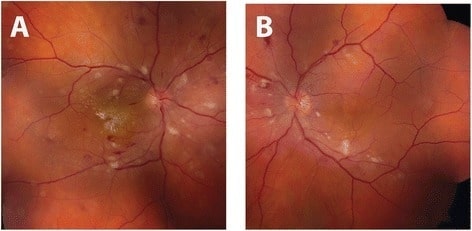
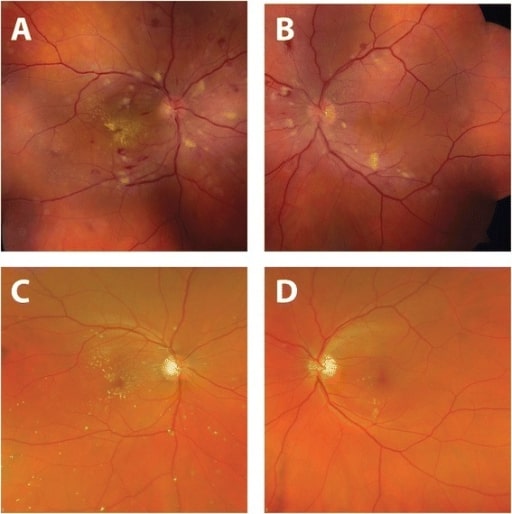
Melhoria das imagens da fundoscopia após a instituição de tratamento anti-hipertensivo.

Fundoscopias tiradas no momento da apresentação (A, B): pode-se observar constrição arteriolar, hemorragias da retina, manchas algodonosas e exsudados duros (à direita).
Quatro meses após o diagnóstico e tratamento da hipertensão arterial (C, D): A normalização da pressão arterial resultou na resolução das hemorragias e das manchas algodonosas.
Melhoria temporal do aspeto dos exsudados duros no olho direito com uma estrela macular residual.

Imagem: “Improvement in fundus appearance after treatment” por the Department of Ophthalmology and Visual Sciences, University of Michigan, 500 S State St, Ann Arbor, MI 48109 USA. Licença: CC BY 4.0.
Diagnóstico Diferencial

  • Catarata: uma diminuição da visão devido à opacificação da lente, que se apresenta indolor, com visão desfocada e com maior sensibilidade ao brilho. As cataratas são a principal causa de cegueira em todo o mundo e podem surgir em qualquer idade, embora sejam mais MAIS Androgen Insensitivity Syndrome frequentes em maiores de 60 anos.
  • Retinopatia diabética: diminuição da acuidade visual por lesões da microvasculatura causadas pela diabetes Diabetes Diabetes mellitus (DM) is a metabolic disease characterized by hyperglycemia and dysfunction of the regulation of glucose metabolism by insulin. Type 1 DM is diagnosed mostly in children and young adults as the result of autoimmune destruction of β cells in the pancreas and the resulting lack of insulin. Type 2 DM has a significant association with obesity and is characterized by insulin resistance. Diabetes Mellitus mellitus. A retinopatia diabética é classificada em retinopatia não proliferativa e retinopatia proliferativa. A retinopatia não proliferativa é caracterizada por microaneurismas, hemorragias intrarretinianas, exsudados e edema Edema Edema is a condition in which excess serous fluid accumulates in the body cavity or interstitial space of connective tissues. Edema is a symptom observed in several medical conditions. It can be categorized into 2 types, namely, peripheral (in the extremities) and internal (in an organ or body cavity). Edema macular. O tipo proliferativo é a caracterizado pela presença de neovascularização da retina Retina The ten-layered nervous tissue membrane of the eye. It is continuous with the optic nerve and receives images of external objects and transmits visual impulses to the brain. Its outer surface is in contact with the choroid and the inner surface with the vitreous body. The outermost layer is pigmented, whereas the inner nine layers are transparent. Eye: Anatomy ou do disco ótico. Os doentes são inicialmente assintomáticos, mas fases finais da doença apresentam visão diminuída ou flutuante, eventualmente com miodisópsias.
  • Descolamento da retina: separação entre a retina e o epitélio pigmentar da retina resultando em lesão dos fotorreceptores Os sintomas incluem alterações indolores na visão como, por exemplo, fotopsias, miodisopsias, dificuldades na visão periférica ou sensação de sombra no campo de visão. A visão é descrita como irregular ou “tipo cortina”. O descolamento da retina Retina The ten-layered nervous tissue membrane of the eye. It is continuous with the optic nerve and receives images of external objects and transmits visual impulses to the brain. Its outer surface is in contact with the choroid and the inner surface with the vitreous body. The outermost layer is pigmented, whereas the inner nine layers are transparent. Eye: Anatomy é uma urgência que requer tratamento cirúrgico.
  • Oclusão da artéria central da retina Retina The ten-layered nervous tissue membrane of the eye. It is continuous with the optic nerve and receives images of external objects and transmits visual impulses to the brain. Its outer surface is in contact with the choroid and the inner surface with the vitreous body. The outermost layer is pigmented, whereas the inner nine layers are transparent. Eye: Anatomy: oclusão da artéria central da retina Retina The ten-layered nervous tissue membrane of the eye. It is continuous with the optic nerve and receives images of external objects and transmits visual impulses to the brain. Its outer surface is in contact with the choroid and the inner surface with the vitreous body. The outermost layer is pigmented, whereas the inner nine layers are transparent. Eye: Anatomy, principal fonte de irrigação sanguínea do nervo ótico, por causa embólica ou aterosclerótica Os doentes geralmente apresentam perda visual súbita, indolor e monocular. Os achados da fundoscopia incluem palidez da retina Retina The ten-layered nervous tissue membrane of the eye. It is continuous with the optic nerve and receives images of external objects and transmits visual impulses to the brain. Its outer surface is in contact with the choroid and the inner surface with the vitreous body. The outermost layer is pigmented, whereas the inner nine layers are transparent. Eye: Anatomy com mácula vermelho-cereja A oclusão da artéria central da retina Retina The ten-layered nervous tissue membrane of the eye. It is continuous with the optic nerve and receives images of external objects and transmits visual impulses to the brain. Its outer surface is in contact with the choroid and the inner surface with the vitreous body. The outermost layer is pigmented, whereas the inner nine layers are transparent. Eye: Anatomy é uma emergência médica e a recuperação visual depende de um diagnóstico e tratamento imediatos.
  • Oclusão da veia central da retina: oclusão da veia central da retina principalmente por trombogênese. Os doentes geralmente apresentam perda súbita, indolor e monocular da visão. A fundoscopia revela veias dilatadas, hemorragias intraretinianas e manchas algodonosas, achados descritos como aparência do tipo “sangue e trovão”. Requer uma referenciação urgente para oftalmologia.

Referências

  1. Lloyd-Jones, D. M., Morris, P. B., Ballantyne, C. M., Birtcher, K. K., Daly, D. D., Jr, DePalma, S. M., Minissian, M. B., Orringer, C. E., & Smith, S. C., Jr (2017). 2017 Focused Update of the 2016 ACC Expert Consensus Decision Pathway on the Role of Non-Statin Therapies for LDL-Cholesterol Lowering in the Management of Atherosclerotic Cardiovascular Disease Risk: A Report of the American College of Cardiology Task Force on Expert Consensus Decision Pathways. Journal of the American College of Cardiology70(14), 1785–1822. https://doi.org/10.1016/j.jacc.2017.07.745
  2. Basile, J., et al. (2024). Overview of Hypertension in adults. UpToDate. Retrieved on August 2, 2025, from https://www.uptodate.com/contents/overview-of-hypertension-in-adults?search=overview
  3. Elliott, W., et al. (2024). Moderate to severe hypertensive retinopathy and hypertensive encephalopathy in adults. UpToDate. Retrieved on August 2, 2025, from https://www.uptodate.com/contents/moderate-to-severe-hypertensive-retinopathy-and-hypertensive-encephalopathy-in-adults
  4. Grosso, A., Veglio, F., Porta, M., Grignolo, F. M., & Wong, T. Y. (2005). Hypertensive retinopathy revisited: some answers, more questions. The British journal of ophthalmology89(12), 1646–1654. https://doi.org/10.1136/bjo.2005.072546
  5. Harjasouliha, A., Raiji, V., & Gonzalez, J. (2017) Review of hypertensive retinopathy. Elsevier. Retrieved on August 2, 2025, from https://www.sciencedirect.com/science/article/abs/pii/S0011502916300839?via%3Dihub
  6. Henderson, A., et al. (2011). Hypertension-related eye abnormalities and the risk of stroke. Rev Neurol Dis, 8(1-2): 1–9. https://www.ncbi.nlm.nih.gov/pmc/articles/PMC3448945/
  7. Modi, P., & Arsiwalla, T. (2023). Hypertensive retinopathy. StatPearls. Retrieved on August 2, 2025, from https://www.ncbi.nlm.nih.gov/books/NBK525980/
  8. Oh, K., Moinfar, N., & Roy, H. (2024). Ophthalmologic Manifestations of Hypertension. Medscape. Retrieved on August 2, 2025, from https://emedicine.medscape.com/article/1201779-overview
  9. Townsend, R. Bakris, G., Kunins, L., & Forman, J. (2024). Ocular effects of hypertension. UpToDate. Retrieved on August 2, 2025, from https://www.uptodate.com/contents/ocular-effects-of-hypertension

Crie sua conta gratuita ou faça login para continuar lendo!

Cadastre-se agora e tenha acesso grátis ao Lecturio, com páginas de conceitos, vídeos de medicina e questões para sua educação médica.

Aprende mais com a Lecturio:

Multiple devices displaying human anatomy and health education content.

Complementa o teu estudo da faculdade com o companheiro de estudo tudo-em-um da Lecturio, através de métodos de ensino baseados em evidência.

Estuda onde quiseres

Two iPhones display medical education apps, one showing anatomy, the other Bookmatcher.

A Lecturio Medical complementa o teu estudo através de métodos de ensino baseados em evidência, vídeos de palestras, perguntas e muito mais – tudo combinado num só lugar e fácil de usar.

User Reviews

Have a holly, jolly study session 🎁 Save 50% on all plans now >>

Que tengas una sesión de estudio alegre y navideña 🎁 Ahorra 50% en todos los planes >>

Details