



Regulação Epigenética

A regulação epigenética diz respeito à regulação da expressão génica que não envolve alterações na sequência do DNA ou em qualquer um dos seus produtos da transcrição. As formas mais comuns de regulação epigenética são a metilação do DNA, que suprime a expressão génica, e as modificações nas proteínas das histonas, que afetam a estrutura de "empacotamento" do DNA DNA A deoxyribonucleotide polymer that is the primary genetic material of all cells. Eukaryotic and prokaryotic organisms normally contain DNA in a double-stranded state, yet several important biological processes transiently involve single-stranded regions. DNA, which consists of a polysugar-phosphate backbone possessing projections of purines (adenine and guanine) and pyrimidines (thymine and cytosine), forms a double helix that is held together by hydrogen bonds between these purines and pyrimidines (adenine to thymine and guanine to cytosine). DNA Types and Structure. As modificações epigenéticas são responsáveis pelas condições relacionadas com o imprinting Imprinting The variable phenotypic expression of a gene depending on whether it is of paternal or maternal origin, which is a function of the DNA methylation pattern. Imprinted regions are observed to be more methylated and less transcriptionally active. Epigenetic Regulation, incluindo as síndromes de Prader-Willi e Angelman.

Last updated: Apr 25, 2025

Editorial responsibility: Stanley Oiseth, Lindsay Jones, Evelin Maza

Descrição Geral

Definição

As modificações epigenéticas são modificações no DNA ou no “empacotamento” do DNA DNA A deoxyribonucleotide polymer that is the primary genetic material of all cells. Eukaryotic and prokaryotic organisms normally contain DNA in a double-stranded state, yet several important biological processes transiently involve single-stranded regions. DNA, which consists of a polysugar-phosphate backbone possessing projections of purines (adenine and guanine) and pyrimidines (thymine and cytosine), forms a double helix that is held together by hydrogen bonds between these purines and pyrimidines (adenine to thymine and guanine to cytosine). DNA Types and Structure que afetam a expressão do gene Gene A category of nucleic acid sequences that function as units of heredity and which code for the basic instructions for the development, reproduction, and maintenance of organisms. Basic Terms of Genetics sem alterar o próprio código genético (ou seja, a sequência do DNA DNA A deoxyribonucleotide polymer that is the primary genetic material of all cells. Eukaryotic and prokaryotic organisms normally contain DNA in a double-stranded state, yet several important biological processes transiently involve single-stranded regions. DNA, which consists of a polysugar-phosphate backbone possessing projections of purines (adenine and guanine) and pyrimidines (thymine and cytosine), forms a double helix that is held together by hydrogen bonds between these purines and pyrimidines (adenine to thymine and guanine to cytosine). DNA Types and Structure).

Estas modificações:

  • Controlar quais regiões do DNA DNA A deoxyribonucleotide polymer that is the primary genetic material of all cells. Eukaryotic and prokaryotic organisms normally contain DNA in a double-stranded state, yet several important biological processes transiently involve single-stranded regions. DNA, which consists of a polysugar-phosphate backbone possessing projections of purines (adenine and guanine) and pyrimidines (thymine and cytosine), forms a double helix that is held together by hydrogen bonds between these purines and pyrimidines (adenine to thymine and guanine to cytosine). DNA Types and Structure estão disponíveis para transcrição
  • Normalmente são reversíveis
  • Pode ser influenciadas por fatores ambientais
  • São hereditárias (ou seja, os padrões epigenéticos são preservados durante a divisão celular)

Descrição geral da regulação epigenética

  • Fatores epigenéticos:
    • Mudam o fenótipo sem mudar o genótipo
    • Podem influenciar como os genes Genes A category of nucleic acid sequences that function as units of heredity and which code for the basic instructions for the development, reproduction, and maintenance of organisms. DNA Types and Structure são expressos em diferentes idades
    • Contribuem significativamente para a expressão génica diferencial em diferentes tecidos
  • As modificações epigenéticas incluem modificações:
    • Diretamente para o DNA DNA A deoxyribonucleotide polymer that is the primary genetic material of all cells. Eukaryotic and prokaryotic organisms normally contain DNA in a double-stranded state, yet several important biological processes transiently involve single-stranded regions. DNA, which consists of a polysugar-phosphate backbone possessing projections of purines (adenine and guanine) and pyrimidines (thymine and cytosine), forms a double helix that is held together by hydrogen bonds between these purines and pyrimidines (adenine to thymine and guanine to cytosine). DNA Types and Structure (por exemplo, metilação do DNA DNA A deoxyribonucleotide polymer that is the primary genetic material of all cells. Eukaryotic and prokaryotic organisms normally contain DNA in a double-stranded state, yet several important biological processes transiently involve single-stranded regions. DNA, which consists of a polysugar-phosphate backbone possessing projections of purines (adenine and guanine) and pyrimidines (thymine and cytosine), forms a double helix that is held together by hydrogen bonds between these purines and pyrimidines (adenine to thymine and guanine to cytosine). DNA Types and Structure)
    • Para as proteínas de ligação do DNA DNA A deoxyribonucleotide polymer that is the primary genetic material of all cells. Eukaryotic and prokaryotic organisms normally contain DNA in a double-stranded state, yet several important biological processes transiently involve single-stranded regions. DNA, which consists of a polysugar-phosphate backbone possessing projections of purines (adenine and guanine) and pyrimidines (thymine and cytosine), forms a double helix that is held together by hydrogen bonds between these purines and pyrimidines (adenine to thymine and guanine to cytosine). DNA Types and Structure (por exemplo, modificação de histonas)
    • Para estruturas de cromatina de ordem superior
  • A regulação epigenética desempenha um papel na:
    • Diferenciação celular
    • Inativação do cromossoma X em mulheres
    • Processos de doença:
      • Doenças com imprinting Imprinting The variable phenotypic expression of a gene depending on whether it is of paternal or maternal origin, which is a function of the DNA methylation pattern. Imprinted regions are observed to be more methylated and less transcriptionally active. Epigenetic Regulation: síndrome de Prader-Willi (SPW), síndrome de Angelman (SA)
      • Cancro
    • Adaptações ao meio ambiente, incluindo:
      • Stress
      • Fome ou obesidade
      • Exposições a toxinas, poluição e/ou produtos químicos desreguladores endócrinos

Revisão do “empacotamento” de DNA DNA A deoxyribonucleotide polymer that is the primary genetic material of all cells. Eukaryotic and prokaryotic organisms normally contain DNA in a double-stranded state, yet several important biological processes transiently involve single-stranded regions. DNA, which consists of a polysugar-phosphate backbone possessing projections of purines (adenine and guanine) and pyrimidines (thymine and cytosine), forms a double helix that is held together by hydrogen bonds between these purines and pyrimidines (adenine to thymine and guanine to cytosine). DNA Types and Structure na cromatina

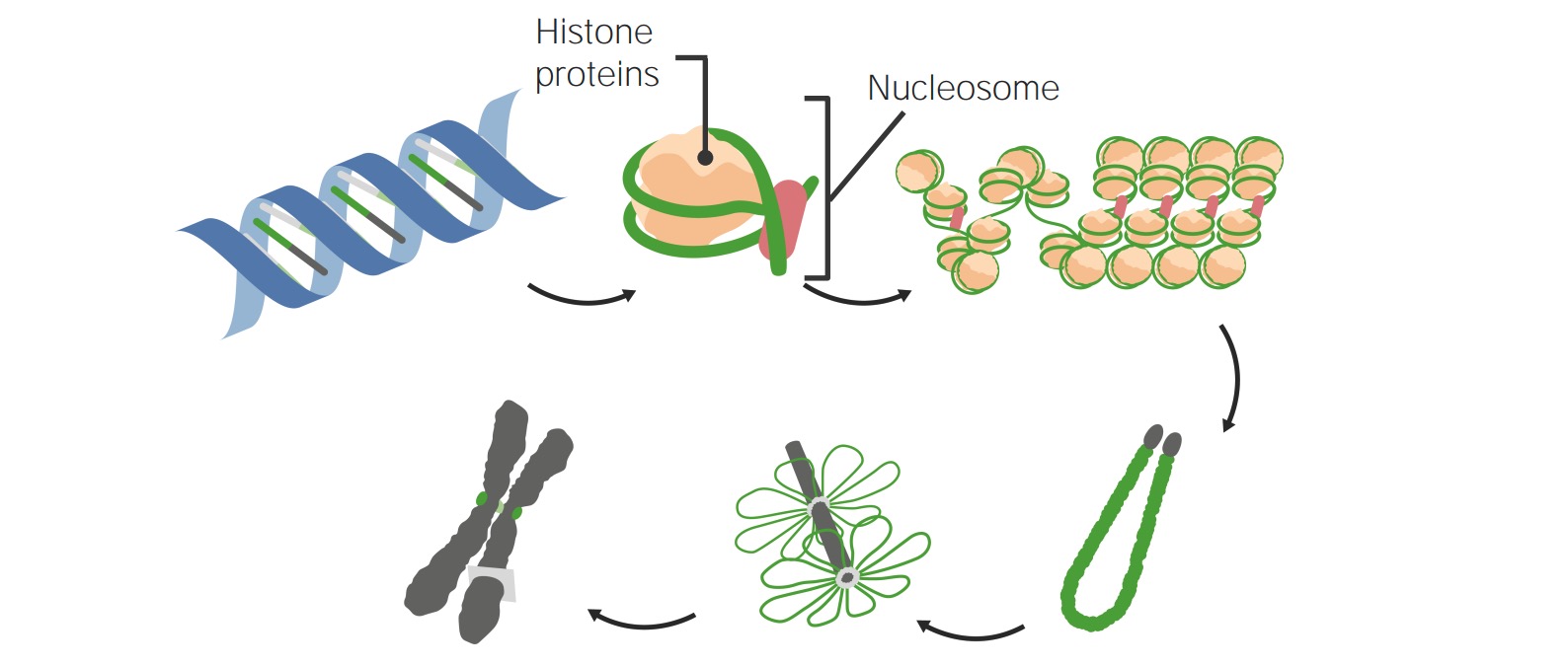
A unidade básica de “empacotamento” do DNA DNA A deoxyribonucleotide polymer that is the primary genetic material of all cells. Eukaryotic and prokaryotic organisms normally contain DNA in a double-stranded state, yet several important biological processes transiently involve single-stranded regions. DNA, which consists of a polysugar-phosphate backbone possessing projections of purines (adenine and guanine) and pyrimidines (thymine and cytosine), forms a double helix that is held together by hydrogen bonds between these purines and pyrimidines (adenine to thymine and guanine to cytosine). DNA Types and Structure é o nucleossoma. O DNA DNA A deoxyribonucleotide polymer that is the primary genetic material of all cells. Eukaryotic and prokaryotic organisms normally contain DNA in a double-stranded state, yet several important biological processes transiently involve single-stranded regions. DNA, which consists of a polysugar-phosphate backbone possessing projections of purines (adenine and guanine) and pyrimidines (thymine and cytosine), forms a double helix that is held together by hydrogen bonds between these purines and pyrimidines (adenine to thymine and guanine to cytosine). DNA Types and Structure envolve 2¼ vezes em torno de um núcleo de 8 proteínas histonas, formando um nucleossoma.
  • Nucleossomas:
    • O núcleo de histonas é composto por 2 de cada uma das seguintes histonas: H2A, H2B, H3 e H4.
    • H1 é a 9ª histona e fica do lado de fora do nucleossoma.
    • Existem aproximadamente 146 pares de bases Bases Usually a hydroxide of lithium, sodium, potassium, rubidium or cesium, but also the carbonates of these metals, ammonia, and the amines. Acid-Base Balance de DNA DNA A deoxyribonucleotide polymer that is the primary genetic material of all cells. Eukaryotic and prokaryotic organisms normally contain DNA in a double-stranded state, yet several important biological processes transiently involve single-stranded regions. DNA, which consists of a polysugar-phosphate backbone possessing projections of purines (adenine and guanine) and pyrimidines (thymine and cytosine), forms a double helix that is held together by hydrogen bonds between these purines and pyrimidines (adenine to thymine and guanine to cytosine). DNA Types and Structure associados a cada nucleossoma.
    • Existem aproximadamente 20-60 pares de bases Bases Usually a hydroxide of lithium, sodium, potassium, rubidium or cesium, but also the carbonates of these metals, ammonia, and the amines. Acid-Base Balance de DNA DNA A deoxyribonucleotide polymer that is the primary genetic material of all cells. Eukaryotic and prokaryotic organisms normally contain DNA in a double-stranded state, yet several important biological processes transiently involve single-stranded regions. DNA, which consists of a polysugar-phosphate backbone possessing projections of purines (adenine and guanine) and pyrimidines (thymine and cytosine), forms a double helix that is held together by hydrogen bonds between these purines and pyrimidines (adenine to thymine and guanine to cytosine). DNA Types and Structure livre entre os nucleossomas.
    • Os nucleossomas aparecem como contas numa corda de DNA DNA A deoxyribonucleotide polymer that is the primary genetic material of all cells. Eukaryotic and prokaryotic organisms normally contain DNA in a double-stranded state, yet several important biological processes transiently involve single-stranded regions. DNA, which consists of a polysugar-phosphate backbone possessing projections of purines (adenine and guanine) and pyrimidines (thymine and cytosine), forms a double helix that is held together by hydrogen bonds between these purines and pyrimidines (adenine to thymine and guanine to cytosine). DNA Types and Structure.
  • Estrutura secundária da cromatina:
    • Modelo de solenoide: uma configuração em espiral de nucleossomas com 6 nucleossomas em cada volta
    • Modelo em ziguezague: uma configuração mais MAIS Androgen Insensitivity Syndrome irregular de nucleossomas compactados
  • Compactação adicional da cromatina:
    • As estruturas secundárias enrolam e estas bobinas sobreenrolam.
    • A cromatina condensa nos cromossomas completos durante a divisão celular.
  • Eucromatina versus heterocromatina:
    • Eucromatina: cromatina que está disponível para transcrição ( DNA DNA A deoxyribonucleotide polymer that is the primary genetic material of all cells. Eukaryotic and prokaryotic organisms normally contain DNA in a double-stranded state, yet several important biological processes transiently involve single-stranded regions. DNA, which consists of a polysugar-phosphate backbone possessing projections of purines (adenine and guanine) and pyrimidines (thymine and cytosine), forms a double helix that is held together by hydrogen bonds between these purines and pyrimidines (adenine to thymine and guanine to cytosine). DNA Types and Structure desenrolado ou enrolado de forma laxa)
    • Heterocromatina: cromatina que não está disponível para transcrição porque está muito enrolada
Embalagem de DNA em nucleossomos

Como o DNA é “empacotado” em nucleossomas e depois em cromossomas

Imagem por Lecturio.

Modificações Epigenéticas

As formas mais MAIS Androgen Insensitivity Syndrome importantes de modificação epigenética incluem metilação direta do DNA DNA A deoxyribonucleotide polymer that is the primary genetic material of all cells. Eukaryotic and prokaryotic organisms normally contain DNA in a double-stranded state, yet several important biological processes transiently involve single-stranded regions. DNA, which consists of a polysugar-phosphate backbone possessing projections of purines (adenine and guanine) and pyrimidines (thymine and cytosine), forms a double helix that is held together by hydrogen bonds between these purines and pyrimidines (adenine to thymine and guanine to cytosine). DNA Types and Structure, modificações nas proteínas das histonas e outras modificações na cromatina.
Metilação do DNA DNA A deoxyribonucleotide polymer that is the primary genetic material of all cells. Eukaryotic and prokaryotic organisms normally contain DNA in a double-stranded state, yet several important biological processes transiently involve single-stranded regions. DNA, which consists of a polysugar-phosphate backbone possessing projections of purines (adenine and guanine) and pyrimidines (thymine and cytosine), forms a double helix that is held together by hydrogen bonds between these purines and pyrimidines (adenine to thymine and guanine to cytosine). DNA Types and Structure

  • Grupos metil podem ser adicionados e removidos do DNA DNA A deoxyribonucleotide polymer that is the primary genetic material of all cells. Eukaryotic and prokaryotic organisms normally contain DNA in a double-stranded state, yet several important biological processes transiently involve single-stranded regions. DNA, which consists of a polysugar-phosphate backbone possessing projections of purines (adenine and guanine) and pyrimidines (thymine and cytosine), forms a double helix that is held together by hydrogen bonds between these purines and pyrimidines (adenine to thymine and guanine to cytosine). DNA Types and Structure.
  • A metilação geralmente ocorre:
    • Em bases Bases Usually a hydroxide of lithium, sodium, potassium, rubidium or cesium, but also the carbonates of these metals, ammonia, and the amines. Acid-Base Balance de citosina no DNA DNA A deoxyribonucleotide polymer that is the primary genetic material of all cells. Eukaryotic and prokaryotic organisms normally contain DNA in a double-stranded state, yet several important biological processes transiently involve single-stranded regions. DNA, which consists of a polysugar-phosphate backbone possessing projections of purines (adenine and guanine) and pyrimidines (thymine and cytosine), forms a double helix that is held together by hydrogen bonds between these purines and pyrimidines (adenine to thymine and guanine to cytosine). DNA Types and Structure
    • Em regiões promotoras e potenciadoras de um gene Gene A category of nucleic acid sequences that function as units of heredity and which code for the basic instructions for the development, reproduction, and maintenance of organisms. Basic Terms of Genetics
  • A metilação normalmente impede a transcrição de um gene Gene A category of nucleic acid sequences that function as units of heredity and which code for the basic instructions for the development, reproduction, and maintenance of organisms. Basic Terms of Genetics:
    • Proteínas reguladoras ligam-se às citosinas metiladas → impedem o acesso da maquinaria de transcrição ao DNA DNA A deoxyribonucleotide polymer that is the primary genetic material of all cells. Eukaryotic and prokaryotic organisms normally contain DNA in a double-stranded state, yet several important biological processes transiently involve single-stranded regions. DNA, which consists of a polysugar-phosphate backbone possessing projections of purines (adenine and guanine) and pyrimidines (thymine and cytosine), forms a double helix that is held together by hydrogen bonds between these purines and pyrimidines (adenine to thymine and guanine to cytosine). DNA Types and Structure → silenciam a expressão génica
    • A remoção de grupos metil → permite a transcrição → ativa a expressão génica
  • Enzimas envolvidas na metilação:
    • DNA DNA A deoxyribonucleotide polymer that is the primary genetic material of all cells. Eukaryotic and prokaryotic organisms normally contain DNA in a double-stranded state, yet several important biological processes transiently involve single-stranded regions. DNA, which consists of a polysugar-phosphate backbone possessing projections of purines (adenine and guanine) and pyrimidines (thymine and cytosine), forms a double helix that is held together by hydrogen bonds between these purines and pyrimidines (adenine to thymine and guanine to cytosine). DNA Types and Structure metiltransferases: enzimas que metilam o DNA DNA A deoxyribonucleotide polymer that is the primary genetic material of all cells. Eukaryotic and prokaryotic organisms normally contain DNA in a double-stranded state, yet several important biological processes transiently involve single-stranded regions. DNA, which consists of a polysugar-phosphate backbone possessing projections of purines (adenine and guanine) and pyrimidines (thymine and cytosine), forms a double helix that is held together by hydrogen bonds between these purines and pyrimidines (adenine to thymine and guanine to cytosine). DNA Types and Structure
    • Metilcitosina dioxigenases: enzimas que removem grupos metil do DNA DNA A deoxyribonucleotide polymer that is the primary genetic material of all cells. Eukaryotic and prokaryotic organisms normally contain DNA in a double-stranded state, yet several important biological processes transiently involve single-stranded regions. DNA, which consists of a polysugar-phosphate backbone possessing projections of purines (adenine and guanine) and pyrimidines (thymine and cytosine), forms a double helix that is held together by hydrogen bonds between these purines and pyrimidines (adenine to thymine and guanine to cytosine). DNA Types and Structure

Modificações de histonas

  • Como o DNA DNA A deoxyribonucleotide polymer that is the primary genetic material of all cells. Eukaryotic and prokaryotic organisms normally contain DNA in a double-stranded state, yet several important biological processes transiently involve single-stranded regions. DNA, which consists of a polysugar-phosphate backbone possessing projections of purines (adenine and guanine) and pyrimidines (thymine and cytosine), forms a double helix that is held together by hydrogen bonds between these purines and pyrimidines (adenine to thymine and guanine to cytosine). DNA Types and Structure está envolvido em proteínas das histonas afeta quais os genes Genes A category of nucleic acid sequences that function as units of heredity and which code for the basic instructions for the development, reproduction, and maintenance of organisms. DNA Types and Structure que podem ser traduzidos:
    • O DNA DNA A deoxyribonucleotide polymer that is the primary genetic material of all cells. Eukaryotic and prokaryotic organisms normally contain DNA in a double-stranded state, yet several important biological processes transiently involve single-stranded regions. DNA, which consists of a polysugar-phosphate backbone possessing projections of purines (adenine and guanine) and pyrimidines (thymine and cytosine), forms a double helix that is held together by hydrogen bonds between these purines and pyrimidines (adenine to thymine and guanine to cytosine). DNA Types and Structure firmemente enrolado é inacessível à maquinaria de transcrição.
    • Alterar a forma como os genes Genes A category of nucleic acid sequences that function as units of heredity and which code for the basic instructions for the development, reproduction, and maintenance of organisms. DNA Types and Structure são envolvidos torna certos segmentos de DNA DNA A deoxyribonucleotide polymer that is the primary genetic material of all cells. Eukaryotic and prokaryotic organisms normally contain DNA in a double-stranded state, yet several important biological processes transiently involve single-stranded regions. DNA, which consists of a polysugar-phosphate backbone possessing projections of purines (adenine and guanine) and pyrimidines (thymine and cytosine), forms a double helix that is held together by hydrogen bonds between these purines and pyrimidines (adenine to thymine and guanine to cytosine). DNA Types and Structure mais MAIS Androgen Insensitivity Syndrome ou menos acessíveis à maquinaria de transcrição.
  • Modificando as histonas:
    • Altera a afinidade das proteínas das histonas pelo DNA DNA A deoxyribonucleotide polymer that is the primary genetic material of all cells. Eukaryotic and prokaryotic organisms normally contain DNA in a double-stranded state, yet several important biological processes transiently involve single-stranded regions. DNA, which consists of a polysugar-phosphate backbone possessing projections of purines (adenine and guanine) and pyrimidines (thymine and cytosine), forms a double helix that is held together by hydrogen bonds between these purines and pyrimidines (adenine to thymine and guanine to cytosine). DNA Types and Structure
    • Pode recrutar outras proteínas que afetam a estrutura da cromatina
  • O efeito das modificações de histonas (por exemplo, aumentar ou suprimir a transcrição) depende da combinação específica de:
    • Quais subunidades de histonas foram modificadas
    • Quais aminoácidos dentro dessas subunidades foram modificados
    • Quais foram as modificações (por exemplo, metilação versus acetilação)
  • As modificações de histonas são um tipo de modificação pós-traducional das proteínas histonas.

Tipos de modificações de histonas

  • Metilação:
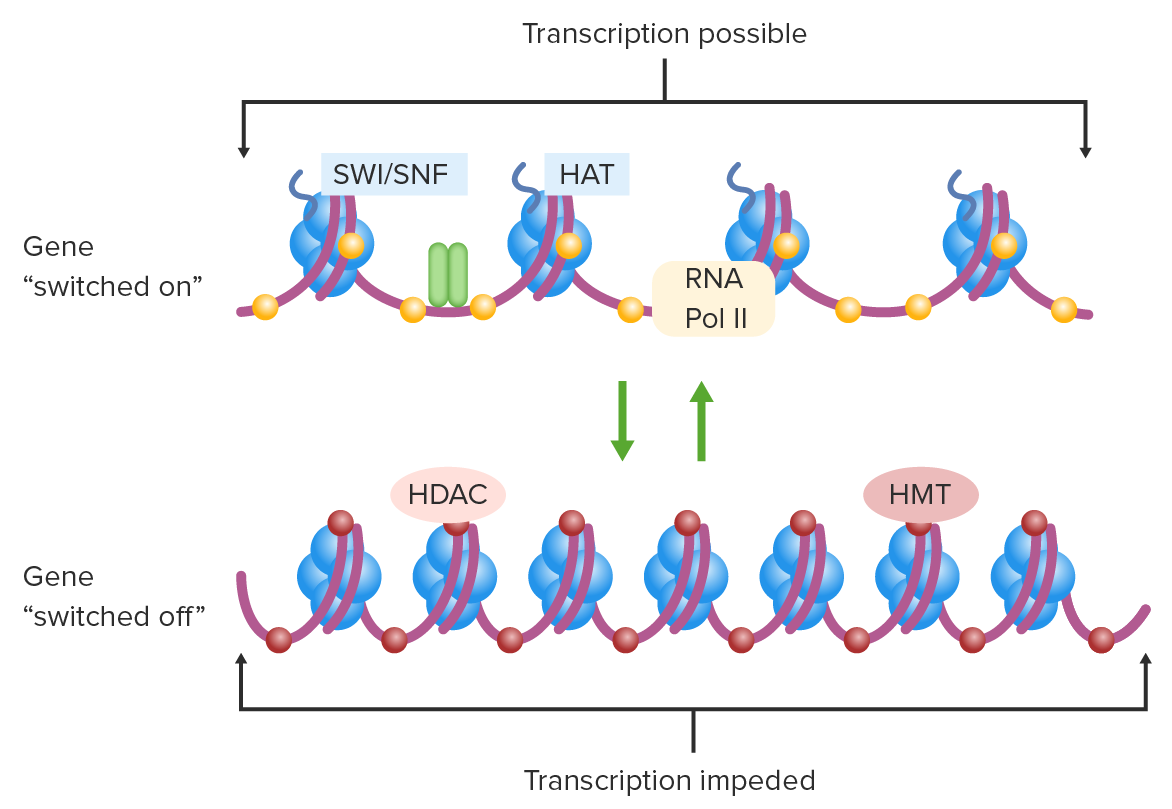
    • Em geral, a metilação está associada ao DNA DNA A deoxyribonucleotide polymer that is the primary genetic material of all cells. Eukaryotic and prokaryotic organisms normally contain DNA in a double-stranded state, yet several important biological processes transiently involve single-stranded regions. DNA, which consists of a polysugar-phosphate backbone possessing projections of purines (adenine and guanine) and pyrimidines (thymine and cytosine), forms a double helix that is held together by hydrogen bonds between these purines and pyrimidines (adenine to thymine and guanine to cytosine). DNA Types and Structure inativo (ou seja, não transcrito).
    • As histonas metiltransferases adicionam grupos metil às lisinas na cauda da histona.
    • As histonas demetilases removem os grupos metil.
  • Acetilação:
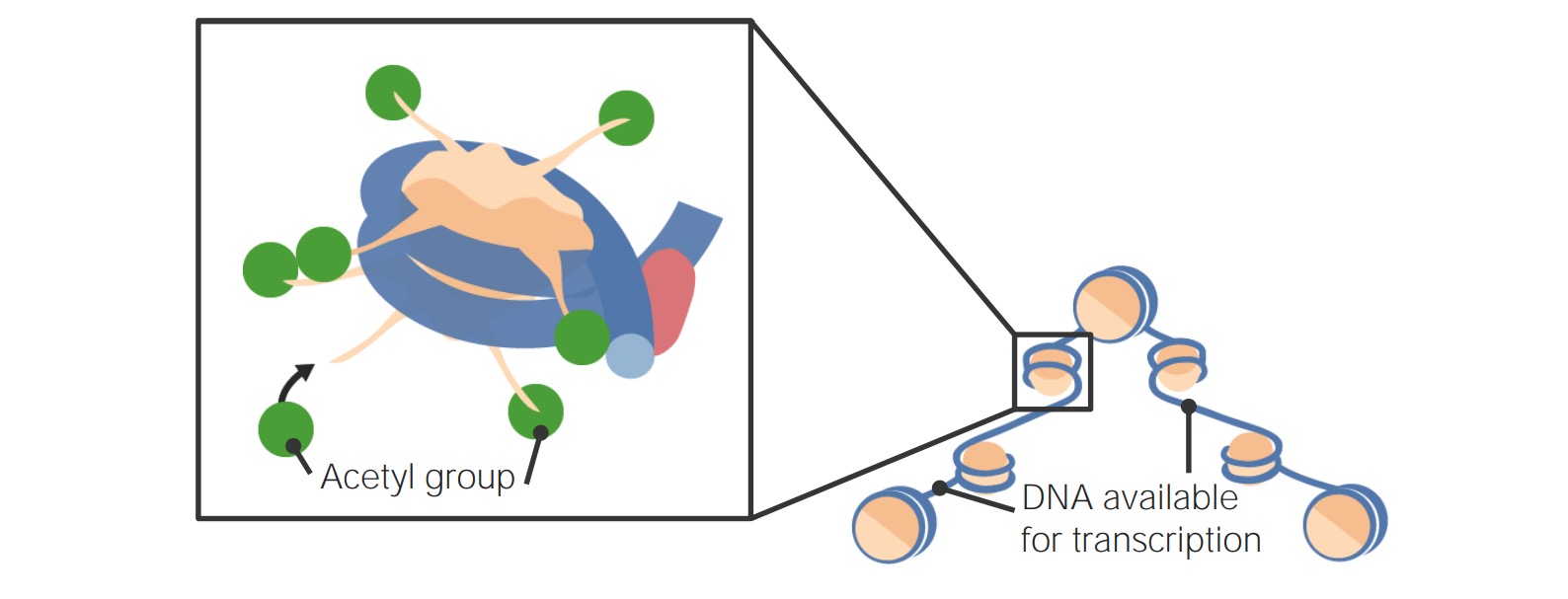
    • Em geral, a acetilação “desempacota” o DNA DNA A deoxyribonucleotide polymer that is the primary genetic material of all cells. Eukaryotic and prokaryotic organisms normally contain DNA in a double-stranded state, yet several important biological processes transiently involve single-stranded regions. DNA, which consists of a polysugar-phosphate backbone possessing projections of purines (adenine and guanine) and pyrimidines (thymine and cytosine), forms a double helix that is held together by hydrogen bonds between these purines and pyrimidines (adenine to thymine and guanine to cytosine). DNA Types and Structure, permitindo a transcrição.
    • As histonas acetiltransferases (HATs) podem adicionar grupos acetil a lisinas na proteína histona.
    • As histonas deacetilases (HDACs) removem os grupos acetil.
    • Essas enzimas normalmente contêm zinco.
  • Outros tipos de modificações de histonas:
    • Ubiquitilação
    • Fosforilação
    • Isomerização da prolina
    • ADP-ribosilação de ácidos glutâmicos
Acetilação de histonas

Acetilação de histonas

Imagem por Lecturio.
Remodelação da cromatina

A remodelação da cromatina e/ou nucleossomas é outra maneira pela qual a célula pode regular Regular Insulin a expressão génica a nível epigenético. A remodelação da cromatina normalmente requer energia. Os tipos de remodelação da cromatina incluem:
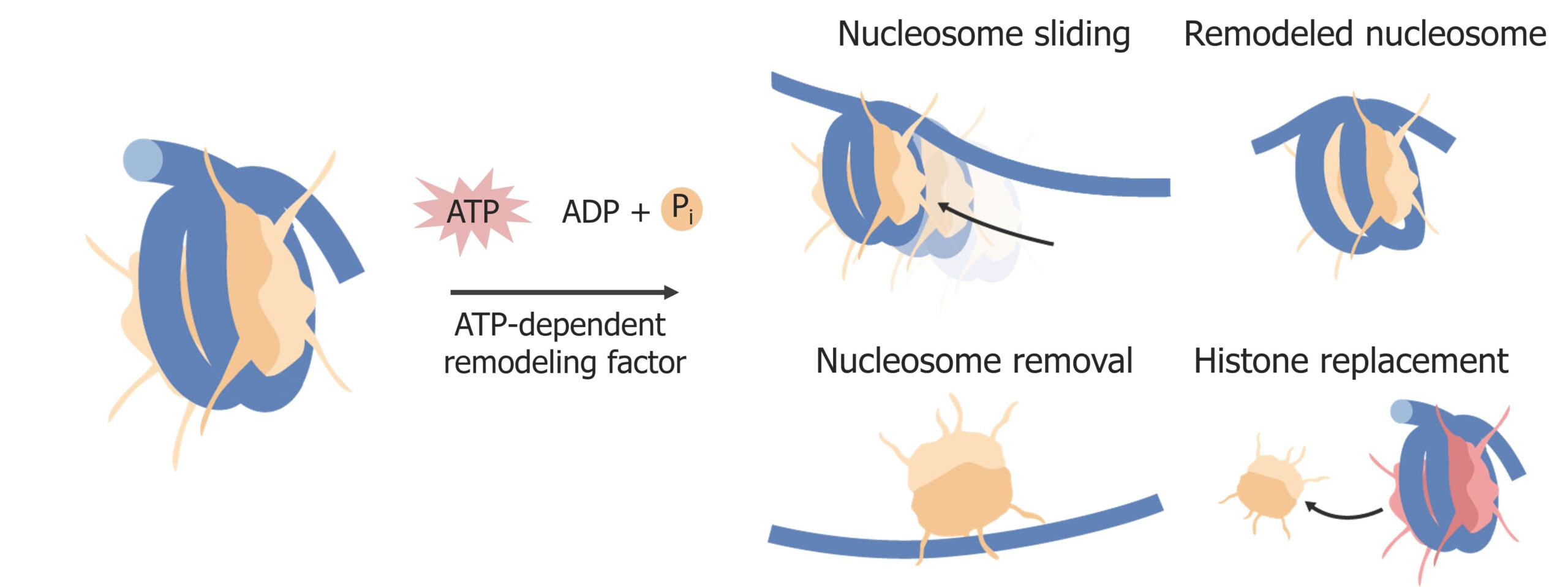
  • Mover ou deslizar o nucleossoma pela cadeia de DNA DNA A deoxyribonucleotide polymer that is the primary genetic material of all cells. Eukaryotic and prokaryotic organisms normally contain DNA in a double-stranded state, yet several important biological processes transiently involve single-stranded regions. DNA, which consists of a polysugar-phosphate backbone possessing projections of purines (adenine and guanine) and pyrimidines (thymine and cytosine), forms a double helix that is held together by hydrogen bonds between these purines and pyrimidines (adenine to thymine and guanine to cytosine). DNA Types and Structure
  • Remodelar a forma do nucleossoma
  • Remoção temporária do nucleossoma
  • Substituição das histonas
Remodelação de nucleossomas

Remodelação de Nucleossomas:
Exemplos de alterações em histonas. Os fatores de remodelação da cromatina também alteram a estrutura da cromatina. A cromatina usa energia do ATP.

Imagem por Lecturio.

Imprinting

Descrição geral

O imprinting Imprinting The variable phenotypic expression of a gene depending on whether it is of paternal or maternal origin, which is a function of the DNA methylation pattern. Imprinted regions are observed to be more methylated and less transcriptionally active. Epigenetic Regulation compreende as modificações epigenéticas específicas que ocorrem nos gâmetas sexo-específicos (ou seja, as modificações ocorrem apenas em espermatozoides ou óvulos).

  • Alguns genes Genes A category of nucleic acid sequences that function as units of heredity and which code for the basic instructions for the development, reproduction, and maintenance of organisms. DNA Types and Structure são transcritos dos cromossomas de um dos pais PAIS Androgen Insensitivity Syndrome, mas não do outro.
  • Esta transcrição é devido à hipermetilação do DNA DNA A deoxyribonucleotide polymer that is the primary genetic material of all cells. Eukaryotic and prokaryotic organisms normally contain DNA in a double-stranded state, yet several important biological processes transiently involve single-stranded regions. DNA, which consists of a polysugar-phosphate backbone possessing projections of purines (adenine and guanine) and pyrimidines (thymine and cytosine), forms a double helix that is held together by hydrogen bonds between these purines and pyrimidines (adenine to thymine and guanine to cytosine). DNA Types and Structure (silenciamento epigenético) desse mesmo gene Gene A category of nucleic acid sequences that function as units of heredity and which code for the basic instructions for the development, reproduction, and maintenance of organisms. Basic Terms of Genetics no progenitor oposto.
  • Implicação clínica: deleções de genes Genes A category of nucleic acid sequences that function as units of heredity and which code for the basic instructions for the development, reproduction, and maintenance of organisms. DNA Types and Structure nestas áreas causam diferentes fenótipos na descendência, dependendo se a mutação foi herdada da mãe ou do pai.
  • O gene “impresso” é o gene Gene A category of nucleic acid sequences that function as units of heredity and which code for the basic instructions for the development, reproduction, and maintenance of organisms. Basic Terms of Genetics hipermetilado e silenciado.
  • Exemplos clássicos de condições relacionadas a genes Genes A category of nucleic acid sequences that function as units of heredity and which code for the basic instructions for the development, reproduction, and maintenance of organisms. DNA Types and Structure impressos:
    • SPW
    • SA
  • Os genes Genes A category of nucleic acid sequences that function as units of heredity and which code for the basic instructions for the development, reproduction, and maintenance of organisms. DNA Types and Structure associados a SPW e SA estão localizados no cromossoma 15q11-13, mas não são exatamente os mesmos genes Genes A category of nucleic acid sequences that function as units of heredity and which code for the basic instructions for the development, reproduction, and maintenance of organisms. DNA Types and Structure.
Estado normal de expressão gênica

Expressão génica normal na região 15q11-13

AS: Síndrome de Angelman
PWS: Síndrome de Prader-Willi
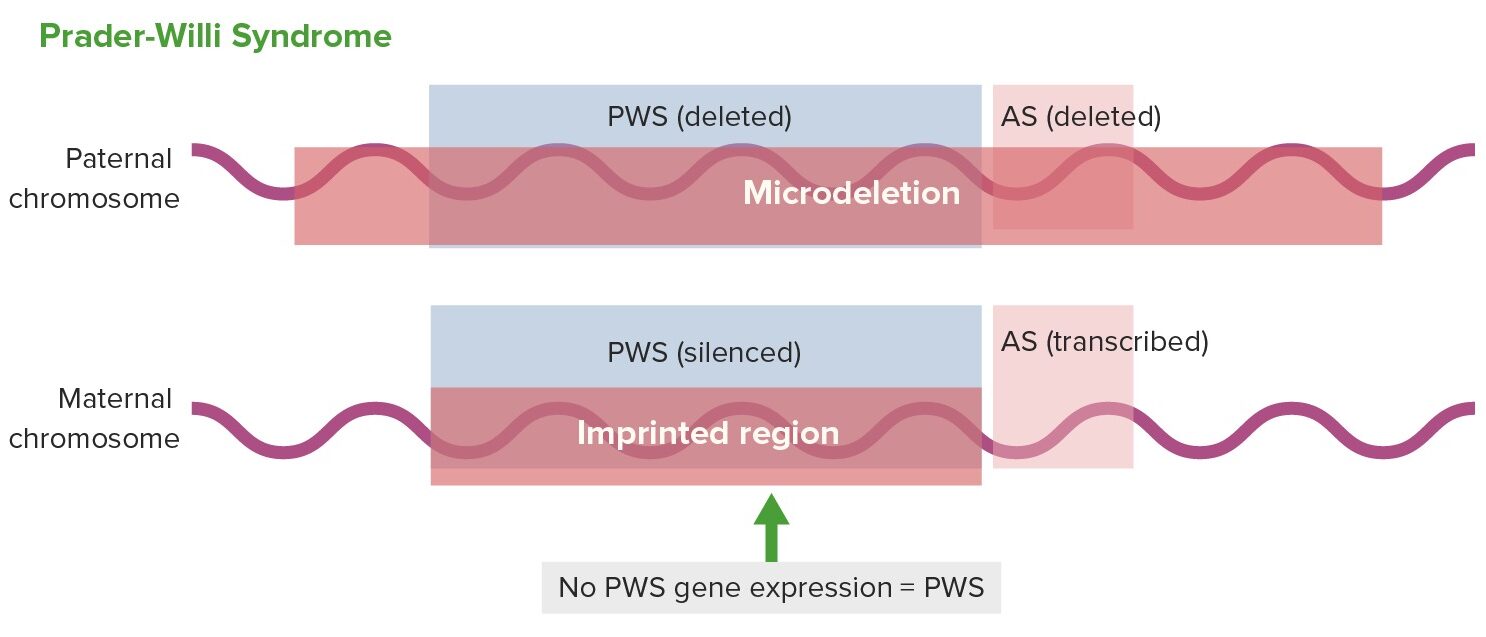
Imagem por Lecturio.

Síndrome de Prader-Willi

  • A região genética Prader-Willi é:
    • Transcrita apenas do cromossoma paterno
    • Hipermetilado (ou seja, silenciado) no cromossoma materno
  • Deleções paternas nesta região resultam em SPW.
  • Apresentação Clínica:
    • Hiperfagia com obesidade precoce
    • Hipogonadismo
    • Atraso leve no desenvolvimento
    • Características faciais anormais
    • Baixa estatura com mãos e pés geralmente pequenos
Expressão gênica em Prader-Willi

Expressão génica na síndrome de Prader-Willi:

AS: Síndrome de Angelman
PWS: Síndrome de Prader-Willi
Imagem por Lecturio.

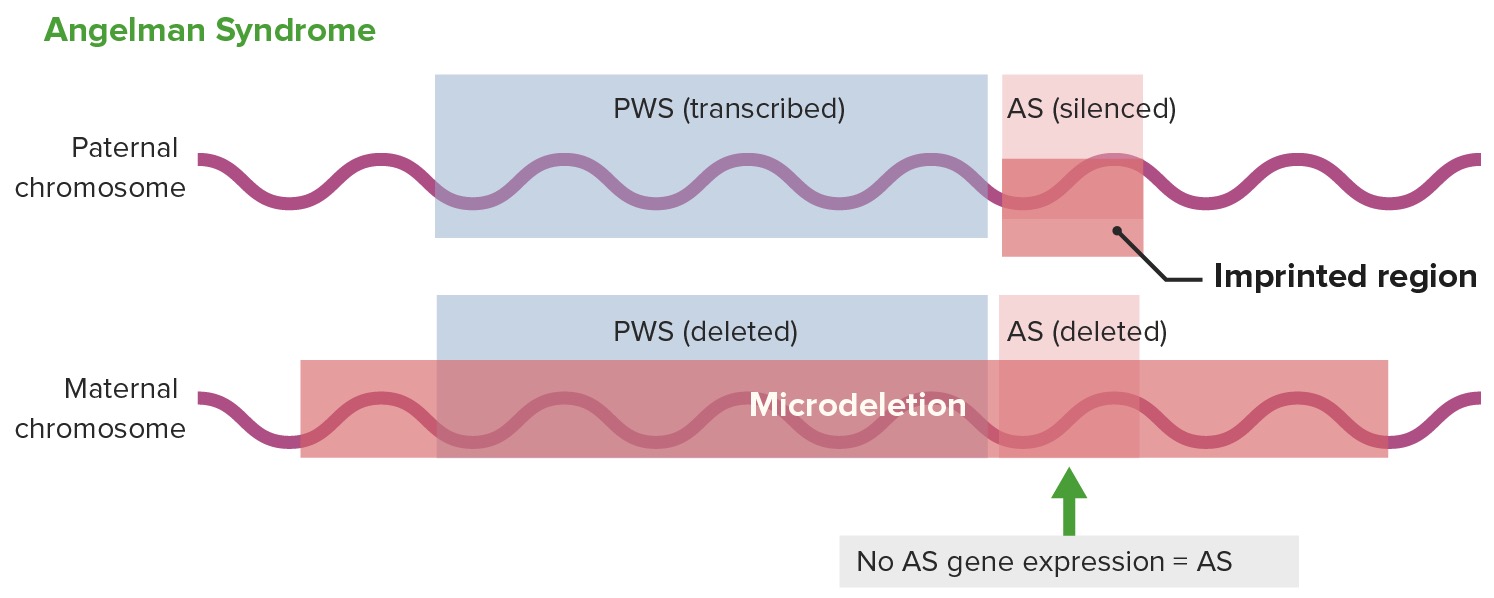
Síndrome de Angelman

  • A região genética Angelman é:
    • Transcrita apenas do cromossoma materno
    • Hipermetilado (ou seja, silenciado) no cromossoma paterno
  • Deleções maternas nesta região resultam em SA.
  • Apresentação clínica: “o fantoche feliz”:
    • Microcefalia com convulsões
    • Atrasos graves no desenvolvimento
    • Discurso mínimo
Expressão gênica em Angelman

Expressão génica na síndrome de Angelman

AS: Síndrome de Angelman
PWS: Síndrome de Prader-Willi

Imagem por Lecturio.

Relevância Clínica

  • Cancro: Todos os cancros têm anomalias na sua regulação epigenética. Além disso, algumas “assinaturas” epigenéticas comuns foram descobertas em certos tipos de cancros. Exemplos destas assinaturas incluem hipometilação global que leva à ativação de oncogenes Oncogenes Genes whose gain-of-function alterations lead to neoplastic cell transformation. They include, for example, genes for activators or stimulators of cell proliferation such as growth factors, growth factor receptors, protein kinases, signal transducers, nuclear phosphoproteins, and transcription factors. A prefix of ‘v-‘ before oncogene symbols indicates oncogenes captured and transmitted by retroviruses; the prefix ‘c-‘ before the gene symbol of an oncogene indicates it is the cellular homolog (proto-oncogenes) of a v-oncogene. Carcinogenesis (por exemplo, RAS RAS Renal artery stenosis (RAS) is the narrowing of one or both renal arteries, usually caused by atherosclerotic disease or by fibromuscular dysplasia. If the stenosis is severe enough, the stenosis causes decreased renal blood flow, which activates the renin-angiotensin-aldosterone system (RAAS) and leads to renovascular hypertension (RVH). Renal Artery Stenosis) e metilação de DNA DNA A deoxyribonucleotide polymer that is the primary genetic material of all cells. Eukaryotic and prokaryotic organisms normally contain DNA in a double-stranded state, yet several important biological processes transiently involve single-stranded regions. DNA, which consists of a polysugar-phosphate backbone possessing projections of purines (adenine and guanine) and pyrimidines (thymine and cytosine), forms a double helix that is held together by hydrogen bonds between these purines and pyrimidines (adenine to thymine and guanine to cytosine). DNA Types and Structure em sequências promotoras que silenciam genes Genes A category of nucleic acid sequences that function as units of heredity and which code for the basic instructions for the development, reproduction, and maintenance of organisms. DNA Types and Structure supressores de tumor Tumor Inflammation. Além disso, as mutações também podem afetar outras modificações de histonas.
  • Inibidores da histona desacetilase: a acetilação da histona ativa a expressão génica e as HDACs removem os grupos acetil; portanto, os inibidores de HDAC acabam por aumentar a expressão génica. Alguns exemplos incluem romidepsina, panobinostat e vorinostat, usados no tratamento de linfomas de células T. Além disso, o ácido valpróico (fármaco antiepilético) também demonstra atividade inibidora de HDAC e está a ser explorado para aplicações além do controlo de convulsões relacionadas com a atividade inibidora de HDAC.
  • Doença de Alzheimer: doença neurodegenerativa que resulta em demência. Acredita-se que a doença de Alzheimer seja o resultado de proteínas mal “dobradas” e/ou anormalmente modificadas, incluindo o peptídeo β-amilóide e as proteínas tau. Também estão implicados na sua patogénese fatores ambientais e epigenéticos, embora os mecanismos exatos ainda sejam desconhecidos. Os doentes apresentam demência progressiva.
  • Síndrome de progeria de Hutchinson-Gilford (HGPS, pela sigla em inglês): síndrome de envelhecimento prematuro relacionada com um defeito genético raro na laminina A, fundamental na estabilização da membrana nuclear. Sem laminina A normal e funcional, a heterocromatina torna-se muito desorganizada e instável, e a transcrição do gene Gene A category of nucleic acid sequences that function as units of heredity and which code for the basic instructions for the development, reproduction, and maintenance of organisms. Basic Terms of Genetics está desregulada. Os doentes com HGPS manifestam-se com múltiplos sintomas de progeroides aos 2 anos de idade, incluindo má progressão estatuto-ponderal e anomalias dermatológicas, musculoesqueléticas, neurológicas, auditivas, oftalmológicas e cardiovasculares limitantes para a vida.

Referências

  1. Azadegan, C., Akbarjalali, M., Chen, Z., & Velayuthan, S. (2025, March). Connecting the dots: Epigenetic regulation of extrachromosomal and inherited DNA amplifications. Journal of Biological Chemistry, Article 108454. https://doi.org/10.1016/j.jbc.2025.108454
  2. Dai, W., Zhang, Y., Chen, X., Xu, X., Gao, C., & Liu, Y. (2024). Epigenetics-targeted drugs: Current paradigms and future challenges. Signal Transduction and Targeted Therapy, 9(1), 1–71. https://doi.org/10.1038/s41392-024-02039-0
  3. Frontiers in Cell and Developmental Biology. (2025). Epigenetic regulation of genome integrity and its implications in human diseases. Frontiers. https://www.frontiersin.org/research-topics/52769/epigenetic-regulation-of-genome-integrity-and-its-implications-in-human-diseases/magazine
  4. Meng, Y., & Nerlov, C. (2025). Epigenetic regulation of hematopoietic stem cell fate. Trends in Cell Biology, 35(3), 217–229. https://doi.org/10.1016/j.tcb.2024.08.005
  5. Nelson, D. L., & Cox, M. M. (2021). Lehninger principles of biochemistry (8th ed.). W. H. Freeman and Company.
  6. Pang, L., Zhai, K., Niu, L., Yu, X., & Zhao, S. (2024). Epigenetic regulation of tumor immunity. The Journal of Clinical Investigation, 134(12). https://doi.org/10.1172/JCI178540
  7. Wang, X., Zhang, S., Song, Y., Wu, J., & Liu, Y. (2024). Mechanisms and advances of epigenetic regulation in cardiovascular disease. Frontiers in Bioscience (Landmark Edition), 29(6), 205. https://doi.org/10.31083/j.fbl2906205

Crie sua conta gratuita ou faça login para continuar lendo!

Cadastre-se agora e tenha acesso grátis ao Lecturio, com páginas de conceitos, vídeos de medicina e questões para sua educação médica.

Aprende mais com a Lecturio:

Multiple devices displaying human anatomy and health education content.

Complementa o teu estudo da faculdade com o companheiro de estudo tudo-em-um da Lecturio, através de métodos de ensino baseados em evidência.

Estuda onde quiseres

Two iPhones display medical education apps, one showing anatomy, the other Bookmatcher.

A Lecturio Medical complementa o teu estudo através de métodos de ensino baseados em evidência, vídeos de palestras, perguntas e muito mais – tudo combinado num só lugar e fácil de usar.

User Reviews

Have a holly, jolly study session 🎁 Save 50% on all plans now >>

Que tengas una sesión de estudio alegre y navideña 🎁 Ahorra 50% en todos los planes >>

Details