A anomalia de Ebstein (AE) é uma cardiopatia congénita (CC) cianótica caracterizada pelo deslocamento para baixo dos folhetos septal e posterior da válvula tricúspide (VTVTVentricular tachycardia is any heart rhythm faster than 100 beats/min, with 3 or more irregular beats in a row, arising distal to the bundle of his. Ventricular tachycardia is the most common form of wide-complex tachycardia, and it is associated with a high mortality rate.Ventricular Tachycardia). A anomalia de Ebstein é responsável por menos de 1% de todos os casos de CC. O uso materno de lítio é uma causa comum da AE. A apresentação clínica varia, sendo o sintoma maisMAISAndrogen Insensitivity Syndrome comum a cianose. A idade de apresentação varia de in utero a adulto e é proporcional à gravidade do deslocamento da VTVTVentricular tachycardia is any heart rhythm faster than 100 beats/min, with 3 or more irregular beats in a row, arising distal to the bundle of his. Ventricular tachycardia is the most common form of wide-complex tachycardia, and it is associated with a high mortality rate.Ventricular Tachycardia, sendo que a maioria dos casos se apresenta durante a adolescência. A anomalia de Ebstein apresenta múltiplas comorbilidades, especialmente a síndrome de Wolff-Parkinson-White. O diagnóstico é confirmado por ecocardiograma e o tratamento definitivo é cirúrgico. Mesmo os pacientes que são tratados adequadamente ainda mantêm uma esperança de vida reduzida.
A anomalia de Ebstein (AE) é uma cardiopatia congénita (CC) cianótica caracterizada pelo deslocamento para baixo dos folhetos septal e posterior da válvula tricúspide (VTVTVentricular tachycardia is any heart rhythm faster than 100 beats/min, with 3 or more irregular beats in a row, arising distal to the bundle of his. Ventricular tachycardia is the most common form of wide-complex tachycardia, and it is associated with a high mortality rate.Ventricular Tachycardia) para o ventrículo direito (VD).
Morfologia
VTVTVentricular tachycardia is any heart rhythm faster than 100 beats/min, with 3 or more irregular beats in a row, arising distal to the bundle of his. Ventricular tachycardia is the most common form of wide-complex tachycardia, and it is associated with a high mortality rate.Ventricular Tachycardia na AE:
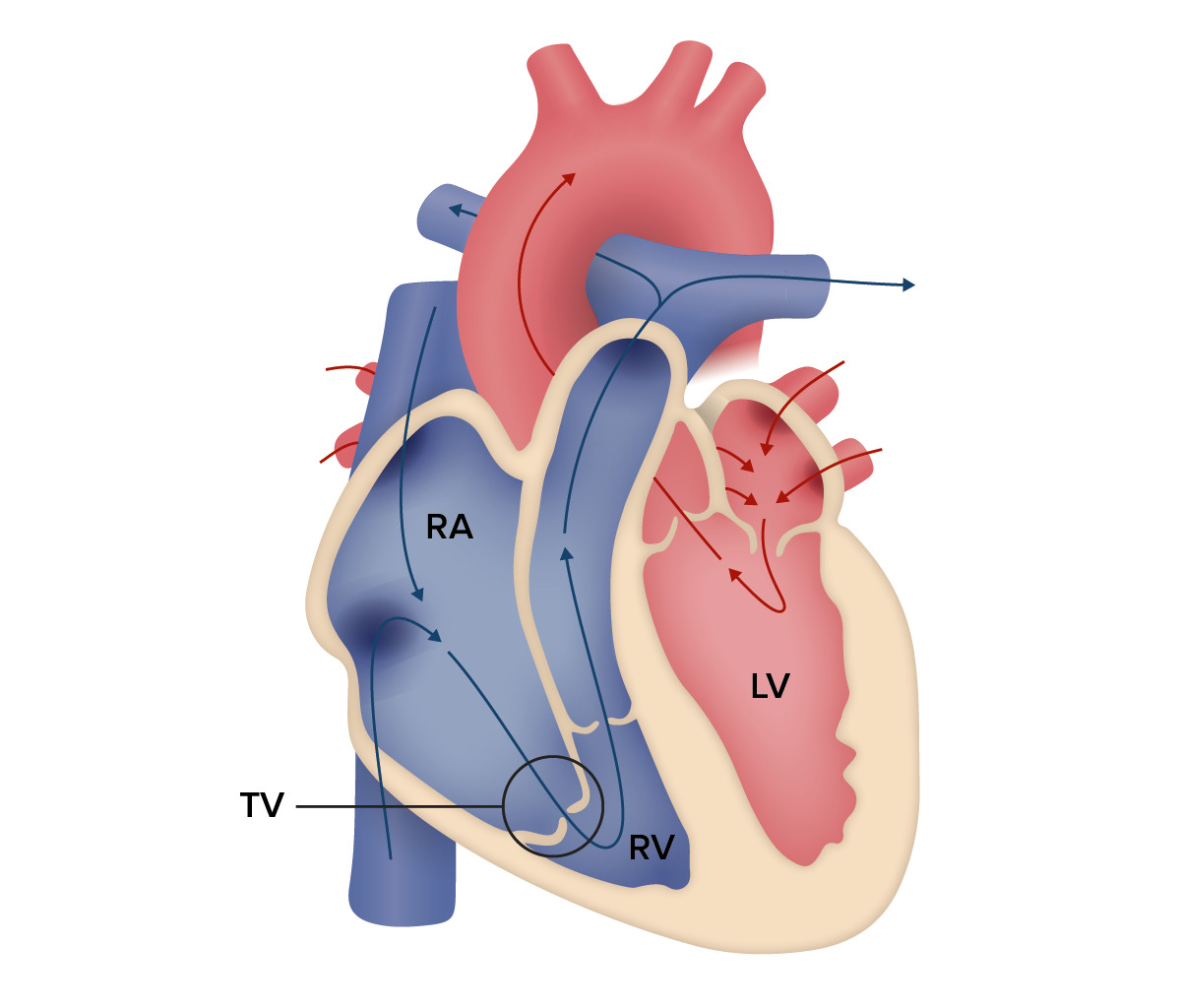
Os folhetos posterior e septal estão deslocados para baixo, afastando-se da junção auriculoventricular (AV) para dentro do VD.
O folheto anterior fica fixado na junção AV e pode ser fenestrado e preso ao miocárdio → regurgitação
VD:
Devido ao deslocamento da junção AV, uma porção do VD é “auricularizada” e fina, sem contratilidade ventricular.
O tamanho do verdadeiro VD “funcional” é limitado e em casos graves pode ser apenas a via de saída do ventrículo direito (VSVD).
Vias de condução acessórias → Síndrome de Wolff-Parkinson-White
Junção AV que afeta a via de condução → bloqueio de ramo direito
Epidemiologia
0.3-0.5% de todos os casos de CC
40% de todas as anomalias congénitas da válvula tricúspide
1.2 a 5 em cada 100.000 nados vivos
A idade média de apresentação é o final da infância ou na adolescência.
Etiologia
Falha de delaminação (separação) da VTVTVentricular tachycardia is any heart rhythm faster than 100 beats/min, with 3 or more irregular beats in a row, arising distal to the bundle of his. Ventricular tachycardia is the most common form of wide-complex tachycardia, and it is associated with a high mortality rate.Ventricular Tachycardia da parede miocárdica devido a:
Uso materno de lítio no início da gravidez
Predisposição genética heterogénea
Estudos recentes identificaram os genesGenesA category of nucleic acid sequences that function as units of heredity and which code for the basic instructions for the development, reproduction, and maintenance of organisms.DNA Types and Structure MYH7, TPM1 e NKX2-5 como associados a casos familiares da anomalia de Ebstein.
Diagrama da AE: Note o deslocamento para baixo da VT e a resultante redução significativa do tamanho (“auricularização”) do VD. RV: ventrículo direito LV: ventrículo esquerdo RA: aurícula direita TV: válvula tricúspide
Imagem por Lecturio.
Fisiopatologia
A cianose e a insuficiência cardíaca na AE devem-se à deficiência funcional do VD e à regurgitação tricúspide que resulta numa fração de ejeção (FE) reduzida.
O aumento do refluxo para a aurícula direita (ADADThe term advance directive (AD) refers to treatment preferences and/or the designation of a surrogate decision-maker in the event that a person becomes unable to make medical decisions on their own behalf. Advance directives represent the ethical principle of autonomy and may take the form of a living will, health care proxy, durable power of attorney for health care, and/or a physician’s order for life-sustaining treatment.Advance Directives) resulta no desvio de sangue da ADADThe term advance directive (AD) refers to treatment preferences and/or the designation of a surrogate decision-maker in the event that a person becomes unable to make medical decisions on their own behalf. Advance directives represent the ethical principle of autonomy and may take the form of a living will, health care proxy, durable power of attorney for health care, and/or a physician’s order for life-sustaining treatment.Advance Directives para a esquerda através da comunicação interauricular, contornando o pulmão e causando cianose.
Redução da FEVD devido a:
Deslocamento da TV fazendo com que o ventrículo se reduza a uma VSVD
Regurgitação da VTVTVentricular tachycardia is any heart rhythm faster than 100 beats/min, with 3 or more irregular beats in a row, arising distal to the bundle of his. Ventricular tachycardia is the most common form of wide-complex tachycardia, and it is associated with a high mortality rate.Ventricular Tachycardia
VD com problemas funcionais devido à porção “auricularizada”
Redução da FE → insuficiência cardíaca do lado direito
Dilatação do VD causa dilatação do anel valvular → agrava a regurgitação
Fluxo de sangue para a ADADThe term advance directive (AD) refers to treatment preferences and/or the designation of a surrogate decision-maker in the event that a person becomes unable to make medical decisions on their own behalf. Advance directives represent the ethical principle of autonomy and may take the form of a living will, health care proxy, durable power of attorney for health care, and/or a physician’s order for life-sustaining treatment.Advance Directives durante a sístole → aumento da pressão na ADADThe term advance directive (AD) refers to treatment preferences and/or the designation of a surrogate decision-maker in the event that a person becomes unable to make medical decisions on their own behalf. Advance directives represent the ethical principle of autonomy and may take the form of a living will, health care proxy, durable power of attorney for health care, and/or a physician’s order for life-sustaining treatment.Advance Directives → aumento da pressão venosa → congestão venosa sistémica
Dilatação da ADADThe term advance directive (AD) refers to treatment preferences and/or the designation of a surrogate decision-maker in the event that a person becomes unable to make medical decisions on their own behalf. Advance directives represent the ethical principle of autonomy and may take the form of a living will, health care proxy, durable power of attorney for health care, and/or a physician’s order for life-sustaining treatment.Advance Directives:
A estagnação do sangue pode causar maisMAISAndrogen Insensitivity Syndrome dilatação da ADADThe term advance directive (AD) refers to treatment preferences and/or the designation of a surrogate decision-maker in the event that a person becomes unable to make medical decisions on their own behalf. Advance directives represent the ethical principle of autonomy and may take the form of a living will, health care proxy, durable power of attorney for health care, and/or a physician’s order for life-sustaining treatment.Advance Directives e arritmias como a fibrilhação auricular.
Aumento da pressão na câmara → shunt direito-esquerdo (D-E) através de uma comunicação interauricular → maisMAISAndrogen Insensitivity Syndrome sangue desoxigenado na circulação sistémica → cianose:
Em recém-nascidos, o shunt D-E é favorecido pela alta resistência vascular pulmonar presente ao nascimento.
Apresentação Clínica
Os sintomas são variáveis porque dependem da gravidade do deslocamento para baixo da VTVTVentricular tachycardia is any heart rhythm faster than 100 beats/min, with 3 or more irregular beats in a row, arising distal to the bundle of his. Ventricular tachycardia is the most common form of wide-complex tachycardia, and it is associated with a high mortality rate.Ventricular Tachycardia, que condiciona o grau de regurgitação e de dilatação do VD.
In utero:
Pode causar hidrópsia fetal
Pode causar cardiomegalia grave ao nascer
Da infância à vida adulta:
Má progressão estaturo-ponderal
Palpitações (arritmia)
Cianose
Insuficiência cardíaca do lado direito:
Dispneia
EdemaEdemaEdema is a condition in which excess serous fluid accumulates in the body cavity or interstitial space of connective tissues. Edema is a symptom observed in several medical conditions. It can be categorized into 2 types, namely, peripheral (in the extremities) and internal (in an organ or body cavity). Edema
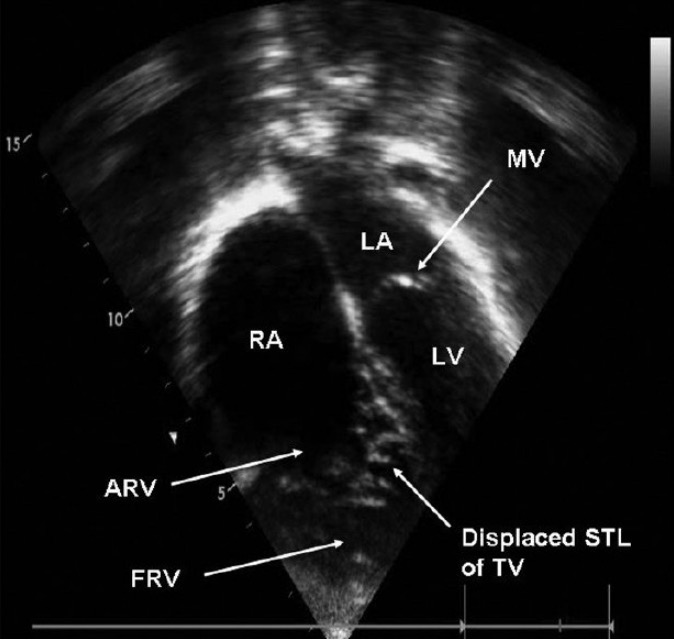
O ecocardiograma é o exame de eleição para o diagnóstico da AE.
O ecocardiograma transtorácico a mostrar o deslocamento apical da VT e porção “auricularizada” do VD, característico da AE ARV: ventrículo direito “auricularizado” FRV: ventrículo direito funcional LA: aurícula esquerda LV: ventrículo esquerdo MV: válvula mitral RA: aurícula direita STL: folheto tricúspide septal
Imagem: “A transthoracic echocardiographic image” por the Department of Pediatric Cardiology, Narayan Hrudayalaya Institute of Cardiac Sciences, Bangalore, India. Licença: CC BY 2.0.
Achados de DopplerDopplerUltrasonography applying the doppler effect, with frequency-shifted ultrasound reflections produced by moving targets (usually red blood cells) in the bloodstream along the ultrasound axis in direct proportion to the velocity of movement of the targets, to determine both direction and velocity of blood flow.Ultrasound (Sonography) e ecocardiograma transtorácico:
Grau de deslocamento dos folhetos tricúspides (> 8 mm/m3)
Exames para confirmar a presença de comorbilidades:
Eletrocardiograma (ECGECGAn electrocardiogram (ECG) is a graphic representation of the electrical activity of the heart plotted against time. Adhesive electrodes are affixed to the skin surface allowing measurement of cardiac impulses from many angles. The ECG provides 3-dimensional information about the conduction system of the heart, the myocardium, and other cardiac structures. Electrocardiogram (ECG))para diagnosticar:
Bloqueio de ramo direito
Síndrome de Wolf-Parkinson-White (ondas delta)
Um ECGECGAn electrocardiogram (ECG) is a graphic representation of the electrical activity of the heart plotted against time. Adhesive electrodes are affixed to the skin surface allowing measurement of cardiac impulses from many angles. The ECG provides 3-dimensional information about the conduction system of the heart, the myocardium, and other cardiac structures. Electrocardiogram (ECG) de 24 horas (Holter) → avaliar arritmias
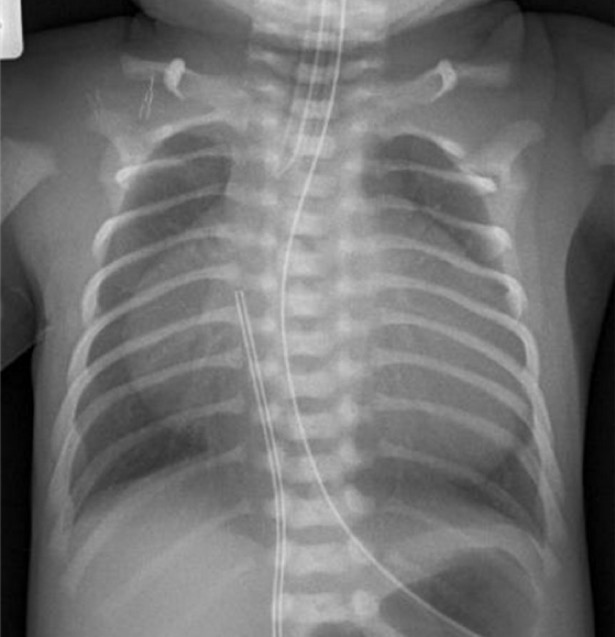
Radiografia de tórax → cardiomegalia (“wall-to-wall heart”)
“Coração de parede a parede” num recém-nascido com AE
Imagem: “Proband’s chest” por Diagnostic Genetics, LabPlus, Auckland City Hospital, P.O. Box 110031, Auckland 1148, New Zealand. Licença: CC BY 3.0.
Tratamento e Prognóstico
Em recém-nascidos, o objetivo é o tratamento médico.
Terapêutica médica
A terapêutica médica é utilizada antes da estabilização cirúrgica para otimizar a insuficiência cardíaca e as arritmias. O tratamento médico está indicado em recém-nascidos e adultos sintomáticos:
Recém-nascidos: visa a redução da pressão vascular pulmonar:
Mantém o canal arterial patente → prostaglandina E1E1An aromatized C18 steroid with a 3-hydroxyl group and a 17-ketone, a major mammalian estrogen. It is converted from androstenedione directly, or from testosterone via estradiol. In humans, it is produced primarily by the cyclic ovaries, placenta, and the adipose tissue of men and postmenopausal women.Noncontraceptive Estrogen and Progestins
Óxido nítrico inalado
Criança/adulto:
Tratar a insuficiência cardíaca e a sobrecarga de volume.
Tratar comorbilidades como arritmias.
Recomenda-se aos doentes que pratiquem atividade física moderada regularmente, conforme tolerado.
Recomenda-se aos doentes que evitem desportos competitivos ou atividades extenuantes que possam exacerbar os sintomas.
Inclui o encerramento dos defeitos associados e a ablação das vias de condução acessórias
A técnica de reparação do cone tornou-se o método cirúrgico preferido para a reparação da válvula tricúspide na anomalia de Ebstein.
Prognóstico
A gravidade da anomalia determina o prognóstico.
Alta taxa de mortalidade in utero
A esperança de vida é reduzida para os anos 50 se a AE se apresentar na infância.
86% dos pacientes necessitam de reparação cirúrgica.
A cianose e a insuficiência cardíaca na infância têm um pior prognóstico.
Diagnóstico Diferencial
Os diagnósticos diferenciais da AE são os seguintes:
Anomalia de Uhl: uma cardiopatia rara caracterizada pela falta de miócitos no VD, resultando na dilatação do VD e no adelgaçamento do miocárdio. A maioria dos casos apresenta-se como insuficiência cardíaca em recém-nascidos. O ecocardiograma diferencia-a da AE porque a anomalia de Uhl poupa a VTVTVentricular tachycardia is any heart rhythm faster than 100 beats/min, with 3 or more irregular beats in a row, arising distal to the bundle of his. Ventricular tachycardia is the most common form of wide-complex tachycardia, and it is associated with a high mortality rate.Ventricular Tachycardia.
AtresiaAtresiaHypoplastic Left Heart Syndrome (HLHS) da VTVTVentricular tachycardia is any heart rhythm faster than 100 beats/min, with 3 or more irregular beats in a row, arising distal to the bundle of his. Ventricular tachycardia is the most common form of wide-complex tachycardia, and it is associated with a high mortality rate.Ventricular Tachycardia: uma malformação congénita causada pela ausência da VTVTVentricular tachycardia is any heart rhythm faster than 100 beats/min, with 3 or more irregular beats in a row, arising distal to the bundle of his. Ventricular tachycardia is the most common form of wide-complex tachycardia, and it is associated with a high mortality rate.Ventricular Tachycardia, onde não há comunicação entre a ADADThe term advance directive (AD) refers to treatment preferences and/or the designation of a surrogate decision-maker in the event that a person becomes unable to make medical decisions on their own behalf. Advance directives represent the ethical principle of autonomy and may take the form of a living will, health care proxy, durable power of attorney for health care, and/or a physician’s order for life-sustaining treatment.Advance Directives e o VD. Os pacientes apresentam cianose e hipoxemia desde o nascimento e inicialmente devem ser tratados medicamente, seguido de correção cirúrgica.
As seguintes malformações são comorbilidades da AE:
Regurgitação tricúspide (RT): uma das principais características morfológicas da AE, a RT resulta no refluxo de sangue do VD para a ADADThe term advance directive (AD) refers to treatment preferences and/or the designation of a surrogate decision-maker in the event that a person becomes unable to make medical decisions on their own behalf. Advance directives represent the ethical principle of autonomy and may take the form of a living will, health care proxy, durable power of attorney for health care, and/or a physician’s order for life-sustaining treatment.Advance Directives durante a sístole. A regurgitação piora com o tempo, devido ao aumento do diâmetro do anel. Deve ser reparada cirurgicamente.
CIACIASyphilis: o defeito intra-auricular maisMAISAndrogen Insensitivity Syndrome comum presente em pacientes com AE. A síndrome de Eisenmenger ocorre à medida que a pressão na ADADThe term advance directive (AD) refers to treatment preferences and/or the designation of a surrogate decision-maker in the event that a person becomes unable to make medical decisions on their own behalf. Advance directives represent the ethical principle of autonomy and may take the form of a living will, health care proxy, durable power of attorney for health care, and/or a physician’s order for life-sustaining treatment.Advance Directives aumenta, resultando em cianose, especialmente no final da infância. Também pode levar a uma embolia paradoxal em alguns casos.
Insuficiência cardíaca: a anomalia de Ebstein resulta em insuficiência cardíaca do lado direito, devido à disfunção do VD. Os sintomas de insuficiência cardíaca do lado direito incluem edemaEdemaEdema is a condition in which excess serous fluid accumulates in the body cavity or interstitial space of connective tissues. Edema is a symptom observed in several medical conditions. It can be categorized into 2 types, namely, peripheral (in the extremities) and internal (in an organ or body cavity). Edema e congestão hepática com sinais de PVJ elevada, edemaEdemaEdema is a condition in which excess serous fluid accumulates in the body cavity or interstitial space of connective tissues. Edema is a symptom observed in several medical conditions. It can be categorized into 2 types, namely, peripheral (in the extremities) and internal (in an organ or body cavity). Edema depressível e ascite.
Taquicardia supraventricular: a anomalia de Ebstein está normalmente associada à presença de vias acessórias, o que resulta em arritmias como a síndrome de Wolff-Parkinson-White. Muitos pacientes na idade adulta podem apresentar palpitações como o 1º sintoma. Outras formas de arritmias como fibrilhação auricular ou flutter auricular têm sido observadas em alguns casos raros devido à dilatação da ADADThe term advance directive (AD) refers to treatment preferences and/or the designation of a surrogate decision-maker in the event that a person becomes unable to make medical decisions on their own behalf. Advance directives represent the ethical principle of autonomy and may take the form of a living will, health care proxy, durable power of attorney for health care, and/or a physician’s order for life-sustaining treatment.Advance Directives.
Referências
Kliegman, R. M. et al. (2020). Cyanotic congenital heart disease: Lesions associated with decreased pulmonary blood flow. In R. M. Kliegman MD et al. Nelson textbook of pediatrics (pp. 239-2407.e1). https://www.clinicalkey.es/#!/content/3-s2.0-B9780323529501004570
Murthy, R., Moe, T. G., Van Arsdell, G. S., Nigro, J. J., & Karamlou, T. (2019). Congenital heart disease. In F. C. Brunicardi et al. (Eds.), Schwartz’s principles of surgery, 11e. New York, NY: McGraw-Hill Education. Retrieved from accessmedicine.mhmedical.com/content.aspx?aid=1164311314
Ramcharan, T. K. W., Goff, D. A., Greenleaf, C. E., & Rychik, J. (2022). Ebstein’s anomaly: From fetus to adult—Literature review and pathway for patient care. Pediatric Cardiology, 43(7), 1409–1428. https://doi.org/10.1007/s00246-022-02908-x
A Lecturio Medical complementa o teu estudo através de métodos de ensino baseados em evidência, vídeos de palestras, perguntas e muito mais – tudo combinado num só lugar e fácil de usar.
User Reviews
One Platform. Everything You Need to Succeed. 📚 Get 30% off all plans and certificates!
Lecturio Premium dá-lhe acesso total a todos os conteúdos e características
Obtenha Premium para ver todos os vídeos
Verifique agora o seu e-mail para obter um teste gratuito.
Crie uma conta gratuita para testar os seus conhecimentos
Lecturio Premium dá-lhe acesso total a todos os conteúdos e características - incluindo o Qbank de Lecturio com perguntas actualizadas ao estilo do board-.