Domina Conceptos Médicos

Estudia para la escuela de medicina y tus examenes con Lecturio.

Sistema Arterial Carotídeo: Anatomía

El sistema arterial carotídeo es el encargado de la irrigación sanguínea a la cabeza y cuello. El sistema arterial comienza con la arteria carótida común, que nace directamente del arco aórtico en EN Erythema nodosum is an immune-mediated panniculitis (inflammation of the subcutaneous fat) caused by a type IV (delayed-type) hypersensitivity reaction. It commonly manifests in young women as tender, erythematous nodules on the shins. Erythema Nodosum el lado izquierdo y del tronco/arteria braquiocefálica en EN Erythema nodosum is an immune-mediated panniculitis (inflammation of the subcutaneous fat) caused by a type IV (delayed-type) hypersensitivity reaction. It commonly manifests in young women as tender, erythematous nodules on the shins. Erythema Nodosum el lado derecho. Posteriormente, ambas arterias carótidas comunes ascienden por el cuello y se dividen en EN Erythema nodosum is an immune-mediated panniculitis (inflammation of the subcutaneous fat) caused by a type IV (delayed-type) hypersensitivity reaction. It commonly manifests in young women as tender, erythematous nodules on the shins. Erythema Nodosum las arterias carótidas internas y externas. La primera abastece las estructuras del cerebro y las órbitas, mientras que la segunda abastece las estructuras superficiales y partes del cuello y la cara.

Last updated: Dec 15, 2025

Editorial responsibility: Stanley Oiseth, Lindsay Jones, Evelin Maza

Arteria Carótida Común

La arteria carótida común posee diferentes orígenes dependiendo de cada lado del cuerpo:

  • Izquierdo: la arteria carótida común izquierda se origina directamente del arco aórtico.
  • Derecho: el tronco/arteria braquiocefálica (1ra rama del arco aórtico) se bifurca por detrás de la articulación esternoclavicular en EN Erythema nodosum is an immune-mediated panniculitis (inflammation of the subcutaneous fat) caused by a type IV (delayed-type) hypersensitivity reaction. It commonly manifests in young women as tender, erythematous nodules on the shins. Erythema Nodosum:
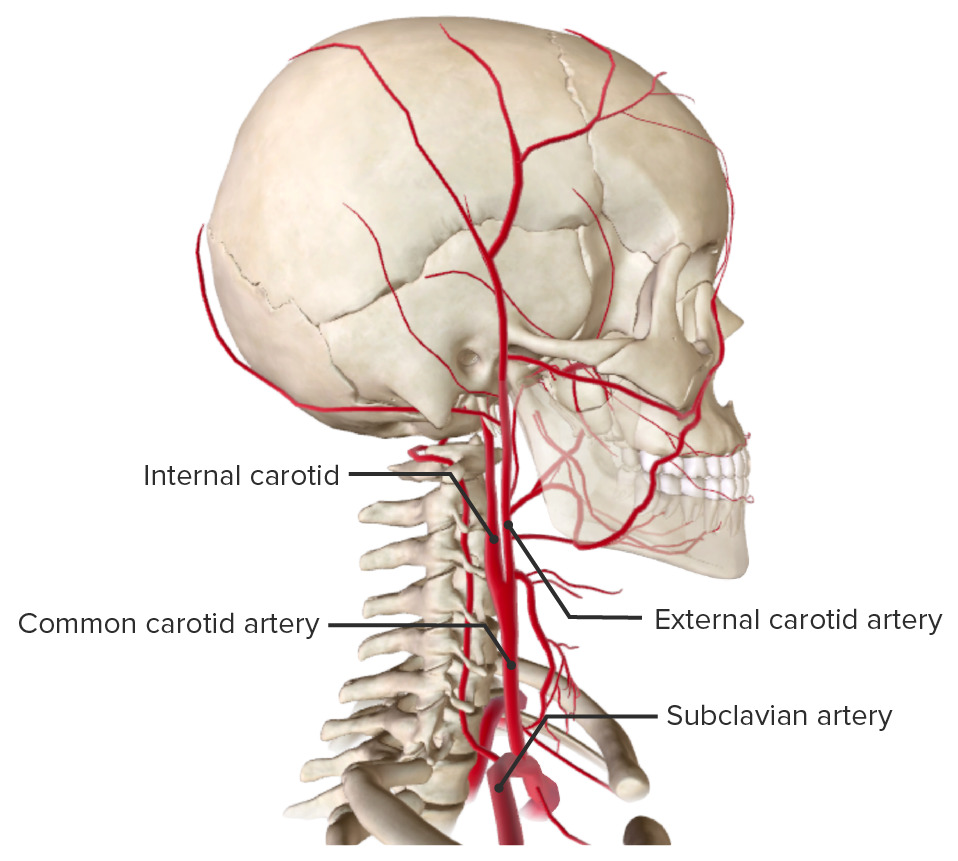
    • Arteria carótida común derecha
    • Arteria subclavia derecha

La arteria carótida común se bifurca a nivel del cartílago tiroides (vértebra C4) en EN Erythema nodosum is an immune-mediated panniculitis (inflammation of the subcutaneous fat) caused by a type IV (delayed-type) hypersensitivity reaction. It commonly manifests in young women as tender, erythematous nodules on the shins. Erythema Nodosum:

  • Arteria carótida externa
  • Arteria carótida interna
Bifurcación de la arteria carótida

Bifurcación de la arteria carótida

Imagen por BioDigital, editada por Lecturio

Glomus o cuerpo carotídeo:

  • Grupo ovalado de quimiorreceptores posterior a la bifurcación
  • Funciona como sensor de los LOS Neisseria niveles de PO2 y de los LOS Neisseria cambios en EN Erythema nodosum is an immune-mediated panniculitis (inflammation of the subcutaneous fat) caused by a type IV (delayed-type) hypersensitivity reaction. It commonly manifests in young women as tender, erythematous nodules on the shins. Erythema Nodosum el pH pH The quantitative measurement of the acidity or basicity of a solution. Acid-Base Balance de la sangre
  • Cambia el ritmo y el volumen de la respiración
  • Inervado por la rama carotídea del nervio glosofaríngeo

Seno carotídeo:

  • Dilatación en EN Erythema nodosum is an immune-mediated panniculitis (inflammation of the subcutaneous fat) caused by a type IV (delayed-type) hypersensitivity reaction. It commonly manifests in young women as tender, erythematous nodules on the shins. Erythema Nodosum la base de la arteria carótida interna
  • Barorreceptor: transmite la información sobre la presión arterial al AL Amyloidosis hipotálamo
  • Inervado por la rama carotídea del nervio glosofaríngeo
Arteria carótida común dentro de la vaina carotídea

Arteria carótida común dentro de la vaina carotídea

Imagen por BioDigital, editada por Lecturio
Tabla: Relaciones espaciales de la arteria carótida común
Parte torácica (izquierda) Parte inferior del cuello (ambas) Parte superior del cuello (ambas)
Anterior
  • Músculos esternohioideos y esternotiroideos
  • Parte anterior de los LOS Neisseria pulmones y la pleura Pleura The pleura is a serous membrane that lines the walls of the thoracic cavity and the surface of the lungs. This structure of mesodermal origin covers both lungs, the mediastinum, the thoracic surface of the diaphragm, and the inner part of the thoracic cage. The pleura is divided into a visceral pleura and parietal pleura. Pleura: Anatomy
  • Restos del timo
  • Vena braquiocefálica izquierda
  • Articulación esternoclavicular
  • Fascia Fascia Layers of connective tissue of variable thickness. The superficial fascia is found immediately below the skin; the deep fascia invests muscles, nerves, and other organs. Cellulitis superficial
  • Platisma
  • Músculos esternocleidomastoideos, esternotiroideos y omohioideos
  • Piel
  • Ramas del plexo cervical
  • Platisma
  • Músculo esternocleidomastoideo
Posterior
  • Tráquea
  • Esófago
  • Nervio laríngeo recurrente izquierdo
  • Conducto torácico
  • Tronco simpático
  • Músculos largo del cuello, largo de la cabeza y escaleno anterior
Lateral
  • Nervio frénico
  • Vago izquierdo
  • Pleura Pleura The pleura is a serous membrane that lines the walls of the thoracic cavity and the surface of the lungs. This structure of mesodermal origin covers both lungs, the mediastinum, the thoracic surface of the diaphragm, and the inner part of the thoracic cage. The pleura is divided into a visceral pleura and parietal pleura. Pleura: Anatomy izquierda
  • Nervio vago
  • Vena yugular interna (dentro de la misma vaina carotídea)
Medial Tronco/arteria braquiocefálica Tráquea
  • Laringe
  • Faringe
  • Glándula tiroidea

Arteria Carótida Externa

La arteria carótida externa irriga las siguientes estructuras:

  • Estructuras superficiales del cuello
  • Cara
  • Mandíbula
  • Cuero cabelludo
  • Meninges Meninges The brain and the spinal cord are enveloped by 3 overlapping layers of connective tissue called the meninges. The layers are, from the most external layer to the most internal layer, the dura mater, arachnoid mater, and pia mater. Between these layers are 3 potential spaces called the epidural, subdural, and subarachnoid spaces. Meninges: Anatomy

Origen

Superficial, dentro del triángulo carotídeo, y a nivel del cartílago tiroides (C4)

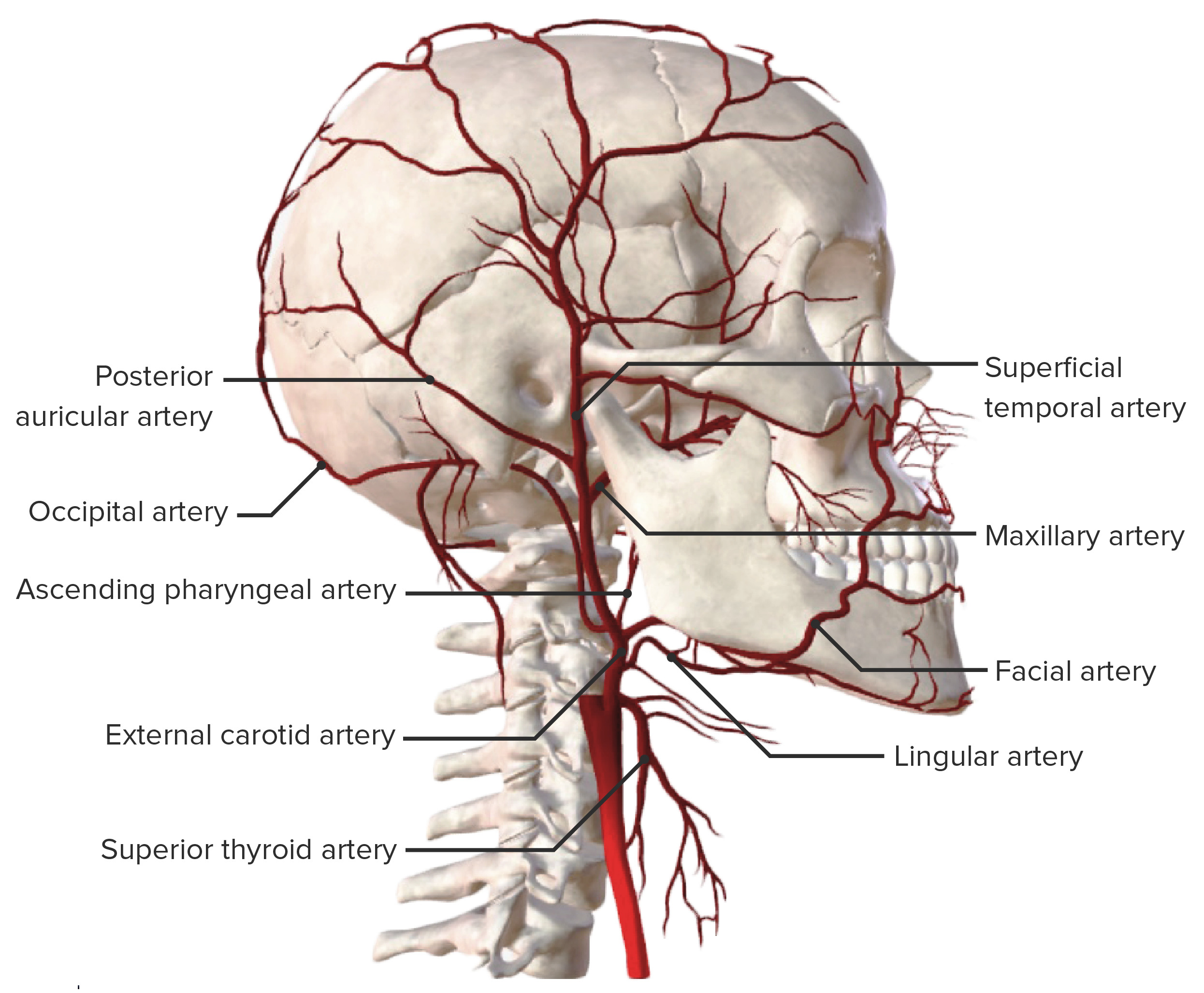
Ocho ramas principales

  1. Arteria tiroidea superior
  2. Arteria faríngea ascendente
  3. Arteria lingual
  4. Arteria facial
  5. Arteria occipital Occipital Part of the back and base of the cranium that encloses the foramen magnum. Skull: Anatomy
  6. Arteria auricular posterior
  7. Arteria maxilar
  8. Arteria temporal superficial
Tabla: Estructuras irrigadas por las 8 ramas principales de la arteria carótida externa
Rama Estructuras irrigadas
Tiroidea superior
  • Glándula tiroides
  • Músculos infrahioideos
  • Músculo esternocleidomastoideo
Faríngea ascendente
  • Faringe
  • Músculos prevertebrales
  • Oído medio
  • Meninges Meninges The brain and the spinal cord are enveloped by 3 overlapping layers of connective tissue called the meninges. The layers are, from the most external layer to the most internal layer, the dura mater, arachnoid mater, and pia mater. Between these layers are 3 potential spaces called the epidural, subdural, and subarachnoid spaces. Meninges: Anatomy craneales
Lingual
  • Músculos intrínsecos de la lengua
  • Suelo de la boca
Facial
  • Amígdalas
  • Paladar
  • Glándulas submandibulares
Occipital Occipital Part of the back and base of the cranium that encloses the foramen magnum. Skull: Anatomy Región posterior del cuero cabelludo
Auricular posterior
  • Glándula parótida
  • Nervio facial
  • Oído
  • Cuero cabelludo
Maxilar
  • Meato acústico externo
  • Membrana timpánica
  • Duramadre
  • Calota
  • Mandíbula
  • Encías
  • Dientes
  • Músculos temporales
  • Músculos pterigoideos
  • Músculos maseteros
  • Músculos buccinadores
Temporal superficial Región temporal del cuero cabelludo
Principales ramas de la arteria carótida externa

Principales ramas de la arteria carótida externa

Imagen por BioDigital, editada por Lecturio

Relaciones

  • Anterior:
    • Piel
    • Fascia Fascia Layers of connective tissue of variable thickness. The superficial fascia is found immediately below the skin; the deep fascia invests muscles, nerves, and other organs. Cellulitis superficial
    • Músculo platisma
    • Fascia Fascia Layers of connective tissue of variable thickness. The superficial fascia is found immediately below the skin; the deep fascia invests muscles, nerves, and other organs. Cellulitis profunda
    • Margen anterior del músculo esternocleidomastoideo
  • Posterior: nervio laríngeo superior
  • Medial:
    • Hueso hioides
    • Faringe
    • Nervio laríngeo superior
    • Glándula parótida
  • Lateral: arteria carótida interna

Arteria Carótida Interna

La arteria carótida interna irriga las siguientes estructuras:

  • Lóbulo frontal Frontal The bone that forms the frontal aspect of the skull. Its flat part forms the forehead, articulating inferiorly with the nasal bone and the cheek bone on each side of the face. Skull: Anatomy
  • Lóbulo parietal Parietal One of a pair of irregularly shaped quadrilateral bones situated between the frontal bone and occipital bone, which together form the sides of the cranium. Skull: Anatomy
  • Lóbulo temporal
  • Diencéfalo
  • Ojos
  • Partes de los LOS Neisseria senos paranasales (arteria oftálmica)
  • Contribuye al AL Amyloidosis polígono de Willis en EN Erythema nodosum is an immune-mediated panniculitis (inflammation of the subcutaneous fat) caused by a type IV (delayed-type) hypersensitivity reaction. It commonly manifests in young women as tender, erythematous nodules on the shins. Erythema Nodosum el sistema cerebrovascular

Localización

  • Se origina en EN Erythema nodosum is an immune-mediated panniculitis (inflammation of the subcutaneous fat) caused by a type IV (delayed-type) hypersensitivity reaction. It commonly manifests in young women as tender, erythematous nodules on the shins. Erythema Nodosum el triángulo carotídeo a nivel del cartílago tiroides (C4)
  • Asciende y entra en EN Erythema nodosum is an immune-mediated panniculitis (inflammation of the subcutaneous fat) caused by a type IV (delayed-type) hypersensitivity reaction. It commonly manifests in young women as tender, erythematous nodules on the shins. Erythema Nodosum el cráneo a través del canal carotídeo (hueso temporal)
  • Termina en EN Erythema nodosum is an immune-mediated panniculitis (inflammation of the subcutaneous fat) caused by a type IV (delayed-type) hypersensitivity reaction. It commonly manifests in young women as tender, erythematous nodules on the shins. Erythema Nodosum las arterias cerebrales media y anterior

Segmentos

La arteria carótida interna se divide en EN Erythema nodosum is an immune-mediated panniculitis (inflammation of the subcutaneous fat) caused by a type IV (delayed-type) hypersensitivity reaction. It commonly manifests in young women as tender, erythematous nodules on the shins. Erythema Nodosum segmentos:
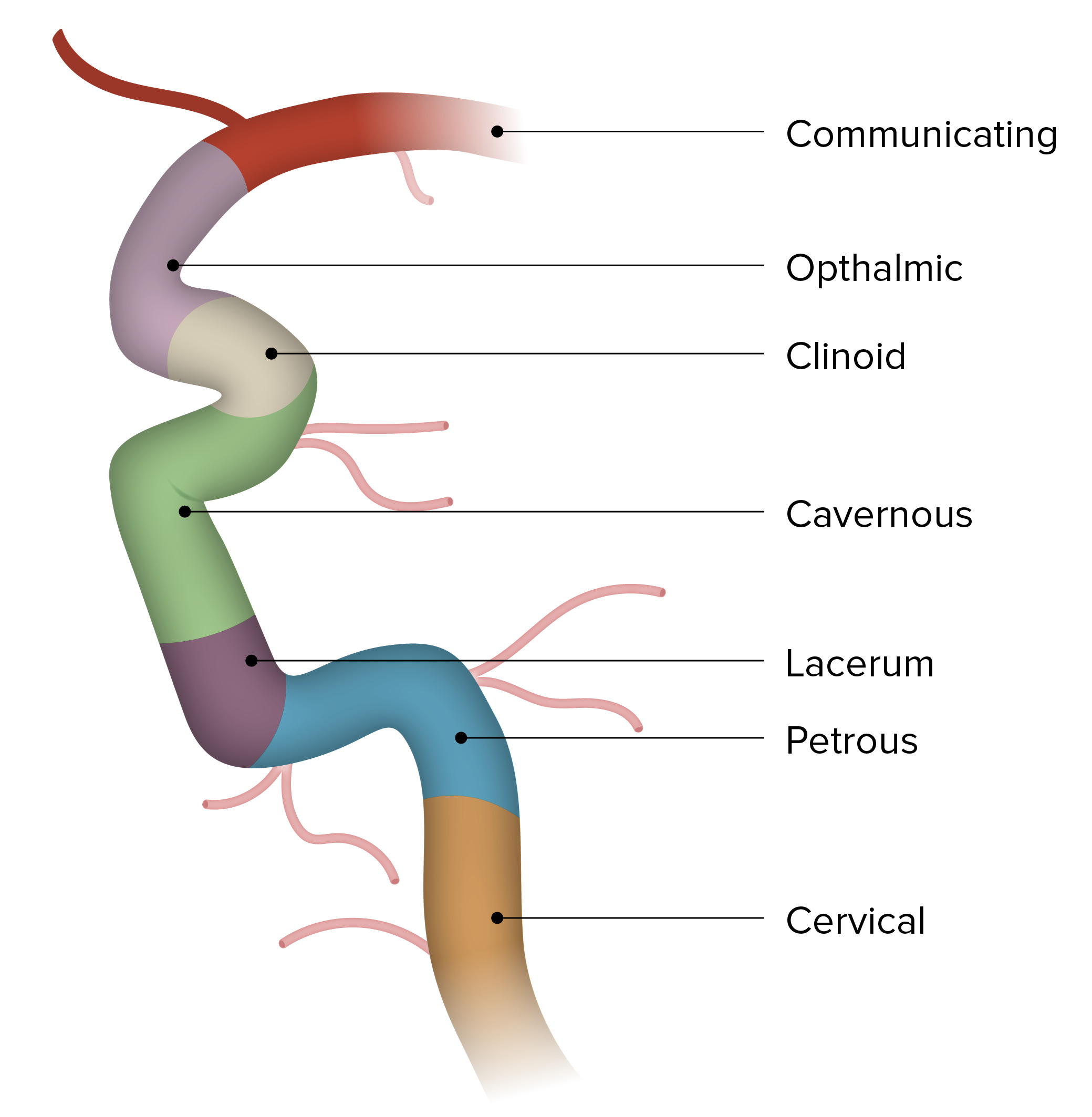
  • División moderna:
    • Porción cervical: sin ramas
    • Porción petrosa
    • Porción cavernosa: se relaciona al AL Amyloidosis seno cavernoso
    • Porción intracraneal
  • Clasificación de Cincinnati:
    • Cervical
    • Petrosa
    • Lacerada
    • Cavernosa
    • Clinoide
    • Oftálmica (supraclinoide)
    • Segmentos comunicantes (terminales)
Segmentos Arteria carótida interna

Segmentos de la arteria carótida interna

Imagen por BioDigital, editada por Lecturio

Relevancia Clínica

  • Estenosis de la arteria carótida: estrechamiento del lumen de las arterias carótidas debido a la deposición de grasa y colesterol. La estenosis de la arteria carótida se produce en EN Erythema nodosum is an immune-mediated panniculitis (inflammation of the subcutaneous fat) caused by a type IV (delayed-type) hypersensitivity reaction. It commonly manifests in young women as tender, erythematous nodules on the shins. Erythema Nodosum pacientes con hipercolesterolemia y aterosclerosis y es un factor de riesgo primario para el accidente cerebrovascular isquémico. La estenosis de la arteria carótida puede tratarse con medicamentos antiplaquetarios o mediante la revascularización quirúrgica en EN Erythema nodosum is an immune-mediated panniculitis (inflammation of the subcutaneous fat) caused by a type IV (delayed-type) hypersensitivity reaction. It commonly manifests in young women as tender, erythematous nodules on the shins. Erythema Nodosum los LOS Neisseria casos graves.
  • Disección de las arterias carótida y vertebral: separación de la túnica media y la túnica íntima de la arteria carótida. La disección suele presentarse con la aparición repentina de un fuerte dolor Dolor Inflammation de cabeza y de cuello. Pueden producirse déficits neurológicos focales secundarios a la estenosis de la arteria carótida o a la formación de trombos.
  • Arteritis temporal superficial: inflamación de la arteria temporal superficial. La arteritis temporal superficial da lugar a un fuerte dolor Dolor Inflammation de cabeza pulsátil en EN Erythema nodosum is an immune-mediated panniculitis (inflammation of the subcutaneous fat) caused by a type IV (delayed-type) hypersensitivity reaction. It commonly manifests in young women as tender, erythematous nodules on the shins. Erythema Nodosum el lado afectado de la cabeza con sensibilidad en EN Erythema nodosum is an immune-mediated panniculitis (inflammation of the subcutaneous fat) caused by a type IV (delayed-type) hypersensitivity reaction. It commonly manifests in young women as tender, erythematous nodules on the shins. Erythema Nodosum el cuero cabelludo. La arteritis temporal suele tratarse con AINE o esteroides. Si no se trata, la arteritis temporal puede provocar ceguera.

Referencias

  1. Drake, R.L., Vogl, A.W., Mitchell, A.W.M. (2014). Gray’s Anatomy for Students (3rd ed.). Philadelphia, PA: Churchill Livingstone.
  2. Sethi, D., Gofur, E.M., Munakomi, S. (2021). Anatomy, Head and Neck, Carotid Arteries. [Updated 2021 Feb 8]. In: StatPearls [Internet]. Treasure Island (FL): StatPearls Publishing https://www.ncbi.nlm.nih.gov/books/NBK545238/
  3. Vijaywargiya, M., et al. (2017). Anatomical study of petrous and cavernous parts of internal carotid artery. Anatomy and Cell Biology, 50(3):163.

¡Crea tu cuenta gratis o inicia una sesión para seguir leyendo!

Regístrate ahora y obtén acceso gratuito a Lecturio con páginas de concepto, videos médicos y cuestionarios para tu educación médica.

User Reviews

Que tengas una sesión de estudio alegre y navideña 🎁 Ahorra 50% en todos los planes >>

Details