
Domina Conceptos Médicos

Estudia para la escuela de medicina y tus examenes con Lecturio.

Síndrome de Lynch

El síndrome de Lynch, también llamado cáncer colorrectal hereditario no polipósico, es el síndrome de cáncer de colon hereditario más común, y conlleva un riesgo significativamente mayor de cáncer de endometrio y otras neoplasias. El síndrome de Lynch tiene un patrón de herencia autosómico dominante que implica variantes patogénicas en uno de los genes reparadores de desajustes (MMR, por sus siglas en inglés) o el gen de la molécula de adhesión de células epiteliales (EpCAM, por sus siglas en inglés). El diagnóstico se realiza mediante pruebas genéticas del paciente índice y de sus familiares. El tratamiento consiste en un tamizaje más temprano de los individuos con genes MMR defectuosos, así como una colectomía total si se descubre una neoplasia colorrectal. La histerectomía y salpingooforectomía profiláctica se recomiendan para las mujeres que superan la edad reproductiva.

Last updated: Jan 18, 2024
Editorial responsibility: Stanley Oiseth, Lindsay Jones, Evelin Maza

Epidemiología

  • Prevalencia: 1 de cada 279 personas es portadora de copias defectuosas de los LOS Neisseria genes Genes A category of nucleic acid sequences that function as units of heredity and which code for the basic instructions for the development, reproduction, and maintenance of organisms. DNA Types and Structure reparadores de desajustes ( MMR MMR A DNA repair pathway involved in correction of errors introduced during DNA replication when an incorrect base, which cannot form hydrogen bonds with the corresponding base in the parent strand, is incorporated into the daughter strand. Excinucleases recognize the base pair mismatch and cause a segment of polynucleotide chain to be excised from the daughter strand, thereby removing the mismatched base. Lynch syndrome, por sus siglas en EN Erythema nodosum is an immune-mediated panniculitis (inflammation of the subcutaneous fat) caused by a type IV (delayed-type) hypersensitivity reaction. It commonly manifests in young women as tender, erythematous nodules on the shins. Erythema Nodosum inglés).
    • Es el síndrome de cáncer colorrectal hereditario más común
    • Representa el 2%–4% de los LOS Neisseria cánceres colorrectales
    • Mayor riesgo de cáncer de endometrio y muchos otros tipos de cáncer
  • Las neoplasias se producen más temprano que en EN Erythema nodosum is an immune-mediated panniculitis (inflammation of the subcutaneous fat) caused by a type IV (delayed-type) hypersensitivity reaction. It commonly manifests in young women as tender, erythematous nodules on the shins. Erythema Nodosum la población general (5ta década).
  • Riesgos generales de cáncer a lo largo de la vida en EN Erythema nodosum is an immune-mediated panniculitis (inflammation of the subcutaneous fat) caused by a type IV (delayed-type) hypersensitivity reaction. It commonly manifests in young women as tender, erythematous nodules on the shins. Erythema Nodosum el síndrome de Lynch (puntos medios aproximados de rangos amplios):
    • Cáncer colorrectal: 50% ( colon Colon The large intestines constitute the last portion of the digestive system. The large intestine consists of the cecum, appendix, colon (with ascending, transverse, descending, and sigmoid segments), rectum, and anal canal. The primary function of the colon is to remove water and compact the stool prior to expulsion from the body via the rectum and anal canal. Colon, Cecum, and Appendix: Anatomy derecho > colon Colon The large intestines constitute the last portion of the digestive system. The large intestine consists of the cecum, appendix, colon (with ascending, transverse, descending, and sigmoid segments), rectum, and anal canal. The primary function of the colon is to remove water and compact the stool prior to expulsion from the body via the rectum and anal canal. Colon, Cecum, and Appendix: Anatomy izquierdo)
    • Cáncer de endometrio: 38%
    • Cáncer de ovario: 19%.
    • Cáncer de estómago: 7%.
  • Proporción de sexos: mujeres = hombres
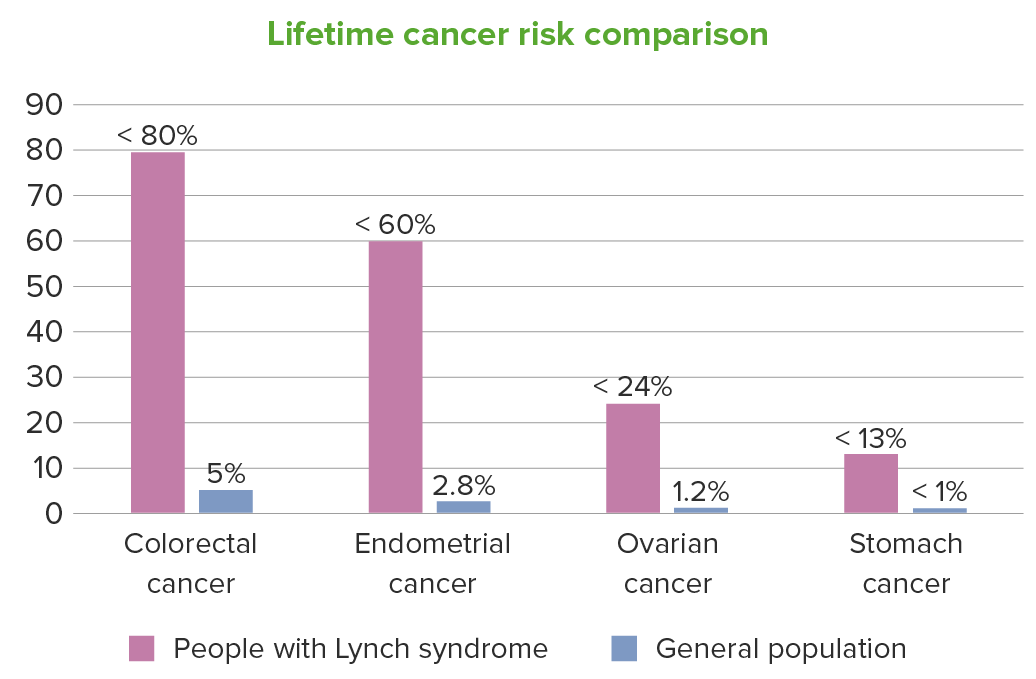
Comparación del riesgo de cáncer del síndrome de Lynch

En el caso de las personas con síndrome de Lynch, el riesgo de cáncer a lo largo de la vida también aumenta en menor medida para otros tipos de cáncer, como: pelvis renal, uréteres, vejiga, cerebro, intestino delgado, tracto hepatobiliar, páncreas, próstata y piel. En la figura, se indican los rangos superiores de los riesgos individuales.

Imagen por Lecturio.

Etiología

Los LOS Neisseria pacientes con síndrome de Lynch heredan uno o más genes Genes A category of nucleic acid sequences that function as units of heredity and which code for the basic instructions for the development, reproduction, and maintenance of organisms. DNA Types and Structure MMR MMR A DNA repair pathway involved in correction of errors introduced during DNA replication when an incorrect base, which cannot form hydrogen bonds with the corresponding base in the parent strand, is incorporated into the daughter strand. Excinucleases recognize the base pair mismatch and cause a segment of polynucleotide chain to be excised from the daughter strand, thereby removing the mismatched base. Lynch syndrome mutantes y los LOS Neisseria respectivos alelos normales; el 2do alelo muta o pierde su función por silenciamiento epigenético con tanta frecuencia que el patrón de herencia es efectivamente autosómico dominante.
  • Genes Genes A category of nucleic acid sequences that function as units of heredity and which code for the basic instructions for the development, reproduction, and maintenance of organisms. DNA Types and Structure MMR MMR A DNA repair pathway involved in correction of errors introduced during DNA replication when an incorrect base, which cannot form hydrogen bonds with the corresponding base in the parent strand, is incorporated into the daughter strand. Excinucleases recognize the base pair mismatch and cause a segment of polynucleotide chain to be excised from the daughter strand, thereby removing the mismatched base. Lynch syndrome que pueden mutar: MLH1, MSH2 (una mutación del gen de la molécula de adhesión de células epiteliales ( EpCAM EPCAM A cell adhesion molecule that is expressed on the membranes of nearly all epithelial cells, especially at the junctions between intestinal epithelial cells and intraepithelial lymphocytes. It also is expressed on the surface of adenocarcinoma and epithelial tumor cells. It may function in the mucosa through homophilic interactions to provide a barrier against infection. It also regulates the proliferation and differentiation of embryonic stem cells. Lynch syndrome, por sus siglás en EN Erythema nodosum is an immune-mediated panniculitis (inflammation of the subcutaneous fat) caused by a type IV (delayed-type) hypersensitivity reaction. It commonly manifests in young women as tender, erythematous nodules on the shins. Erythema Nodosum inglés) también puede causar pérdida), MSH6 y PMS2
  • Las mutaciones se producen entonces a un ritmo hasta 1000 veces superior al AL Amyloidosis normal, sobre todo en EN Erythema nodosum is an immune-mediated panniculitis (inflammation of the subcutaneous fat) caused by a type IV (delayed-type) hypersensitivity reaction. It commonly manifests in young women as tender, erythematous nodules on the shins. Erythema Nodosum regiones de secuencias repetitivas llamadas microsatélites.
  • Los productos proteicos de los genes MMR son importantes en la “corrección ortográfica” del ADN durante la duplicación, detectando y reparando los LOS Neisseria defectos del ADN.
  • La pérdida de la actividad de los MMR provoca una acumulación de errores de replicación del ADN, especialmente en las secuencias repetitivas (“repeticiones en tándem”).
    • Las pruebas de microsatélites basadas en EN Erythema nodosum is an immune-mediated panniculitis (inflammation of the subcutaneous fat) caused by a type IV (delayed-type) hypersensitivity reaction. It commonly manifests in young women as tender, erythematous nodules on the shins. Erythema Nodosum PCR PCR Polymerase chain reaction (PCR) is a technique that amplifies DNA fragments exponentially for analysis. The process is highly specific, allowing for the targeting of specific genomic sequences, even with minuscule sample amounts. The PCR cycles multiple times through 3 phases: denaturation of the template DNA, annealing of a specific primer to the individual DNA strands, and synthesis/elongation of new DNA molecules. Polymerase Chain Reaction (PCR) que muestran inestabilidad en EN Erythema nodosum is an immune-mediated panniculitis (inflammation of the subcutaneous fat) caused by a type IV (delayed-type) hypersensitivity reaction. It commonly manifests in young women as tender, erythematous nodules on the shins. Erythema Nodosum ≥30-40 % de los LOS Neisseria loci analizados se denominan inestabilidad de microsatélites alta (MSI-H, por sus siglas en EN Erythema nodosum is an immune-mediated panniculitis (inflammation of the subcutaneous fat) caused by a type IV (delayed-type) hypersensitivity reaction. It commonly manifests in young women as tender, erythematous nodules on the shins. Erythema Nodosum inglés) y son un sello distintivo de la deficiencia de MMR MMR A DNA repair pathway involved in correction of errors introduced during DNA replication when an incorrect base, which cannot form hydrogen bonds with the corresponding base in the parent strand, is incorporated into the daughter strand. Excinucleases recognize the base pair mismatch and cause a segment of polynucleotide chain to be excised from the daughter strand, thereby removing the mismatched base. Lynch syndrome.
    • Una mutación carcinógena se crea eventualmente por uno de los LOS Neisseria errores no corregidos que se cometen durante la replicación del ADN.
  • Las mutaciones del MMR MMR A DNA repair pathway involved in correction of errors introduced during DNA replication when an incorrect base, which cannot form hydrogen bonds with the corresponding base in the parent strand, is incorporated into the daughter strand. Excinucleases recognize the base pair mismatch and cause a segment of polynucleotide chain to be excised from the daughter strand, thereby removing the mismatched base. Lynch syndrome también pueden producirse como mutaciones somáticas esporádicas.
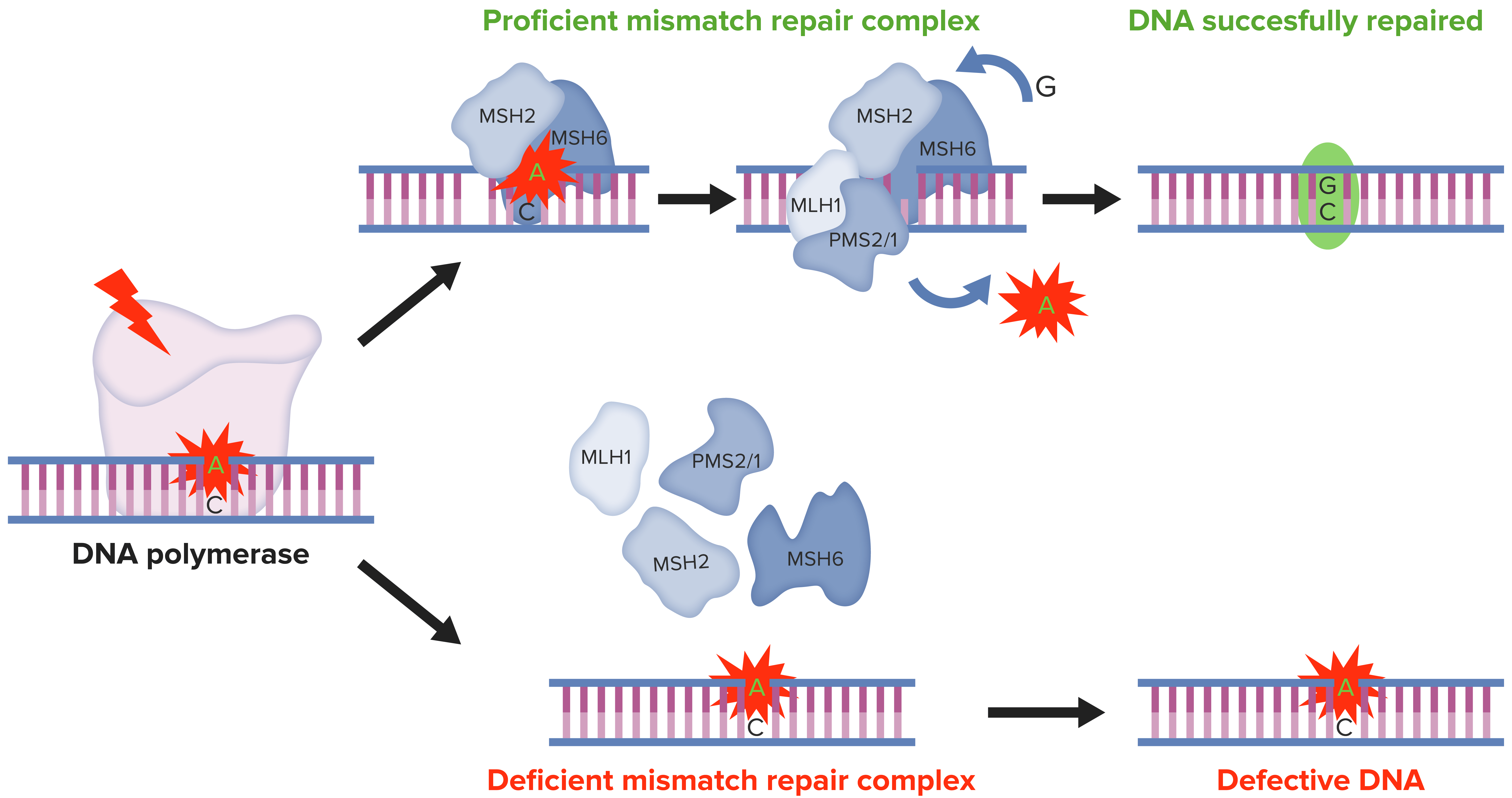
DNA MMR

ADN MMR:
En las células normales, el ADN MMR reconoce y repara los desajustes genéticos generados durante la replicación del ADN. Por el contrario, en las células tumorales MSI la presencia de un sistema MMR deficiente da lugar a una MMR del ADN defectuosa en los microsatélites, lo que determina la acumulación de mutaciones en diferentes codones genómicos.
MMR: reparación de desajustes
MSI: inestabilidad de microsatélites

Imagen por Lecturio.

Patogénesis y Patología

Patogénesis

  • Algunas secuencias de microsatélites mutadas se asocian a los LOS Neisseria genes Genes A category of nucleic acid sequences that function as units of heredity and which code for the basic instructions for the development, reproduction, and maintenance of organisms. DNA Types and Structure de crecimiento celular, dando lugar a un pólipo/carcinoma neoplásico benigno y luego maligno.
  • La vía MMR MMR A DNA repair pathway involved in correction of errors introduced during DNA replication when an incorrect base, which cannot form hydrogen bonds with the corresponding base in the parent strand, is incorporated into the daughter strand. Excinucleases recognize the base pair mismatch and cause a segment of polynucleotide chain to be excised from the daughter strand, thereby removing the mismatched base. Lynch syndrome de carcinogénesis de colon Colon The large intestines constitute the last portion of the digestive system. The large intestine consists of the cecum, appendix, colon (with ascending, transverse, descending, and sigmoid segments), rectum, and anal canal. The primary function of the colon is to remove water and compact the stool prior to expulsion from the body via the rectum and anal canal. Colon, Cecum, and Appendix: Anatomy es la 2da vía más común de cáncer colorrectal (CCR), después de la vía adenoma-carcinoma de carcinogénesis del colon Colon The large intestines constitute the last portion of the digestive system. The large intestine consists of the cecum, appendix, colon (with ascending, transverse, descending, and sigmoid segments), rectum, and anal canal. The primary function of the colon is to remove water and compact the stool prior to expulsion from the body via the rectum and anal canal. Colon, Cecum, and Appendix: Anatomy.

Patología

  • Características de los LOS Neisseria CCR que surgen a través de la vía MMR MMR A DNA repair pathway involved in correction of errors introduced during DNA replication when an incorrect base, which cannot form hydrogen bonds with the corresponding base in the parent strand, is incorporated into the daughter strand. Excinucleases recognize the base pair mismatch and cause a segment of polynucleotide chain to be excised from the daughter strand, thereby removing the mismatched base. Lynch syndrome (MSI-H): tienden a mostrar más rasgos mucinosos y linfocitos reactivos infiltrados en EN Erythema nodosum is an immune-mediated panniculitis (inflammation of the subcutaneous fat) caused by a type IV (delayed-type) hypersensitivity reaction. It commonly manifests in young women as tender, erythematous nodules on the shins. Erythema Nodosum el tumor Tumor Inflammation
  • Características de los LOS Neisseria carcinomas endometriales en EN Erythema nodosum is an immune-mediated panniculitis (inflammation of the subcutaneous fat) caused by a type IV (delayed-type) hypersensitivity reaction. It commonly manifests in young women as tender, erythematous nodules on the shins. Erythema Nodosum el síndrome de Lynch: mayor frecuencia de histologías de carcinoma no endometrioide
  • Número de pólipos adenomatosos ligeramente superior al AL Amyloidosis de la población general, pero una tasa de progresión a CCR superior a la de los LOS Neisseria pólipos típicos.

Presentación Clínica y Diagnóstico

Presentación clínica

  • Los LOS Neisseria pacientes son asintomáticos hasta que desarrollan una malignidad.
  • Adenocarcinomas colorrectales:
    • El síndrome de Lynch se manifiesta con un número de pólipos bajo o ligeramente superior al AL Amyloidosis habitual.
    • Carcinomas del lado derecho (más frecuentes): anemia Anemia Anemia is a condition in which individuals have low Hb levels, which can arise from various causes. Anemia is accompanied by a reduced number of RBCs and may manifest with fatigue, shortness of breath, pallor, and weakness. Subtypes are classified by the size of RBCs, chronicity, and etiology. Anemia: Overview and Types ferropénica por hemorragia
    • Carcinomas del lado izquierdo: cambios en EN Erythema nodosum is an immune-mediated panniculitis (inflammation of the subcutaneous fat) caused by a type IV (delayed-type) hypersensitivity reaction. It commonly manifests in young women as tender, erythematous nodules on the shins. Erythema Nodosum los LOS Neisseria hábitos intestinales o en EN Erythema nodosum is an immune-mediated panniculitis (inflammation of the subcutaneous fat) caused by a type IV (delayed-type) hypersensitivity reaction. It commonly manifests in young women as tender, erythematous nodules on the shins. Erythema Nodosum el calibre de las heces
  • Carcinomas endometriales: hemorragia endometrial anormal

Diagnóstico

  • Se necesitan 1 o más mutaciones de la línea germinal en EN Erythema nodosum is an immune-mediated panniculitis (inflammation of the subcutaneous fat) caused by a type IV (delayed-type) hypersensitivity reaction. It commonly manifests in young women as tender, erythematous nodules on the shins. Erythema Nodosum los LOS Neisseria genes Genes A category of nucleic acid sequences that function as units of heredity and which code for the basic instructions for the development, reproduction, and maintenance of organisms. DNA Types and Structure MMR MMR A DNA repair pathway involved in correction of errors introduced during DNA replication when an incorrect base, which cannot form hydrogen bonds with the corresponding base in the parent strand, is incorporated into the daughter strand. Excinucleases recognize the base pair mismatch and cause a segment of polynucleotide chain to be excised from the daughter strand, thereby removing the mismatched base. Lynch syndrome o en EN Erythema nodosum is an immune-mediated panniculitis (inflammation of the subcutaneous fat) caused by a type IV (delayed-type) hypersensitivity reaction. It commonly manifests in young women as tender, erythematous nodules on the shins. Erythema Nodosum el gen EPCAM EPCAM A cell adhesion molecule that is expressed on the membranes of nearly all epithelial cells, especially at the junctions between intestinal epithelial cells and intraepithelial lymphocytes. It also is expressed on the surface of adenocarcinoma and epithelial tumor cells. It may function in the mucosa through homophilic interactions to provide a barrier against infection. It also regulates the proliferation and differentiation of embryonic stem cells. Lynch syndrome para el diagnóstico definitivo del síndrome de Lynch.
  • Se utilizan dos vías para establecer el diagnóstico: Analizar primero el tumor Tumor Inflammation o basar las pruebas en EN Erythema nodosum is an immune-mediated panniculitis (inflammation of the subcutaneous fat) caused by a type IV (delayed-type) hypersensitivity reaction. It commonly manifests in young women as tender, erythematous nodules on the shins. Erythema Nodosum los LOS Neisseria antecedentes familiares.
  • Sospechar el síndrome de Lynch en EN Erythema nodosum is an immune-mediated panniculitis (inflammation of the subcutaneous fat) caused by a type IV (delayed-type) hypersensitivity reaction. It commonly manifests in young women as tender, erythematous nodules on the shins. Erythema Nodosum cualquier paciente que tenga:
    • CCR antes de los LOS Neisseria 50 años de edad, o si presenta más de 1 CCR
    • Carcinoma endometrial < 60 años de edad
    • Un familiar de 1er grado diagnosticado con síndrome de Lynch
    • Cumplen los LOS Neisseria criterios aceptados para la síndrome de Lynch (criterios de Ámsterdam o criterios de Bethesda)
  • Criterios de Amsterdam II (mala sensibilidad, sospecha de síndrome de Lynch si se cumplen los LOS Neisseria siguientes criterios):
    • 3 o más familiares ( al AL Amyloidosis menos uno de 1er grado) tienen cánceres asociados al AL Amyloidosis síndrome de Lynch; se excluye la poliposis adenomatosa familiar.
    • Cánceres asociados al AL Amyloidosis síndrome de Lynch que afectan al AL Amyloidosis menos a 2 generaciones
    • 1 o más cánceres diagnosticados antes de los LOS Neisseria 50 años
  • Criterios de Bethesda, revisados (mejor sensibilidad y especificidad que los LOS Neisseria criterios de Amsterdam):
    • CCR diagnosticado < 50 años de edad
    • 2 o más cánceres asociados al AL Amyloidosis síndrome de Lynch
    • CCR con histología tipo MSI-H en EN Erythema nodosum is an immune-mediated panniculitis (inflammation of the subcutaneous fat) caused by a type IV (delayed-type) hypersensitivity reaction. It commonly manifests in young women as tender, erythematous nodules on the shins. Erythema Nodosum paciente < 60 años de edad
    • CCR en EN Erythema nodosum is an immune-mediated panniculitis (inflammation of the subcutaneous fat) caused by a type IV (delayed-type) hypersensitivity reaction. It commonly manifests in young women as tender, erythematous nodules on the shins. Erythema Nodosum paciente con un familiar de 1er grado con cáncer asociado a síndrome de Lynch < 50 años
    • CCR en EN Erythema nodosum is an immune-mediated panniculitis (inflammation of the subcutaneous fat) caused by a type IV (delayed-type) hypersensitivity reaction. It commonly manifests in young women as tender, erythematous nodules on the shins. Erythema Nodosum paciente con 2 familiares de 1er grado con cáncer asociado a síndrome de Lynch, cualquier edad

Tratamiento

Pruebas de vigilancia y tamizaje

  • Para el CCR: colonoscopia anual a partir de los LOS Neisseria 20–25 años de edad, o 2–5 años antes de la edad más temprana de diagnóstico de CCR en EN Erythema nodosum is an immune-mediated panniculitis (inflammation of the subcutaneous fat) caused by a type IV (delayed-type) hypersensitivity reaction. It commonly manifests in young women as tender, erythematous nodules on the shins. Erythema Nodosum la familia
  • Para el cáncer de endometrio: biopsia endometrial anual, a partir de los LOS Neisseria 30 años de edad
  • Exámenes anuales de la piel para detectar: tumores sebáceos (benignos y malignos) y queratoacantomas cutáneos asociados al AL Amyloidosis síndrome de Muir-Torre (una variante del síndrome de Lynch)
  • Asesoramiento reproductivo: ofrecer asesoramiento genético

Tratamiento quirúrgico

Para CCR:

  • Colectomía abdominal total en EN Erythema nodosum is an immune-mediated panniculitis (inflammation of the subcutaneous fat) caused by a type IV (delayed-type) hypersensitivity reaction. It commonly manifests in young women as tender, erythematous nodules on the shins. Erythema Nodosum lugar de resección segmentaria para el CCR
  • En EN Erythema nodosum is an immune-mediated panniculitis (inflammation of the subcutaneous fat) caused by a type IV (delayed-type) hypersensitivity reaction. It commonly manifests in young women as tender, erythematous nodules on the shins. Erythema Nodosum caso de cáncer rectal: proctocolectomía total

Para el cáncer de endometrio:

  • Histerectomía abdominal total y salpingooforectomía bilateral si se diagnostica cáncer
  • Histerectomía abdominal total y salpingooforectomía bilateral profiláctica cuando se decide culminar la maternidad

Tratamiento médico

Quimioprevención:

  • Los LOS Neisseria anticonceptivos de estrógeno-progestina reducen el riesgo de cáncer de endometrio y ovario
  • Aspirina: puede reducir el riesgo de CCR

Inmunoterapia:

  • Pembrolizumab Pembrolizumab Squamous Cell Carcinoma (SCC) o nivolumab Nivolumab A genetically engineered, fully humanized immunoglobulin g4 monoclonal antibody that binds to the pd-1 receptor, activating an immune response to tumor cells. It is used as monotherapy or in combination with ipilimumab for the treatment of advanced malignant melanoma. It is also used in the treatment of advanced or recurring non-small cell lung cancer; renal cell carcinoma; and Hodgkin’s lymphoma. Melanoma
  • Utilizado en EN Erythema nodosum is an immune-mediated panniculitis (inflammation of the subcutaneous fat) caused by a type IV (delayed-type) hypersensitivity reaction. It commonly manifests in young women as tender, erythematous nodules on the shins. Erythema Nodosum tumores deficientes en EN Erythema nodosum is an immune-mediated panniculitis (inflammation of the subcutaneous fat) caused by a type IV (delayed-type) hypersensitivity reaction. It commonly manifests in young women as tender, erythematous nodules on the shins. Erythema Nodosum MSI-H/ MMR MMR A DNA repair pathway involved in correction of errors introduced during DNA replication when an incorrect base, which cannot form hydrogen bonds with the corresponding base in the parent strand, is incorporated into the daughter strand. Excinucleases recognize the base pair mismatch and cause a segment of polynucleotide chain to be excised from the daughter strand, thereby removing the mismatched base. Lynch syndrome

Diagnóstico Diferencial

  • Poliposis adenomatosa familiar: se presenta con cientos de pólipos adenomatosos y suele provocar CCR en EN Erythema nodosum is an immune-mediated panniculitis (inflammation of the subcutaneous fat) caused by a type IV (delayed-type) hypersensitivity reaction. It commonly manifests in young women as tender, erythematous nodules on the shins. Erythema Nodosum el colon Colon The large intestines constitute the last portion of the digestive system. The large intestine consists of the cecum, appendix, colon (with ascending, transverse, descending, and sigmoid segments), rectum, and anal canal. The primary function of the colon is to remove water and compact the stool prior to expulsion from the body via the rectum and anal canal. Colon, Cecum, and Appendix: Anatomy distal. El síndrome de Lynch se manifiesta típicamente con un CCR en EN Erythema nodosum is an immune-mediated panniculitis (inflammation of the subcutaneous fat) caused by a type IV (delayed-type) hypersensitivity reaction. It commonly manifests in young women as tender, erythematous nodules on the shins. Erythema Nodosum el colon Colon The large intestines constitute the last portion of the digestive system. The large intestine consists of the cecum, appendix, colon (with ascending, transverse, descending, and sigmoid segments), rectum, and anal canal. The primary function of the colon is to remove water and compact the stool prior to expulsion from the body via the rectum and anal canal. Colon, Cecum, and Appendix: Anatomy proximal y un número reducido de pólipos. Las pruebas genéticas pueden distinguir entre las dos condiciones.
  • Cáncer colorrectal familiar tipo X: Se cumplen los LOS Neisseria criterios de Amsterdam I pero los LOS Neisseria tumores carecen de la MSI MSI The occurrence of highly polymorphic mono- and dinucleotide microsatellite repeats in somatic cells. It is a form of genome instability associated with defects in DNA mismatch repair. Colorectal Cancer que se observa en EN Erythema nodosum is an immune-mediated panniculitis (inflammation of the subcutaneous fat) caused by a type IV (delayed-type) hypersensitivity reaction. It commonly manifests in young women as tender, erythematous nodules on the shins. Erythema Nodosum el síndrome de Lynch. No hay mayor riesgo de otros cánceres asociados al AL Amyloidosis síndrome de Lynch.

Referencias

  1. Win, A.K. (2025). Lynch syndrome (hereditary nonpolyposis colorectal cancer): Clinical manifestations and diagnosis. UpToDate. Retrieved September 27, 2025, from https://www.uptodate.com/contents/lynch-syndrome-hereditary-nonpolyposis-colorectal-cancer-clinical-manifestations-and-diagnosis
  2. Kumar, V., Abbas, A. K., Aster, J.C., (Eds.). (2020). Small Intestine and Colon. Robbins & Cotran Pathologic Basis of Disease. (10th ed. pp. 814-816). Elsevier, Inc.
  3. Lynch syndrome. (n.d.). Cancer.Net. Retrieved September 27, 2025, from https://www.cancer.net/cancer-types/lynch-syndrome
  4. Li, K., Luo, H., Huang, L., Luo, H., & Zhu, X. (2020). Microsatellite instability: A review of what the oncologist should know. Cancer Cell International, 20(1), 16. https://doi.org/10.1186/s12935-019-1091-8
  5. Checkpoint inhibitor immunotherapy delays colorectal cancer progression. (2020). News.Cancerconnect.Com. Retrieved September 27, 2025, from https://news.cancerconnect.com/checkpoint-inhibitor-immunotherapy-delays-colorectal-cancer-progression/
  6. Oiseth, S. J., & Aziz, M. S. (2017). Cancer immunotherapy: A brief review of the history, possibilities, and challenges ahead. Journal of Cancer Metastasis and Treatment, 3, 250–261. https://doi.org/10.20517/2394-4722.2017.41
  7. Mardis, E. R. (2019). Neoantigens and genome instability: Impact on immunogenomic phenotypes and immunotherapy response. Genome Medicine, 11(1), 71. https://doi.org/10.1186/s13073-019-0684-0
  8. Therkildsen, C., Ladelund, S., Smith-Hansen, L. et al. (2017). Towards gene- and gender-based risk estimates in Lynch syndrome; age-specific incidences for 13 extra-colorectal cancer types. Br J Cancer, 117, 1702–1710. https://doi.org/10.1038/bjc.2017.348 
  9. Kalady, M. F., Kravochuck, S. E., Heald, B., Burke, C. A., & Church, J. M. (2015). Defining the adenoma burden in lynch syndrome. Diseases of the colon and rectum, 58(4), 388–392. https://doi.org/10.1097/DCR.0000000000000333
  10. Burn J, Sheth H, Elliott F, et al (Eds.) (2020). Cancer prevention with aspirin in hereditary colorectal cancer (Lynch syndrome), 10-year follow-up and registry-based 20-year data in the CAPP2 study: a double-blind, randomised, placebo-controlled trial. Lancet (London, England), 395(10240), 1855–1863. https://doi.org/10.1016/S0140-6736(20)30366-4
  11. Peltomäki, P., Olkinuora, A., & Nieminen, T. T. (2020). Updates in the field of hereditary nonpolyposis colorectal cancer. Expert Review of Gastroenterology & Hepatology, 14(8), 707–720. https://doi.org/10.1080/17474124.2020.1782187
  12. Møller, P. (2020). The Prospective Lynch Syndrome Database reports enable evidence-based personal precision health care. Hereditary Cancer in Clinical Practice, 18. https://doi.org/10.1186/s13053-020-0138-0

¡Crea tu cuenta gratis o inicia una sesión para seguir leyendo!

Regístrate ahora y obtén acceso gratuito a Lecturio con páginas de concepto, videos médicos y cuestionarios para tu educación médica.

User Reviews

Que tengas una sesión de estudio alegre y navideña 🎁 Ahorra 50% en todos los planes >>

Details