Domina Conceptos Médicos

Estudia para la escuela de medicina y tus examenes con Lecturio.

Queratosis Seborreicas

Las queratosis seborreicas son la neoplasia epitelial cutánea benigna más común. La afección consiste en EN Erythema nodosum is an immune-mediated panniculitis (inflammation of the subcutaneous fat) caused by a type IV (delayed-type) hypersensitivity reaction. It commonly manifests in young women as tender, erythematous nodules on the shins. Erythema Nodosum queratinocitos inmaduros. Las queratosis seborreicas son el tumor Tumor Inflammation cutáneo benigno más común en EN Erythema nodosum is an immune-mediated panniculitis (inflammation of the subcutaneous fat) caused by a type IV (delayed-type) hypersensitivity reaction. It commonly manifests in young women as tender, erythematous nodules on the shins. Erythema Nodosum adultos de mediana edad y ancianos y se presenta como una lesión cutánea exofítica bien delimitada que puede ser de color marrón o negra y tiene un aspecto “de estar pegada”. Puede haber prurito o dolor Dolor Inflammation si estas lesiones se inflaman secundariamente por un trauma, especialmente si están dentro de los LOS Neisseria pliegues cutáneos. Se cree que la genética juega un papel, pero la patogenia es incierta. Las mutaciones más comunes involucran dos oncogenes Oncogenes Genes whose gain-of-function alterations lead to neoplastic cell transformation. They include, for example, genes for activators or stimulators of cell proliferation such as growth factors, growth factor receptors, protein kinases, signal transducers, nuclear phosphoproteins, and transcription factors. A prefix of 'v-' before oncogene symbols indicates oncogenes captured and transmitted by retroviruses; the prefix 'c-' before the gene symbol of an oncogene indicates it is the cellular homolog (proto-oncogenes) of a v-oncogene. Carcinogenesis: el receptor Receptor Receptors are proteins located either on the surface of or within a cell that can bind to signaling molecules known as ligands (e.g., hormones) and cause some type of response within the cell. Receptors 3 del factor de crecimiento de fibroblastos (FGFR3) y PIK3CA. Existe una predisposición familiar a desarrollar un elevado número de queratosis seborreicas. El tratamiento no es necesario, ya que se trata de una afección benigna, pero se puede realizar crioterapia, curetaje o electrodesecación por molestias o problemas estéticos.

Last updated: Dec 15, 2025

Editorial responsibility: Stanley Oiseth, Lindsay Jones, Evelin Maza

Descripción General

Definición

Las queratosis seborreicas son tumores benignos de la piel que consisten en EN Erythema nodosum is an immune-mediated panniculitis (inflammation of the subcutaneous fat) caused by a type IV (delayed-type) hypersensitivity reaction. It commonly manifests in young women as tender, erythematous nodules on the shins. Erythema Nodosum una proliferación de queratinocitos inmaduros.
Epidemiología

  • Las queratosis seborreicas son los LOS Neisseria tumores benignos más comunes en EN Erythema nodosum is an immune-mediated panniculitis (inflammation of the subcutaneous fat) caused by a type IV (delayed-type) hypersensitivity reaction. It commonly manifests in young women as tender, erythematous nodules on the shins. Erythema Nodosum adultos de mediana edad y mayores.
  • La mayoría de los LOS Neisseria adultos desarrollarán al AL Amyloidosis menos 1 queratosis seborreica en EN Erythema nodosum is an immune-mediated panniculitis (inflammation of the subcutaneous fat) caused by a type IV (delayed-type) hypersensitivity reaction. It commonly manifests in young women as tender, erythematous nodules on the shins. Erythema Nodosum su vida.
  • Prevalencia del grupo de edad:
    • 15–25 años: 8%–24% tienen al AL Amyloidosis menos 1 queratosis seborreica
    • > 64 años: 90% tiene al AL Amyloidosis menos 1 queratosis seborreica; 30%–60% tienen ≥ 10 queratosis seborreicas
  • Más frecuente en EN Erythema nodosum is an immune-mediated panniculitis (inflammation of the subcutaneous fat) caused by a type IV (delayed-type) hypersensitivity reaction. It commonly manifests in young women as tender, erythematous nodules on the shins. Erythema Nodosum personas con tonos de piel más claros
  • Sexo: Sin diferencias

Etiología

  • Genética:
    • Mutaciones más comunes en EN Erythema nodosum is an immune-mediated panniculitis (inflammation of the subcutaneous fat) caused by a type IV (delayed-type) hypersensitivity reaction. It commonly manifests in young women as tender, erythematous nodules on the shins. Erythema Nodosum dos oncogenes Oncogenes Genes whose gain-of-function alterations lead to neoplastic cell transformation. They include, for example, genes for activators or stimulators of cell proliferation such as growth factors, growth factor receptors, protein kinases, signal transducers, nuclear phosphoproteins, and transcription factors. A prefix of ‘v-‘ before oncogene symbols indicates oncogenes captured and transmitted by retroviruses; the prefix ‘c-‘ before the gene symbol of an oncogene indicates it is the cellular homolog (proto-oncogenes) of a v-oncogene. Carcinogenesis: receptor Receptor Receptors are proteins located either on the surface of or within a cell that can bind to signaling molecules known as ligands (e.g., hormones) and cause some type of response within the cell. Receptors 3 del factor de crecimiento de fibroblastos (FGFR3) y PIK3CA
    • Predisposición familiar/genética a desarrollar un elevado número de queratosis seborreicas
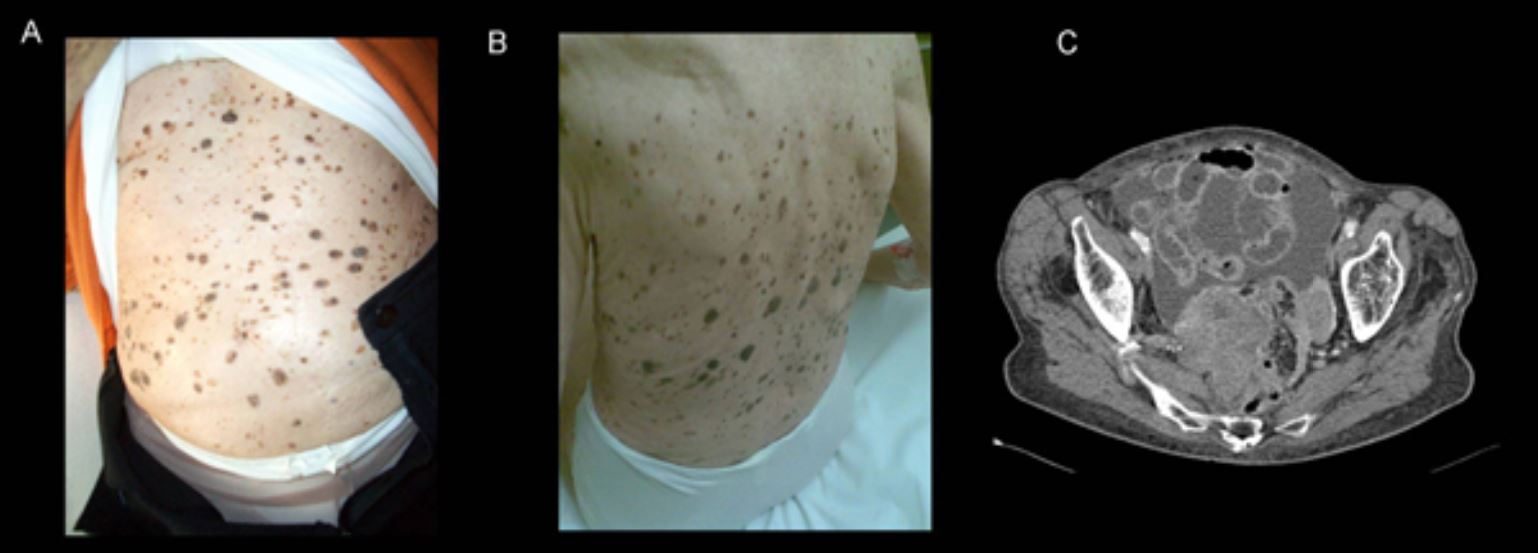
  • Signo de Leser-Trélat:
    • Síndrome paraneoplásico asociado a erupción súbita de múltiples queratosis seborreicas causado por una neoplasia maligna interna
    • Posiblemente debido a hipersensibilidad a un factor de crecimiento del tumor Tumor Inflammation (e.g., factor de crecimiento epidérmico o factor de crecimiento transformante alfa)
  • Exposición acumulada a la radiación UV:
    • La mayoría de los LOS Neisseria patrones mutacionales son tipos típicos de firma ultlravioleta con cambios de base C > T y CC > TT en EN Erythema nodosum is an immune-mediated panniculitis (inflammation of the subcutaneous fat) caused by a type IV (delayed-type) hypersensitivity reaction. It commonly manifests in young women as tender, erythematous nodules on the shins. Erythema Nodosum sitios dipirimidínicos.
    • Más común en EN Erythema nodosum is an immune-mediated panniculitis (inflammation of the subcutaneous fat) caused by a type IV (delayed-type) hypersensitivity reaction. It commonly manifests in young women as tender, erythematous nodules on the shins. Erythema Nodosum personas de piel más clara; 3 veces más común en EN Erythema nodosum is an immune-mediated panniculitis (inflammation of the subcutaneous fat) caused by a type IV (delayed-type) hypersensitivity reaction. It commonly manifests in young women as tender, erythematous nodules on the shins. Erythema Nodosum surfistas australianos
  • Infección por VPH: evidencia inconsistente

Fisiopatología y Presentación Clínica

Patogénesis

  • Expansión clonal de células somáticamente mutadas (no hiperplasia epidérmica):
    • El crecimiento está impulsado por mutaciones en EN Erythema nodosum is an immune-mediated panniculitis (inflammation of the subcutaneous fat) caused by a type IV (delayed-type) hypersensitivity reaction. It commonly manifests in young women as tender, erythematous nodules on the shins. Erythema Nodosum oncogenes Oncogenes Genes whose gain-of-function alterations lead to neoplastic cell transformation. They include, for example, genes for activators or stimulators of cell proliferation such as growth factors, growth factor receptors, protein kinases, signal transducers, nuclear phosphoproteins, and transcription factors. A prefix of ‘v-‘ before oncogene symbols indicates oncogenes captured and transmitted by retroviruses; the prefix ‘c-‘ before the gene symbol of an oncogene indicates it is the cellular homolog (proto-oncogenes) of a v-oncogene. Carcinogenesis, más comúnmente FGFR3 y PIK3CA.
    • Genéticamente estable (a diferencia de los LOS Neisseria tumores malignos)
  • Carecen de potencial maligno, posiblemente debido a:
    • Ausencia de mutaciones en EN Erythema nodosum is an immune-mediated panniculitis (inflammation of the subcutaneous fat) caused by a type IV (delayed-type) hypersensitivity reaction. It commonly manifests in young women as tender, erythematous nodules on the shins. Erythema Nodosum genes Genes A category of nucleic acid sequences that function as units of heredity and which code for the basic instructions for the development, reproduction, and maintenance of organisms. DNA Types and Structure supresores de tumores
    • Estimulación del factor de transcripción de diferenciación FOXN1 por FGFR3

Morfología

  • Sitios: solo superficies con pelo (e. g., tronco, cabeza, cuello, cara, extremidades, genitales)
  • Tamaño: 0,2 cm a > 3 cm
  • Forma: de cúpula o aplanada; bordes redondos o irregulares
  • 3 características comunes a todas las queratosis seborreicas:
    • Bordes claramente delimitados (pueden ser irregulares)
    • Aspecto “de estar pegadas” debido a que el crecimiento se limita a la epidermis Epidermis The external, nonvascular layer of the skin. It is made up, from within outward, of five layers of epithelium: (1) basal layer (stratum basale epidermidis); (2) spinous layer (stratum spinosum epidermidis); (3) granular layer (stratum granulosum epidermidis); (4) clear layer (stratum lucidum epidermidis); and (5) horny layer (stratum corneum epidermidis). Skin: Structure and Functions
    • Color marrón claro, marrón oscuro o negro (puede ser variado)
  • La superficie es uniforme en EN Erythema nodosum is an immune-mediated panniculitis (inflammation of the subcutaneous fat) caused by a type IV (delayed-type) hypersensitivity reaction. It commonly manifests in young women as tender, erythematous nodules on the shins. Erythema Nodosum cada lesión (a diferencia del melanoma Melanoma Melanoma is a malignant tumor arising from melanocytes, the melanin-producing cells of the epidermis. These tumors are most common in fair-skinned individuals with a history of excessive sun exposure and sunburns. Melanoma):
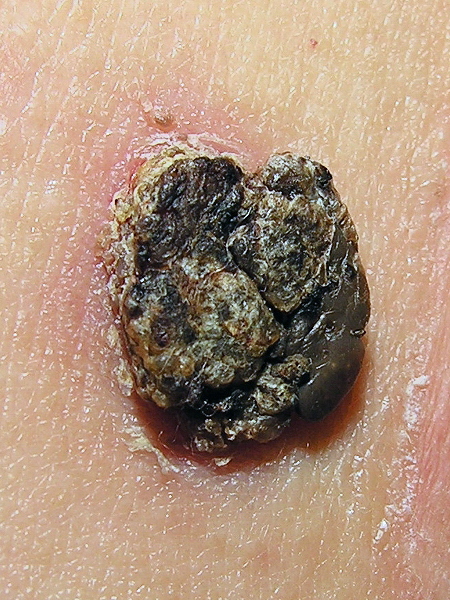
    • Las queratosis seborreicas de superficie rugosa son más comunes que las de superficie lisa: perlas córneas de queratina submilimétricas en EN Erythema nodosum is an immune-mediated panniculitis (inflammation of the subcutaneous fat) caused by a type IV (delayed-type) hypersensitivity reaction. It commonly manifests in young women as tender, erythematous nodules on the shins. Erythema Nodosum la superficie (diferencia con el melanoma Melanoma Melanoma is a malignant tumor arising from melanocytes, the melanin-producing cells of the epidermis. These tumors are most common in fair-skinned individuals with a history of excessive sun exposure and sunburns. Melanoma)
    • Aspecto ceroso debido a la producción de queratina.
  • Lesiones solitarias o múltiples: número creciente con la edad

Histología

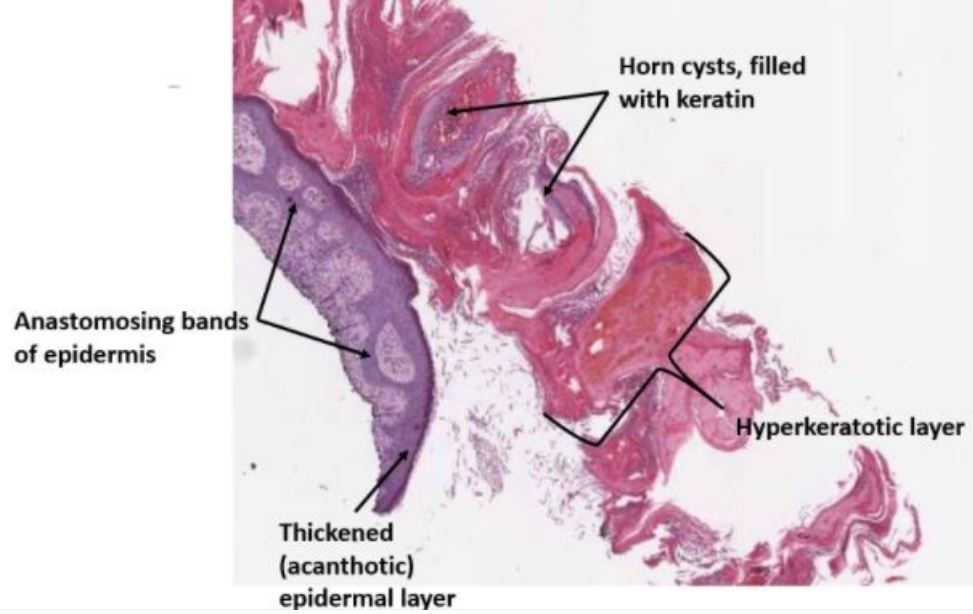
  • Lesión proliferativa exofítica, compuesta por pequeños queratinocitos completamente dentro de la epidermis Epidermis The external, nonvascular layer of the skin. It is made up, from within outward, of five layers of epithelium: (1) basal layer (stratum basale epidermidis); (2) spinous layer (stratum spinosum epidermidis); (3) granular layer (stratum granulosum epidermidis); (4) clear layer (stratum lucidum epidermidis); and (5) horny layer (stratum corneum epidermidis). Skin: Structure and Functions, sin atipia citológica; similar a las células basales de la epidermis Epidermis The external, nonvascular layer of the skin. It is made up, from within outward, of five layers of epithelium: (1) basal layer (stratum basale epidermidis); (2) spinous layer (stratum spinosum epidermidis); (3) granular layer (stratum granulosum epidermidis); (4) clear layer (stratum lucidum epidermidis); and (5) horny layer (stratum corneum epidermidis). Skin: Structure and Functions normal
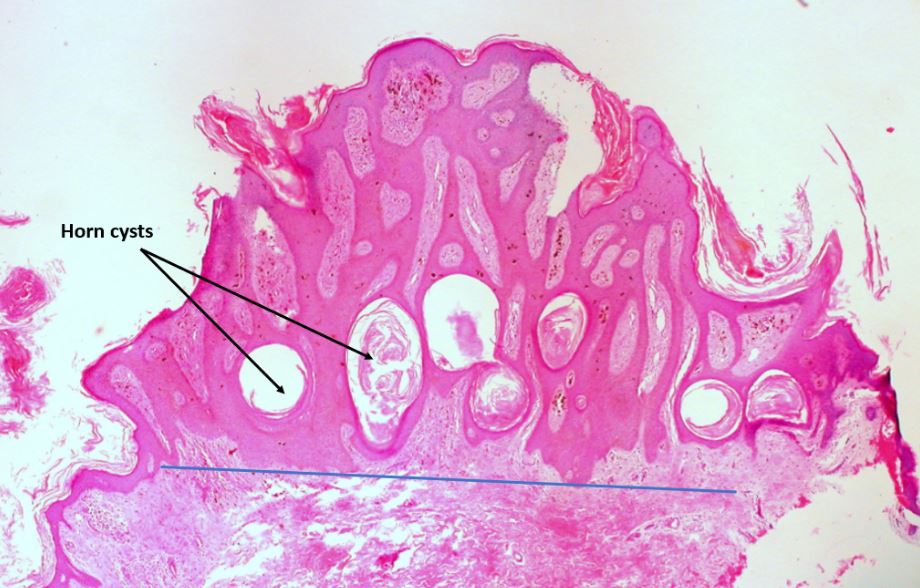
  • “Pseudoquistes córneos”: quistes redondos intralesionales de queratina suelta
  • La lesión se extiende de manera uniforme a una sola profundidad, de modo que se puede trazar una línea horizontal paralela a la superficie epidérmica subyacente a la lesión (“signo de la cuerda”).
  • La pigmentación melánica es variable Variable Variables represent information about something that can change. The design of the measurement scales, or of the methods for obtaining information, will determine the data gathered and the characteristics of that data. As a result, a variable can be qualitative or quantitative, and may be further classified into subgroups. Types of Variables.
  • Muchas variantes histológicas pero sin significado clínico (e.g., hiperqueratósico, irritado con metaplasia Metaplasia A condition in which there is a change of one adult cell type to another similar adult cell type. Cellular Adaptation escamosa pronunciada)

Presentación clínica

  • Lesiones cutáneas elevadas con aspecto de estar pegadas
  • Bien delimitada, con superficie verrugosa
  • Marrón claro u oscuro, o negro
  • Única o múltiple
  • Por lo general, es indolora, pero el traumatismo por fricción puede causar sangrado y prurito.
Queratosis seborreica con superficie rugosa

Queratosis seborreica con superficie rugosa:
Obsérvese el aspecto ceroso típico, el borde bien delimitado y el aspectode estar pegada.

Imagen: “Queratose seborreica 2” por Lmbuga. Licencia: Dominio Público
Queratosis seborreicas eruptivas múltiples

A y B: Signo de Leser-Trélat en una mujer de 92 años con cáncer de ovario avanzado. Las queratosis seborreicas eruptivas múltiples habían aumentado drásticamente en tamaño y número durante los 2 años anteriores.
C: TC que muestra un tumor ovárico necrótico acompañado de signos de carcinomatosis peritoneal

Imagen: “Leser-Trélat sign presenting in a patient with ovarian cancer: a case report”  por Bölke E, et al. Licencia: CC BY 3.0

Diagnóstico y Tratamiento

Diagnóstico

Examen físico:

  • Aspecto clínico clásico
  • Típicamente en EN Erythema nodosum is an immune-mediated panniculitis (inflammation of the subcutaneous fat) caused by a type IV (delayed-type) hypersensitivity reaction. It commonly manifests in young women as tender, erythematous nodules on the shins. Erythema Nodosum tronco, cara o extremidades superiores
  • Los LOS Neisseria quistes córneos se pueden ver con una lupa.

Dermatoscopia:

  • Quistes de millium, aberturas en EN Erythema nodosum is an immune-mediated panniculitis (inflammation of the subcutaneous fat) caused by a type IV (delayed-type) hypersensitivity reaction. It commonly manifests in young women as tender, erythematous nodules on the shins. Erythema Nodosum forma de comedón
  • Patrón cerebriforme (crestas y fisuras)

Biopsia:

  • Si el diagnóstico es incierto y se sospecha malignidad
  • En EN Erythema nodosum is an immune-mediated panniculitis (inflammation of the subcutaneous fat) caused by a type IV (delayed-type) hypersensitivity reaction. It commonly manifests in young women as tender, erythematous nodules on the shins. Erythema Nodosum raras ocasiones puede coexistir con melanoma Melanoma Melanoma is a malignant tumor arising from melanocytes, the melanin-producing cells of the epidermis. These tumors are most common in fair-skinned individuals with a history of excessive sun exposure and sunburns. Melanoma o carcinoma basocelular

Tratamiento

  • Por lo general, no se requiere tratamiento.
  • Si la lesión es sintomática o causa problemas estéticos, se pueden utilizar varios métodos de eliminación, según el tamaño de la lesión y el tipo de piel:
    • Crioterapia:
      • Método más común, particularmente para lesiones planas o delgadas
      • Se necesita un cuidado postoperatorio mínimo de la herida
      • Evitar en EN Erythema nodosum is an immune-mediated panniculitis (inflammation of the subcutaneous fat) caused by a type IV (delayed-type) hypersensitivity reaction. It commonly manifests in young women as tender, erythematous nodules on the shins. Erythema Nodosum personas de piel oscura (puede causar hipopigmentación)
    • Curetaje/escisión por rasurado: puede someterse a patología para diagnóstico
    • Electrodesecación: sola o seguida de curetaje
    • Láseres: muchos tipos
    • Peróxido de hidrógeno al AL Amyloidosis 40%: solo eficacia modesta

Diagnóstico Diferencial

  • Melanoma Melanoma Melanoma is a malignant tumor arising from melanocytes, the melanin-producing cells of the epidermis. These tumors are most common in fair-skinned individuals with a history of excessive sun exposure and sunburns. Melanoma: tumor Tumor Inflammation cutáneo maligno más letal, derivado de la transformación maligna de los LOS Neisseria melanocitos: los LOS Neisseria melanomas se presentan como lesiones cutáneas pigmentadas en EN Erythema nodosum is an immune-mediated panniculitis (inflammation of the subcutaneous fat) caused by a type IV (delayed-type) hypersensitivity reaction. It commonly manifests in young women as tender, erythematous nodules on the shins. Erythema Nodosum crecimiento, elevadas o planas, generalmente con bordes irregulares y coloración abigarrada. El diagnóstico se establece con la biopsia. Los LOS Neisseria melanomas se tratan con escisión local amplia.
  • Queratosis actínica: las queratosis actínicas son lesiones precancerosas que afectan a las zonas expuestas al AL Amyloidosis sol y consisten en EN Erythema nodosum is an immune-mediated panniculitis (inflammation of the subcutaneous fat) caused by a type IV (delayed-type) hypersensitivity reaction. It commonly manifests in young women as tender, erythematous nodules on the shins. Erythema Nodosum queratinocitos atípicos/displásicos que no ocupan todo el espesor de la epidermis Epidermis The external, nonvascular layer of the skin. It is made up, from within outward, of five layers of epithelium: (1) basal layer (stratum basale epidermidis); (2) spinous layer (stratum spinosum epidermidis); (3) granular layer (stratum granulosum epidermidis); (4) clear layer (stratum lucidum epidermidis); and (5) horny layer (stratum corneum epidermidis). Skin: Structure and Functions. Estas lesiones pueden resolverse espontáneamente, permanecer estables o progresar a carcinoma de células escamosas o, a veces, a carcinoma basocelular. El diagnóstico se puede establecer sobre la base de la apariencia clínica y la biopsia. Las queratosis actínicas se pueden tratar con escisión.
  • Carcinoma basocelular: el cáncer de piel invasivo más común, que surge de los LOS Neisseria queratinocitos basales de la epidermis Epidermis The external, nonvascular layer of the skin. It is made up, from within outward, of five layers of epithelium: (1) basal layer (stratum basale epidermidis); (2) spinous layer (stratum spinosum epidermidis); (3) granular layer (stratum granulosum epidermidis); (4) clear layer (stratum lucidum epidermidis); and (5) horny layer (stratum corneum epidermidis). Skin: Structure and Functions: el carcinoma basocelular generalmente se presenta como lesiones perladas elevadas, más comúnmente en EN Erythema nodosum is an immune-mediated panniculitis (inflammation of the subcutaneous fat) caused by a type IV (delayed-type) hypersensitivity reaction. It commonly manifests in young women as tender, erythematous nodules on the shins. Erythema Nodosum la cara. El diagnóstico se puede hacer sobre la base de la apariencia clínica y respaldado con una biopsia. El tratamiento es con escisión quirúrgica.
  • Carcinoma de células escamosas: segundo cáncer de piel más común: el carcinoma de células escamosas generalmente se presenta como una placa o pápula firme, eritematosa y queratósica. El diagnóstico se establece con la biopsia. El tratamiento suele ser la extirpación quirúrgica, pero puede incluir radiación o quimioterapia tópica.
  • Nevo atípico (nevo displásico): el nevo atípico es una lesión benigna, pero es un marcador fenotípico de un mayor riesgo de melanoma Melanoma Melanoma is a malignant tumor arising from melanocytes, the melanin-producing cells of the epidermis. These tumors are most common in fair-skinned individuals with a history of excessive sun exposure and sunburns. Melanoma, especialmente si hay lesiones múltiples y/o si hay antecedentes familiares positivos de melanoma Melanoma Melanoma is a malignant tumor arising from melanocytes, the melanin-producing cells of the epidermis. These tumors are most common in fair-skinned individuals with a history of excessive sun exposure and sunburns. Melanoma. Un nevo atípico puede convertirse en EN Erythema nodosum is an immune-mediated panniculitis (inflammation of the subcutaneous fat) caused by a type IV (delayed-type) hypersensitivity reaction. It commonly manifests in young women as tender, erythematous nodules on the shins. Erythema Nodosum melanoma Melanoma Melanoma is a malignant tumor arising from melanocytes, the melanin-producing cells of the epidermis. These tumors are most common in fair-skinned individuals with a history of excessive sun exposure and sunburns. Melanoma. El diagnóstico se realiza con biopsia. La escisión puede ser necesaria si el diagnóstico está en EN Erythema nodosum is an immune-mediated panniculitis (inflammation of the subcutaneous fat) caused by a type IV (delayed-type) hypersensitivity reaction. It commonly manifests in young women as tender, erythematous nodules on the shins. Erythema Nodosum duda.
  • Dermatofibroma: una reacción proliferativa fibrohistiocítica común, benigna, generalmente a un traumatismo, una infección viral o una picadura de insecto: el dermatofibroma a menudo está presente en EN Erythema nodosum is an immune-mediated panniculitis (inflammation of the subcutaneous fat) caused by a type IV (delayed-type) hypersensitivity reaction. It commonly manifests in young women as tender, erythematous nodules on the shins. Erythema Nodosum las superficies anteriores de la parte inferior de las piernas como un nódulo firme, indurado y móvil de 0,5–1 cm que se retrae debajo de la piel durante un intento de comprimirlo y elevarlo (“retracción” o “signo del hoyuelo”). El diagnóstico suele ser clínico y, por lo general, no se requiere tratamiento.

Referencias

  1. Balin AK. (2020). Seborrheic keratosis: background, pathophysiology, etiology. https://emedicine.medscape.com/article/1059477-overview#a7
  2. Dinulos JGH. (2020). Benign skin tumors. In Dinulos J. (Ed.). Habif’s Clinical Dermatology, 7th ed. Elsevier, pp. 787–793.
  3. Lazar AJ. (2020). The skin. In Kumar V, et al. (Eds.), Robbins & Cotran Pathologic Basis of Disease. 10th ed. p. 1142.
  4. Goldstein BG, Goldstein AO. (2020). Overview of benign lesions of the skin. Uptodate. Retrieved December 24, 2020, from https://www.uptodate.com/contents/overview-of-benign-lesions-of-the-skin
  5. Heidenreich B, et al. (2017). Genetic alterations in seborrheic keratoses. Oncotarget 8:36639–36649. https://www.oncotarget.com/article/16698/text/

¡Crea tu cuenta gratis o inicia una sesión para seguir leyendo!

Regístrate ahora y obtén acceso gratuito a Lecturio con páginas de concepto, videos médicos y cuestionarios para tu educación médica.

User Reviews

Que tengas una sesión de estudio alegre y navideña 🎁 Ahorra 50% en todos los planes >>

Details