Domina Conceptos Médicos

Estudia para la escuela de medicina y tus examenes con Lecturio.

Órganos Linfáticos Primarios

Los LOS Neisseria órganos linfoides primarios, también denominados órganos linfoides/linfáticos centrales, son los LOS Neisseria tejidos responsables de la producción de células linfoides a partir de células progenitoras, incluyendo la médula ósea y el timo. En EN Erythema nodosum is an immune-mediated panniculitis (inflammation of the subcutaneous fat) caused by a type IV (delayed-type) hypersensitivity reaction. It commonly manifests in young women as tender, erythematous nodules on the shins. Erythema Nodosum la médula ósea, las células madre hematopoyéticas progresan hasta convertirse en EN Erythema nodosum is an immune-mediated panniculitis (inflammation of the subcutaneous fat) caused by a type IV (delayed-type) hypersensitivity reaction. It commonly manifests in young women as tender, erythematous nodules on the shins. Erythema Nodosum progenitores oligopotentes ( en EN Erythema nodosum is an immune-mediated panniculitis (inflammation of the subcutaneous fat) caused by a type IV (delayed-type) hypersensitivity reaction. It commonly manifests in young women as tender, erythematous nodules on the shins. Erythema Nodosum el caso de los LOS Neisseria linfocitos, el progenitor linfoide común). Los LOS Neisseria linfocitos B permanecen y se someten a procesos de diferenciación antes de migrar a los LOS Neisseria órganos linfoides secundarios (como los LOS Neisseria ganglios linfáticos). Las células progenitoras que se convertirán en EN Erythema nodosum is an immune-mediated panniculitis (inflammation of the subcutaneous fat) caused by a type IV (delayed-type) hypersensitivity reaction. It commonly manifests in young women as tender, erythematous nodules on the shins. Erythema Nodosum linfocitos T pasan al AL Amyloidosis timo para seguir madurando.

Last updated: Dec 15, 2025

Editorial responsibility: Stanley Oiseth, Lindsay Jones, Evelin Maza

Descripción General

Sistema inmunitario

  • El sistema inmunitario proporciona defensa (inmunidad) contra los LOS Neisseria patógenos invasores, desde los LOS Neisseria virus Virus Viruses are infectious, obligate intracellular parasites composed of a nucleic acid core surrounded by a protein capsid. Viruses can be either naked (non-enveloped) or enveloped. The classification of viruses is complex and based on many factors, including type and structure of the nucleoid and capsid, the presence of an envelope, the replication cycle, and the host range. Virology hasta los LOS Neisseria parásitos. Los LOS Neisseria componentes del sistema inmunitario están interconectados por la sangre y la circulación linfática.
  • Dos líneas de defensa superpuestas:
    • Inmunidad innata (inespecífica), en EN Erythema nodosum is an immune-mediated panniculitis (inflammation of the subcutaneous fat) caused by a type IV (delayed-type) hypersensitivity reaction. It commonly manifests in young women as tender, erythematous nodules on the shins. Erythema Nodosum la que participan las siguientes células:
      • Células asesinas naturales
      • Monocitos/macrófagos
      • Células dendríticas
      • Neutrófilos, basófilos, eosinófilos
      • Mastocitos tisulares
    • La inmunidad adaptativa (basada en EN Erythema nodosum is an immune-mediated panniculitis (inflammation of the subcutaneous fat) caused by a type IV (delayed-type) hypersensitivity reaction. It commonly manifests in young women as tender, erythematous nodules on the shins. Erythema Nodosum el reconocimiento de antígenos específicos) implica a las siguientes células:
      • Linfocitos T y B (derivados de órganos linfoides)
      • Células presentadoras de antígenos

Sistema linfático

El sistema linfático (vasos linfáticos, líquido linfático y órganos linfoides) forman parte del sistema inmunitario del organismo.
  • Órganos linfáticos:
    • Primarios:
      • Lugares donde se desarrollan los LOS Neisseria linfocitos a partir de células progenitoras (formación inicial)
      • Incluye la médula ósea y el timo
    • Secundarios:
      • Lugares en EN Erythema nodosum is an immune-mediated panniculitis (inflammation of the subcutaneous fat) caused by a type IV (delayed-type) hypersensitivity reaction. It commonly manifests in young women as tender, erythematous nodules on the shins. Erythema Nodosum los LOS Neisseria que los LOS Neisseria linfocitos se activan, proliferan y maduran.
      • Incluye el bazo, los LOS Neisseria ganglios linfáticos y la mucosa asociada a tejido linfoide (i.e., las amígdalas)
  • Vasos linfáticosy conductos:
    • Una red, similar a los LOS Neisseria vasos sanguíneos, que se extiende por todo el cuerpo humano.
    • Conecta los LOS Neisseria órganos linfáticos y transporta el líquido intersticial (linfa)
    • Desempeñan un papel crucial en EN Erythema nodosum is an immune-mediated panniculitis (inflammation of the subcutaneous fat) caused by a type IV (delayed-type) hypersensitivity reaction. It commonly manifests in young women as tender, erythematous nodules on the shins. Erythema Nodosum la respuesta inmunitaria y el equilibrio de los LOS Neisseria fluidos
Anatomía del sistema linfático

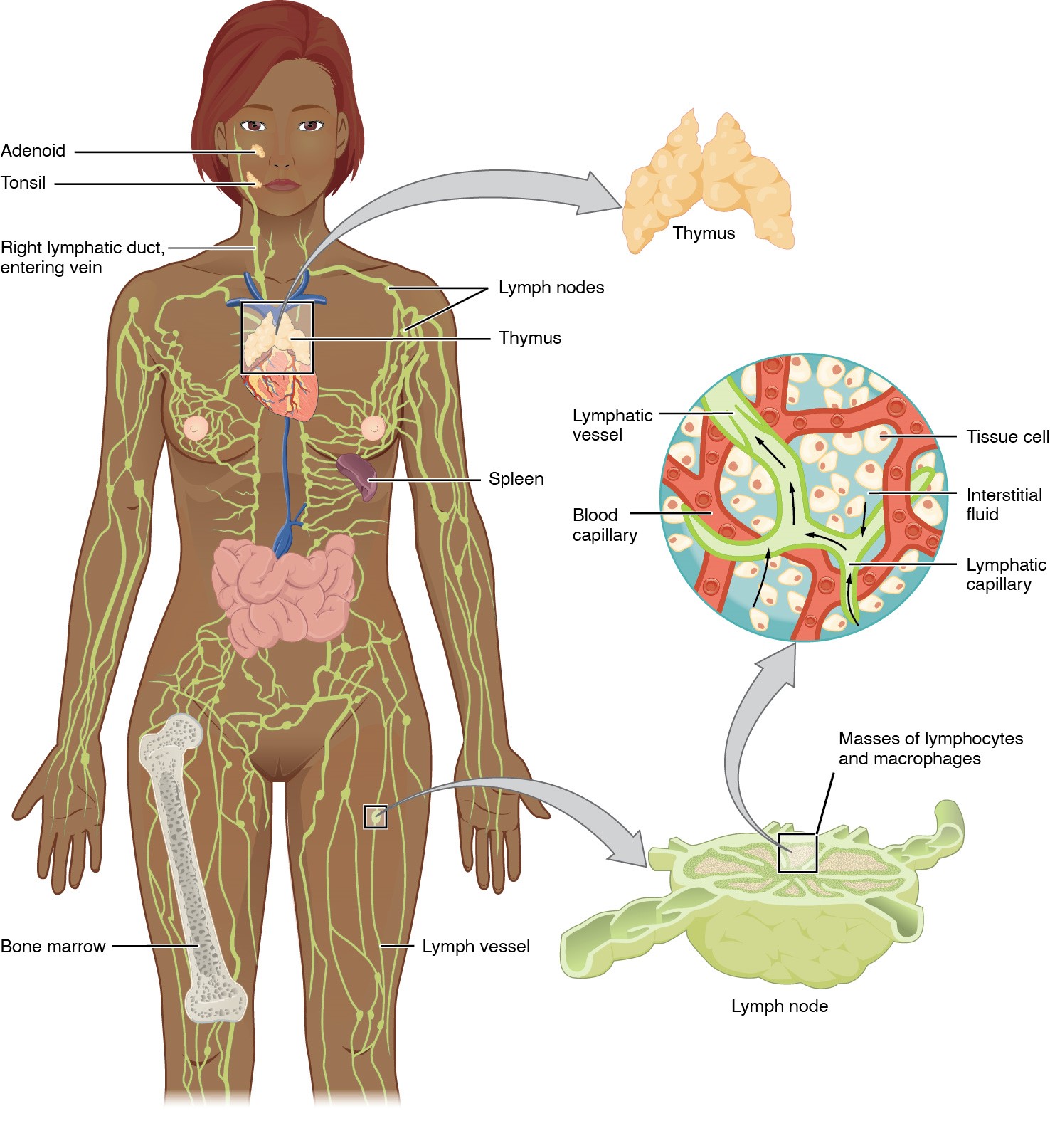
Anatomía del sistema linfático:
Incluye los órganos linfoides primarios (médula ósea, timo) y secundarios (bazo, ganglios linfáticos y mucosa asociada a tejido linfoide)
Los vasos linfáticos transportan la linfa a los vasos linfáticos mayores del torso, transportando el líquido de vuelta a la circulación venosa.

Imagen: Anatomy of the Lymphatic System por OpenStax. Licencia: CC BY 4.0

Médula Ósea

Anatomía

La médula ósea es el tejido esponjoso que se encuentra en EN Erythema nodosum is an immune-mediated panniculitis (inflammation of the subcutaneous fat) caused by a type IV (delayed-type) hypersensitivity reaction. It commonly manifests in young women as tender, erythematous nodules on the shins. Erythema Nodosum los LOS Neisseria canales medulares de los LOS Neisseria huesos largos y en EN Erythema nodosum is an immune-mediated panniculitis (inflammation of the subcutaneous fat) caused by a type IV (delayed-type) hypersensitivity reaction. It commonly manifests in young women as tender, erythematous nodules on the shins. Erythema Nodosum las cavidades de los LOS Neisseria huesos esponjosos.
  • Médula ósea roja:
    • Hematopoyética/formadora de sangre
    • Se localiza en EN Erythema nodosum is an immune-mediated panniculitis (inflammation of the subcutaneous fat) caused by a type IV (delayed-type) hypersensitivity reaction. It commonly manifests in young women as tender, erythematous nodules on the shins. Erythema Nodosum los LOS Neisseria huesos planos (cráneo, esternón, vértebras, escápulas y huesos de la pelvis Pelvis The pelvis consists of the bony pelvic girdle, the muscular and ligamentous pelvic floor, and the pelvic cavity, which contains viscera, vessels, and multiple nerves and muscles. The pelvic girdle, composed of 2 “hip” bones and the sacrum, is a ring-like bony structure of the axial skeleton that links the vertebral column with the lower extremities. Pelvis: Anatomy) y en EN Erythema nodosum is an immune-mediated panniculitis (inflammation of the subcutaneous fat) caused by a type IV (delayed-type) hypersensitivity reaction. It commonly manifests in young women as tender, erythematous nodules on the shins. Erythema Nodosum las epífisis de los LOS Neisseria huesos largos (fémur, tibia Tibia The second longest bone of the skeleton. It is located on the medial side of the lower leg, articulating with the fibula laterally, the talus distally, and the femur proximally. Knee Joint: Anatomy, húmero)
  • Médula ósea amarilla:
    • No hematopoyética
    • Situado en EN Erythema nodosum is an immune-mediated panniculitis (inflammation of the subcutaneous fat) caused by a type IV (delayed-type) hypersensitivity reaction. It commonly manifests in young women as tender, erythematous nodules on the shins. Erythema Nodosum la diáfisis de los LOS Neisseria huesos largos
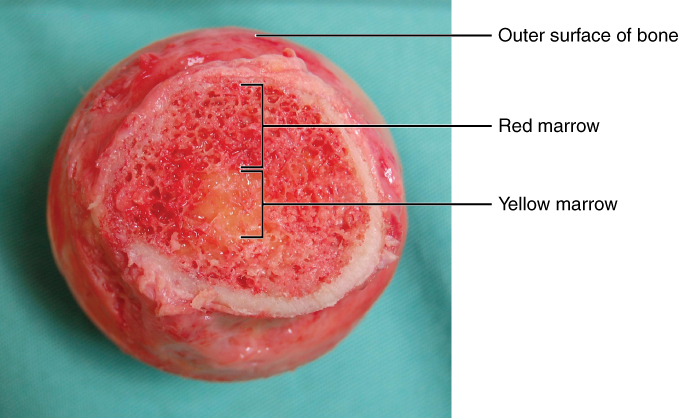
Porciones de médula roja y amarilla del hueso

La médula ósea:
Sección transversal que muestra la médula roja y amarilla del hueso
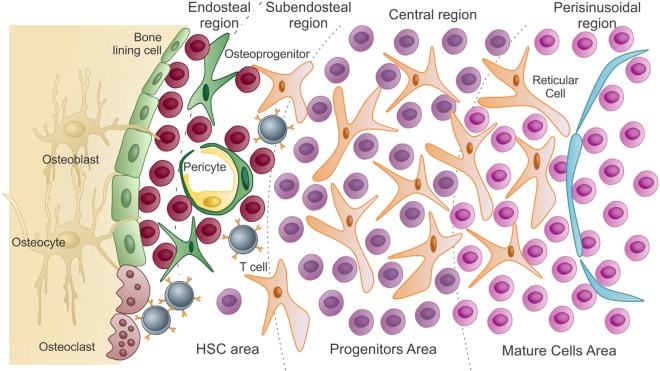
Imagen: 619 Red and Yellow Bone Marrow por OpenStax College. Licencia: CC BY 3.0

Funciones principales

  • Lugar primario de formación de las células sanguíneas ( en EN Erythema nodosum is an immune-mediated panniculitis (inflammation of the subcutaneous fat) caused by a type IV (delayed-type) hypersensitivity reaction. It commonly manifests in young women as tender, erythematous nodules on the shins. Erythema Nodosum el 5to mes de gestación)
  • Descomposición de los LOS Neisseria eritrocitos viejos ( en EN Erythema nodosum is an immune-mediated panniculitis (inflammation of the subcutaneous fat) caused by a type IV (delayed-type) hypersensitivity reaction. It commonly manifests in young women as tender, erythematous nodules on the shins. Erythema Nodosum bilirrubina, hierro, globina) a través de los LOS Neisseria macrófagos y reutilización del hierro
  • Almacenamiento de grasa a través de los LOS Neisseria adipocitos

Estructuras

  • Hematopoyéticas:
    • Las células madre hematopoyéticas son células multipotentes con capacidad de autorrenovación y diferenciación a todas las células del linaje hematopoyético.
    • Células madre hematopoyéticas → células progenitoras multipotentes → progenitores oligopotentes:
      • Células progenitoras linfoides comunes
      • Células progenitoras mieloides comunes
    • Las células progenitoras mieloides comunes y las células progenitoras linfoides comunes son progenitores de linaje restringido y, a través de etapas, acaban convirtiéndose en EN Erythema nodosum is an immune-mediated panniculitis (inflammation of the subcutaneous fat) caused by a type IV (delayed-type) hypersensitivity reaction. It commonly manifests in young women as tender, erythematous nodules on the shins. Erythema Nodosum células efectoras o en EN Erythema nodosum is an immune-mediated panniculitis (inflammation of the subcutaneous fat) caused by a type IV (delayed-type) hypersensitivity reaction. It commonly manifests in young women as tender, erythematous nodules on the shins. Erythema Nodosum células diferenciadas:
      • Células progenitoras multipotentes → granulocitos, monocitos, megacariocitos, eritrocitos
      • Células progenitoras linfoides comunes → linfocitos (las células progenitoras T van al AL Amyloidosis timo)
  • No hematopoyéticas: estructuras que proporcionan un microambiente que favorece la diferenciación de las células hematopoyéticas y la proliferación de las células sanguíneas:
    • Células óseas
    • Estroma de la médula
    • Sinusoides

Timo

Anatomía

  • Órgano linfoide primario bilobulado encapsulado
  • Localizado en EN Erythema nodosum is an immune-mediated panniculitis (inflammation of the subcutaneous fat) caused by a type IV (delayed-type) hypersensitivity reaction. It commonly manifests in young women as tender, erythematous nodules on the shins. Erythema Nodosum el mediastino anterosuperior
  • Desarrollo y crecimiento:
    • Surge de la 3ra y 4ta bolsa faríngea (endodermo)
    • Los LOS Neisseria linfocitos tímicos surgen del mesodermo.
    • Pesa 12 g al AL Amyloidosis nacer, y alcanza el peso máximo en EN Erythema nodosum is an immune-mediated panniculitis (inflammation of the subcutaneous fat) caused by a type IV (delayed-type) hypersensitivity reaction. It commonly manifests in young women as tender, erythematous nodules on the shins. Erythema Nodosum la pubertad (30–40 g)
    • Después de la pubertad, sufre una involución (el parénquima linfático es sustituido por tejido adiposo).

Función principal

La función principal de la médula ósea es actuar como lugar de diferenciación y maduración de las células T (desde la médula ósea, las células progenitoras van al AL Amyloidosis timo).
Estructura general

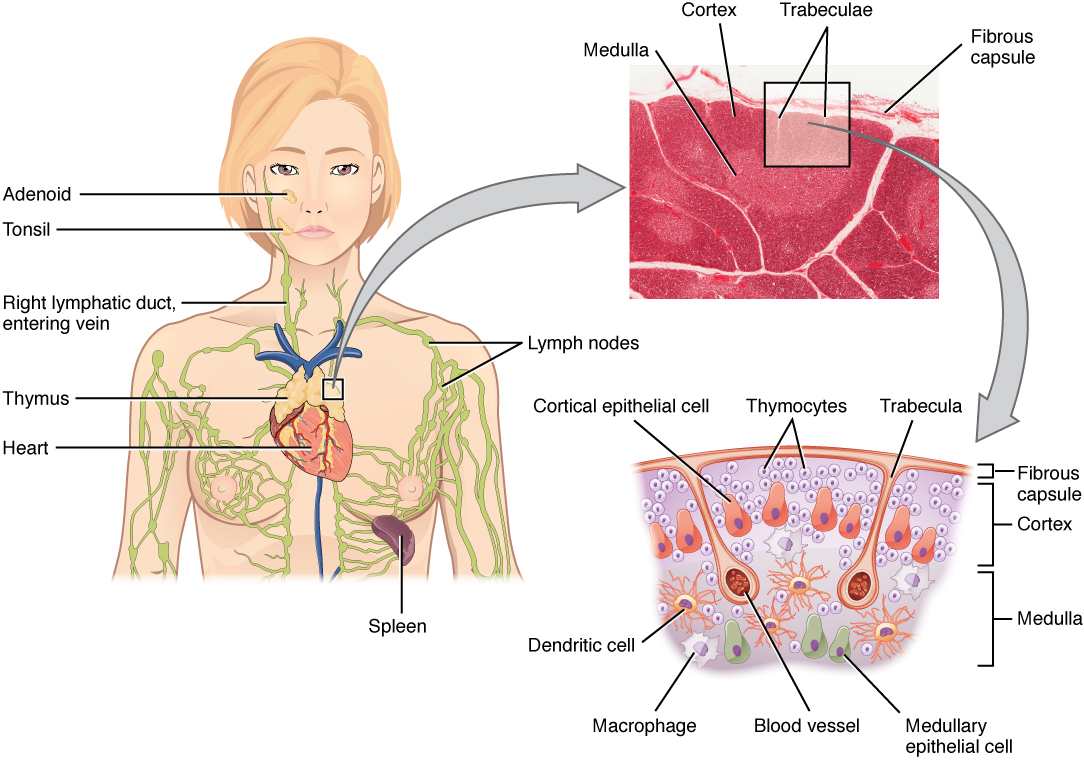
  • Con cápsula de tejido conectivo denso
  • Dividido en EN Erythema nodosum is an immune-mediated panniculitis (inflammation of the subcutaneous fat) caused by a type IV (delayed-type) hypersensitivity reaction. It commonly manifests in young women as tender, erythematous nodules on the shins. Erythema Nodosum 2 lóbulos asimétricos (el derecho es más grande):
    • Cada lóbulo del timo tiene lóbulos más pequeños separados por trabéculas (septos fibrosos que se extienden desde la cápsula externa).
    • Cada lóbulo contiene un:
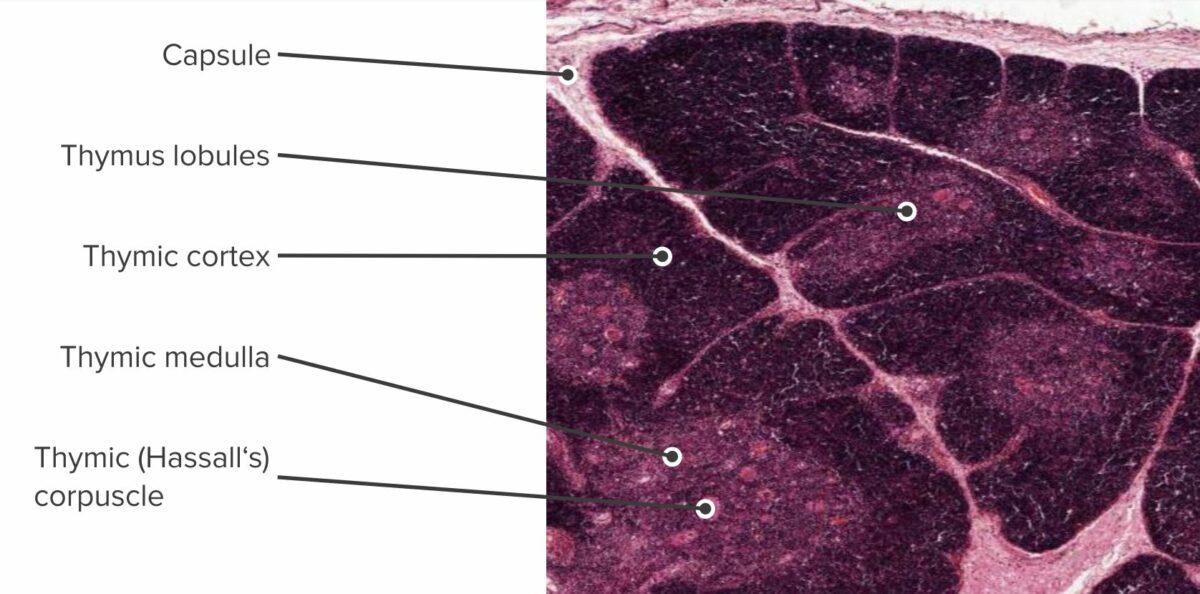
      • Cortex
      • Médula

Regiones funcionales

  • Corteza:
    • Parte exterior del lóbulo (oscuro)
    • Zona de entrada de las células derivadas de la médula ósea (CD4–, CD8–).
    • Contiene grupos densos de células T inmaduras/timocitos en EN Erythema nodosum is an immune-mediated panniculitis (inflammation of the subcutaneous fat) caused by a type IV (delayed-type) hypersensitivity reaction. It commonly manifests in young women as tender, erythematous nodules on the shins. Erythema Nodosum desarrollo (con tamaños variables y escasas mitosis Mitosis A type of cell nucleus division by means of which the two daughter nuclei normally receive identical complements of the number of chromosomes of the somatic cells of the species. Cell Cycle)
  • La médula:
    • Zona central del lóbulo con tinción más clara
    • Ordenado de forma imprecisa
    • A medida que las células T maduran, migran desde la corteza hacia la médula.
    • Contiene:
      • Linfocitos maduros (menos numerosos)
      • Corpúsculos de Hassall o tímicos: células epiteliales de aspecto escamoso (restos de células degeneradas y citoqueratinas) dispuestas en EN Erythema nodosum is an immune-mediated panniculitis (inflammation of the subcutaneous fat) caused by a type IV (delayed-type) hypersensitivity reaction. It commonly manifests in young women as tender, erythematous nodules on the shins. Erythema Nodosum espirales concéntricos
  • La unión corticomedular contiene células presentadoras de antígenos, células dendríticas y macrófagos.

Irrigación

  • La irrigación de sangre arterial proviene de las arterias torácicas internas.
  • La sangre venosa drena en EN Erythema nodosum is an immune-mediated panniculitis (inflammation of the subcutaneous fat) caused by a type IV (delayed-type) hypersensitivity reaction. It commonly manifests in young women as tender, erythematous nodules on the shins. Erythema Nodosum las venas braquiocefálicas y torácicas internas.
  • Los LOS Neisseria vasos sanguíneos entran y salen del timo a través de las trabéculas.
  • El timo solo contiene linfáticos eferentes que acaban transportando los LOS Neisseria linfocitos maduros desde el timo.

Related videos

Relevancia Clínica

  • Leucemia linfoblástica aguda: neoplasia hematológica con proliferación descontrolada de células precursoras linfoides. La leucemia/linfoma linfoblástica aguda, es la forma más común de cáncer que afecta a niños, y se caracteriza por un aumento de los LOS Neisseria linfoblastos. La enfermedad provoca la sustitución de la médula normal por linfoblastos, que acaban pasando a la circulación y se infiltran en EN Erythema nodosum is an immune-mediated panniculitis (inflammation of the subcutaneous fat) caused by a type IV (delayed-type) hypersensitivity reaction. It commonly manifests in young women as tender, erythematous nodules on the shins. Erythema Nodosum otros órganos. La presentación clínica consiste en EN Erythema nodosum is an immune-mediated panniculitis (inflammation of the subcutaneous fat) caused by a type IV (delayed-type) hypersensitivity reaction. It commonly manifests in young women as tender, erythematous nodules on the shins. Erythema Nodosum fatiga, hemorragias, fiebre e infecciones relacionadas con la anemia Anemia Anemia is a condition in which individuals have low Hb levels, which can arise from various causes. Anemia is accompanied by a reduced number of RBCs and may manifest with fatigue, shortness of breath, pallor, and weakness. Subtypes are classified by the size of RBCs, chronicity, and etiology. Anemia: Overview and Types, la trombocitopenia y escasos leucocitos funcionales. El diagnóstico se realiza mediante un frotis de sangre periférica y un examen de biopsia de médula ósea en EN Erythema nodosum is an immune-mediated panniculitis (inflammation of the subcutaneous fat) caused by a type IV (delayed-type) hypersensitivity reaction. It commonly manifests in young women as tender, erythematous nodules on the shins. Erythema Nodosum la que predominan linfoblastos. El tratamiento es principalmente quimioterapia administrada en EN Erythema nodosum is an immune-mediated panniculitis (inflammation of the subcutaneous fat) caused by a type IV (delayed-type) hypersensitivity reaction. It commonly manifests in young women as tender, erythematous nodules on the shins. Erythema Nodosum fases.
  • Timoma: neoplasia tímica poco frecuente que se descubre a menudo de forma incidental en EN Erythema nodosum is an immune-mediated panniculitis (inflammation of the subcutaneous fat) caused by a type IV (delayed-type) hypersensitivity reaction. It commonly manifests in young women as tender, erythematous nodules on the shins. Erythema Nodosum la imagenología. Los LOS Neisseria síntomas torácicos se producen debido a los LOS Neisseria efectos sobre los LOS Neisseria órganos adyacentes (pueden causar dificultad para respirar, tos TOS Thoracic outlet syndrome (TOS) is a broad term used for a spectrum of syndromes related to the general region of the thoracic outlet, which involves the compression or irritation of elements of the brachial plexus, subclavian artery, or subclavian vein. Thoracic Outlet Syndrome, parálisis del nervio frénico, síndrome de la vena cava superior). El síndrome paraneoplásico más común asociado a un timoma es la miastenia gravis.
  • Síndrome de DiGeorge: enfermedad causada por una microdeleción en EN Erythema nodosum is an immune-mediated panniculitis (inflammation of the subcutaneous fat) caused by a type IV (delayed-type) hypersensitivity reaction. It commonly manifests in young women as tender, erythematous nodules on the shins. Erythema Nodosum la localización q11.2 del cromosoma 22. En EN Erythema nodosum is an immune-mediated panniculitis (inflammation of the subcutaneous fat) caused by a type IV (delayed-type) hypersensitivity reaction. It commonly manifests in young women as tender, erythematous nodules on the shins. Erythema Nodosum el síndrome de DiGeorge, hay un desarrollo defectuoso de la tercera y cuarta bolsa faríngea, lo que lleva a una hipoplasia tímica y paratiroidea (que causa inmunodeficiencia de células T e hipocalcemia, respectivamente). Las anomalías conotruncales se presentan como defectos cardíacos congénitos. El diagnóstico se realiza a través de los LOS Neisseria hallazgos clínicos, las pruebas de laboratorio (que muestran una reducción de las células T y un nivel bajo de calcio), la ecocardiografía y el análisis genético. El tratamiento puede incluir la administración de suplementos de calcio, antibióticos profilácticos, cirugía y trasplante de timo o células hematopoyéticas.

Referencias

  1. Bindu, A. H., & Srilatha, B. (2023). Histology, bone marrow. In StatPearls. StatPearls Publishing. https://www.ncbi.nlm.nih.gov/books/NBK588989/
  2. Crisan, M., & Dzierzak, E. (2023). The many faces of hematopoietic stem cell heterogeneity. Development, 150(6), dev200932. https://doi.org/10.1242/dev.200932
  3. Gasteiger, G., Kastenmuller, W., Ljapoci, R., Sarde, A., & Busch, D. H. (2023). The immune system anatomy, components, and function. Handbook of Experimental Pharmacology, 272, 1-33. https://doi.org/10.1007/164_2022_652
  4. Hess, C., & Kemper, C. (2023). Immunometabolism in health and disease. Science, 380(6650), eadf5885. https://doi.org/10.1126/science.adf5885
  5. Kumar, V., Abbas, A. K., & Aster, J. C. (2023). Robbins and Cotran Pathologic Basis of Disease (10th ed.). Elsevier.
  6. Mescher, A. L. (2023). The immune system & lymphoid organs. In Junqueira’s Basic Histology: Text and Atlas (16th ed.). McGraw-Hill Education.
  7. Netea, M. G., Domínguez-Andrés, J., Barreiro, L. B., Chavakis, T., Divangahi, M., Fuchs, E., Joosten, L., van der Meer, J., Mhlanga, M. M., Mulder, W., Riksen, N. P., Schlitzer, A., Schultze, J. L., Stabell Benn, C., Sun, J. C., Xavier, R. J., & Latz, E. (2020). Defining trained immunity and its role in health and disease. Nature Reviews Immunology, 20(6), 375–388. https://doi.org/10.1038/s41577-020-0285-6
  8. Scoville, S. D., & Caligiuri, M. A. (2021). The organization and structure of lymphoid tissues. In K. Kaushansky, M. A. Lichtman, J. T. Prchal, M. M. Levi, D. C. Press, L. J. Burns, & M. A. Caligiuri (Eds.), Williams Hematology (10th ed.). McGraw-Hill Education.
  9. Steinhagen, F., Zillinger, T., & Weber, F. (2023). Molecular mechanisms of innate antiviral immunity. Journal of Molecular Medicine, 101(1), 15-28. https://doi.org/10.1007/s00109-022-02274-4
  10. Zhao, E., Xu, H., Wang, L., Kryczek, I., Wu, K., Hu, Y., Wang, G., & Zou, W. (2021). Bone marrow and the control of immunity. Cellular & Molecular Immunology, 9(1), 11-19. https://doi.org/10.1038/cmi.2011.47

¡Crea tu cuenta gratis o inicia una sesión para seguir leyendo!

Regístrate ahora y obtén acceso gratuito a Lecturio con páginas de concepto, videos médicos y cuestionarios para tu educación médica.

User Reviews

Que tengas una sesión de estudio alegre y navideña 🎁 Ahorra 50% en todos los planes >>

Details