Domina Conceptos Médicos

Estudia para la escuela de medicina y tus examenes con Lecturio.

Malformaciones de Chiari

Las malformaciones de Chiari son un grupo de afecciones del sistema nervioso central (SNC) que se caracterizan por el subdesarrollo de la fosa craneal posterior con la consiguiente protrusión de estructuras neurales a través del foramen magnum. Existen 4 tipos de malformaciones de Chiari, siendo la tipo I la más común. El síntoma más frecuente es la cefalea. El diagnóstico se realiza por medio de los LOS Neisseria hallazgos clínicos y se confirma con una resonancia magnética (RM). El tratamiento es quirúrgico, y se basa en EN Erythema nodosum is an immune-mediated panniculitis (inflammation of the subcutaneous fat) caused by a type IV (delayed-type) hypersensitivity reaction. It commonly manifests in young women as tender, erythematous nodules on the shins. Erythema Nodosum la descompresión de la fosa posterior y el restablecimiento del flujo del SNC. El pronóstico depende del tipo de malformación.

Last updated: Dec 15, 2025

Editorial responsibility: Stanley Oiseth, Lindsay Jones, Evelin Maza

Descripción General

Definición

Las malformaciones de Chiari son un grupo de trastornos definidos por déficits estructurales en EN Erythema nodosum is an immune-mediated panniculitis (inflammation of the subcutaneous fat) caused by a type IV (delayed-type) hypersensitivity reaction. It commonly manifests in young women as tender, erythematous nodules on the shins. Erythema Nodosum el cerebro y la médula espinal que conducen a un espacio limitado en EN Erythema nodosum is an immune-mediated panniculitis (inflammation of the subcutaneous fat) caused by a type IV (delayed-type) hypersensitivity reaction. It commonly manifests in young women as tender, erythematous nodules on the shins. Erythema Nodosum la fosa posterior, lo que obliga a las estructuras cerebelosas a sobresalir a través del foramen magnum.
Clasificación

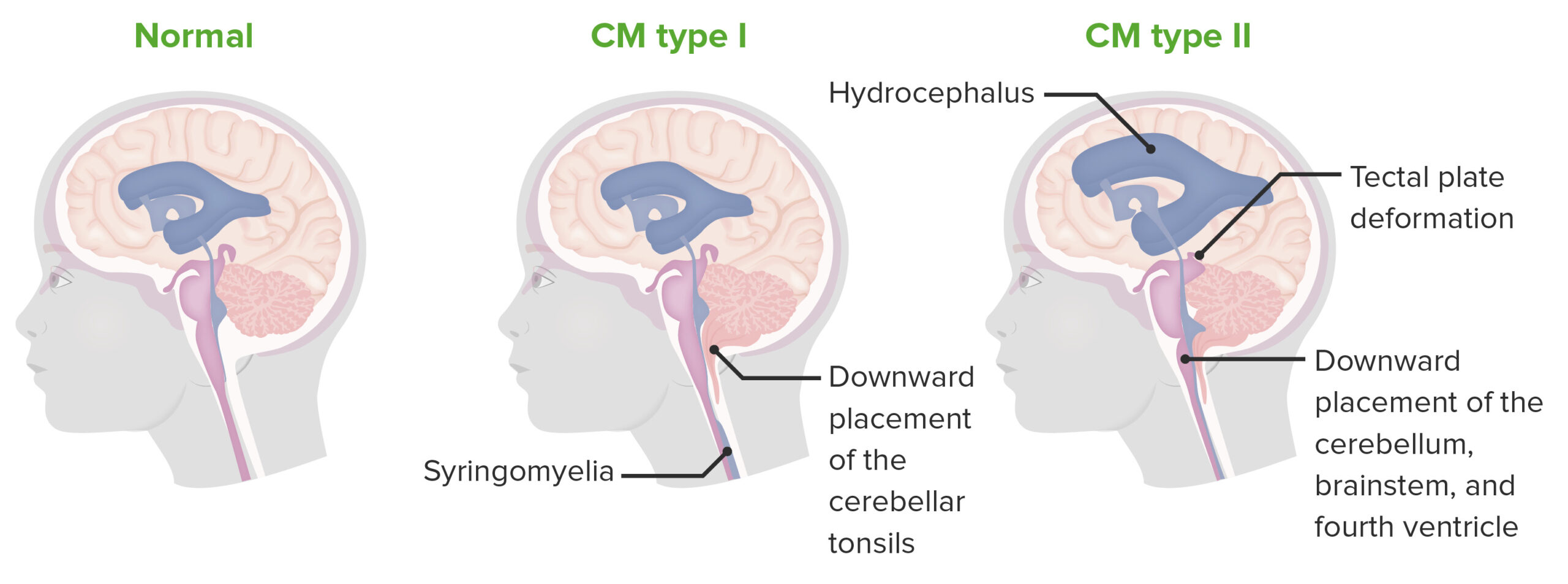
  • Tipo I: hernia Hernia Protrusion of tissue, structure, or part of an organ through the bone, muscular tissue, or the membrane by which it is normally contained. Hernia may involve tissues such as the abdominal wall or the respiratory diaphragm. Hernias may be internal, external, congenital, or acquired. Abdominal Hernias amigdalina > 5 mm inferior al AL Amyloidosis plano del foramen magnum
    • Amígdalas cerebelosas de forma anormal
    • No hay hernia Hernia Protrusion of tissue, structure, or part of an organ through the bone, muscular tissue, or the membrane by which it is normally contained. Hernia may involve tissues such as the abdominal wall or the respiratory diaphragm. Hernias may be internal, external, congenital, or acquired. Abdominal Hernias del tronco cerebral asociada ni anomalías supratentoriales
    • Es común la asociación con hidrocefalia e hidrosiringomielia
  • Tipo II: hernia Hernia Protrusion of tissue, structure, or part of an organ through the bone, muscular tissue, or the membrane by which it is normally contained. Hernia may involve tissues such as the abdominal wall or the respiratory diaphragm. Hernias may be internal, external, congenital, or acquired. Abdominal Hernias del vermis cerebeloso, del tronco cerebral y del 4to ventrículo en EN Erythema nodosum is an immune-mediated panniculitis (inflammation of the subcutaneous fat) caused by a type IV (delayed-type) hypersensitivity reaction. It commonly manifests in young women as tender, erythematous nodules on the shins. Erythema Nodosum el foramen magnum
    • Asociada a mielomeningocele y a múltiples anomalías cerebrales
    • La hidrocefalia y la siringomielia asociadas son muy frecuentes.
  • Tipo III: hernia Hernia Protrusion of tissue, structure, or part of an organ through the bone, muscular tissue, or the membrane by which it is normally contained. Hernia may involve tissues such as the abdominal wall or the respiratory diaphragm. Hernias may be internal, external, congenital, or acquired. Abdominal Hernias del cerebelo y del tronco cerebral que comprime la médula espinal
    • Encefalocele cervical u occipital Occipital Part of the back and base of the cranium that encloses the foramen magnum. Skull: Anatomy alto que contiene tejido cerebeloso y de tronco cerebral herniado
    • Rara y típicamente incompatible con la vida
  • Tipo IV: cerebelo incompleto o poco desarrollado con cráneo y médula espinal expuestos
Malformaciones de Chiari

Chiari tipo I y II
Las malformaciones de Chiari se caracterizan por una fosa craneal posterior subdesarrollada, con la consiguiente protrusión de las estructuras neurales a través del foramen magnum. La tipo 1 se caracteriza por la herniación de las amígdalas cerebelosas únicamente, mientras que la tipo 2 afecta a más estructuras.
Imagen por Lecturio.

Epidemiología

Incidencia:

  • Tipo I:
    • Forma más común
    • 1 de cada 1 000–5 000 nacidos vivos
    • Ligero predominio femenino
  • Tipo II:
    • Aproximadamente 1 de cada 2 000 nacidos vivos
    • Disminución de la incidencia con la administración de suplementos de folato prenatal
    • No hay predominio de género
    • Siempre asociada a mielomeningocele
  • Tipo III:
    • Forma más rara
    • Constituye 1–4,5% de todas las malformaciones de Chiari

Condiciones asociadas:

  • Secuencia de Pierre Robin
  • Síndrome de Noonan
  • Neurofibromatosis tipo 1

Etiología y Fisiopatología

Etiología

  • Mecanismo de la hernia Hernia Protrusion of tissue, structure, or part of an organ through the bone, muscular tissue, or the membrane by which it is normally contained. Hernia may involve tissues such as the abdominal wall or the respiratory diaphragm. Hernias may be internal, external, congenital, or acquired. Abdominal Hernias
    • Formación de una fosa posterior pequeña ➝ crecimiento limitado del cerebelo y de las estructuras cercanas
    • Las estructuras en EN Erythema nodosum is an immune-mediated panniculitis (inflammation of the subcutaneous fat) caused by a type IV (delayed-type) hypersensitivity reaction. It commonly manifests in young women as tender, erythematous nodules on the shins. Erythema Nodosum crecimiento se hernian a través del foramen magnum o del vermis.
  • Múltiples causas propuestas:
    • Causa genética:
      • Segmentación anormal del rombencéfalo
      • Provoca un desarrollo embrionario anormal de los LOS Neisseria tejidos óseos y nerviosos
    • El crecimiento restringido de la fosa posterior provoca la compresión de los LOS Neisseria tejidos neurales.
    • La hidrocefalia progresiva empuja las estructuras hacia abajo.

Fisiopatología

Los LOS Neisseria síntomas neurológicos son causados por:
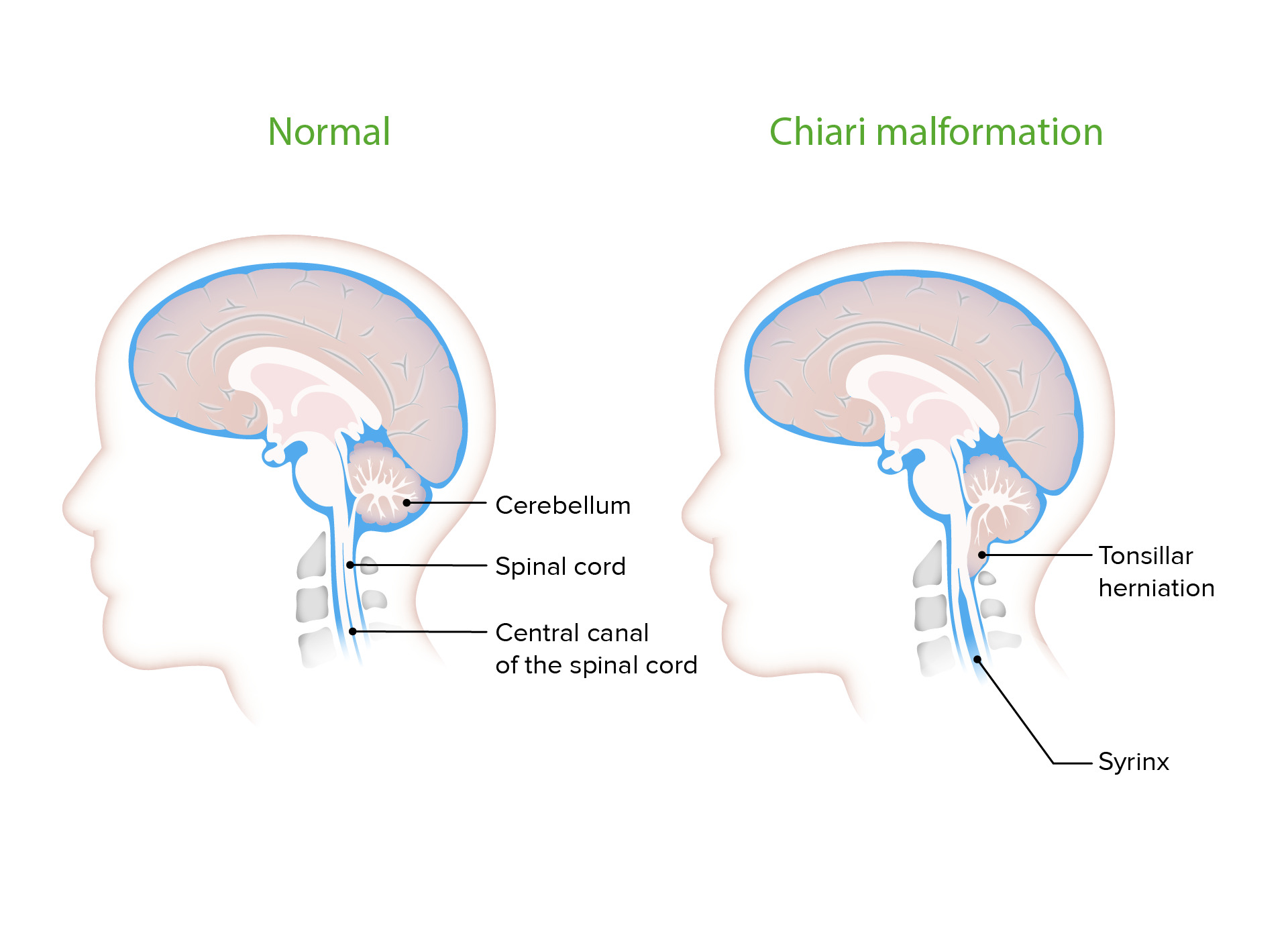
  • Compresión del sistema nervioso central (SNC; cerebelo, tronco cerebral) contra el foramen magnum y el canal espinal
  • Formación de cavidades en EN Erythema nodosum is an immune-mediated panniculitis (inflammation of the subcutaneous fat) caused by a type IV (delayed-type) hypersensitivity reaction. It commonly manifests in young women as tender, erythematous nodules on the shins. Erythema Nodosum la médula espinal (siringomielia) debido a la obstrucción del flujo de salida del liquido cefalorraquideo (LCR)
Presión sobre el SNC debido a la malformación de Chiari

Siringomielia observada con malformación de Chiari
Las cavidades llenas de líquido cefalorraquídeo (LCR) se observan con frecuencia en las malformaciones de Chiari. Provocan la sintomatología comúnmente asociada a la malformación al ejercer presión sobre el tejido neural circundante.

Imagen por Lecturio.

Presentación Clínica

Tipo I

Síntomas:

  • Asintomática en EN Erythema nodosum is an immune-mediated panniculitis (inflammation of the subcutaneous fat) caused by a type IV (delayed-type) hypersensitivity reaction. It commonly manifests in young women as tender, erythematous nodules on the shins. Erythema Nodosum algunos casos
  • Cefalea:
    • Síntoma más común (60%–70%)
    • Generalmente occipital Occipital Part of the back and base of the cranium that encloses the foramen magnum. Skull: Anatomy y cervical superior
    • Cefalea occipital Occipital Part of the back and base of the cranium that encloses the foramen magnum. Skull: Anatomy que empeora con la maniobra de Valsalva
  • Ataxia Ataxia Impairment of the ability to perform smoothly coordinated voluntary movements. This condition may affect the limbs, trunk, eyes, pharynx, larynx, and other structures. Ataxia may result from impaired sensory or motor function. Sensory ataxia may result from posterior column injury or peripheral nerve diseases. Motor ataxia may be associated with cerebellar diseases; cerebral cortex diseases; thalamic diseases; basal ganglia diseases; injury to the red nucleus; and other conditions. Ataxia-telangiectasia y nistagmo (debido a la compresión del cerebelo)
  • La compresión de los LOS Neisseria nervios craneales puede provocar:
    • Disfonía
    • Parálisis de las cuerdas vocales
    • Asimetría de la lengua
  • Apnea central del sueño

Signos físicos:

  • Siringomielia y síndrome del cordón central:
    • Se desarrolla a nivel de C8–T1
    • Zona de pérdida de la sensación de dolor y calor “en forma de capa” por afectación del tracto espinotalámico
    • Parálisis flácida y atrofia muscular por afectación de la neurona motora inferior
  • Escoliosis: debido al AL Amyloidosis desarrollo asimétrico de las vértebras

Tipo II

Síntomas:

  • Signos de disfunción del tronco cerebral (e.g., ataxia Ataxia Impairment of the ability to perform smoothly coordinated voluntary movements. This condition may affect the limbs, trunk, eyes, pharynx, larynx, and other structures. Ataxia may result from impaired sensory or motor function. Sensory ataxia may result from posterior column injury or peripheral nerve diseases. Motor ataxia may be associated with cerebellar diseases; cerebral cortex diseases; thalamic diseases; basal ganglia diseases; injury to the red nucleus; and other conditions. Ataxia-telangiectasia, incontinencia urinaria)
  • Dificultades para deglutir y alimentarse
  • Estridor/dificultad para respirar/apnea
  • Llanto débil
  • Nistagmo
  • Cefaleas occipitales

Signos físicos:

  • Mielomeningocele: protrusión del SNC y de las meninges Meninges The brain and the spinal cord are enveloped by 3 overlapping layers of connective tissue called the meninges. The layers are, from the most external layer to the most internal layer, the dura mater, arachnoid mater, and pia mater. Between these layers are 3 potential spaces called the epidural, subdural, and subarachnoid spaces. Meninges: Anatomy
    • Comúnmente lumbosacra o torácica
    • Generalmente se diagnostica prenatalmente
  • Hidrocefalia (< 10%):
    • Fontanelas tensas o abultadas
    • Aumento del perímetro cefálico > 98vo percentil
    • Rigidez nucal y sensibilidad en EN Erythema nodosum is an immune-mediated panniculitis (inflammation of the subcutaneous fat) caused by a type IV (delayed-type) hypersensitivity reaction. It commonly manifests in young women as tender, erythematous nodules on the shins. Erythema Nodosum el cuello
    • Deterioro cognitivo
    • Desequilibrio y alteraciones de la marcha
    • Incontinencia urinaria

Tipo III

Hay una alta mortalidad infantil con este tipo.

Síntomas:

  • Defectos neurológicos graves, del desarrollo y de los LOS Neisseria nervios craneales
  • Convulsiones
  • Insuficiencia respiratoria
  • Parálisis de la neurona motora superior e inferior

Signos físicos:

  • Encefalocele: defecto protuberante que contiene parte del cerebelo y estructuras superiores
  • Parálisis espástica o flácida

Tipo IV

  • El SNC no está desarrollado.
  • Los LOS Neisseria lactantes fallecen poco después de nacer.

Diagnóstico

Metodología diagnostica

  • Descartar otras causas de hernia Hernia Protrusion of tissue, structure, or part of an organ through the bone, muscular tissue, or the membrane by which it is normally contained. Hernia may involve tissues such as the abdominal wall or the respiratory diaphragm. Hernias may be internal, external, congenital, or acquired. Abdominal Hernias amigdalina (e.g., lesión de masa intracraneal, hidrocefalia).
  • Prenatal:
    • Ultrasonidos obstétricos en EN Erythema nodosum is an immune-mediated panniculitis (inflammation of the subcutaneous fat) caused by a type IV (delayed-type) hypersensitivity reaction. It commonly manifests in young women as tender, erythematous nodules on the shins. Erythema Nodosum busca de anomalías congénitas en EN Erythema nodosum is an immune-mediated panniculitis (inflammation of the subcutaneous fat) caused by a type IV (delayed-type) hypersensitivity reaction. It commonly manifests in young women as tender, erythematous nodules on the shins. Erythema Nodosum la semana 18 de gestación (ausencia de vermis)
    • Amniocentesis Amniocentesis Percutaneous transabdominal puncture of the uterus during pregnancy to obtain amniotic fluid. It is commonly used for fetal karyotype determination in order to diagnose abnormal fetal conditions. Polyhydramnios y cariotipo
  • Postnatal:
    • Ultrasonido de la cabeza preferentemente en EN Erythema nodosum is an immune-mediated panniculitis (inflammation of the subcutaneous fat) caused by a type IV (delayed-type) hypersensitivity reaction. It commonly manifests in young women as tender, erythematous nodules on the shins. Erythema Nodosum neonatos
    • Se prefiere RM en EN Erythema nodosum is an immune-mediated panniculitis (inflammation of the subcutaneous fat) caused by a type IV (delayed-type) hypersensitivity reaction. It commonly manifests in young women as tender, erythematous nodules on the shins. Erythema Nodosum niños mayores y adultos

Diagnóstico

  • Hallazgos clínicos con diagnóstico por imagenología para confirmar
  • Puede hacerse de forma prenatal
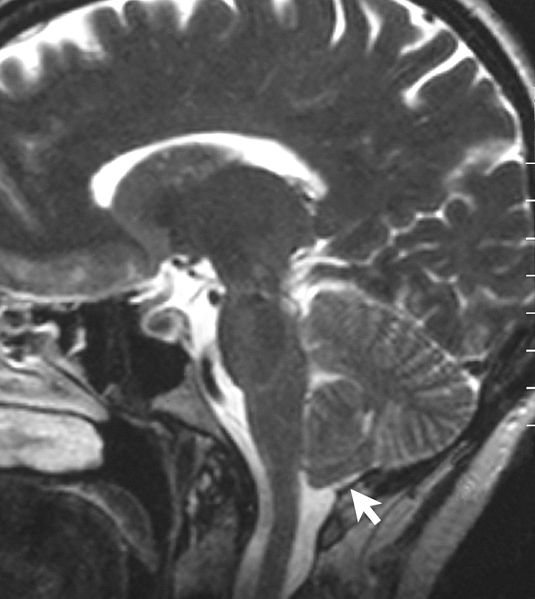
Chiari I malformation

Resonancia magnética que muestra una malformación de Chiari tipo I. Observe la hernia amigdalina.

Imagen: “Sagittal MRI scan of brain of patient with Chiari malformation” por Raymond F Sekula Jr et al. Licencia: CC BY 2.0

Pronóstico

  • Pronóstico favorable con una vida normal esperada tras la intervención
  • La malformación de Chiari III tiene el peor pronóstico.

Tratamiento y Complicaciones

Tratamiento quirúrgico

  • Descompresión de la unión cervicomedular → restablecimiento de la dinámica normal del LCR
  • Opciones:
    • Craniectomía de la fosa posterior sola o con escarificación dural
    • Electrocauterización del cerebelo mediante corrientes eléctricas de alta frecuencia
    • Laminectomía espinal para eliminar el techo óseo patológico del canal espinal

Tratamiento conservador

  • Analgésicos y relajantes musculares para la cefalea y dolor Dolor Inflammation de cuello
  • Uso ocasional del collarín blando
  • Necesidad de educación especial en EN Erythema nodosum is an immune-mediated panniculitis (inflammation of the subcutaneous fat) caused by a type IV (delayed-type) hypersensitivity reaction. It commonly manifests in young women as tender, erythematous nodules on the shins. Erythema Nodosum caso de retraso en EN Erythema nodosum is an immune-mediated panniculitis (inflammation of the subcutaneous fat) caused by a type IV (delayed-type) hypersensitivity reaction. It commonly manifests in young women as tender, erythematous nodules on the shins. Erythema Nodosum los LOS Neisseria hitos del desarrollo

Complicaciones

  • Hidrocefalia: acumulación de LCR en EN Erythema nodosum is an immune-mediated panniculitis (inflammation of the subcutaneous fat) caused by a type IV (delayed-type) hypersensitivity reaction. It commonly manifests in young women as tender, erythematous nodules on the shins. Erythema Nodosum la cavidad craneal; una malformación de Chiari es una causa obstructiva o no comunicante de la hidrocefalia
  • Formación de pseudomeningocele y fuga de LCR
  • Meningitis Meningitis Meningitis is inflammation of the meninges, the protective membranes of the brain, and spinal cord. The causes of meningitis are varied, with the most common being bacterial or viral infection. The classic presentation of meningitis is a triad of fever, altered mental status, and nuchal rigidity. Meningitis e infección de la herida en EN Erythema nodosum is an immune-mediated panniculitis (inflammation of the subcutaneous fat) caused by a type IV (delayed-type) hypersensitivity reaction. It commonly manifests in young women as tender, erythematous nodules on the shins. Erythema Nodosum el postoperatorio
  • Lesión neurovascular durante la cirugía
  • Ptosis Ptosis Cranial Nerve Palsies cerebelosa en EN Erythema nodosum is an immune-mediated panniculitis (inflammation of the subcutaneous fat) caused by a type IV (delayed-type) hypersensitivity reaction. It commonly manifests in young women as tender, erythematous nodules on the shins. Erythema Nodosum una gran craniectomía occipital Occipital Part of the back and base of the cranium that encloses the foramen magnum. Skull: Anatomy

Diagnóstico Diferencial

  • Hidrocefalia: afección potencialmente mortal causada por la acumulación excesiva de LCR en EN Erythema nodosum is an immune-mediated panniculitis (inflammation of the subcutaneous fat) caused by a type IV (delayed-type) hypersensitivity reaction. It commonly manifests in young women as tender, erythematous nodules on the shins. Erythema Nodosum el sistema ventricular. La presentación clínica es inespecífica e incluye cefalea, cambios de comportamiento, retrasos en EN Erythema nodosum is an immune-mediated panniculitis (inflammation of the subcutaneous fat) caused by a type IV (delayed-type) hypersensitivity reaction. It commonly manifests in young women as tender, erythematous nodules on the shins. Erythema Nodosum el desarrollo o náuseas y vómitos. El diagnóstico se confirma con una neuroimagen (ultrasonido, TC craneal o RM) que muestra ventriculomegalia. El tratamiento es la colocación de una derivación de LCR.
  • Meningitis Meningitis Meningitis is inflammation of the meninges, the protective membranes of the brain, and spinal cord. The causes of meningitis are varied, with the most common being bacterial or viral infection. The classic presentation of meningitis is a triad of fever, altered mental status, and nuchal rigidity. Meningitis: inflamación de las leptomeninges Leptomeninges Meninges: Anatomy, generalmente debida a un agente infeccioso. Los LOS Neisseria pacientes presentarán cefalea, fiebre y rigidez de cuello. El diagnóstico se sospecha por la presentación clínica y se confirma con la punción lumbar. El tratamiento se dirige a la infección causante.
  • Trastornos del tubo neural: trastornos ocasionados por un fallo en EN Erythema nodosum is an immune-mediated panniculitis (inflammation of the subcutaneous fat) caused by a type IV (delayed-type) hypersensitivity reaction. It commonly manifests in young women as tender, erythematous nodules on the shins. Erythema Nodosum el cierre del tubo neural durante el desarrollo embriológico. Los LOS Neisseria síntomas van desde los LOS Neisseria asintomáticos hasta las malformaciones muy graves de la columna vertebral y el cerebro. Las etiologías son multifactoriales, desde la nutrición materna hasta los LOS Neisseria determinantes genéticos. El diagnóstico prenatal se realiza mediante ultrasonido y nivel de α-fetoproteína materna. El tratamiento es principalmente quirúrgico.

Referencias

  1. Schijman, E. History, anatomic forms, and pathogenesis of Chiari I malformations. Childs Nerv Syst 20, 323–328 (2004). Retrieved January 7, 2025, from https://doi.org/10.1007/s00381-003-0878-y
  2. Khoury, C. (2023). Chiari malformations. UpToDate. Retrieved January 7, 2025, from https://www.uptodate.com/contents/chiari-malformations.
  3. Abd-El-Barr MM, Strong CI, Groff MW. Chiari malformations: diagnosis, treatments and failures. J Neurosurg Sci. 2014 Dec. 58 (4):215–21.
  4. McClugage, S. G., & Oakes, W. J. (2019, September 1). The Chiari I malformation. Journal of Neurosurgery: Pediatrics. Retrieved January 7, 2025, from https://thejns.org/pediatrics/view/journals/j-neurosurg-pediatr/24/3/article-p217.xml
  5. Langridge B, Phillips E, Choi D. (2017). Chiari Malformation Type 1: A Systematic Review of Natural History and Conservative Management. World Neurosurg.
  6. Rosenblum, J. S., Pomeraniec, I. J., & Heiss, J. D. (2022). Chiari malformation: Update on diagnosis and treatment. Neurologic Clinics, 40(2), 297–307. Retrieved January 7, 2025, from https://doi.org/10.1016/j.ncl.2021.11.007

¡Crea tu cuenta gratis o inicia una sesión para seguir leyendo!

Regístrate ahora y obtén acceso gratuito a Lecturio con páginas de concepto, videos médicos y cuestionarios para tu educación médica.

User Reviews

Que tengas una sesión de estudio alegre y navideña 🎁 Ahorra 50% en todos los planes >>

Details