
Domina Conceptos Médicos

Estudia para la escuela de medicina y tus examenes con Lecturio.

Homeostasis Energética

La homeostasis Homeostasis The processes whereby the internal environment of an organism tends to remain balanced and stable. Cell Injury and Death es el estado estacionario de equilibrio. De manera similar, en EN Erythema nodosum is an immune-mediated panniculitis (inflammation of the subcutaneous fat) caused by a type IV (delayed-type) hypersensitivity reaction. It commonly manifests in young women as tender, erythematous nodules on the shins. Erythema Nodosum bioquímica, la homeostasis Homeostasis The processes whereby the internal environment of an organism tends to remain balanced and stable. Cell Injury and Death energética es el punto de equilibrio entre la energía suministrada y la energía disipada (i.e., un estado de energía constante) que el cuerpo humano busca mantener para un desempeño óptimo. El hipotálamo juega un papel central en EN Erythema nodosum is an immune-mediated panniculitis (inflammation of the subcutaneous fat) caused by a type IV (delayed-type) hypersensitivity reaction. It commonly manifests in young women as tender, erythematous nodules on the shins. Erythema Nodosum la regulación de la homeostasis Homeostasis The processes whereby the internal environment of an organism tends to remain balanced and stable. Cell Injury and Death energética. Se cree que la homeostasis Homeostasis The processes whereby the internal environment of an organism tends to remain balanced and stable. Cell Injury and Death energética ineficiente es un factor importante en EN Erythema nodosum is an immune-mediated panniculitis (inflammation of the subcutaneous fat) caused by a type IV (delayed-type) hypersensitivity reaction. It commonly manifests in young women as tender, erythematous nodules on the shins. Erythema Nodosum la epidemia de obesidad. Se han propuesto muchos modelos para explicar y comprender mejor el mecanismo de la homeostasis Homeostasis The processes whereby the internal environment of an organism tends to remain balanced and stable. Cell Injury and Death energética.

Last updated: Apr 25, 2025
Editorial responsibility: Stanley Oiseth, Lindsay Jones, Evelin Maza

Descripción General

Términos importantes

  • Consumo de energía:
    • Medido por la cantidad de calorías consumidas de alimentos y líquidos
    • Modulada por el hambre, que está regulada principalmente por el hipotálamo
  • Gasto de energía: suma del calor Calor Inflammation interno producido y el trabajo externo
    • El calor Calor Inflammation interno producido es la suma de la tasa metabólica basal y el efecto térmico de los LOS Neisseria alimentos.
    • El trabajo externo se estima midiendo el nivel de actividad física.
  • Teoría del punto de ajuste:
    • Postula que el cuerpo de todas las personas tiene un peso fijo programado, con mecanismos reguladores para compensar
    • Se ha HA Hemolytic anemia (HA) is the term given to a large group of anemias that are caused by the premature destruction/hemolysis of circulating red blood cells (RBCs). Hemolysis can occur within (intravascular hemolysis) or outside the blood vessels (extravascular hemolysis). Hemolytic Anemia descartado, ya que se ha HA Hemolytic anemia (HA) is the term given to a large group of anemias that are caused by the premature destruction/hemolysis of circulating red blood cells (RBCs). Hemolysis can occur within (intravascular hemolysis) or outside the blood vessels (extravascular hemolysis). Hemolytic Anemia demostrado que múltiples factores juegan un papel en EN Erythema nodosum is an immune-mediated panniculitis (inflammation of the subcutaneous fat) caused by a type IV (delayed-type) hypersensitivity reaction. It commonly manifests in young women as tender, erythematous nodules on the shins. Erythema Nodosum el cambio de peso
    • El cuerpo no puede compensar con precisión los LOS Neisseria errores en EN Erythema nodosum is an immune-mediated panniculitis (inflammation of the subcutaneous fat) caused by a type IV (delayed-type) hypersensitivity reaction. It commonly manifests in young women as tender, erythematous nodules on the shins. Erythema Nodosum la ingesta de energía/calorías, contrariamente a la hipótesis de la teoría del punto de ajuste.
  • Balance energético positivo:
    • Resultado obtenido cuando la ingesta de energía es superior a la consumida en EN Erythema nodosum is an immune-mediated panniculitis (inflammation of the subcutaneous fat) caused by a type IV (delayed-type) hypersensitivity reaction. It commonly manifests in young women as tender, erythematous nodules on the shins. Erythema Nodosum trabajo externo y otros medios de gasto de energía
    • Un balance positivo da como resultado que la energía se almacene en EN Erythema nodosum is an immune-mediated panniculitis (inflammation of the subcutaneous fat) caused by a type IV (delayed-type) hypersensitivity reaction. It commonly manifests in young women as tender, erythematous nodules on the shins. Erythema Nodosum forma de grasa y/o músculo, lo que provoca un aumento de peso; con el tiempo, esto puede resultar en EN Erythema nodosum is an immune-mediated panniculitis (inflammation of the subcutaneous fat) caused by a type IV (delayed-type) hypersensitivity reaction. It commonly manifests in young women as tender, erythematous nodules on the shins. Erythema Nodosum obesidad.
    • Causas prevenibles de la obesidad: comer en EN Erythema nodosum is an immune-mediated panniculitis (inflammation of the subcutaneous fat) caused by a type IV (delayed-type) hypersensitivity reaction. It commonly manifests in young women as tender, erythematous nodules on the shins. Erythema Nodosum exceso y un estilo de vida sedentario
  • Balance de energía negativo:
    • Resultado obtenido cuando la ingesta de energía es menor que la que se consume en EN Erythema nodosum is an immune-mediated panniculitis (inflammation of the subcutaneous fat) caused by a type IV (delayed-type) hypersensitivity reaction. It commonly manifests in young women as tender, erythematous nodules on the shins. Erythema Nodosum trabajo externo y otros medios corporales de gasto de energía
    • Causas principales:
      • Disminución de la ingesta debido a afecciones médicas como anorexia Anorexia The lack or loss of appetite accompanied by an aversion to food and the inability to eat. It is the defining characteristic of the disorder anorexia nervosa. Anorexia Nervosa nerviosa, hipertiroidismo y disminución del apetito debido a afecciones subyacentes
      • Mayor requerimiento metabólico debido a procesos patológicos como cáncer, infección o anormalidades metabólicas
  • Requerimiento normal de energía:
    • Depende de la edad, el sexo y el nivel de actividad física
    • Un método bastante preciso utilizado para el cálculo de los LOS Neisseria requisitos de energía es la ecuación de Harris-Benedict:
      • Hombres: tasa metabólica basal = (10 × peso en EN Erythema nodosum is an immune-mediated panniculitis (inflammation of the subcutaneous fat) caused by a type IV (delayed-type) hypersensitivity reaction. It commonly manifests in young women as tender, erythematous nodules on the shins. Erythema Nodosum kg) + (6,25 × altura en EN Erythema nodosum is an immune-mediated panniculitis (inflammation of the subcutaneous fat) caused by a type IV (delayed-type) hypersensitivity reaction. It commonly manifests in young women as tender, erythematous nodules on the shins. Erythema Nodosum cm) – (5 × edad en EN Erythema nodosum is an immune-mediated panniculitis (inflammation of the subcutaneous fat) caused by a type IV (delayed-type) hypersensitivity reaction. It commonly manifests in young women as tender, erythematous nodules on the shins. Erythema Nodosum años) + 5
      • Mujeres: tasa metabólica basal = (10 × peso en EN Erythema nodosum is an immune-mediated panniculitis (inflammation of the subcutaneous fat) caused by a type IV (delayed-type) hypersensitivity reaction. It commonly manifests in young women as tender, erythematous nodules on the shins. Erythema Nodosum kg) + (6,25 × altura en EN Erythema nodosum is an immune-mediated panniculitis (inflammation of the subcutaneous fat) caused by a type IV (delayed-type) hypersensitivity reaction. It commonly manifests in young women as tender, erythematous nodules on the shins. Erythema Nodosum cm) – (5 × edad en EN Erythema nodosum is an immune-mediated panniculitis (inflammation of the subcutaneous fat) caused by a type IV (delayed-type) hypersensitivity reaction. It commonly manifests in young women as tender, erythematous nodules on the shins. Erythema Nodosum años) – 161

Teorías y modelos

  • Modelo de entrada–salida:
    • Establece que un estado interno estable se logra cuando la entrada de energía es igual a la salida de energía
    • No considera otros factores que afectan la homeostasis Homeostasis The processes whereby the internal environment of an organism tends to remain balanced and stable. Cell Injury and Death, como la actividad física
  • Teoría del punto de ajuste:
    • Un valor fisiológico alrededor del cual fluctúa el rango normal
    • Asume que cada cuerpo tiene un cierto punto de ajuste y que los LOS Neisseria mecanismos biológicos dentro del tallo encefálico y el hipotálamo están involucrados en EN Erythema nodosum is an immune-mediated panniculitis (inflammation of the subcutaneous fat) caused by a type IV (delayed-type) hypersensitivity reaction. It commonly manifests in young women as tender, erythematous nodules on the shins. Erythema Nodosum la defensa del cuerpo
    • Propone que la masa de tejido adiposo está regulada por el hipotálamo
    • Estos mecanismos están involucrados en EN Erythema nodosum is an immune-mediated panniculitis (inflammation of the subcutaneous fat) caused by a type IV (delayed-type) hypersensitivity reaction. It commonly manifests in young women as tender, erythematous nodules on the shins. Erythema Nodosum el control de 3 factores importantes (un equilibrio en EN Erythema nodosum is an immune-mediated panniculitis (inflammation of the subcutaneous fat) caused by a type IV (delayed-type) hypersensitivity reaction. It commonly manifests in young women as tender, erythematous nodules on the shins. Erythema Nodosum estos conduce a un balance general de energía):
      • Ingesta de energía
      • Reservas de energía
      • Gasto de energía.
  • Modelo de bucle glucoadipostático:
    • Vincula la energía almacenada en EN Erythema nodosum is an immune-mediated panniculitis (inflammation of the subcutaneous fat) caused by a type IV (delayed-type) hypersensitivity reaction. It commonly manifests in young women as tender, erythematous nodules on the shins. Erythema Nodosum el tejido adiposo con la homeostasis Homeostasis The processes whereby the internal environment of an organism tends to remain balanced and stable. Cell Injury and Death energética a través de cambios en EN Erythema nodosum is an immune-mediated panniculitis (inflammation of the subcutaneous fat) caused by a type IV (delayed-type) hypersensitivity reaction. It commonly manifests in young women as tender, erythematous nodules on the shins. Erythema Nodosum el comportamiento alimentario a través de la leptina y la actividad del sistema nervioso simpático
    • Concepto relativamente nuevo; tiene en EN Erythema nodosum is an immune-mediated panniculitis (inflammation of the subcutaneous fat) caused by a type IV (delayed-type) hypersensitivity reaction. It commonly manifests in young women as tender, erythematous nodules on the shins. Erythema Nodosum cuenta una participación general no solo de la ingesta y la producción de energía, sino que también considera el almacenamiento y la participación de la estimulación en EN Erythema nodosum is an immune-mediated panniculitis (inflammation of the subcutaneous fat) caused by a type IV (delayed-type) hypersensitivity reaction. It commonly manifests in young women as tender, erythematous nodules on the shins. Erythema Nodosum los LOS Neisseria estados de hambre
  • Modelos alternativos:
    • Alostasis: proceso de mantenimiento de la homeostasis Homeostasis The processes whereby the internal environment of an organism tends to remain balanced and stable. Cell Injury and Death a través del cambio adaptativo del entorno interno del organismo para satisfacer las demandas percibidas y anticipadas (i.e., estabilidad a través del cambio)

Fuentes de Energía

General

  • 3 biomoléculas se utilizan comúnmente como fuentes de energía:
    • Carbohidratos
    • Proteínas
    • Grasa
  • Estos nutrientes se digieren y se absorben en EN Erythema nodosum is an immune-mediated panniculitis (inflammation of the subcutaneous fat) caused by a type IV (delayed-type) hypersensitivity reaction. It commonly manifests in young women as tender, erythematous nodules on the shins. Erythema Nodosum el torrente sanguíneo, que los LOS Neisseria distribuye a los LOS Neisseria tejidos de todo el cuerpo, donde finalmente son absorbidos por las células.
  • Los LOS Neisseria carbohidratos se transportan a través de la sangre como glucosa, las proteínas como aminoácidos y los LOS Neisseria lípidos como lipoproteínas.
  • Dentro de las células, las biomoléculas sufren 1 de 3 destinos posibles:
    • Se pueden descomponer en EN Erythema nodosum is an immune-mediated panniculitis (inflammation of the subcutaneous fat) caused by a type IV (delayed-type) hypersensitivity reaction. It commonly manifests in young women as tender, erythematous nodules on the shins. Erythema Nodosum moléculas más pequeñas para liberar energía que se utiliza inmediatamente.
    • Se pueden usar como sustratos para sintetizar otras moléculas que las células y los LOS Neisseria tejidos necesitan para su funcionamiento, crecimiento y reparación normales.
    • Se pueden convertir en EN Erythema nodosum is an immune-mediated panniculitis (inflammation of the subcutaneous fat) caused by a type IV (delayed-type) hypersensitivity reaction. It commonly manifests in young women as tender, erythematous nodules on the shins. Erythema Nodosum moléculas de almacenamiento de energía que proporcionan energía durante el período entre comidas (moléculas de almacenamiento primario: glucógeno y triglicéridos).
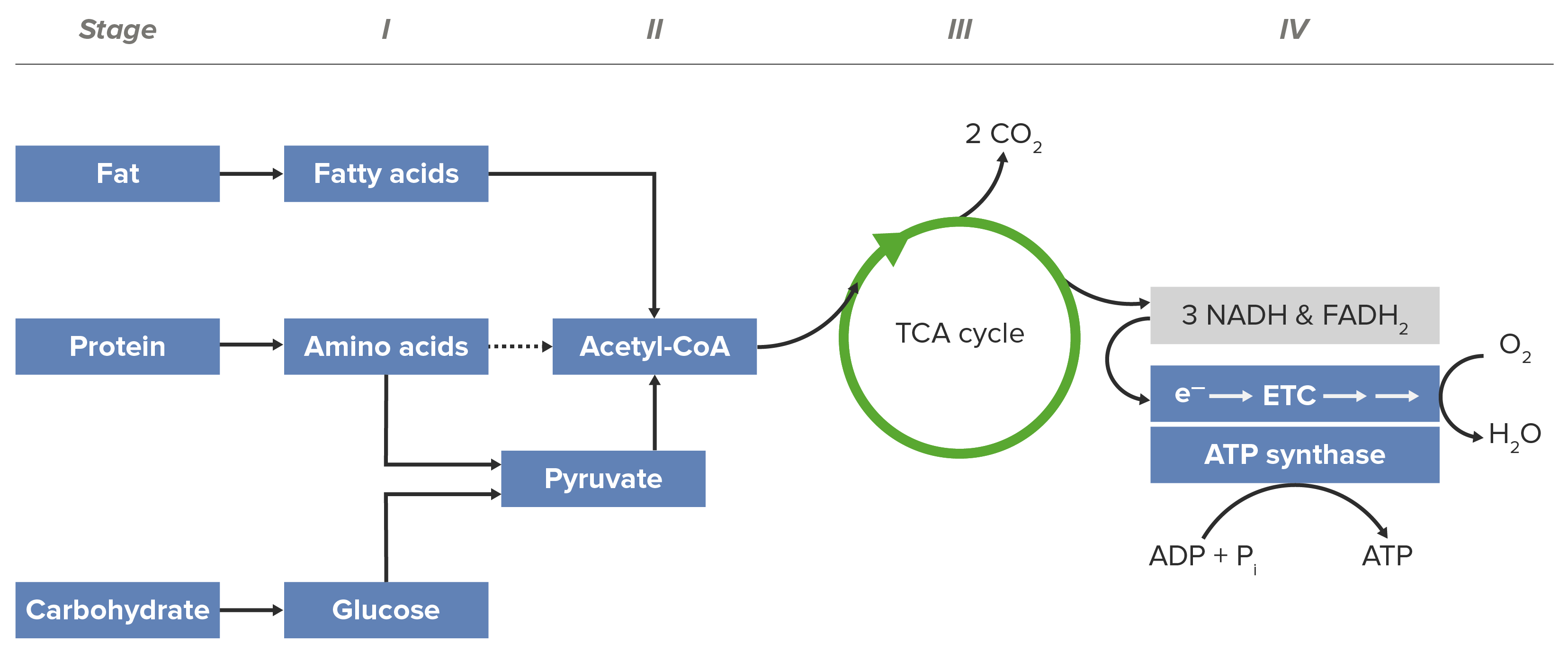
Energía generada a partir de combustibles metabólicos

Energía generada a partir de combustibles metabólicos
ETC: cadena de transporte de electrones
FADH: dinucleótido de flavina y adenina
NADP: nicotinamida adenina dinucleótido fosfato
TCA: ácido tricarboxílico
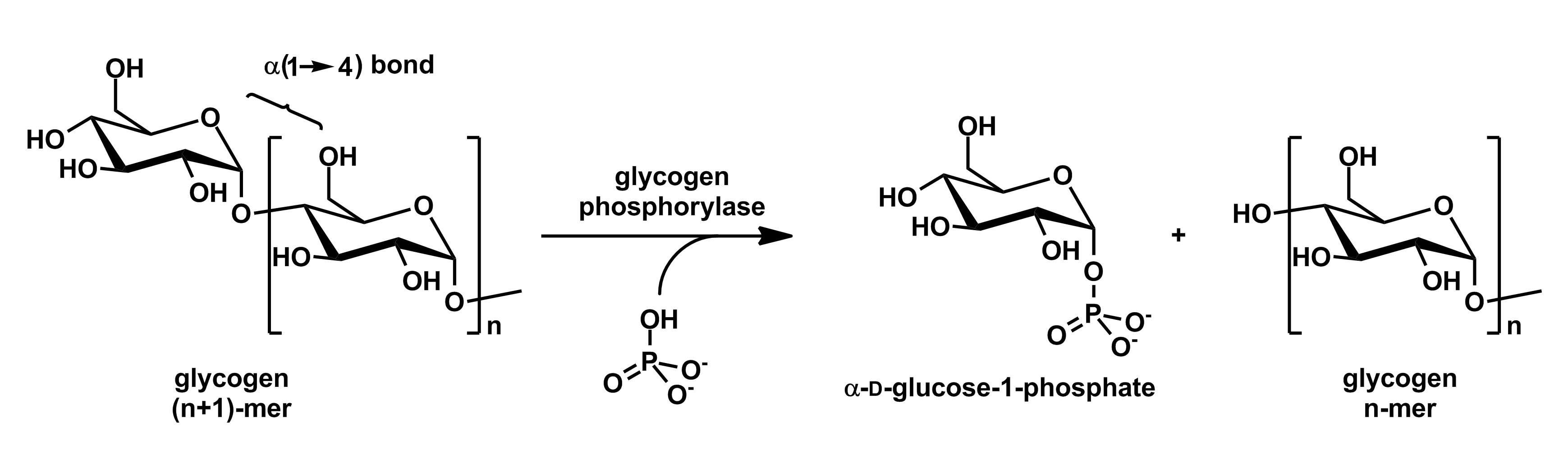
Imagen por Lecturio.

Carbohidratos

  • Absorción:
    • Consumidos en EN Erythema nodosum is an immune-mediated panniculitis (inflammation of the subcutaneous fat) caused by a type IV (delayed-type) hypersensitivity reaction. It commonly manifests in young women as tender, erythematous nodules on the shins. Erythema Nodosum una variedad de formas
    • Los LOS Neisseria monosacáridos, especialmente la glucosa, son la forma más común que se encuentra en EN Erythema nodosum is an immune-mediated panniculitis (inflammation of the subcutaneous fat) caused by a type IV (delayed-type) hypersensitivity reaction. It commonly manifests in young women as tender, erythematous nodules on the shins. Erythema Nodosum el torrente sanguíneo.
  • Utilización:
    • Las moléculas de glucosa son transportadas a las células por transportadores de glucosa.
    • Dentro de las células, la glucosa se oxida generando energía, produciendo CO2 como producto de desecho.
  • Almacenamiento:
    • La glucosa se convierte en EN Erythema nodosum is an immune-mediated panniculitis (inflammation of the subcutaneous fat) caused by a type IV (delayed-type) hypersensitivity reaction. It commonly manifests in young women as tender, erythematous nodules on the shins. Erythema Nodosum glucógeno para su almacenamiento.
    • El glucógeno puede descomponerse en EN Erythema nodosum is an immune-mediated panniculitis (inflammation of the subcutaneous fat) caused by a type IV (delayed-type) hypersensitivity reaction. It commonly manifests in young women as tender, erythematous nodules on the shins. Erythema Nodosum glucosa por glucogenólisis en EN Erythema nodosum is an immune-mediated panniculitis (inflammation of the subcutaneous fat) caused by a type IV (delayed-type) hypersensitivity reaction. It commonly manifests in young women as tender, erythematous nodules on the shins. Erythema Nodosum presencia de glucógeno fosforilasa.
glucógeno fosforilasa

Glucógeno fosforilasa:
El proceso de descomposición del glucógeno involucra a la enzima glucógeno fosforilasa.
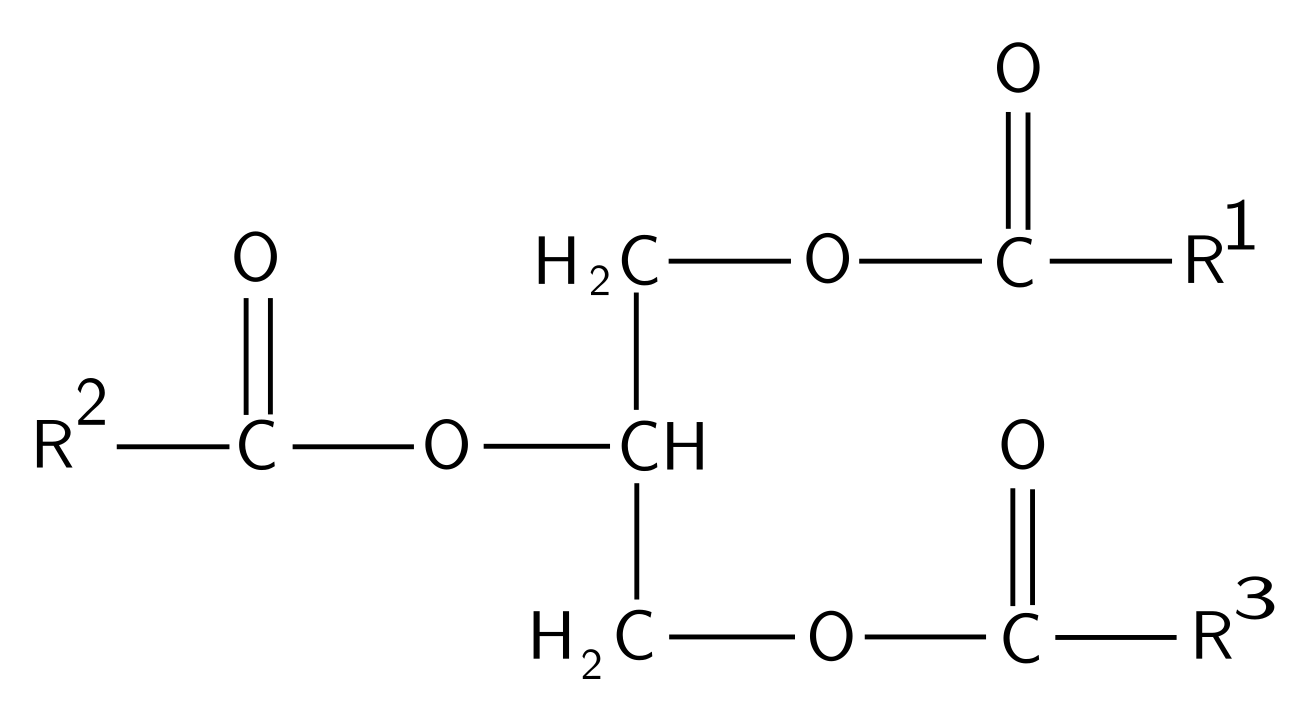
Imagen: “Glycogen phosphorylase stereo” por Michał Sobkowski. Licencia: Dominio Público

Proteínas

  • Absorción: Las proteínas se transportan en EN Erythema nodosum is an immune-mediated panniculitis (inflammation of the subcutaneous fat) caused by a type IV (delayed-type) hypersensitivity reaction. It commonly manifests in young women as tender, erythematous nodules on the shins. Erythema Nodosum el torrente sanguíneo en EN Erythema nodosum is an immune-mediated panniculitis (inflammation of the subcutaneous fat) caused by a type IV (delayed-type) hypersensitivity reaction. It commonly manifests in young women as tender, erythematous nodules on the shins. Erythema Nodosum forma de aminoácidos.
  • Utilización:
    • Después de la absorción por las células, los LOS Neisseria aminoácidos se utilizan para la síntesis de proteínas o se catabolizan para obtener energía mediante proteólisis.
    • Las células utilizan el catabolismo de proteínas para obtener energía con menos frecuencia que los LOS Neisseria carbohidratos y los LOS Neisseria lípidos.
    • Las proteínas son
      • Menos disponibles para el consumo de energía
      • Importantes como bloques de construcción para las moléculas
  • Almacenamiento:
    • Las proteínas de almacenamiento sirven como reservas biológicas de iones metálicos y aminoácidos y son utilizadas principalmente por el músculo esquelético.
    • Hasta el 15% de la proteína se utiliza para tejidos estructurales como la piel y los LOS Neisseria huesos.
    • Las proteínas restantes se encuentran en EN Erythema nodosum is an immune-mediated panniculitis (inflammation of the subcutaneous fat) caused by a type IV (delayed-type) hypersensitivity reaction. It commonly manifests in young women as tender, erythematous nodules on the shins. Erythema Nodosum tejidos y órganos, incluidos los LOS Neisseria riñones y el hígado.

Grasas

  • Absorción:
    • Los LOS Neisseria triglicéridos se transportan y absorben como lipoproteínas en EN Erythema nodosum is an immune-mediated panniculitis (inflammation of the subcutaneous fat) caused by a type IV (delayed-type) hypersensitivity reaction. It commonly manifests in young women as tender, erythematous nodules on the shins. Erythema Nodosum el torrente sanguíneo.
    • Una variedad de lipoproteínas de densidades variables transportan lípidos a varias células diana.
  • Utilización:
    • Para facilitar la entrada en EN Erythema nodosum is an immune-mediated panniculitis (inflammation of the subcutaneous fat) caused by a type IV (delayed-type) hypersensitivity reaction. It commonly manifests in young women as tender, erythematous nodules on the shins. Erythema Nodosum las células, la enzima lipoproteína lipasa descompone los LOS Neisseria triglicéridos en EN Erythema nodosum is an immune-mediated panniculitis (inflammation of the subcutaneous fat) caused by a type IV (delayed-type) hypersensitivity reaction. It commonly manifests in young women as tender, erythematous nodules on the shins. Erythema Nodosum la superficie externa de las lipoproteínas.
    • La lipoproteína lipasa descompone los LOS Neisseria triglicéridos en EN Erythema nodosum is an immune-mediated panniculitis (inflammation of the subcutaneous fat) caused by a type IV (delayed-type) hypersensitivity reaction. It commonly manifests in young women as tender, erythematous nodules on the shins. Erythema Nodosum ácidos grasos y monoglicéridos:
      • Los LOS Neisseria monoglicéridos finalmente se metabolizan en EN Erythema nodosum is an immune-mediated panniculitis (inflammation of the subcutaneous fat) caused by a type IV (delayed-type) hypersensitivity reaction. It commonly manifests in young women as tender, erythematous nodules on the shins. Erythema Nodosum el hígado.
      • Después de entrar en EN Erythema nodosum is an immune-mediated panniculitis (inflammation of the subcutaneous fat) caused by a type IV (delayed-type) hypersensitivity reaction. It commonly manifests in young women as tender, erythematous nodules on the shins. Erythema Nodosum las células, los LOS Neisseria ácidos grasos pueden oxidarse para obtener energía o combinarse con glicerol para formar nuevos triglicéridos.
  • Almacenamiento:
    • La grasa se almacena en EN Erythema nodosum is an immune-mediated panniculitis (inflammation of the subcutaneous fat) caused by a type IV (delayed-type) hypersensitivity reaction. It commonly manifests in young women as tender, erythematous nodules on the shins. Erythema Nodosum los LOS Neisseria adipocitos.
    • Los LOS Neisseria triglicéridos almacenados se pueden descomponer posteriormente en EN Erythema nodosum is an immune-mediated panniculitis (inflammation of the subcutaneous fat) caused by a type IV (delayed-type) hypersensitivity reaction. It commonly manifests in young women as tender, erythematous nodules on the shins. Erythema Nodosum glicerol y ácidos grasos.
    • La descomposición de los LOS Neisseria triglicéridos en EN Erythema nodosum is an immune-mediated panniculitis (inflammation of the subcutaneous fat) caused by a type IV (delayed-type) hypersensitivity reaction. It commonly manifests in young women as tender, erythematous nodules on the shins. Erythema Nodosum ácidos grasos y glicerol produce CO2 como producto de desecho.
Estructura de los triglicéridos

Estructura de los triglicéridos

Imagen: “General structural formula of triglycerides” por Lennert B. Licencia: Dominio Público
Metabolismo

Metabolismo en EN Erythema nodosum is an immune-mediated panniculitis (inflammation of the subcutaneous fat) caused by a type IV (delayed-type) hypersensitivity reaction. It commonly manifests in young women as tender, erythematous nodules on the shins. Erythema Nodosum estado de absorción

  • Los LOS Neisseria carbohidratos consumidos se descomponen en EN Erythema nodosum is an immune-mediated panniculitis (inflammation of the subcutaneous fat) caused by a type IV (delayed-type) hypersensitivity reaction. It commonly manifests in young women as tender, erythematous nodules on the shins. Erythema Nodosum azúcares simples mediante enzimas hidrolasas en EN Erythema nodosum is an immune-mediated panniculitis (inflammation of the subcutaneous fat) caused by a type IV (delayed-type) hypersensitivity reaction. It commonly manifests in young women as tender, erythematous nodules on the shins. Erythema Nodosum el borde en EN Erythema nodosum is an immune-mediated panniculitis (inflammation of the subcutaneous fat) caused by a type IV (delayed-type) hypersensitivity reaction. It commonly manifests in young women as tender, erythematous nodules on the shins. Erythema Nodosum cepillo del intestino.
  • Los LOS Neisseria azúcares simples se importan hacia los LOS Neisseria enterocitos intestinales utilizando un simportador de sodio.
  • Las proteínas se descomponen en EN Erythema nodosum is an immune-mediated panniculitis (inflammation of the subcutaneous fat) caused by a type IV (delayed-type) hypersensitivity reaction. It commonly manifests in young women as tender, erythematous nodules on the shins. Erythema Nodosum aminoácidos → se importan a los LOS Neisseria enterocitos intestinales mediante un simportador de sodio
  • Luego, los LOS Neisseria aminoácidos y la glucosa ingresan al AL Amyloidosis torrente sanguíneo → llegan al AL Amyloidosis hígado a través de la vena porta hepática
  • ↑ Nivel de glucosa y aminoácidos después de una comida → las células beta de las células de los LOS Neisseria islotes pancreáticos liberan insulina:
    • Insulina: hormona principal que dirige a los LOS Neisseria órganos, tejidos y células a utilizar los LOS Neisseria nutrientes durante el estado de absorción
    • Todos los LOS Neisseria tejidos aumentan su captación y utilización de glucosa y aminoácidos en EN Erythema nodosum is an immune-mediated panniculitis (inflammation of the subcutaneous fat) caused by a type IV (delayed-type) hypersensitivity reaction. It commonly manifests in young women as tender, erythematous nodules on the shins. Erythema Nodosum presencia de insulina.
  • El hígado monitoriza y regula los LOS Neisseria niveles de glucosa y aminoácidos en EN Erythema nodosum is an immune-mediated panniculitis (inflammation of the subcutaneous fat) caused by a type IV (delayed-type) hypersensitivity reaction. It commonly manifests in young women as tender, erythematous nodules on the shins. Erythema Nodosum la sangre que llegan a través de la vena porta hepática.
  • Los LOS Neisseria hepatocitos convierten la glucosa en EN Erythema nodosum is an immune-mediated panniculitis (inflammation of the subcutaneous fat) caused by a type IV (delayed-type) hypersensitivity reaction. It commonly manifests in young women as tender, erythematous nodules on the shins. Erythema Nodosum glucógeno mediante la glucogénesis hasta que se llenan las reservas hepáticas y también utilizan la glucosa para la producción de energía mediante la glucólisis.
  • Los LOS Neisseria hepatocitos forman triglicéridos y los LOS Neisseria exportan como lipoproteína de muy baja densidad (VLDL, por sus siglas en EN Erythema nodosum is an immune-mediated panniculitis (inflammation of the subcutaneous fat) caused by a type IV (delayed-type) hypersensitivity reaction. It commonly manifests in young women as tender, erythematous nodules on the shins. Erythema Nodosum inglés), para ser captados por los LOS Neisseria tejidos adiposos.
  • Los LOS Neisseria hepatocitos usan los LOS Neisseria aminoácidos para la síntesis de proteínas y los LOS Neisseria exportan para que circulen a otros tejidos para ser utilizados en EN Erythema nodosum is an immune-mediated panniculitis (inflammation of the subcutaneous fat) caused by a type IV (delayed-type) hypersensitivity reaction. It commonly manifests in young women as tender, erythematous nodules on the shins. Erythema Nodosum la síntesis de proteínas.
  • En EN Erythema nodosum is an immune-mediated panniculitis (inflammation of the subcutaneous fat) caused by a type IV (delayed-type) hypersensitivity reaction. It commonly manifests in young women as tender, erythematous nodules on the shins. Erythema Nodosum el tejido adiposo, la insulina dirige a los LOS Neisseria adipocitos para que absorban ácidos grasos y glicerol para la síntesis de triglicéridos (lipogénesis).
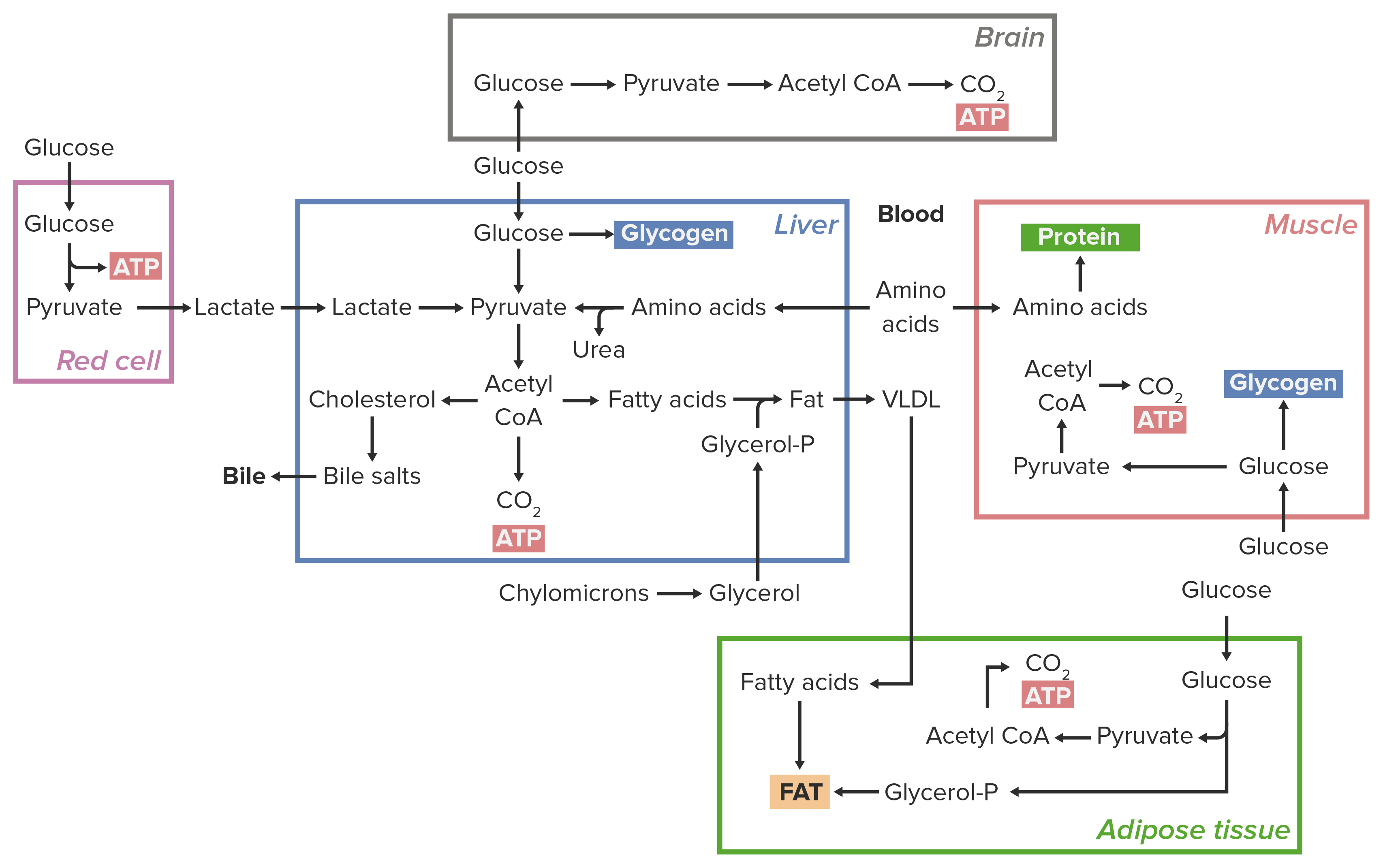
Metabolismo en estado de absorción en diferentes tejidos del cuerpo.

Metabolismo en estado de absorción en diferentes tejidos del cuerpo

Imagen por Lecturio.
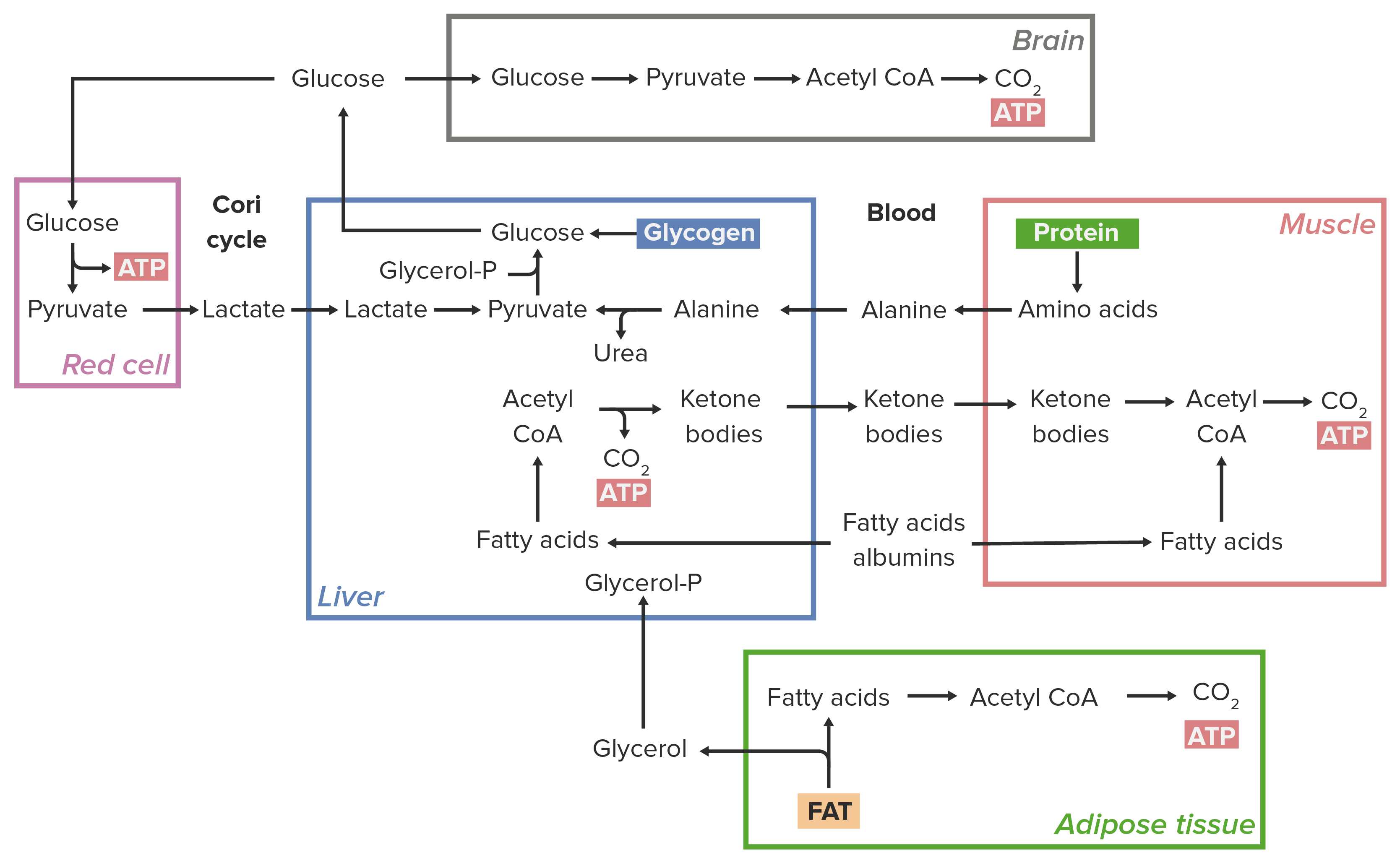
Metabolismo en EN Erythema nodosum is an immune-mediated panniculitis (inflammation of the subcutaneous fat) caused by a type IV (delayed-type) hypersensitivity reaction. It commonly manifests in young women as tender, erythematous nodules on the shins. Erythema Nodosum el estado posabsorción

  • Fin del estado de absorción: los LOS Neisseria enterocitos dejan de importar glucosa a la circulación portal hepática.
  • Los LOS Neisseria tejidos periféricos continúan con la captación de glucosa para mantener un estado normoglucémico.
  • Los LOS Neisseria niveles de glucosa disminuyen, estimulando el aumento de los LOS Neisseria niveles de glucagón y epinefrina.
  • En EN Erythema nodosum is an immune-mediated panniculitis (inflammation of the subcutaneous fat) caused by a type IV (delayed-type) hypersensitivity reaction. It commonly manifests in young women as tender, erythematous nodules on the shins. Erythema Nodosum este punto, los LOS Neisseria hepatocitos comienzan la glucogenólisis (conversión del glucógeno almacenado en EN Erythema nodosum is an immune-mediated panniculitis (inflammation of the subcutaneous fat) caused by a type IV (delayed-type) hypersensitivity reaction. It commonly manifests in young women as tender, erythematous nodules on the shins. Erythema Nodosum glucosa fácilmente utilizable).
  • La glucogenólisis agota las reservas del hígado y provoca hipoglucemia → el hígado inicia el proceso de gluconeogénesis estimulado por los LOS Neisseria glucocorticoides liberados por la corteza suprarrenal
  • Los LOS Neisseria ácidos grasos circulantes y el glicerol se utilizan en EN Erythema nodosum is an immune-mediated panniculitis (inflammation of the subcutaneous fat) caused by a type IV (delayed-type) hypersensitivity reaction. It commonly manifests in young women as tender, erythematous nodules on the shins. Erythema Nodosum el proceso de gluconeogénesis.
  • A medida que se prolonga la duración del estado posterior a la absorción, el hígado comienza a importar aminoácidos para la gluconeogénesis y la síntesis de cetonas (también conocida como cetogénesis) como fuente alternativa de energía.
  • Un aumento en EN Erythema nodosum is an immune-mediated panniculitis (inflammation of the subcutaneous fat) caused by a type IV (delayed-type) hypersensitivity reaction. It commonly manifests in young women as tender, erythematous nodules on the shins. Erythema Nodosum los LOS Neisseria niveles de cetonas y lípidos circulantes en EN Erythema nodosum is an immune-mediated panniculitis (inflammation of the subcutaneous fat) caused by a type IV (delayed-type) hypersensitivity reaction. It commonly manifests in young women as tender, erythematous nodules on the shins. Erythema Nodosum el tejido periférico disminuye su dependencia de la glucosa y aumenta su dependencia a estos compuestos.
  • Las neuronas continúan dependiendo exclusivamente de la glucosa hasta que los LOS Neisseria niveles de glucosa son insuficientes para satisfacer sus demandas energéticas → luego dependen de las cetonas circulantes
Metabolismo en estado postabsortivo en diferentes tejidos del cuerpo.

Metabolismo en estado posabsorción en diferentes tejidos del cuerpo:
Obsérvese el papel de la glucosa, cuerpos cetónicos y ácidos grasos.

Imagen por Lecturio.

Regulación del metabolismo

  • Estado de absorción:
    • Insulina: principal regulador en EN Erythema nodosum is an immune-mediated panniculitis (inflammation of the subcutaneous fat) caused by a type IV (delayed-type) hypersensitivity reaction. It commonly manifests in young women as tender, erythematous nodules on the shins. Erythema Nodosum el estado de absorción
    • Se dirige al AL Amyloidosis hígado, músculos y tejido adiposo para estimular la síntesis de glucógeno y la formación de triglicéridos
    • El cerebro y los LOS Neisseria eritrocitos son insensibles a la insulina.
  • Estado posabsorción:
    • Niveles de glucagón y epinefrina:
      • Aumentan en EN Erythema nodosum is an immune-mediated panniculitis (inflammation of the subcutaneous fat) caused by a type IV (delayed-type) hypersensitivity reaction. It commonly manifests in young women as tender, erythematous nodules on the shins. Erythema Nodosum ayunas
      • Se dirigen al AL Amyloidosis músculo esquelético, tejido adiposo e hígado para degradar el glucógeno
    • La liberación de ácidos grasos y aminoácidos es estimulada por:
  • Ayuno prolongado:
    • Niveles de glucagón y epinefrina ↑↑ en EN Erythema nodosum is an immune-mediated panniculitis (inflammation of the subcutaneous fat) caused by a type IV (delayed-type) hypersensitivity reaction. It commonly manifests in young women as tender, erythematous nodules on the shins. Erythema Nodosum estados de ayuno prolongado
    • La lipólisis forma un exceso de acetil-coenzima A → se utiliza para la síntesis de cetonas → niveles elevados de lípidos y cetonas
    • Los LOS Neisseria músculos utilizan los LOS Neisseria ácidos grasos como combustible.
    • El cerebro utiliza las cetonas como combustible.
    • Las proteínas se salvan, ya que las cetonas se utilizan en EN Erythema nodosum is an immune-mediated panniculitis (inflammation of the subcutaneous fat) caused by a type IV (delayed-type) hypersensitivity reaction. It commonly manifests in young women as tender, erythematous nodules on the shins. Erythema Nodosum lugar de la glucosa.
    • Los LOS Neisseria eritrocitos siguen dependiendo de la glucosa como principal fuente de energía.

Metabolismo en Tejidos Individuales

Hígado

  • Biomoléculas utilizadas en EN Erythema nodosum is an immune-mediated panniculitis (inflammation of the subcutaneous fat) caused by a type IV (delayed-type) hypersensitivity reaction. It commonly manifests in young women as tender, erythematous nodules on the shins. Erythema Nodosum estado de alimentación: glucosa y aminoácidos
  • Biomolécula utilizada en EN Erythema nodosum is an immune-mediated panniculitis (inflammation of the subcutaneous fat) caused by a type IV (delayed-type) hypersensitivity reaction. It commonly manifests in young women as tender, erythematous nodules on the shins. Erythema Nodosum ayunas: ácidos grasos
  • El hígado mantiene en EN Erythema nodosum is an immune-mediated panniculitis (inflammation of the subcutaneous fat) caused by a type IV (delayed-type) hypersensitivity reaction. It commonly manifests in young women as tender, erythematous nodules on the shins. Erythema Nodosum gran medida un nivel de glucosa constante en EN Erythema nodosum is an immune-mediated panniculitis (inflammation of the subcutaneous fat) caused by a type IV (delayed-type) hypersensitivity reaction. It commonly manifests in young women as tender, erythematous nodules on the shins. Erythema Nodosum ayunas y en EN Erythema nodosum is an immune-mediated panniculitis (inflammation of the subcutaneous fat) caused by a type IV (delayed-type) hypersensitivity reaction. It commonly manifests in young women as tender, erythematous nodules on the shins. Erythema Nodosum estado de alimentación y participa en EN Erythema nodosum is an immune-mediated panniculitis (inflammation of the subcutaneous fat) caused by a type IV (delayed-type) hypersensitivity reaction. It commonly manifests in young women as tender, erythematous nodules on the shins. Erythema Nodosum la síntesis de cetonas en EN Erythema nodosum is an immune-mediated panniculitis (inflammation of the subcutaneous fat) caused by a type IV (delayed-type) hypersensitivity reaction. It commonly manifests in young women as tender, erythematous nodules on the shins. Erythema Nodosum caso de utilización excesiva de ácidos grasos.
Tabla: Utilización de energía del hígado durante los LOS Neisseria estados de alimentación y ayuno
Estado de Alimentación Estado de ayuno
  • Niveles de glucosa ↑ después de una comida
  • El hígado convierte el exceso de glucosa en EN Erythema nodosum is an immune-mediated panniculitis (inflammation of the subcutaneous fat) caused by a type IV (delayed-type) hypersensitivity reaction. It commonly manifests in young women as tender, erythematous nodules on the shins. Erythema Nodosum glucógeno.
  • La glucosa restante se convierte en EN Erythema nodosum is an immune-mediated panniculitis (inflammation of the subcutaneous fat) caused by a type IV (delayed-type) hypersensitivity reaction. It commonly manifests in young women as tender, erythematous nodules on the shins. Erythema Nodosum acetil-coenzima A → se utiliza para la síntesis de ácidos grasos
  • Niveles de insulina ↑ en EN Erythema nodosum is an immune-mediated panniculitis (inflammation of the subcutaneous fat) caused by a type IV (delayed-type) hypersensitivity reaction. It commonly manifests in young women as tender, erythematous nodules on the shins. Erythema Nodosum un estado de buena alimentación → estimula la síntesis de glucógeno y ácidos grasos
  • Glucosa: principal fuente de energía en EN Erythema nodosum is an immune-mediated panniculitis (inflammation of the subcutaneous fat) caused by a type IV (delayed-type) hypersensitivity reaction. It commonly manifests in young women as tender, erythematous nodules on the shins. Erythema Nodosum ayunas
  • El hígado convierte el glucógeno almacenado en EN Erythema nodosum is an immune-mediated panniculitis (inflammation of the subcutaneous fat) caused by a type IV (delayed-type) hypersensitivity reaction. It commonly manifests in young women as tender, erythematous nodules on the shins. Erythema Nodosum glucosa.
  • Niveles de glucagón ↑ durante el ayuno, estimulando la glucogenólisis y la gluconeogénesis.

Tejido adiposo

  • Biomolécula utilizada en EN Erythema nodosum is an immune-mediated panniculitis (inflammation of the subcutaneous fat) caused by a type IV (delayed-type) hypersensitivity reaction. It commonly manifests in young women as tender, erythematous nodules on the shins. Erythema Nodosum estado de alimentación: glucosa
  • Biomolécula utilizada en EN Erythema nodosum is an immune-mediated panniculitis (inflammation of the subcutaneous fat) caused by a type IV (delayed-type) hypersensitivity reaction. It commonly manifests in young women as tender, erythematous nodules on the shins. Erythema Nodosum ayunas: ácidos grasos
Tabla: Utilización de energía del tejido adiposo durante los LOS Neisseria estados de alimentación y ayuno
Estado de alimentación Estado de ayuno
  • En EN Erythema nodosum is an immune-mediated panniculitis (inflammation of the subcutaneous fat) caused by a type IV (delayed-type) hypersensitivity reaction. It commonly manifests in young women as tender, erythematous nodules on the shins. Erythema Nodosum respuesta a la abundante glucosa de una comida, los LOS Neisseria niveles de insulina aumentan, estimulando la absorción de glucosa y la liberación de ácidos grasos de los LOS Neisseria triglicéridos.
  • La lipoproteína lipasa descompone las lipoproteínas → captadas por el tejido adiposo → las esterifica a triglicéridos
  • ↓ Niveles de insulina
  • ↑ Niveles de epinefrina
  • Estimula la liberación de ácidos grasos a la circulación

Músculo esquelético

  • Biomolécula utilizada en EN Erythema nodosum is an immune-mediated panniculitis (inflammation of the subcutaneous fat) caused by a type IV (delayed-type) hypersensitivity reaction. It commonly manifests in young women as tender, erythematous nodules on the shins. Erythema Nodosum estado de alimentación: glucosa
  • Biomoléculas utilizadas en EN Erythema nodosum is an immune-mediated panniculitis (inflammation of the subcutaneous fat) caused by a type IV (delayed-type) hypersensitivity reaction. It commonly manifests in young women as tender, erythematous nodules on the shins. Erythema Nodosum ayunas: ácidos grasos y cetonas
  • La utilización de energía difiere significativamente entre los LOS Neisseria estados de reposo y activo.

Músculo en EN Erythema nodosum is an immune-mediated panniculitis (inflammation of the subcutaneous fat) caused by a type IV (delayed-type) hypersensitivity reaction. It commonly manifests in young women as tender, erythematous nodules on the shins. Erythema Nodosum reposo:

  • Estado de alimentación: los LOS Neisseria niveles de insulina aumentan y estimulan el músculo para almacenar glucosa como glucógeno.
  • Estado de ayuno: Los LOS Neisseria ácidos grasos se recogen del torrente sanguíneo y se utilizan como combustible. Durante el ayuno prolongado, se utilizan cetonas.

Músculo activo:

  • El músculo se vuelve activo durante el ejercicio, y las biomoléculas utilizadas como fuentes de energía se basan en EN Erythema nodosum is an immune-mediated panniculitis (inflammation of the subcutaneous fat) caused by a type IV (delayed-type) hypersensitivity reaction. It commonly manifests in young women as tender, erythematous nodules on the shins. Erythema Nodosum 3 factores:
    • Magnitud del ejercicio
    • Duración del ejercicio
    • Fibras musculares involucradas
  • Fibras musculares de contracción lenta (fibras musculares de tipo 1):
    • Se fatigan lentamente
    • Activas durante un periodo prolongado de ejercicio de intensidad baja a moderada
    • La oxidación de la glucosa y los LOS Neisseria ácidos grasos son la principal fuente de energía una vez agotadas las reservas de glucógeno.
  • Fibras musculares de contracción rápida (fibras musculares de tipo 2):
    • Se fatigan rápidamente
    • Tienen una gran capacidad de glucólisis anaeróbica.
    • Activas en EN Erythema nodosum is an immune-mediated panniculitis (inflammation of the subcutaneous fat) caused by a type IV (delayed-type) hypersensitivity reaction. It commonly manifests in young women as tender, erythematous nodules on the shins. Erythema Nodosum ejercicios de corta duración y alta intensidad
    • Sustentadas por el glucógeno muscular

Músculo cardíaco

  • Biomolécula utilizada en EN Erythema nodosum is an immune-mediated panniculitis (inflammation of the subcutaneous fat) caused by a type IV (delayed-type) hypersensitivity reaction. It commonly manifests in young women as tender, erythematous nodules on the shins. Erythema Nodosum estado de alimentación: ácidos grasos
  • Biomoléculas utilizadas en EN Erythema nodosum is an immune-mediated panniculitis (inflammation of the subcutaneous fat) caused by a type IV (delayed-type) hypersensitivity reaction. It commonly manifests in young women as tender, erythematous nodules on the shins. Erythema Nodosum ayunas: ácidos grasos y cetonas
  • Condiciones específicas en EN Erythema nodosum is an immune-mediated panniculitis (inflammation of the subcutaneous fat) caused by a type IV (delayed-type) hypersensitivity reaction. It commonly manifests in young women as tender, erythematous nodules on the shins. Erythema Nodosum las que la utilización de la energía se desplaza hacia diferentes fuentes:
    • Durante el desarrollo fetal, la glucosa es la principal fuente de energía.
    • En EN Erythema nodosum is an immune-mediated panniculitis (inflammation of the subcutaneous fat) caused by a type IV (delayed-type) hypersensitivity reaction. It commonly manifests in young women as tender, erythematous nodules on the shins. Erythema Nodosum el período posnatal, la oxidación β de los LOS Neisseria ácidos grasos es la principal fuente de energía.
    • En EN Erythema nodosum is an immune-mediated panniculitis (inflammation of the subcutaneous fat) caused by a type IV (delayed-type) hypersensitivity reaction. It commonly manifests in young women as tender, erythematous nodules on the shins. Erythema Nodosum la hipertrofia cardíaca, hay un aumento en EN Erythema nodosum is an immune-mediated panniculitis (inflammation of the subcutaneous fat) caused by a type IV (delayed-type) hypersensitivity reaction. It commonly manifests in young women as tender, erythematous nodules on the shins. Erythema Nodosum la oxidación de glucosa y una disminución en EN Erythema nodosum is an immune-mediated panniculitis (inflammation of the subcutaneous fat) caused by a type IV (delayed-type) hypersensitivity reaction. It commonly manifests in young women as tender, erythematous nodules on the shins. Erythema Nodosum la oxidación β de ácidos grasos.

Cerebro

  • Biomolécula utilizada en EN Erythema nodosum is an immune-mediated panniculitis (inflammation of the subcutaneous fat) caused by a type IV (delayed-type) hypersensitivity reaction. It commonly manifests in young women as tender, erythematous nodules on the shins. Erythema Nodosum estado de alimentación: glucosa
  • Biomolécula utilizada en EN Erythema nodosum is an immune-mediated panniculitis (inflammation of the subcutaneous fat) caused by a type IV (delayed-type) hypersensitivity reaction. It commonly manifests in young women as tender, erythematous nodules on the shins. Erythema Nodosum ayunas: glucosa con captación de cetonas en EN Erythema nodosum is an immune-mediated panniculitis (inflammation of the subcutaneous fat) caused by a type IV (delayed-type) hypersensitivity reaction. It commonly manifests in young women as tender, erythematous nodules on the shins. Erythema Nodosum ayunas prolongadas
  • El transportador de glucosa 1 y transportador de glucosa 3 participan en EN Erythema nodosum is an immune-mediated panniculitis (inflammation of the subcutaneous fat) caused by a type IV (delayed-type) hypersensitivity reaction. It commonly manifests in young women as tender, erythematous nodules on the shins. Erythema Nodosum la captación de glucosa y regulan los LOS Neisseria niveles de concentración.
  • Las reservas de glucógeno en EN Erythema nodosum is an immune-mediated panniculitis (inflammation of the subcutaneous fat) caused by a type IV (delayed-type) hypersensitivity reaction. It commonly manifests in young women as tender, erythematous nodules on the shins. Erythema Nodosum el cerebro son mínimas → la glucosa del torrente sanguíneo es la principal fuente de energía
  • El hipotálamo estimula la liberación de glucagón y epinefrina en EN Erythema nodosum is an immune-mediated panniculitis (inflammation of the subcutaneous fat) caused by a type IV (delayed-type) hypersensitivity reaction. It commonly manifests in young women as tender, erythematous nodules on the shins. Erythema Nodosum condiciones de hipoglucemia.
  • La barrera hematoencefálica no permite el paso de los LOS Neisseria ácidos grasos, por lo que no se utilizan como combustible.
  • Principal fuente de energía en EN Erythema nodosum is an immune-mediated panniculitis (inflammation of the subcutaneous fat) caused by a type IV (delayed-type) hypersensitivity reaction. It commonly manifests in young women as tender, erythematous nodules on the shins. Erythema Nodosum ayunas: glucosa procedente de la glucogenólisis hepática o gluconeogénesis
  • El estado de ayuno prolongado conduce a la utilización de cetonas para obtener energía

Eritrocitos

  • Biomolécula utilizada en EN Erythema nodosum is an immune-mediated panniculitis (inflammation of the subcutaneous fat) caused by a type IV (delayed-type) hypersensitivity reaction. It commonly manifests in young women as tender, erythematous nodules on the shins. Erythema Nodosum estado de alimentación: glucosa
  • Biomolécula utilizada en EN Erythema nodosum is an immune-mediated panniculitis (inflammation of the subcutaneous fat) caused by a type IV (delayed-type) hypersensitivity reaction. It commonly manifests in young women as tender, erythematous nodules on the shins. Erythema Nodosum ayunas: glucosa

Relevancia Clínica

  • Anorexia Anorexia The lack or loss of appetite accompanied by an aversion to food and the inability to eat. It is the defining characteristic of the disorder anorexia nervosa. Anorexia Nervosa: trastorno caracterizado por una reducción en EN Erythema nodosum is an immune-mediated panniculitis (inflammation of the subcutaneous fat) caused by a type IV (delayed-type) hypersensitivity reaction. It commonly manifests in young women as tender, erythematous nodules on the shins. Erythema Nodosum la ingesta de energía y pérdida de peso. Las personas con anorexia Anorexia The lack or loss of appetite accompanied by an aversion to food and the inability to eat. It is the defining characteristic of the disorder anorexia nervosa. Anorexia Nervosa tienen una visión distorsionada de su peso y, a menudo, se ven con sobrepeso a pesar de tener un peso inferior al AL Amyloidosis normal. Estas personas pueden obligarse a sí mismas a hacer ejercicio en EN Erythema nodosum is an immune-mediated panniculitis (inflammation of the subcutaneous fat) caused by a type IV (delayed-type) hypersensitivity reaction. It commonly manifests in young women as tender, erythematous nodules on the shins. Erythema Nodosum exceso para mantener un peso bajo. Muchos cuentan las calorías y se limitan a comidas pequeñas. El tratamiento es desafiante y se enfoca en EN Erythema nodosum is an immune-mediated panniculitis (inflammation of the subcutaneous fat) caused by a type IV (delayed-type) hypersensitivity reaction. It commonly manifests in young women as tender, erythematous nodules on the shins. Erythema Nodosum abordar los LOS Neisseria problemas psicosociales mientras se lleva al AL Amyloidosis individuo a un peso normal.
  • Resistencia a la leptina: la leptina es una hormona que inhibe el hambre y reduce el almacenamiento de grasa en EN Erythema nodosum is an immune-mediated panniculitis (inflammation of the subcutaneous fat) caused by a type IV (delayed-type) hypersensitivity reaction. It commonly manifests in young women as tender, erythematous nodules on the shins. Erythema Nodosum los LOS Neisseria adipocitos. La resistencia a la leptina es un estado en EN Erythema nodosum is an immune-mediated panniculitis (inflammation of the subcutaneous fat) caused by a type IV (delayed-type) hypersensitivity reaction. It commonly manifests in young women as tender, erythematous nodules on the shins. Erythema Nodosum el que el cuerpo ya no responde al AL Amyloidosis efecto anoréxico de la leptina exógena. Esto puede deberse a mutaciones en EN Erythema nodosum is an immune-mediated panniculitis (inflammation of the subcutaneous fat) caused by a type IV (delayed-type) hypersensitivity reaction. It commonly manifests in young women as tender, erythematous nodules on the shins. Erythema Nodosum la vía JAK–STAT. Los LOS Neisseria triglicéridos que cruzan la barrera hematoencefálica pueden contribuir a la resistencia a la leptina.
  • Caquexia: afección caracterizada por anorexia Anorexia The lack or loss of appetite accompanied by an aversion to food and the inability to eat. It is the defining characteristic of the disorder anorexia nervosa. Anorexia Nervosa, pérdida de peso y desgaste desproporcionado de músculo y tejido adiposo. La caquexia generalmente es causada por una enfermedad subyacente que contribuye a la pérdida de masa muscular. La caquexia es diferente de la pérdida de peso por una nutrición inadecuada, ya que la caquexia se debe principalmente a la pérdida de masa muscular, mientras que una nutrición inadecuada conduce a la pérdida de grasa. Esta afección se asocia más comúnmente con cáncer.
  • Obesidad: acumulación anormal de grasa debido a una homeostasis Homeostasis The processes whereby the internal environment of an organism tends to remain balanced and stable. Cell Injury and Death energética defectuosa. La acumulación de grasa es consecuencia de desequilibrios energéticos relacionados con factores complejos (genética, medio ambiente, etc ETC The electron transport chain (ETC) sends electrons through a series of proteins, which generate an electrochemical proton gradient that produces energy in the form of adenosine triphosphate (ATP). Electron Transport Chain (ETC).) y resulta de una ingesta energética superior al AL Amyloidosis gasto energético. La obesidad está relacionada con una serie de afecciones médicas. La obesidad representa un factor de riesgo para diabetes Diabetes Diabetes mellitus (DM) is a metabolic disease characterized by hyperglycemia and dysfunction of the regulation of glucose metabolism by insulin. Type 1 DM is diagnosed mostly in children and young adults as the result of autoimmune destruction of β cells in the pancreas and the resulting lack of insulin. Type 2 DM has a significant association with obesity and is characterized by insulin resistance. Diabetes Mellitus, enfermedades cardiovasculares, cáncer y otras enfermedades crónicas.

Referencias

  1. Chen, B., Smith, K., Jones, M., & Williams, T. (2024). The interactions between energy homeostasis and neurovascular plasticity. Nature Reviews Endocrinology, 20(12), 749-759. https://doi.org/10.1038/s41574-024-01021-8
  2. Jarrah, M., Thompson, R., Garcia, L., & Anderson, P. (2024). Spinal afferent neurons: Emerging regulators of energy balance and metabolism. Frontiers in Molecular Neuroscience, 17. https://doi.org/10.3389/fnmol.2024.1479876
  3. Liu, H., Zhang, Y., Wang, S., & Chen, J. (2025). Energy metabolism in health and diseases. Signal Transduction and Targeted Therapy, 10(1), 1-71. https://doi.org/10.1038/s41392-025-02141-x
  4. Nelson, D. L., & Cox, M. M. (2021). Lehninger principles of biochemistry (8th ed.). W. H. Freeman and Company.
  5. Rossi, M. A. (2023). Control of energy homeostasis by the lateral hypothalamic area. Trends in Neurosciences, 46(9), 738-749. https://doi.org/10.1016/j.tins.2023.05.010
  6. Stefanakis, K., Johnson, A., Miller, B., & Thomas, R. (2024). Leptin physiology and pathophysiology in energy homeostasis, immune function, neuroendocrine regulation and bone health. Metabolism, 161, 156056. https://doi.org/10.1016/j.metabol.2024.156056
  7. Theodorakis, N., & Nikolaou, M. (2025). The human energy balance: Uncovering the hidden variables of obesity. Diseases, 13(2), 55. https://doi.org/10.3390/diseases13020055
  8. [Unknown Author]. (2025). Hypothalamic regulation of energy homeostasis. SpringerLink. https://link.springer.com/collections/efijbfibhf

¡Crea tu cuenta gratis o inicia una sesión para seguir leyendo!

Regístrate ahora y obtén acceso gratuito a Lecturio con páginas de concepto, videos médicos y cuestionarios para tu educación médica.

User Reviews

Que tengas una sesión de estudio alegre y navideña 🎁 Ahorra 50% en todos los planes >>

Details