
Domina Conceptos Médicos

Estudia para la escuela de medicina y tus examenes con Lecturio.

Helicobacter

Helicobacter pylori Helicobacter pylori A spiral bacterium active as a human gastric pathogen. It is a gram-negative, urease-positive, curved or slightly spiral organism initially isolated in 1982 from patients with lesions of gastritis or peptic ulcers in Western Australia. Helicobacter pylori was originally classified in the genus campylobacter, but RNA sequencing, cellular fatty acid profiles, growth patterns, and other taxonomic characteristics indicate that the micro-organism should be included in the genus Helicobacter. It has been officially transferred to Helicobacter gen. Helicobacter es una bacteria Bacteria Bacteria are prokaryotic single-celled microorganisms that are metabolically active and divide by binary fission. Some of these organisms play a significant role in the pathogenesis of diseases. Bacteriology gramnegativa que causa una infección gástrica. Es la especie más conocida y clínicamente significativa de Helicobacter Helicobacter Helicobacter pylori is a gram-negative bacterium that causes gastric infection. It is the most well known and clinically significant species of Helicobacter. Transmission is believed to occur by ingestion of contaminated food or water; therefore, a higher prevalence of infection is seen in areas with poor sanitation. Helicobacter. Se cree que la transmisión se produce por la ingesta de agua o alimentos contaminados; por lo tanto, se observa una mayor prevalencia de infección en EN Erythema nodosum is an immune-mediated panniculitis (inflammation of the subcutaneous fat) caused by a type IV (delayed-type) hypersensitivity reaction. It commonly manifests in young women as tender, erythematous nodules on the shins. Erythema Nodosum áreas con una higiene deficiente. Ciertas características bacterianas contribuyen a la patogenicidad de H. pylori H. pylori A spiral bacterium active as a human gastric pathogen. It is a gram-negative, urease-positive, curved or slightly spiral organism initially isolated in 1982 from patients with lesions of gastritis or peptic ulcers in Western Australia. Helicobacter pylori was originally classified in the genus campylobacter, but RNA sequencing, cellular fatty acid profiles, growth patterns, and other taxonomic characteristics indicate that the micro-organism should be included in the genus Helicobacter. It has been officially transferred to Helicobacter gen. Helicobacter: producción de ureasa (permitiendo la supervivencia en EN Erythema nodosum is an immune-mediated panniculitis (inflammation of the subcutaneous fat) caused by a type IV (delayed-type) hypersensitivity reaction. It commonly manifests in young women as tender, erythematous nodules on the shins. Erythema Nodosum un ambiente ácido), motilidad (permitiendo el movimiento hacia el epitelio gástrico) y varias toxinas (creando daño local e inflamación). La infección crónica por H. pylori H. pylori A spiral bacterium active as a human gastric pathogen. It is a gram-negative, urease-positive, curved or slightly spiral organism initially isolated in 1982 from patients with lesions of gastritis or peptic ulcers in Western Australia. Helicobacter pylori was originally classified in the genus campylobacter, but RNA sequencing, cellular fatty acid profiles, growth patterns, and other taxonomic characteristics indicate that the micro-organism should be included in the genus Helicobacter. It has been officially transferred to Helicobacter gen. Helicobacter puede provocar enfermedad por úlcera péptica o incluso cáncer gástrico en EN Erythema nodosum is an immune-mediated panniculitis (inflammation of the subcutaneous fat) caused by a type IV (delayed-type) hypersensitivity reaction. It commonly manifests in young women as tender, erythematous nodules on the shins. Erythema Nodosum casos graves.

Last updated: Apr 2, 2025
Editorial responsibility: Stanley Oiseth, Lindsay Jones, Evelin Maza

Clasificación

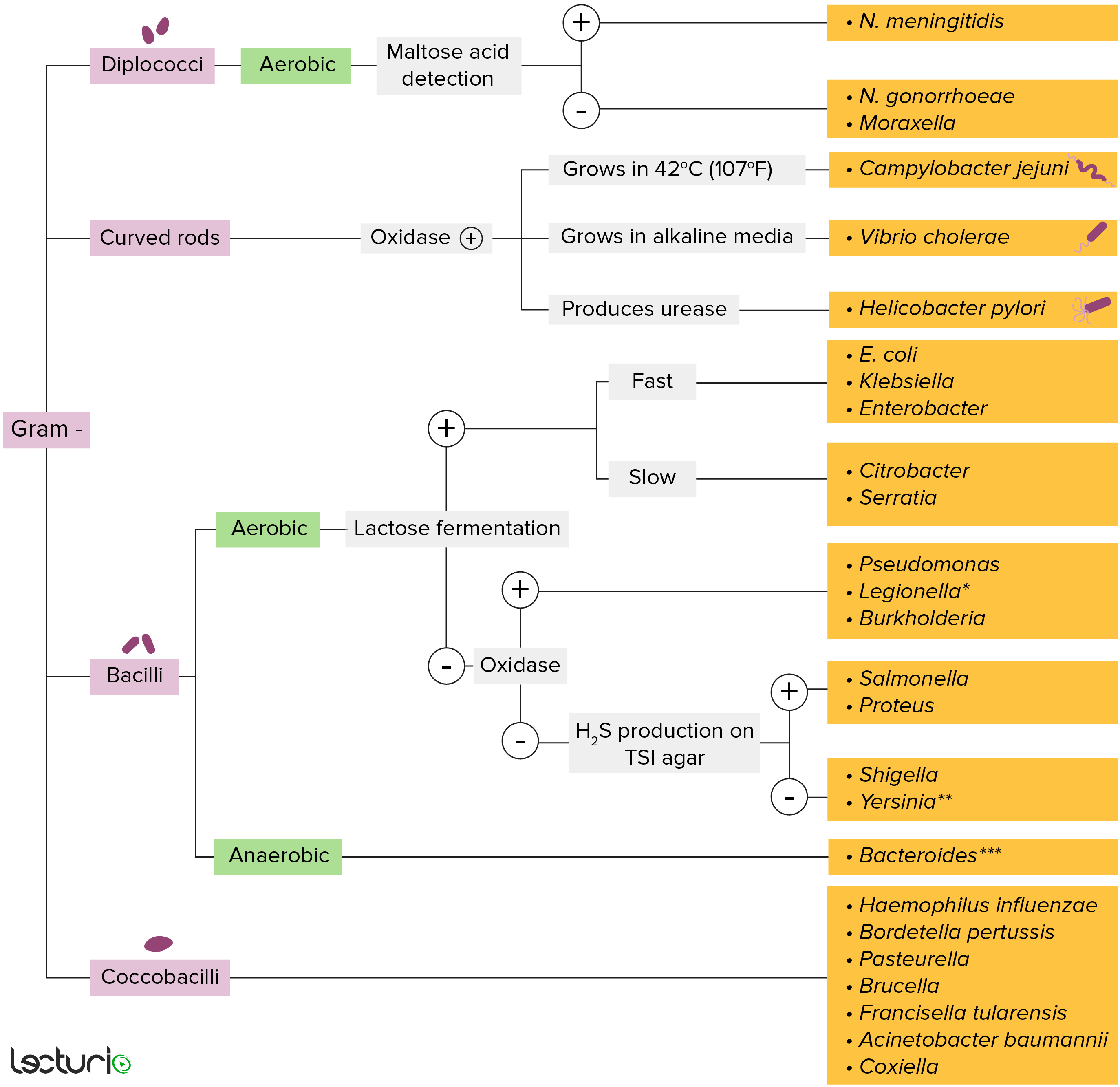
Diagrama de flujo de clasificación de bacterias gram negativas

Bacterias gramnegativas:
La mayoría de las bacterias se pueden clasificar de acuerdo a un procedimiento de laboratorio llamado tinción de Gram.
Las bacterias con paredes celulares que tienen una capa delgada de peptidoglicano no retienen la tinción de cristal violeta utilizada en la tinción de Gram. Sin embargo, estas bacterias retienen la contratinción de safranina y, por lo tanto, adoptan un color rojo-rosado en la tinción, lo que las hace gramnegativas. Estas bacterias pueden clasificarse además según su morfología (diplococos, bastones curvos, bacilos y cocobacilos) y su capacidad para crecer en presencia de oxígeno (aeróbicos versus anaeróbicos). Las bacterias se pueden identificar de manera más profunda cultivándolas en medios específicos (agar hierro triple azúcar) donde se pueden identificar sus enzimas (ureasa, oxidasa) y se puede probar su capacidad para fermentar lactosa.
* Se tiñe mal en la tinción de Gram
** Bacilo pleomórfico/cocobacilo
*** Requiere medios de transporte especiales

Imagen por Lecturio.

Características

Características:

  • Tinciones:
    • Gram-negativo
    • Detectado con tinción de plata
  • Morfología:
    • Bacilo móvil
    • Forma curva
    • Contiene múltiples flagelos
  • Crecimiento y cultivo:
    • Microaerófilo
    • Requisitos de crecimiento complejos (se requieren medios de transporte especiales)
    • Oxidasa positivo, catalasa positivo
    • Producción de ureasa positiva: crea un ambiente alcalino que permite la supervivencia de las bacterias en EN Erythema nodosum is an immune-mediated panniculitis (inflammation of the subcutaneous fat) caused by a type IV (delayed-type) hypersensitivity reaction. It commonly manifests in young women as tender, erythematous nodules on the shins. Erythema Nodosum la mucosa ácida

El género Helicobacter Helicobacter Helicobacter pylori is a gram-negative bacterium that causes gastric infection. It is the most well known and clinically significant species of Helicobacter. Transmission is believed to occur by ingestion of contaminated food or water; therefore, a higher prevalence of infection is seen in areas with poor sanitation. Helicobacter contiene alrededor de 35 especies, con H. pylori H. pylori A spiral bacterium active as a human gastric pathogen. It is a gram-negative, urease-positive, curved or slightly spiral organism initially isolated in 1982 from patients with lesions of gastritis or peptic ulcers in Western Australia. Helicobacter pylori was originally classified in the genus campylobacter, but RNA sequencing, cellular fatty acid profiles, growth patterns, and other taxonomic characteristics indicate that the micro-organism should be included in the genus Helicobacter. It has been officially transferred to Helicobacter gen. Helicobacter siendo la más conocida.
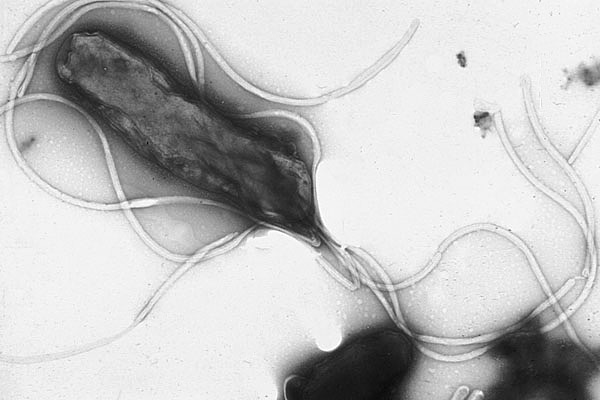
Micrografía electrónica de helicobacter pylori

Micrografía electrónica de Helicobacter pylori que posee múltiples flagelos (tinción negativa)

Imagen: “Electron micrograph of helicobacter pylori” por Yutaka Tsutsumi, MD Licencia: Dominio Público
Related videos

Patogénesis

Transmisión

  • Organismo ubicuo
  • Los LOS Neisseria humanos son el reservorio primario.
  • Adquirido por:
    • Ingesta:
      • Transmisión oral-oral: bacterias regurgitadas con contenido gástrico y colonizan temporalmente la cavidad oral
      • Transmisión fecal-oral: alimentos y suministros de agua contaminados (saneamiento deficiente)
    • Contacto de persona a persona: grupos de infección observados en EN Erythema nodosum is an immune-mediated panniculitis (inflammation of the subcutaneous fat) caused by a type IV (delayed-type) hypersensitivity reaction. It commonly manifests in young women as tender, erythematous nodules on the shins. Erythema Nodosum las familias
  • Prevalencia de la infección:
    • Se adquiere típicamente durante la infancia.
    • Es una de las infecciones bacterianas crónicas más comunes en EN Erythema nodosum is an immune-mediated panniculitis (inflammation of the subcutaneous fat) caused by a type IV (delayed-type) hypersensitivity reaction. It commonly manifests in young women as tender, erythematous nodules on the shins. Erythema Nodosum todo el mundo.
    • Aproximadamente dos tercios de la población mundial está infectada.
    • La tasa es mayor en EN Erythema nodosum is an immune-mediated panniculitis (inflammation of the subcutaneous fat) caused by a type IV (delayed-type) hypersensitivity reaction. It commonly manifests in young women as tender, erythematous nodules on the shins. Erythema Nodosum los LOS Neisseria países en EN Erythema nodosum is an immune-mediated panniculitis (inflammation of the subcutaneous fat) caused by a type IV (delayed-type) hypersensitivity reaction. It commonly manifests in young women as tender, erythematous nodules on the shins. Erythema Nodosum vías de desarrollo
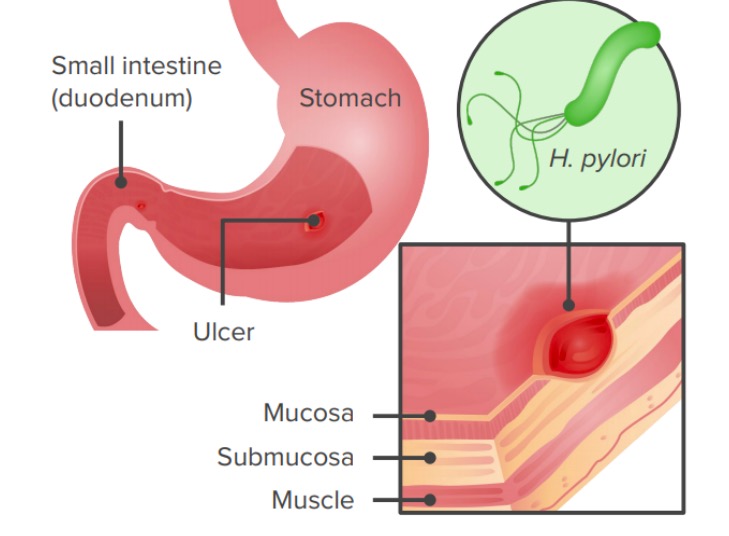
Infección por helicobacter pylori

La infección por Helicobacter pylori a través de la ingesta del patógeno produce úlceras gástricas o gastritis.

Imagen por Lecturio.
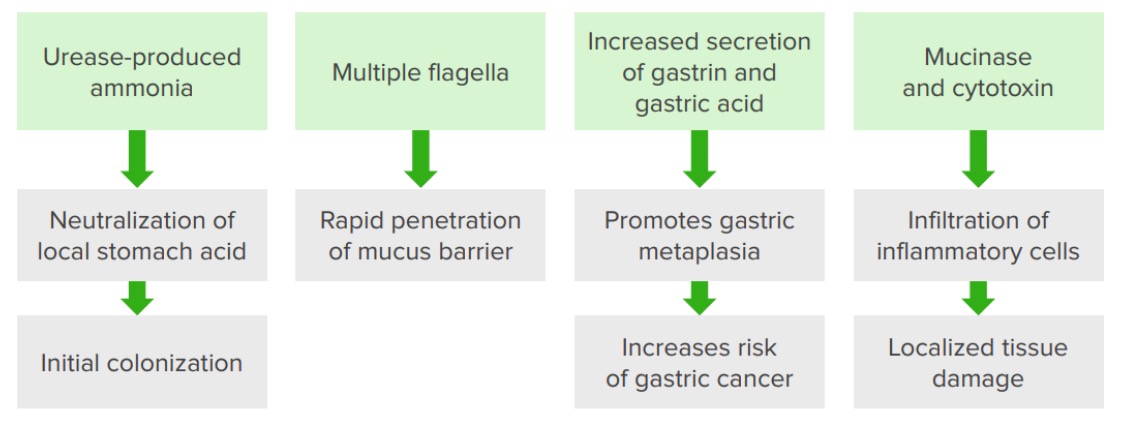
Características patogénicas de Helicobacter pylori Helicobacter pylori A spiral bacterium active as a human gastric pathogen. It is a gram-negative, urease-positive, curved or slightly spiral organism initially isolated in 1982 from patients with lesions of gastritis or peptic ulcers in Western Australia. Helicobacter pylori was originally classified in the genus campylobacter, but RNA sequencing, cellular fatty acid profiles, growth patterns, and other taxonomic characteristics indicate that the micro-organism should be included in the genus Helicobacter. It has been officially transferred to Helicobacter gen. Helicobacter

  • Organismo ureasa positivo que produce amoníaco:
    • Neutraliza el ácido gástrico → hipoclorhidria → estimula la producción de gastrina → aumento del ácido gástrico → daño de la mucosa
    • La neutralización inicial del ácido gástrico permite la colonización de la mucosa.
  • Los LOS Neisseria múltiples flagelos permiten una rápida penetración en EN Erythema nodosum is an immune-mediated panniculitis (inflammation of the subcutaneous fat) caused by a type IV (delayed-type) hypersensitivity reaction. It commonly manifests in young women as tender, erythematous nodules on the shins. Erythema Nodosum la mucosa.
  • Contiene mucinasa y citotoxinas:
    • Produce daño tisular local
    • Actúa como quimioatrayente y activa la respuesta inflamatoria del huésped
  • La inflamación crónica provoca daño al AL Amyloidosis ADN y proliferación celular anormal → cáncer
  • Efectos: gastritis Gastritis Gastritis refers to inflammation of the gastric mucosa. Gastritis may occur suddenly (acute gastritis) or slowly over time (chronic gastritis). Gastritis may be asymptomatic or with symptoms, including burning abdominal pain (which either worsens or improves with eating), dyspepsia, nausea, and vomiting. Gastritis, desarrollo de úlcera(s), carcinoma gástrico y linfomas MALT MALT Colon, Cecum, and Appendix: Anatomy gástricos
Características patogénicas de helicobacter pylori

Características patogénicas de Helicobacter pylori

Imagen por Lecturio.

Enfermedades Asociadas

Gastritis Gastritis Gastritis refers to inflammation of the gastric mucosa. Gastritis may occur suddenly (acute gastritis) or slowly over time (chronic gastritis). Gastritis may be asymptomatic or with symptoms, including burning abdominal pain (which either worsens or improves with eating), dyspepsia, nausea, and vomiting. Gastritis

  • Aumento de la producción de ácido gástrico o daño de la barrera de la mucosa gástrica → irrita el sensible revestimiento del estómago → gastritis Gastritis Gastritis refers to inflammation of the gastric mucosa. Gastritis may occur suddenly (acute gastritis) or slowly over time (chronic gastritis). Gastritis may be asymptomatic or with symptoms, including burning abdominal pain (which either worsens or improves with eating), dyspepsia, nausea, and vomiting. Gastritis
  • La infección por H. pylori H. pylori A spiral bacterium active as a human gastric pathogen. It is a gram-negative, urease-positive, curved or slightly spiral organism initially isolated in 1982 from patients with lesions of gastritis or peptic ulcers in Western Australia. Helicobacter pylori was originally classified in the genus campylobacter, but RNA sequencing, cellular fatty acid profiles, growth patterns, and other taxonomic characteristics indicate that the micro-organism should be included in the genus Helicobacter. It has been officially transferred to Helicobacter gen. Helicobacter es una de las etiologías más comunes.
  • Puede ser asintomática o los LOS Neisseria síntomas pueden incluir dolor Dolor Inflammation abdominal urente, dispepsia, náuseas y vómitos
  • Diagnóstico: prueba de aliento con urea Urea A compound formed in the liver from ammonia produced by the deamination of amino acids. It is the principal end product of protein catabolism and constitutes about one half of the total urinary solids. Urea Cycle, prueba de antígenos en EN Erythema nodosum is an immune-mediated panniculitis (inflammation of the subcutaneous fat) caused by a type IV (delayed-type) hypersensitivity reaction. It commonly manifests in young women as tender, erythematous nodules on the shins. Erythema Nodosum heces o biopsia endoscópica invasiva
  • Tratamiento de la infección por H. pylori H. pylori A spiral bacterium active as a human gastric pathogen. It is a gram-negative, urease-positive, curved or slightly spiral organism initially isolated in 1982 from patients with lesions of gastritis or peptic ulcers in Western Australia. Helicobacter pylori was originally classified in the genus campylobacter, but RNA sequencing, cellular fatty acid profiles, growth patterns, and other taxonomic characteristics indicate that the micro-organism should be included in the genus Helicobacter. It has been officially transferred to Helicobacter gen. Helicobacter: una combinación de antibióticos e inhibidores de la bomba de protones (IBP) o un bloqueante ácido competitivo de potasio (BAC-P)
    • La selección de un régimen antibiótico debe basarse en EN Erythema nodosum is an immune-mediated panniculitis (inflammation of the subcutaneous fat) caused by a type IV (delayed-type) hypersensitivity reaction. It commonly manifests in young women as tender, erythematous nodules on the shins. Erythema Nodosum las tasas de resistencia local a claritromicina, metronidazol y levofloxacino.
    • Se recomienda realizar pruebas de seguimiento de 4 a 6 semanas después del tratamiento para confirmar la erradicación.

Úlceras gástricas y duodenales

  • Los LOS Neisseria dos tipos más comunes de úlceras pépticas:
    • Úlceras gástricas:
      • Localizadas en EN Erythema nodosum is an immune-mediated panniculitis (inflammation of the subcutaneous fat) caused by a type IV (delayed-type) hypersensitivity reaction. It commonly manifests in young women as tender, erythematous nodules on the shins. Erythema Nodosum el estómago
      • Clásicamente asociadas con dolor Dolor Inflammation que empeora al AL Amyloidosis comer
    • Úlceras duodenales:
      • Localizadas en EN Erythema nodosum is an immune-mediated panniculitis (inflammation of the subcutaneous fat) caused by a type IV (delayed-type) hypersensitivity reaction. It commonly manifests in young women as tender, erythematous nodules on the shins. Erythema Nodosum el duodeno
      • Por lo general, tienen una mejoría en EN Erythema nodosum is an immune-mediated panniculitis (inflammation of the subcutaneous fat) caused by a type IV (delayed-type) hypersensitivity reaction. It commonly manifests in young women as tender, erythematous nodules on the shins. Erythema Nodosum el nivel de dolor Dolor Inflammation al AL Amyloidosis comer, seguido de un empeoramiento del dolor Dolor Inflammation después de finalizar la comida.
  • Las etiologías más comunes incluyen la infección por H. pylori H. pylori A spiral bacterium active as a human gastric pathogen. It is a gram-negative, urease-positive, curved or slightly spiral organism initially isolated in 1982 from patients with lesions of gastritis or peptic ulcers in Western Australia. Helicobacter pylori was originally classified in the genus campylobacter, but RNA sequencing, cellular fatty acid profiles, growth patterns, and other taxonomic characteristics indicate that the micro-organism should be included in the genus Helicobacter. It has been officially transferred to Helicobacter gen. Helicobacter y el uso prolongado de AINE.
  • Tratamiento:
    • Erradicación de H. pylori H. pylori A spiral bacterium active as a human gastric pathogen. It is a gram-negative, urease-positive, curved or slightly spiral organism initially isolated in 1982 from patients with lesions of gastritis or peptic ulcers in Western Australia. Helicobacter pylori was originally classified in the genus campylobacter, but RNA sequencing, cellular fatty acid profiles, growth patterns, and other taxonomic characteristics indicate that the micro-organism should be included in the genus Helicobacter. It has been officially transferred to Helicobacter gen. Helicobacter (antibióticos más un IBP o un BAC-P)
    • Eliminación de factores de riesgo

Adenocarcinoma gástrico

  • El cáncer gástrico es la formación de neoplasias malignas del revestimiento del estómago.
  • Segundo cáncer más común del tracto gastrointestinal
  • Infección crónica por H. pylori H. pylori A spiral bacterium active as a human gastric pathogen. It is a gram-negative, urease-positive, curved or slightly spiral organism initially isolated in 1982 from patients with lesions of gastritis or peptic ulcers in Western Australia. Helicobacter pylori was originally classified in the genus campylobacter, but RNA sequencing, cellular fatty acid profiles, growth patterns, and other taxonomic characteristics indicate that the micro-organism should be included in the genus Helicobacter. It has been officially transferred to Helicobacter gen. Helicobacter: asociada con un mayor riesgo de adenocarcinoma gástrico

Anemia Anemia Anemia is a condition in which individuals have low Hb levels, which can arise from various causes. Anemia is accompanied by a reduced number of RBCs and may manifest with fatigue, shortness of breath, pallor, and weakness. Subtypes are classified by the size of RBCs, chronicity, and etiology. Anemia: Overview and Types por deficiencia de hierro y deficiencia de vitamina B12

En EN Erythema nodosum is an immune-mediated panniculitis (inflammation of the subcutaneous fat) caused by a type IV (delayed-type) hypersensitivity reaction. It commonly manifests in young women as tender, erythematous nodules on the shins. Erythema Nodosum la infección por H. pylori H. pylori A spiral bacterium active as a human gastric pathogen. It is a gram-negative, urease-positive, curved or slightly spiral organism initially isolated in 1982 from patients with lesions of gastritis or peptic ulcers in Western Australia. Helicobacter pylori was originally classified in the genus campylobacter, but RNA sequencing, cellular fatty acid profiles, growth patterns, and other taxonomic characteristics indicate that the micro-organism should be included in the genus Helicobacter. It has been officially transferred to Helicobacter gen. Helicobacter:

  • Se observa ↓ absorción de hierro en EN Erythema nodosum is an immune-mediated panniculitis (inflammation of the subcutaneous fat) caused by a type IV (delayed-type) hypersensitivity reaction. It commonly manifests in young women as tender, erythematous nodules on the shins. Erythema Nodosum el tracto gastrointestinal, ya que la absorción de hierro requiere un ambiente ácido.
  • La gastritis Gastritis Gastritis refers to inflammation of the gastric mucosa. Gastritis may occur suddenly (acute gastritis) or slowly over time (chronic gastritis). Gastritis may be asymptomatic or with symptoms, including burning abdominal pain (which either worsens or improves with eating), dyspepsia, nausea, and vomiting. Gastritis crónica crea daño inflamatorio a las células productoras de ácido → pérdida de producción de ácido → reducción de la absorción de hierro
  • La inflamación continua también conduce a la pérdida de células parietales a partir de las cuales se produce el factor intrínseco.
  • Sin factor intrínseco, se desarrolla deficiencia de vitamina B12.

Referencias

  1. Jensen P. J.. (2023). Acute and chronic gastritis due to Helicobacter pylori. In Lamont, J.T., Meyer, C. UpToDate. Retrieved April 2, 2025, from https://www.uptodate.com/contents/acute-and-chronic-gastritis-due-to-helicobacter-pylori
  2. Kusters J. G., van Vliet A. H. M., Kuipers E. J. (2006). Pathogenesis of Helicobacter pylori infection. Clinical Microbiology Reviews 19:449–490.
  3. Riedel S., Hobden J. A., Miller S., et al. (Eds.). (2019). Jawetz, Melnick, & Adelberg’s Medical Microbiology, 28th ed. McGraw-Hill.
  4. Shah, S.C., Kao, J.Y., Moss, S.F. (2025, March). Treatment of Helicobacter pylori infection in adults. In Talley, N.J., Swenson, S., Meyer, C. UpToDate. Retrieved April 2, 2025, from https://www.uptodate.com/contents/treatment-of-helicobacter-pylori-infection-in-adults
  5. Connor, B. (2023, May 1). Helicobacter pylori. Centers for Disease Control and Prevention. https://wwwnc.cdc.gov/travel/yellowbook/2024/infections-diseases/helicobacter-pylori#epi
  6. Mayo Clinic Staff. (2022, May 5). Helicobacter pylori (H. pylori) infection. Mayo Foundation for Medical Education and Research. Retrieved April 2, 2025, from https://www.mayoclinic.org/diseases-conditions/h-pylori/diagnosis-treatment/drc-20356177
  7. Shah, S.C., Kao, J.Y., Moss, S.F.. (2025, March). Helicobacter pylori: Epidemiology, pathophysiology, and overview of disease associations. In Talley, N.J., Swenson, S., Meyer, C. UpToDate. Retrieved April 2, 2025, from https://www.uptodate.com/contents/helicobacter-pylori-epidemiology-pathophysiology-and-overview-of-disease-associations

¡Crea tu cuenta gratis o inicia una sesión para seguir leyendo!

Regístrate ahora y obtén acceso gratuito a Lecturio con páginas de concepto, videos médicos y cuestionarios para tu educación médica.

User Reviews

Que tengas una sesión de estudio alegre y navideña 🎁 Ahorra 50% en todos los planes >>

Details