El edemaEdemaEdema is a condition in which excess serous fluid accumulates in the body cavity or interstitial space of connective tissues. Edema is a symptom observed in several medical conditions. It can be categorized into 2 types, namely, peripheral (in the extremities) and internal (in an organ or body cavity). Edema pulmonar es una afección causada por el exceso de líquido dentro del parénquima pulmonar y losLOSNeisseria alvéolos como consecuencia de un proceso patológico. EnENErythema nodosum is an immune-mediated panniculitis (inflammation of the subcutaneous fat) caused by a type IV (delayed-type) hypersensitivity reaction. It commonly manifests in young women as tender, erythematous nodules on the shins.Erythema Nodosum función de la etiología, el edemaEdemaEdema is a condition in which excess serous fluid accumulates in the body cavity or interstitial space of connective tissues. Edema is a symptom observed in several medical conditions. It can be categorized into 2 types, namely, peripheral (in the extremities) and internal (in an organ or body cavity). Edema pulmonar se clasifica como cardiogénico o no cardiogénico. LosLOSNeisseria pacientes pueden presentar disnea progresiva, ortopnea, tosTOSThoracic outlet syndrome (TOS) is a broad term used for a spectrum of syndromes related to the general region of the thoracic outlet, which involves the compression or irritation of elements of the brachial plexus, subclavian artery, or subclavian vein.Thoracic Outlet Syndrome o insuficiencia respiratoria. El edemaEdemaEdema is a condition in which excess serous fluid accumulates in the body cavity or interstitial space of connective tissues. Edema is a symptom observed in several medical conditions. It can be categorized into 2 types, namely, peripheral (in the extremities) and internal (in an organ or body cavity). Edema pulmonar se reconoce fácilmente enENErythema nodosum is an immune-mediated panniculitis (inflammation of the subcutaneous fat) caused by a type IV (delayed-type) hypersensitivity reaction. It commonly manifests in young women as tender, erythematous nodules on the shins.Erythema Nodosum una radiografía de tórax, y debe realizarse una evaluación para identificar la causa subyacente. El tratamiento implica soporte del estado respiratorio del paciente con oxígeno, diuréticos y el tratamiento de la causa subyacente.
El edemaEdemaEdema is a condition in which excess serous fluid accumulates in the body cavity or interstitial space of connective tissues. Edema is a symptom observed in several medical conditions. It can be categorized into 2 types, namely, peripheral (in the extremities) and internal (in an organ or body cavity). Edema pulmonar es la acumulación de un exceso de líquido dentro del parénquima pulmonar y losLOSNeisseria alvéolos.
Epidemiología
Causa frecuente de ingreso hospitalario de pacientes con insuficiencia cardíaca
Hombres > mujeres
Se observa con más frecuencia enENErythema nodosum is an immune-mediated panniculitis (inflammation of the subcutaneous fat) caused by a type IV (delayed-type) hypersensitivity reaction. It commonly manifests in young women as tender, erythematous nodules on the shins.Erythema NodosumlosLOSNeisseria ancianos o enENErythema nodosum is an immune-mediated panniculitis (inflammation of the subcutaneous fat) caused by a type IV (delayed-type) hypersensitivity reaction. It commonly manifests in young women as tender, erythematous nodules on the shins.Erythema Nodosum enfermos críticos
Etiología
El edemaEdemaEdema is a condition in which excess serous fluid accumulates in the body cavity or interstitial space of connective tissues. Edema is a symptom observed in several medical conditions. It can be categorized into 2 types, namely, peripheral (in the extremities) and internal (in an organ or body cavity). Edema pulmonar se clasifica enENErythema nodosum is an immune-mediated panniculitis (inflammation of the subcutaneous fat) caused by a type IV (delayed-type) hypersensitivity reaction. It commonly manifests in young women as tender, erythematous nodules on the shins.Erythema Nodosum función de la etiología subyacente.
EdemaEdemaEdema is a condition in which excess serous fluid accumulates in the body cavity or interstitial space of connective tissues. Edema is a symptom observed in several medical conditions. It can be categorized into 2 types, namely, peripheral (in the extremities) and internal (in an organ or body cavity). Edema pulmonar cardiogénico:
EdemaEdemaEdema is a condition in which excess serous fluid accumulates in the body cavity or interstitial space of connective tissues. Edema is a symptom observed in several medical conditions. It can be categorized into 2 types, namely, peripheral (in the extremities) and internal (in an organ or body cavity). Edema pulmonar no cardiogénico:
Síndrome de distrés respiratorio agudo
Lesión pulmonar aguda producida por transfusión
Sobrecarga de líquidos relacionada con insuficiencia renal
Exposición a grandes alturas
Infección severa
Lesión por inhalación
Aspiración
Casi ahogamiento
Anafilaxis
Reexpansión pulmonar (e.g., tras una toracocentesis de gran volumen)
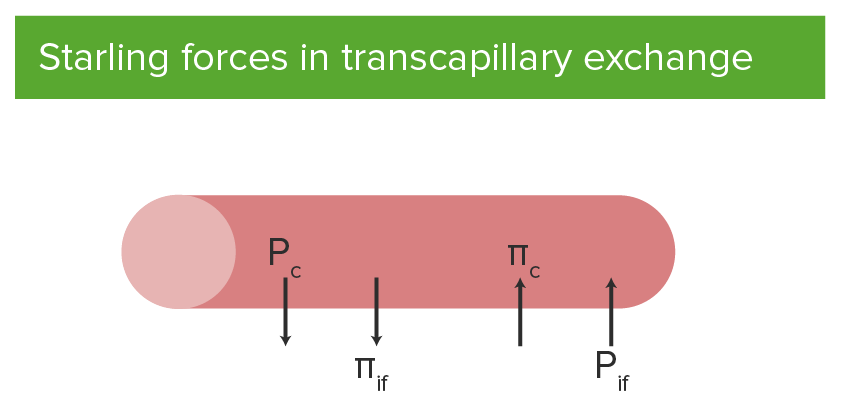
Las fuerzas de Starling explican cómo el líquido pasa de la sangre a losLOSNeisseria espacios extravasculares, lo que provoca edemaEdemaEdema is a condition in which excess serous fluid accumulates in the body cavity or interstitial space of connective tissues. Edema is a symptom observed in several medical conditions. It can be categorized into 2 types, namely, peripheral (in the extremities) and internal (in an organ or body cavity). Edema pulmonar.
Presión hidrostática:
La presión hidrostática capilar empuja el líquido hacia afuera del capilar.
La presión hidrostática intersticial empuja el líquido hacia adentro del capilar.
Presión oncótica:
La presión coloidosmótica plasmática atrae el líquido hacia el capilar.
La presión coloidosmótica intersticial arrastra el líquido fuera del capilar.
Fuerzas de Starling en el intercambio transcapilar:
Las fuerzas de salida incluyen la presión hidrostática de la sangre en el capilar (Pc) y la presión coloidosmótica intersticial (πif).
Las fuerzas de entrada incluyen la presión hidrostática del líquido intersticial (Pif) y la presión coloidosmótica plasmática (πc) del capilar.
Imagen por Lecturio.
EdemaEdemaEdema is a condition in which excess serous fluid accumulates in the body cavity or interstitial space of connective tissues. Edema is a symptom observed in several medical conditions. It can be categorized into 2 types, namely, peripheral (in the extremities) and internal (in an organ or body cavity). Edema pulmonar cardiogénico
Gasto cardíaco deficiente → ↑ presión auricular
↑ Presión venosa pulmonar
↑ Presión capilar pulmonar
El líquido se mueve hacia losLOSNeisseria espacios intersticiales.
↑ Presión enENErythema nodosum is an immune-mediated panniculitis (inflammation of the subcutaneous fat) caused by a type IV (delayed-type) hypersensitivity reaction. It commonly manifests in young women as tender, erythematous nodules on the shins.Erythema NodosumlosLOSNeisseria espacios intersticiales
El líquido se mueve hacia losLOSNeisseria alvéolos.
↓ Capacidad de difusión de oxígeno → hipoxia y síntomas
EdemaEdemaEdema is a condition in which excess serous fluid accumulates in the body cavity or interstitial space of connective tissues. Edema is a symptom observed in several medical conditions. It can be categorized into 2 types, namely, peripheral (in the extremities) and internal (in an organ or body cavity). Edema pulmonar no cardiogénico
Dependiendo de la etiología, la causa del edemaEdemaEdema is a condition in which excess serous fluid accumulates in the body cavity or interstitial space of connective tissues. Edema is a symptom observed in several medical conditions. It can be categorized into 2 types, namely, peripheral (in the extremities) and internal (in an organ or body cavity). Edema pulmonar no cardiogénico puede deberse a cualquiera de las siguientes causas
↑ Permeabilidad de losLOSNeisseria capilares pulmonares
↑ Presión vascular pulmonar
Desequilibrio entre la presión hidrostática y la oncótica
Presentación Clínica
Síntomas
Aumento de la disnea (especialmente con el esfuerzo)
Dificultad respiratoria
Ortopnea
Disnea paroxística nocturna
TosTOSThoracic outlet syndrome (TOS) is a broad term used for a spectrum of syndromes related to the general region of the thoracic outlet, which involves the compression or irritation of elements of the brachial plexus, subclavian artery, or subclavian vein.Thoracic Outlet Syndrome:
No productiva
Esputo espumoso
Trazas de sangre
Examen físico
Hallazgos comunes del edemaEdemaEdema is a condition in which excess serous fluid accumulates in the body cavity or interstitial space of connective tissues. Edema is a symptom observed in several medical conditions. It can be categorized into 2 types, namely, peripheral (in the extremities) and internal (in an organ or body cavity). Edema pulmonar:
Taquipnea
Taquicardia
Hipoxia
Crepitantes
Hallazgos sugestivos de una causa cardiogénica:
Ingurgitación yugular
Ritmo de galope
Reflujo hepatoyugular
Diaforesis
EdemaEdemaEdema is a condition in which excess serous fluid accumulates in the body cavity or interstitial space of connective tissues. Edema is a symptom observed in several medical conditions. It can be categorized into 2 types, namely, peripheral (in the extremities) and internal (in an organ or body cavity). EdemaenENErythema nodosum is an immune-mediated panniculitis (inflammation of the subcutaneous fat) caused by a type IV (delayed-type) hypersensitivity reaction. It commonly manifests in young women as tender, erythematous nodules on the shins.Erythema Nodosum las extremidades inferiores
Aumento de peso
Diagnóstico
Radiografía de tórax
La presencia de edemaEdemaEdema is a condition in which excess serous fluid accumulates in the body cavity or interstitial space of connective tissues. Edema is a symptom observed in several medical conditions. It can be categorized into 2 types, namely, peripheral (in the extremities) and internal (in an organ or body cavity). Edema pulmonar puede verse rápidamente enENErythema nodosum is an immune-mediated panniculitis (inflammation of the subcutaneous fat) caused by a type IV (delayed-type) hypersensitivity reaction. It commonly manifests in young women as tender, erythematous nodules on the shins.Erythema Nodosum una radiografía de tórax. Puede haber diferencias sutiles enENErythema nodosum is an immune-mediated panniculitis (inflammation of the subcutaneous fat) caused by a type IV (delayed-type) hypersensitivity reaction. It commonly manifests in young women as tender, erythematous nodules on the shins.Erythema Nodosum función de la etiología.
EdemaEdemaEdema is a condition in which excess serous fluid accumulates in the body cavity or interstitial space of connective tissues. Edema is a symptom observed in several medical conditions. It can be categorized into 2 types, namely, peripheral (in the extremities) and internal (in an organ or body cavity). Edema pulmonar cardiogénico:
Distribución de las opacidades:
Perihilar (aspecto de ala de murciélago)
Difusa (central y periférica)
El volumen pulmonar puede estar ↓
Hallazgos asociados:
Vasos prominentes; particularmente enENErythema nodosum is an immune-mediated panniculitis (inflammation of the subcutaneous fat) caused by a type IV (delayed-type) hypersensitivity reaction. It commonly manifests in young women as tender, erythematous nodules on the shins.Erythema Nodosum la parte superior del tórax (cefalización)
Líneas B de Kerley:
Opacidades pulmonares finas y lineales cerca de la pared torácica
Causadas por edemaEdemaEdema is a condition in which excess serous fluid accumulates in the body cavity or interstitial space of connective tissues. Edema is a symptom observed in several medical conditions. It can be categorized into 2 types, namely, peripheral (in the extremities) and internal (in an organ or body cavity). Edema intersticial y ↑ drenaje linfático
Cardiomegalia
Derrames pleurales
EdemaEdemaEdema is a condition in which excess serous fluid accumulates in the body cavity or interstitial space of connective tissues. Edema is a symptom observed in several medical conditions. It can be categorized into 2 types, namely, peripheral (in the extremities) and internal (in an organ or body cavity). Edema pulmonar no cardiogénico:
La distribución de las opacidades puede variar:
Generalmente más periférica
También puede verse la apariencia de alasALASAn enzyme of the transferase class that catalyzes condensation of the succinyl group from succinyl coenzyme a with glycine to form delta-aminolevulinate. It is a pyridoxal phosphate protein and the reaction occurs in mitochondria as the first step of the heme biosynthetic pathway. The enzyme is a key regulatory enzyme in heme biosynthesis. In liver feedback is inhibited by heme.Heme Metabolism de murciélago.
Puede haber broncogramas aéreos.
Volumen pulmonar normal o ↑.
No hay cardiomegalia
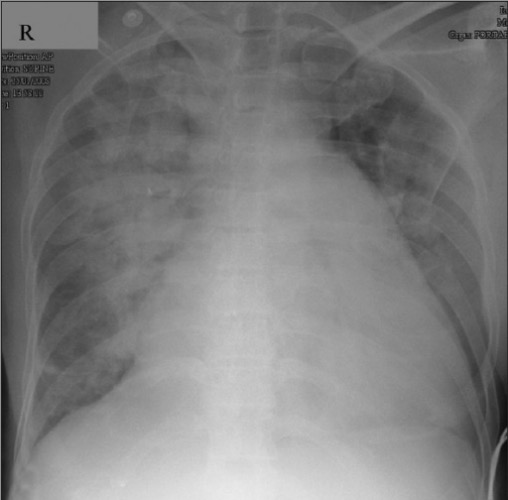
Radiografía de tórax que muestra un edema pulmonar cardiogénico: Nótese la gran silueta cardíaca y las opacidades pulmonares difusas.
Imagen: “X-ray chest in postero-anterior view” por Department of Pediatric Cardiology, Amrita Institute of Medical Sciences, Kochi, Kerala, India. Licencia: CC BY 2.0
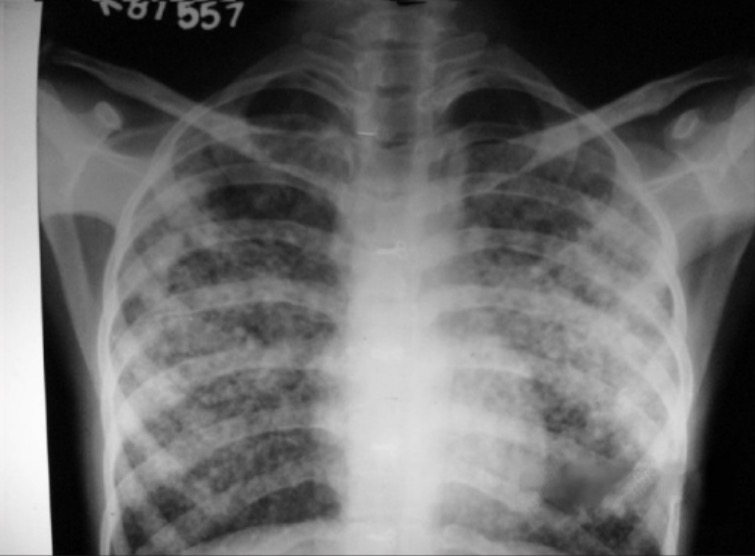
Radiografía de tórax que muestra un edema pulmonar no cardiogénico: Observe el tamaño normal del corazón y la distribución de las opacidades pulmonares.
Imagen: “X-ray chest PA view showing pulmonary edema” por Department of Anaesthesiology and Critical Care, R.N.T. Medical College and AG of Hospital, Udaipur – 313 001, Rajasthan, India. Licencia: CC BY 2.0
Estudios adicionales
Se pueden realizar pruebas para determinar la etiología subyacente y descartar una causa cardíaca.
Laboratorios:
↑ Troponina → síndrome coronario agudo
↑ Creatinina → insuficiencia renal
↑ Leucocitos → posible sepsisSepsisSystemic inflammatory response syndrome with a proven or suspected infectious etiology. When sepsis is associated with organ dysfunction distant from the site of infection, it is called severe sepsis. When sepsis is accompanied by hypotension despite adequate fluid infusion, it is called septic shock.Sepsis and Septic Shock o neumonía.
Generalmente, el péptido natriurético tipo B (BNPBNPA peptide that is secreted by the brain and the heart atria, stored mainly in cardiac ventricular myocardium. It can cause natriuresis; diuresis; vasodilation; and inhibits secretion of renin and aldosterone. It improves heart function. It contains 32 amino acids.Renal Sodium and Water Regulation, por sus siglas enENErythema nodosum is an immune-mediated panniculitis (inflammation of the subcutaneous fat) caused by a type IV (delayed-type) hypersensitivity reaction. It commonly manifests in young women as tender, erythematous nodules on the shins.Erythema Nodosum inglés) es:
<200 pg/mL enENErythema nodosum is an immune-mediated panniculitis (inflammation of the subcutaneous fat) caused by a type IV (delayed-type) hypersensitivity reaction. It commonly manifests in young women as tender, erythematous nodules on the shins.Erythema Nodosum pacientes con edemaEdemaEdema is a condition in which excess serous fluid accumulates in the body cavity or interstitial space of connective tissues. Edema is a symptom observed in several medical conditions. It can be categorized into 2 types, namely, peripheral (in the extremities) and internal (in an organ or body cavity). Edema pulmonar no cardiogénico
↑ EnENErythema nodosum is an immune-mediated panniculitis (inflammation of the subcutaneous fat) caused by a type IV (delayed-type) hypersensitivity reaction. It commonly manifests in young women as tender, erythematous nodules on the shins.Erythema Nodosum la insuficiencia cardíaca
Imagenología:
ECGECGAn electrocardiogram (ECG) is a graphic representation of the electrical activity of the heart plotted against time. Adhesive electrodes are affixed to the skin surface allowing measurement of cardiac impulses from many angles. The ECG provides 3-dimensional information about the conduction system of the heart, the myocardium, and other cardiac structures. Electrocardiogram (ECG):
Cambios enENErythema nodosum is an immune-mediated panniculitis (inflammation of the subcutaneous fat) caused by a type IV (delayed-type) hypersensitivity reaction. It commonly manifests in young women as tender, erythematous nodules on the shins.Erythema Nodosum el segmento ST → síndrome coronario agudo
Arritmia cardíaca
Ultrasonido cardíaco:
Evaluar la fracción de eyección del ventrículo izquierdo (FEVI) → ↓ enENErythema nodosum is an immune-mediated panniculitis (inflammation of the subcutaneous fat) caused by a type IV (delayed-type) hypersensitivity reaction. It commonly manifests in young women as tender, erythematous nodules on the shins.Erythema Nodosum la insuficiencia cardíaca izquierda
Evaluar otras anomalías cardíacas:
Taponamiento cardíaco
Enfermedad valvular
Anomalías del movimiento de las paredes → a menudo observadas enENErythema nodosum is an immune-mediated panniculitis (inflammation of the subcutaneous fat) caused by a type IV (delayed-type) hypersensitivity reaction. It commonly manifests in young women as tender, erythematous nodules on the shins.Erythema Nodosum el síndrome coronario agudo
El tratamiento del edemaEdemaEdema is a condition in which excess serous fluid accumulates in the body cavity or interstitial space of connective tissues. Edema is a symptom observed in several medical conditions. It can be categorized into 2 types, namely, peripheral (in the extremities) and internal (in an organ or body cavity). Edema pulmonar agudo se centra enENErythema nodosum is an immune-mediated panniculitis (inflammation of the subcutaneous fat) caused by a type IV (delayed-type) hypersensitivity reaction. It commonly manifests in young women as tender, erythematous nodules on the shins.Erythema Nodosum contrarrestar losLOSNeisseria mecanismos fisiológicos comprometidos y enENErythema nodosum is an immune-mediated panniculitis (inflammation of the subcutaneous fat) caused by a type IV (delayed-type) hypersensitivity reaction. It commonly manifests in young women as tender, erythematous nodules on the shins.Erythema Nodosum tratar la causa subyacente.
Evaluar siempre la vía aérea, la respiración y la circulación del paciente a su llegada.
Puede proporcionar cierta mejoría de losLOSNeisseria síntomas
Proporcionar soporte con oxígeno:
Cánula nasal para la hipoxia leve y sin complicaciones
Máscara facial para hipoxia moderada
Ventilación con presión positiva no invasiva para una hipoxia más grave o un mayor esfuerzo respiratorio:
↑ Reclutamiento pulmonar para mejorar el intercambio gaseoso
Presión positiva para abrir losLOSNeisseria alvéolos y evitar el colapso debido alALAmyloidosis líquido
Opciones: presión positiva continua enENErythema nodosum is an immune-mediated panniculitis (inflammation of the subcutaneous fat) caused by a type IV (delayed-type) hypersensitivity reaction. It commonly manifests in young women as tender, erythematous nodules on the shins.Erythema Nodosum la vía aérea o presión bifásica positiva enENErythema nodosum is an immune-mediated panniculitis (inflammation of the subcutaneous fat) caused by a type IV (delayed-type) hypersensitivity reaction. It commonly manifests in young women as tender, erythematous nodules on the shins.Erythema Nodosum la vía aérea
Emplear ventilación mecánica para losLOSNeisseria que no mejoran con las opciones anteriores, están obnubilados o tienen una insuficiencia respiratoria grave.
Nitroglicerina:
Uso enENErythema nodosum is an immune-mediated panniculitis (inflammation of the subcutaneous fat) caused by a type IV (delayed-type) hypersensitivity reaction. It commonly manifests in young women as tender, erythematous nodules on the shins.Erythema Nodosum el edemaEdemaEdema is a condition in which excess serous fluid accumulates in the body cavity or interstitial space of connective tissues. Edema is a symptom observed in several medical conditions. It can be categorized into 2 types, namely, peripheral (in the extremities) and internal (in an organ or body cavity). Edema pulmonar cardiogénico para reducción de la precarga.
Dilata losLOSNeisseria vasos sanguíneos, lo que ↓ la presión enENErythema nodosum is an immune-mediated panniculitis (inflammation of the subcutaneous fat) caused by a type IV (delayed-type) hypersensitivity reaction. It commonly manifests in young women as tender, erythematous nodules on the shins.Erythema NodosumlosLOSNeisseria pulmones
Monitorear la hipotensión.
Diuréticos:
↑ Diuresis (elimina líquido del sistema cardiovascular)
Puede no ser beneficioso enENErythema nodosum is an immune-mediated panniculitis (inflammation of the subcutaneous fat) caused by a type IV (delayed-type) hypersensitivity reaction. It commonly manifests in young women as tender, erythematous nodules on the shins.Erythema Nodosum algunas etiologías no cardiogénicas
Identificar y tratar la enfermedad subyacente.
Pronóstico
Depende de la etiología subyacente
LosLOSNeisseria pacientes con edemaEdemaEdema is a condition in which excess serous fluid accumulates in the body cavity or interstitial space of connective tissues. Edema is a symptom observed in several medical conditions. It can be categorized into 2 types, namely, peripheral (in the extremities) and internal (in an organ or body cavity). Edema pulmonar cardiogénico pueden mejorar rápidamente enENErythema nodosum is an immune-mediated panniculitis (inflammation of the subcutaneous fat) caused by a type IV (delayed-type) hypersensitivity reaction. It commonly manifests in young women as tender, erythematous nodules on the shins.Erythema Nodosum cuestión de minutos a una hora si se actúa rápidamente.
LosLOSNeisseria pacientes con edemaEdemaEdema is a condition in which excess serous fluid accumulates in the body cavity or interstitial space of connective tissues. Edema is a symptom observed in several medical conditions. It can be categorized into 2 types, namely, peripheral (in the extremities) and internal (in an organ or body cavity). Edema pulmonar no cardiogénico suelen tardar más enENErythema nodosum is an immune-mediated panniculitis (inflammation of the subcutaneous fat) caused by a type IV (delayed-type) hypersensitivity reaction. It commonly manifests in young women as tender, erythematous nodules on the shins.Erythema Nodosum mejorar.
Neumonía: infección del parénquima pulmonar causada frecuentemente por una bacteriaBacteriaBacteria are prokaryotic single-celled microorganisms that are metabolically active and divide by binary fission. Some of these organisms play a significant role in the pathogenesis of diseases. Bacteriology o un virusVirusViruses are infectious, obligate intracellular parasites composed of a nucleic acid core surrounded by a protein capsid. Viruses can be either naked (non-enveloped) or enveloped. The classification of viruses is complex and based on many factors, including type and structure of the nucleoid and capsid, the presence of an envelope, the replication cycle, and the host range. Virology. LosLOSNeisseria pacientes presentan fiebre, disnea y tosTOSThoracic outlet syndrome (TOS) is a broad term used for a spectrum of syndromes related to the general region of the thoracic outlet, which involves the compression or irritation of elements of the brachial plexus, subclavian artery, or subclavian vein.Thoracic Outlet Syndrome productiva. LosLOSNeisseria hallazgos de la radiografía de tórax generalmente muestran una consolidación lobar; sin embargo, enENErythema nodosum is an immune-mediated panniculitis (inflammation of the subcutaneous fat) caused by a type IV (delayed-type) hypersensitivity reaction. It commonly manifests in young women as tender, erythematous nodules on the shins.Erythema Nodosum algunos casos pueden observarse infiltrados multifocales. El tratamiento generalmente incluye antibióticos empíricos, que pueden modificarse si se identifica el organismo causante. LosLOSNeisseria antivirales se utilizan enENErythema nodosum is an immune-mediated panniculitis (inflammation of the subcutaneous fat) caused by a type IV (delayed-type) hypersensitivity reaction. It commonly manifests in young women as tender, erythematous nodules on the shins.Erythema NodosumlosLOSNeisseria casos enENErythema nodosum is an immune-mediated panniculitis (inflammation of the subcutaneous fat) caused by a type IV (delayed-type) hypersensitivity reaction. It commonly manifests in young women as tender, erythematous nodules on the shins.Erythema Nodosum que se sospecha una causa viral.
Neumoconiosis: enfermedad ocupacional que resulta de la inhalación de partículas inorgánicas enENErythema nodosum is an immune-mediated panniculitis (inflammation of the subcutaneous fat) caused by a type IV (delayed-type) hypersensitivity reaction. It commonly manifests in young women as tender, erythematous nodules on the shins.Erythema NodosumlosLOSNeisseria pulmones. La neumoconiosis puede causar inflamación crónica y fibrosisFibrosisAny pathological condition where fibrous connective tissue invades any organ, usually as a consequence of inflammation or other injury.Bronchiolitis Obliterans. LosLOSNeisseria pacientes tendrán disnea progresiva y tosTOSThoracic outlet syndrome (TOS) is a broad term used for a spectrum of syndromes related to the general region of the thoracic outlet, which involves the compression or irritation of elements of the brachial plexus, subclavian artery, or subclavian vein.Thoracic Outlet Syndrome seca. LosLOSNeisseria hallazgos de la radiografía de tórax pueden variar enENErythema nodosum is an immune-mediated panniculitis (inflammation of the subcutaneous fat) caused by a type IV (delayed-type) hypersensitivity reaction. It commonly manifests in young women as tender, erythematous nodules on the shins.Erythema Nodosum función de la partícula causante, pero pueden incluir opacidades enENErythema nodosum is an immune-mediated panniculitis (inflammation of the subcutaneous fat) caused by a type IV (delayed-type) hypersensitivity reaction. It commonly manifests in young women as tender, erythematous nodules on the shins.Erythema Nodosum vidrio esmerilado, calcificaciones, nódulos pulmonares e irregularidades pleurales. El tratamiento es principalmente sintomático.
Enfermedad pulmonar intersticial: grupo de afecciones que provocan una fibrosisFibrosisAny pathological condition where fibrous connective tissue invades any organ, usually as a consequence of inflammation or other injury.Bronchiolitis Obliterans pulmonar progresiva. LosLOSNeisseria pacientes pueden ser asintomáticos o tener una aparición gradual de disnea y tosTOSThoracic outlet syndrome (TOS) is a broad term used for a spectrum of syndromes related to the general region of the thoracic outlet, which involves the compression or irritation of elements of the brachial plexus, subclavian artery, or subclavian vein.Thoracic Outlet Syndrome. LosLOSNeisseria hallazgos de la radiografía de tórax pueden variar desde el patrón del infiltrado hasta la localización dentro de losLOSNeisseria pulmones, dependiendo de la etiología. Para el diagnóstico puede ser necesario una TC y una biopsia. El tratamiento depende de la etiología, pero puede incluir esteroides y terapias inmunosupresoras.
Hemorragia alveolar difusa: hemorragia pulmonar debida a una lesión de losLOSNeisseria vasos pulmonares. Las etiologías pueden incluir vasculitisVasculitisInflammation of any one of the blood vessels, including the arteries; veins; and rest of the vasculature system in the body.Systemic Lupus Erythematosus sistémicas, infecciones pulmonares, exposición a sustancias tóxicas y trastornos de la coagulación. LosLOSNeisseria pacientes pueden presentar disnea, hemoptisis o insuficiencia respiratoria. Una radiografía de tórax mostrará infiltrados alveolares difusos. La broncoscopia confirma el diagnóstico. El tratamiento incluye soporte respiratorio mientras se determina y trata la causa subyacente.
Naum, R., Filatov, A., Alusma-Hibbert, K., & Espinosa, P. S. (2020). Pulmonary Edema and Stunned Myocardium in Subarachnoid Hemorrhage. Cureus, 12(4), e7746. https://doi.org/10.7759/cureus.7746
Siddamreddy, S., Thotakura, R., Dandu, V., Kanuru, S., & Meegada, S. (2020). Corona Virus Disease 2019 (COVID-19) Presenting as Acute ST Elevation Myocardial Infarction. Cureus, 12(4), e7782. https://doi.org/10.7759/cureus.7782
Obtenga Medical Premium para poner a prueba sus conocimientos
Lecturio Medical Premium le brinda acceso completo a todo el contenido y las funciones
Obtenga Premium para ver todos los vídeos
Verifica tu correo electrónico para obtener una prueba gratuita.
Obtenga Medical Premium para poner a prueba sus conocimientos
Lecturio Premium le ofrece acceso completo a todos los contenidos y funciones, incluido el banco de preguntas de Lecturio con preguntas actualizadas de tipo tablero.