
Domina Conceptos Médicos

Estudia para la escuela de medicina y tus examenes con Lecturio.

Deficiencia de la Vía Terminal del Complemento

El complejo de ataque a la membrana, formado por proteínas del complemento, desempeña un papel crucial en EN Erythema nodosum is an immune-mediated panniculitis (inflammation of the subcutaneous fat) caused by a type IV (delayed-type) hypersensitivity reaction. It commonly manifests in young women as tender, erythematous nodules on the shins. Erythema Nodosum la erradicación de las infecciones bacterianas, especialmente de las especies de Neisseria Neisseria Neisseria is a genus of bacteria commonly present on mucosal surfaces. Several species exist, but only 2 are pathogenic to humans: N. gonorrhoeae and N. meningitidis. Neisseria species are non-motile, gram-negative diplococci most commonly isolated on modified Thayer-Martin (MTM) agar. Neisseria y otras bacterias encapsuladas, al AL Amyloidosis adherirse a la membrana plasmática bacteriana y formar poros que finalmente conducen a la lisis celular. Los LOS Neisseria pacientes con deficiencia de la vía terminal del complemento pueden presentar infecciones neiséricas recurrentes y severas, ya que son incapaces de sintetizar el complejo de ataque a la membrana debido a la deficiencia de uno de sus componentes (e.g., las proteínas tardías del complemento). El tratamiento consiste en EN Erythema nodosum is an immune-mediated panniculitis (inflammation of the subcutaneous fat) caused by a type IV (delayed-type) hypersensitivity reaction. It commonly manifests in young women as tender, erythematous nodules on the shins. Erythema Nodosum antibióticos para la infección y vacunación contra las bacterias encapsuladas.

Last updated: Dec 15, 2025

Editorial responsibility: Stanley Oiseth, Lindsay Jones, Evelin Maza

Etiología y Fisiopatología

Epidemiología y etiología

  • Trastorno genético con herencia autosómica recesiva
  • Deficiencia de 1 de las proteínas terminales del complemento
  • Las deficiencias más comunes en EN Erythema nodosum is an immune-mediated panniculitis (inflammation of the subcutaneous fat) caused by a type IV (delayed-type) hypersensitivity reaction. It commonly manifests in young women as tender, erythematous nodules on the shins. Erythema Nodosum Estados Unidos: C5, C6 o C8

Fisiopatología

Estructura y función del complejo de ataque a la membrana:
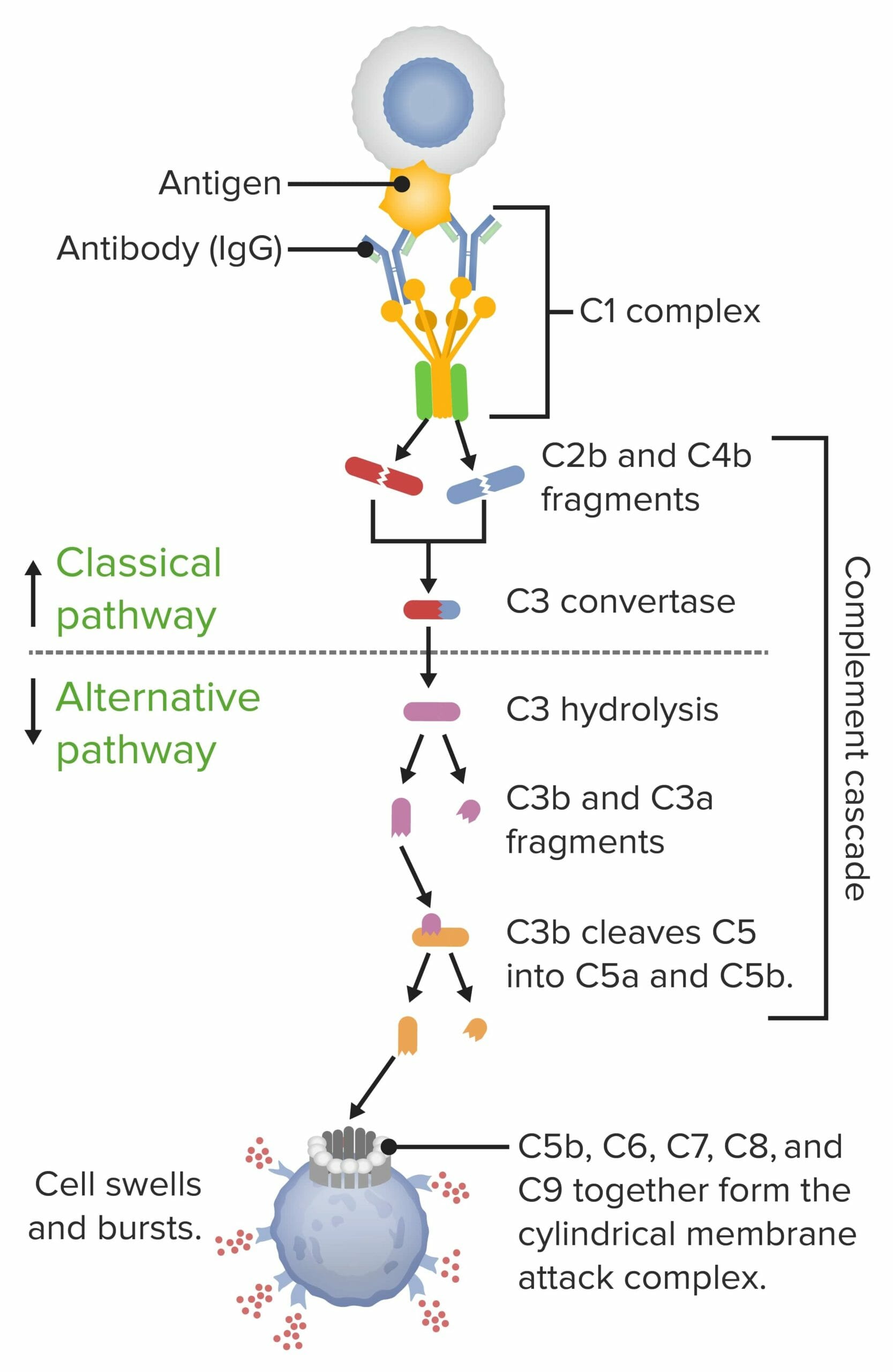
  • Estructura: anular formada por las proteínas terminales del complemento activadas (C5b, C6, C7, C8 y C9)
  • Función:
    • Se adhiere a la membrana bacteriana para crear poros
    • Produce una difusión libre entre los LOS Neisseria componentes intracelulares y extracelulares, lo que conduce a la lisis del microorganismo
  • Fisiopatología:
    • La disminución de la capacidad de crear poros en EN Erythema nodosum is an immune-mediated panniculitis (inflammation of the subcutaneous fat) caused by a type IV (delayed-type) hypersensitivity reaction. It commonly manifests in young women as tender, erythematous nodules on the shins. Erythema Nodosum la membrana de la célula bacteriana conduce a una lisis deficiente del microorganismo.
    • Mayor susceptibilidad a organismos encapsulados
Membrane attack complex (MAC) formation

Formación del complejo de ataque a la membrana:
Cuando la primera proteína de la serie del complemento se activa (normalmente por un anticuerpo que se ha fijado a un antígeno), pone en marcha un efecto dominó. Cada componente sigue su turno en una cadena precisa de pasos conocida como la cascada del complemento. El producto final es un cilindro del complejo de ataque a la membrana que se inserta en la pared de la célula (y la perfora). Con los fluidos y las moléculas que entran y salen, la célula aumenta de tamaño y estalla.

Imagen por Lecturio.

Related videos

Presentación Clínica

La mayoría de los LOS Neisseria pacientes son asintomáticos.

Los LOS Neisseria pacientes sintomáticos presentan:

  • Infecciones bacterianas por encapsulados recurrentes:
    • Infecciones meningocócicas
    • Infecciones gonocócicas
  • Infección neisérica severa y diseminada:
    • Meningococemia
    • Sepsis Sepsis Systemic inflammatory response syndrome with a proven or suspected infectious etiology. When sepsis is associated with organ dysfunction distant from the site of infection, it is called severe sepsis. When sepsis is accompanied by hypotension despite adequate fluid infusion, it is called septic shock. Sepsis and Septic Shock y shock Shock Shock is a life-threatening condition associated with impaired circulation that results in tissue hypoxia. The different types of shock are based on the underlying cause: distributive (↑ cardiac output (CO), ↓ systemic vascular resistance (SVR)), cardiogenic (↓ CO, ↑ SVR), hypovolemic (↓ CO, ↑ SVR), obstructive (↓ CO), and mixed. Types of Shock séptico

Diagnóstico y Tratamiento

Diagnóstico

La actividad total del complemento ( CH50 CH50 Terminal Complement Pathway Deficiency) se utiliza para el tamizaje. Si el CH50 CH50 Terminal Complement Pathway Deficiency es bajo/indetectable, debe pedirse la medición del nivel de proteínas séricas del complemento. Los LOS Neisseria hallazgos incluyen:

Tratamiento

  • Tratar las infecciones de forma agresiva con antibióticos.
  • Vacunación contra bacterias encapsuladas:
    • Neumococo
    • Meningococo
    • Haemophilus influenzae Haemophilus Influenzae A species of Haemophilus found on the mucous membranes of humans and a variety of animals. The species is further divided into biotypes I through viii. Haemophilus tipo b

Diagnóstico Diferencial

  • Sepsis Sepsis Systemic inflammatory response syndrome with a proven or suspected infectious etiology. When sepsis is associated with organ dysfunction distant from the site of infection, it is called severe sepsis. When sepsis is accompanied by hypotension despite adequate fluid infusion, it is called septic shock. Sepsis and Septic Shock bacteriana/ shock Shock Shock is a life-threatening condition associated with impaired circulation that results in tissue hypoxia. The different types of shock are based on the underlying cause: distributive (↑ cardiac output (CO), ↓ systemic vascular resistance (SVR)), cardiogenic (↓ CO, ↑ SVR), hypovolemic (↓ CO, ↑ SVR), obstructive (↓ CO), and mixed. Types of Shock séptico: síndrome potencialmente mortal que puede ser causado por infecciones bacterianas. La sepsis Sepsis Systemic inflammatory response syndrome with a proven or suspected infectious etiology. When sepsis is associated with organ dysfunction distant from the site of infection, it is called severe sepsis. When sepsis is accompanied by hypotension despite adequate fluid infusion, it is called septic shock. Sepsis and Septic Shock es una respuesta inmune generalizada que puede provocar la disfunción o el fallo de un órgano. La identificación precoz es primordial para poder iniciar el tratamiento adecuado con reanimación con líquidos intravenosos, antibióticos y vasopresores (si es necesario).
  • Hipogammaglobulinemia: se refiere a un hallazgo de laboratorio ( IgG IgG The major immunoglobulin isotype class in normal human serum. There are several isotype subclasses of igg, for example, igg1, igg2a, and igg2b. Hypersensitivity Pneumonitis baja) que puede ser asintomático o que puede estar relacionado con una serie de situaciones clínicas con diferentes causas y manifestaciones de ser más severo. La hipogammaglobulinemia puede estar causada por una inmunodeficiencia primaria o puede ser secundaria a otras enfermedades. La característica principal de la hipogammaglobulinemia sintomática son las infecciones a repetición que normalmente se previenen con respuestas de anticuerpos.
  • Meningococemia: se define como la diseminación de meningococos ( Neisseria meningitidis Neisseria meningitidis A species of gram-negative, aerobic bacteria. It is a commensal and pathogen only of humans, and can be carried asymptomatically in the nasopharynx. When found in cerebrospinal fluid it is the causative agent of cerebrospinal meningitis. It is also found in venereal discharges and blood. There are at least 13 serogroups based on antigenic differences in the capsular polysaccharides; the ones causing most meningitis infections being a, b, c, y, and w-135. Each serogroup can be further classified by serotype, serosubtype, and immunotype. Neisseria) en EN Erythema nodosum is an immune-mediated panniculitis (inflammation of the subcutaneous fat) caused by a type IV (delayed-type) hypersensitivity reaction. It commonly manifests in young women as tender, erythematous nodules on the shins. Erythema Nodosum el torrente sanguíneo. Los LOS Neisseria pacientes con meningococemia aguda pueden presentar meningitis Meningitis Meningitis is inflammation of the meninges, the protective membranes of the brain, and spinal cord. The causes of meningitis are varied, with the most common being bacterial or viral infection. The classic presentation of meningitis is a triad of fever, altered mental status, and nuchal rigidity. Meningitis, meningitis Meningitis Meningitis is inflammation of the meninges, the protective membranes of the brain, and spinal cord. The causes of meningitis are varied, with the most common being bacterial or viral infection. The classic presentation of meningitis is a triad of fever, altered mental status, and nuchal rigidity. Meningitis con meningococemia o meningococemia sin meningitis Meningitis Meningitis is inflammation of the meninges, the protective membranes of the brain, and spinal cord. The causes of meningitis are varied, with the most common being bacterial or viral infection. The classic presentation of meningitis is a triad of fever, altered mental status, and nuchal rigidity. Meningitis clínicamente aparente.

Referencias

  1. Liszewski, M.K., et al. (2024). Inherited disorders of the complement system. In Schur, P.H., et al. (Ed.), UpToDate. Retrieved August 4, 2025, from https://www.uptodate.com/contents/inherited-disorders-of-the-complement-system
  2. Liszewski, M.K., et al. (2024). Overview and clinical assessment of the complement system. In Schur, P.H., et al. (Ed.), UpToDate. Retrieved August 4, 2025, from https://www.uptodate.com/contents/overview-and-clinical-assessment-of-the-complement-system
  3. Fischer, A. (2018). Primary immune deficiency diseases. Chapter 344 of Jameson JL, et al. (Ed.), Harrison’s Principles of Internal Medicine, 20th ed. McGraw-Hill.

¡Crea tu cuenta gratis o inicia una sesión para seguir leyendo!

Regístrate ahora y obtén acceso gratuito a Lecturio con páginas de concepto, videos médicos y cuestionarios para tu educación médica.

User Reviews

Que tengas una sesión de estudio alegre y navideña 🎁 Ahorra 50% en todos los planes >>

Details