
Domina Conceptos Médicos

Estudia para la escuela de medicina y tus examenes con Lecturio.

Coma

El coma Coma Coma is defined as a deep state of unarousable unresponsiveness, characterized by a score of 3 points on the GCS. A comatose state can be caused by a multitude of conditions, making the precise epidemiology and prognosis of coma difficult to determine. Coma se define como un estado profundo de inconsciencia y ausencia de respuesta ambiental, caracterizado por una puntuación de 3 puntos en EN Erythema nodosum is an immune-mediated panniculitis (inflammation of the subcutaneous fat) caused by a type IV (delayed-type) hypersensitivity reaction. It commonly manifests in young women as tender, erythematous nodules on the shins. Erythema Nodosum la GCS GCS A scale that assesses the response to stimuli in patients with craniocerebral injuries. The parameters are eye opening, motor response, and verbal response. Coma (Glasgow Coma Coma Coma is defined as a deep state of unarousable unresponsiveness, characterized by a score of 3 points on the GCS. A comatose state can be caused by a multitude of conditions, making the precise epidemiology and prognosis of coma difficult to determine. Coma Scale Scale Dermatologic Examination, por sus siglas en EN Erythema nodosum is an immune-mediated panniculitis (inflammation of the subcutaneous fat) caused by a type IV (delayed-type) hypersensitivity reaction. It commonly manifests in young women as tender, erythematous nodules on the shins. Erythema Nodosum inglés). Un estado comatoso puede ser causado por una multitud de afecciones, lo que dificulta determinar la epidemiología precisa y el pronóstico del coma Coma Coma is defined as a deep state of unarousable unresponsiveness, characterized by a score of 3 points on the GCS. A comatose state can be caused by a multitude of conditions, making the precise epidemiology and prognosis of coma difficult to determine. Coma. El diagnóstico se realiza clínicamente mediante un examen neurológico completo, incluyendo la evaluación del tronco encefálico para evaluar la presencia de muerte cerebral. El tratamiento definitivo depende de la etiología subyacente.

Last updated: May 7, 2024

Editorial responsibility: Stanley Oiseth, Lindsay Jones, Evelin Maza

Descripción General

Definición

  • Un estado profundo de inconsciencia y ausencia de respuesta ambiental.
  • Puntaje más bajo en EN Erythema nodosum is an immune-mediated panniculitis (inflammation of the subcutaneous fat) caused by a type IV (delayed-type) hypersensitivity reaction. It commonly manifests in young women as tender, erythematous nodules on the shins. Erythema Nodosum la capacidad de respuesta en EN Erythema nodosum is an immune-mediated panniculitis (inflammation of the subcutaneous fat) caused by a type IV (delayed-type) hypersensitivity reaction. It commonly manifests in young women as tender, erythematous nodules on the shins. Erythema Nodosum la GCS GCS A scale that assesses the response to stimuli in patients with craniocerebral injuries. The parameters are eye opening, motor response, and verbal response. Coma = 3
Table: Escala de Coma Coma Coma is defined as a deep state of unarousable unresponsiveness, characterized by a score of 3 points on the GCS. A comatose state can be caused by a multitude of conditions, making the precise epidemiology and prognosis of coma difficult to determine. Coma de Glasgow
Descripción Puntaje
Apertura ocular Espontánea 4
Apertura al AL Amyloidosis habla 3
Responde al AL Amyloidosis dolor Dolor Inflammation 2
Ninguna 1
Mejor respuesta verbal Orientado 5
Confundido 4
Palabras inapropiadas 3
Palabras incomprensibles 2
Ninguna 1
Mejor respuesta motora Obedece órdenes 6
Localiza el dolor Dolor Inflammation 5
Retira al AL Amyloidosis dolor Dolor Inflammation 4
Postura de decorticación (flexión) 3
Postura de descerebración (extensión) 2
Ninguna 1
El puntaje de la escala de coma de Glasgow es entre 3 y 15 (3 es el peor, 15 la mejor).

Clasificación

  • Patológico (debido a una patología subyacente)
  • Artificial o inducido (e.g., por anestesia general)

Epidemiología

Difícil de determinar debido a:

  • Variación en EN Erythema nodosum is an immune-mediated panniculitis (inflammation of the subcutaneous fat) caused by a type IV (delayed-type) hypersensitivity reaction. It commonly manifests in young women as tender, erythematous nodules on the shins. Erythema Nodosum las evaluaciones por los LOS Neisseria diferentes evaluadores
  • Codificación diagnóstica de la etiología y no del coma Coma Coma is defined as a deep state of unarousable unresponsiveness, characterized by a score of 3 points on the GCS. A comatose state can be caused by a multitude of conditions, making the precise epidemiology and prognosis of coma difficult to determine. Coma en EN Erythema nodosum is an immune-mediated panniculitis (inflammation of the subcutaneous fat) caused by a type IV (delayed-type) hypersensitivity reaction. It commonly manifests in young women as tender, erythematous nodules on the shins. Erythema Nodosum

Etiología

Tabla: Causas del coma Coma Coma is defined as a deep state of unarousable unresponsiveness, characterized by a score of 3 points on the GCS. A comatose state can be caused by a multitude of conditions, making the precise epidemiology and prognosis of coma difficult to determine. Coma
Estructurales Tóxicos Metabólicos
  • Accidente cerebrovascular
  • Tumor Tumor Inflammation cerebral
  • Hemorragia epidural
  • Hemorragia subdural
  • Hemorragia subaracnoidea
  • Hidrocefalia
  • Síndromes de herniación
  • Intoxicación
  • Anestésicos
  • Agentes disociativos
  • Intoxicación por dióxido de carbono
  • Alcoholes tóxicos
  • Antidepresivos
  • Anticonvulsivos
  • Asfixia
  • Síndrome serotoninérgico
  • Síndrome neuroléptico maligno
  • Clonidina
  • Insuficiencia respiratoria
  • Distermia
  • Hipoglucemia/hiperglucemia
  • Meningitis Meningitis Meningitis is inflammation of the meninges, the protective membranes of the brain, and spinal cord. The causes of meningitis are varied, with the most common being bacterial or viral infection. The classic presentation of meningitis is a triad of fever, altered mental status, and nuchal rigidity. Meningitis
  • Encefalitis
  • Hipotiroidismo (mixedema)
  • Deficiencia de tiamina
  • Estado epiléptico no convulsivo
  • Alteraciones electrolíticas

Fisiopatología

La secuencia específica de esta afección depende de la etiología subyacente, pero en EN Erythema nodosum is an immune-mediated panniculitis (inflammation of the subcutaneous fat) caused by a type IV (delayed-type) hypersensitivity reaction. It commonly manifests in young women as tender, erythematous nodules on the shins. Erythema Nodosum términos generales:

  1. Se produce una lesión inicial en EN Erythema nodosum is an immune-mediated panniculitis (inflammation of the subcutaneous fat) caused by a type IV (delayed-type) hypersensitivity reaction. It commonly manifests in young women as tender, erythematous nodules on the shins. Erythema Nodosum el área cerebral, que puede ser directa (traumatismo, isquemia, efecto de masa) o indirecta (tóxico, metabólico).
  2. Si la causa de la lesión inicial se prolonga, se produce daño secundario en EN Erythema nodosum is an immune-mediated panniculitis (inflammation of the subcutaneous fat) caused by a type IV (delayed-type) hypersensitivity reaction. It commonly manifests in young women as tender, erythematous nodules on the shins. Erythema Nodosum el SNC y disfunción neuronal.
  3. Debido a que las áreas de excitación están comprometidas, el individuo entra en EN Erythema nodosum is an immune-mediated panniculitis (inflammation of the subcutaneous fat) caused by a type IV (delayed-type) hypersensitivity reaction. It commonly manifests in young women as tender, erythematous nodules on the shins. Erythema Nodosum estado comatoso.

Presentación Clínica

Antecedentes

  • Se debe interrogar a los LOS Neisseria paramédicos, miembros de la familia, compañeros de trabajo o transeúntes sobre las circunstancias involucradas en EN Erythema nodosum is an immune-mediated panniculitis (inflammation of the subcutaneous fat) caused by a type IV (delayed-type) hypersensitivity reaction. It commonly manifests in young women as tender, erythematous nodules on the shins. Erythema Nodosum la pérdida del conocimiento para determinar la etiología más probable.
  • Durante el interrogatorio se debe determinar lo siguiente:
    • Circunstancias y rapidez del desarrollo de los LOS Neisseria síntomas neurológicos
    • Síntomas previos a la pérdida del conocimiento (e.g., cefalea, fiebre, convulsiones, vómitos)
    • Uso de medicamentos, drogas ilegales o alcohol.
    • Antecedentes médicos (e.g., hepatopatía crónica, cardiopatía isquémica)

Examen físico

La evaluación y el abordaje puede ocurrir de manera simultánea.

Inicial:

  • ABC:
    • Vía aérea:
      • ¿Obstruida?
      • ¿Comprometida?
    • Ventilación:
      • ¿Esfuerzo respiratorio espontáneo?
      • ¿Mantiene la saturación de O2?
    • Circulación:
      • ¿Pulso palpable?
      • ¿Signos de perfusión?
      • ¿Presión arterial adecuada?
  • Signos de trauma

Exploración neurológica (nivel de respuesta a los LOS Neisseria estímulos):

  • Decir o gritar el nombre del paciente (estimulación verbal)
  • Sacudir/tocar al AL Amyloidosis paciente (estimulación táctil)
  • Presionar sobre los LOS Neisseria lechos ungueales del individuo (estimulación dolorosa periférica)
  • Frotamiento esternal/presión supraorbitaria (estímulo doloroso central)

Examen del tronco encefálico (determinación de muerte cerebral):

  • Reflejo pupilar a la luz:
    • Aferente: nervio craneal II
    • Eferente: nervio craneal III (parasimpático)
    • Se realiza haciendo brillar una luz en EN Erythema nodosum is an immune-mediated panniculitis (inflammation of the subcutaneous fat) caused by a type IV (delayed-type) hypersensitivity reaction. It commonly manifests in young women as tender, erythematous nodules on the shins. Erythema Nodosum cada pupila y observando la pupila ipsilateral y contralateral para observar la respuesta a la luz.
    • La respuesta normal es la constricción pupilar directa y consensuada.
    • La respuesta en EN Erythema nodosum is an immune-mediated panniculitis (inflammation of the subcutaneous fat) caused by a type IV (delayed-type) hypersensitivity reaction. It commonly manifests in young women as tender, erythematous nodules on the shins. Erythema Nodosum coma Coma Coma is defined as a deep state of unarousable unresponsiveness, characterized by a score of 3 points on the GCS. A comatose state can be caused by a multitude of conditions, making the precise epidemiology and prognosis of coma difficult to determine. Coma es la falta de constricción.
  • Maniobra oculocefálica:
    • Parte de la evaluación del reflejo vestibuloocular
    • Aferente: nervio craneal VIII
    • Eferente: nervio craneal III, IV, VI
    • Se realiza girando la cabeza de un lado a otro ( en EN Erythema nodosum is an immune-mediated panniculitis (inflammation of the subcutaneous fat) caused by a type IV (delayed-type) hypersensitivity reaction. It commonly manifests in young women as tender, erythematous nodules on the shins. Erythema Nodosum un plano horizontal)
    • El reflejo está presente (“positivo”):
      • Los LOS Neisseria ojos giran en EN Erythema nodosum is an immune-mediated panniculitis (inflammation of the subcutaneous fat) caused by a type IV (delayed-type) hypersensitivity reaction. It commonly manifests in young women as tender, erythematous nodules on the shins. Erythema Nodosum el sentido contrario a la rotación de la cabeza (reflejo de ojos de muñeca).
      • Indica una función intacta del tronco encefálico (el tronco encefálico mantiene los LOS Neisseria ojos fijos en EN Erythema nodosum is an immune-mediated panniculitis (inflammation of the subcutaneous fat) caused by a type IV (delayed-type) hypersensitivity reaction. It commonly manifests in young women as tender, erythematous nodules on the shins. Erythema Nodosum un solo punto, manteniendo la mirada fija a pesar del movimiento de la cabeza)
    • El reflejo es “negativo”:
      • Los LOS Neisseria ojos están fijos o se mueven en EN Erythema nodosum is an immune-mediated panniculitis (inflammation of the subcutaneous fat) caused by a type IV (delayed-type) hypersensitivity reaction. It commonly manifests in young women as tender, erythematous nodules on the shins. Erythema Nodosum la misma dirección que la cabeza.
      • Indica una disfunción cerebral
    • Nota: Asegúrese de que la columna cervical está intacta antes de realizarla.
  • Prueba calórica en EN Erythema nodosum is an immune-mediated panniculitis (inflammation of the subcutaneous fat) caused by a type IV (delayed-type) hypersensitivity reaction. It commonly manifests in young women as tender, erythematous nodules on the shins. Erythema Nodosum frío:
    • Parte de la evaluación del reflejo vestibuloocular
    • Aplique un chorro de agua fría en EN Erythema nodosum is an immune-mediated panniculitis (inflammation of the subcutaneous fat) caused by a type IV (delayed-type) hypersensitivity reaction. It commonly manifests in young women as tender, erythematous nodules on the shins. Erythema Nodosum cada meato/canal auditivo externo y observe los LOS Neisseria ojos para ver la respuesta oculomotora.
    • La respuesta normal (como se observa en EN Erythema nodosum is an immune-mediated panniculitis (inflammation of the subcutaneous fat) caused by a type IV (delayed-type) hypersensitivity reaction. It commonly manifests in young women as tender, erythematous nodules on the shins. Erythema Nodosum personas conscientes/despiertas) es la mirada ipsilateral lenta hacia el oído irrigado, seguida de un nistagmo rápido en EN Erythema nodosum is an immune-mediated panniculitis (inflammation of the subcutaneous fat) caused by a type IV (delayed-type) hypersensitivity reaction. It commonly manifests in young women as tender, erythematous nodules on the shins. Erythema Nodosum la dirección opuesta.
    • La respuesta de coma Coma Coma is defined as a deep state of unarousable unresponsiveness, characterized by a score of 3 points on the GCS. A comatose state can be caused by a multitude of conditions, making the precise epidemiology and prognosis of coma difficult to determine. Coma es la mirada de fase lenta sin el nistagmo de fase rápida.
  • Reflejo corneal:
    • Aferente: nervio craneal V (rama oftálmica)
    • Eferente: nervio craneal VII
    • Se realiza tocando suavemente con un hisopo de punta blanda la córnea de cada ojo
    • La respuesta normal es el parpadeo bilateral.
    • La respuesta en EN Erythema nodosum is an immune-mediated panniculitis (inflammation of the subcutaneous fat) caused by a type IV (delayed-type) hypersensitivity reaction. It commonly manifests in young women as tender, erythematous nodules on the shins. Erythema Nodosum coma Coma Coma is defined as a deep state of unarousable unresponsiveness, characterized by a score of 3 points on the GCS. A comatose state can be caused by a multitude of conditions, making the precise epidemiology and prognosis of coma difficult to determine. Coma es la ausencia de parpadeo.
  • Reflejo nauseoso
    • Aferente: nervio craneal IX
    • Eferente: nervio craneal X
    • Se realiza tocando suavemente con un hisopo de punta blanda la úvula y/o la faringe posterior
    • La respuesta normal es el reflejo nauseoso.
    • La respuesta en EN Erythema nodosum is an immune-mediated panniculitis (inflammation of the subcutaneous fat) caused by a type IV (delayed-type) hypersensitivity reaction. It commonly manifests in young women as tender, erythematous nodules on the shins. Erythema Nodosum coma Coma Coma is defined as a deep state of unarousable unresponsiveness, characterized by a score of 3 points on the GCS. A comatose state can be caused by a multitude of conditions, making the precise epidemiology and prognosis of coma difficult to determine. Coma: puede seguir teniendo un reflejo nauseoso (dependiendo de la actividad restante del tronco cerebral), pero el reflejo nauseoso está ausente en EN Erythema nodosum is an immune-mediated panniculitis (inflammation of the subcutaneous fat) caused by a type IV (delayed-type) hypersensitivity reaction. It commonly manifests in young women as tender, erythematous nodules on the shins. Erythema Nodosum la muerte cerebral

El resto del examen físico se guía por la sospecha clínica de la etiología subyacente. Por ejemplo, si se sospecha meningitis Meningitis Meningitis is inflammation of the meninges, the protective membranes of the brain, and spinal cord. The causes of meningitis are varied, with the most common being bacterial or viral infection. The classic presentation of meningitis is a triad of fever, altered mental status, and nuchal rigidity. Meningitis, se justifica la prueba de signos de irritación meníngea.
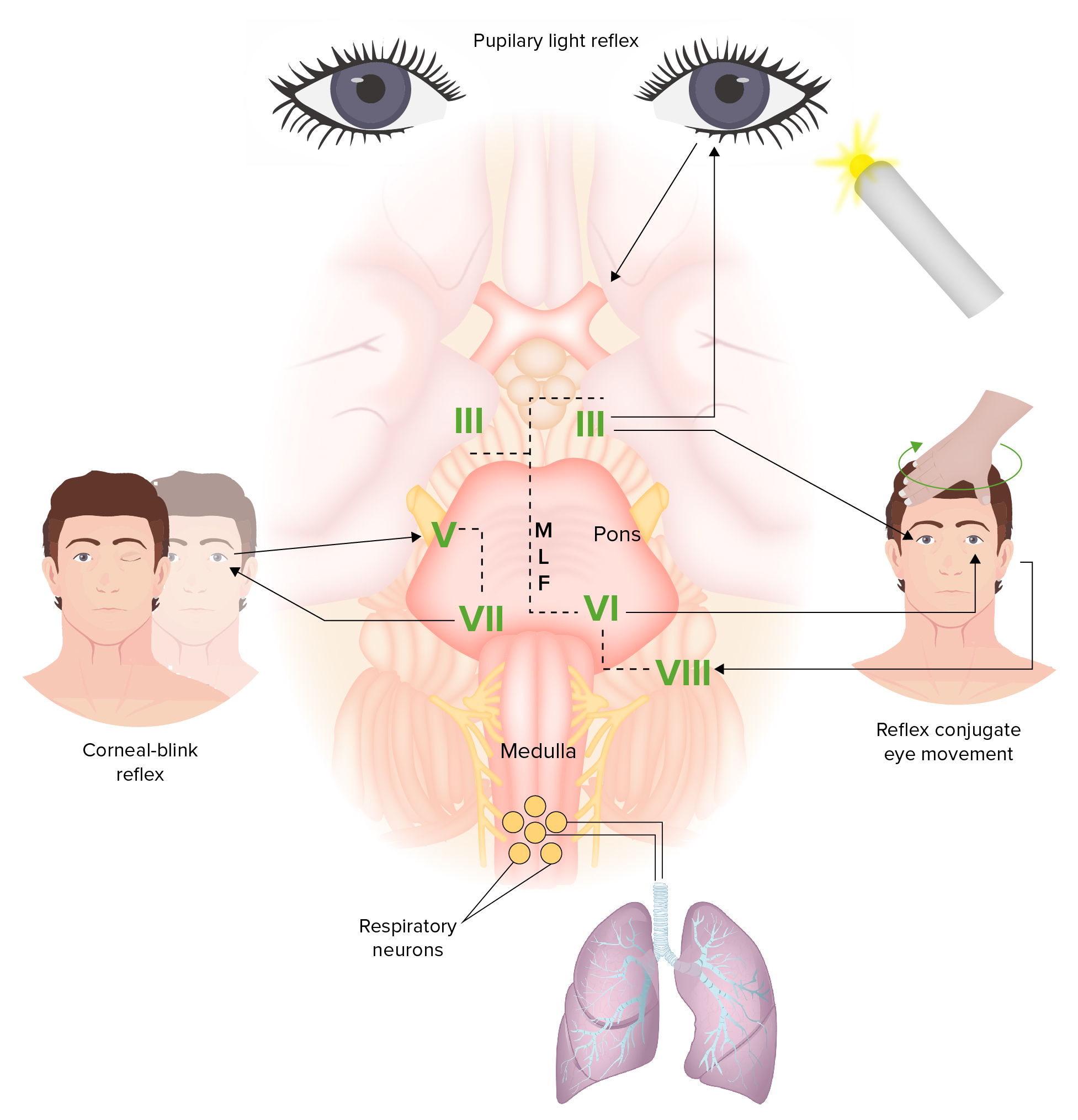
Examen de los reflejos cerebrales

Tronco cerebral y reflejos:
El tronco cerebral conecta las vías entre el cerebro y la médula espinal. Las funciones controladas por el tronco encefálico incluyen el ciclo sueño-vigilia, los reflejos del tronco encefálico y la regulación del ritmo cardíaco y la respiración. La rama aferente del reflejo luminoso pupilar es el nervio óptico (NC II); la rama eferente es el nervio oculomotor (NC III). El reflejo oculocefálico (reflejo del ojo de muñeca) implica la rotación de la cabeza, un movimiento detectado por el nervio vestibular (NC VIII). Las señales llegan al núcleo vestibular. La salida se envía al NC III, que inerva el recto medial, y al nervio abducens (NC VI), que inerva el recto lateral. La coordinación del movimiento ocular se realiza a través del fascículo longitudinal medial (FML), que tiene fibras que conectan el núcleo abducens con el núcleo oculomotor contralateral. Esta conexión es importante para realizar la mirada horizontal conjugada. El reflejo corneal es causado por un bucle a través del nervio trigémino sensorial (NC V) en la córnea, que se proyecta al núcleo facial, y el nervio facial (NC VII), que sale del núcleo facial e inerva el músculo orbicular.

Imagen por Lecturio.

Diagnóstico

El diagnóstico de coma Coma Coma is defined as a deep state of unarousable unresponsiveness, characterized by a score of 3 points on the GCS. A comatose state can be caused by a multitude of conditions, making the precise epidemiology and prognosis of coma difficult to determine. Coma es estrictamente clínico y se basa en EN Erythema nodosum is an immune-mediated panniculitis (inflammation of the subcutaneous fat) caused by a type IV (delayed-type) hypersensitivity reaction. It commonly manifests in young women as tender, erythematous nodules on the shins. Erythema Nodosum un examen neurológico completo. Se llevan a cabo investigaciones adicionales (imagenología y laboratorios) para determinar la etiología.

Laboratorios

Los LOS Neisseria estudios de laboratorio a solicitar dependen de la sospecha de la etiología subyacente. Algunos análisis de rutina incluyen:

  • Electrolitos
  • Hemograma
  • Análisis de gases en EN Erythema nodosum is an immune-mediated panniculitis (inflammation of the subcutaneous fat) caused by a type IV (delayed-type) hypersensitivity reaction. It commonly manifests in young women as tender, erythematous nodules on the shins. Erythema Nodosum sangre arterial o venosa
  • Estudios de toxicología
  • Análisis de LCR: evaluación urgente en EN Erythema nodosum is an immune-mediated panniculitis (inflammation of the subcutaneous fat) caused by a type IV (delayed-type) hypersensitivity reaction. It commonly manifests in young women as tender, erythematous nodules on the shins. Erythema Nodosum sospecha de infección

Neuroimagenología

TC/RM para evaluar:

  • Alteraciones de la perfusión cerebral
  • Aneurisma o hemorragia intracerebral
  • Edema Edema Edema is a condition in which excess serous fluid accumulates in the body cavity or interstitial space of connective tissues. Edema is a symptom observed in several medical conditions. It can be categorized into 2 types, namely, peripheral (in the extremities) and internal (in an organ or body cavity). Edema cerebral
  • Masa intracraneal

Tratamiento

Inicial (ABC)

  • Intubación de la vía aérea:
    • Los LOS Neisseria pacientes en EN Erythema nodosum is an immune-mediated panniculitis (inflammation of the subcutaneous fat) caused by a type IV (delayed-type) hypersensitivity reaction. It commonly manifests in young women as tender, erythematous nodules on the shins. Erythema Nodosum coma Coma Coma is defined as a deep state of unarousable unresponsiveness, characterized by a score of 3 points on the GCS. A comatose state can be caused by a multitude of conditions, making the precise epidemiology and prognosis of coma difficult to determine. Coma son incapaces de proteger su propia vía respiratoria.
    • Los LOS Neisseria pacientes traumatizados pueden tener una vía aérea comprometida.
  • Ventilación:
    • Incluso con una vía aérea establecida, los LOS Neisseria pacientes en EN Erythema nodosum is an immune-mediated panniculitis (inflammation of the subcutaneous fat) caused by a type IV (delayed-type) hypersensitivity reaction. It commonly manifests in young women as tender, erythematous nodules on the shins. Erythema Nodosum coma Coma Coma is defined as a deep state of unarousable unresponsiveness, characterized by a score of 3 points on the GCS. A comatose state can be caused by a multitude of conditions, making the precise epidemiology and prognosis of coma difficult to determine. Coma pueden tener insuficiencia respiratoria.
    • La saturación de oxígeno debe mantenerse > 90%.
    • Es posible que se requiera soporte ventilatorio mecánico.
  • Circulación:
    • Los LOS Neisseria pacientes en EN Erythema nodosum is an immune-mediated panniculitis (inflammation of the subcutaneous fat) caused by a type IV (delayed-type) hypersensitivity reaction. It commonly manifests in young women as tender, erythematous nodules on the shins. Erythema Nodosum coma Coma Coma is defined as a deep state of unarousable unresponsiveness, characterized by a score of 3 points on the GCS. A comatose state can be caused by a multitude of conditions, making the precise epidemiology and prognosis of coma difficult to determine. Coma pueden estar en EN Erythema nodosum is an immune-mediated panniculitis (inflammation of the subcutaneous fat) caused by a type IV (delayed-type) hypersensitivity reaction. It commonly manifests in young women as tender, erythematous nodules on the shins. Erythema Nodosum estado de shock Shock Shock is a life-threatening condition associated with impaired circulation that results in tissue hypoxia. The different types of shock are based on the underlying cause: distributive (↑ cardiac output (CO), ↓ systemic vascular resistance (SVR)), cardiogenic (↓ CO, ↑ SVR), hypovolemic (↓ CO, ↑ SVR), obstructive (↓ CO), and mixed. Types of Shock debido a una gran variedad etiologica:
      • Causas cardiogénicas
      • Septicemia
      • Hipovolemia
    • Debe establecerse un acceso vascular adecuado:
      • Intravenoso periférico
      • Catéter venoso central
      • Línea arterial
    • Puede requerirse soporte circulatorio químico y/o mecánico:
      • Protocolos de RCP/soporte vital cardíaco avanzado (ACLS, por sus siglas en EN Erythema nodosum is an immune-mediated panniculitis (inflammation of the subcutaneous fat) caused by a type IV (delayed-type) hypersensitivity reaction. It commonly manifests in young women as tender, erythematous nodules on the shins. Erythema Nodosum inglés)
      • Vasopresores químicos
      • Balón de aire intraaórtico

Tratamiento continuo

  • Ingreso en EN Erythema nodosum is an immune-mediated panniculitis (inflammation of the subcutaneous fat) caused by a type IV (delayed-type) hypersensitivity reaction. It commonly manifests in young women as tender, erythematous nodules on the shins. Erythema Nodosum la UCI
  • Monitoreo continuo
  • Cuidados de soporte
  • Tratamiento dirigido a la etiología subyacente:
    • Por ejemplo, se debe considerar la naloxona en EN Erythema nodosum is an immune-mediated panniculitis (inflammation of the subcutaneous fat) caused by a type IV (delayed-type) hypersensitivity reaction. It commonly manifests in young women as tender, erythematous nodules on the shins. Erythema Nodosum casos de sobredosis por opioides.
    • Deben iniciarse antibióticos ante la sospecha de meningitis Meningitis Meningitis is inflammation of the meninges, the protective membranes of the brain, and spinal cord. The causes of meningitis are varied, with the most common being bacterial or viral infection. The classic presentation of meningitis is a triad of fever, altered mental status, and nuchal rigidity. Meningitis.

Recuperación

La recuperación se define como el regreso de la capacidad de seguir órdenes de manera convincente y consistente.

Complicaciones

  • Muerte cerebral: cese irreversible de todas las funciones del cerebro y del tronco encefálico (independientemente de la causa)
  • Estado vegetativo:
    • Estado de vigilia sin conciencia de sí mismo y del entorno.
    • Están presentes las respuestas de parpadeo, las respuestas motoras primitivas y los LOS Neisseria ciclos de sueño y vigilia.
  • Estado vegetativo persistente:
    • Estado vegetativo que dura > 3 meses en EN Erythema nodosum is an immune-mediated panniculitis (inflammation of the subcutaneous fat) caused by a type IV (delayed-type) hypersensitivity reaction. It commonly manifests in young women as tender, erythematous nodules on the shins. Erythema Nodosum caso de lesión cerebral no traumática, o > 12 meses después de una lesión cerebral traumática.
    • Anteriormente conocido como síndrome apálico (inconsciencia despierta) o muerte neocortical

Pronóstico

  • El estado de coma Coma Coma is defined as a deep state of unarousable unresponsiveness, characterized by a score of 3 points on the GCS. A comatose state can be caused by a multitude of conditions, making the precise epidemiology and prognosis of coma difficult to determine. Coma en EN Erythema nodosum is an immune-mediated panniculitis (inflammation of the subcutaneous fat) caused by a type IV (delayed-type) hypersensitivity reaction. It commonly manifests in young women as tender, erythematous nodules on the shins. Erythema Nodosum sí puede durar un período de tiempo indefinido.
  • Los LOS Neisseria resultados dependen de la etiología subyacente y la variabilidad entre los LOS Neisseria pacientes.
  • Los LOS Neisseria efectos de la lesión neuronal difusa pueden persistir por el resto de la vida del paciente.

Relevancia Clínica

Posibles etiologías subyacentes del coma Coma Coma is defined as a deep state of unarousable unresponsiveness, characterized by a score of 3 points on the GCS. A comatose state can be caused by a multitude of conditions, making the precise epidemiology and prognosis of coma difficult to determine. Coma

  • Pérdida del gasto cardíaco (e.g., embolia pulmonar masiva, arritmia cardíaca, infarto de miocardio masivo)
  • Accidente cerebrovascular (e.g., accidente cerebrovascular hemorrágico, accidente cerebrovascular isquémico)
  • Hipovolemia grave (e.g., hemorragia, sepsis Sepsis Systemic inflammatory response syndrome with a proven or suspected infectious etiology. When sepsis is associated with organ dysfunction distant from the site of infection, it is called severe sepsis. When sepsis is accompanied by hypotension despite adequate fluid infusion, it is called septic shock. Sepsis and Septic Shock)
  • Sobredosis o exposición tóxica (e.g., venenos, drogas, alcohol)
  • Trauma (e.g., caída, accidente automovilístico, electrocución)

Diagnóstico diferencial del coma Coma Coma is defined as a deep state of unarousable unresponsiveness, characterized by a score of 3 points on the GCS. A comatose state can be caused by a multitude of conditions, making the precise epidemiology and prognosis of coma difficult to determine. Coma

  • Síndrome de enclaustramiento: afeencción neurológica caracterizada por tetraplejía y parálisis bulbar como consecuencia de una lesión en EN Erythema nodosum is an immune-mediated panniculitis (inflammation of the subcutaneous fat) caused by a type IV (delayed-type) hypersensitivity reaction. It commonly manifests in young women as tender, erythematous nodules on the shins. Erythema Nodosum el tronco encefálico. La conciencia está presenta, así como parpadeo involuntario y movimientos oculares verticales.
  • Mutismo acinético: afección rara caracterizada por un movimiento corporal patológicamente lento o inexistente (acinesia) y pérdida del habla (mutismo) en EN Erythema nodosum is an immune-mediated panniculitis (inflammation of the subcutaneous fat) caused by a type IV (delayed-type) hypersensitivity reaction. It commonly manifests in young women as tender, erythematous nodules on the shins. Erythema Nodosum una persona despierta. La afección se deriva de una lesión en EN Erythema nodosum is an immune-mediated panniculitis (inflammation of the subcutaneous fat) caused by a type IV (delayed-type) hypersensitivity reaction. It commonly manifests in young women as tender, erythematous nodules on the shins. Erythema Nodosum las áreas premotoras o prefrontales.
  • Falta de respuesta psicógena: también llamado coma Coma Coma is defined as a deep state of unarousable unresponsiveness, characterized by a score of 3 points on the GCS. A comatose state can be caused by a multitude of conditions, making the precise epidemiology and prognosis of coma difficult to determine. Coma psicógeno. La falta de respuesta psicógena es la falta total de respuesta a estímulos externos, derivada de una etiología psiquiátrica sin causa orgánica.
  • Parálisis neuromuscular: caracterizada por debilidad neuromuscular de inicio agudo que progresa a parálisis durante días o semanas (< 1 mes). La afectación de los LOS Neisseria músculos respiratorios y el bulbo es variable Variable Variables represent information about something that can change. The design of the measurement scales, or of the methods for obtaining information, will determine the data gathered and the characteristics of that data. As a result, a variable can be qualitative or quantitative, and may be further classified into subgroups. Types of Variables.
  • Síncope: pérdida breve de la conciencia seguida de un retorno inmediato al AL Amyloidosis estado total de alerta.

Referencias

  1. Huff JS, Tadi P. (2021). Coma. StatPearls. http://www.ncbi.nlm.nih.gov/books/NBK430722/ 
  2. Josephson S, Ropper AH, Hauser SL (2018). Coma. IN: Jameson J, Fauci AS, Kasper DL, Hauser SL, Longo DL, Loscalzo J (Eds.), Harrison’s Principles of Internal Medicine, 20th ed. McGraw-Hill. https://accessmedicine-mhmedical-com.ezproxy.unbosque.edu.co/content.aspx?bookid=2129&sectionid=192032318 
  3. Young GB. (2021). Stupor and coma in adults. UpToDate. Retrieved June 20, 2021, from https://www.uptodate.com/contents/stupor-and-coma-in-adults
  4. Young, G. B. (2025). Stupor and coma in adults. In M. J. Aminoff (Ed.), UpToDate. Wolters Kluwer. Retrieved June 3, 2025, from https://www.uptodate.com/contents/stupor-and-coma-in-adults
  5. Ropper A.H., Samuels M.A., Klein J.P., & Prasad S. (Eds.), (2019). Coma and related disorders of consciousness. Adams and Victor’s Principles of Neurology, 11e. McGraw Hill. https://accessmedicine.mhmedical.com/content.aspx?bookid=1477&sectionid=117186166
  6. Weinhouse G., Young G. (2022). Hypoxic-ischemic brain injury in adults: Evaluation and prognosis. UpToDate. Retrieved Mar 24, 2022 from https://www.uptodate.com/contents/hypoxic-ischemic-brain-injury-in-adults-evaluation-and-prognosis

¡Crea tu cuenta gratis o inicia una sesión para seguir leyendo!

Regístrate ahora y obtén acceso gratuito a Lecturio con páginas de concepto, videos médicos y cuestionarios para tu educación médica.

User Reviews

Que tengas una sesión de estudio alegre y navideña 🎁 Ahorra 50% en todos los planes >>

Details