Domina Conceptos Médicos

Estudia para la escuela de medicina y tus examenes con Lecturio.

Coartación de la Aorta

La coartación de la aorta Aorta The main trunk of the systemic arteries. Mediastinum and Great Vessels: Anatomy es un estrechamiento de la aorta Aorta The main trunk of the systemic arteries. Mediastinum and Great Vessels: Anatomy entre el arco aórtico y la bifurcación ilíaca, normalmente alrededor del punto de inserción del conducto arterioso. La coartación de la aorta Aorta The main trunk of the systemic arteries. Mediastinum and Great Vessels: Anatomy es típicamente congénita y la presentación clínica depende de la edad del paciente. Los LOS Neisseria neonatos presentan insuficiencia cardíaca al AL Amyloidosis cerrarse el conducto arterioso, mientras que los LOS Neisseria niños y los LOS Neisseria adultos presentan hipoperfusión y/o hipertensión. Los LOS Neisseria hallazgos clásicos en EN Erythema nodosum is an immune-mediated panniculitis (inflammation of the subcutaneous fat) caused by a type IV (delayed-type) hypersensitivity reaction. It commonly manifests in young women as tender, erythematous nodules on the shins. Erythema Nodosum la exploración física son el retraso radio/braquiofemoral y la disminución de la presión arterial en EN Erythema nodosum is an immune-mediated panniculitis (inflammation of the subcutaneous fat) caused by a type IV (delayed-type) hypersensitivity reaction. It commonly manifests in young women as tender, erythematous nodules on the shins. Erythema Nodosum las extremidades inferiores. El diagnóstico se confirma con un ecocardiograma. Los LOS Neisseria pacientes deben ser tratados quirúrgicamente lo antes posible para evitar las complicaciones de la hipertensión. Se requiere un seguimiento estrecho, ya que el riesgo de hipertensión y recoartación se mantiene.

Last updated: Dec 15, 2025

Editorial responsibility: Stanley Oiseth, Lindsay Jones, Evelin Maza

Descripción General

Definición

La coartación de la aorta Aorta The main trunk of the systemic arteries. Mediastinum and Great Vessels: Anatomy es un estrechamiento de la aorta Aorta The main trunk of the systemic arteries. Mediastinum and Great Vessels: Anatomy causado por el engrosamiento de la capa media en EN Erythema nodosum is an immune-mediated panniculitis (inflammation of the subcutaneous fat) caused by a type IV (delayed-type) hypersensitivity reaction. It commonly manifests in young women as tender, erythematous nodules on the shins. Erythema Nodosum un punto localizado, más comúnmente cerca de la inserción del conducto arterioso.
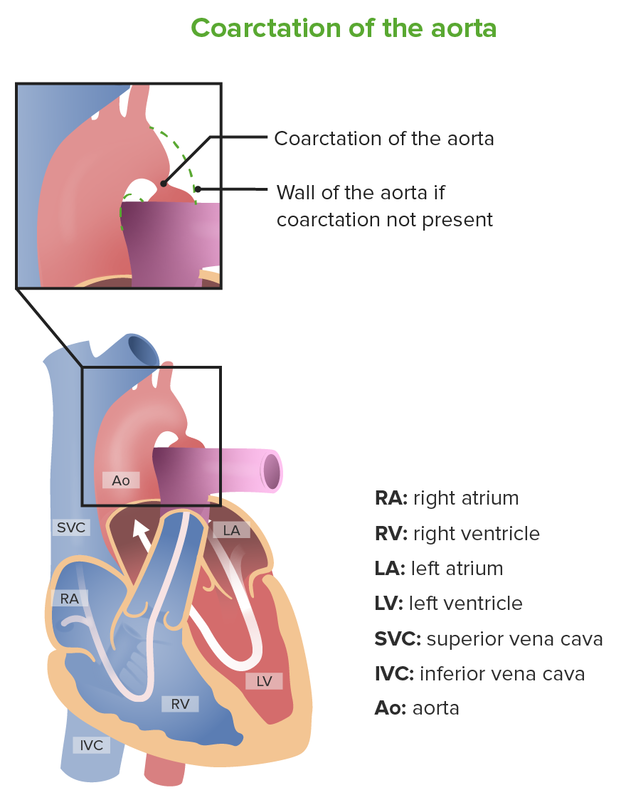
Coartación de la aorta

Representación esquemática de la coartación de la aorta

Imagen por Lecturio.
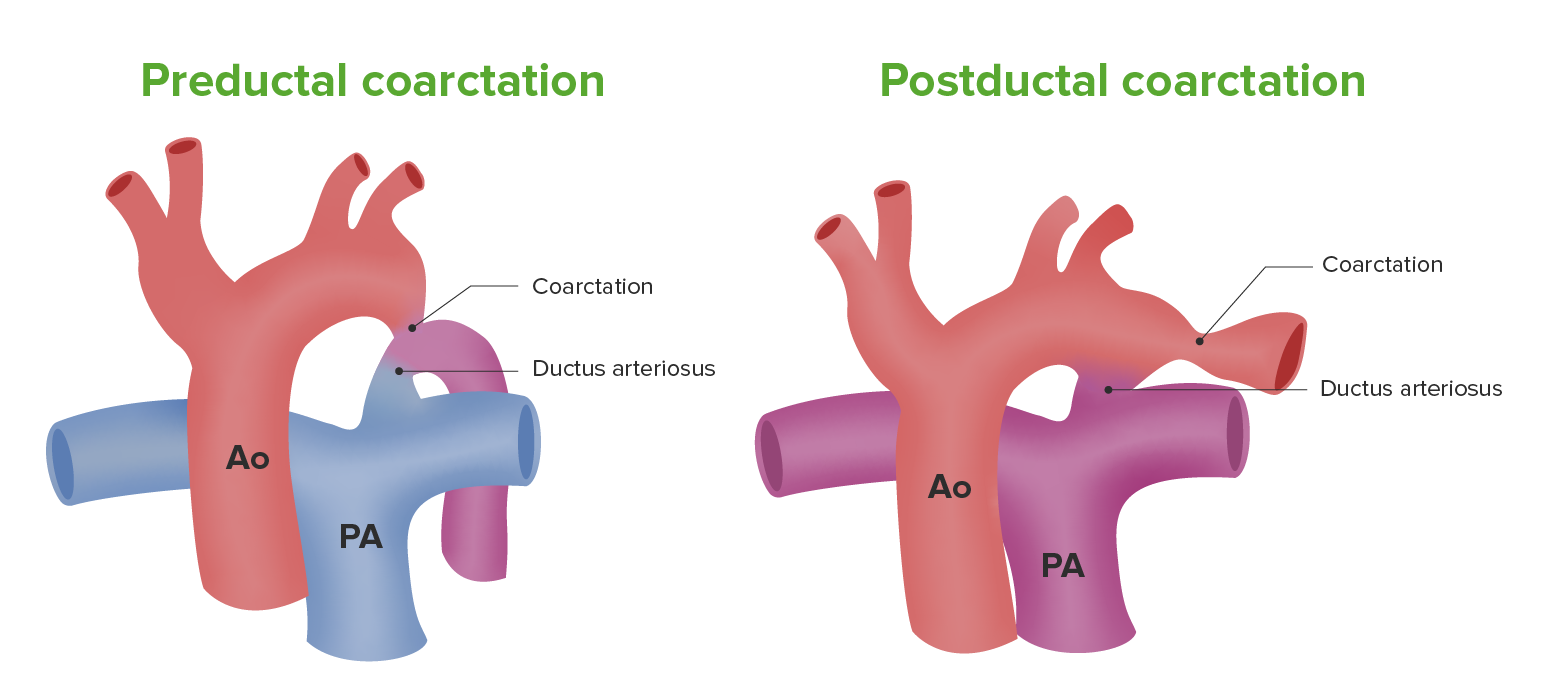
Tipos

  • Preductal: El estrechamiento se localiza proximal al AL Amyloidosis conducto arterioso.
  • Postductal: El estrechamiento se localiza distal al AL Amyloidosis conducto arterioso.
Ilustración coartación de la aorta

Tipos de coartación de aorta

Imagen por Lecturio.
Epidemiología

  • Incidencia en EN Erythema nodosum is an immune-mediated panniculitis (inflammation of the subcutaneous fat) caused by a type IV (delayed-type) hypersensitivity reaction. It commonly manifests in young women as tender, erythematous nodules on the shins. Erythema Nodosum Estados Unidos: 4 por cada 10 000 nacidos vivos
  • Representa aproximadamente el 6% de todas las cardiopatías congénitas
  • Más común en EN Erythema nodosum is an immune-mediated panniculitis (inflammation of the subcutaneous fat) caused by a type IV (delayed-type) hypersensitivity reaction. It commonly manifests in young women as tender, erythematous nodules on the shins. Erythema Nodosum los LOS Neisseria niños (proporción de 2:1 entre hombres:mujeres)
  • Condiciones asociadas:
    • Hasta el 15% de las niñas con coartación de aorta Aorta The main trunk of the systemic arteries. Mediastinum and Great Vessels: Anatomy tienen el síndrome de Turner.
    • Acompañado de una válvula aórtica bicúspide en EN Erythema nodosum is an immune-mediated panniculitis (inflammation of the subcutaneous fat) caused by a type IV (delayed-type) hypersensitivity reaction. It commonly manifests in young women as tender, erythematous nodules on the shins. Erythema Nodosum más del 70% de los LOS Neisseria casos

Etiología y Fisiopatología

Etiología

  • Congénita:
    • La mayoría de los LOS Neisseria casos
    • Causada por factores intrauterinos o predisposición genética que alteran el desarrollo endotelial y la elasticidad de la aorta Aorta The main trunk of the systemic arteries. Mediastinum and Great Vessels: Anatomy
    • 2 teorías de desarrollo aceptadas:
  • Adquirida: Esta forma puede verse en EN Erythema nodosum is an immune-mediated panniculitis (inflammation of the subcutaneous fat) caused by a type IV (delayed-type) hypersensitivity reaction. It commonly manifests in young women as tender, erythematous nodules on the shins. Erythema Nodosum pacientes adultos con aortitis Aortitis Inflammation of the wall of the aorta. Ankylosing Spondylitis secundaria a la arteritis de Takayasu.

Fisiopatología

  • En EN Erythema nodosum is an immune-mediated panniculitis (inflammation of the subcutaneous fat) caused by a type IV (delayed-type) hypersensitivity reaction. It commonly manifests in young women as tender, erythematous nodules on the shins. Erythema Nodosum el útero y en EN Erythema nodosum is an immune-mediated panniculitis (inflammation of the subcutaneous fat) caused by a type IV (delayed-type) hypersensitivity reaction. It commonly manifests in young women as tender, erythematous nodules on the shins. Erythema Nodosum los LOS Neisseria neonatos, la presencia del foramen oval y el conducto arterioso proporcionan una derivación aórtica fisiológica.
  • La insuficiencia cardíaca comienza a desarrollarse cuando las estructuras se cierran tras el nacimiento y el neonato empieza a depender de la aorta Aorta The main trunk of the systemic arteries. Mediastinum and Great Vessels: Anatomy para la circulación sistémica.
  • El estrechamiento de la aorta Aorta The main trunk of the systemic arteries. Mediastinum and Great Vessels: Anatomy provoca un aumento de la poscarga que incrementa la presión sistólica en EN Erythema nodosum is an immune-mediated panniculitis (inflammation of the subcutaneous fat) caused by a type IV (delayed-type) hypersensitivity reaction. It commonly manifests in young women as tender, erythematous nodules on the shins. Erythema Nodosum el ventrículo izquierdo y la aorta Aorta The main trunk of the systemic arteries. Mediastinum and Great Vessels: Anatomy proximal.
  • En EN Erythema nodosum is an immune-mediated panniculitis (inflammation of the subcutaneous fat) caused by a type IV (delayed-type) hypersensitivity reaction. It commonly manifests in young women as tender, erythematous nodules on the shins. Erythema Nodosum cambio, hay hipoperfusión de los LOS Neisseria tejidos distales al AL Amyloidosis estrechamiento.
  • Para compensar, el ventrículo izquierdo sufre una hipertrofia para mantener la fracción de eyección.
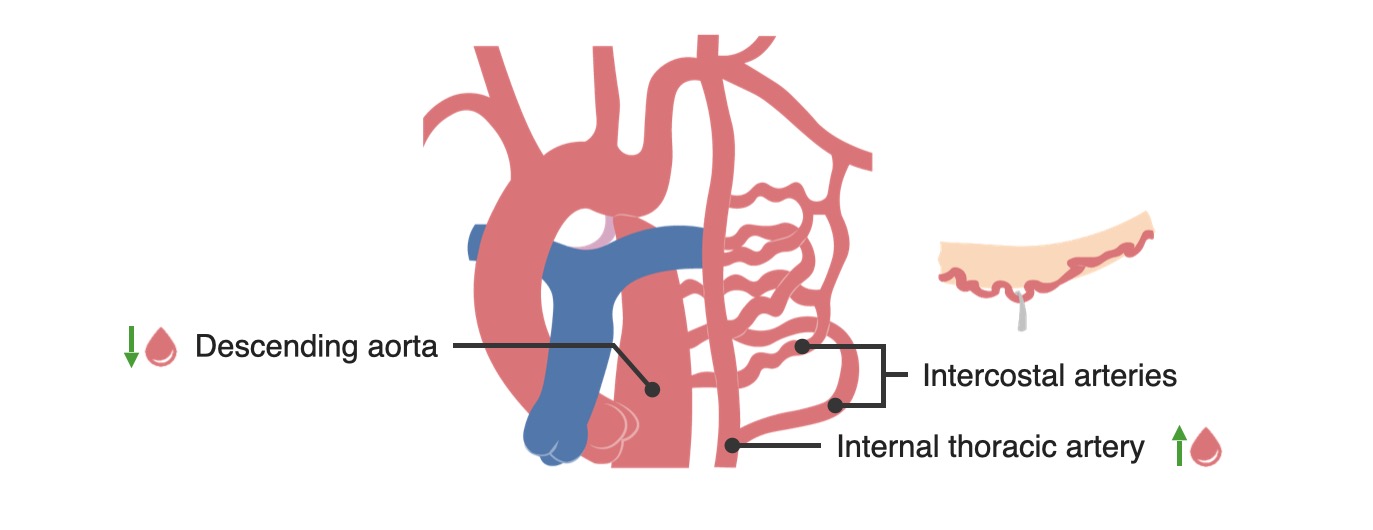
  • Para evitar el estrechamiento, se desarrolla un flujo sanguíneo colateral a través de las arterias intercostales inferiores, mamarias internas y escapulares.
Circulación colateral en la coartación de aorta

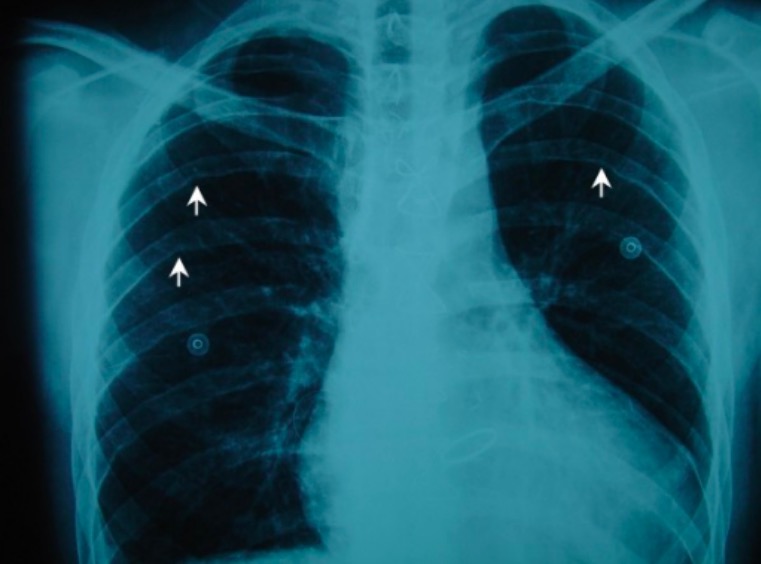
La circulación colateral compuesta por los vasos intercostales inferiores se desarrolla para sortear la coartación, lo que da lugar a una muescas en las costillas.

Imagen por Lecturio.

Presentación Clínica

Neonatos

  • Asintomático mientras haya un conducto arterioso persistente (CAP)
  • Cuando el conducto arterioso se cierra, el paciente presenta signos de insuficiencia cardíaca (cianosis, disnea, diaforesis, shock Shock Shock is a life-threatening condition associated with impaired circulation that results in tissue hypoxia. The different types of shock are based on the underlying cause: distributive (↑ cardiac output (CO), ↓ systemic vascular resistance (SVR)), cardiogenic (↓ CO, ↑ SVR), hypovolemic (↓ CO, ↑ SVR), obstructive (↓ CO), and mixed. Types of Shock).
  • En EN Erythema nodosum is an immune-mediated panniculitis (inflammation of the subcutaneous fat) caused by a type IV (delayed-type) hypersensitivity reaction. It commonly manifests in young women as tender, erythematous nodules on the shins. Erythema Nodosum el examen físico:
    • Retraso o ausencia de pulsos femorales
    • Extremidades inferiores cianóticas y/o frías
    • Soplo sistólico de eyección en EN Erythema nodosum is an immune-mediated panniculitis (inflammation of the subcutaneous fat) caused by a type IV (delayed-type) hypersensitivity reaction. It commonly manifests in young women as tender, erythematous nodules on the shins. Erythema Nodosum el borde esternal izquierdo debido a una válvula aórtica bicúspide subyacente
    • Soplo continuo de tipo maquinal de localización infraclavicular debido al AL Amyloidosis conducto arterioso persistente o a la circulación colateral

Niños

  • Desmayo o casi desmayo
  • Claudicación, debilidad o dolor Dolor Inflammation torácico de esfuerzo
  • Fallo en EN Erythema nodosum is an immune-mediated panniculitis (inflammation of the subcutaneous fat) caused by a type IV (delayed-type) hypersensitivity reaction. It commonly manifests in young women as tender, erythematous nodules on the shins. Erythema Nodosum el desarrollo
  • En EN Erythema nodosum is an immune-mediated panniculitis (inflammation of the subcutaneous fat) caused by a type IV (delayed-type) hypersensitivity reaction. It commonly manifests in young women as tender, erythematous nodules on the shins. Erythema Nodosum el examen físico:
    • Retraso radiofemoral/retraso braquiofemoral: Los LOS Neisseria pulsos femorales se retrasan en EN Erythema nodosum is an immune-mediated panniculitis (inflammation of the subcutaneous fat) caused by a type IV (delayed-type) hypersensitivity reaction. It commonly manifests in young women as tender, erythematous nodules on the shins. Erythema Nodosum comparación con los LOS Neisseria pulsos radiales o braquiales.
    • Mayor presión arterial en EN Erythema nodosum is an immune-mediated panniculitis (inflammation of the subcutaneous fat) caused by a type IV (delayed-type) hypersensitivity reaction. It commonly manifests in young women as tender, erythematous nodules on the shins. Erythema Nodosum las extremidades superiores frente a las inferiores (diferencia de > 20 mm Hg)
    • Presencia de soplo continuo debido a la circulación colateral
    • Presencia de un soplo sistólico de eyección debido a una válvula aórtica bicúspide

Adultos

  • Hipertensión
  • Accidente cerebrovascular secundario a un aneurisma intracraneal
  • Pulsos débiles de las extremidades inferiores
  • Mayor presión arterial en EN Erythema nodosum is an immune-mediated panniculitis (inflammation of the subcutaneous fat) caused by a type IV (delayed-type) hypersensitivity reaction. It commonly manifests in young women as tender, erythematous nodules on the shins. Erythema Nodosum las extremidades superiores frente a las inferiores (diferencia de > 20 mm Hg)

Diagnóstico

Prueba diagnóstica de elección: ecocardiograma

Hallazgos:

  • Estrechamiento del lumen
  • Cualquier lesión cardíaca adicional (e.g., válvula aórtica bicúspide)
  • Doppler Doppler Ultrasonography applying the doppler effect, with frequency-shifted ultrasound reflections produced by moving targets (usually red blood cells) in the bloodstream along the ultrasound axis in direct proportion to the velocity of movement of the targets, to determine both direction and velocity of blood flow. Ultrasound (Sonography): aumento de la velocidad y la turbulencia del flujo sanguíneo a través del estrechamiento

Estudio de apoyo no invasivo

  • Radiografía de tórax:
    • Neonatos: cardiomegalia con congestión pulmonar
    • Niños mayores:
      • Signo del 3: formado por la indentación en EN Erythema nodosum is an immune-mediated panniculitis (inflammation of the subcutaneous fat) caused by a type IV (delayed-type) hypersensitivity reaction. It commonly manifests in young women as tender, erythematous nodules on the shins. Erythema Nodosum el punto de coartación a lo largo de la aorta Aorta The main trunk of the systemic arteries. Mediastinum and Great Vessels: Anatomy dilatada
      • Muesca costal: erosión de la superficie inferior de las costillas debido al AL Amyloidosis aumento del flujo sanguíneo a través de las arterias intercostales colaterales
  • El ECG ECG An electrocardiogram (ECG) is a graphic representation of the electrical activity of the heart plotted against time. Adhesive electrodes are affixed to the skin surface allowing measurement of cardiac impulses from many angles. The ECG provides 3-dimensional information about the conduction system of the heart, the myocardium, and other cardiac structures. Electrocardiogram (ECG) muestra hipertrofia del ventrículo izquierdo.
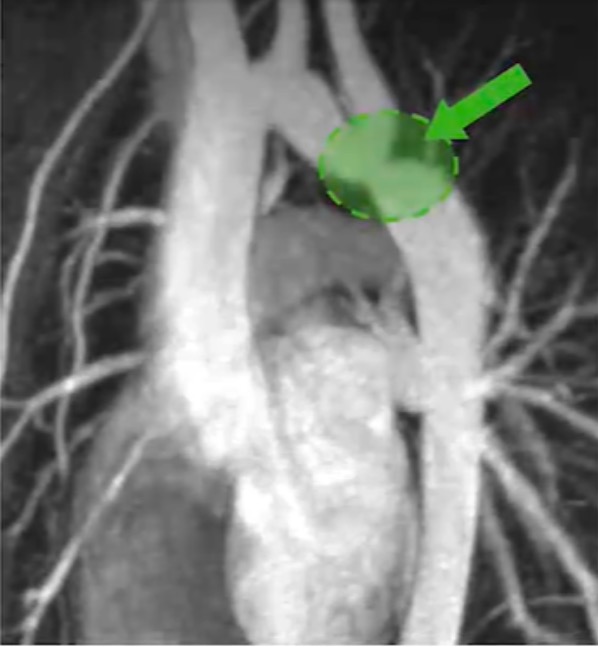
  • La TC y RM pueden ser útiles cuando los LOS Neisseria resultados del ecocardiograma son deficientes o poco claros.

Tamizaje de comorbilidades

  • Pruebas genéticas para mujeres sospechosas de padecer el síndrome de Turner
  • En EN Erythema nodosum is an immune-mediated panniculitis (inflammation of the subcutaneous fat) caused by a type IV (delayed-type) hypersensitivity reaction. It commonly manifests in young women as tender, erythematous nodules on the shins. Erythema Nodosum adultos, angiografía por TC para detectar aneurismas intracraneales, aneurismas aórticos abdominales y cambios ateroscleróticos en EN Erythema nodosum is an immune-mediated panniculitis (inflammation of the subcutaneous fat) caused by a type IV (delayed-type) hypersensitivity reaction. It commonly manifests in young women as tender, erythematous nodules on the shins. Erythema Nodosum las arterias coronarias

Tratamiento y Complicaciones

Tratamiento

Neonatos:

  • Prostaglandina E1 E1 An aromatized C18 steroid with a 3-hydroxyl group and a 17-ketone, a major mammalian estrogen. It is converted from androstenedione directly, or from testosterone via estradiol. In humans, it is produced primarily by the cyclic ovaries, placenta, and the adipose tissue of men and postmenopausal women. Noncontraceptive Estrogen and Progestins intravenosa para mantener el conducto arterioso abierto
  • Tratamiento quirúrgico de los LOS Neisseria pacientes dependientes del CAP

Niños y adultos:

  • El tratamiento quirúrgico está indicado en EN Erythema nodosum is an immune-mediated panniculitis (inflammation of the subcutaneous fat) caused by a type IV (delayed-type) hypersensitivity reaction. It commonly manifests in young women as tender, erythematous nodules on the shins. Erythema Nodosum el caso de:
    • Insuficiencia cardíaca
    • > 20 mm Hg de gradiente a través de la coartación
    • Presencia de flujo sanguíneo colateral
  • Los LOS Neisseria procedimientos terapéuticos incluyen resección quirúrgica con anastomosis término-terminal, angioplastia con balón (con o sin colocación de stent) o aortoplastia con parche.

Complicaciones

Tras la reparación quirúrgica pueden surgir algunas complicaciones a largo plazo:

  • Hipertensión de rebote:
    • Más común en EN Erythema nodosum is an immune-mediated panniculitis (inflammation of the subcutaneous fat) caused by a type IV (delayed-type) hypersensitivity reaction. It commonly manifests in young women as tender, erythematous nodules on the shins. Erythema Nodosum adultos
    • Hay que descartar la recoartación.
    • La hipertensión debe ser tratada médicamente para reducir el riesgo de enfermedad coronaria o cerebrovascular.
  • Re-coartación:
    • Más comúnmente visto en EN Erythema nodosum is an immune-mediated panniculitis (inflammation of the subcutaneous fat) caused by a type IV (delayed-type) hypersensitivity reaction. It commonly manifests in young women as tender, erythematous nodules on the shins. Erythema Nodosum neonatos y niños
    • Debido a un crecimiento inadecuado de las paredes
    • Debe sospecharse en EN Erythema nodosum is an immune-mediated panniculitis (inflammation of the subcutaneous fat) caused by a type IV (delayed-type) hypersensitivity reaction. It commonly manifests in young women as tender, erythematous nodules on the shins. Erythema Nodosum los LOS Neisseria casos en EN Erythema nodosum is an immune-mediated panniculitis (inflammation of the subcutaneous fat) caused by a type IV (delayed-type) hypersensitivity reaction. It commonly manifests in young women as tender, erythematous nodules on the shins. Erythema Nodosum que los LOS Neisseria síntomas reaparecen
  • Aneurisma y disección de la aorta Aorta The main trunk of the systemic arteries. Mediastinum and Great Vessels: Anatomy: principalmente en EN Erythema nodosum is an immune-mediated panniculitis (inflammation of the subcutaneous fat) caused by a type IV (delayed-type) hypersensitivity reaction. It commonly manifests in young women as tender, erythematous nodules on the shins. Erythema Nodosum adultos en EN Erythema nodosum is an immune-mediated panniculitis (inflammation of the subcutaneous fat) caused by a type IV (delayed-type) hypersensitivity reaction. It commonly manifests in young women as tender, erythematous nodules on the shins. Erythema Nodosum el lugar de la reparación

Seguimiento postoperatorio: Se requieren una consulta anual e imagenología, como en EN Erythema nodosum is an immune-mediated panniculitis (inflammation of the subcutaneous fat) caused by a type IV (delayed-type) hypersensitivity reaction. It commonly manifests in young women as tender, erythematous nodules on the shins. Erythema Nodosum el caso de ecocardiograma, para detectar complicaciones.

Pronóstico

  • Cuando se detecta en EN Erythema nodosum is an immune-mediated panniculitis (inflammation of the subcutaneous fat) caused by a type IV (delayed-type) hypersensitivity reaction. It commonly manifests in young women as tender, erythematous nodules on the shins. Erythema Nodosum la infancia y no se trata, la muerte se produce a los LOS Neisseria 20–40 años debido a complicaciones hipertensivas como la enfermedad coronaria o el accidente cerebrovascular.
  • Si la cirugía se realiza antes de los LOS Neisseria 20 años, la estimación de supervivencia a 10 años después de la reparación es del 90%.
  • Los LOS Neisseria pacientes pueden reanudar todas las formas de ejercicio en EN Erythema nodosum is an immune-mediated panniculitis (inflammation of the subcutaneous fat) caused by a type IV (delayed-type) hypersensitivity reaction. It commonly manifests in young women as tender, erythematous nodules on the shins. Erythema Nodosum el plazo de un año tras la reparación sin complicaciones.

Diagnóstico Diferencial

El diagnóstico diferencial de la coartación de aorta Aorta The main trunk of the systemic arteries. Mediastinum and Great Vessels: Anatomy debe considerarse en EN Erythema nodosum is an immune-mediated panniculitis (inflammation of the subcutaneous fat) caused by a type IV (delayed-type) hypersensitivity reaction. It commonly manifests in young women as tender, erythematous nodules on the shins. Erythema Nodosum función del grupo de edad de los LOS Neisseria pacientes.

Neonatos

Dado que los LOS Neisseria pacientes se presentan en EN Erythema nodosum is an immune-mediated panniculitis (inflammation of the subcutaneous fat) caused by a type IV (delayed-type) hypersensitivity reaction. It commonly manifests in young women as tender, erythematous nodules on the shins. Erythema Nodosum estado de shock Shock Shock is a life-threatening condition associated with impaired circulation that results in tissue hypoxia. The different types of shock are based on the underlying cause: distributive (↑ cardiac output (CO), ↓ systemic vascular resistance (SVR)), cardiogenic (↓ CO, ↑ SVR), hypovolemic (↓ CO, ↑ SVR), obstructive (↓ CO), and mixed. Types of Shock, deben descartarse otras causas como el shock Shock Shock is a life-threatening condition associated with impaired circulation that results in tissue hypoxia. The different types of shock are based on the underlying cause: distributive (↑ cardiac output (CO), ↓ systemic vascular resistance (SVR)), cardiogenic (↓ CO, ↑ SVR), hypovolemic (↓ CO, ↑ SVR), obstructive (↓ CO), and mixed. Types of Shock séptico o el shock Shock Shock is a life-threatening condition associated with impaired circulation that results in tissue hypoxia. The different types of shock are based on the underlying cause: distributive (↑ cardiac output (CO), ↓ systemic vascular resistance (SVR)), cardiogenic (↓ CO, ↑ SVR), hypovolemic (↓ CO, ↑ SVR), obstructive (↓ CO), and mixed. Types of Shock hipovolémico.

  • Shock Shock Shock is a life-threatening condition associated with impaired circulation that results in tissue hypoxia. The different types of shock are based on the underlying cause: distributive (↑ cardiac output (CO), ↓ systemic vascular resistance (SVR)), cardiogenic (↓ CO, ↑ SVR), hypovolemic (↓ CO, ↑ SVR), obstructive (↓ CO), and mixed. Types of Shock séptico: disfunción orgánica resultante de una respuesta sistémica desregulada del huésped a la infección. La etiología es principalmente bacteriana; la neumonía es el origen más conocido. La presentación incluye fiebre, taquicardia, taquipnea, hipotensión y/o alteraciones mentales. El diagnóstico se confirma durante el tratamiento cuando los LOS Neisseria vasopresores son necesarios para controlar la hipotensión.
  • Shock Shock Shock is a life-threatening condition associated with impaired circulation that results in tissue hypoxia. The different types of shock are based on the underlying cause: distributive (↑ cardiac output (CO), ↓ systemic vascular resistance (SVR)), cardiogenic (↓ CO, ↑ SVR), hypovolemic (↓ CO, ↑ SVR), obstructive (↓ CO), and mixed. Types of Shock hipovolémico: estado de disfunción orgánica que pone en EN Erythema nodosum is an immune-mediated panniculitis (inflammation of the subcutaneous fat) caused by a type IV (delayed-type) hypersensitivity reaction. It commonly manifests in young women as tender, erythematous nodules on the shins. Erythema Nodosum peligro la vida del paciente y que es consecuencia de la disminución del gasto cardíaco debido a la reducción de la precarga, secundaria a una hemorragia, pérdidas gastrointestinales, quemaduras o poliuria. La presentación incluye taquicardia, taquipnea, hipotensión, disminución del tiempo de llenado capilar y piel fría y húmeda en EN Erythema nodosum is an immune-mediated panniculitis (inflammation of the subcutaneous fat) caused by a type IV (delayed-type) hypersensitivity reaction. It commonly manifests in young women as tender, erythematous nodules on the shins. Erythema Nodosum el caso de shock Shock Shock is a life-threatening condition associated with impaired circulation that results in tissue hypoxia. The different types of shock are based on the underlying cause: distributive (↑ cardiac output (CO), ↓ systemic vascular resistance (SVR)), cardiogenic (↓ CO, ↑ SVR), hypovolemic (↓ CO, ↑ SVR), obstructive (↓ CO), and mixed. Types of Shock compensado. El tratamiento se basa en EN Erythema nodosum is an immune-mediated panniculitis (inflammation of the subcutaneous fat) caused by a type IV (delayed-type) hypersensitivity reaction. It commonly manifests in young women as tender, erythematous nodules on the shins. Erythema Nodosum la reanimación por volumen.

Niños

Si se diagnostica una coartación en EN Erythema nodosum is an immune-mediated panniculitis (inflammation of the subcutaneous fat) caused by a type IV (delayed-type) hypersensitivity reaction. It commonly manifests in young women as tender, erythematous nodules on the shins. Erythema Nodosum una niña, debe realizarse un cariotipo para el síndrome de Turner, ya que representa el 15% de los LOS Neisseria casos.

Síndrome de Turner: condición genética en EN Erythema nodosum is an immune-mediated panniculitis (inflammation of the subcutaneous fat) caused by a type IV (delayed-type) hypersensitivity reaction. It commonly manifests in young women as tender, erythematous nodules on the shins. Erythema Nodosum la que falta parcial o totalmente un cromosoma X, lo que da lugar a un cariotipo 45,X0. La presentación incluye amenorrea primaria (característica de una mujer de baja estatura), cuello palmeado, pecho ancho y pezones muy espaciados. Las pruebas genéticas confirman el diagnóstico y el tratamiento se basa en EN Erythema nodosum is an immune-mediated panniculitis (inflammation of the subcutaneous fat) caused by a type IV (delayed-type) hypersensitivity reaction. It commonly manifests in young women as tender, erythematous nodules on the shins. Erythema Nodosum la sustitución hormonal.

Adultos

También puede observarse un retraso del pulso en EN Erythema nodosum is an immune-mediated panniculitis (inflammation of the subcutaneous fat) caused by a type IV (delayed-type) hypersensitivity reaction. It commonly manifests in young women as tender, erythematous nodules on the shins. Erythema Nodosum la enfermedad arterial periférica y en EN Erythema nodosum is an immune-mediated panniculitis (inflammation of the subcutaneous fat) caused by a type IV (delayed-type) hypersensitivity reaction. It commonly manifests in young women as tender, erythematous nodules on the shins. Erythema Nodosum la disección aórtica.

  • Enfermedad arterial periférica: obstrucción de la luz arterial que provoca una disminución del flujo sanguíneo hacia las extremidades distales, causada por la aterosclerosis o la trombosis. Los LOS Neisseria pacientes pueden ser asintomáticos, tener claudicación progresiva, decoloración de la piel, úlceras isquémicas o gangrena. El diagnóstico se confirma con la medición del índice tobillo-brazo y con imagenología para localizar y evaluar la enfermedad. El tratamiento varía en EN Erythema nodosum is an immune-mediated panniculitis (inflammation of the subcutaneous fat) caused by a type IV (delayed-type) hypersensitivity reaction. It commonly manifests in young women as tender, erythematous nodules on the shins. Erythema Nodosum función de la gravedad de la enfermedad.
  • Disección aórtica: un desgarro en EN Erythema nodosum is an immune-mediated panniculitis (inflammation of the subcutaneous fat) caused by a type IV (delayed-type) hypersensitivity reaction. It commonly manifests in young women as tender, erythematous nodules on the shins. Erythema Nodosum la túnica íntima de la pared aórtica que permite que la sangre fluya hacia los LOS Neisseria medios y cree un “falso lumen”. La disección de la aorta Aorta The main trunk of the systemic arteries. Mediastinum and Great Vessels: Anatomy es el resultado de un esfuerzo de cizallamiento de la presión pulsátil, secundario a una hipertensión no controlada. La presentación incluye dolor Dolor Inflammation torácico o lumbar agudo “desgarrador”. La tomografía computarizada es la modalidad diagnóstica de elección. Las disecciones de tipo A requieren cirugía, mientras que las de tipo B pueden tratarse médicamente con el control de los LOS Neisseria impulsos mediante betabloqueadores y bloqueadores de los LOS Neisseria canales de calcio.

Referencias

  1. Kliegman, R.M., St. Geme, J.W., Blum, N.J., Shah, S.S., Tasker, R.C., & Wilson, K.M. (2020). Acyanotic congenital heart disease: Obstructive lesions. Nelson textbook of pediatrics (pp. 238-2393.e1). https://www.clinicalkey.es/#!/content/3-s2.0-B9780323529501004545
  2. Eckhauser, A., South, S.T., Meyers, L., Bleyl, S.B., & Botto, L.D. (2015). Turner Syndrome in Girls Presenting with Coarctation of the Aorta. The Journal of pediatrics, 167(5), 1062–1066. DOI:10.1016/j.jpeds.2015.08.002
  3. Hijazi, Z.M. (2025). Clinical Manifestation and diagnosis of coarctation of the aorta. UpToDate. Retrieved April 23, 2025, from https://www.uptodate.com/contents/clinical-manifestations-and-diagnosis-of-coarctation-of-the-aorta
  4. Bacha, E., Hijazi, Z. M., Fulton, D. R., Connolly, H. M., Armsby, C., & Yeon, S. B. (2024). Management of coarctation of the aorta. UpToDate. Retrieved April 23, 2025, from https://www.uptodate.com/contents/management-of-coarctation-of-the-aorta

¡Crea tu cuenta gratis o inicia una sesión para seguir leyendo!

Regístrate ahora y obtén acceso gratuito a Lecturio con páginas de concepto, videos médicos y cuestionarios para tu educación médica.

User Reviews

Que tengas una sesión de estudio alegre y navideña 🎁 Ahorra 50% en todos los planes >>

Details