Domina Conceptos Médicos

Estudia para la escuela de medicina y tus examenes con Lecturio.

Ciclo Menstrual

El ciclo menstrual es el patrón cíclico de actividad hormonal y tisular que prepara un ambiente uterino adecuado para la fertilización de un óvulo e implantación de un embrión. El ciclo menstrual incluye un ciclo endometrial y ovárico que dependen el uno del otro para su correcto funcionamiento. Hay 2 fases del ciclo ovárico (folicular y lútea) y 3 fases del ciclo endometrial (descamación o menstruación, proliferativa y secretora). El ciclo menstrual está regulado por el eje hipotalámico-hipofisario-ovárico a través de la hormona foliculoestimulante ( FSH FSH A major gonadotropin secreted by the adenohypophysis. Follicle-stimulating hormone stimulates gametogenesis and the supporting cells such as the ovarian granulosa cells, the testicular sertoli cells, and leydig cells. Fsh consists of two noncovalently linked subunits, alpha and beta. Within a species, the alpha subunit is common in the three pituitary glycoprotein hormones (TSH, LH, and FSH), but the beta subunit is unique and confers its biological specificity. Menstrual Cycle, por sus siglas en EN Erythema nodosum is an immune-mediated panniculitis (inflammation of the subcutaneous fat) caused by a type IV (delayed-type) hypersensitivity reaction. It commonly manifests in young women as tender, erythematous nodules on the shins. Erythema Nodosum inglés) y la hormona luteinizante ( LH LH A major gonadotropin secreted by the adenohypophysis. Luteinizing hormone regulates steroid production by the interstitial cells of the testis and the ovary. The preovulatory luteinizing hormone surge in females induces ovulation, and subsequent luteinization of the follicle. Luteinizing hormone consists of two noncovalently linked subunits, alpha and beta. Within a species, the alpha subunit is common in the three pituitary glycoprotein hormones (TSH, LH, and FSH), but the beta subunit is unique and confers its biological specificity. Menstrual Cycle, por sus siglas en EN Erythema nodosum is an immune-mediated panniculitis (inflammation of the subcutaneous fat) caused by a type IV (delayed-type) hypersensitivity reaction. It commonly manifests in young women as tender, erythematous nodules on the shins. Erythema Nodosum inglés). El 1er ciclo menstrual de una mujer se conoce como menarca y los LOS Neisseria ciclos continúan hasta la menopausia.

Last updated: Dec 15, 2025

Editorial responsibility: Stanley Oiseth, Lindsay Jones, Evelin Maza

Descripción General

Terminología

  • Menarca: 1er período menstrual
  • Menstruación: el tiempo de menstruar
  • Perimenopausia: intervalo (meses a años) de irregularidades menstruales que conducen al AL Amyloidosis cese total de los LOS Neisseria ciclos
  • Menopausia: cese de la menstruación durante 12 meses o más

Fases

El ciclo menstrual se divide en EN Erythema nodosum is an immune-mediated panniculitis (inflammation of the subcutaneous fat) caused by a type IV (delayed-type) hypersensitivity reaction. It commonly manifests in young women as tender, erythematous nodules on the shins. Erythema Nodosum 2 componentes: ciclo ovárico y ciclo endometrial.

  • El ciclo menstrual promedio de un adulto es de 28–35 días.
  • La duración del ciclo “normal” se define como 24-38 días.
  • Los ciclos “regulares” son cuando la variación de la duración del ciclo es ≤ 7-9 días.
  • Los LOS Neisseria intervalos en EN Erythema nodosum is an immune-mediated panniculitis (inflammation of the subcutaneous fat) caused by a type IV (delayed-type) hypersensitivity reaction. It commonly manifests in young women as tender, erythematous nodules on the shins. Erythema Nodosum los LOS Neisseria ciclos suelen ser constantes hasta la perimenopausia, cuando las fases foliculares se vuelven más cortas y más frecuentes.

Fases del ciclo ovárico:

  • Fase folicular:
    • Representa el tiempo durante el cual el folículo y su ovocito se desarrolla, llevando a la ovulación
    • Se extiende desde el inicio de la menstruación (día 1) hasta el día anterior al AL Amyloidosis pico de la LH LH A major gonadotropin secreted by the adenohypophysis. Luteinizing hormone regulates steroid production by the interstitial cells of the testis and the ovary. The preovulatory luteinizing hormone surge in females induces ovulation, and subsequent luteinization of the follicle. Luteinizing hormone consists of two noncovalently linked subunits, alpha and beta. Within a species, the alpha subunit is common in the three pituitary glycoprotein hormones (TSH, LH, and FSH), but the beta subunit is unique and confers its biological specificity. Menstrual Cycle, que conduce a la ovulación
    • Duración: 14 a 21 días (puede ser más corto, especialmente en EN Erythema nodosum is an immune-mediated panniculitis (inflammation of the subcutaneous fat) caused by a type IV (delayed-type) hypersensitivity reaction. It commonly manifests in young women as tender, erythematous nodules on the shins. Erythema Nodosum la perimenopausia)
  • Fase lútea:
    • Es el momento después de la ovulación en EN Erythema nodosum is an immune-mediated panniculitis (inflammation of the subcutaneous fat) caused by a type IV (delayed-type) hypersensitivity reaction. It commonly manifests in young women as tender, erythematous nodules on the shins. Erythema Nodosum el que el ovario produce hormonas para favorecer un posible embarazo y mantener un endometrio sano.
    • Se extiende desde el día del pico de la LH LH A major gonadotropin secreted by the adenohypophysis. Luteinizing hormone regulates steroid production by the interstitial cells of the testis and the ovary. The preovulatory luteinizing hormone surge in females induces ovulation, and subsequent luteinization of the follicle. Luteinizing hormone consists of two noncovalently linked subunits, alpha and beta. Within a species, the alpha subunit is common in the three pituitary glycoprotein hormones (TSH, LH, and FSH), but the beta subunit is unique and confers its biological specificity. Menstrual Cycle hasta el inicio de la siguiente menstruación
    • Duración: 14 días

Fases del ciclo endometrial:

  • Descamación: desprendimiento del revestimiento endometrial (menstruación)
  • Fase proliferativa: proliferación endometrial con glándulas tubulares rectas
  • Fase secretora: maduración de las arterias espirales y las glándulas endometriales, preparando el endometiro para un posible embarazo

Regulación del Ciclo Menstrual

El ciclo menstrual está regulado por el eje hipotalámico-hipofisario-ovárico.

Hipotálamo:

  • Libera la hormona liberadora de gonadotropina (GnRH, por sus siglas en EN Erythema nodosum is an immune-mediated panniculitis (inflammation of the subcutaneous fat) caused by a type IV (delayed-type) hypersensitivity reaction. It commonly manifests in young women as tender, erythematous nodules on the shins. Erythema Nodosum inglés) → estimula las gonadotropinas de la hipófisis anterior
  • Secretada por las neuronas preópticas del hipotálamo de forma pulsátil
  • Se regula por ritmos biológicos (y en EN Erythema nodosum is an immune-mediated panniculitis (inflammation of the subcutaneous fat) caused by a type IV (delayed-type) hypersensitivity reaction. It commonly manifests in young women as tender, erythematous nodules on the shins. Erythema Nodosum menor medida por otros factores fisiológicos, como el estrés)

Hipófisis anterior:

  • Estimulada por GnRH → libera la hormona foliculoestimulante ( FSH FSH A major gonadotropin secreted by the adenohypophysis. Follicle-stimulating hormone stimulates gametogenesis and the supporting cells such as the ovarian granulosa cells, the testicular sertoli cells, and leydig cells. Fsh consists of two noncovalently linked subunits, alpha and beta. Within a species, the alpha subunit is common in the three pituitary glycoprotein hormones (TSH, LH, and FSH), but the beta subunit is unique and confers its biological specificity. Menstrual Cycle, por sus siglas en EN Erythema nodosum is an immune-mediated panniculitis (inflammation of the subcutaneous fat) caused by a type IV (delayed-type) hypersensitivity reaction. It commonly manifests in young women as tender, erythematous nodules on the shins. Erythema Nodosum inglés) y la hormona luteinizante ( LH LH A major gonadotropin secreted by the adenohypophysis. Luteinizing hormone regulates steroid production by the interstitial cells of the testis and the ovary. The preovulatory luteinizing hormone surge in females induces ovulation, and subsequent luteinization of the follicle. Luteinizing hormone consists of two noncovalently linked subunits, alpha and beta. Within a species, the alpha subunit is common in the three pituitary glycoprotein hormones (TSH, LH, and FSH), but the beta subunit is unique and confers its biological specificity. Menstrual Cycle, por sus siglas en EN Erythema nodosum is an immune-mediated panniculitis (inflammation of the subcutaneous fat) caused by a type IV (delayed-type) hypersensitivity reaction. It commonly manifests in young women as tender, erythematous nodules on the shins. Erythema Nodosum inglés)
  • FSH FSH A major gonadotropin secreted by the adenohypophysis. Follicle-stimulating hormone stimulates gametogenesis and the supporting cells such as the ovarian granulosa cells, the testicular sertoli cells, and leydig cells. Fsh consists of two noncovalently linked subunits, alpha and beta. Within a species, the alpha subunit is common in the three pituitary glycoprotein hormones (TSH, LH, and FSH), but the beta subunit is unique and confers its biological specificity. Menstrual Cycle y LH LH A major gonadotropin secreted by the adenohypophysis. Luteinizing hormone regulates steroid production by the interstitial cells of the testis and the ovary. The preovulatory luteinizing hormone surge in females induces ovulation, and subsequent luteinization of the follicle. Luteinizing hormone consists of two noncovalently linked subunits, alpha and beta. Within a species, the alpha subunit is common in the three pituitary glycoprotein hormones (TSH, LH, and FSH), but the beta subunit is unique and confers its biological specificity. Menstrual Cycle → estimulan los LOS Neisseria ovarios
    • FSH FSH A major gonadotropin secreted by the adenohypophysis. Follicle-stimulating hormone stimulates gametogenesis and the supporting cells such as the ovarian granulosa cells, the testicular sertoli cells, and leydig cells. Fsh consists of two noncovalently linked subunits, alpha and beta. Within a species, the alpha subunit is common in the three pituitary glycoprotein hormones (TSH, LH, and FSH), but the beta subunit is unique and confers its biological specificity. Menstrual Cycle:
      • Estimula el desarrollo folicular y la maduración del óvulo
      • Estimula las células de la granulosa dentro del ovario para producir estradiol Estradiol The 17-beta-isomer of estradiol, an aromatized C18 steroid with hydroxyl group at 3-beta- and 17-beta-position. Estradiol-17-beta is the most potent form of mammalian estrogenic steroids. Noncontraceptive Estrogen and Progestins
    • LH LH A major gonadotropin secreted by the adenohypophysis. Luteinizing hormone regulates steroid production by the interstitial cells of the testis and the ovary. The preovulatory luteinizing hormone surge in females induces ovulation, and subsequent luteinization of the follicle. Luteinizing hormone consists of two noncovalently linked subunits, alpha and beta. Within a species, the alpha subunit is common in the three pituitary glycoprotein hormones (TSH, LH, and FSH), but the beta subunit is unique and confers its biological specificity. Menstrual Cycle:
      • Estimula las células de la teca dentro del ovario para que produzcan testosterona (la mayor parte de la cual se convierte en EN Erythema nodosum is an immune-mediated panniculitis (inflammation of the subcutaneous fat) caused by a type IV (delayed-type) hypersensitivity reaction. It commonly manifests in young women as tender, erythematous nodules on the shins. Erythema Nodosum estradiol Estradiol The 17-beta-isomer of estradiol, an aromatized C18 steroid with hydroxyl group at 3-beta- and 17-beta-position. Estradiol-17-beta is the most potent form of mammalian estrogenic steroids. Noncontraceptive Estrogen and Progestins en EN Erythema nodosum is an immune-mediated panniculitis (inflammation of the subcutaneous fat) caused by a type IV (delayed-type) hypersensitivity reaction. It commonly manifests in young women as tender, erythematous nodules on the shins. Erythema Nodosum las células de la granulosa).
      • Un pico de LH LH A major gonadotropin secreted by the adenohypophysis. Luteinizing hormone regulates steroid production by the interstitial cells of the testis and the ovary. The preovulatory luteinizing hormone surge in females induces ovulation, and subsequent luteinization of the follicle. Luteinizing hormone consists of two noncovalently linked subunits, alpha and beta. Within a species, the alpha subunit is common in the three pituitary glycoprotein hormones (TSH, LH, and FSH), but the beta subunit is unique and confers its biological specificity. Menstrual Cycle a mitad del ciclo desencadena la ovulación.

Ovarios:

  • Estrógenos:
    • El estradiol Estradiol The 17-beta-isomer of estradiol, an aromatized C18 steroid with hydroxyl group at 3-beta- and 17-beta-position. Estradiol-17-beta is the most potent form of mammalian estrogenic steroids. Noncontraceptive Estrogen and Progestins es el más notable.
    • Secretado por las células de la granulosa de los LOS Neisseria folículos ováricos → estimulado por FSH FSH A major gonadotropin secreted by the adenohypophysis. Follicle-stimulating hormone stimulates gametogenesis and the supporting cells such as the ovarian granulosa cells, the testicular sertoli cells, and leydig cells. Fsh consists of two noncovalently linked subunits, alpha and beta. Within a species, the alpha subunit is common in the three pituitary glycoprotein hormones (TSH, LH, and FSH), but the beta subunit is unique and confers its biological specificity. Menstrual Cycle
    • Estimula el crecimiento/desarrollo del endometrio
    • Hace HACE Altitude Sickness que los LOS Neisseria folículos en EN Erythema nodosum is an immune-mediated panniculitis (inflammation of the subcutaneous fat) caused by a type IV (delayed-type) hypersensitivity reaction. It commonly manifests in young women as tender, erythematous nodules on the shins. Erythema Nodosum desarrollo sean más sensibles a la FSH FSH A major gonadotropin secreted by the adenohypophysis. Follicle-stimulating hormone stimulates gametogenesis and the supporting cells such as the ovarian granulosa cells, the testicular sertoli cells, and leydig cells. Fsh consists of two noncovalently linked subunits, alpha and beta. Within a species, the alpha subunit is common in the three pituitary glycoprotein hormones (TSH, LH, and FSH), but the beta subunit is unique and confers its biological specificity. Menstrual Cycle
    • Retroalimentación/regulación:
      • Inhibición por retroalimentación negativa: Durante la mayor parte del ciclo menstrual, los LOS Neisseria estrógenos inhiben las secreciones posteriores de FSH FSH A major gonadotropin secreted by the adenohypophysis. Follicle-stimulating hormone stimulates gametogenesis and the supporting cells such as the ovarian granulosa cells, the testicular sertoli cells, and leydig cells. Fsh consists of two noncovalently linked subunits, alpha and beta. Within a species, the alpha subunit is common in the three pituitary glycoprotein hormones (TSH, LH, and FSH), but the beta subunit is unique and confers its biological specificity. Menstrual Cycle, LH LH A major gonadotropin secreted by the adenohypophysis. Luteinizing hormone regulates steroid production by the interstitial cells of the testis and the ovary. The preovulatory luteinizing hormone surge in females induces ovulation, and subsequent luteinization of the follicle. Luteinizing hormone consists of two noncovalently linked subunits, alpha and beta. Within a species, the alpha subunit is common in the three pituitary glycoprotein hormones (TSH, LH, and FSH), but the beta subunit is unique and confers its biological specificity. Menstrual Cycle y GnRH.
      • Retroalimentación positiva: Durante un breve periodo de tiempo en EN Erythema nodosum is an immune-mediated panniculitis (inflammation of the subcutaneous fat) caused by a type IV (delayed-type) hypersensitivity reaction. It commonly manifests in young women as tender, erythematous nodules on the shins. Erythema Nodosum la mitad del ciclo, el estradiol Estradiol The 17-beta-isomer of estradiol, an aromatized C18 steroid with hydroxyl group at 3-beta- and 17-beta-position. Estradiol-17-beta is the most potent form of mammalian estrogenic steroids. Noncontraceptive Estrogen and Progestins estimula la secreción de FSH FSH A major gonadotropin secreted by the adenohypophysis. Follicle-stimulating hormone stimulates gametogenesis and the supporting cells such as the ovarian granulosa cells, the testicular sertoli cells, and leydig cells. Fsh consists of two noncovalently linked subunits, alpha and beta. Within a species, the alpha subunit is common in the three pituitary glycoprotein hormones (TSH, LH, and FSH), but the beta subunit is unique and confers its biological specificity. Menstrual Cycle y LH LH A major gonadotropin secreted by the adenohypophysis. Luteinizing hormone regulates steroid production by the interstitial cells of the testis and the ovary. The preovulatory luteinizing hormone surge in females induces ovulation, and subsequent luteinization of the follicle. Luteinizing hormone consists of two noncovalently linked subunits, alpha and beta. Within a species, the alpha subunit is common in the three pituitary glycoprotein hormones (TSH, LH, and FSH), but the beta subunit is unique and confers its biological specificity. Menstrual Cycle desde la hipófisis → da lugar a una producción ↑ de estrógenos en EN Erythema nodosum is an immune-mediated panniculitis (inflammation of the subcutaneous fat) caused by a type IV (delayed-type) hypersensitivity reaction. It commonly manifests in young women as tender, erythematous nodules on the shins. Erythema Nodosum los LOS Neisseria ovarios y provoca el aumento de LH LH A major gonadotropin secreted by the adenohypophysis. Luteinizing hormone regulates steroid production by the interstitial cells of the testis and the ovary. The preovulatory luteinizing hormone surge in females induces ovulation, and subsequent luteinization of the follicle. Luteinizing hormone consists of two noncovalently linked subunits, alpha and beta. Within a species, the alpha subunit is common in the three pituitary glycoprotein hormones (TSH, LH, and FSH), but the beta subunit is unique and confers its biological specificity. Menstrual Cycle, que desencadena la ovulación
  • Progestinas:
    • La progesterona es la más notable.
    • Secretada por las células de teca-luteína y granulosa luteína en EN Erythema nodosum is an immune-mediated panniculitis (inflammation of the subcutaneous fat) caused by a type IV (delayed-type) hypersensitivity reaction. It commonly manifests in young women as tender, erythematous nodules on the shins. Erythema Nodosum el cuerpo lúteo (estimuladas por LH LH A major gonadotropin secreted by the adenohypophysis. Luteinizing hormone regulates steroid production by the interstitial cells of the testis and the ovary. The preovulatory luteinizing hormone surge in females induces ovulation, and subsequent luteinization of the follicle. Luteinizing hormone consists of two noncovalently linked subunits, alpha and beta. Within a species, the alpha subunit is common in the three pituitary glycoprotein hormones (TSH, LH, and FSH), but the beta subunit is unique and confers its biological specificity. Menstrual Cycle) después de la ovulación
    • Efectos uterinos:
      • ↓ Crecimiento endometrial
      • Estabiliza y provoca la maduración del endometrio → prepara el endometrio para la implantación
      • ↑ Secreciones endometriales (↑ espesor de la secreción).
      • La deprivación de la progestina al AL Amyloidosis final de las fases lútea/secretoras desencadena el sangrado menstrual.
    • Efectos en EN Erythema nodosum is an immune-mediated panniculitis (inflammation of the subcutaneous fat) caused by a type IV (delayed-type) hypersensitivity reaction. It commonly manifests in young women as tender, erythematous nodules on the shins. Erythema Nodosum las mamas:
      • ↑ Desarrollo lobulillar
      • Inhibición de la producción de leche
    • ↑ Temperatura corporal→ puede utilizarse para monitorizar la ovulación
    • Requeridas para el desarrollo de la placenta Placenta A highly vascularized mammalian fetal-maternal organ and major site of transport of oxygen, nutrients, and fetal waste products. It includes a fetal portion (chorionic villi) derived from trophoblasts and a maternal portion (decidua) derived from the uterine endometrium. The placenta produces an array of steroid, protein and peptide hormones (placental hormones). Placenta, Umbilical Cord, and Amniotic Cavity durante el embarazo
  • Activinas:
    • Secretadas por las células de la granulosa de los LOS Neisseria folículos ováricos (estimulados por la FSH FSH A major gonadotropin secreted by the adenohypophysis. Follicle-stimulating hormone stimulates gametogenesis and the supporting cells such as the ovarian granulosa cells, the testicular sertoli cells, and leydig cells. Fsh consists of two noncovalently linked subunits, alpha and beta. Within a species, the alpha subunit is common in the three pituitary glycoprotein hormones (TSH, LH, and FSH), but the beta subunit is unique and confers its biological specificity. Menstrual Cycle)
    • Proveen retroalimentación positiva a los LOS Neisseria gonadotropos → estimula la secreción de LH LH A major gonadotropin secreted by the adenohypophysis. Luteinizing hormone regulates steroid production by the interstitial cells of the testis and the ovary. The preovulatory luteinizing hormone surge in females induces ovulation, and subsequent luteinization of the follicle. Luteinizing hormone consists of two noncovalently linked subunits, alpha and beta. Within a species, the alpha subunit is common in the three pituitary glycoprotein hormones (TSH, LH, and FSH), but the beta subunit is unique and confers its biological specificity. Menstrual Cycle, especialmente en EN Erythema nodosum is an immune-mediated panniculitis (inflammation of the subcutaneous fat) caused by a type IV (delayed-type) hypersensitivity reaction. It commonly manifests in young women as tender, erythematous nodules on the shins. Erythema Nodosum la mitad del ciclo
  • Inhibinas:
    • Secretadas por las células de la granulosa de los LOS Neisseria folículos ováricos (estimulados por la FSH FSH A major gonadotropin secreted by the adenohypophysis. Follicle-stimulating hormone stimulates gametogenesis and the supporting cells such as the ovarian granulosa cells, the testicular sertoli cells, and leydig cells. Fsh consists of two noncovalently linked subunits, alpha and beta. Within a species, the alpha subunit is common in the three pituitary glycoprotein hormones (TSH, LH, and FSH), but the beta subunit is unique and confers its biological specificity. Menstrual Cycle)
    • Provee retroalimentación negativa a los LOS Neisseria gonadotropos→ inhibe selectivamente la secreción adicional de FSH FSH A major gonadotropin secreted by the adenohypophysis. Follicle-stimulating hormone stimulates gametogenesis and the supporting cells such as the ovarian granulosa cells, the testicular sertoli cells, and leydig cells. Fsh consists of two noncovalently linked subunits, alpha and beta. Within a species, the alpha subunit is common in the three pituitary glycoprotein hormones (TSH, LH, and FSH), but the beta subunit is unique and confers its biological specificity. Menstrual Cycle
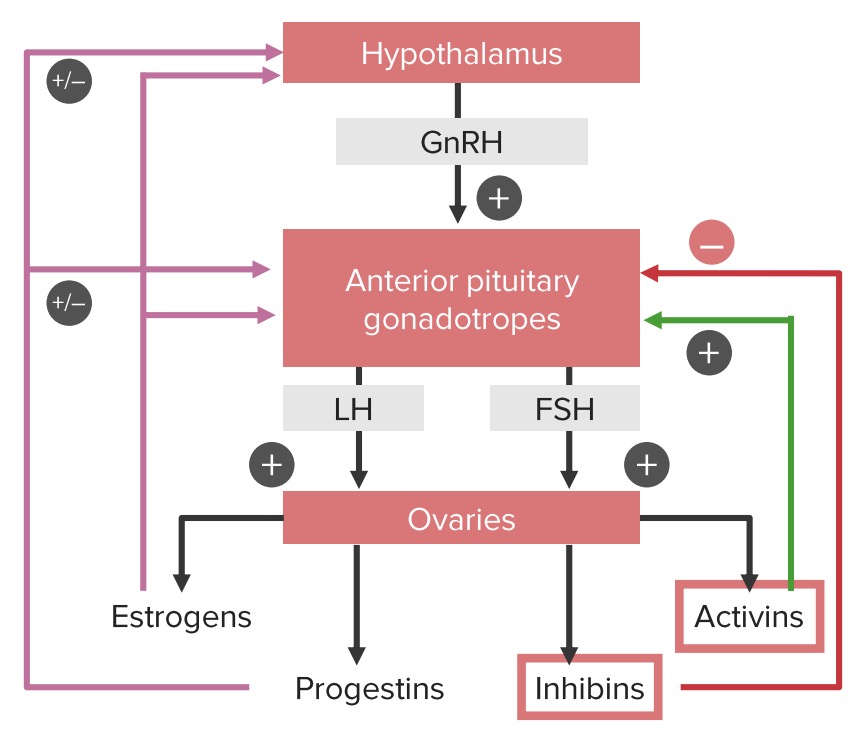
Eje ovárico hipofisario hipotalámico

Ciclos de retroalimentación positiva y negativa del eje hipotalámico-hipofisario-ovárico. Obsérvese que los estrógenos y las progestinas pueden tener tanto una influencia positiva como negativa sobre el hipotálamo y la glándula hipófisis, según la fase del ciclo. Los estrógenos proporcionan retroalimentación negativa hasta la mitad del ciclo. En ese momento, los estrógenos comienzan a estimular las células gonadotrópicas de la hipófisis, lo que da lugar al pico de LH, que desencadena la ovulación.

LH: hormona luteinizante
FSH: hormona foliculoestimulante
GnRH: hormona liberadora de gonadotropina


Imagen por Lecturio.

Ciclo Ovárico

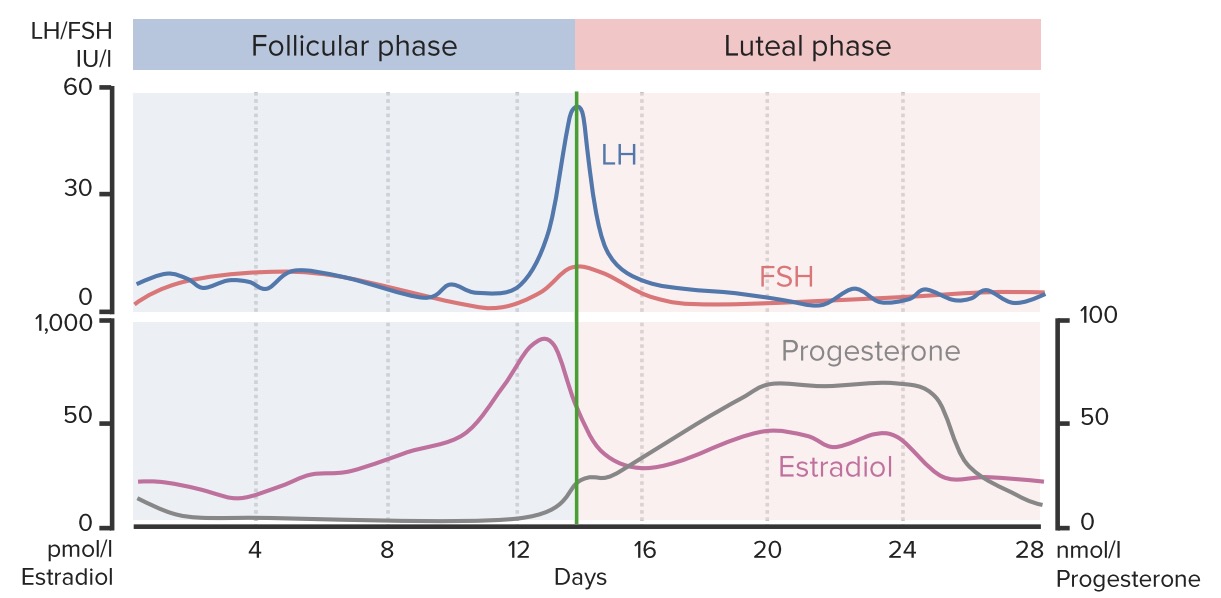
Ciclo ovárico

Un gráfico que muestra las concentraciones cambiantes de las hormonas claves a lo largo del ciclo menstrual: obsérvese el aumento repentino de estradiol, LH y hormona foliculoestimulante (FSH) alrededor del día 14 (ovulación), y el aumento de progesterona durante la fase lútea en anticipación de la fertilización y la implantación del óvulo.

Imagen por Lecturio.

Fase folicular

Fase que representa el tiempo durante el cual se desarrolla el folículo (y el ovocito que contiene) y que conduce a la ovulación. La fase folicular de los LOS Neisseria ovarios coincide con la menstruación y la fase proliferativa del endometrio.
  • Tiene lugar durante los LOS Neisseria días 114 (hasta el día 21) del ciclo menstrual
  • Principalmente bajo el control de la FSH FSH A major gonadotropin secreted by the adenohypophysis. Follicle-stimulating hormone stimulates gametogenesis and the supporting cells such as the ovarian granulosa cells, the testicular sertoli cells, and leydig cells. Fsh consists of two noncovalently linked subunits, alpha and beta. Within a species, the alpha subunit is common in the three pituitary glycoprotein hormones (TSH, LH, and FSH), but the beta subunit is unique and confers its biological specificity. Menstrual Cycle
  • La hormona liberadora de gonadotropina (GnRH, por sus siglas en EN Erythema nodosum is an immune-mediated panniculitis (inflammation of the subcutaneous fat) caused by a type IV (delayed-type) hypersensitivity reaction. It commonly manifests in young women as tender, erythematous nodules on the shins. Erythema Nodosum inglés) se libera del hipotálamo → estimula la liberación de FSH FSH A major gonadotropin secreted by the adenohypophysis. Follicle-stimulating hormone stimulates gametogenesis and the supporting cells such as the ovarian granulosa cells, the testicular sertoli cells, and leydig cells. Fsh consists of two noncovalently linked subunits, alpha and beta. Within a species, the alpha subunit is common in the three pituitary glycoprotein hormones (TSH, LH, and FSH), but the beta subunit is unique and confers its biological specificity. Menstrual Cycle de la hipófisis anterior → estimula los LOS Neisseria folículos primarios del ovario para que comiencen a desarrollarse/madurarse
  • Los LOS Neisseria folículos primarios en EN Erythema nodosum is an immune-mediated panniculitis (inflammation of the subcutaneous fat) caused by a type IV (delayed-type) hypersensitivity reaction. It commonly manifests in young women as tender, erythematous nodules on the shins. Erythema Nodosum maduración producen (a través de las células de la granulosa y la teca):
    • Estradiol Estradiol The 17-beta-isomer of estradiol, an aromatized C18 steroid with hydroxyl group at 3-beta- and 17-beta-position. Estradiol-17-beta is the most potent form of mammalian estrogenic steroids. Noncontraceptive Estrogen and Progestins:
      • Estimula el desarrollo del endometrio
      • Ayuda a seleccionar un folículo dominante inhibiendo la liberación de FSH (“matando de hambre” a otros folículos) y haciendo al AL Amyloidosis mismo tiempo que los LOS Neisseria folículos restantes sean más sensibles a la disminución de FSH FSH A major gonadotropin secreted by the adenohypophysis. Follicle-stimulating hormone stimulates gametogenesis and the supporting cells such as the ovarian granulosa cells, the testicular sertoli cells, and leydig cells. Fsh consists of two noncovalently linked subunits, alpha and beta. Within a species, the alpha subunit is common in the three pituitary glycoprotein hormones (TSH, LH, and FSH), but the beta subunit is unique and confers its biological specificity. Menstrual Cycle
    • Inhibina A → inhibe la liberación de FSH FSH A major gonadotropin secreted by the adenohypophysis. Follicle-stimulating hormone stimulates gametogenesis and the supporting cells such as the ovarian granulosa cells, the testicular sertoli cells, and leydig cells. Fsh consists of two noncovalently linked subunits, alpha and beta. Within a species, the alpha subunit is common in the three pituitary glycoprotein hormones (TSH, LH, and FSH), but the beta subunit is unique and confers its biological specificity. Menstrual Cycle de la hipófisis anterior (retroalimentación negativa)
  • La hipófisis anterior libera un estallido luteinizante u oleada → desencadena la ovulación aproximadamente 12 horas después
    • Durante la ovulación, se libera un ovocito maduro del folículo dominante.
    • El pico de LH LH A major gonadotropin secreted by the adenohypophysis. Luteinizing hormone regulates steroid production by the interstitial cells of the testis and the ovary. The preovulatory luteinizing hormone surge in females induces ovulation, and subsequent luteinization of the follicle. Luteinizing hormone consists of two noncovalently linked subunits, alpha and beta. Within a species, the alpha subunit is common in the three pituitary glycoprotein hormones (TSH, LH, and FSH), but the beta subunit is unique and confers its biological specificity. Menstrual Cycle pone fin a la fase folicular.
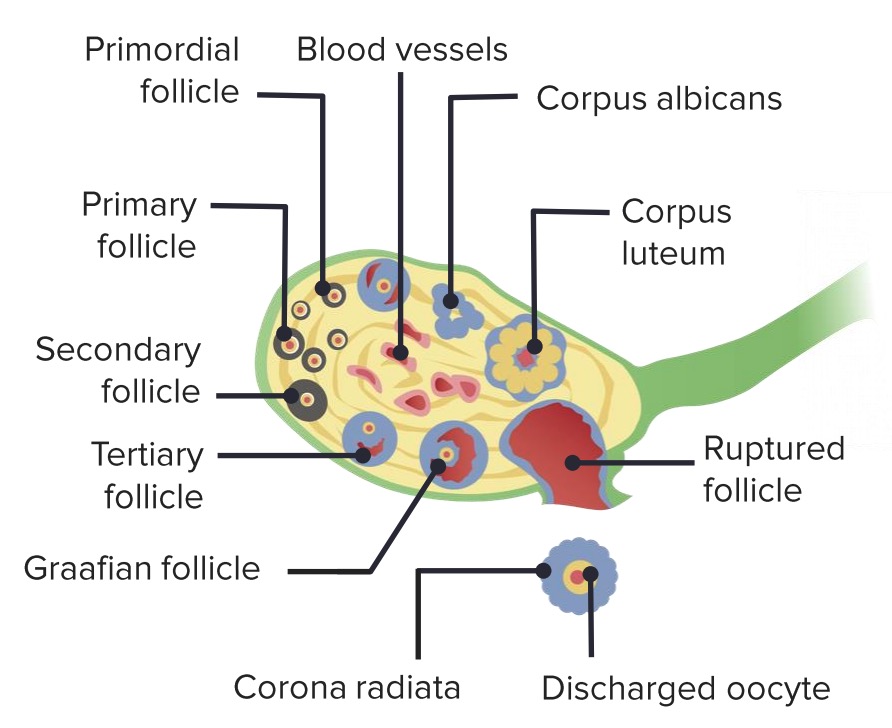
Etapas de maduración del folículo ovárico.

Etapas de maduración de un folículo ovárico. Durante la fase folicular del ciclo menstrual, la hormona estimulante del folículo (FSH) estimula la maduración de los folículos primarios. Normalmente, sólo un folículo (el folículo dominante) madura hasta convertirse en un folículo graafiano. El folículo de Graaf se rompe, liberando el ovocito (ovulación), y se transforma en un cuerpo lúteo. Durante la fase lútea del ciclo menstrual, el cuerpo lúteo produce las hormonas (especialmente la progesterona) necesarias para provocar la maduración del endometrio y favorecer potencialmente un embarazo temprano.

Imagen por Lecturio.

Fase lútea

La fase lútea de los LOS Neisseria ovarios coincide con la fase secretora del endometrio.

  • Suele tener lugar durante los LOS Neisseria días 1528 del ciclo menstrual, después de que el ovocito es liberado
  • El ovocito migra a la fimbria de la trompa de Falopio (puede tardar 3 días).
  • Potencial de fecundación por parte de los LOS Neisseria espermatozoides en EN Erythema nodosum is an immune-mediated panniculitis (inflammation of the subcutaneous fat) caused by a type IV (delayed-type) hypersensitivity reaction. It commonly manifests in young women as tender, erythematous nodules on the shins. Erythema Nodosum esta fase
  • El cuerpo lúteo del ovocito maduro produce progesterona:
    • Provoca la maduración del endometrio (endometrio proliferativo → secretor)
    • La retroalimentación de progesterona inhibe la secreción de LH LH A major gonadotropin secreted by the adenohypophysis. Luteinizing hormone regulates steroid production by the interstitial cells of the testis and the ovary. The preovulatory luteinizing hormone surge in females induces ovulation, and subsequent luteinization of the follicle. Luteinizing hormone consists of two noncovalently linked subunits, alpha and beta. Within a species, the alpha subunit is common in the three pituitary glycoprotein hormones (TSH, LH, and FSH), but the beta subunit is unique and confers its biological specificity. Menstrual Cycle de la hipófisis anterior.
  • Si la concepción no ocurre:
    • Los LOS Neisseria niveles de LH LH A major gonadotropin secreted by the adenohypophysis. Luteinizing hormone regulates steroid production by the interstitial cells of the testis and the ovary. The preovulatory luteinizing hormone surge in females induces ovulation, and subsequent luteinization of the follicle. Luteinizing hormone consists of two noncovalently linked subunits, alpha and beta. Within a species, the alpha subunit is common in the three pituitary glycoprotein hormones (TSH, LH, and FSH), but the beta subunit is unique and confers its biological specificity. Menstrual Cycle continúan ↓ y el cuerpo lúteo se degenera a un cuerpo albicans.
    • A medida que el cuerpo lúteo retrocede:
      • Progesterona ↓ → desencadena la menstruación (fin de la fase lútea).
      • El estradiol Estradiol The 17-beta-isomer of estradiol, an aromatized C18 steroid with hydroxyl group at 3-beta- and 17-beta-position. Estradiol-17-beta is the most potent form of mammalian estrogenic steroids. Noncontraceptive Estrogen and Progestins ↓ → libera una retroalimentación negativa sobre el hipotálamo y la hipófisis → El pulso de GnRH comienza de nuevo para iniciar el siguiente ciclo
  • Si se produce un embarazo, la secreción de hCG salva el cuerpo lúteo y le permite continuar con su función secretora.
Estructura del folículo ovárico primario

Estructura de un folículo ovárico terciario (antral)

Imagen por Lecturio.

Ciclo Endometrial

Hay 3 fases del ciclo endometrial:

  1. Descamación o menstruación
  2. Fase proliferativa
  3. Fase secretora
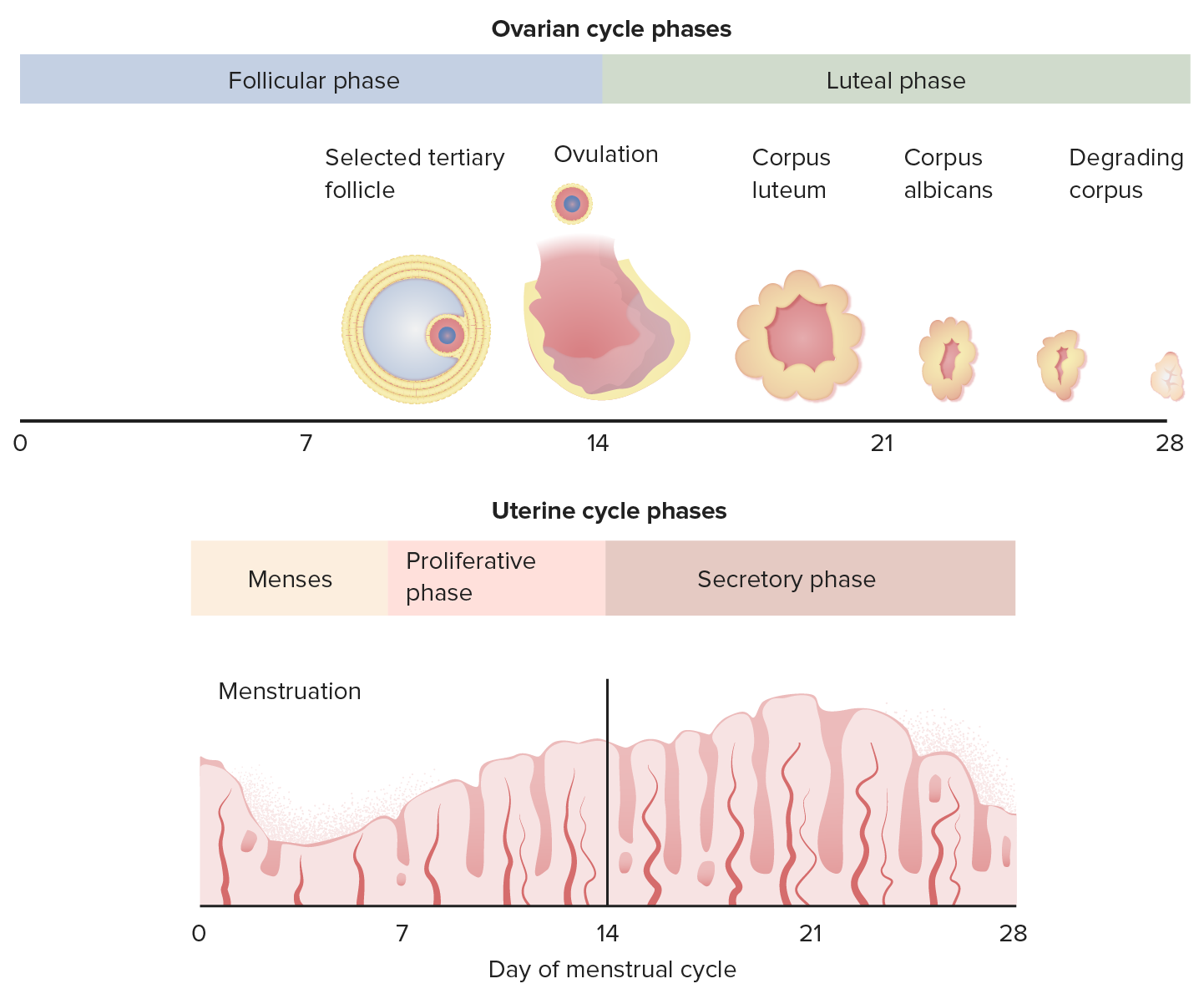
Correlación entre el ciclo ovárico y el ciclo endometrial

Un diagrama que muestra la correlación entre el ciclo ovárico y el ciclo endometrial

Imagen por Lecturio.

Menstruación

El día 1 del sangrado menstrual marca el comienzo del siguiente ciclo.

  • Coincide con el día 1 de la fase folicular
  • Si no se produce la concepción, el cuerpo lúteo se degenera y los LOS Neisseria niveles de progesterona disminuyen
  • La retirada de la progesterona desencadena la descamación de la capa funcional del endometrio (menstruación)
    • Las arterias espirales se contraen.
    • El endometrio muere por apoptosis Apoptosis A regulated cell death mechanism characterized by distinctive morphologic changes in the nucleus and cytoplasm, including the endonucleolytic cleavage of genomic DNA, at regularly spaced, internucleosomal sites, I.e., DNA fragmentation. It is genetically-programmed and serves as a balance to mitosis in regulating the size of animal tissues and in mediating pathologic processes associated with tumor growth. Ischemic Cell Damage.
    • Las contracciones uterinas desprenden y expulsan la capa superior del endometrio (stratum functionalis).
  • Menstruación normal:
    • Dura de 3 a 8 días
    • Pérdida de < 80 mL de sangre/tejido
  • El ovocito se pierde en EN Erythema nodosum is an immune-mediated panniculitis (inflammation of the subcutaneous fat) caused by a type IV (delayed-type) hypersensitivity reaction. It commonly manifests in young women as tender, erythematous nodules on the shins. Erythema Nodosum el sangrado menstrual.

Fase proliferativa

  • Fase proliferativa (días 414) → se desarrolla un nuevo endometrio (stratum functionalis crece a partir de la capa más profunda de endometrio restante (stratum basalis) que no se desprende durante la menstruación)
  • Estimulado por los LOS Neisseria estrógenos producidos por los LOS Neisseria folículos en EN Erythema nodosum is an immune-mediated panniculitis (inflammation of the subcutaneous fat) caused by a type IV (delayed-type) hypersensitivity reaction. It commonly manifests in young women as tender, erythematous nodules on the shins. Erythema Nodosum crecimiento:
    • Las células de la teca de los LOS Neisseria folículos en EN Erythema nodosum is an immune-mediated panniculitis (inflammation of the subcutaneous fat) caused by a type IV (delayed-type) hypersensitivity reaction. It commonly manifests in young women as tender, erythematous nodules on the shins. Erythema Nodosum desarrollo producen andrógenos.
    • Las células de la granulosa liberan aromatasa → convierten los LOS Neisseria andrógenos en EN Erythema nodosum is an immune-mediated panniculitis (inflammation of the subcutaneous fat) caused by a type IV (delayed-type) hypersensitivity reaction. It commonly manifests in young women as tender, erythematous nodules on the shins. Erythema Nodosum estrógenos, que actúan como factor de crecimiento en EN Erythema nodosum is an immune-mediated panniculitis (inflammation of the subcutaneous fat) caused by a type IV (delayed-type) hypersensitivity reaction. It commonly manifests in young women as tender, erythematous nodules on the shins. Erythema Nodosum el tejido endometrial
  • Proliferación endometrial con glándulas tubulares rectas

Fase secretora

  • Inicia entre los LOS Neisseria días 13 y 15 del ciclo menstrual (más tarde en EN Erythema nodosum is an immune-mediated panniculitis (inflammation of the subcutaneous fat) caused by a type IV (delayed-type) hypersensitivity reaction. It commonly manifests in young women as tender, erythematous nodules on the shins. Erythema Nodosum algunas personas)
  • Preparación de las arterias espirales y las glándulas endometriales para la posible implantación de un embrión:
    • Activada por la liberación de progesterona
    • Aumento de la tortuosidad de la glándula endometrial
    • Secreciones ricas en EN Erythema nodosum is an immune-mediated panniculitis (inflammation of the subcutaneous fat) caused by a type IV (delayed-type) hypersensitivity reaction. It commonly manifests in young women as tender, erythematous nodules on the shins. Erythema Nodosum glucógeno
    • Células estromales edematosas
    • Las arterias espirales uterinas se extienden a lo largo del endometrio.
  • Si no hay embarazo, los LOS Neisseria niveles de progesterona disminuyen → induciendo la apoptosis Apoptosis A regulated cell death mechanism characterized by distinctive morphologic changes in the nucleus and cytoplasm, including the endonucleolytic cleavage of genomic DNA, at regularly spaced, internucleosomal sites, I.e., DNA fragmentation. It is genetically-programmed and serves as a balance to mitosis in regulating the size of animal tissues and in mediating pathologic processes associated with tumor growth. Ischemic Cell Damage de la capa funcional del endometrio, lo que lleva a la menstruación

Relevancia Clínica

  • Embarazo: período de tiempo en EN Erythema nodosum is an immune-mediated panniculitis (inflammation of the subcutaneous fat) caused by a type IV (delayed-type) hypersensitivity reaction. It commonly manifests in young women as tender, erythematous nodules on the shins. Erythema Nodosum el que un feto se desarrolla dentro del útero. Cuando el ovocito es fertilizado por un espermatozoide y el embrión en EN Erythema nodosum is an immune-mediated panniculitis (inflammation of the subcutaneous fat) caused by a type IV (delayed-type) hypersensitivity reaction. It commonly manifests in young women as tender, erythematous nodules on the shins. Erythema Nodosum desarrollo se implanta en EN Erythema nodosum is an immune-mediated panniculitis (inflammation of the subcutaneous fat) caused by a type IV (delayed-type) hypersensitivity reaction. It commonly manifests in young women as tender, erythematous nodules on the shins. Erythema Nodosum el endometrio, el ciclo menstrual se suprime para evitar la evacuación del revestimiento uterino y del embrión a través de las contracciones uterinas. El embarazo dura aproximadamente 40 semanas y crea un estado fisiológico en EN Erythema nodosum is an immune-mediated panniculitis (inflammation of the subcutaneous fat) caused by a type IV (delayed-type) hypersensitivity reaction. It commonly manifests in young women as tender, erythematous nodules on the shins. Erythema Nodosum el cuerpo para apoyar la gestación fetal.
  • Dismenorrea: dolor Dolor Inflammation abdominal recurrente asociado con la menstruación; puede ser de naturaleza primaria o secundaria
  • Hiperplasia endometrial: ocurre cuando el endometrio recibe estimulación prolongada por parte de los LOS Neisseria estrógenos para proliferar. Se presenta como sangrado uterino anormal. Las mujeres que sufren de hiperplasia endometrial tienen un mayor riesgo de desarrollar displasia y cáncer de endometrio.

Las siguientes afecciones están relacionadas con anomalías del ciclo menstrual, conocida como hemorragia uterina anormal:

  • Amenorrea: ausencia de menstruación debido a causas hipotalámicas, hipofisarias, ováricas, uterinas o vaginales. La amenorrea puede ser primaria (ausencia de menarca a los LOS Neisseria 15 años) o secundaria (ausencia de menstruación durante más de 3 ciclos o 6 meses en EN Erythema nodosum is an immune-mediated panniculitis (inflammation of the subcutaneous fat) caused by a type IV (delayed-type) hypersensitivity reaction. It commonly manifests in young women as tender, erythematous nodules on the shins. Erythema Nodosum niñas y mujeres con ciclos previamente normales).
  • Sangrado menstrual abundante: (previamente llamada menorragia): intervalos menstruales regulares con un flujo menstrual excesivo (> 80 ml durante las menstruaciones)
  • Sangrado uterino prolongado: menstruaciones que duran más de 8 días
  • Sangrado uterino irregular (antes llamado metrorragia): sangrado uterino irregular entre períodos menstruales o a intervalos irregulares definidos como variación entre los LOS Neisseria ciclos más cortos y más largos de ≥ 8-10 días
  • Hemorragia uterina infrecuente (antes llamada oligomenorrea): intervalo menstrual > 38 días
  • Hemorragia uterina frecuente (antes llamada polimenorrea): intervalo menstrual < 24 días
  • Referencias
  • Welt, C.K. (2021). Physiology of the normal menstrual cycle Menstrual cycle The menstrual cycle is the cyclic pattern of hormonal and tissular activity that prepares a suitable uterine environment for the fertilization and implantation of an ovum. The menstrual cycle involves both an endometrial and ovarian cycle that are dependent on one another for proper functioning. There are 2 phases of the ovarian cycle and 3 phases of the endometrial cycle. Menstrual Cycle. UpToDate. Retrieved May 17, 2022 from https://www.uptodate.com/contents/physiology-of-the-normal-menstrual-cycle 
  • Saladin, K.S., Miller, L. (2004). Anatomy and Physiology, 3rd ed., McGraw-Hill Education, pp. 1050‒1055.
  • Munro, M.G., Critchley, H.O.D., Fraser, I.S. (2018). The two FIGO systems for normal and abnormal uterine bleeding Abnormal Uterine Bleeding Abnormal uterine bleeding is the medical term for abnormalities in the frequency, volume, duration, and regularity of the menstrual cycle. Abnormal uterine bleeding is classified using the acronym PALM-COEIN, with PALM representing the structural causes and COEIN indicating the non-structural causes. Abnormal Uterine Bleeding symptoms and classification of causes of abnormal uterine bleeding Abnormal Uterine Bleeding Abnormal uterine bleeding is the medical term for abnormalities in the frequency, volume, duration, and regularity of the menstrual cycle. Abnormal uterine bleeding is classified using the acronym PALM-COEIN, with PALM representing the structural causes and COEIN indicating the non-structural causes. Abnormal Uterine Bleeding in the reproductive years: 2018 revisions. Int J Gynecol Obstet; 143: 393‒408.
  • Moore, K.L., Dalley, A.F. (2006). Clinically Oriented Anatomy, 5th ed., Lippincott Williams and Wilkins, pp. 415-429.

¡Crea tu cuenta gratis o inicia una sesión para seguir leyendo!

Regístrate ahora y obtén acceso gratuito a Lecturio con páginas de concepto, videos médicos y cuestionarios para tu educación médica.

User Reviews

Que tengas una sesión de estudio alegre y navideña 🎁 Ahorra 50% en todos los planes >>

Details