
Domina Conceptos Médicos

Estudia para la escuela de medicina y tus examenes con Lecturio.

Ciclo del Ácido Cítrico

El ciclo del ácido cítrico, también conocido como ciclo del ácido tricarboxílico o ciclo de Krebs, es un conjunto cíclico de reacciones que ocurren en EN Erythema nodosum is an immune-mediated panniculitis (inflammation of the subcutaneous fat) caused by a type IV (delayed-type) hypersensitivity reaction. It commonly manifests in young women as tender, erythematous nodules on the shins. Erythema Nodosum la matriz mitocondrial. El ciclo del ácido tricarboxílico es la continuación de cualquier vía metabólica que produce piruvato, que se convierte en EN Erythema nodosum is an immune-mediated panniculitis (inflammation of the subcutaneous fat) caused by a type IV (delayed-type) hypersensitivity reaction. It commonly manifests in young women as tender, erythematous nodules on the shins. Erythema Nodosum su principal sustrato, acetil-CoA. El ciclo del ácido tricarboxílico oxida acetil-CoA y produce 2 CO2, guanosín trifosfato (GTP, por sus siglas en EN Erythema nodosum is an immune-mediated panniculitis (inflammation of the subcutaneous fat) caused by a type IV (delayed-type) hypersensitivity reaction. It commonly manifests in young women as tender, erythematous nodules on the shins. Erythema Nodosum inglés), 3 nicotinamida adenina dinucleótido hidruro (NADH, por sus siglas en EN Erythema nodosum is an immune-mediated panniculitis (inflammation of the subcutaneous fat) caused by a type IV (delayed-type) hypersensitivity reaction. It commonly manifests in young women as tender, erythematous nodules on the shins. Erythema Nodosum inglés) + H+ y flavín adenín dinucleótido hidruro 2 (FADH2, por sus siglas en EN Erythema nodosum is an immune-mediated panniculitis (inflammation of the subcutaneous fat) caused by a type IV (delayed-type) hypersensitivity reaction. It commonly manifests in young women as tender, erythematous nodules on the shins. Erythema Nodosum inglés). Sus productos finales (NADH + H+ y FADH2) pasan a la cadena de transporte de electrones para producir un total de 10 adenosin trifosfato (ATP, por sus siglas en EN Erythema nodosum is an immune-mediated panniculitis (inflammation of the subcutaneous fat) caused by a type IV (delayed-type) hypersensitivity reaction. It commonly manifests in young women as tender, erythematous nodules on the shins. Erythema Nodosum inglés) por ciclo.

Last updated: Apr 25, 2025

Editorial responsibility: Stanley Oiseth, Lindsay Jones, Evelin Maza

Funciones

Producción de energía

  • Producción directa de GTP (equivalente a ATP)
  • NADH + H + y FADH2 luego producen ATP dentro de la cadena respiratoria.

Centro anfibólico

El ciclo del ácido cítrico proporciona precursores para muchos procesos catabólicos y anabólicos.
  • Precursores de aminoácidos:
    • Alfa-cetoglutarato para glutamato
    • Oxalacetato para aspartato
  • La succinil-CoA es crucial para la síntesis de porfirinas o hemo.
  • El citrato es necesario para la síntesis de ácidos grasos y colesterol.
  • El oxaloacetato es un sustrato para la gluconeogénesis.

Related videos

Reacciones, Rendimiento y Balance Energético

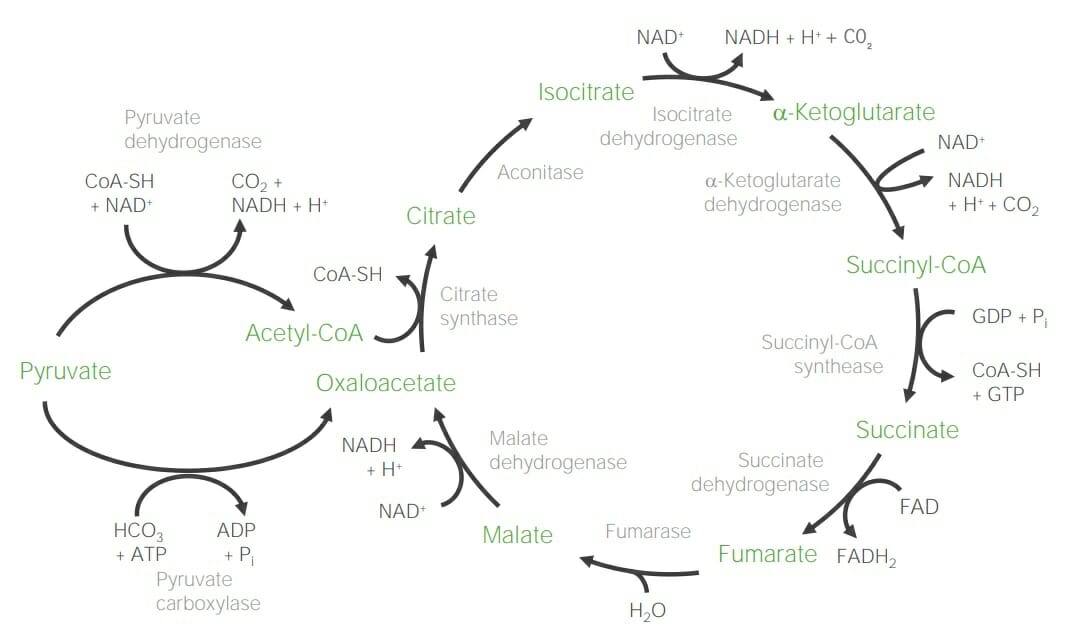
Diagrama esquemático del ciclo del ácido cítrico

Imagen por Lecturio. Licencia: CC BY-NC-SA 4.0

Dos sustratos principales: acetil-CoA y oxaloacetato

  • Acetil-CoA de la beta-oxidación de ácidos grasos y la glucólisis
    • La piruvato deshidrogenasa produce acetil-CoA a partir del piruvato.
  • Oxalacetato de regeneración dentro del ciclo de Krebs o de piruvato
    • La piruvato carboxilasa produce oxaloacetato a partir de piruvato y CO2.

Pasos:
Acetil-CoA (C2) + oxaloacetato (C4) → Citrato (C6) → Isocitrato (C6) → α- Cetoglutarato (Ketoglutarate) (C5) → Succinil-CoA (C4) → Succinato (C4) → Fumarato (C4) → Malato (C4) → Oxalacetato (C4)
Mnemotecnia ( en EN Erythema nodosum is an immune-mediated panniculitis (inflammation of the subcutaneous fat) caused by a type IV (delayed-type) hypersensitivity reaction. It commonly manifests in young women as tender, erythematous nodules on the shins. Erythema Nodosum inglés es): Citrate (citrato) Is (es) Krebs’ (Krebs) Starting (inicial) Substrate (sustrato) For (para) Making (formar) Oxaloacetate (oxaloacetato)

Reacciones notables:

  • Irreversibles:
    • Acetil-CoA + oxaloacetato → citrato vía citrato sintasa
    • Isocitrato → α-cetoglutarato vía isocitrato deshidrogenasa
    • α-cetoglutarato → succinil-CoA a través de α-cetoglutarato deshidrogenasa
  • Succinato deshidrogenasa: única enzima del ciclo de Krebs que está anclada a la membrana interna de la mitocondria
  • α-cetoglutarato deshidrogenasa: requiere de 5 cofactores
    • Pirofosfato de tiamina
    • Ácido lipoico
    • Coenzima A
    • FAD
    • NAD NAD+ A coenzyme composed of ribosylnicotinamide 5′-diphosphate coupled to adenosine 5′-phosphate by pyrophosphate linkage. It is found widely in nature and is involved in numerous enzymatic reactions in which it serves as an electron carrier by being alternately oxidized (NAD+) and reduced (NADH). Pentose Phosphate Pathway+

Rendimiento:
3 NADH + H+ + 1 FADH2 + 1 GTP + 2 CO2 por acetil-CoA (x 2 por glucosa)

Balance de energía:
7.5 ATP (3 NADH + H+) + 1.5 ATP (1 FADH2) + 1 ATP (1 GTP) = 10 ATP por cada acetil-CoA (x 2 por glucosa)

Regulación

Regulación del ciclo del ácido cítrico
(principalmente por la disponibilidad de sustratos y la inhibición del producto)
Enzima Activada por Inhibida por
Piruvato deshidrogenasa
  • Adenosin difosfato (ADP, por sus siglas en EN Erythema nodosum is an immune-mediated panniculitis (inflammation of the subcutaneous fat) caused by a type IV (delayed-type) hypersensitivity reaction. It commonly manifests in young women as tender, erythematous nodules on the shins. Erythema Nodosum inglés)
  • Disminución en EN Erythema nodosum is an immune-mediated panniculitis (inflammation of the subcutaneous fat) caused by a type IV (delayed-type) hypersensitivity reaction. It commonly manifests in young women as tender, erythematous nodules on the shins. Erythema Nodosum la relación NADH/ NAD NAD+ A coenzyme composed of ribosylnicotinamide 5′-diphosphate coupled to adenosine 5′-phosphate by pyrophosphate linkage. It is found widely in nature and is involved in numerous enzymatic reactions in which it serves as an electron carrier by being alternately oxidized (NAD+) and reduced (NADH). Pentose Phosphate Pathway+
  • Ca CA Condylomata acuminata are a clinical manifestation of genital HPV infection. Condylomata acuminata are described as raised, pearly, flesh-colored, papular, cauliflower-like lesions seen in the anogenital region that may cause itching, pain, or bleeding. Condylomata Acuminata (Genital Warts)2+
  • Aumento en EN Erythema nodosum is an immune-mediated panniculitis (inflammation of the subcutaneous fat) caused by a type IV (delayed-type) hypersensitivity reaction. It commonly manifests in young women as tender, erythematous nodules on the shins. Erythema Nodosum la relación acetil-CoA/CoA
  • Aumento en EN Erythema nodosum is an immune-mediated panniculitis (inflammation of the subcutaneous fat) caused by a type IV (delayed-type) hypersensitivity reaction. It commonly manifests in young women as tender, erythematous nodules on the shins. Erythema Nodosum la relación NADH/ NAD NAD+ A coenzyme composed of ribosylnicotinamide 5′-diphosphate coupled to adenosine 5′-phosphate by pyrophosphate linkage. It is found widely in nature and is involved in numerous enzymatic reactions in which it serves as an electron carrier by being alternately oxidized (NAD+) and reduced (NADH). Pentose Phosphate Pathway+
  • Aumento en EN Erythema nodosum is an immune-mediated panniculitis (inflammation of the subcutaneous fat) caused by a type IV (delayed-type) hypersensitivity reaction. It commonly manifests in young women as tender, erythematous nodules on the shins. Erythema Nodosum la relación ATP/ADP
Citrato sintasa
  • ADP
  • Oxaloacetato
  • Acetil-CoA
  • Citrato
  • NADH + H+
  • ATP
  • Succinil-CoA
Isocitrato deshidrogenasa (mayor impacto en EN Erythema nodosum is an immune-mediated panniculitis (inflammation of the subcutaneous fat) caused by a type IV (delayed-type) hypersensitivity reaction. It commonly manifests in young women as tender, erythematous nodules on the shins. Erythema Nodosum el ciclo del ácido cítrico)
  • ADP
  • Ca CA Condylomata acuminata are a clinical manifestation of genital HPV infection. Condylomata acuminata are described as raised, pearly, flesh-colored, papular, cauliflower-like lesions seen in the anogenital region that may cause itching, pain, or bleeding. Condylomata Acuminata (Genital Warts)2+
  • ATP
  • NADH + H+
α-cetoglutarato deshidrogenasa Ca CA Condylomata acuminata are a clinical manifestation of genital HPV infection. Condylomata acuminata are described as raised, pearly, flesh-colored, papular, cauliflower-like lesions seen in the anogenital region that may cause itching, pain, or bleeding. Condylomata Acuminata (Genital Warts)2+
  • Succinil-CoA
  • NADH + H+
Succinato deshidrogenasa Succinato Oxaloacetato

Relevancia Clínica

El siguiente proceso es estimulado por el ciclo del ácido tricarboxílico:

  • Cetogénesis: la síntesis de cuerpos cetónicos a partir de acetil-CoA. La cetogénesis es causada por inanición prolongada, cetoacidosis diabética y alcoholismo. La inhibición del ciclo del ácido tricarboxílico conduce a un aumento de los LOS Neisseria niveles de acetil-CoA, lo que estimula directamente la cetogénesis.

Las siguientes afecciones inhiben el ciclo del ácido tricarboxílico:

  • Hiperamonemia: una afección definida por un exceso de amoníaco en EN Erythema nodosum is an immune-mediated panniculitis (inflammation of the subcutaneous fat) caused by a type IV (delayed-type) hypersensitivity reaction. It commonly manifests in young women as tender, erythematous nodules on the shins. Erythema Nodosum la sangre. Puede ser adquirida (enfermedad hepática) o hereditaria (deficiencias enzimáticas del ciclo de la urea Urea A compound formed in the liver from ammonia produced by the deamination of amino acids. It is the principal end product of protein catabolism and constitutes about one half of the total urinary solids. Urea Cycle). En EN Erythema nodosum is an immune-mediated panniculitis (inflammation of the subcutaneous fat) caused by a type IV (delayed-type) hypersensitivity reaction. It commonly manifests in young women as tender, erythematous nodules on the shins. Erythema Nodosum la hiperamonemia, el nivel de α-cetoglutarato aumenta, lo que inhibe el ciclo del ácido tricarboxílico. Se presenta como asterixis Asterixis Hepatic Encephalopathy, dificultad para hablar, somnolencia, vómitos, edema Edema Edema is a condition in which excess serous fluid accumulates in the body cavity or interstitial space of connective tissues. Edema is a symptom observed in several medical conditions. It can be categorized into 2 types, namely, peripheral (in the extremities) and internal (in an organ or body cavity). Edema cerebral y visión borrosa.
  • Deficiencia de tiamina: afección que se produce por desnutrición y/o alcoholismo, que inhibe la enzima α-cetoglutarato deshidrogenasa por falta de uno de sus cofactores (tiamina). Esto conduce a la acumulación de glutamato, lo que lleva a la encefalopatía de Wernicke. Se presenta como una tríada de confusión, oftalmoplejía y ataxia Ataxia Impairment of the ability to perform smoothly coordinated voluntary movements. This condition may affect the limbs, trunk, eyes, pharynx, larynx, and other structures. Ataxia may result from impaired sensory or motor function. Sensory ataxia may result from posterior column injury or peripheral nerve diseases. Motor ataxia may be associated with cerebellar diseases; cerebral cortex diseases; thalamic diseases; basal ganglia diseases; injury to the red nucleus; and other conditions. Ataxia-telangiectasia.
  • Cetoacidosis diabética: una afección que se observa principalmente en EN Erythema nodosum is an immune-mediated panniculitis (inflammation of the subcutaneous fat) caused by a type IV (delayed-type) hypersensitivity reaction. It commonly manifests in young women as tender, erythematous nodules on the shins. Erythema Nodosum pacientes con diabetes Diabetes Diabetes mellitus (DM) is a metabolic disease characterized by hyperglycemia and dysfunction of the regulation of glucose metabolism by insulin. Type 1 DM is diagnosed mostly in children and young adults as the result of autoimmune destruction of β cells in the pancreas and the resulting lack of insulin. Type 2 DM has a significant association with obesity and is characterized by insulin resistance. Diabetes Mellitus mellitus tipo I, que es causada por niveles insuficientes de insulina. Se presenta con hiperglucemia, poliuria, polidipsia, náuseas, vómitos y depleción de volumen. Puede inhibir el ciclo del ácido tricarboxílico al AL Amyloidosis reducir los LOS Neisseria niveles de oxaloacetato.
  • Trastornos por consumo de alcohol: el alcoholismo es un nivel de consumo de alcohol que excede el estándar sociocultural. La afección está marcada por la adicción mental y física, con un deseo irresistible por el alcohol y la tolerancia a la sustancia. Puede inhibir el ciclo del ácido tricarboxílico provocando un aumento en EN Erythema nodosum is an immune-mediated panniculitis (inflammation of the subcutaneous fat) caused by a type IV (delayed-type) hypersensitivity reaction. It commonly manifests in young women as tender, erythematous nodules on the shins. Erythema Nodosum la relación NADH/ NAD NAD+ A coenzyme composed of ribosylnicotinamide 5′-diphosphate coupled to adenosine 5′-phosphate by pyrophosphate linkage. It is found widely in nature and is involved in numerous enzymatic reactions in which it serves as an electron carrier by being alternately oxidized (NAD+) and reduced (NADH). Pentose Phosphate Pathway+.

Referencias

  1. Kennelly, P. J., Botham, K. M., McGuinness, O., Rodwell, V. W., & Weil, P. A. (2022). Harper’s illustrated biochemistry (32nd ed.). Lange/McGraw-Hill Education.
  2. Khorana, A. A. (2024, June 26). Don’t ‘forget the Krebs cycle’: New findings in cancer metabolism. ASCO Daily News. https://dailynews.ascopubs.org/do/don-t-forget-krebs-cycle-new-findings-cancer-metabolism
  3. Nelson, D. L., & Cox, M. M. (2021). Lehninger principles of biochemistry (8th ed.). W. H. Freeman.
  4. Suryavanshi, A., et al. (2025). Metabolic flexibility and essentiality of the tricarboxylic acid cycle in Plasmodium. ACS Infectious Diseases, 11(2), 335–349. https://doi.org/10.1021/acsinfecdis.4c00788

¡Crea tu cuenta gratis o inicia una sesión para seguir leyendo!

Regístrate ahora y obtén acceso gratuito a Lecturio con páginas de concepto, videos médicos y cuestionarios para tu educación médica.

User Reviews

Details