


Taenia/Teníase

Taenia Taenia Taenia belong to the Cestoda class of helminths. Humans are infected with these tapeworms by eating undercooked beef (T. saginata) or pork (T. solium and T. asiatica). Taeniasis is often asymptomatic, but the ingestion of larvae can cause abdominal discomfort, nausea, and constipation or diarrhea. Taenia/Taeniasis pertence à classe dos Céstodos de helmintas. Os humanos são infetados por estas ténias quando é consumida carne bovina ( T. saginata T. saginata Species of tapeworm in the genus taenia, that infects cattle. It is acquired by humans through the ingestion of raw or insufficiently cooked beef. Taenia/Taeniasis) ou suína ( T. solium T. solium Species of tapeworm in the genus taenia, that infects swine. It is acquired by humans through the ingestion of cured or undercooked pork. Taenia/Taeniasis e T. asiatica T. asiatica Taenia/Taeniasis) mal cozinhada. A teníase é frequentemente assintomática, mas a ingestão de larvas pode causar desconforto abdominal, náuseas e obstipação ou diarreia. A excreção de proglótides nas fezes é o sinal mais MAIS Androgen Insensitivity Syndrome comum da teníase. Um paciente que ingere ovos de T. solium T. solium Species of tapeworm in the genus taenia, that infects swine. It is acquired by humans through the ingestion of cured or undercooked pork. Taenia/Taeniasis pode desenvolver cisticercose, apresentando quistos musculares e cutâneos, envolvimento ocular ou manifestações neurológicas (neurocisticercose). O diagnóstico é obtido através da identificação de proglótides ou ovos nas fezes. Os achados característicos da TC ou RM ajudam a diagnosticar a neurocisticercose. O tratamento inclui geralmente terapêutica anti-helmíntica.

Last updated: Feb 11, 2025

Editorial responsibility: Stanley Oiseth, Lindsay Jones, Evelin Maza

Características Gerais e Epidemiologia

Características gerais da Taenia Taenia Taenia belong to the Cestoda class of helminths. Humans are infected with these tapeworms by eating undercooked beef (T. saginata) or pork (T. solium and T. asiatica). Taeniasis is often asymptomatic, but the ingestion of larvae can cause abdominal discomfort, nausea, and constipation or diarrhea. Taenia/Taeniasis

Taenia Taenia Taenia belong to the Cestoda class of helminths. Humans are infected with these tapeworms by eating undercooked beef (T. saginata) or pork (T. solium and T. asiatica). Taeniasis is often asymptomatic, but the ingestion of larvae can cause abdominal discomfort, nausea, and constipation or diarrhea. Taenia/Taeniasis é um género de céstodos parasitas (ténias).

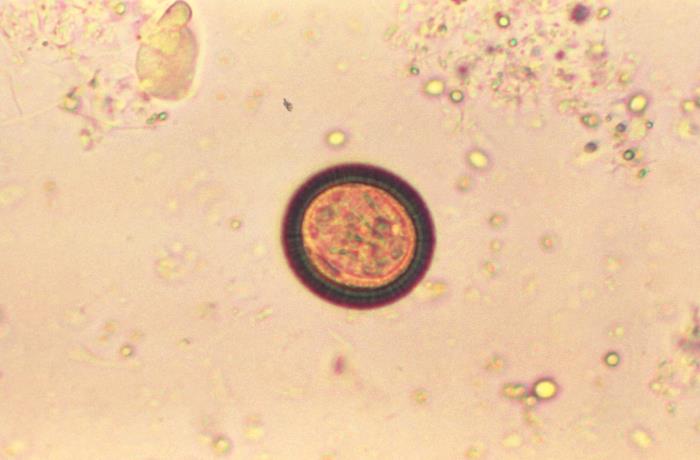
Ovos:

  • Esféricos
  • Parede espessa e estriada
  • Contêm um embrião de 6 ganchos (hexacanto)

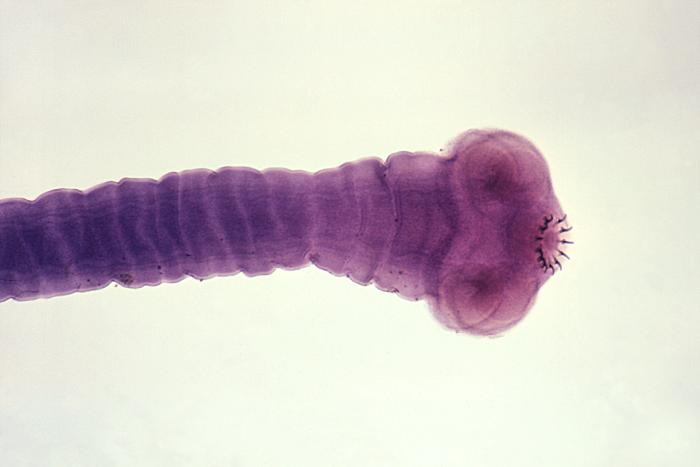
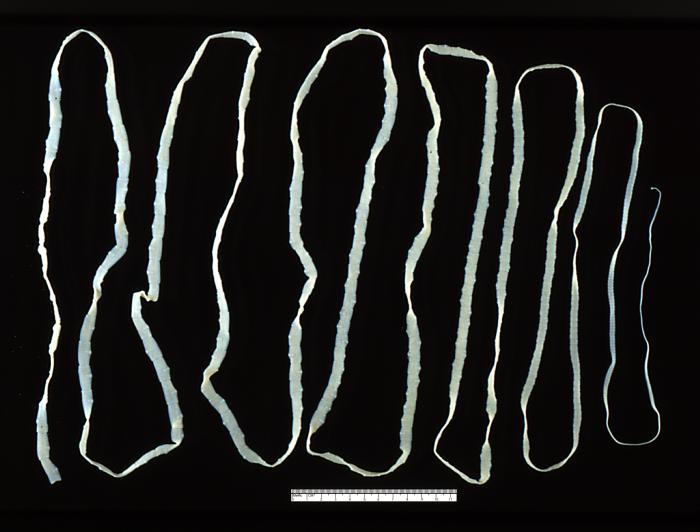
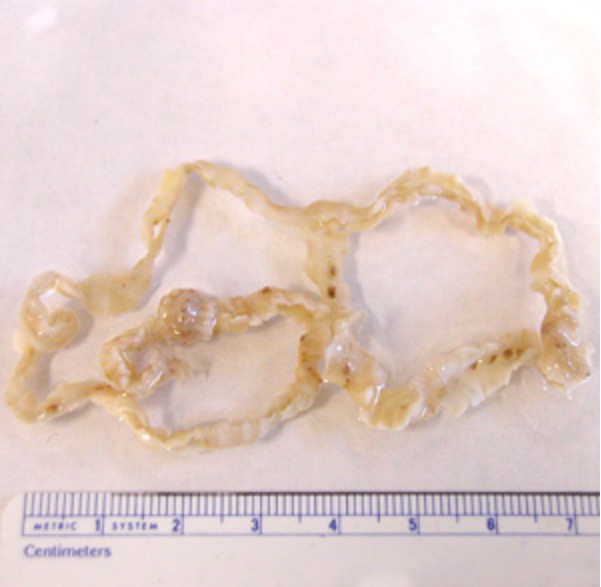
Adultos:

  • Tamanho:
    • T. saginata T. saginata Species of tapeworm in the genus taenia, that infects cattle. It is acquired by humans through the ingestion of raw or insufficiently cooked beef. Taenia/Taeniasis: < 5 m de comprimento
    • T. solium T. solium Species of tapeworm in the genus taenia, that infects swine. It is acquired by humans through the ingestion of cured or undercooked pork. Taenia/Taeniasis: aproximadamente 2-7 m de comprimento
  • Corpo segmentado, em forma de fita:
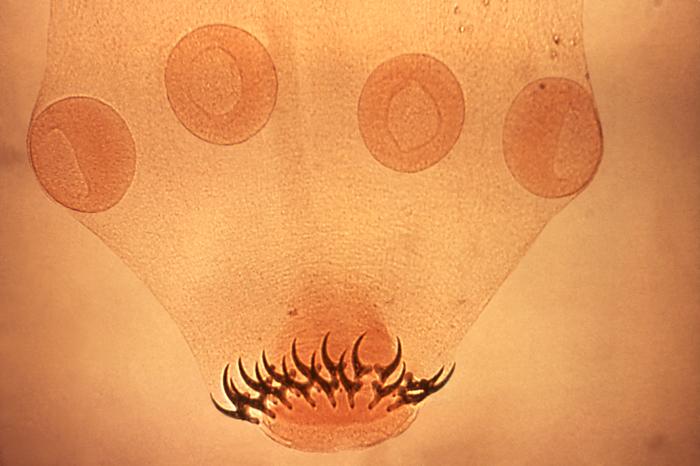
    • Escoléx:
      • Rostelo com 2 anéis em forma de gancho em T. solium T. solium Species of tapeworm in the genus taenia, that infects swine. It is acquired by humans through the ingestion of cured or undercooked pork. Taenia/Taeniasis
      • 4 ventosas musculares
    • Estróbilo com aproximadamente 1000 proglótides:
      • Segmentado
      • Possui aparelhos de órgãos reprodutores

Espécies clinicamente relevantes

As doenças a seguir abordadas são causadas por ténias:

  • Teníase:
    • T. saginata T. saginata Species of tapeworm in the genus taenia, that infects cattle. It is acquired by humans through the ingestion of raw or insufficiently cooked beef. Taenia/Taeniasis (ténia de bovino)
    • T. solium T. solium Species of tapeworm in the genus taenia, that infects swine. It is acquired by humans through the ingestion of cured or undercooked pork. Taenia/Taeniasis (ténia de porco)
    • T. asiatica T. asiatica Taenia/Taeniasis (ténia asiática)
  • Cisticercose: T. solium T. solium Species of tapeworm in the genus taenia, that infects swine. It is acquired by humans through the ingestion of cured or undercooked pork. Taenia/Taeniasis

Epidemiologia

Distribuição geográfica das espécies:

  • T. solium T. solium Species of tapeworm in the genus taenia, that infects swine. It is acquired by humans through the ingestion of cured or undercooked pork. Taenia/Taeniasis e T. saginata T. saginata Species of tapeworm in the genus taenia, that infects cattle. It is acquired by humans through the ingestion of raw or insufficiently cooked beef. Taenia/Taeniasis: distribuição mundial
  • T. asiatica T. asiatica Taenia/Taeniasis: Ásia

Teníase:

  • Afeta aproximadamente 50 milhões de pessoas a nível mundial
  • Rara nos Estados Unidos
  • Maior incidência em zonas onde:
    • Há menos acesso a água limpa.
    • A ingestão de carne crua ou mal cozinhada é comum

Cisticercose:

Patogénese

Hospedeiros

  • Hospedeiro definitivo: humanos
  • Hospedeiros intermédios:
    • T. saginata T. saginata Species of tapeworm in the genus taenia, that infects cattle. It is acquired by humans through the ingestion of raw or insufficiently cooked beef. Taenia/Taeniasis: gado
    • T. solium T. solium Species of tapeworm in the genus taenia, that infects swine. It is acquired by humans through the ingestion of cured or undercooked pork. Taenia/Taeniasis e T. asiatica T. asiatica Taenia/Taeniasis: suínos

Fatores de risco para os hospedeiros

  • Consumo de carne de vaca ou porco crua ou mal cozinhada
  • Habitantes nas seguintes condições:
    • Áreas rurais
    • Países em desenvolvimento
  • Falta de saneamento básico
  • Contacto próximo com animais infetados

Transmissão

  • Teníase: ingestão de fases larvares na carne
  • Cisticercose: ingestão de ovos de T. solium T. solium Species of tapeworm in the genus taenia, that infects swine. It is acquired by humans through the ingestion of cured or undercooked pork. Taenia/Taeniasis através:
    • Alimentos ou água contaminados
    • Transmissão fecal-oral

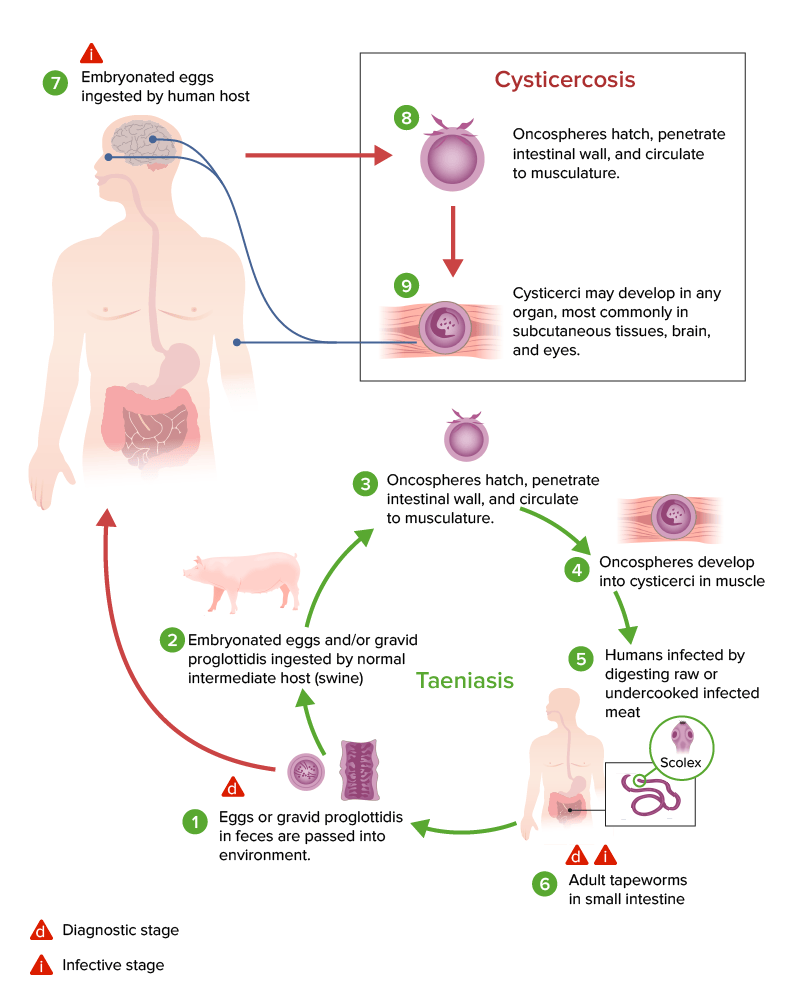
Ciclo de vida e fisiopatologia

Teníase:

  1. Os porcos ou bovinos ingerem vegetação contaminada com ovos ou proglótides grávidas.
  2. Os ovos eclodem no intestino → oncosferas
  3. Invasão da parede intestinal → circulação sanguínea → migração para o músculo estriado → transformação em cisticerco (larva dentro de um saco cheio de líquido)
  4. Os humanos ingerem carne de vaca ou porco crua ou mal cozinhada → desenvolve-se uma ténia adulta no intestino, fixando-se à parede intestinal com o escólex
  5. A forma adulta produz proglótides → amadurecem e engravidam → desprendem-se da ténia
  6. Os proglótides e os ovos são excretados nas fezes → continuação do ciclo

Cisticercose:

  1. Os humanos consomem alimentos ou água contaminados com ovos de T. solium T. solium Species of tapeworm in the genus taenia, that infects swine. It is acquired by humans through the ingestion of cured or undercooked pork. Taenia/Taeniasis ou proglótides grávidas.
  2. Os ovos eclodem no intestino → oncosferas
  3. Invasão da parede intestinal → circulação sanguínea → migração para os tecidos e órgãos → transformação em cisticerco → cisticercose
  4. O cisticerco pode migrar para o SNC → neurocisticercose
Life cycle of Taenia Solium cysticercosis taeniasis

Ciclo de vida de Taenia solium e desenvolvimento da cisticercose versus teníase.

Imagem: “Cisticercose” por CDC. Licença: Public Domain

Apresentação Clínica

Teníase

A maioria dos pacientes (sobretudo adultos) são assintomáticos.

  • Os sintomas mais MAIS Androgen Insensitivity Syndrome comuns incluem:
    • Excreção de proglótides nas fezes ( mais MAIS Androgen Insensitivity Syndrome comum)
    • Náuseas
    • Anorexia Anorexia The lack or loss of appetite accompanied by an aversion to food and the inability to eat. It is the defining characteristic of the disorder anorexia nervosa. Anorexia Nervosa
    • Dor abdominal
    • Prurido anal
  • Menos comuns:
    • Obstipação ou diarreia
    • Cefaleias
    • Tonturas
    • Ansiedade
  • Complicações resultantes da obstrução por segmentos de ténias:
    • Obstrução biliar:
      • Colecistite
      • Pancreatite
    • Obstrução intestinal
    • Apendicite

Cisticercose

Os sinais e sintomas dependem dos tecidos envolvidos.

Cisticercose muscular e cutânea:

  • Maioritariamente assintomática.
  • É possível palpar os quistos sob a pele.
  • Mialgias
  • Miosite

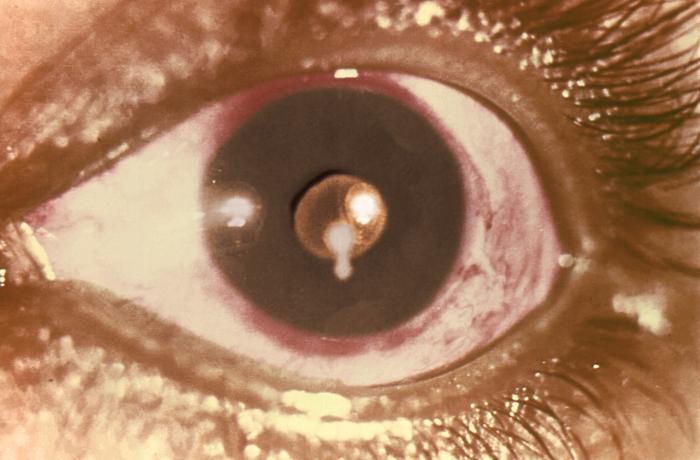
Cisticercose ocular:

  • Sensação de corpo estranho
  • Dor ocular
  • Moscas volantes
  • Diminuição da acuidade visual
  • Tremor Tremor Cyclical movement of a body part that can represent either a physiologic process or a manifestation of disease. Intention or action tremor, a common manifestation of cerebellar diseases, is aggravated by movement. In contrast, resting tremor is maximal when there is no attempt at voluntary movement, and occurs as a relatively frequent manifestation of parkinson disease. Myotonic Dystrophies ocular
  • Olho vermelho
  • Fotofobia

Neurocisticercose:

  • Convulsões
  • Défices neurológicos focais
  • Hipertensão intracraniana:
    • Cefaleias
    • Náuseas
    • Vertigens
    • Papiledema
  • Distúrbios psiquiátricos:
    • Alteração do estado de consciência
    • Distúrbios de personalidade
    • Dificuldades de aprendizagem
Cisticercose ocular

Cisticerco de ténia solium na pupila do olho de um paciente:
Embora seja raro, os cisticercos podem flutuar no olho, afetando a visão.
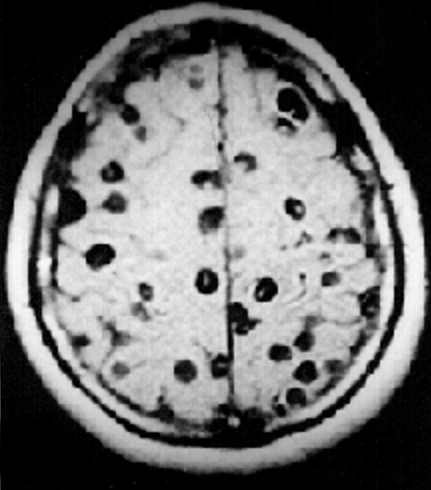
Imagem: “14629” por CDC/Dr. H. Zaiman, Dr. Myron G. Schultz. Licença: Public Domain

Diagnóstico e Tratamento

Diagnóstico

  • Achados laboratoriais inespecíficos:
    • Anemia Anemia Anemia is a condition in which individuals have low Hb levels, which can arise from various causes. Anemia is accompanied by a reduced number of RBCs and may manifest with fatigue, shortness of breath, pallor, and weakness. Subtypes are classified by the size of RBCs, chronicity, and etiology. Anemia: Overview and Types
    • Eosinofilia
  • Análise das fezes:
    • A identificação de ovos ou proglótides estabelece o diagnóstico de teníase.
    • ELISA ELISA An immunoassay utilizing an antibody labeled with an enzyme marker such as horseradish peroxidase. While either the enzyme or the antibody is bound to an immunosorbent substrate, they both retain their biologic activity; the change in enzyme activity as a result of the enzyme-antibody-antigen reaction is proportional to the concentration of the antigen and can be measured spectrophotometrically or with the naked eye. Many variations of the method have been developed. St. Louis Encephalitis Virus para pesquisa de antigénios de Taenia Taenia Taenia belong to the Cestoda class of helminths. Humans are infected with these tapeworms by eating undercooked beef (T. saginata) or pork (T. solium and T. asiatica). Taeniasis is often asymptomatic, but the ingestion of larvae can cause abdominal discomfort, nausea, and constipation or diarrhea. Taenia/Taeniasis
    • PCR PCR Polymerase chain reaction (PCR) is a technique that amplifies DNA fragments exponentially for analysis. The process is highly specific, allowing for the targeting of specific genomic sequences, even with minuscule sample amounts. The PCR cycles multiple times through 3 phases: denaturation of the template DNA, annealing of a specific primer to the individual DNA strands, and synthesis/elongation of new DNA molecules. Polymerase Chain Reaction (PCR) para identificar o ADN
  • Teste serológico para a cisticercose: “enzyme-linked immunoelectrotransfer blot” (EITB)
  • A TAC ou RM pode ser utilizada em pacientes com suspeita de neurocisticercose.
    • Aparência de “queijo suíço”
    • As lesões podem ser:
      • Quísticas
      • Calcificadas
      • Em formato de anel
    • Outras achados sugestivos:
      • Hidrocefalia com alargamento dos ventrículos
      • Envolvimento leptomeníngeo
Neurocisticercose

RM de um paciente com neurocisticercose:
Lesões quísticas do tipo “queijo suíço” dispersas pelo cérebro.

Imagem: “Neurocysticercosis” de Shushruth. Licença: Public Domain

Tratamento da teníase

A teníase pode ser tratada com fármacos anti-helmínticos:

  • Praziquantel Praziquantel An anthelmintic used in most schistosome and many cestode infestations. Anthelmintic Drugs (preferencialmente)
  • Niclosamida

Tratamento da cisticercose

  • Geral: A doença assintomática não requer tratamento.
  • Cisticercose ocular: avaliação oftalmológica
  • Neurocisticercose:
    • Terapêutica anti-helmíntica
      • Albendazole Albendazole A benzimidazole broad-spectrum anthelmintic structurally related to mebendazole that is effective against many diseases. Anthelmintic Drugs
      • Pode ser associado Praziquantel Praziquantel An anthelmintic used in most schistosome and many cestode infestations. Anthelmintic Drugs.
    • Corticosteróides
      • Prednisona ou dexametasona
      • Admnistrados antes e durante a terapêutica anti-helmíntica
      • Reduzem a inflamação causada por quistos degenerados
    • Fármacos anti-epiléticos
    • Seguimento em consulta de neurocirurgica devido a:
      • ↑ Pressão intracraniana
      • Cisticercos intraventriculares

Prevenção

  • Cozinhar bem a carne.
  • Identificar e tratar os pacientes infetados.
  • Medidas de higiene adequadas.
  • Evitar alimentos e água potencialmente contaminados.

Comparação de Espécies de Ténias

Tabela: Características e doenças de diferentes espécies de ténias
Microrganismo Dibothriocephalus latus Taenia Taenia Taenia belong to the Cestoda class of helminths. Humans are infected with these tapeworms by eating undercooked beef (T. saginata) or pork (T. solium and T. asiatica). Taeniasis is often asymptomatic, but the ingestion of larvae can cause abdominal discomfort, nausea, and constipation or diarrhea. Taenia/Taeniasis saginata Echinococcus Echinococcus Echinococcosis is a parasitic disease caused by Echinococcus tapeworms. Infection most often occurs from the ingestion of Echinococcus eggs in food or water contaminated with dog feces. Signs and symptoms are caused by hydatid cyst development in visceral organs and depend on the species. Echinococcus/Echinococcosis granulosus
Características
  • Aproximadamente 10 m de comprimento
  • Sem ganchos
  • Bothria presente
  • > 3000 proglótides
  • < 5 m de comprimento
  • Sem ganchos
  • Sem pescoço
  • Aproximadamente 1000 proglótides
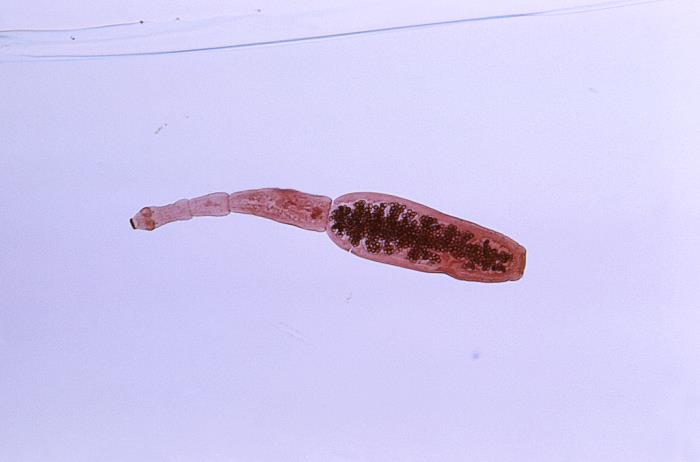
  • 2-7 mm de comprimento
  • Ganchos presentes
  • 3-6 proglótides
Transmissão Ingestão de peixe cru infetado Ingestão de carne bovina crua infetada Fecal-oral (ingestão de alimentos ou água contaminados)
Doença Difilobotríase Teníase Equinococose quística
Clínica
  • Desconforto abdominal
  • Perda de peso
  • Défice de vitamina B12
  • Obstrução intestinal
  • Frequentemente assintomática
  • Sintomas GI ligeiros
Dependente da localização e tamanho dos quistos hidáticos
Diagnóstico Ovos ou proglótides nas fezes Ovos ou proglótides nas fezes
  • Imagiologia
  • Serologia
Tratamento
  • Albendazole Albendazole A benzimidazole broad-spectrum anthelmintic structurally related to mebendazole that is effective against many diseases. Anthelmintic Drugs
  • Drenagem percutânea
  • Excisão cirúrgica
Prevenção
  • Congelar peixe.
  • Cozinhar bem o peixe.
  • Medidas de saneamento da água
Cozinhar bem a carne.
  • Higiene pessoal
  • Evitar o contacto com cães vadios.
  • Evitar alimentos potencialmente contaminados.
  • Melhorar o saneamento da água.

Diagnósticos Diferenciais

  • Ascaridiose: infeção causada pelo parasita Ascaris Ascaris Ascaris is a genus of parasitic nematodes. The infection, ascariasis, is most often caused by A. lumbricoides. Transmission occurs primarily via ingestion of water or food contaminated with Ascaris eggs. Most patients with ascariasis are asymptomatic. Ascaris/Ascariasis lumbricoides. A sua transmissão ocorre por ingestão de água ou alimentos contaminados com ovos de Ascaris Ascaris Ascaris is a genus of parasitic nematodes. The infection, ascariasis, is most often caused by A. lumbricoides. Transmission occurs primarily via ingestion of water or food contaminated with Ascaris eggs. Most patients with ascariasis are asymptomatic. Ascaris/Ascariasis. Os pacientes podem ser assintomáticos ou apresentar tosse e hemoptises. Uma grande quantidade de larvas pode levar a obstrução intestinal e afetar o crescimento das crianças. A análise das fezes pode revelar a presença de larvas ou ovos. O tratamento é feito com fármacos anti-helmínticos.
  • Gastroenterite: inflamação gástrica e intestinal, geralmente causada por bactérias, vírus ou parasitas: As características clínicas mais MAIS Androgen Insensitivity Syndrome comuns incluem dor abdominal, diarreia, vómitos, febre e desidratação. Nem sempre é necessária a análise ou cultura das fezes para confirmar o diagnóstico, embora possa ajudar a estabelecer a etiologia em determinadas circunstâncias. A maioria dos casos são autolimitados; portanto, o único tratamento necessário é o de suporte (hidratação).
  • Doença inflamatória intestinal (DII): inclui a doença de Crohn e a colite ulcerativa e é caracterizada por inflamação crónica do tubo digestivo, por efeito de uma resposta imunomediada por células contra a mucosa gastrointestinal. Os sintomas mais MAIS Androgen Insensitivity Syndrome comuns são diarreia, dor abdominal, perda de peso e manifestações extraintestinais. O diagnóstico envolve imagiologia, endoscopia e biópsia. O tratamento inclui corticosteróides, aminossalicilatos, imunomoduladores e agentes biológicos.
  • Anemia Anemia Anemia is a condition in which individuals have low Hb levels, which can arise from various causes. Anemia is accompanied by a reduced number of RBCs and may manifest with fatigue, shortness of breath, pallor, and weakness. Subtypes are classified by the size of RBCs, chronicity, and etiology. Anemia: Overview and Types perniciosa: ausa deficiência de vitamina B12 e anemia Anemia Anemia is a condition in which individuals have low Hb levels, which can arise from various causes. Anemia is accompanied by a reduced number of RBCs and may manifest with fatigue, shortness of breath, pallor, and weakness. Subtypes are classified by the size of RBCs, chronicity, and etiology. Anemia: Overview and Types megaloblástica, devido à deficiência do fator intrínseco, que é necessário para a absorção da vitamina B12. Os pacientes podem manifestar fadiga, diminuição da função cognitiva, neuropatia, ataxia Ataxia Impairment of the ability to perform smoothly coordinated voluntary movements. This condition may affect the limbs, trunk, eyes, pharynx, larynx, and other structures. Ataxia may result from impaired sensory or motor function. Sensory ataxia may result from posterior column injury or peripheral nerve diseases. Motor ataxia may be associated with cerebellar diseases; cerebral cortex diseases; thalamic diseases; basal ganglia diseases; injury to the red nucleus; and other conditions. Ataxia-telangiectasia e glossite. Níveis de vitamina B12 baixos, anticorpos anti-fator intrínseco e o teste de Schilling podem ser usados para chegar ao diagnóstico. O tratamento inclui a reposição de vitamina B12.
  • Meningite bacteriana: infeção bacteriana das meninges Meninges The brain and the spinal cord are enveloped by 3 overlapping layers of connective tissue called the meninges. The layers are, from the most external layer to the most internal layer, the dura mater, arachnoid mater, and pia mater. Between these layers are 3 potential spaces called the epidural, subdural, and subarachnoid spaces. Meninges: Anatomy, que acarreta maior risco de vida: A meningite bacteriana pode cursar com febre, cefaleias, sinais meníngeos e convulsões. O diagnóstico é feito através da história clínica e confirmado pela deteção de bactérias no LCR, obtido por punção lombar. O tratamento envolve corticosteróides e antibioterapia intravenosa dirigida contra as bactérias identificadas.
  • Tumores intracranianos: crescimento benigno ou maligno de células no cérebro: Os tumores intracranianos manifestam-se clinicamente por cefaleias, náuseas ou vómitos inexplicáveis, visão desfocada e dificuldades na fala ou audição. O diagnóstico é obtido através de um exame neurológico, exames imagiológicos (RM ou TAC) e, por vezes, biópsia. O tratamento inclui radioterapia, quimioterapia e/ou cirurgia.
  • Abcesso cerebral: coleção de pus no parênquima cerebral provocada por uma infeção: Um abcesso cerebral manifesta-se clinicamente por febre, cefaleias, convulsões, náuseas e vómitos. O diagnóstico é confirmado por exame imagiológico, uma vez que é difícil obter um diagnóstico definitivo apenas com base na apresentação clínica. O tratamento inclui antibioterapia e drenagem cirúrgica do abcesso.

Referências

  1. Craig P, Ito A. (2007). Intestinal cestodes. Curr Opin Infect Dis 20:524–532. http://reference.medscape.com/medline/abstract/17762788
  2. O’Neal S, Noh J, Wilkins P, Keene W, Lambert W, Anderson J. (2011). Taenia solium tapeworm infection, Oregon, 2006-2009. Emerg Infect Dis 17:1030–1036. http://reference.medscape.com/medline/abstract/21749764
  3. O’Keefe KA, Eberhard ML, Shafir SC, Wilkins P, Ash LR, Sorvillo FJ. (2015). Cysticercosis-related hospitalizations in the United States, 1998-2011. Am J Trop Med Hyg 92:354–359. http://reference.medscape.com/medline/abstract/25385857
  4. Garcia HH, Del Brutto OH. (2005). Neurocysticercosis: updated concepts about an old disease. Lancet Neurol 4:653–661. http://reference.medscape.com/medline/abstract/16168934
  5. Centers for Disease Control and Prevention. (2024). About human tapeworm (taeniasis). Centers for Disease Control and Prevention. https://www.cdc.gov/taeniasis/about/index.html
  6. Leder K, Weller PF. (2025). Tapeworm infections. In Baron EL (Ed.), UpToDate. Retrieved February 10, 2025, from https://www.uptodate.com/contents/tapeworm-infections
  7. Pearson RD. (2023). Taenia solium (pork tapeworm) infection and cysticercosis. MSD Manual Professional Version. Retrieved February 10, 2025, from https://www.msdmanuals.com/professional/infectious-diseases/cestodes-tapeworms/taenia-solium-pork-tapeworm-infection-and-cysticercosis
  8. Pearson RD. (2023). Taenia saginata (beef tapeworm) infection. MSD Manual Professional Version. Retrieved February 10, 2025, from https://www.msdmanuals.com/professional/infectious-diseases/cestodes-tapeworms/taenia-saginata-beef-tapeworm-infection
  9. Pearson RD. (2023). Taenia asiatica (Asian tapeworm) infection. MSD Manual Profession Version. Retrieved February 10, 2025, from https://www.msdmanuals.com/professional/infectious-diseases/cestodes-tapeworms/taenia-asiatica-asian-tapeworm-infection
  10. Lesh EJ, Brady MF. (2023). Tapeworm. StatPearls. Retrieved February 10, 2025, from https://www.ncbi.nlm.nih.gov/books/NBK537154/
  11. The Australian Society for Parasitology Inc. (n.d.). Taenia. Retrieved February 10, 2025, from https://parasite.org.au/para-site/text/taenia-text.html
  12. Tengsupakul S. (2023). Taenia infection. In Steele RW (Ed.), Medscape. Retrieved February 10, 2025, from https://emedicine.medscape.com/article/999727-overview

Crie sua conta gratuita ou faça login para continuar lendo!

Cadastre-se agora e tenha acesso grátis ao Lecturio, com páginas de conceitos, vídeos de medicina e questões para sua educação médica.

Aprende mais com a Lecturio:

Multiple devices displaying human anatomy and health education content.

Complementa o teu estudo da faculdade com o companheiro de estudo tudo-em-um da Lecturio, através de métodos de ensino baseados em evidência.

Estuda onde quiseres

Two iPhones display medical education apps, one showing anatomy, the other Bookmatcher.

A Lecturio Medical complementa o teu estudo através de métodos de ensino baseados em evidência, vídeos de palestras, perguntas e muito mais – tudo combinado num só lugar e fácil de usar.

User Reviews

Have a holly, jolly study session 🎁 Save 50% on all plans now >>

Que tengas una sesión de estudio alegre y navideña 🎁 Ahorra 50% en todos los planes >>

Details