


Digestão e Absorção de Hidratos de Carbono

Os hidratos de carbono armazenam energia e são 1 dos 3 principais macronutrientes (para além das proteínas e dos lípidos). Estes estão presentes em diversos alimentos, tais como cereais, frutas, leguminosas e muitos vegetais. Os polissacarídeos, a maioria sob a forma de amido, são a principal fonte alimentar de hidratos de carbono para os seres humanos. Para serem utilizados como energia pelos humanos, a maioria dos hidratos de carbono devem ser digeridos (decompostos) em monossacarídeos que, por sua vez, podem ser absorvidos e depois metabolizados. A digestão dos hidratos de carbono começa na boca com a ação das amilases salivares. O amido restante é ainda decomposto pela amilase pancreática e pelas enzimas da bordadura em escova nos intestinos. A oxidação de 1 g de hidratos de carbono fornece 4 kcal de energia.

Last updated: Apr 25, 2025

Editorial responsibility: Stanley Oiseth, Lindsay Jones, Evelin Maza

Revisão da Estrutura dos Hidratos de Carbono

Classificação

Tabela: Classificação dos hidratos de carbono com base no tamanho
Nome Definição Exemplos em humanos
Monossacarídeos Moléculas que consistem num grupo de açúcar simples
  • Glucose Glucose A primary source of energy for living organisms. It is naturally occurring and is found in fruits and other parts of plants in its free state. It is used therapeutically in fluid and nutrient replacement. Lactose Intolerance
  • Galactose Galactose An aldohexose that occurs naturally in the d-form in lactose, cerebrosides, gangliosides, and mucoproteins. Deficiency of galactosyl-1-phosphate uridyltransferase causes an error in galactose metabolism called galactosemia, resulting in elevations of galactose in the blood. Lactose Intolerance
  • Frutose
    Dissacarídeos Combinação de 2 monossacarídeos
    • Maltose ( glucose Glucose A primary source of energy for living organisms. It is naturally occurring and is found in fruits and other parts of plants in its free state. It is used therapeutically in fluid and nutrient replacement. Lactose Intolerance + glucose Glucose A primary source of energy for living organisms. It is naturally occurring and is found in fruits and other parts of plants in its free state. It is used therapeutically in fluid and nutrient replacement. Lactose Intolerance)
    • Lactose ( glucose Glucose A primary source of energy for living organisms. It is naturally occurring and is found in fruits and other parts of plants in its free state. It is used therapeutically in fluid and nutrient replacement. Lactose Intolerance + galactose Galactose An aldohexose that occurs naturally in the d-form in lactose, cerebrosides, gangliosides, and mucoproteins. Deficiency of galactosyl-1-phosphate uridyltransferase causes an error in galactose metabolism called galactosemia, resulting in elevations of galactose in the blood. Lactose Intolerance)
    • Sacarose ( glucose Glucose A primary source of energy for living organisms. It is naturally occurring and is found in fruits and other parts of plants in its free state. It is used therapeutically in fluid and nutrient replacement. Lactose Intolerance + frutose)
      Oligossacarídeos Combinação de 3-10 monossacarídeos Geralmente ligados a:
      • Proteínas (formando glicoproteínas)
      • Lípidos (formando glicolípidos)
        Polissacarídeos Combinação de > 10 monossacarídeos
        • Glicogénio
        • Celulose
        • Glicosaminoglicanos (GAGs)
        • Amido (combinação de 2 polissacarídeos: amilose e amilopectina)

          Ligações glicosídicas

          • Ligam uma molécula de açúcar a qualquer outro componente
          • Ligações covalentes entre:
            • O grupo -OH e o carbono anomérico (geralmente C1) de um açúcar
            • O grupo -OH e outro composto (pode ser outra molécula de açúcar ou qualquer outro componente)
          • A formação da ligação resulta na perda de H2O
          • A nomenclatura baseia-se nos carbonos ligados e no anomerismo do carbono anomérico
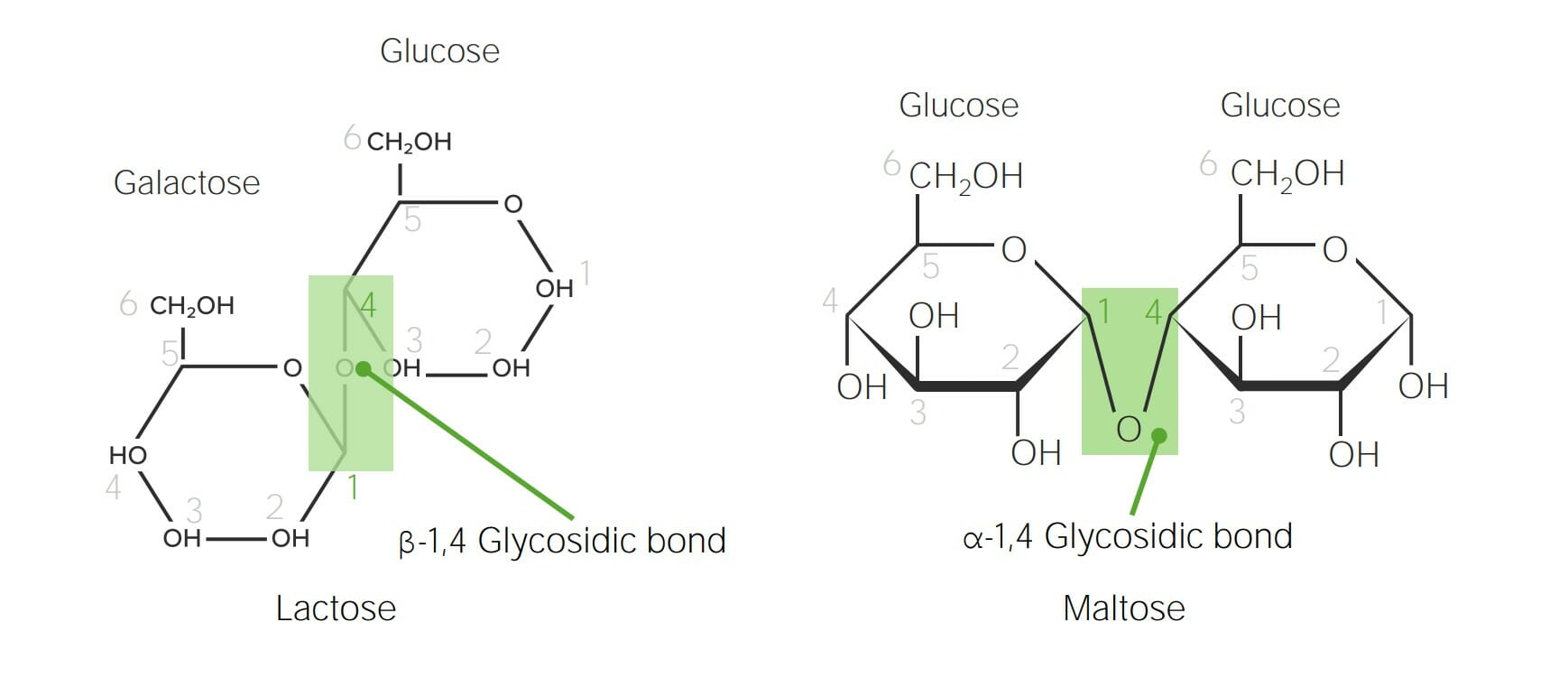
            • E.g., ligações glicosídicas α-1,4 ligam o carbono C1 (anomérico) ao primeiro sacarídeo (com um grupo hidroxil orientado na configuração α) ao grupo hidroxilo no carbono C4 do sacarídeo seguinte
          Chemical structure of lactose and maltose demonstrating α versus β glycosidic bonds

          Estrutura química da lactose e maltose demonstrando ligações glicosídicas α versus β:
          Na lactose, o carbono anomérico na galactose (C1) está na configuração β (o grupo hidroxilo aponta para cima); portanto, quando se forma uma ligação da galactose com o C4 na glicose, forma-se uma ligação β-1,4-glicosídica. A maltose é constituída por 2 moléculas de glucose. O carbono anomérico na glucose (C1) tem a configuração α (o grupo hidroxilo aponta para baixo); portanto, a ligação na maltose é uma ligação α-1,4-glicosídica entre 2 moléculas de glucose.

          Imagem por Lecturio.

          Digestão dos Hidratos de Carbono

          Os hidratos de carbono são principalmente digeridos por amilases e enzimas da bordadura em escova. Os hidratos de carbono só podem ser absorvidos como monossacarídeos, pelo que estas enzimas decompõem grandes moléculas de amido até serem obtidos monossacarídeos únicos.

          Nota: Muitos hidratos de carbono dietéticos encontram-se sob a forma de amido, que é uma mistura de amilose e amilopectina (ambos são constituídos inteiramente por moléculas de glucose Glucose A primary source of energy for living organisms. It is naturally occurring and is found in fruits and other parts of plants in its free state. It is used therapeutically in fluid and nutrient replacement. Lactose Intolerance):
          • A amilose é uma cadeia linear de moléculas de glucose Glucose A primary source of energy for living organisms. It is naturally occurring and is found in fruits and other parts of plants in its free state. It is used therapeutically in fluid and nutrient replacement. Lactose Intolerance unidas a ligações α-1,4-glicosídicas.
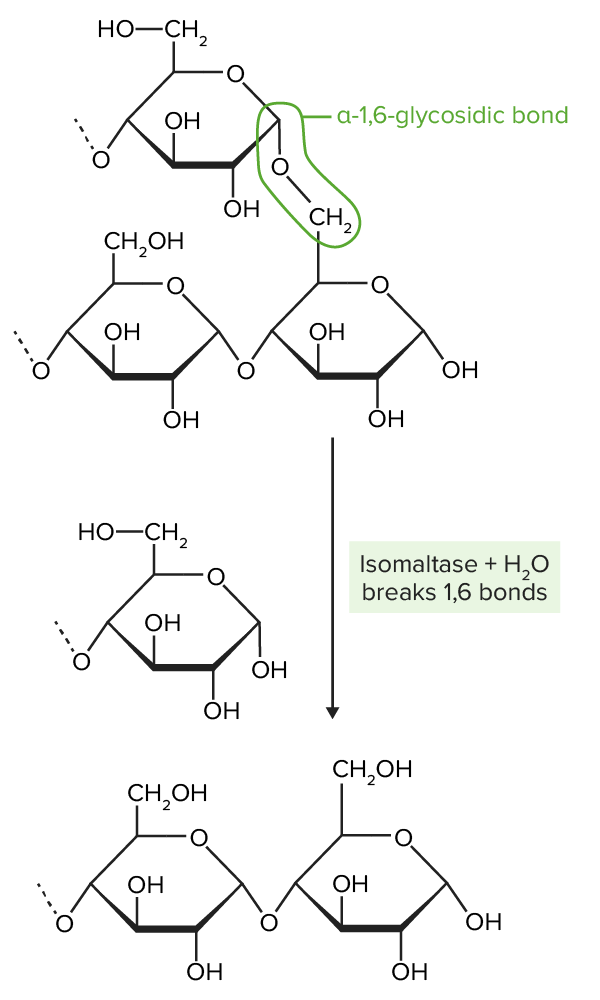
          • A amilopectina inclui numerosos ramos formados por ligações α-1,6- glicosídicas.

          Amilases

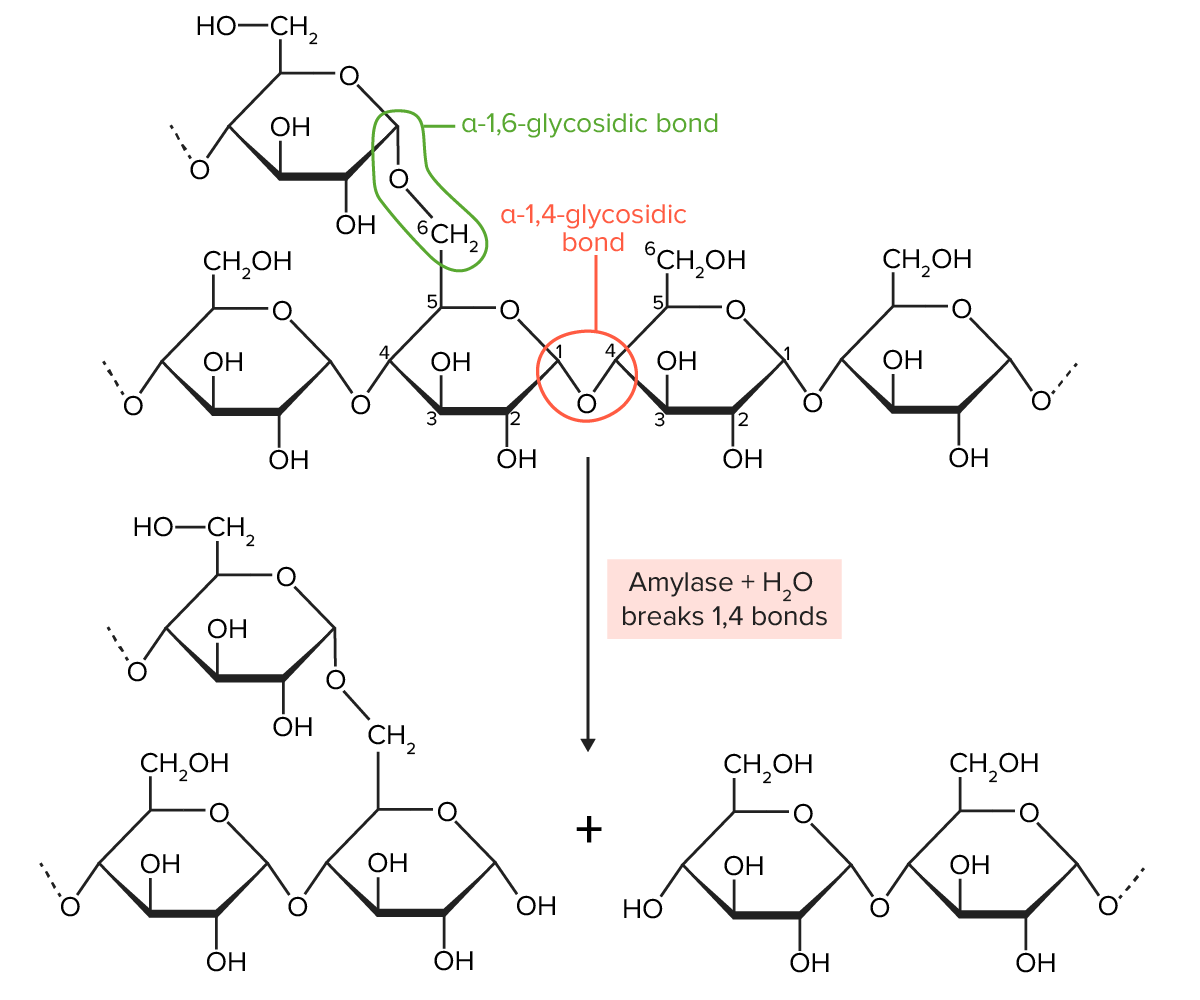
          • Clivam ligações α-1,4-glicosídicas entre moléculas de açúcar
          • Criam cadeias de polissacarídeos cada vez mais MAIS Androgen Insensitivity Syndrome pequenas até que a maioria das ligações α-1,4-glicosídicas sejam decompostas, resultando em:
            • Monossacarídeos
            • Dissacarídeos
            • Oligossacarídeos
            • Amidos indigestos (açúcares unidos por outros tipos de ligações)
          • Ativam na presença de um pH pH The quantitative measurement of the acidity or basicity of a solution. Acid-Base Balance mais MAIS Androgen Insensitivity Syndrome elevado:
            • Ativas na boca e no intestino delgado
            • Inativas no estômago
          • Tipos e localização da amilase:
            • Amilase salivar: secretada na boca, por glândulas salivares
            • Amilase pancreática: secretada no duodeno, pelo pâncreas exócrino
          Amylopectin is partially digested by amylase

          A amilopectina é parcialmente digerida pela amilase. As moléculas de amilopectina são cadeias de glucose, unidas por ligações glicosídicas α-1,4 (criam uma cadeia reta de moléculas de glucose) e ligações glicosídicas α-1,6 (criam um ramo fora da cadeia reta). A amilase quebra as ligações glicosídicas α-1,4.

          Imagem por Lecturio.

          Enzimas da bordadura em escova

          As enzimas de bordadura em escova são proteínas ligadas à membrana, na superfície luminal dos enterócitos, no intestino delgado. Existem 4 grandes enzimas da bordadura em escova envolvidas na digestão dos hidratos de carbono.
          • Isomaltase Isomaltase An enzyme that catalyzes the endohydrolysis of 1, 6-alpha-glycosidic linkages in isomaltose and dextrins produced from starch and glycogen by alpha-amylases. Digestion and Absorption of Carbohydrates: cliva as ligações α-1,6-glicosídicas
          • Maltase Maltase Digestion and Absorption of Carbohydrates:
            • Cliva a maltose → glicose + glicose
            • Cliva a maltotriose → glicose + glicose + glicose
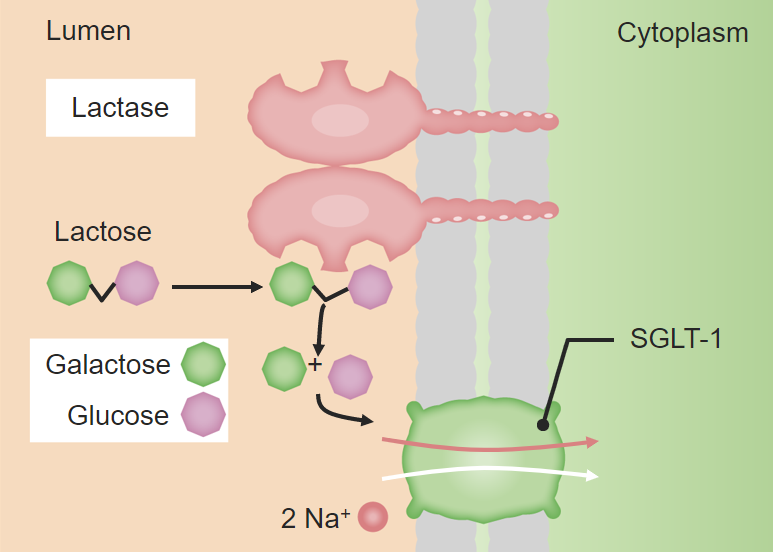
          • Lactase Lactase An enzyme which catalyzes the hydrolysis of lactose to d-galactose and d-glucose. Defects in the enzyme cause lactose intolerance. Digestion and Absorption of Carbohydrates: cliva a lactose → glicose + galactose Galactose An aldohexose that occurs naturally in the d-form in lactose, cerebrosides, gangliosides, and mucoproteins. Deficiency of galactosyl-1-phosphate uridyltransferase causes an error in galactose metabolism called galactosemia, resulting in elevations of galactose in the blood. Lactose Intolerance
          • Sacarase:
            • Cliva a sacarose → glicose + frutose
            • Cliva outros oligossacarídeos pequenos

          Absorção de Hidratos de Carbono

          Após a digestão, os hidratos de carbono são absorvidos e transportados através da circulação sanguínea até à circulação portal. O transporte pode ser um mecanismo ativo, facilitado ou passivo.

          • O transporte ativo envolve o uso de enzimas transportadoras, que utilizam energia para movimentarem os hidratos de carbono através da membrana plasmática, mesmo contra o gradiente de concentração.
          • A difusão facilitada ocorre em níveis de concentração mais MAIS Androgen Insensitivity Syndrome baixos com a ajuda adicional de enzimas transmembranares que não requerem energia.
          • A absorção passiva faz baixar os níveis de concentração dos açúcares sem assistência enzimática ou energia necessária; é o mecanismo mais MAIS Androgen Insensitivity Syndrome lento.

          Os transportadores têm funções específicas e as suas funções podem ser ativas, facilitadas ou passivas.

          • Transportador de glucose Glucose A primary source of energy for living organisms. It is naturally occurring and is found in fruits and other parts of plants in its free state. It is used therapeutically in fluid and nutrient replacement. Lactose Intolerance tipo 1 (SGLT1, pela sigla em inglês):
            • Encontrado na membrana luminal dos enterócitos, no intestino delgado
            • Atua transportando glicose e galactose Galactose An aldohexose that occurs naturally in the d-form in lactose, cerebrosides, gangliosides, and mucoproteins. Deficiency of galactosyl-1-phosphate uridyltransferase causes an error in galactose metabolism called galactosemia, resulting in elevations of galactose in the blood. Lactose Intolerance para o interior dos enterócitos
            • Depende de um gradiente de sódio gerado ativamente por uma ATPase Na+/K+
            • Transporta 2 iões sódio, 1 glucose Glucose A primary source of energy for living organisms. It is naturally occurring and is found in fruits and other parts of plants in its free state. It is used therapeutically in fluid and nutrient replacement. Lactose Intolerance ou galactose Galactose An aldohexose that occurs naturally in the d-form in lactose, cerebrosides, gangliosides, and mucoproteins. Deficiency of galactosyl-1-phosphate uridyltransferase causes an error in galactose metabolism called galactosemia, resulting in elevations of galactose in the blood. Lactose Intolerance e água
          • Transportador de glucose Glucose A primary source of energy for living organisms. It is naturally occurring and is found in fruits and other parts of plants in its free state. It is used therapeutically in fluid and nutrient replacement. Lactose Intolerance 2 ( GLUT2 GLUT2 A glucose transport facilitator that is expressed primarily in pancreatic beta cells; liver; and kidneys. It may function as a glucose sensor to regulate insulin release and glucose homeostasis. Digestion and Absorption, pela sigla em inglês)
            • Encontrado nos rins, no fígado e no pâncreas e na membrana basolateral dos enterócitos do intestino delgado.
            • Transporta os 3 monossacarídeos primários ( glucose Glucose A primary source of energy for living organisms. It is naturally occurring and is found in fruits and other parts of plants in its free state. It is used therapeutically in fluid and nutrient replacement. Lactose Intolerance, galactose Galactose An aldohexose that occurs naturally in the d-form in lactose, cerebrosides, gangliosides, and mucoproteins. Deficiency of galactosyl-1-phosphate uridyltransferase causes an error in galactose metabolism called galactosemia, resulting in elevations of galactose in the blood. Lactose Intolerance e frutose) através de difusão facilitada
            • No que diz respeito à absorção: o GLUT2 GLUT2 A glucose transport facilitator that is expressed primarily in pancreatic beta cells; liver; and kidneys. It may function as a glucose sensor to regulate insulin release and glucose homeostasis. Digestion and Absorption transporta monossacarídeos para o exterior dos enterócitos e para o espaço intersticial.
            • A bidirecionalidade permite uma mudança de função dependendo das condições celulares.
          • GLUT5 GLUT5 A hexose transporter that mediates fructose transport in skeletal muscle and adipocytes and is responsible for luminal uptake of dietary fructose in the small intestine. Digestion and Absorption
            • Transporte de frutose através de difusões facilitadas

          A absorção passiva de glucose Glucose A primary source of energy for living organisms. It is naturally occurring and is found in fruits and other parts of plants in its free state. It is used therapeutically in fluid and nutrient replacement. Lactose Intolerance representa uma pequena parte da capacidade de absorção. A maior parte da absorção ocorre na 1.ª parte do intestino delgado (duodeno, jejuno).

          Ordem de eventos na absorção de monossacarídeos:
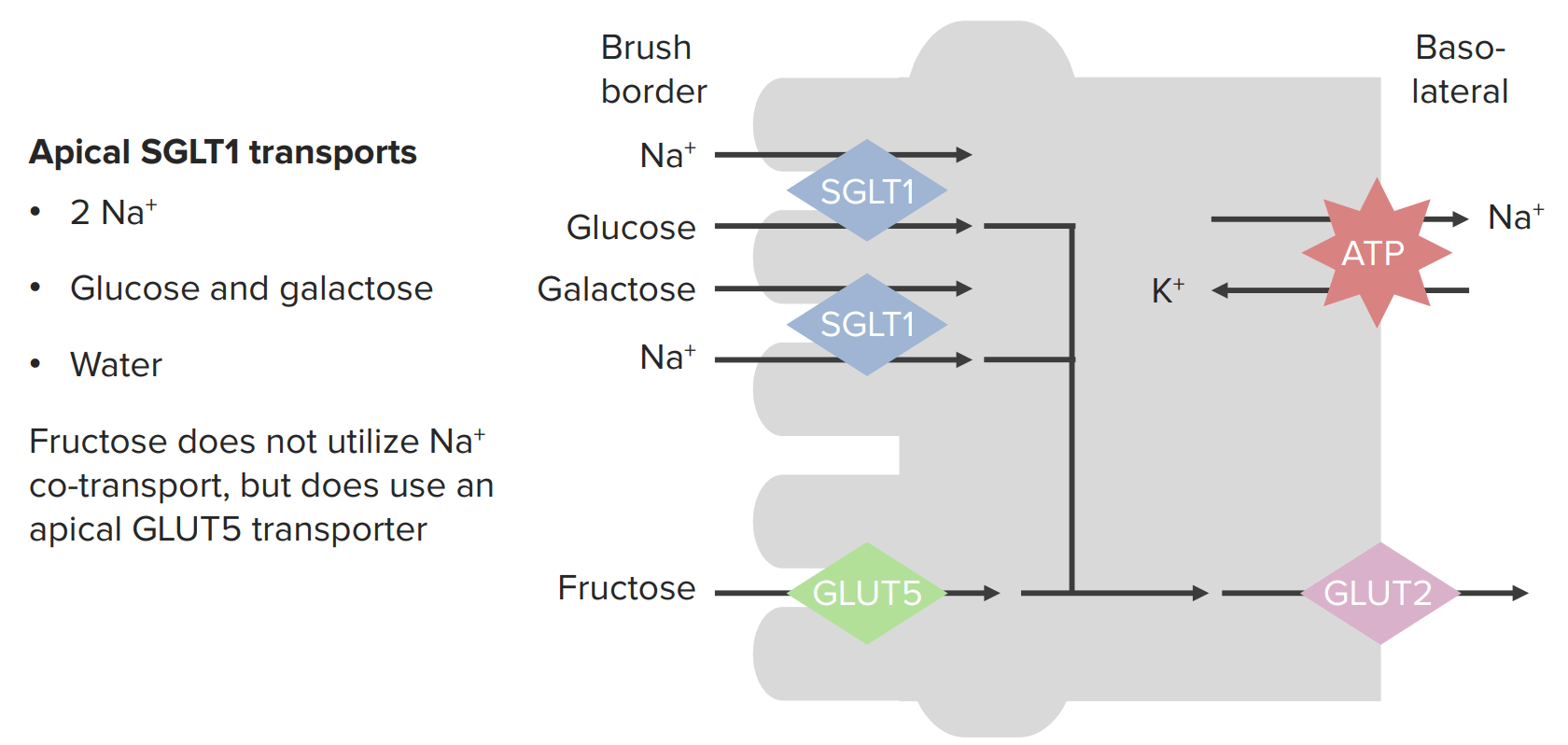
          1. Absorção para os enterócitos através da membrana apical:
            • Glucose Glucose A primary source of energy for living organisms. It is naturally occurring and is found in fruits and other parts of plants in its free state. It is used therapeutically in fluid and nutrient replacement. Lactose Intolerance e galactose Galactose An aldohexose that occurs naturally in the d-form in lactose, cerebrosides, gangliosides, and mucoproteins. Deficiency of galactosyl-1-phosphate uridyltransferase causes an error in galactose metabolism called galactosemia, resulting in elevations of galactose in the blood. Lactose Intolerance: via SGLT1
            • Frutose: via GLUT5 GLUT5 A hexose transporter that mediates fructose transport in skeletal muscle and adipocytes and is responsible for luminal uptake of dietary fructose in the small intestine. Digestion and Absorption
          2. Libertação dos mesmos no espaço intersticial através do GLUT2 GLUT2 A glucose transport facilitator that is expressed primarily in pancreatic beta cells; liver; and kidneys. It may function as a glucose sensor to regulate insulin release and glucose homeostasis. Digestion and Absorption, na membrana basolateral, através de difusão facilitada
          3. Absorção para os capilares a partir do espaço intersticial
          4. Os capilares drenam para as veias → veia portal → fígado para utilização no metabolismo
          Absorption Monosaccharides

          Absorção de monossacarídeos através de enterócitos
          SGLT1: transportador ligado a glucose-sódio
          GLUT5: transportador de glicose 5
          GLUT2: transportador de glicose 2
          (pelas siglas em inglês)

          Imagem por Lecturio.

          Transporte de Monossacarídeos Dentro do Organismo

          Uma vez na circulação sanguínea, os monossacarídeos são transportados para diferentes células em todo o corpo e absorvidos pelas células periféricas, por vários transportadores diferentes. Vários transportadores de glicose importantes incluem:

          • GLUT4:
            • O transportador mais MAIS Androgen Insensitivity Syndrome importante de absorção de glucose Glucose A primary source of energy for living organisms. It is naturally occurring and is found in fruits and other parts of plants in its free state. It is used therapeutically in fluid and nutrient replacement. Lactose Intolerance
            • Encontra-se expressa sobretudo no músculo esquelético e no tecido adiposo
            • Estimulado pela insulina para transportar glicose circulante para as células, para utilização e/ou armazenamento
          • SGLT2:
            • Localizado no túbulo contornado proximal (TCP) nos rins
            • Responsável por > 90% da reabsorção da glicose filtrada
          Tabela: Revisão dos transportadores
          Transportador Localização Função
          GLUT1 Maioria das células humanas: hemácias, SNC, córnea, placenta Placenta A highly vascularized mammalian fetal-maternal organ and major site of transport of oxygen, nutrients, and fetal waste products. It includes a fetal portion (chorionic villi) derived from trophoblasts and a maternal portion (decidua) derived from the uterine endometrium. The placenta produces an array of steroid, protein and peptide hormones (placental hormones). Placenta, Umbilical Cord, and Amniotic Cavity, tecido fetal…
          • Controla a absorção de glucose Glucose A primary source of energy for living organisms. It is naturally occurring and is found in fruits and other parts of plants in its free state. It is used therapeutically in fluid and nutrient replacement. Lactose Intolerance para o SNC através da barreira hemato-encefálica
          • Absorção basal de glucose Glucose A primary source of energy for living organisms. It is naturally occurring and is found in fruits and other parts of plants in its free state. It is used therapeutically in fluid and nutrient replacement. Lactose Intolerance em todas as células
          • Alta afinidade para a glicose
          GLUT2 GLUT2 A glucose transport facilitator that is expressed primarily in pancreatic beta cells; liver; and kidneys. It may function as a glucose sensor to regulate insulin release and glucose homeostasis. Digestion and Absorption
          • Intestino delgado: membrana basolateral dos enterócitos
          • Fígado: hepatócitos
          • Células β dos ilhéus pancreáticos
          • Rim e intestino delgado
          • Transporta os monossacarídeos da membrana basolateral dos enterócitos para o sangue
          • Permite que os hepatócitos absorvam e libertem glucose Glucose A primary source of energy for living organisms. It is naturally occurring and is found in fruits and other parts of plants in its free state. It is used therapeutically in fluid and nutrient replacement. Lactose Intolerance para a glicólise e para a gluconeogénese
          GLUT3
          • Maioria das células humanas
          • SNC
          • Placenta Placenta A highly vascularized mammalian fetal-maternal organ and major site of transport of oxygen, nutrients, and fetal waste products. It includes a fetal portion (chorionic villi) derived from trophoblasts and a maternal portion (decidua) derived from the uterine endometrium. The placenta produces an array of steroid, protein and peptide hormones (placental hormones). Placenta, Umbilical Cord, and Amniotic Cavity
          • Transporta glucose Glucose A primary source of energy for living organisms. It is naturally occurring and is found in fruits and other parts of plants in its free state. It is used therapeutically in fluid and nutrient replacement. Lactose Intolerance através da barreira hemato-encefálica, mesmo em momentos de hipoglicemia relativa
          • Alta afinidade para a glicose
          GLUT4
          • Tecido adiposo
          • Tecido muscular
          • Regula a homeostasia da glicose
          • Estimulado pela insulina: captação e armazenamento controlado da glucose Glucose A primary source of energy for living organisms. It is naturally occurring and is found in fruits and other parts of plants in its free state. It is used therapeutically in fluid and nutrient replacement. Lactose Intolerance
          • Induzido pelo exercício físico
          GLUT5 GLUT5 A hexose transporter that mediates fructose transport in skeletal muscle and adipocytes and is responsible for luminal uptake of dietary fructose in the small intestine. Digestion and Absorption
          • Enterócitos
          • Espermatócitos
          • Transporta frutose
          SGLT1
          • Membrana apical dos enterócitos do intestino delgado
          • Absorção de glucose Glucose A primary source of energy for living organisms. It is naturally occurring and is found in fruits and other parts of plants in its free state. It is used therapeutically in fluid and nutrient replacement. Lactose Intolerance e galactose Galactose An aldohexose that occurs naturally in the d-form in lactose, cerebrosides, gangliosides, and mucoproteins. Deficiency of galactosyl-1-phosphate uridyltransferase causes an error in galactose metabolism called galactosemia, resulting in elevations of galactose in the blood. Lactose Intolerance a partir do lúmen intestinal para os enterócitos
          SGLT2 Túbulo contornado proximal (TCP)
          • Proteínas de transporte de alta afinidade e baixa capacidade
          • Responsável por >90% da reabsorção de glucose Glucose A primary source of energy for living organisms. It is naturally occurring and is found in fruits and other parts of plants in its free state. It is used therapeutically in fluid and nutrient replacement. Lactose Intolerance

          Relevância Clínica

          • Intolerância à lactose: perturbação gastrointestinal de má absorção causada por deficiência de lactase Lactase An enzyme which catalyzes the hydrolysis of lactose to d-galactose and d-glucose. Defects in the enzyme cause lactose intolerance. Digestion and Absorption of Carbohydrates, uma enzima da margem das vilosidades envolvida na digestão e absorção da lactose. A lactose é um dissacarídeo composto por glicose e galactose Galactose An aldohexose that occurs naturally in the d-form in lactose, cerebrosides, gangliosides, and mucoproteins. Deficiency of galactosyl-1-phosphate uridyltransferase causes an error in galactose metabolism called galactosemia, resulting in elevations of galactose in the blood. Lactose Intolerance. Pacientes com intolerância à lactose apresentam dor abdominal, diarreia e flatulência após o consumo de produtos à base de lactose. O tratamento é a modificação alimentar ou suplementação com lactase Lactase An enzyme which catalyzes the hydrolysis of lactose to d-galactose and d-glucose. Defects in the enzyme cause lactose intolerance. Digestion and Absorption of Carbohydrates em casos mais MAIS Androgen Insensitivity Syndrome leves.
          • Galactosemia Galactosemia Galactosemia is a disorder caused by defects in galactose metabolism. Galactosemia is an inherited, autosomal-recessive condition, which results in inadequate galactose processing and high blood levels of monosaccharide. The rare disorder often presents in infants with symptoms of lethargy, nausea, vomiting, diarrhea, and jaundice. Galactosemia: doença autossómica recessiva que impede o processamento de galactose Galactose An aldohexose that occurs naturally in the d-form in lactose, cerebrosides, gangliosides, and mucoproteins. Deficiency of galactosyl-1-phosphate uridyltransferase causes an error in galactose metabolism called galactosemia, resulting in elevations of galactose in the blood. Lactose Intolerance, devido ao défice em 1 de 3 enzimas chave, a mais MAIS Androgen Insensitivity Syndrome comum sendo a galactose-1-fosfato uridiltransferase. A galactosemia Galactosemia Galactosemia is a disorder caused by defects in galactose metabolism. Galactosemia is an inherited, autosomal-recessive condition, which results in inadequate galactose processing and high blood levels of monosaccharide. The rare disorder often presents in infants with symptoms of lethargy, nausea, vomiting, diarrhea, and jaundice. Galactosemia é uma patologia grave que se apresenta cedo na vida dos lactentes, que sofrem de letargia, náuseas, vómitos, diarreia e icterícia. As manifestações tardias podem incluir sintomas do neurodesenvolvimento, cataratas, atraso no crescimento e insuficiência ovárica prematura. O tratamento passa pela reeducação alimentar.
          • Diabetes Diabetes Diabetes mellitus (DM) is a metabolic disease characterized by hyperglycemia and dysfunction of the regulation of glucose metabolism by insulin. Type 1 DM is diagnosed mostly in children and young adults as the result of autoimmune destruction of β cells in the pancreas and the resulting lack of insulin. Type 2 DM has a significant association with obesity and is characterized by insulin resistance. Diabetes Mellitus mellitus: doença metabólica causada por hiperglicemia crónica. A diabetes Diabetes Diabetes mellitus (DM) is a metabolic disease characterized by hyperglycemia and dysfunction of the regulation of glucose metabolism by insulin. Type 1 DM is diagnosed mostly in children and young adults as the result of autoimmune destruction of β cells in the pancreas and the resulting lack of insulin. Type 2 DM has a significant association with obesity and is characterized by insulin resistance. Diabetes Mellitus mellitus é devida a deficiência ou resistência à insulina. Os transportadores GLUT4 são insulinossensíveis e ajudam a promover o armazenamento de glicose em determinadas condições. Doentes com diabetes Diabetes Diabetes mellitus (DM) is a metabolic disease characterized by hyperglycemia and dysfunction of the regulation of glucose metabolism by insulin. Type 1 DM is diagnosed mostly in children and young adults as the result of autoimmune destruction of β cells in the pancreas and the resulting lack of insulin. Type 2 DM has a significant association with obesity and is characterized by insulin resistance. Diabetes Mellitus mellitus tipo 2 têm uma interrupção na resposta à insulina e, assim, a glicose acumula-se no sangue, causando hiperglicemia crónica. Os sintomas incluem frequência urinária, aumento da sede e aumento do apetite. As complicações graves da diabetes Diabetes Diabetes mellitus (DM) is a metabolic disease characterized by hyperglycemia and dysfunction of the regulation of glucose metabolism by insulin. Type 1 DM is diagnosed mostly in children and young adults as the result of autoimmune destruction of β cells in the pancreas and the resulting lack of insulin. Type 2 DM has a significant association with obesity and is characterized by insulin resistance. Diabetes Mellitus mellitus incluem cetoacidose diabética, doença cardiovascular, neuropatia e doença renal.

          Referências

          1. Fan, S., Wang, Y., Zhang, X., Li, J., Sun, S., & Chen, W. (2024). Rethinking the classification of non‐digestible carbohydrates: Perspectives from the gut microbiome. Comprehensive Reviews in Food Science and Food Safety, 23(6), Article e70046. https://doi.org/10.1111/1541-4337.70046
          2. Lenti, M. V., Sanders, D. S., Biagi, F., Corazza, G. R., Di Sabatino, A., Elli, L., Gasbarrini, A., Le Moli, R., Ludvigsson, J. F., Mulder, C. J. J., Pesce, M., Rogler, G., Schumann, M., Torres, J., Uhlig, H. H., Volta, U., & Iacono, G. (2025). European Consensus on Malabsorption—UEG & SIGE, LGA, SPG, SRGH, CGS, ESPCG, EAGEN, ESPEN, and ESPGHAN. Part 1: Definitions, clinical phenotypes, and diagnostic testing for malabsorption. United European Gastroenterology Journal, 13(4), 599–613. https://doi.org/10.1002/ueg2.70012
          3. Mphasha, M. H., & Vagiri, R. (2025). A narrative review of the interplay between carbohydrate intake and diabetes medications: Unexplored connections and clinical implications. International Journal of Molecular Sciences, 26(2), Article 624. https://doi.org/10.3390/ijms26020624
          4. Nelson, D. L., & Cox, M. M. (2021). Lehninger principles of biochemistry (8th ed.). W. H. Freeman and Company.
          5. Yin, J., Wang, X., Li, Y., Liu, R., Ye, X., & Kong, F. (2025). Understanding the influence of the digestive characteristics of glycemic carbohydrates on eating behavior: Nutrient-sensing perspectives. Food Research International, 153, Article 116582. https://doi.org/10.1016/j.foodres.2025.116582
          6. Zalewski, B. M., Patro-Gołąb, B., Szajewska, H., Aggett, P., Koletzko, B., van Goudoever, J. B., Fewtrell, M., & Shamir, R. (2025). ILSI Europe systematic review: The impact of digestible and nondigestible carbohydrate consumption for toddlers (1–4 years) in relation to health outcomes. Nutrition

          Crie sua conta gratuita ou faça login para continuar lendo!

          Cadastre-se agora e tenha acesso grátis ao Lecturio, com páginas de conceitos, vídeos de medicina e questões para sua educação médica.

          Aprende mais com a Lecturio:

          Multiple devices displaying human anatomy and health education content.

          Complementa o teu estudo da faculdade com o companheiro de estudo tudo-em-um da Lecturio, através de métodos de ensino baseados em evidência.

          Estuda onde quiseres

          Two iPhones display medical education apps, one showing anatomy, the other Bookmatcher.

          A Lecturio Medical complementa o teu estudo através de métodos de ensino baseados em evidência, vídeos de palestras, perguntas e muito mais – tudo combinado num só lugar e fácil de usar.

          User Reviews

          Have a holly, jolly study session 🎁 Save 50% on all plans now >>

          Que tengas una sesión de estudio alegre y navideña 🎁 Ahorra 50% en todos los planes >>

          Details