
Domina Conceptos Médicos

Estudia para la escuela de medicina y tus examenes con Lecturio.

Síndrome del Seno Enfermo

El síndrome del seno enfermo, también conocido como disfunción del nodo sinusal, se caracteriza por la degeneración del nodo sinoauricular, el principal marcapasos del corazón. Los LOS Neisseria pacientes con síndrome del seno enfermo pueden ser asintomáticos o presentar taquicardia o bradicardia. En EN Erythema nodosum is an immune-mediated panniculitis (inflammation of the subcutaneous fat) caused by a type IV (delayed-type) hypersensitivity reaction. It commonly manifests in young women as tender, erythematous nodules on the shins. Erythema Nodosum los LOS Neisseria casos de bradicardia, los LOS Neisseria pacientes pueden experimentar fatiga, mareo y síncope. El diagnóstico se realiza mediante un examen físico y un electrocardiograma ( ECG ECG An electrocardiogram (ECG) is a graphic representation of the electrical activity of the heart plotted against time. Adhesive electrodes are affixed to the skin surface allowing measurement of cardiac impulses from many angles. The ECG provides 3-dimensional information about the conduction system of the heart, the myocardium, and other cardiac structures. Electrocardiogram (ECG)). El tratamiento puede incluir un marcapasos.

Last updated: Dec 15, 2025
Editorial responsibility: Stanley Oiseth, Lindsay Jones, Evelin Maza

Epidemiología y Etiología

Epidemiología

  • Más común en EN Erythema nodosum is an immune-mediated panniculitis (inflammation of the subcutaneous fat) caused by a type IV (delayed-type) hypersensitivity reaction. It commonly manifests in young women as tender, erythematous nodules on the shins. Erythema Nodosum las personas mayores
  • Es la razón más frecuente de colocación de un marcapasos artificial

Etiología

  • Cambios degenerativos y fibrosis Fibrosis Any pathological condition where fibrous connective tissue invades any organ, usually as a consequence of inflammation or other injury. Bronchiolitis Obliterans del nodo sinoauricular y del miocardio circundante:
    • Cambios en EN Erythema nodosum is an immune-mediated panniculitis (inflammation of the subcutaneous fat) caused by a type IV (delayed-type) hypersensitivity reaction. It commonly manifests in young women as tender, erythematous nodules on the shins. Erythema Nodosum los LOS Neisseria tejidos relacionados con la edad
    • Daño tisular por enfermedad cardíaca adquirida (e.g., infarto al AL Amyloidosis miocardio)
    • Enfermedad de depósito cardíaco:
      • Sarcoidosis Sarcoidosis Sarcoidosis is a multisystem inflammatory disease that causes noncaseating granulomas. The exact etiology is unknown. Sarcoidosis usually affects the lungs and thoracic lymph nodes, but it can also affect almost every system in the body, including the skin, heart, and eyes, most commonly. Sarcoidosis
      • Amiloidosis
      • Hemocromatosis
  • El síndrome del seno enfermo hereditario puede deberse a mutaciones del gen responsable de la formación de la subunidad alfa del canal de sodio (SCN5A).
  • Medicamentos:
    • Betabloqueadores
    • Bloqueadores de los LOS Neisseria canales de calcio
  • Condiciones médicas subyacentes:
    • Hipotiroidismo
    • Hiperpotasemia

Fisiopatología

Fisiología normal

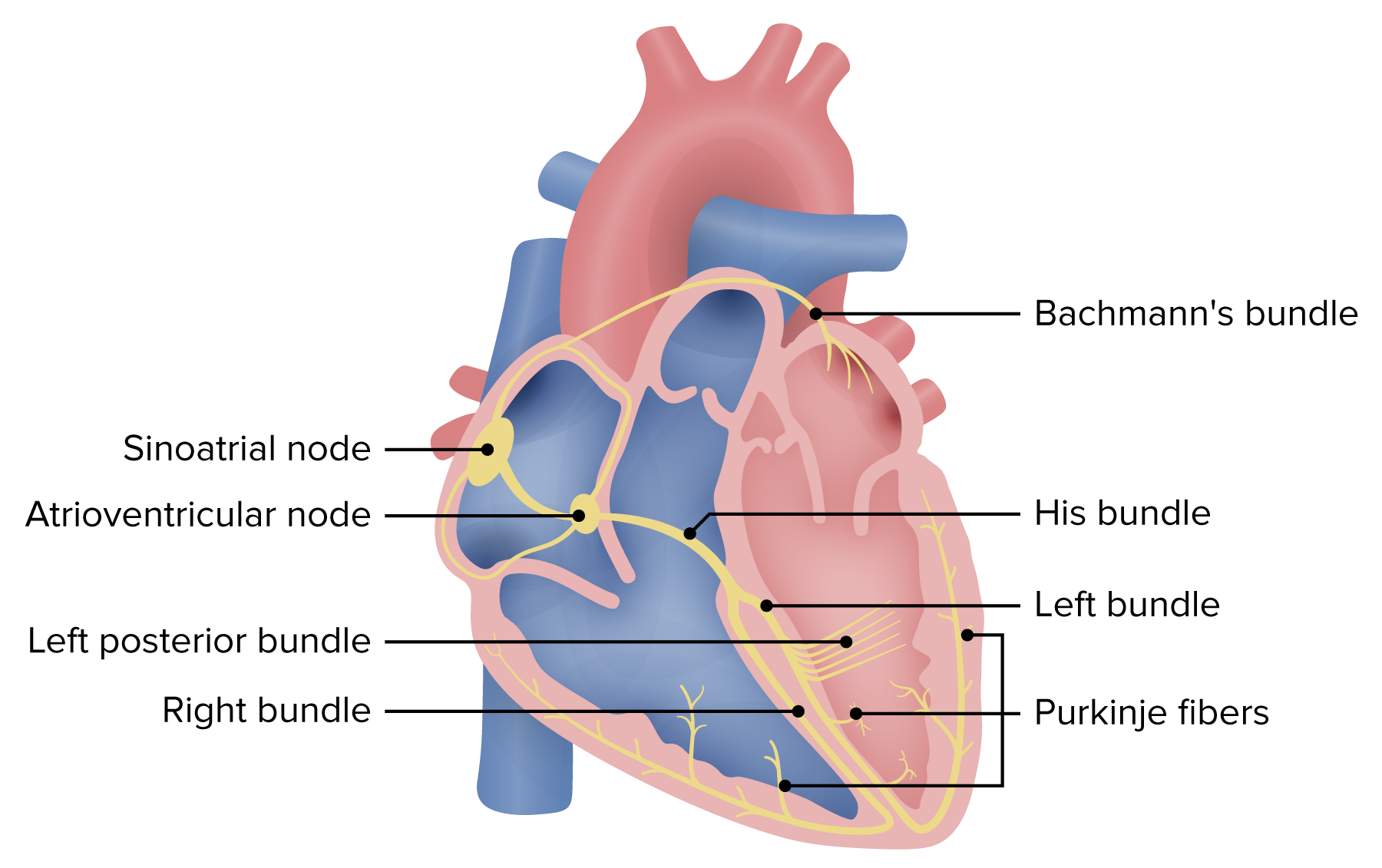
  • Seno o nodo sinoauricular:
    • Un grupo de células cerca de la unión de la aurícula derecha y la vena cava superior
    • “Marcapasos natural” que inicia los LOS Neisseria impulsos eléctricos para estimular la contracción
  • Inervación del corazón:
    • Parasimpático: reduce la automaticidad del nodo sinusal (↓ frecuencia cardíaca)
    • Simpático: aumenta la automaticidad del nodo sinusal (↑ frecuencia cardíaca)
  • Eventos secuenciales de un ciclo cardíaco:
    1. El nodo sinoauricular inicia el impulso/onda P
      • Despolarización auricular
      • Contracción auricular
    2. Segmento PR:
    3. Complejo QRS:
      • Repolarización auricular
      • Despolarización de los LOS Neisseria ventrículos
      • Contracción ventricular
    4. Segmento ST: finalización de la despolarización ventricular
    5. Onda T: repolarización de los LOS Neisseria ventrículos
    6. Finalización de la repolarización
Sistema de conducción del corazón

Sistema de conducción del corazón

Imagen por Lecturio.

Fisiopatología

Degeneración del nodo sinoauricular:

  • Afecta la capacidad de generar o transmitir impulsos a las aurículas → el sistema de conducción en EN Erythema nodosum is an immune-mediated panniculitis (inflammation of the subcutaneous fat) caused by a type IV (delayed-type) hypersensitivity reaction. It commonly manifests in young women as tender, erythematous nodules on the shins. Erythema Nodosum su conjunto no funciona de forma eficaz
  • Los LOS Neisseria latidos no se originan en EN Erythema nodosum is an immune-mediated panniculitis (inflammation of the subcutaneous fat) caused by a type IV (delayed-type) hypersensitivity reaction. It commonly manifests in young women as tender, erythematous nodules on the shins. Erythema Nodosum el nodo sinoauricular → pueden dar lugar a un síndrome de taquicardia–bradicardia

Presentación Clínica

Los LOS Neisseria síntomas de la bradicardia o del síndrome de taquicardia-bradicardia incluyen:

  • Dolor Dolor Inflammation torácico
  • Palpitaciones
  • Manifestaciones de bajo gasto cardíaco:
    • Síncope
    • Hipotensión
    • Palidez
    • Disnea
    • Confusión
    • Mareo
  • Ataques de Adams-Stokes: pérdida repentina de la conciencia debido a un trastorno del ritmo cardíaco en EN Erythema nodosum is an immune-mediated panniculitis (inflammation of the subcutaneous fat) caused by a type IV (delayed-type) hypersensitivity reaction. It commonly manifests in young women as tender, erythematous nodules on the shins. Erythema Nodosum el que hay un pulso lento o ausente

Las siguientes anomalías del ritmo cardíaco pueden observarse como parte del síndrome del seno enfermo:
  • Pausa sinusal:
    • Fallo temporal en EN Erythema nodosum is an immune-mediated panniculitis (inflammation of the subcutaneous fat) caused by a type IV (delayed-type) hypersensitivity reaction. It commonly manifests in young women as tender, erythematous nodules on the shins. Erythema Nodosum la despolarización del nodo sinoauricular
    • Puede verse en EN Erythema nodosum is an immune-mediated panniculitis (inflammation of the subcutaneous fat) caused by a type IV (delayed-type) hypersensitivity reaction. It commonly manifests in young women as tender, erythematous nodules on the shins. Erythema Nodosum un electrocardiograma ( ECG ECG An electrocardiogram (ECG) is a graphic representation of the electrical activity of the heart plotted against time. Adhesive electrodes are affixed to the skin surface allowing measurement of cardiac impulses from many angles. The ECG provides 3-dimensional information about the conduction system of the heart, the myocardium, and other cardiac structures. Electrocardiogram (ECG)) de 12 derivaciones como ondas P ausentes
    • Normalmente, el nodo auriculoventricular tomará el relevo como marcapasos (ritmo de escape).
    • Una pausa sinusal de < 3 segundos se encuentra ocasionalmente en EN Erythema nodosum is an immune-mediated panniculitis (inflammation of the subcutaneous fat) caused by a type IV (delayed-type) hypersensitivity reaction. It commonly manifests in young women as tender, erythematous nodules on the shins. Erythema Nodosum adultos sanos.
    • Una pausa > 3 segundos puede requerir una intervención.
  • Bloqueo sinoauricular:
    • Condición en EN Erythema nodosum is an immune-mediated panniculitis (inflammation of the subcutaneous fat) caused by a type IV (delayed-type) hypersensitivity reaction. It commonly manifests in young women as tender, erythematous nodules on the shins. Erythema Nodosum la que el nodo sinoauricular se despolariza, pero la señal no progresa a través del resto de la aurícula
    • Puede considerarse como síndrome del seno enfermo “temporal”; comparte muchos factores etiológicos comunes con el síndrome del seno enfermo
  • Fibrilación auricular:
    • Arritmia supraventricular más común
    • Se caracteriza por una contracción auricular desorganizada y un mayor riesgo de enfermedad tromboembólica
  • Flutter auricular: taquiarritmia supraventricular caracterizada por ondas tipo flutter en “sierra dentada” en EN Erythema nodosum is an immune-mediated panniculitis (inflammation of the subcutaneous fat) caused by a type IV (delayed-type) hypersensitivity reaction. It commonly manifests in young women as tender, erythematous nodules on the shins. Erythema Nodosum el ECG ECG An electrocardiogram (ECG) is a graphic representation of the electrical activity of the heart plotted against time. Adhesive electrodes are affixed to the skin surface allowing measurement of cardiac impulses from many angles. The ECG provides 3-dimensional information about the conduction system of the heart, the myocardium, and other cardiac structures. Electrocardiogram (ECG)

Diagnóstico

  • El diagnóstico se realiza mediante un ECG ECG An electrocardiogram (ECG) is a graphic representation of the electrical activity of the heart plotted against time. Adhesive electrodes are affixed to the skin surface allowing measurement of cardiac impulses from many angles. The ECG provides 3-dimensional information about the conduction system of the heart, the myocardium, and other cardiac structures. Electrocardiogram (ECG).
    • La monitorización ambulatoria (Holter) podría ser necesaria si la arritmia es transitoria.
    • Los LOS Neisseria hallazgos del ECG ECG An electrocardiogram (ECG) is a graphic representation of the electrical activity of the heart plotted against time. Adhesive electrodes are affixed to the skin surface allowing measurement of cardiac impulses from many angles. The ECG provides 3-dimensional information about the conduction system of the heart, the myocardium, and other cardiac structures. Electrocardiogram (ECG) pueden variar mucho:
      • Arritmia sinusal
      • Arresto sinusal
      • Bloqueo sinusal
      • Pausas asistólicas
      • Taquicardia por reentrada
  • Prueba de esfuerzo cardíaco: la prueba de esfuerzo o con medicamentos muestra un aumento inadecuado de la frecuencia cardíaca en EN Erythema nodosum is an immune-mediated panniculitis (inflammation of the subcutaneous fat) caused by a type IV (delayed-type) hypersensitivity reaction. It commonly manifests in young women as tender, erythematous nodules on the shins. Erythema Nodosum relación con el esfuerzo/la actividad física.
  • Los LOS Neisseria estudios electrofisiológicos pueden mostrar un tiempo de recuperación sinusal prolongado, pero no se utilizan con frecuencia con fines diagnósticos debido a su baja sensibilidad y especificidad.
  • La prueba de la mesa inclinada puede emplearse para revelar algunas formas de síndrome del seno enfermo.
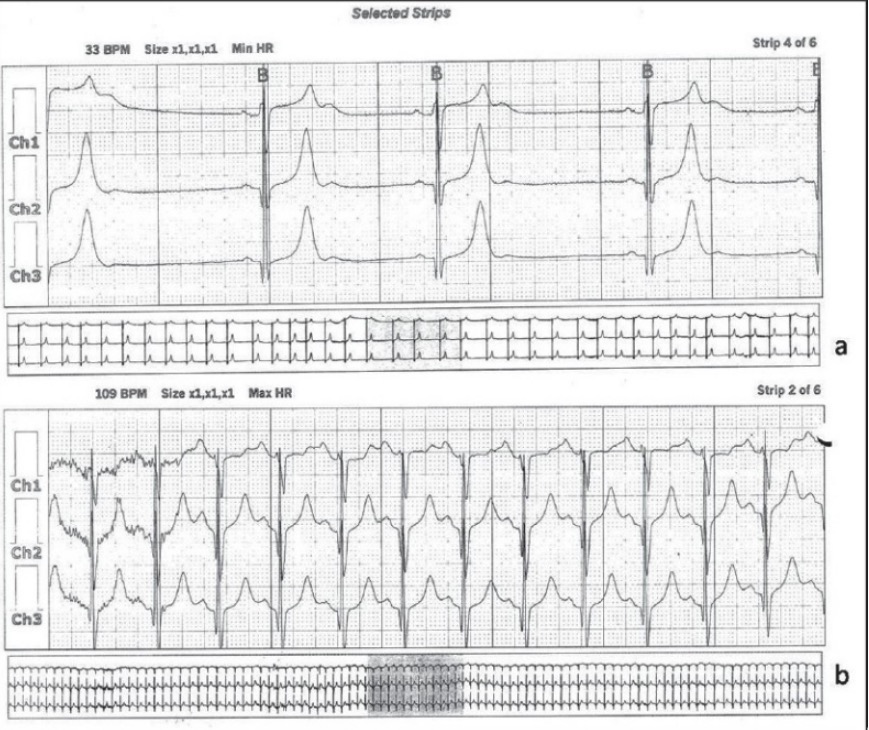
Holter de 24 horas

Registro del monitor Holter de 24 horas que demuestra tanto la bradicardia (panel a) y taquicardia (panel b); síndrome de bradicardia-taquicardia

Imagen: “24-Hour Holter” por Department of Pediatrics, Seth G.S. Medical College and KEM Hospital, Mumbai, India. Licencia: CC BY 2.0

Tratamiento

  • Tratar las causas reversibles que puedan estar afectando a la función del nodo sinoauricular:
    • Alteraciones electrolíticas
    • Retirar los LOS Neisseria medicamentos desencadenantes.
  • Los LOS Neisseria pacientes estables y asintomáticos pueden no requerir intervención médica.
  • En EN Erythema nodosum is an immune-mediated panniculitis (inflammation of the subcutaneous fat) caused by a type IV (delayed-type) hypersensitivity reaction. It commonly manifests in young women as tender, erythematous nodules on the shins. Erythema Nodosum pacientes hemodinámicamente inestables (presión arterial sistólica < 90 mmHg) o sintomáticos (estado mental alterado, dolor Dolor Inflammation torácico):
    • El mejor paso inicial es la atropina y la estimulación transcutánea.
    • Los LOS Neisseria simpaticomiméticos pueden utilizarse si falla la estimulación transcutánea:
      • Epinefrina
      • Dopamina
      • Dobutamina
    • Puede ser necesario un marcapasos temporal externo o transvenoso.
  • La terapia definitiva a largo plazo para la enfermedad refractaria es la colocación de un marcapasos.
  • Los LOS Neisseria síndromes de taquicardia concurrentes deben ser tratados igualmente.

Relevancia Clínica

Las siguientes condiciones pueden predisponer al AL Amyloidosis síndrome del seno enfermo.

  • Amiloidosis: trastorno causado por el depósito extracelular de amiloide anormal insoluble que altera la función de los LOS Neisseria tejidos, especialmente el sistema de conducción cardíaco
  • Miocardiopatías: un grupo variado de enfermedades miocárdicas (dilatadas, restrictivas, hipertróficas) asociadas a un deterioro de la función sistólica y diastólica
  • Hipotiroidismo: deficiencia de triyodotironina (T3) y tiroxina (T4): la enfermedad de Hashimoto (tiroiditis autoinmune) es la principal causa de hipotiroidismo en EN Erythema nodosum is an immune-mediated panniculitis (inflammation of the subcutaneous fat) caused by a type IV (delayed-type) hypersensitivity reaction. It commonly manifests in young women as tender, erythematous nodules on the shins. Erythema Nodosum las regiones donde no hay deficiencia de yodo. El hipotiroidismo puede disminuir la tasa metabólica general.
  • Hemocromatosis: trastorno genético autosómico recesivo causado por mutaciones en EN Erythema nodosum is an immune-mediated panniculitis (inflammation of the subcutaneous fat) caused by a type IV (delayed-type) hypersensitivity reaction. It commonly manifests in young women as tender, erythematous nodules on the shins. Erythema Nodosum el gen HFE que provoca un aumento de la absorción intestinal de hierro
  • Sarcoidosis Sarcoidosis Sarcoidosis is a multisystem inflammatory disease that causes noncaseating granulomas. The exact etiology is unknown. Sarcoidosis usually affects the lungs and thoracic lymph nodes, but it can also affect almost every system in the body, including the skin, heart, and eyes, most commonly. Sarcoidosis: enfermedad multisistémica cuya génesis aún no se conoce del todo y que se caracteriza por la presencia de granulomas Granulomas A relatively small nodular inflammatory lesion containing grouped mononuclear phagocytes, caused by infectious and noninfectious agents. Sarcoidosis no caseificantes en EN Erythema nodosum is an immune-mediated panniculitis (inflammation of the subcutaneous fat) caused by a type IV (delayed-type) hypersensitivity reaction. It commonly manifests in young women as tender, erythematous nodules on the shins. Erythema Nodosum los LOS Neisseria órganos afectados: las principales localizaciones en EN Erythema nodosum is an immune-mediated panniculitis (inflammation of the subcutaneous fat) caused by a type IV (delayed-type) hypersensitivity reaction. It commonly manifests in young women as tender, erythematous nodules on the shins. Erythema Nodosum las que se manifiesta esta enfermedad es en EN Erythema nodosum is an immune-mediated panniculitis (inflammation of the subcutaneous fat) caused by a type IV (delayed-type) hypersensitivity reaction. It commonly manifests in young women as tender, erythematous nodules on the shins. Erythema Nodosum los LOS Neisseria pulmones y ganglios linfáticos hiliares.
  • Hiperpotasemia: nivel de potasio sérico > 5,5 mEq/L: la hiperpotasemia severa es rara, pero puede causar parálisis respiratoria, parálisis muscular generalizada y paro cardíaco.

Las siguientes afecciones se incluyen en EN Erythema nodosum is an immune-mediated panniculitis (inflammation of the subcutaneous fat) caused by a type IV (delayed-type) hypersensitivity reaction. It commonly manifests in young women as tender, erythematous nodules on the shins. Erythema Nodosum el diagnóstico diferencial del síndrome del seno enfermo.

  • Síncope: pérdida temporal de la conciencia causada por una caída de la presión arterial: el síncope puede deberse a muchas causas, desde las benignas hasta las que ponen en EN Erythema nodosum is an immune-mediated panniculitis (inflammation of the subcutaneous fat) caused by a type IV (delayed-type) hypersensitivity reaction. It commonly manifests in young women as tender, erythematous nodules on the shins. Erythema Nodosum peligro la vida.
  • Infarto al AL Amyloidosis miocardio: isquemia del tejido miocárdico debida a la obstrucción de una arteria coronaria: suele ir acompañado de un aumento de las enzimas cardíacas, anomalías en EN Erythema nodosum is an immune-mediated panniculitis (inflammation of the subcutaneous fat) caused by a type IV (delayed-type) hypersensitivity reaction. It commonly manifests in young women as tender, erythematous nodules on the shins. Erythema Nodosum el ECG ECG An electrocardiogram (ECG) is a graphic representation of the electrical activity of the heart plotted against time. Adhesive electrodes are affixed to the skin surface allowing measurement of cardiac impulses from many angles. The ECG provides 3-dimensional information about the conduction system of the heart, the myocardium, and other cardiac structures. Electrocardiogram (ECG) y dolor Dolor Inflammation torácico.

Referencias

  1. Kusumoto, F. M., Schoenfeld, M. H., Barrett, C., Edgerton, J. R., Ellenbogen, K. A., Gold, M. R., Goldschlager, N. F., Hamilton, R. M., Joglar, J. A., Kim, R. J., Lee, R., Marine, J. E., McLeod, C. J., Oken, K. R., Patton, K. K., Pellegrini, C. N., Selzman, K. A., Thompson, A., & Varosy, P. D. (2019). 2018 ACC/AHA/HRS Guideline on the Evaluation and Management of Patients With Bradycardia and Cardiac Conduction Delay: A Report of the American College of Cardiology/American Heart Association Task Force on Clinical Practice Guidelines and the Heart Rhythm Society. Journal of the American College of Cardiology74(7), e51–e156. https://doi.org/10.1016/j.jacc.2018.10.044
  2. Keller, K. B., Lemberg, L. (2006). The sick sinus syndrome. American Journal of Critical Care, 15(2), 226-229. doi:10.4037/ajcc2006.15.2.226
  3. Homoud, M. K. (2024). Sinus node dysfunction: Epidemiology, etiology, and natural history. UpToDate. Retrieved July 21, 2025, from https://www.uptodate.com/contents/sinus-node-dysfunction-epidemiology-etiology-and-natural-history
  4. Homoud, M. K. (2025). Sinus node dysfunction: Clinical manifestations and diagnosis. UpToDate. Retrieved July 21, 2025, from https://www.uptodate.com/contents/sinus-node-dysfunction-clinical-manifestations-and-diagnosis
  5. Homoud, M. K. (2024). Sinus node dysfunction: Treatment. UpToDate. Retrieved July 21, 2025, from https://www.uptodate.com/contents/sinus-node-dysfunction-treatment

¡Crea tu cuenta gratis o inicia una sesión para seguir leyendo!

Regístrate ahora y obtén acceso gratuito a Lecturio con páginas de concepto, videos médicos y cuestionarios para tu educación médica.

User Reviews

Que tengas una sesión de estudio alegre y navideña 🎁 Ahorra 50% en todos los planes >>

Details