
Domina Conceptos Médicos

Estudia para la escuela de medicina y tus examenes con Lecturio.

Síndrome de Cri-Du-Chat

Cri du chat es el término francés que significa “llanto de gato” o “maullido de gato”. El término hace HACE Altitude Sickness referencia al AL Amyloidosis llanto de un paciente pediátrico con síndrome de cri-du-chat parecido al AL Amyloidosis maullido de un gato. Se trata de un raro trastorno genético causado por mutaciones de deleción en EN Erythema nodosum is an immune-mediated panniculitis (inflammation of the subcutaneous fat) caused by a type IV (delayed-type) hypersensitivity reaction. It commonly manifests in young women as tender, erythematous nodules on the shins. Erythema Nodosum el cromosoma 5. El síndrome de Cri-du-chat es más frecuente en EN Erythema nodosum is an immune-mediated panniculitis (inflammation of the subcutaneous fat) caused by a type IV (delayed-type) hypersensitivity reaction. It commonly manifests in young women as tender, erythematous nodules on the shins. Erythema Nodosum las mujeres que en EN Erythema nodosum is an immune-mediated panniculitis (inflammation of the subcutaneous fat) caused by a type IV (delayed-type) hypersensitivity reaction. It commonly manifests in young women as tender, erythematous nodules on the shins. Erythema Nodosum los LOS Neisseria hombres. Además del llanto característico, la enfermedad también presenta disfagia, bajo peso al AL Amyloidosis nacer, crecimiento deficiente y graves discapacidades cognitivas del habla y motoras.

Last updated: Dec 15, 2025

Editorial responsibility: Stanley Oiseth, Lindsay Jones, Evelin Maza

Epidemiología y Etiología

Epidemiología

  • Más común en EN Erythema nodosum is an immune-mediated panniculitis (inflammation of the subcutaneous fat) caused by a type IV (delayed-type) hypersensitivity reaction. It commonly manifests in young women as tender, erythematous nodules on the shins. Erythema Nodosum las mujeres, en EN Erythema nodosum is an immune-mediated panniculitis (inflammation of the subcutaneous fat) caused by a type IV (delayed-type) hypersensitivity reaction. It commonly manifests in young women as tender, erythematous nodules on the shins. Erythema Nodosum una proporción de 1:0.72
  • La incidencia oscila entre 1 de cada 15 000–50 000 nacidos vivos

Etiología

  • El síndrome de Cri-du-chat está causado por deleciones en EN Erythema nodosum is an immune-mediated panniculitis (inflammation of the subcutaneous fat) caused by a type IV (delayed-type) hypersensitivity reaction. It commonly manifests in young women as tender, erythematous nodules on the shins. Erythema Nodosum el brazo corto terminal del cromosoma 5 (puede afectar desde sólo la región 5p15.3 hasta todo el brazo corto del cromosoma 5).
    • Monosomía 5p, que da lugar a un cariotipo 46,XX o XY,5p-
    • Monosomía parcial
      • El 80% de los LOS Neisseria casos son esporádicos (mutaciones de novo).
      • Del 10%15% de los LOS Neisseria casos se originan por una translocación balanceada de los LOS Neisseria padres.
      • < 10% de los LOS Neisseria casos están asociados a aberraciones citogenéticas raras.
  • La deleción en EN Erythema nodosum is an immune-mediated panniculitis (inflammation of the subcutaneous fat) caused by a type IV (delayed-type) hypersensitivity reaction. It commonly manifests in young women as tender, erythematous nodules on the shins. Erythema Nodosum el cromosoma 5 es de origen paterno en EN Erythema nodosum is an immune-mediated panniculitis (inflammation of the subcutaneous fat) caused by a type IV (delayed-type) hypersensitivity reaction. It commonly manifests in young women as tender, erythematous nodules on the shins. Erythema Nodosum la mayoría de los LOS Neisseria casos (80%85%).
  • Genes Genes A category of nucleic acid sequences that function as units of heredity and which code for the basic instructions for the development, reproduction, and maintenance of organisms. DNA Types and Structure que contribuyen al AL Amyloidosis Cri-du-chat:
    • El gen de la transcriptasa inversa de la telomerasa, situado en EN Erythema nodosum is an immune-mediated panniculitis (inflammation of the subcutaneous fat) caused by a type IV (delayed-type) hypersensitivity reaction. It commonly manifests in young women as tender, erythematous nodules on the shins. Erythema Nodosum el 5p13.33 (el brazo corto del cromosoma 5 en EN Erythema nodosum is an immune-mediated panniculitis (inflammation of the subcutaneous fat) caused by a type IV (delayed-type) hypersensitivity reaction. It commonly manifests in young women as tender, erythematous nodules on the shins. Erythema Nodosum la banda 13.33), está asociado a los LOS Neisseria cambios fenotípicos.
    • El gen de la semaforina F (SEMA5A) y el gen de la delta catenina (CTNND2) en EN Erythema nodosum is an immune-mediated panniculitis (inflammation of the subcutaneous fat) caused by a type IV (delayed-type) hypersensitivity reaction. It commonly manifests in young women as tender, erythematous nodules on the shins. Erythema Nodosum el 5p15.2 que están implicados en EN Erythema nodosum is an immune-mediated panniculitis (inflammation of the subcutaneous fat) caused by a type IV (delayed-type) hypersensitivity reaction. It commonly manifests in young women as tender, erythematous nodules on the shins. Erythema Nodosum el desarrollo cerebral.

Presentación Clínica

Los LOS Neisseria síntomas varían y dependen de la cantidad de material genético eliminado.
Síntomas neonatales

  • El síndrome recibe su nombre por el característico llanto parecido a un maullido” de los LOS Neisseria lactantes afectados, causado por problemas de la laringe y del sistema nervioso. Dura las primeras semanas de vida.
  • Disfagia
  • Bajo peso al AL Amyloidosis nacer y pobre crecimiento, debido a:
    • Retraso en EN Erythema nodosum is an immune-mediated panniculitis (inflammation of the subcutaneous fat) caused by a type IV (delayed-type) hypersensitivity reaction. It commonly manifests in young women as tender, erythematous nodules on the shins. Erythema Nodosum el desarrollo
    • Problemas de alimentación por bajo tono muscular, mala succión y enfermedad por reflujo gastroesofágico (puede provocar neumonía por aspiración)
  • Discapacidades intelectuales, del habla y psicomotoras graves, como:
    • Retraso en EN Erythema nodosum is an immune-mediated panniculitis (inflammation of the subcutaneous fat) caused by a type IV (delayed-type) hypersensitivity reaction. It commonly manifests in young women as tender, erythematous nodules on the shins. Erythema Nodosum sentarse y caminar
    • Torpeza
  • Hiperactividad, agresividad, arrebatos y movimientos repetitivos
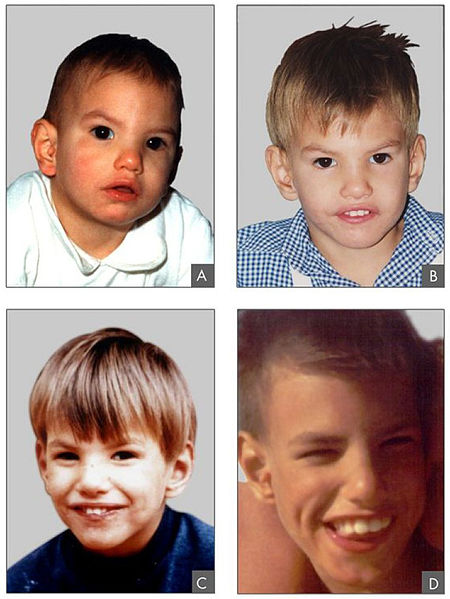
  • Rasgos faciales inusuales:
    • Microcefalia
    • Hipertelorismo, marcas de piel delante de los LOS Neisseria ojos, pliegues epicánticos, fisuras palpebrales inclinadas hacia abajo y estrabismo
    • Cara pequeña y redonda con mejillas llenas
    • Puente nasal plano y ancho y filtrum corto
    • Micrognatia, boca girada hacia abajo, babeo excesivo, labio/paladar hendido y úvula bífida
    • Orejas de implantación baja
  • Hipotonía
  • Estreñimiento
  • Infecciones recurrentes (e.g., otitis media, infecciones respiratorias e infecciones del tracto urinario [ITU])
  • Pies equino-varo, sindactilia, dedos cortos y pliegues palmares únicos
  • Defectos cardíacos:
    • Defecto septal ventricular
    • Defecto septal auricular
    • Conducto arterioso persistente
    • Tetralogía de Fallot
    • Estenosis pulmonar
    • Anomalías de la válvula aórtica

Síntomas de la edad escolar y la adolescencia

  • Discapacidad intelectual
  • Engrosamiento de los LOS Neisseria rasgos faciales con crestas supraorbitales prominentes, ojos hundidos y puente nasal hipoplásico
  • Maloclusión dental severa
  • Escoliosis
  • Las niñas afectadas tienen un desarrollo normal de los LOS Neisseria caracteres sexuales
  • En EN Erythema nodosum is an immune-mediated panniculitis (inflammation of the subcutaneous fat) caused by a type IV (delayed-type) hypersensitivity reaction. It commonly manifests in young women as tender, erythematous nodules on the shins. Erythema Nodosum los LOS Neisseria niños, los LOS Neisseria testículos suelen ser pequeños, mientras que la espermatogénesis es normal
Características fenotípicas del Cri-du-chat

Características fenotípicas asociadas al síndrome de Cri-du-chat

Imagen: “Criduchat” por Paola Cerruti Mainardi. Licencia: CC BY 2.0

Diagnóstico y Tratamiento

Diagnóstico

  • El llanto característico y los LOS Neisseria problemas físicos asociados llevan a la sospecha clínica al AL Amyloidosis nacer.
  • Se puede ofrecer asesoramiento y pruebas genéticas (cariotipo).
    • Si hay una alta sospecha clínica y el cariotipo es normal, esta indicado solictar una hibridación in situ con fluorescencia ( FISH FISH A type of in situ hybridization in which target sequences are stained with fluorescent dye so their location and size can be determined using fluorescence microscopy. This staining is sufficiently distinct that the hybridization signal can be seen both in metaphase spreads and in interphase nuclei. Chromosome Testing, por sus siglas en EN Erythema nodosum is an immune-mediated panniculitis (inflammation of the subcutaneous fat) caused by a type IV (delayed-type) hypersensitivity reaction. It commonly manifests in young women as tender, erythematous nodules on the shins. Erythema Nodosum inglés) para comprobar si hay síndromes similares.
  • Prenatalmente, la deleción en EN Erythema nodosum is an immune-mediated panniculitis (inflammation of the subcutaneous fat) caused by a type IV (delayed-type) hypersensitivity reaction. It commonly manifests in young women as tender, erythematous nodules on the shins. Erythema Nodosum el cromosoma 5 puede detectarse mediante el análisis genético de:
    • Muestras de líquido amniótico
    • Muestras de vellosidades coriónicas

Tratamiento

  • No se conoce ninguna cura
  • El tratamiento está dirigido a:
    • Maximizar el desarrollo de las personas afectadas mediante terapia del habla, física y ocupacional
    • Tratamiento de enfermedades que ponen en EN Erythema nodosum is an immune-mediated panniculitis (inflammation of the subcutaneous fat) caused by a type IV (delayed-type) hypersensitivity reaction. It commonly manifests in young women as tender, erythematous nodules on the shins. Erythema Nodosum peligro la vida (e.g., cardiopatías congénitas)

Pronóstico

  • Es bueno después de los LOS Neisseria primeros años de vida; la morbilidad es baja
  • Es posible una esperanza de vida normal en EN Erythema nodosum is an immune-mediated panniculitis (inflammation of the subcutaneous fat) caused by a type IV (delayed-type) hypersensitivity reaction. It commonly manifests in young women as tender, erythematous nodules on the shins. Erythema Nodosum función del tratamiento y las terapias

Diagnóstico Diferencial

Las siguientes condiciones son diagnósticos diferenciales del síndrome de Cri-du-chat:

  • Síndrome de Wolf-Hirschhorn (síndrome de Wolf): trastorno cromosómico raro causado por una deleción parcial del brazo corto del cromosoma 4, especialmente de la banda 4p16.3. Las anomalías asociadas suelen incluir bajo peso al AL Amyloidosis nacer, retraso en EN Erythema nodosum is an immune-mediated panniculitis (inflammation of the subcutaneous fat) caused by a type IV (delayed-type) hypersensitivity reaction. It commonly manifests in young women as tender, erythematous nodules on the shins. Erythema Nodosum el crecimiento, hipotonía y retrasos y/o discapacidades psicomotoras.
  • Síndrome de Mowat-Wilson: una afección genética causada por mutaciones en EN Erythema nodosum is an immune-mediated panniculitis (inflammation of the subcutaneous fat) caused by a type IV (delayed-type) hypersensitivity reaction. It commonly manifests in young women as tender, erythematous nodules on the shins. Erythema Nodosum el gen ZEB2, que se caracteriza por microcefalia, discapacidad intelectual, retraso en EN Erythema nodosum is an immune-mediated panniculitis (inflammation of the subcutaneous fat) caused by a type IV (delayed-type) hypersensitivity reaction. It commonly manifests in young women as tender, erythematous nodules on the shins. Erythema Nodosum el desarrollo y enfermedad de Hirschsprung, entre otros defectos congénitos y rasgos faciales distintivos (e.g., cara de forma cuadrada, ojos hundidos y muy separados, puente nasal ancho, punta nasal redondeada y barbilla prominente y puntiaguda).
  • Síndrome de Patau (trisomía 13): síndrome genético causado por la presencia de 3 copias del cromosoma 13. La enfermedad se caracteriza por microcefalia, holoprosencefalia, anomalías faciales características (e.g., labio-paladar hendido, orejas de implantación baja y malformadas, nariz bulbosa, mentón pequeño, microftalmia, coloboma Coloboma Congenital anomaly in which some of the structures of the eye are absent due to incomplete fusion of the fetal intraocular fissure during gestation. Esophageal Atresia and Tracheoesophageal Fistula), polidactilia y defectos cardíacos congénitos.
  • Trastornos del espectro alcohólico fetal: grupo de afecciones que pueden darse en EN Erythema nodosum is an immune-mediated panniculitis (inflammation of the subcutaneous fat) caused by a type IV (delayed-type) hypersensitivity reaction. It commonly manifests in young women as tender, erythematous nodules on the shins. Erythema Nodosum neonatos cuyas madres consumieron grandes cantidades de alcohol durante el embarazo. Los LOS Neisseria problemas pueden incluir cambios craneofaciales característicos, baja estatura, bajo peso corporal, tamaño pequeño de la cabeza, mala coordinación, baja inteligencia, problemas de comportamiento y problemas de audición o visión.
  • Síndrome de Cohen: trastorno hereditario con anomalías que incluyen hipotonía, retraso en EN Erythema nodosum is an immune-mediated panniculitis (inflammation of the subcutaneous fat) caused by a type IV (delayed-type) hypersensitivity reaction. It commonly manifests in young women as tender, erythematous nodules on the shins. Erythema Nodosum el crecimiento, microcefalia, hipermovilidad articular, retraso en EN Erythema nodosum is an immune-mediated panniculitis (inflammation of the subcutaneous fat) caused by a type IV (delayed-type) hypersensitivity reaction. It commonly manifests in young women as tender, erythematous nodules on the shins. Erythema Nodosum el desarrollo, trastornos visuales como miopía y estrabismo, y rasgos faciales característicos (e.g., párpados arqueados, línea de nacimiento del cabello baja, pestañas y cejas gruesas, paladar alto).
  • Síndrome de Edwards (trisomía 18): síndrome genético causado por la presencia de 3 copias del cromosoma 18. Las anomalías asociadas incluyen microcefalia, mielomeningocele, onfalocele, malformación de órganos viscerales como riñón en EN Erythema nodosum is an immune-mediated panniculitis (inflammation of the subcutaneous fat) caused by a type IV (delayed-type) hypersensitivity reaction. It commonly manifests in young women as tender, erythematous nodules on the shins. Erythema Nodosum herradura y hernias, discapacidad intelectual grave, defectos cardíacos congénitos y anomalías faciales características (e.g., nariz ancha, orejas de implantación baja, hipoplasia mandibular, labio/paladar hendido).

Referencias

  1. Cornish, K., & Bramble, D. (2002). Cri du chat syndrome: genotype-phenotype correlations and recommendations for clinical management. Developmental medicine and child neurology44(7), 494–497. Retrieved November 27, 2024, from https://doi.org/10.1017/s0012162201002419
  2. Powell-Hamilton, N. N. (2023). Cri-du-chat syndrome – CRI-du-chat syndrome. Merck Manual Consumer Version. Retrieved November 27, 2024, from https://www.merckmanuals.com/home/children-s-health-issues/chromosome-and-gene-abnormalities/cri-du-chat-syndrome?ruleredirectid=747
  3. Sellars, E. A., & Hopkin, R. J. (2021). Pediatric Genetics (3rd ed.). Springer.
  4. Zeldin, R. K., & Schwartz, M. (2022). Immunology Made Ridiculously Simple. MedMaster Inc.
  5. Giersch, A.B.S. (2024). Congenital cytogenetic abnormalities. UpToDate. Retrieved November 27, 2024, from https://www.uptodate.com/contents/congenital-cytogenetic-abnormalities
  6. Lal, M. K. (2024). Cri-du-chat syndrome. eMedicine. https://emedicine.medscape.com/article/942897-overview
  7. Merck Manual. (2024). Cri-du-chat syndrome. In The Merck Manual of Diagnosis and Therapy (20th ed.). Merck & Co. https://www.merckmanuals.com/en-pr/home/children-s-health-issues/chromosome-and-gene-abnormalities/cri-du-chat-syndrome
  8. Osmosis. (2024). Cri du chat syndrome: Video, anatomy & definition. https://www.osmosis.org/learn/Cri_du_chat_syndrome
  9. Popescu, M. C., & Luchian, I. (2023). Advances in understanding the genetic basis of Cri du chat syndrome. Journal of Genetics and Genomics, 50(1), 14-21. https://doi.org/10.1016/j.jgg.2023.04.001

¡Crea tu cuenta gratis o inicia una sesión para seguir leyendo!

Regístrate ahora y obtén acceso gratuito a Lecturio con páginas de concepto, videos médicos y cuestionarios para tu educación médica.

User Reviews

Que tengas una sesión de estudio alegre y navideña 🎁 Ahorra 50% en todos los planes >>

Details