
Domina Conceptos Médicos

Estudia para la escuela de medicina y tus examenes con Lecturio.

Retorno Venoso Pulmonar Total Anómalo

El retorno venoso pulmonar total anómalo es un defecto cardíaco congénito cianótico en EN Erythema nodosum is an immune-mediated panniculitis (inflammation of the subcutaneous fat) caused by a type IV (delayed-type) hypersensitivity reaction. It commonly manifests in young women as tender, erythematous nodules on the shins. Erythema Nodosum el que las venas pulmonares drenan en EN Erythema nodosum is an immune-mediated panniculitis (inflammation of the subcutaneous fat) caused by a type IV (delayed-type) hypersensitivity reaction. It commonly manifests in young women as tender, erythematous nodules on the shins. Erythema Nodosum lugares anatómicos distintos de la aurícula izquierda. El subtipo más común es la forma supra cardíaca, en EN Erythema nodosum is an immune-mediated panniculitis (inflammation of the subcutaneous fat) caused by a type IV (delayed-type) hypersensitivity reaction. It commonly manifests in young women as tender, erythematous nodules on the shins. Erythema Nodosum la que el drenaje es en EN Erythema nodosum is an immune-mediated panniculitis (inflammation of the subcutaneous fat) caused by a type IV (delayed-type) hypersensitivity reaction. It commonly manifests in young women as tender, erythematous nodules on the shins. Erythema Nodosum la vena cava superior. Los LOS Neisseria pacientes suelen estar cianóticos desde el nacimiento y presentan insuficiencia respiratoria y cardíaca justo después de nacer. En EN Erythema nodosum is an immune-mediated panniculitis (inflammation of the subcutaneous fat) caused by a type IV (delayed-type) hypersensitivity reaction. It commonly manifests in young women as tender, erythematous nodules on the shins. Erythema Nodosum la exploración física hay un sonido cardíaco fijo y amplio de una fracción de segundo, y una radiografía de tórax podría revelar el signo del “muñeco de nieve”. El diagnóstico se confirma mediante un ecocardiograma, que puede ser prenatal. Todos los LOS Neisseria pacientes necesitan una intervención quirúrgica para sobrevivir y el tratamiento médico se utiliza como paliativo en EN Erythema nodosum is an immune-mediated panniculitis (inflammation of the subcutaneous fat) caused by a type IV (delayed-type) hypersensitivity reaction. It commonly manifests in young women as tender, erythematous nodules on the shins. Erythema Nodosum espera de la intervención quirúrgica.

Last updated: Dec 15, 2025

Editorial responsibility: Stanley Oiseth, Lindsay Jones, Evelin Maza

Descripción General

Definición

El retorno venoso pulmonar total anómalo es un defecto cardíaco congénito cianótico que provoca el drenaje de las 4 venas pulmonares hacia la circulación venosa sistémica, en EN Erythema nodosum is an immune-mediated panniculitis (inflammation of the subcutaneous fat) caused by a type IV (delayed-type) hypersensitivity reaction. It commonly manifests in young women as tender, erythematous nodules on the shins. Erythema Nodosum lugar de hacia la aurícula izquierda, lo que provoca la mezcla de sangre oxigenada y desoxigenada. Debe haber un defecto interauricular (comunicación interauricular, foramen oval persistente o ducto arterioso persistente) para permitir que la sangre mixta se desvíe hacia el lado izquierdo del corazón y la circulación arterial sistémica.
Clasificación

  • Basado en EN Erythema nodosum is an immune-mediated panniculitis (inflammation of the subcutaneous fat) caused by a type IV (delayed-type) hypersensitivity reaction. It commonly manifests in young women as tender, erythematous nodules on the shins. Erythema Nodosum el lugar donde drenan las venas pulmonares:
    • Supracardiaca (50% de los LOS Neisseria casos): en EN Erythema nodosum is an immune-mediated panniculitis (inflammation of the subcutaneous fat) caused by a type IV (delayed-type) hypersensitivity reaction. It commonly manifests in young women as tender, erythematous nodules on the shins. Erythema Nodosum la vena cava superior
    • Infracardiaco (20%): en EN Erythema nodosum is an immune-mediated panniculitis (inflammation of the subcutaneous fat) caused by a type IV (delayed-type) hypersensitivity reaction. It commonly manifests in young women as tender, erythematous nodules on the shins. Erythema Nodosum la vena cava inferior
    • Cardíaco (20%): en EN Erythema nodosum is an immune-mediated panniculitis (inflammation of the subcutaneous fat) caused by a type IV (delayed-type) hypersensitivity reaction. It commonly manifests in young women as tender, erythematous nodules on the shins. Erythema Nodosum la aurícula derecha
    • Mixto (10%): combinación de las formas anteriores
  • Retorno venoso pulmonar total anómalo obstruido: La vena pulmonar está estrechada, lo que provoca un impedimento para que la sangre salga de la circulación pulmonar.
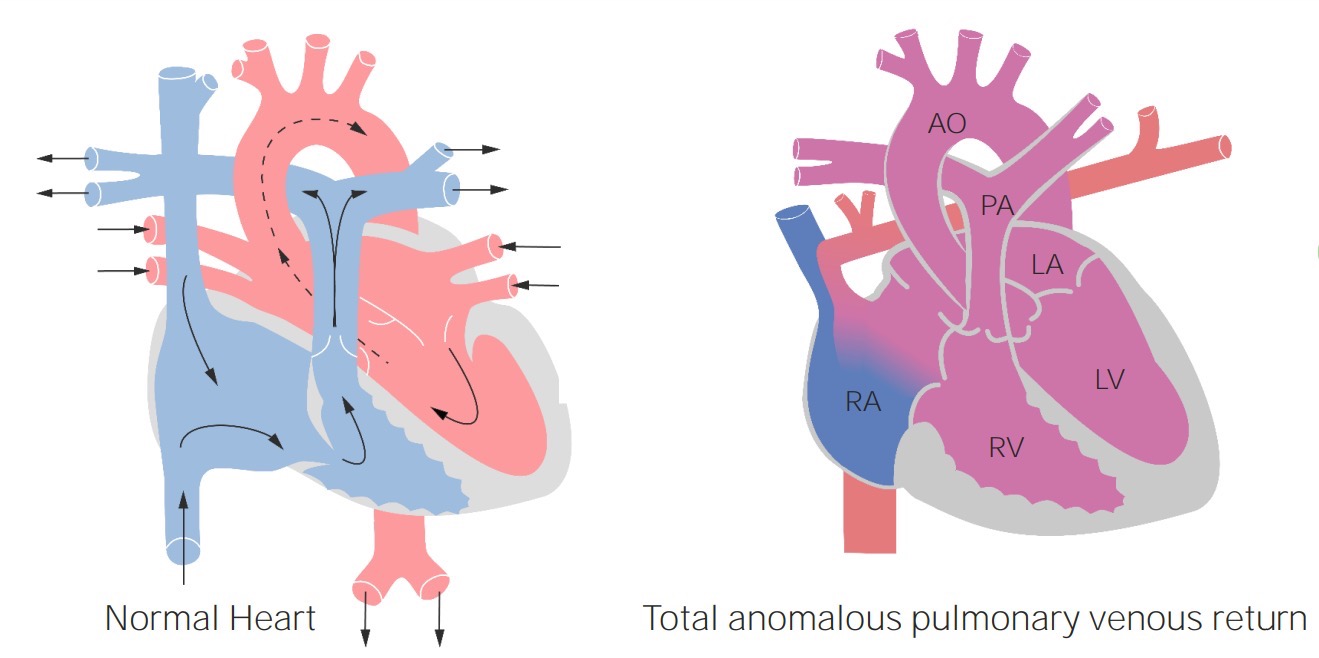
Retorno venoso pulmonar total anómalo en comparación a un corazón normal

Un corazón con anatomía normal en comparación a un corazón con retorno venoso pulmonar total anómalo:
La forma más común de retorno venoso pulmonar total anómalo presenta las 4 venas pulmonares que drenan en la vena cava superior como se muestra aquí. Obsérvese el aumento de tamaño de la pared del ventrículo derecho, debido a la sobrecarga ventricular progresiva.

Imagen por Lecturio.

Epidemiología

  • Enfermedad poco frecuente: 0,7%–1,5% de todos los LOS Neisseria defectos congénitos cardíacos
  • Prevalencia: 1 por cada 7 800 nacimientos en EN Erythema nodosum is an immune-mediated panniculitis (inflammation of the subcutaneous fat) caused by a type IV (delayed-type) hypersensitivity reaction. It commonly manifests in young women as tender, erythematous nodules on the shins. Erythema Nodosum Estados Unidos

Embriología

This condition arises due to the failure of the left atrium to merge with the pulmonary venous plexus during fetal development.
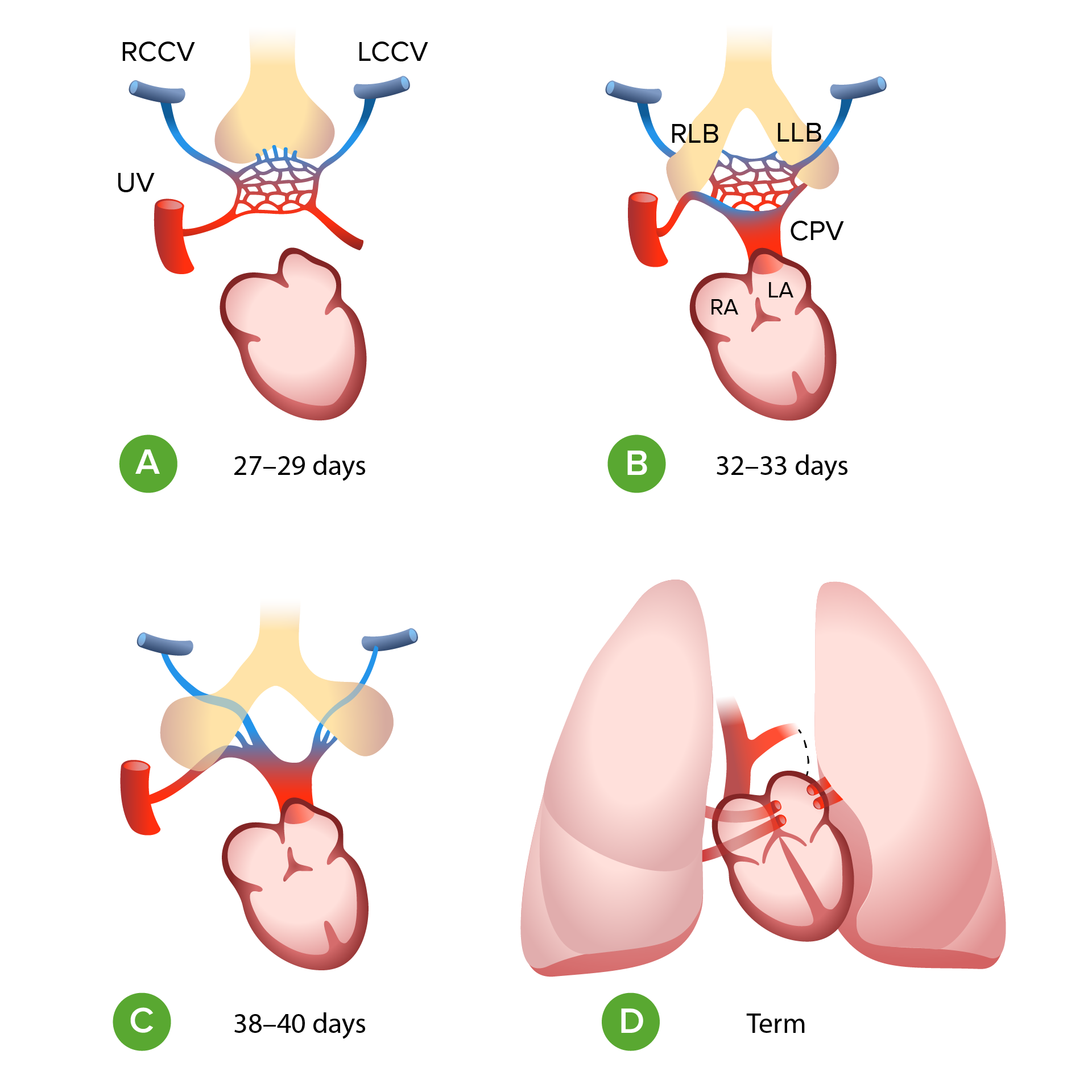
  • Primer mes de gestación: Los LOS Neisseria vasos cardinales y umbilicovitelinos primitivos drenan la circulación sistémica hacia el corazón del feto.
  • 27-29 días desde la concepción:
    • El plexo venoso pulmonar surge del plexo esplácnico.
    • La aurícula izquierda embrionaria da lugar a la vena pulmonar común.
    • La vena pulmonar común se fusiona con el plexo venoso.
    • La vena pulmonar común se divide en EN Erythema nodosum is an immune-mediated panniculitis (inflammation of the subcutaneous fat) caused by a type IV (delayed-type) hypersensitivity reaction. It commonly manifests in young women as tender, erythematous nodules on the shins. Erythema Nodosum 4 y se incorpora a la pared de la aurícula izquierda.
  • Fracaso de la vena pulmonar común para fusionarse con el plexo venoso que resulta en EN Erythema nodosum is an immune-mediated panniculitis (inflammation of the subcutaneous fat) caused by a type IV (delayed-type) hypersensitivity reaction. It commonly manifests in young women as tender, erythematous nodules on the shins. Erythema Nodosum retorno venoso pulmonar total anómalo:
    • Conexión con el sistema venoso cardinal primitivo (que drena en EN Erythema nodosum is an immune-mediated panniculitis (inflammation of the subcutaneous fat) caused by a type IV (delayed-type) hypersensitivity reaction. It commonly manifests in young women as tender, erythematous nodules on the shins. Erythema Nodosum la aurícula derecha o la vena cava superior) y el sistema umbilicovitelino (vena cava inferior, vena hepática o vena porta)
Embriología de retorno venoso pulmonar total anómalo

A: During the first month of gestation the left and right common cardinal vein (LCCV, RCCV) and the umbilical vein (UV) drain the splanchnic plexus (the primitive pulmonary vasculature) into the fetal heart.
B: At the end of the first month of gestation the embryonal left atrium (LA) gives rise to common pulmonary vein (CPV) which merges with the venous plexus
C: The connection to the LCCV, RCCV and UV disappear
D: CPV splits into 4 and is incorporated into the wall of the left atrium
RA: right atrium
LLB: left lung bud
RLB: right lung bud
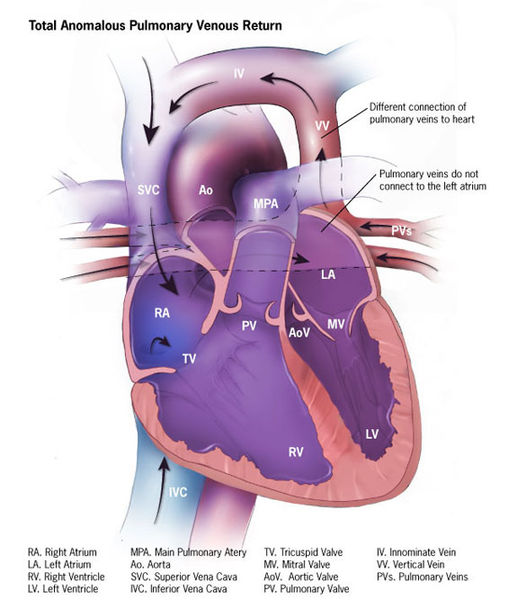
Image by Lecturio.

Fisiopatología y Presentación Clínica

Fisiopatología

  • En EN Erythema nodosum is an immune-mediated panniculitis (inflammation of the subcutaneous fat) caused by a type IV (delayed-type) hypersensitivity reaction. It commonly manifests in young women as tender, erythematous nodules on the shins. Erythema Nodosum el retorno venoso pulmonar total anómalo no obstruido:
    • La sangre oxigenada del plexo venoso pulmonar fluye hacia la sangre desoxigenada que se encuentra en EN Erythema nodosum is an immune-mediated panniculitis (inflammation of the subcutaneous fat) caused by a type IV (delayed-type) hypersensitivity reaction. It commonly manifests in young women as tender, erythematous nodules on the shins. Erythema Nodosum la aurícula derecha, la vena cava inferior o la vena cava superior → mezcla venosa
    • La sangre mixta se desvía de derecha a izquierda a través de la comunicación interauricular hacia la circulación sistémica → causando cianosis
    • La aurícula derecha y el ventrículo derecho se dilatan para acomodar el volumen extra → insuficiencia cardíaca derecha
  • En EN Erythema nodosum is an immune-mediated panniculitis (inflammation of the subcutaneous fat) caused by a type IV (delayed-type) hypersensitivity reaction. It commonly manifests in young women as tender, erythematous nodules on the shins. Erythema Nodosum la obstrucción moderada al AL Amyloidosis retorno pulmonar: aumento de la presión en EN Erythema nodosum is an immune-mediated panniculitis (inflammation of the subcutaneous fat) caused by a type IV (delayed-type) hypersensitivity reaction. It commonly manifests in young women as tender, erythematous nodules on the shins. Erythema Nodosum la vena pulmonar → aumento de la presión en EN Erythema nodosum is an immune-mediated panniculitis (inflammation of the subcutaneous fat) caused by a type IV (delayed-type) hypersensitivity reaction. It commonly manifests in young women as tender, erythematous nodules on the shins. Erythema Nodosum la arteria pulmonar → hipertensión pulmonar → hipertrofia de ventrículo derecho → insuficiencia cardíaca derecha.
Patología del retorno venoso pulmonar total anómalo

Mezcla de sangre en el retorno venoso pulmonar total anómalo:
En el retorno venoso pulmonar total anómalo, la sangre oxigenada de los pulmones regresa a la circulación venosa sistémica mezclándose con la sangre desoxigenada. Esta sangre mezclada se desvía entonces hacia el lado izquierdo del corazón a través de un defecto del tabique auricular y fluye hacia el resto del cuerpo dando lugar a la cianosis.

Imagen: “Illustration of totaly anomalyous pulmonary venous return” por Centers for Disease Control and Prevention. Licencia: CC0

Presentación clínica

El grado de obstrucción de las venas pulmonares determina la edad de presentación:
  • Obstruido:
    • Al AL Amyloidosis nacer
    • Cianosis
    • Signos de shock Shock Shock is a life-threatening condition associated with impaired circulation that results in tissue hypoxia. The different types of shock are based on the underlying cause: distributive (↑ cardiac output (CO), ↓ systemic vascular resistance (SVR)), cardiogenic (↓ CO, ↑ SVR), hypovolemic (↓ CO, ↑ SVR), obstructive (↓ CO), and mixed. Types of Shock
    • Poca reactividad
    • Dificultad respiratoria grave o apnea
  • No obstruido:
    • 30 + días de edad
    • Cianosis sutil
    • Mala alimentación
    • Respiración dificultosa

Diagnóstico

Examen físico

  • Cianosis:
    • Oximetría de pulso: ↓ Sp02
  • Fallo en EN Erythema nodosum is an immune-mediated panniculitis (inflammation of the subcutaneous fat) caused by a type IV (delayed-type) hypersensitivity reaction. It commonly manifests in young women as tender, erythematous nodules on the shins. Erythema Nodosum el desarrollo
  • Sonidos del corazón:
    • S2 S2 Heart Sounds fijo, dividido, fuerte
    • Soplo continuo en EN Erythema nodosum is an immune-mediated panniculitis (inflammation of the subcutaneous fat) caused by a type IV (delayed-type) hypersensitivity reaction. It commonly manifests in young women as tender, erythematous nodules on the shins. Erythema Nodosum el lugar de la obstrucción
    • Válvula pulmonar → soplo sistólico de eyección
    • Válvula tricúspide → retumbe diastólico
  • Signos de insuficiencia respiratoria:
    • Taquipnea
    • Gruñidos
    • Aleteo nasal
  • Signos de insuficiencia cardíaca:
    • Hepatomegalia
    • Taquicardia
    • Hipotensión
    • Extremidades frías
    • Pulsos débiles
  • Asplenia Asplenia Asplenia is the absence of splenic tissue or function and can stem from several factors ranging from congenital to iatrogenic. There is a distinction between anatomic asplenia, which is due to the surgical removal of the spleen, and functional asplenia, which is due to a condition that leads to splenic atrophy, infarct, congestion, or infiltrative disease. Asplenia (observada en EN Erythema nodosum is an immune-mediated panniculitis (inflammation of the subcutaneous fat) caused by a type IV (delayed-type) hypersensitivity reaction. It commonly manifests in young women as tender, erythematous nodules on the shins. Erythema Nodosum pacientes con síndromes de heterotaxia)

Imagenología

  • Ecocardiograma:
    • Confirma el diagnóstico
    • Puede realizarse de forma prenatal
    • Evalúa:
      • Tipo de retorno venoso pulmonar total anómalo
      • Grado de obstrucción
      • Derivación de derecha a izquierda
      • Dilatación del ventrículo derecho
      • Con doppler Doppler Ultrasonography applying the doppler effect, with frequency-shifted ultrasound reflections produced by moving targets (usually red blood cells) in the bloodstream along the ultrasound axis in direct proportion to the velocity of movement of the targets, to determine both direction and velocity of blood flow. Ultrasound (Sonography) → presión vascular pulmonar
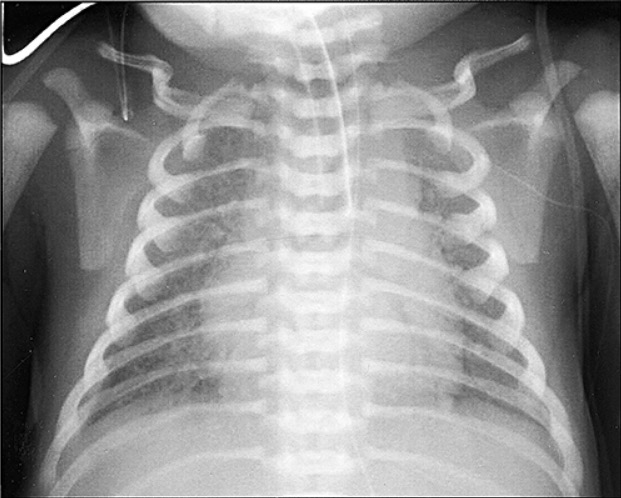
  • Radiografía de tórax:
    • El clásico signo del “muñeco de nieve” visto en EN Erythema nodosum is an immune-mediated panniculitis (inflammation of the subcutaneous fat) caused by a type IV (delayed-type) hypersensitivity reaction. It commonly manifests in young women as tender, erythematous nodules on the shins. Erythema Nodosum el retorno venoso pulmonar total anómalo supracardíaco
    • Congestión venosa pulmonar
    • Agrandamiento del corazón derecho
  • Electrocardiograma:
    • Desviación del eje hacia la derecha
    • Hipertrofia del ventrículo derecho
  • Angiografía por Tomografía Computarizada (ATC) y Angiografía por Resonancia Magnética ( ARM Arm The arm, or “upper arm” in common usage, is the region of the upper limb that extends from the shoulder to the elbow joint and connects inferiorly to the forearm through the cubital fossa. It is divided into 2 fascial compartments (anterior and posterior). Arm: Anatomy):
    • Se utilizan cuando la ecocardiografía no es concluyente.
    • Proporcionan una visualización detallada de las vías y conexiones pulmonares.
    • La ATC es mejor para el parénquima pulmonar, pero implica radiación.
    • La ARM Arm The arm, or “upper arm” in common usage, is the region of the upper limb that extends from the shoulder to the elbow joint and connects inferiorly to the forearm through the cubital fossa. It is divided into 2 fascial compartments (anterior and posterior). Arm: Anatomy evita la radiación, pero tiene una resolución espacial menor y un tiempo de adquisición de imágenes más prolongado.
    • Ambas requieren contraste intravenoso.
Drenaje total de la vena pulmonar anómala

Total anomalous pulmonary vein drainage: marked pulmonary congestion and diffuse bilateral reticulogranular infiltrates

Image: “Total anomalous pulmonary vein drainage” by Departments of Pathology and Cell Biology, School of Medicine, University of Occupational and Environmental Health, Fukuoka Shin Mizumaki Hospital, Kitakyushu, Japan. License: CC BY 2.5

Tratamiento

  • Se requiere cirugía en EN Erythema nodosum is an immune-mediated panniculitis (inflammation of the subcutaneous fat) caused by a type IV (delayed-type) hypersensitivity reaction. It commonly manifests in young women as tender, erythematous nodules on the shins. Erythema Nodosum todos los LOS Neisseria pacientes
  • Se requiere un manejo médico para estabilizar al AL Amyloidosis paciente y hacer tiempo hasta la cirugía:
    • Oxígeno suplementario
    • Inotrópicos
    • Prostaglandina E1 E1 An aromatized C18 steroid with a 3-hydroxyl group and a 17-ketone, a major mammalian estrogen. It is converted from androstenedione directly, or from testosterone via estradiol. In humans, it is produced primarily by the cyclic ovaries, placenta, and the adipose tissue of men and postmenopausal women. Noncontraceptive Estrogen and Progestins intravenosa para mantener abierto el conducto arterioso (si es la única conexión intraauricular)
    • Soporte ventilatorio
  • Manejo quirúrgico:
    • Terapia definitiva para redirigir el drenaje de las venas pulmonares hacia la aurícula izquierda
    • La cirugía paliativa en EN Erythema nodosum is an immune-mediated panniculitis (inflammation of the subcutaneous fat) caused by a type IV (delayed-type) hypersensitivity reaction. It commonly manifests in young women as tender, erythematous nodules on the shins. Erythema Nodosum el retorno venoso pulmonar total anómalo severamente obstruido (recién nacidos enfermos) incluye:
      • Septostomía auricular
      • Colocación del stent

Pronóstico

  • Si no se trata, el neonato suele morir en EN Erythema nodosum is an immune-mediated panniculitis (inflammation of the subcutaneous fat) caused by a type IV (delayed-type) hypersensitivity reaction. It commonly manifests in young women as tender, erythematous nodules on the shins. Erythema Nodosum el primer mes de vida.
  • La reparación quirúrgica tiene una tasa de mortalidad muy baja y un excelente resultado a largo plazo.

Diagnóstico Diferencial

  • Tetralogía de Fallot: cardiopatía congénita caracterizada por la aparición de 4 rasgos cardinales clave: aorta Aorta The main trunk of the systemic arteries. Mediastinum and Great Vessels: Anatomy cabalgada, defecto septal ventricular, obstrucción de la salida del ventrículo derecho e hipertrofia ventricular derecha. Los LOS Neisseria pacientes se presentan con cianosis y antecedentes de cianosis esporádicos (desmayos al AL Amyloidosis llorar). El diagnóstico se confirma con un ecocardiograma y el paciente es tratado quirúrgicamente.
  • Atresia Atresia Hypoplastic Left Heart Syndrome (HLHS) de la válvula tricúspide: cardiopatía congénita caracterizada por la falta de desarrollo de la válvula tricúspide. Presenta cianosis, respiración dificultosa y episodios de hipoxia. El soplo holosistólico y el S2 S2 Heart Sounds único están presentes en EN Erythema nodosum is an immune-mediated panniculitis (inflammation of the subcutaneous fat) caused by a type IV (delayed-type) hypersensitivity reaction. It commonly manifests in young women as tender, erythematous nodules on the shins. Erythema Nodosum el examen. Diagnóstico realizado por ecocardiograma. El tratamiento definitivo es quirúrgico.
  • Transposición de los LOS Neisseria grandes vasos: defecto cardíaco congénito caracterizado por la conmutación de los LOS Neisseria grandes vasos, de modo que la aorta Aorta The main trunk of the systemic arteries. Mediastinum and Great Vessels: Anatomy se origina en EN Erythema nodosum is an immune-mediated panniculitis (inflammation of the subcutaneous fat) caused by a type IV (delayed-type) hypersensitivity reaction. It commonly manifests in young women as tender, erythematous nodules on the shins. Erythema Nodosum el ventrículo derecho y la arteria pulmonar en EN Erythema nodosum is an immune-mediated panniculitis (inflammation of the subcutaneous fat) caused by a type IV (delayed-type) hypersensitivity reaction. It commonly manifests in young women as tender, erythematous nodules on the shins. Erythema Nodosum el izquierdo. Se presenta con cianosis, taquipnea, insuficiencia cardíaca, hipoxemia y falta de respuesta al AL Amyloidosis oxígeno suplementario. El tratamiento definitivo es quirúrgico.
  • Tronco arterioso: origen de la aorta Aorta The main trunk of the systemic arteries. Mediastinum and Great Vessels: Anatomy y la arteria pulmonar desde el tronco común que cabalga sobre una comunicación interventricular. Sintomático desde los LOS Neisseria primeros días de vida, incluyendo cianosis, dificultad respiratoria, insuficiencia cardíaca, mala alimentación y sudoración excesiva. Diagnosticado por ecocardiograma. El tratamiento definitivo es quirúrgico.
  • Anomalía de Ebstein: defecto cardíaco congénito en EN Erythema nodosum is an immune-mediated panniculitis (inflammation of the subcutaneous fat) caused by a type IV (delayed-type) hypersensitivity reaction. It commonly manifests in young women as tender, erythematous nodules on the shins. Erythema Nodosum el que existe un desplazamiento hacia abajo de las valvas de la válvula tricúspide que provoca una obstrucción del tracto de salida del ventrículo derecho. Presenta cianosis, arritmias y retraso en EN Erythema nodosum is an immune-mediated panniculitis (inflammation of the subcutaneous fat) caused by a type IV (delayed-type) hypersensitivity reaction. It commonly manifests in young women as tender, erythematous nodules on the shins. Erythema Nodosum el desarrollo. Diagnosticado por ecocardiograma. El tratamiento definitivo es quirúrgico.

Referencias

  1. Burroughs, J.T., Edwards, J.E. (1960). Total anomalous pulmonary venous connection. American heart journal59, 913–931. https://doi.org/10.1016/0002-8703(60)90414-2
  2. Hoffman, J. I., & Kaplan, S. (2002). The incidence of congenital heart disease. Journal of the American College of Cardiology39(12), 1890–1900. https://doi.org/10.1016/s0735-1097(02)01886-7
  3. Sadler, T. W., & Langman, J. (2012). Langman’s medical embryology (12th ed.). Philadelphia: Wolters Kluwer Health/Lippincott Williams & Wilkins.
  4. Seale, A. N., Uemura, H., Webber, S. A., Partridge, J., Roughton, M., Ho, S. Y., McCarthy, K. P., Jones, S., Shaughnessy, L., Sunnegardh, J., Hanseus, K., Berggren, H., Johansson, S., Rigby, M. L., Keeton, B. R., Daubeney, P. E., & British Congenital Cardiac Association (2010). Total anomalous pulmonary venous connection: morphology and outcome from an international population-based study. Circulation122(25), 2718–2726. https://doi.org/10.1161/CIRCULATIONAHA.110.940825
  5. Soriano, B. D., & Fulton, D. R. (2024). Total anomalous pulmonary venous connection. In J. K. Friedman (Section Ed.) & C. Armsby (Deputy Ed.), UpToDate. Retrieved March 19, 2025, from https://www.uptodate.com/contents/total-anomalous-pulmonary-venous-connection
  6. Centers for Disease Control and Prevention. (2024). About total anomalous pulmonary venous return. Centers for Disease Control and Prevention. https://www.cdc.gov/heart-defects/about/tapvr.html

¡Crea tu cuenta gratis o inicia una sesión para seguir leyendo!

Regístrate ahora y obtén acceso gratuito a Lecturio con páginas de concepto, videos médicos y cuestionarios para tu educación médica.

User Reviews

Que tengas una sesión de estudio alegre y navideña 🎁 Ahorra 50% en todos los planes >>

Details