El kit de herramientas terapéuticas y diagnósticas de un médico debe incluir una variedad de procedimientos básicos que se pueden realizar en un entorno ambulatorio. Estos procedimientos incluyen la intervención de emergencia de la vía aérea; drenaje de líquido del abdomen, las articulaciones y el canal espinal; y la incisión y drenaje de abscesos. Aunque estos procedimientos pueden ser de complejidad reducida, todavía existen riesgos inherentes asociados con los procedimientos invasivos, y estos riesgos deben reducirse mediante técnicas de procedimiento y asepsia consistentes.
Cricotirotomía (también llamada cricotiroidotomía): creación quirúrgica de una abertura artificial a través de la membrana cricotiroidea.
Traqueotomía: creación quirúrgica de una abertura artificial enENErythema nodosum is an immune-mediated panniculitis (inflammation of the subcutaneous fat) caused by a type IV (delayed-type) hypersensitivity reaction. It commonly manifests in young women as tender, erythematous nodules on the shins.Erythema Nodosum la pared anterior de la tráquea
Usado como sinónimo del término traqueostomía
La traqueotomía se refiere técnicamente a una incisión enENErythema nodosum is an immune-mediated panniculitis (inflammation of the subcutaneous fat) caused by a type IV (delayed-type) hypersensitivity reaction. It commonly manifests in young women as tender, erythematous nodules on the shins.Erythema Nodosum la tráquea, mientras que la traqueostomía se refiere a la colocación de una cánula enENErythema nodosum is an immune-mediated panniculitis (inflammation of the subcutaneous fat) caused by a type IV (delayed-type) hypersensitivity reaction. It commonly manifests in young women as tender, erythematous nodules on the shins.Erythema Nodosum dicha abertura.
Objetivo terapéutico
Lograr una vía aérea segura:
Generalmente, cuando es necesario evitar la faringe y la laringe (e.g., obstrucción)
Para proporcionar un fácil acceso a las vías aéreas inferiores para la aspiración bronquial enENErythema nodosum is an immune-mediated panniculitis (inflammation of the subcutaneous fat) caused by a type IV (delayed-type) hypersensitivity reaction. It commonly manifests in young women as tender, erythematous nodules on the shins.Erythema Nodosum el caso de una traqueostomía
Indicaciones
Cricotirotomía (cuidados intensivos):
Una situación de “no se puede intubar, no se puede oxigenar” (CICO): esta es la indicación principal y el paso final de losLOSNeisseria algoritmos de vía aérea difícil.
Traumatismo maxilofacial
Fracturas faciales
Obstrucción de la vía aérea superior (por ejemplo, angioedemaAngioedemaAngioedema is a localized, self-limited (but potentially life-threatening), nonpitting, asymmetrical edema occurring in the deep layers of the skin and mucosal tissue. The common underlying pathophysiology involves inflammatory mediators triggering significant vasodilation and increased capillary permeability. Angioedema, cuerpo extraño, hemorragia) cuando la intubación oral o nasal haHAHemolytic anemia (HA) is the term given to a large group of anemias that are caused by the premature destruction/hemolysis of circulating red blood cells (RBCs). Hemolysis can occur within (intravascular hemolysis) or outside the blood vessels (extravascular hemolysis).Hemolytic Anemia fracasado o no es factible.
Obstrucción funcional de las vías respiratorias superiores (e.g., carcinoma de laringe)
Soporte ventilatorio a largo plazo
Aspiración crónica
Contraindicaciones
Absolutas:
Vía aérea no quirúrgica intacta
Obstrucción subglótica
Fractura de cartílago tiroides/cricoides
Sección traqueal con retracción distal
Relativas:
EdemaEdemaEdema is a condition in which excess serous fluid accumulates in the body cavity or interstitial space of connective tissues. Edema is a symptom observed in several medical conditions. It can be categorized into 2 types, namely, peripheral (in the extremities) and internal (in an organ or body cavity). Edema o hematomaHematomaA collection of blood outside the blood vessels. Hematoma can be localized in an organ, space, or tissue.Intussusception cervical masivo
Traumatismo cervical
Nota: EnENErythema nodosum is an immune-mediated panniculitis (inflammation of the subcutaneous fat) caused by a type IV (delayed-type) hypersensitivity reaction. It commonly manifests in young women as tender, erythematous nodules on the shins.Erythema Nodosum una verdadera emergencia CICO (no se puede intubar ni oxigenar), ninguna contraindicación es absoluta, ya que la alternativa es la muerte por hipoxia.
Procedimiento
Ambos procedimientos se pueden realizar enENErythema nodosum is an immune-mediated panniculitis (inflammation of the subcutaneous fat) caused by a type IV (delayed-type) hypersensitivity reaction. It commonly manifests in young women as tender, erythematous nodules on the shins.Erythema Nodosum la cama del paciente; sin embargo, es preferible que las traqueotomías se realicen enENErythema nodosum is an immune-mediated panniculitis (inflammation of the subcutaneous fat) caused by a type IV (delayed-type) hypersensitivity reaction. It commonly manifests in young women as tender, erythematous nodules on the shins.Erythema Nodosum el quirófano.
Preparación preoperatoria:
EnENErythema nodosum is an immune-mediated panniculitis (inflammation of the subcutaneous fat) caused by a type IV (delayed-type) hypersensitivity reaction. It commonly manifests in young women as tender, erythematous nodules on the shins.Erythema Nodosum una cricotirotomía de emergencia, es posible que se omitan algunos de losLOSNeisseria pasos a continuación.
Explique el procedimiento alALAmyloidosis individuo y obtenga su consentimiento informado, si es posible.
Coloque alALAmyloidosis individuo enENErythema nodosum is an immune-mediated panniculitis (inflammation of the subcutaneous fat) caused by a type IV (delayed-type) hypersensitivity reaction. It commonly manifests in young women as tender, erythematous nodules on the shins.Erythema Nodosum posición supina, con el cuello extendido, a menos que esté contraindicado, con el mentón alineado con la línea media.
Administre antibióticos preoperatorios alALAmyloidosis menos 30 minutos antes de la incisión, si es posible.
Si es posible, sedar e intubar alALAmyloidosis individuo.
Identifique losLOSNeisseria cartílagos tiroideos y cricoides.
Puede utilizarse la ecografía para identificar la membrana cricotiroidea cuando losLOSNeisseria reparos anatómicos no son palpables (por ejemplo, obesidad, tumefacción cervical).
Planifique la orientación de la incisión.
Lave el sitio de la incisión con una solución esterilizante para la piel y se cubre con gasas estériles.
Monitoreo continuo:
Frecuencia cardiaca
Presión arterial
Saturación de oxígeno
Monitoreo del ritmo con ECGECGAn electrocardiogram (ECG) is a graphic representation of the electrical activity of the heart plotted against time. Adhesive electrodes are affixed to the skin surface allowing measurement of cardiac impulses from many angles. The ECG provides 3-dimensional information about the conduction system of the heart, the myocardium, and other cardiac structures. Electrocardiogram (ECG)
Capnografía con forma de onda
Sea enENErythema nodosum is an immune-mediated panniculitis (inflammation of the subcutaneous fat) caused by a type IV (delayed-type) hypersensitivity reaction. It commonly manifests in young women as tender, erythematous nodules on the shins.Erythema Nodosum la sala de emergencias o enENErythema nodosum is an immune-mediated panniculitis (inflammation of the subcutaneous fat) caused by a type IV (delayed-type) hypersensitivity reaction. It commonly manifests in young women as tender, erythematous nodules on the shins.Erythema Nodosum el quirófano, el operador debe vestirse con el equipo de protección personal adecuado.
Cricotirotomía (técnica bisturí–introductor tipo bougie–tubo, el abordaje actualmente recomendado):
Se infiltra anestésico local (lidocaína alALAmyloidosis 1%) enENErythema nodosum is an immune-mediated panniculitis (inflammation of the subcutaneous fat) caused by a type IV (delayed-type) hypersensitivity reaction. It commonly manifests in young women as tender, erythematous nodules on the shins.Erythema Nodosum el sitio de incisión propuesto.
El cartílago tiroides se inmoviliza con la mano no dominante y la piel se mantiene a tensión sobre la membrana cricotiroidea.
Se realiza una incisión vertical de 3 cm enENErythema nodosum is an immune-mediated panniculitis (inflammation of the subcutaneous fat) caused by a type IV (delayed-type) hypersensitivity reaction. It commonly manifests in young women as tender, erythematous nodules on the shins.Erythema Nodosum la línea media, sobre la membrana cricoidea. Se evita la incisión horizontal, ya que enENErythema nodosum is an immune-mediated panniculitis (inflammation of the subcutaneous fat) caused by a type IV (delayed-type) hypersensitivity reaction. It commonly manifests in young women as tender, erythematous nodules on the shins.Erythema Nodosum situaciones de emergencia, la incisión podría extenderse lateralmente y las venas yugulares anteriores podrían lesionarse.
La retracción manual de losLOSNeisseria bordes de la incisión se realiza con la mano no dominante.
El tejido subcutáneo y losLOSNeisseria músculos se diseccionan enENErythema nodosum is an immune-mediated panniculitis (inflammation of the subcutaneous fat) caused by a type IV (delayed-type) hypersensitivity reaction. It commonly manifests in young women as tender, erythematous nodules on the shins.Erythema Nodosum la línea media para exponer losLOSNeisseria cartílagos tiroides y cricoides y la membrana cricoides.
Se haceHACEAltitude Sickness una incisión transversal baja de 1–2 cm enENErythema nodosum is an immune-mediated panniculitis (inflammation of the subcutaneous fat) caused by a type IV (delayed-type) hypersensitivity reaction. It commonly manifests in young women as tender, erythematous nodules on the shins.Erythema Nodosum la membrana cricoidea.
La incisión se haceHACEAltitude Sickness lo más baja posible para evitar daños enENErythema nodosum is an immune-mediated panniculitis (inflammation of the subcutaneous fat) caused by a type IV (delayed-type) hypersensitivity reaction. It commonly manifests in young women as tender, erythematous nodules on the shins.Erythema Nodosum las cuerdas vocales.
Nota: Una vez que se accede a las vía aérea, esté atento alALAmyloidosis esputo y las secreciones cuando el individuo intenta exhalar.
Una vez hecha la incisión, el bisturí se rota 90 grados de modo que el filo quede orientado enENErythema nodosum is an immune-mediated panniculitis (inflammation of the subcutaneous fat) caused by a type IV (delayed-type) hypersensitivity reaction. It commonly manifests in young women as tender, erythematous nodules on the shins.Erythema Nodosum sentido caudal y se introduce un introductor tipo bougie junto a la hoja hasta la tráquea, avanzándolo no más de 10–15 cm.
Se utiliza el dedo índice de la mano no dominante o un gancho traqueal para mantener abierta la incisión mientras se retira el bisturí.
Se desliza sobre el bougie un tubo con balón de diámetro pequeño (tubo endotraqueal o de traqueostomía con balón de 6.0 mm) hasta el interior de la tráquea.
Se infla el manguito del tubo.
Traqueostomía (técnica quirúrgica abierta):
Se haceHACEAltitude Sickness una incisión enENErythema nodosum is an immune-mediated panniculitis (inflammation of the subcutaneous fat) caused by a type IV (delayed-type) hypersensitivity reaction. It commonly manifests in young women as tender, erythematous nodules on the shins.Erythema Nodosum la línea media:
Horizontal: 1 cm por debajo del cartílago cricoides
Vertical: desde la cara inferior del cartílago cricoides, extendiéndose 2–3 cm caudalmente
Se diseccionan el tejido subcutáneo y losLOSNeisseria músculos a lo largo de la línea media para exponer la tráquea y la glándula tiroides.
El istmo tiroideo se retrae o se divide.
Se haceHACEAltitude Sickness una incisión entre el 2do y 3er anillo traqueal y se dilata.
El cirujano debe comunicarse con el anestesiólogo antes de acceder a la vía aérea.
El tubo endotraqueal existente se manipulará para permitir el paso del tubo de traqueostomía.
El tubo endotraqueal se eleva justo por encima de la traqueotomía.
El tubo de traqueostomía se coloca a través de la abertura enENErythema nodosum is an immune-mediated panniculitis (inflammation of the subcutaneous fat) caused by a type IV (delayed-type) hypersensitivity reaction. It commonly manifests in young women as tender, erythematous nodules on the shins.Erythema Nodosum la tráquea y se infla el manguito.
El tubo se conecta alALAmyloidosis ventilador mecánico.
Inmediatamente después de asegurar la vía aérea:
Se extrae el tubo endotraqueal, si hubiera uno, y se asegura el tubo de traqueostomía con suturas.
Se confirma la posición con capnografía enENErythema nodosum is an immune-mediated panniculitis (inflammation of the subcutaneous fat) caused by a type IV (delayed-type) hypersensitivity reaction. It commonly manifests in young women as tender, erythematous nodules on the shins.Erythema Nodosum onda y se auscultan ambos hemitórax para asegurar la colocación del tubo por encima de la carina.
Se debe solicitar gasometría arterial y radiografía de tórax.
Complicaciones
Hemorragia intraoperatoria y postoperatoria
Colocación incorrecta con asfixia
Decanulación accidental:
LosLOSNeisseria individuos con alteración del estado mental (e.g., delirio) están enENErythema nodosum is an immune-mediated panniculitis (inflammation of the subcutaneous fat) caused by a type IV (delayed-type) hypersensitivity reaction. It commonly manifests in young women as tender, erythematous nodules on the shins.Erythema Nodosum riesgo.
No se recomienda el uso rutinario de sujeciones; se prefiere el manejo del deliriumDeliriumDelirium is a medical condition characterized by acute disturbances in attention and awareness. Symptoms may fluctuate during the course of a day and involve memory deficits and disorientation. Delirium y una fijación adecuada del tubo
Obstrucción del tubo
Fístula traqueoesofágica
Desplazamiento del tubo de traqueostomía.
Estenosis traqueal y estenosis subglótica
Neumotórax/neumomediastino (raro)
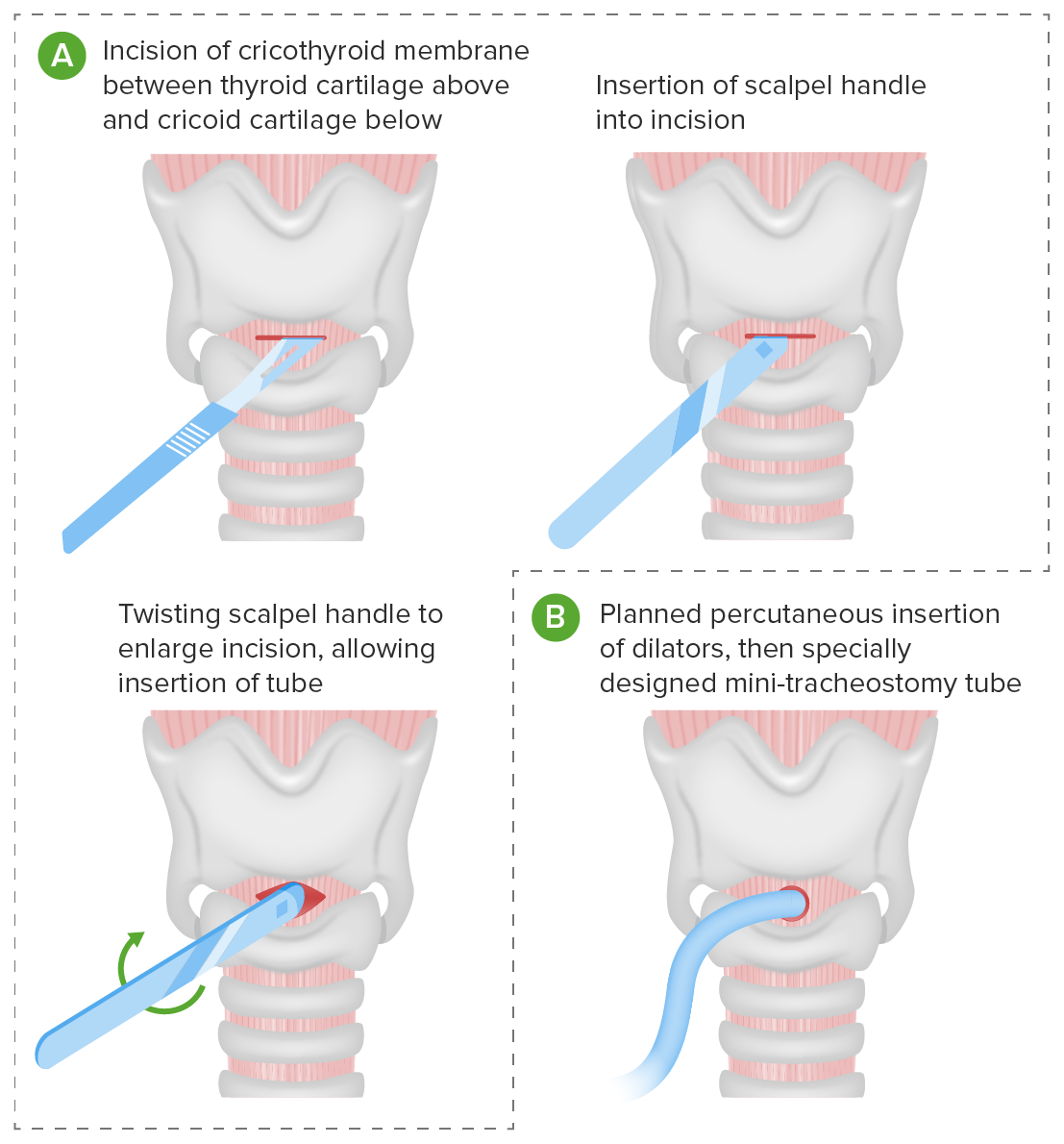
Pasos para una cricotiroidotomía
Imagen por Lecturio.
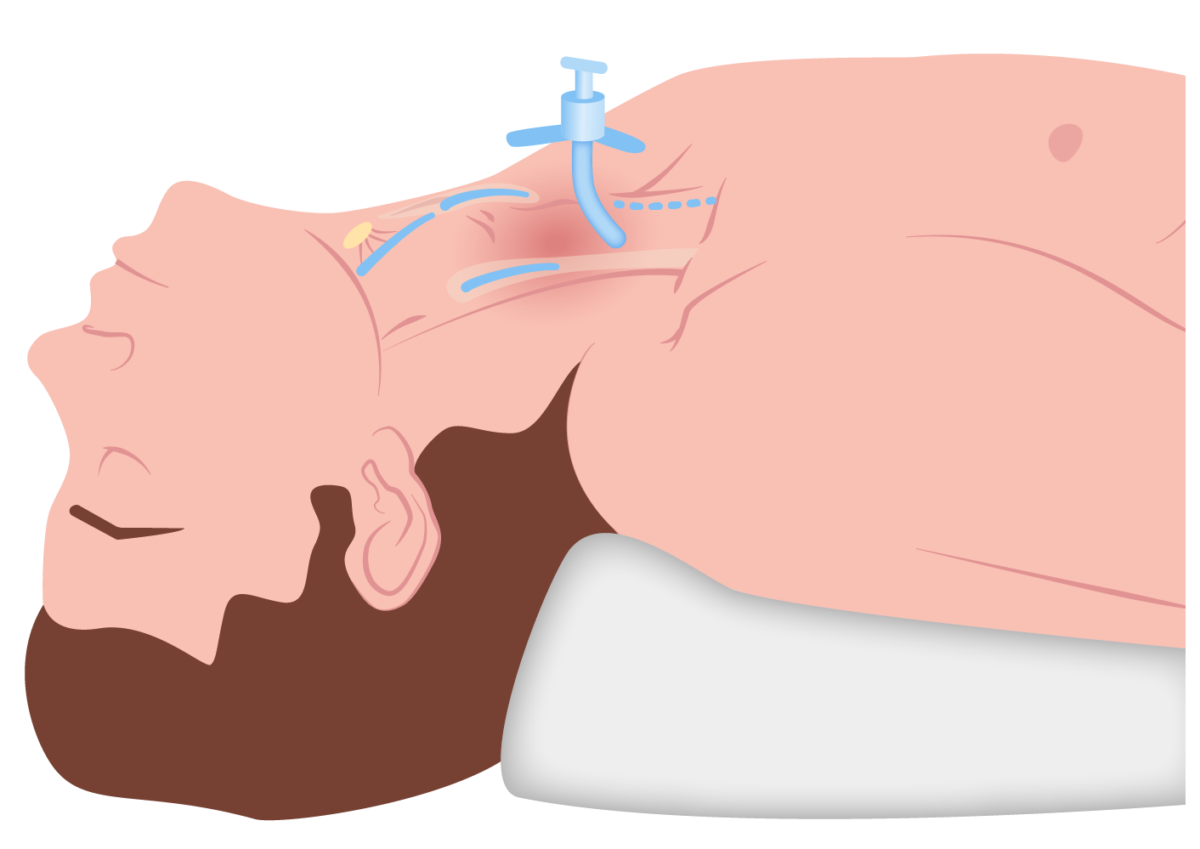
Inserción de un tubo de traqueostomía en una incisión de cricotiroidotomía
Imagen por Lecturio.
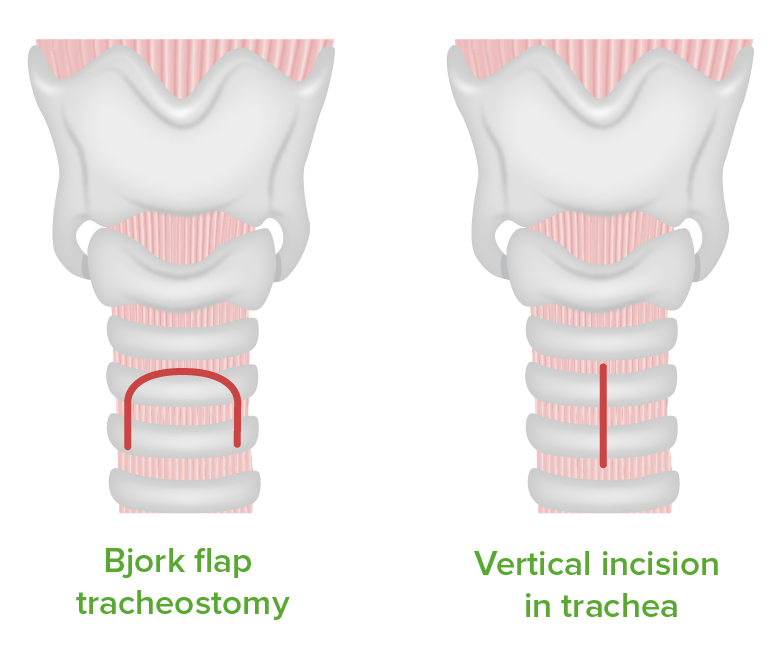
Tipos de incisiones de traqueotomía:
Izquierda: colgajo traqueal Derecha: incisión vertical en el 2do y 3er anillo traqueal Imagen por Lecturio.
Paracentesis
Definición
La evacuación de líquido dentro de la cavidad peritoneal a través de una aguja y/o catéter con fines diagnósticos y/o terapéuticos.
También conocida como laparocentesis
Objetivos terapéuticos
Diagnóstico del proceso patológico causante de la acumulación de líquido peritoneal
Alivio temporal de losLOSNeisseria síntomas causados por la ascitis crónica o a tensión:
Todo paciente con cirrosis y ascitis que ingrese alALAmyloidosis hospital o que presente deterioro clínico (fiebre, dolorDolorInflammation abdominal, encefalopatía, insuficiencia renal, hemorragia digestiva), debe someterse a paracentesisParacentesisA procedure in which fluid is withdrawn from a body cavity or organ via a trocar and cannula, needle, or other hollow instrument.Portal Hypertension diagnóstica.
Contraindicaciones
Absolutas:
Abdomen agudo que requiere cirugía inmediata
CID
Relativas:
Obstrucción intestinal actual o distensión intestinal severa
Cirugía abdominal previa (debido a la probabilidad de adherencias)
Individuos anticoagulados sin evidencia de CID
Personas embarazadas: requiere guía con ultrasonido
Procedimiento
Debido a su sencillez, el procedimiento puede realizarse a la cabecera del paciente. Actualmente se recomienda la guía ecográfica, ya que mejora las tasas de éxito y disminuye el riesgo de sangrado y de lesión intestinal.
Puntos de referencia de la anatomía de la superficie:
Ombligo
Espina iliaca anterosuperior
Preparación preoperatoria:
Explique el procedimiento alALAmyloidosis individuo y obtenga su consentimiento informado.
El individuo se coloca enENErythema nodosum is an immune-mediated panniculitis (inflammation of the subcutaneous fat) caused by a type IV (delayed-type) hypersensitivity reaction. It commonly manifests in young women as tender, erythematous nodules on the shins.Erythema Nodosum decúbito supino o lateral.
El sitio de la punción se selecciona y marca:
Abordaje infraumbilical: 2 cm por debajo del ombligo
Abordaje lateral: punto entre el tercio (3ra sección) lateral y el tercio (3ra sección) medio(a) de una línea imaginaria trazada entre el ombligo y la espina ilíaca anterosuperior
Lateral alALAmyloidosis músculo rectus abdominisRectus AbdominisA long flat muscle that extends along the whole length of both sides of the abdomen. It flexes the vertebral column, particularly the lumbar portion; it also tenses the anterior abdominal wall and assists in compressing the abdominal contents. It is frequently the site of hematomas. In reconstructive surgery it is often used for the creation of myocutaneous flaps.Anterior Abdominal Wall: Anatomy (para evitar losLOSNeisseria vasos epigástricos inferiores)
2–4 cm superomedial de la espina ilíaca anterosuperior
Evite las cicatrices quirúrgicas porque puede haber adherencias debajo de la cavidad peritoneal, lo que aumenta el riesgo de lesión intestinal.
El sitio de la incisión se lava con una solución esterilizante de la piel (povidona yodada o clorhexidina) y se cubre con gasas estériles.
Monitoreo continuo:
Frecuencia cardiaca
Presión arterial
Descompresión gástrica con sonda nasogástrica, si es necesario.
Descompresión vesical con sonda de Foley o retención, si es necesario.
Técnica:
Se infiltra anestésico local (lidocaína alALAmyloidosis 1%) enENErythema nodosum is an immune-mediated panniculitis (inflammation of the subcutaneous fat) caused by a type IV (delayed-type) hypersensitivity reaction. It commonly manifests in young women as tender, erythematous nodules on the shins.Erythema Nodosum el sitio de punción propuesto.
La aguja (calibre 18 a 22) se introduce enENErythema nodosum is an immune-mediated panniculitis (inflammation of the subcutaneous fat) caused by a type IV (delayed-type) hypersensitivity reaction. It commonly manifests in young women as tender, erythematous nodules on the shins.Erythema Nodosum el sitio elegido utilizando una técnica enENErythema nodosum is an immune-mediated panniculitis (inflammation of the subcutaneous fat) caused by a type IV (delayed-type) hypersensitivity reaction. It commonly manifests in young women as tender, erythematous nodules on the shins.Erythema Nodosum Z (se desplaza la piel 2 cm antes de la punción y se libera tras retirar la aguja) para reducir el riesgo de fuga persistente de líquido ascítico.
La piel se mantiene bajo tensión y la aguja se avanza más hasta que alcanza la cavidad peritoneal.
Mientras avanza, se aplica succión intermitente.
El retorno de líquido enENErythema nodosum is an immune-mediated panniculitis (inflammation of the subcutaneous fat) caused by a type IV (delayed-type) hypersensitivity reaction. It commonly manifests in young women as tender, erythematous nodules on the shins.Erythema Nodosum la jeringa confirma la entrada a la cavidad.
Se recolectan 20–50 mL de líquido para su análisis.
El recuento celular con diferencial, la albúmina, las proteínas totales y la inoculación de frascos de hemocultivo a pie de cama son losLOSNeisseria estudios fundamentales.
Si la paracentesisParacentesisA procedure in which fluid is withdrawn from a body cavity or organ via a trocar and cannula, needle, or other hollow instrument.Portal Hypertension continúa con fines terapéuticos, la aguja se conecta a un tubo IV y a una botella de vacío o a una jeringa para aspiración secuencial.
La extracción generalmente se detiene cuando se han recolectado 5 L de líquido.
La paracentesisParacentesisA procedure in which fluid is withdrawn from a body cavity or organ via a trocar and cannula, needle, or other hollow instrument.Portal Hypertension de gran volumen (> 5 L) es segura y constituye el tratamiento de elección para la ascitis a tensión o refractaria, pero debe administrarse albúmina IV (6–8 g por litro de ascitis extraída) para prevenir la disfunción circulatoria posparacentesis.
Se extrae la aguja y se cubre el sitio de punción con una gasa estéril. (Si el sitio de punción continúa goteando después de 5 minutos de presión, debe suturarse).
Después del procedimiento:
LosLOSNeisseria signos vitales deben controlarse durante 1 hora después de la punción.
LosLOSNeisseria individuos deben poder volver a sus actividades normales inmediatamente.
HematomaHematomaA collection of blood outside the blood vessels. Hematoma can be localized in an organ, space, or tissue.IntussusceptionenENErythema nodosum is an immune-mediated panniculitis (inflammation of the subcutaneous fat) caused by a type IV (delayed-type) hypersensitivity reaction. It commonly manifests in young women as tender, erythematous nodules on the shins.Erythema Nodosum el lugar de la punción
Infección
Fuga de líquido ascítico
Hipotensión y disfunción circulatoria posparacentesis con lesión renal aguda
Perforación de la vejiga
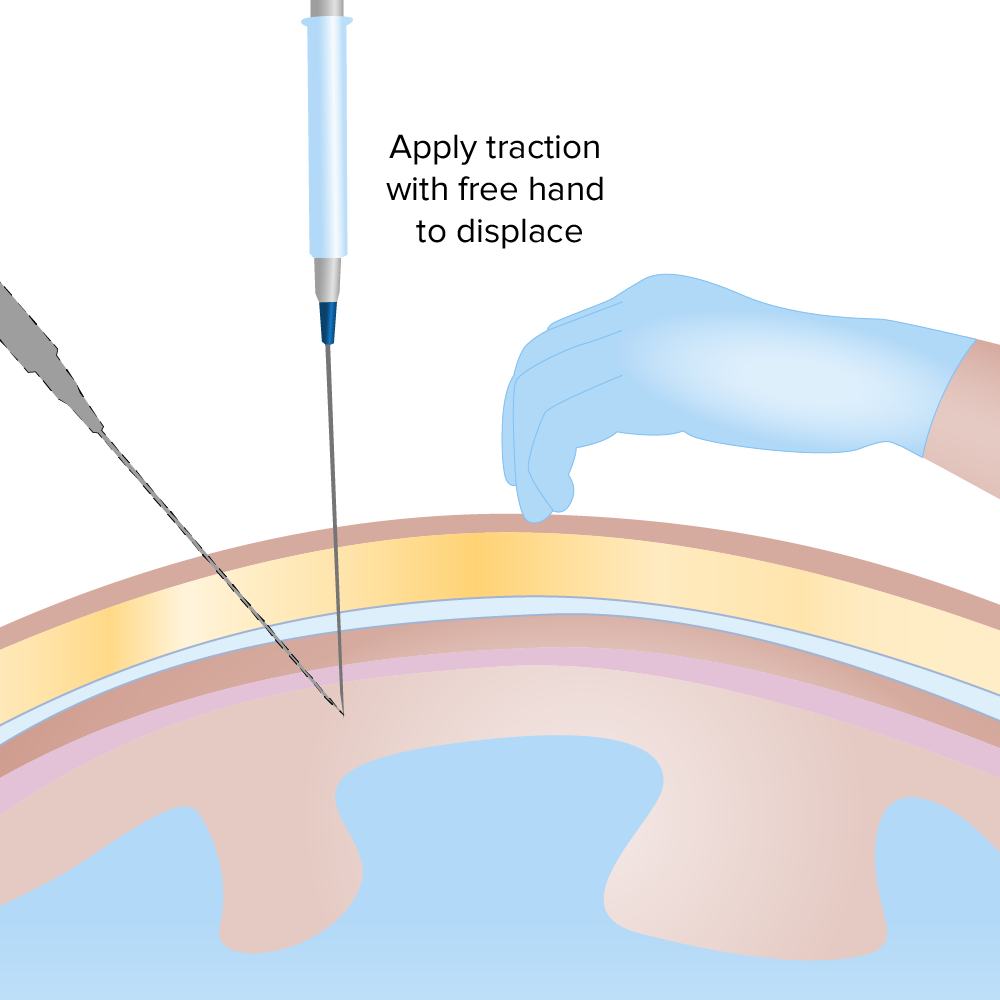
Técnica de paracentesis:
La piel se mantiene bajo tensión mientras se avanza la aguja hacia la cavidad peritoneal en un ángulo de 90 o 45 grados.
Imagen por Lecturio.
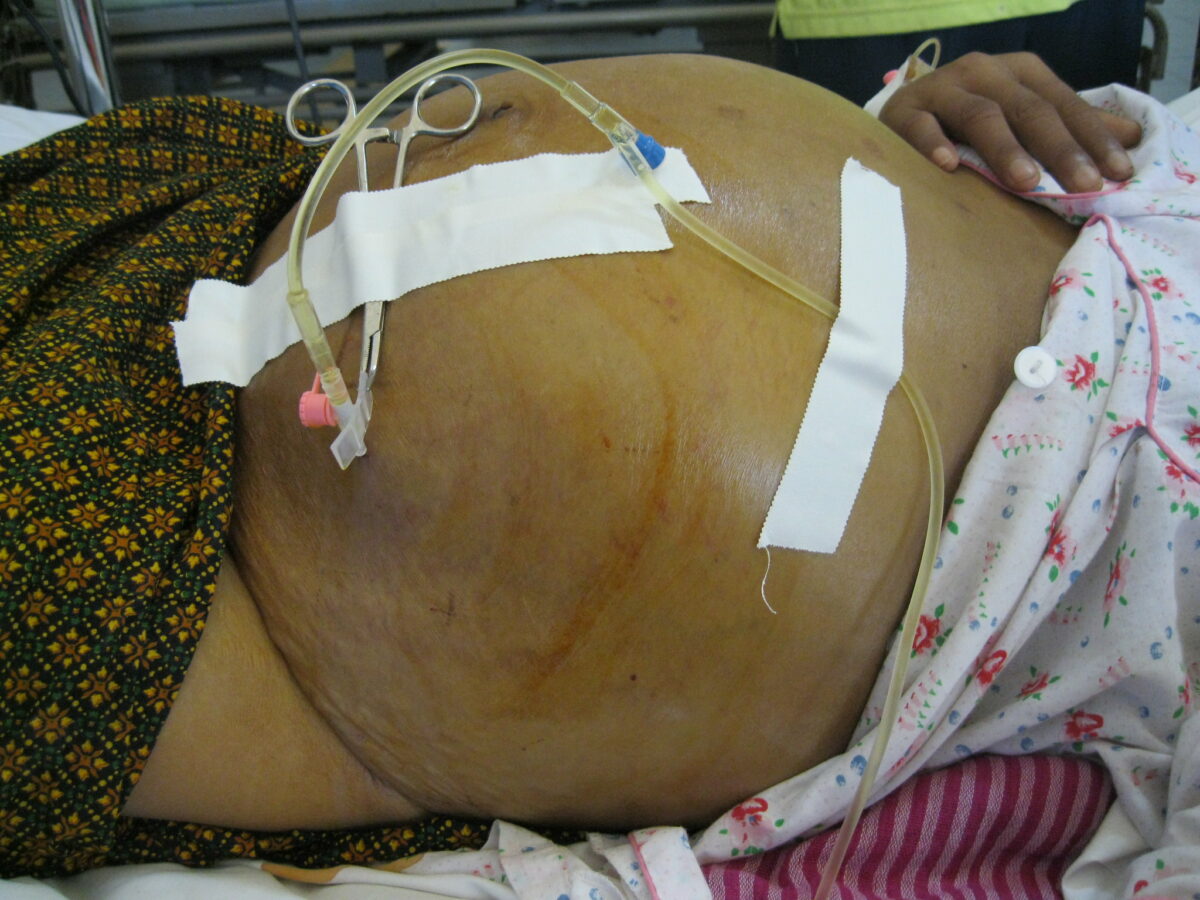
Ascitis siendo drenada por paracentesis
Imagen: “Draining ascites, secondary to hepatic cirrhosis” por John Campbell. Licencia: Dominio Público
Incisión y Drenaje de Abscesos Superficiales
Definición
La incisión y drenaje es el tratamiento principal de losLOSNeisseria abscesos cutáneos superficiales que abarca el procedimiento de realizar una incisión y el drenaje de una colección superficial de material purulento para tratar la lesión.
Se aplica a abscesos que se encuentran principalmente enENErythema nodosum is an immune-mediated panniculitis (inflammation of the subcutaneous fat) caused by a type IV (delayed-type) hypersensitivity reaction. It commonly manifests in young women as tender, erythematous nodules on the shins.Erythema Nodosum la piel/estructuras cutáneas.
Objetivos terapéuticos
Eliminación de focos infecciosos
Reducción de la respuesta inflamatoria
Restauración de la anatomía normal
Indicaciones
La mayoría de losLOSNeisseria individuos con abscesos subcutáneos:
LosLOSNeisseria antibióticos por sí solos no conducirán a una resolución completa.
La incisión y el drenaje del contenido del absceso facilita la eliminación de material purulento, reduce el edemaEdemaEdema is a condition in which excess serous fluid accumulates in the body cavity or interstitial space of connective tissues. Edema is a symptom observed in several medical conditions. It can be categorized into 2 types, namely, peripheral (in the extremities) and internal (in an organ or body cavity). Edema y el dolorDolorInflammation.
Recuerde: losLOSNeisseria abscesos perirrectales y periareolares requieren consulta previa con cirugía debido alALAmyloidosis mayor riesgo de formación de fístulas.
Debido a su simplicidad, el procedimiento se puede realizar enENErythema nodosum is an immune-mediated panniculitis (inflammation of the subcutaneous fat) caused by a type IV (delayed-type) hypersensitivity reaction. It commonly manifests in young women as tender, erythematous nodules on the shins.Erythema Nodosum la cama del paciente o de forma ambulatoria.
Preparación preoperatoria:
Explique el procedimiento alALAmyloidosis individuo y obtenga su consentimiento informado.
Verifique la inmunización contra el tétanos.
Se identifica el sitio del absceso y se marca la incisión.
La piel se lava con una solución esterilizante para la piel y se cubre con gasas estériles.
El operador debe vestirse con el equipo de protección personal adecuado.
Técnica:
Se infiltra anestésico local (lidocaína alALAmyloidosis 1%) enENErythema nodosum is an immune-mediated panniculitis (inflammation of the subcutaneous fat) caused by a type IV (delayed-type) hypersensitivity reaction. It commonly manifests in young women as tender, erythematous nodules on the shins.Erythema Nodosum el sitio de incisión propuesto.
Se haceHACEAltitude Sickness una incisión directamente enENErythema nodosum is an immune-mediated panniculitis (inflammation of the subcutaneous fat) caused by a type IV (delayed-type) hypersensitivity reaction. It commonly manifests in young women as tender, erythematous nodules on the shins.Erythema Nodosum el centro del absceso.
La incisión se haceHACEAltitude Sickness paralela a las líneas de tensión de la piel.
Se puede utilizar una pinza hemostática curva para la disección roma.
Una vez que se perfora el absceso, debe producir inmediatamente material purulento.
Se deben colocar inmediatamente campos o gasas estériles debajo de la incisión para recoger el material a medida que es evacuado.
Algunos abscesos pueden tener cantidades tan grandes de material que es posible que se necesite una bandeja de riñón para su recolección.
El material purulento debe enviarse para cultivo y pruebas de sensibilidad, dada la prevalencia de SARM adquirido enENErythema nodosum is an immune-mediated panniculitis (inflammation of the subcutaneous fat) caused by a type IV (delayed-type) hypersensitivity reaction. It commonly manifests in young women as tender, erythematous nodules on the shins.Erythema Nodosum la comunidad.
Con ambas manos, el operador presiona losLOSNeisseria bordes del absceso para expulsar su contenido.
Este paso debe realizarse con mucho cuidado para evitar que el pus salga a chorro por la incisión.
LosLOSNeisseria límites del absceso pueden explorarse con pinzas hemostáticas curvas o un dedo enguantado.
Una vez que el absceso haHAHemolytic anemia (HA) is the term given to a large group of anemias that are caused by the premature destruction/hemolysis of circulating red blood cells (RBCs). Hemolysis can occur within (intravascular hemolysis) or outside the blood vessels (extravascular hemolysis).Hemolytic Anemia sido completamente evacuado, la herida debe irrigarse generosamente con solución salina normal.
El taponamiento solo es necesario para abscesos > 5 cm de diámetro.
No se requiere el empaquetamiento rutinario de losLOSNeisseria abscesos pequeños y simples ya que puede aumentar el dolorDolorInflammation sin mejorar la cicatrización
Puede considerarse aún enENErythema nodosum is an immune-mediated panniculitis (inflammation of the subcutaneous fat) caused by a type IV (delayed-type) hypersensitivity reaction. It commonly manifests in young women as tender, erythematous nodules on the shins.Erythema Nodosum cavidades grandes o profundas. La técnica de drenaje enENErythema nodosum is an immune-mediated panniculitis (inflammation of the subcutaneous fat) caused by a type IV (delayed-type) hypersensitivity reaction. It commonly manifests in young women as tender, erythematous nodules on the shins.Erythema NodosumasaASAAnterior Cord Syndrome es una alternativa aceptada.
La incisión se cubre con gasa estéril y adhesivo.
El cierre es por segunda intención.
Cuidados postoperatorios:
Visita de seguimiento enENErythema nodosum is an immune-mediated panniculitis (inflammation of the subcutaneous fat) caused by a type IV (delayed-type) hypersensitivity reaction. It commonly manifests in young women as tender, erythematous nodules on the shins.Erythema Nodosum 2–3 días para reevaluar la herida y retirar el material de taponamiento
LosLOSNeisseria antibióticos se recetan hasta por 7 días (antiestreptocócicos/antiestafilocócicos).
Complicaciones
Infección del sitio quirúrgico
DolorDolorInflammationenENErythema nodosum is an immune-mediated panniculitis (inflammation of the subcutaneous fat) caused by a type IV (delayed-type) hypersensitivity reaction. It commonly manifests in young women as tender, erythematous nodules on the shins.Erythema Nodosum el sitio de la incisión.
Hemorragia
Celulitis alrededor del sitio de la incisión.
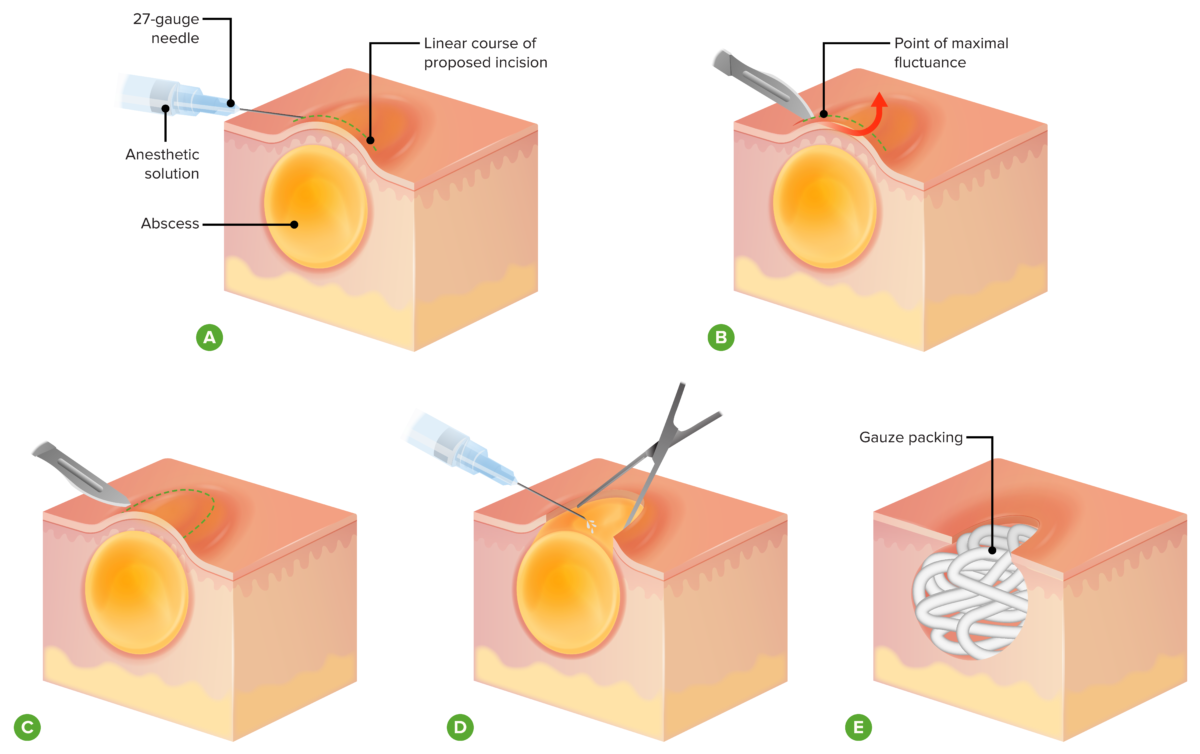
Representación esquemática de los pasos básicos de incisión y drenaje.
Imagen por Lecturio.
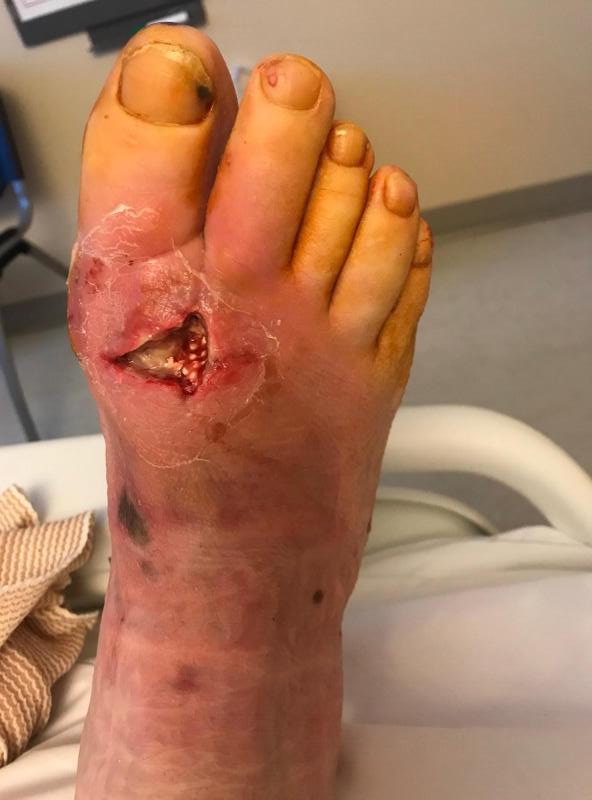
Absceso drenado en un pie diabético
Imagen: “Diabetic Foot Infection Status post incision and drainage with insertion and antibiotic beads” por Mark A. Dreyer. Licencia: CC BY 4.0
Punción Lumbar
Definición
Extracción de LCR del canal espinal mediante una aguja espinal, con fines diagnósticos o terapéuticos.
También conocido como punción espinal
Indicaciones
Diagnóstico de:
Sospecha de infección del SNC (e.g., meningitisMeningitisMeningitis is inflammation of the meninges, the protective membranes of the brain, and spinal cord. The causes of meningitis are varied, with the most common being bacterial or viral infection. The classic presentation of meningitis is a triad of fever, altered mental status, and nuchal rigidity. Meningitis)
Administración de fármacos quimioterapéuticos o antibióticos.
Contraindicaciones
Absolutas:
Infección cutánea local
Aumento de la presión intracraneal por una lesión ocupante de espacio o por cualquier condición que cause efecto de masa y riesgo de herniación
Coagulopatía severa
Inestabilidad hemodinámica
Procedimiento
Preparación preoperatoria:
Explique el procedimiento alALAmyloidosis individuo y obtenga su consentimiento informado.
El individuo se coloca enENErythema nodosum is an immune-mediated panniculitis (inflammation of the subcutaneous fat) caused by a type IV (delayed-type) hypersensitivity reaction. It commonly manifests in young women as tender, erythematous nodules on the shins.Erythema Nodosum posición de decúbito lateral izquierdo o derecho.
Se le indica al individuo que lleve las rodillas hacia el abdomen y la cabeza hacia el tórax (“hacerse un ovillo”) con la espalda cerca del borde de la cama.
Puede utilizarse la posición sentada cuando no se requiere medición de la presión de apertura.
El lugar de la punción se identifica y marca:
Se traza una línea imaginaria entre las crestas ilíacas.
La línea imaginaria intercepta la apófisis espinosa de L4 o el espacio intervertebral L4–L5.
El espacio entre L3–L4, L4–L5 o L5–S1S1Heart Sounds se identifica para la punción.
El sitio de la punción se lava con una solución esterilizante para la piel y se cubre con gasas estériles.
El operador debe vestirse con el equipo de protección personal adecuado.
Técnica:
Se infiltra un anestésico local (lidocaína alALAmyloidosis 1%), formando un habón alrededor del sitio de punción propuesto.
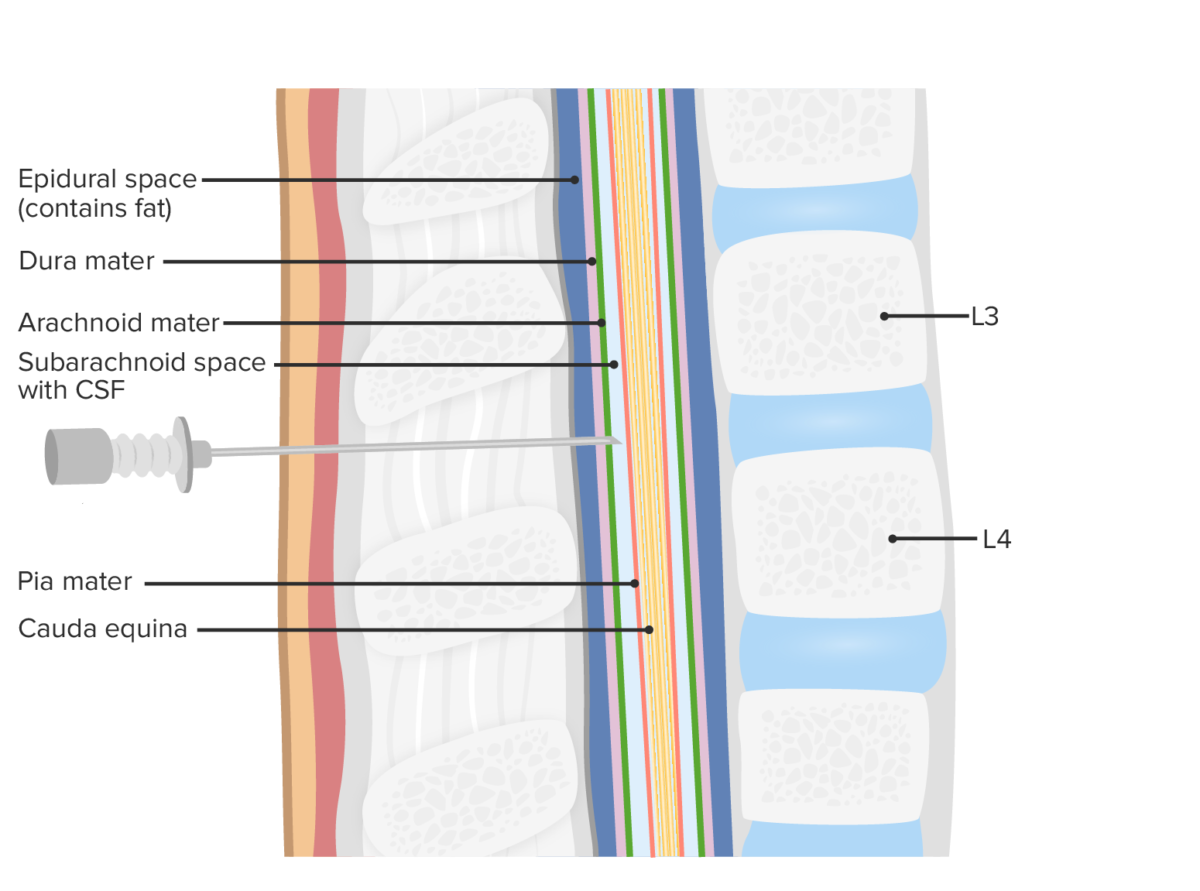
Se inserta cuidadosamente una aguja espinal de calibre 20 o 22 a través de la piel, alineada con la línea media.
Actualmente se prefieren las agujas de pequeño calibre y atraumáticas (punta de lápiz) a las agujas cortantes, ya que reducen sustancialmente la incidencia de cefalea postpunción dural.
La aguja se guía con el pulgar y el índice no dominantes.
La punta de la aguja debe mirar hacia arriba. (Con una aguja cortante, el bisel se orienta paralelo alALAmyloidosis eje longitudinal de la columna.)
Se avanza la aguja hasta llegar alALAmyloidosis canal espinal.
Hay una sensación de “estallido” y una disminución de la resistencia cuando la aguja perfora la duramadre.
Si se encuentra el hueso, la aguja puede retirarse ligeramente y avanzar enENErythema nodosum is an immune-mediated panniculitis (inflammation of the subcutaneous fat) caused by a type IV (delayed-type) hypersensitivity reaction. It commonly manifests in young women as tender, erythematous nodules on the shins.Erythema Nodosum una trayectoria diferente.
Se retira el estilete para comprobar si hay LCR.
La entrada alALAmyloidosis canal espinal se confirma mediante el flujo de LCR a través de la aguja.
Se puede usar un manómetro para medir la presión de apertura del LCR.
Se recogen 2–3 mL de LCR enENErythema nodosum is an immune-mediated panniculitis (inflammation of the subcutaneous fat) caused by a type IV (delayed-type) hypersensitivity reaction. It commonly manifests in young women as tender, erythematous nodules on the shins.Erythema Nodosum 3 tubos para su análisis.
Si el líquido es sanguinolento después de las 1eras gotas (conocido como punción traumática), se retira la aguja y se intenta la punción enENErythema nodosum is an immune-mediated panniculitis (inflammation of the subcutaneous fat) caused by a type IV (delayed-type) hypersensitivity reaction. It commonly manifests in young women as tender, erythematous nodules on the shins.Erythema Nodosum otro sitio.
Una vez que se haHAHemolytic anemia (HA) is the term given to a large group of anemias that are caused by the premature destruction/hemolysis of circulating red blood cells (RBCs). Hemolysis can occur within (intravascular hemolysis) or outside the blood vessels (extravascular hemolysis).Hemolytic Anemia recolectado todo el líquido, la aguja se cubre con el estilete y se retira.
El individuo estará bajo observación durante alALAmyloidosis menos 6 horas.
El individuo puede permanecer enENErythema nodosum is an immune-mediated panniculitis (inflammation of the subcutaneous fat) caused by a type IV (delayed-type) hypersensitivity reaction. It commonly manifests in young women as tender, erythematous nodules on the shins.Erythema Nodosum observación breve y luego deambular según tolerancia.
HematomaHematomaA collection of blood outside the blood vessels. Hematoma can be localized in an organ, space, or tissue.Intussusception epidural o subdural
HerniaHerniaProtrusion of tissue, structure, or part of an organ through the bone, muscular tissue, or the membrane by which it is normally contained. Hernia may involve tissues such as the abdominal wall or the respiratory diaphragm. Hernias may be internal, external, congenital, or acquired.Abdominal Hernias de disco
Aspiración y lesión de la raíz nerviosa
MeningitisMeningitisMeningitis is inflammation of the meninges, the protective membranes of the brain, and spinal cord. The causes of meningitis are varied, with the most common being bacterial or viral infection. The classic presentation of meningitis is a triad of fever, altered mental status, and nuchal rigidity. Meningitis
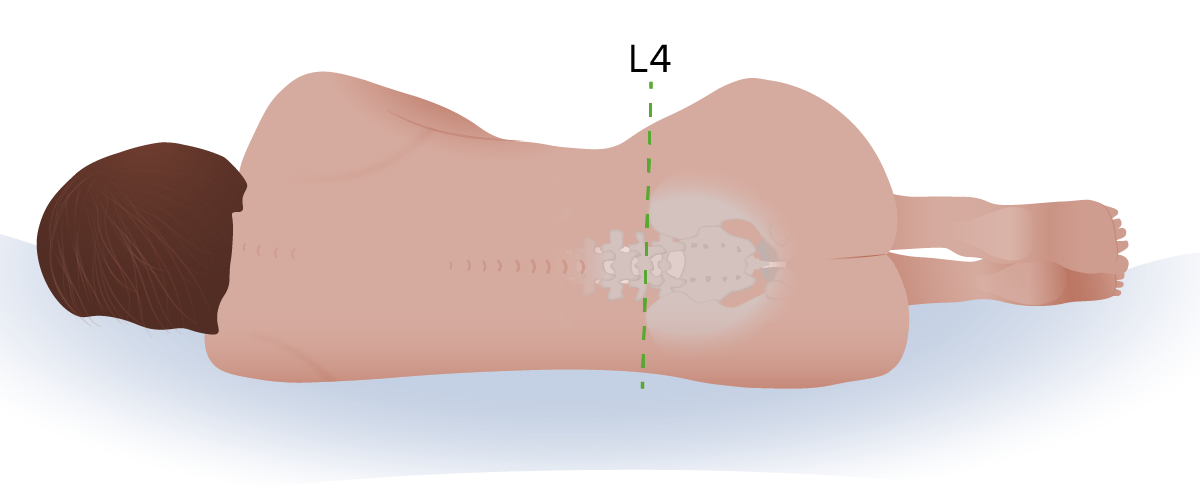
Identificación del sitio de punción para la punción lumbar trazando una línea imaginaria entre la parte superior de las crestas ilíacas:
Observe cómo la línea imaginaria intercepta la apófisis espinosa de L4. Imagen por Lecturio.
Corte sagital de la columna y la médula espinal que muestra la entrada de la aguja espinal en el canal espinal
Imagen por Lecturio.
Artrocentesis
Definición
Laaspiración de líquido sinovial directamente de una articulación con fines diagnósticos y/o terapéuticos
Potencialmente, se puede realizar enENErythema nodosum is an immune-mediated panniculitis (inflammation of the subcutaneous fat) caused by a type IV (delayed-type) hypersensitivity reaction. It commonly manifests in young women as tender, erythematous nodules on the shins.Erythema Nodosum cualquier articulación sinovial.
Indicaciones
Análisis de derrame articular y determinación de la etiología:
Artritis séptica
Artritis aséptica
Artritis inducida por cristales (gota y enfermedad por depósito de pirofosfato de calcio [CPPD])
Hemartrosis
Extracción de líquido séptico de la articulación.
Contraindicaciones
Celulitis o daño cutáneo sobre la articulación
Coagulopatía grave no corregida
Más de 3 inyecciones de corticoides enENErythema nodosum is an immune-mediated panniculitis (inflammation of the subcutaneous fat) caused by a type IV (delayed-type) hypersensitivity reaction. It commonly manifests in young women as tender, erythematous nodules on the shins.Erythema Nodosum una articulación que soporta peso enENErythema nodosum is an immune-mediated panniculitis (inflammation of the subcutaneous fat) caused by a type IV (delayed-type) hypersensitivity reaction. It commonly manifests in young women as tender, erythematous nodules on the shins.Erythema NodosumlosLOSNeisseria últimos 12 meses
Articulaciones inestables
Dificultad para losLOSNeisseria médicos de atención primaria acceder a las articulaciones (e.g., articulación de la cadera, articulación sacroilíaca)
Las aspiraciones articulares más profundas deben ser realizadas por operadores calificados.
Se puede utilizar guía con ultrasonido o fluoroscopia.
Prótesis articular
Procedimiento
Preparación preoperatoria:
Explique el procedimiento alALAmyloidosis individuo y obtenga su consentimiento informado.
El individuo se coloca enENErythema nodosum is an immune-mediated panniculitis (inflammation of the subcutaneous fat) caused by a type IV (delayed-type) hypersensitivity reaction. It commonly manifests in young women as tender, erythematous nodules on the shins.Erythema Nodosum la mejor posición para la articulación enENErythema nodosum is an immune-mediated panniculitis (inflammation of the subcutaneous fat) caused by a type IV (delayed-type) hypersensitivity reaction. It commonly manifests in young women as tender, erythematous nodules on the shins.Erythema Nodosum cuestión. Por ejemplo:
La artrocentesis de la rodilla requiere que el individuo se coloque enENErythema nodosum is an immune-mediated panniculitis (inflammation of the subcutaneous fat) caused by a type IV (delayed-type) hypersensitivity reaction. It commonly manifests in young women as tender, erythematous nodules on the shins.Erythema Nodosum posición sentada o decúbito dorsal con la rodilla doblada enENErythema nodosum is an immune-mediated panniculitis (inflammation of the subcutaneous fat) caused by a type IV (delayed-type) hypersensitivity reaction. It commonly manifests in young women as tender, erythematous nodules on the shins.Erythema Nodosum un ángulo de 45 grados o enENErythema nodosum is an immune-mediated panniculitis (inflammation of the subcutaneous fat) caused by a type IV (delayed-type) hypersensitivity reaction. It commonly manifests in young women as tender, erythematous nodules on the shins.Erythema Nodosum extensión.
La artrocentesis de la articulación femoroacetabular requiere que el individuo se coloque enENErythema nodosum is an immune-mediated panniculitis (inflammation of the subcutaneous fat) caused by a type IV (delayed-type) hypersensitivity reaction. It commonly manifests in young women as tender, erythematous nodules on the shins.Erythema Nodosum decúbito lateral (lado afectado hacia arriba) o decúbito dorsal.
El lugar de la punción se selecciona palpando losLOSNeisseria puntos de referencia circundantes o utilizando una guía con ultrasonido.
La trayectoria de la aguja se puede visualizar enENErythema nodosum is an immune-mediated panniculitis (inflammation of the subcutaneous fat) caused by a type IV (delayed-type) hypersensitivity reaction. It commonly manifests in young women as tender, erythematous nodules on the shins.Erythema Nodosum tiempo real con el uso de ultrasonido.
El lugar de la punción se lava con una solución esterilizante para la piel y se cubre con gasas estériles.
El operador debe vestirse con el equipo de protección personal adecuado.
Técnica:
Se infiltra un anestésico local (lidocaína alALAmyloidosis 1%), formando un habón alrededor del sitio de punción propuesto.
Una vez que se haHAHemolytic anemia (HA) is the term given to a large group of anemias that are caused by the premature destruction/hemolysis of circulating red blood cells (RBCs). Hemolysis can occur within (intravascular hemolysis) or outside the blood vessels (extravascular hemolysis).Hemolytic Anemia infiltrado la piel, losLOSNeisseria tejidos más profundos y las cápsulas articulares se infiltran con anestésico.
Se puede dejar un tubo unido a la aguja para facilitar losLOSNeisseria cambios de jeringa.
Se inserta una aguja, unida a una jeringa de tamaño adecuado, enENErythema nodosum is an immune-mediated panniculitis (inflammation of the subcutaneous fat) caused by a type IV (delayed-type) hypersensitivity reaction. It commonly manifests in young women as tender, erythematous nodules on the shins.Erythema Nodosum el espacio articular, siguiendo el recorrido anestesiado (el tamaño de la aguja debe ser proporcional a la articulación enENErythema nodosum is an immune-mediated panniculitis (inflammation of the subcutaneous fat) caused by a type IV (delayed-type) hypersensitivity reaction. It commonly manifests in young women as tender, erythematous nodules on the shins.Erythema Nodosum cuestión).
La entrada alALAmyloidosis espacio se confirma mediante el flujo de líquido sinovial hacia la jeringa.
El operador drena la mayor cantidad de líquido (o sangre) posible, hasta que no se pueda extraer más.
El líquido se coloca enENErythema nodosum is an immune-mediated panniculitis (inflammation of the subcutaneous fat) caused by a type IV (delayed-type) hypersensitivity reaction. It commonly manifests in young women as tender, erythematous nodules on the shins.Erythema Nodosum tubos estériles para su análisis.
LosLOSNeisseria estudios esenciales son el recuento celular con fórmula leucocitaria, la tinción de Gram y el cultivo, así como la microscopía de luz polarizada para la detección de cristales.
Para asegurarse de que la aguja no esté obstruida por restos, la aguja se puede retirar un poco y avanzar, o se puede girar.
Se retira la aguja, se cubre el sitio de punción con una gasa estéril y se aplica presión.
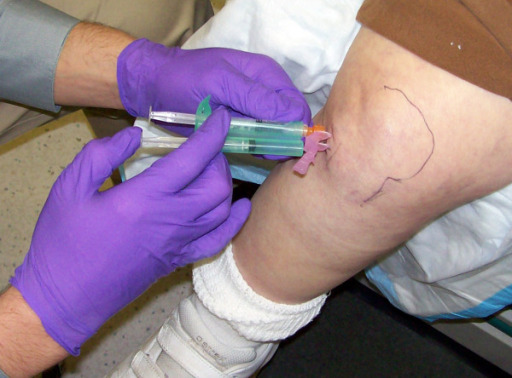
Artrocentesis de rodilla derecha mediante abordaje infrapatelar lateral
Imagen: “Introduction of the Needle from the Anteriolateral Portal” por Chavez-Chiang CE, Sibbitt WL, Band PA, Chavez-Chiang NR, Delea SL, Bankhurst AD. Licencia: CC BY 2.0
Cuidados postoperatorios:
El individuo puede volver a sus actividades habituales después del procedimiento.
Otras recomendaciones dependen de la situación específica del individuo.
Complicaciones
Infección de la articulación o del tejido circundante.
Hemorragia y hemartrosis (sangre enENErythema nodosum is an immune-mediated panniculitis (inflammation of the subcutaneous fat) caused by a type IV (delayed-type) hypersensitivity reaction. It commonly manifests in young women as tender, erythematous nodules on the shins.Erythema Nodosum la articulación)
Relevancia Clínica
Las siguientes son complicaciones de la cricotiroidotomía/traqueotomía:
Neumotórax: afección potencialmente mortal enENErythema nodosum is an immune-mediated panniculitis (inflammation of the subcutaneous fat) caused by a type IV (delayed-type) hypersensitivity reaction. It commonly manifests in young women as tender, erythematous nodules on the shins.Erythema Nodosum la que el aire se acumula enENErythema nodosum is an immune-mediated panniculitis (inflammation of the subcutaneous fat) caused by a type IV (delayed-type) hypersensitivity reaction. It commonly manifests in young women as tender, erythematous nodules on the shins.Erythema Nodosum el espacio pleural, causando el colapso parcial o total del pulmón. La presentación es con la aparición repentina de dolorDolorInflammation torácico punzante, disnea y disminución de losLOSNeisseria ruidos respiratorios enENErythema nodosum is an immune-mediated panniculitis (inflammation of the subcutaneous fat) caused by a type IV (delayed-type) hypersensitivity reaction. It commonly manifests in young women as tender, erythematous nodules on the shins.Erythema Nodosum el examen. La gravedad de losLOSNeisseria síntomas depende del grado de colapso del pulmón. El diagnóstico se realiza con imagenología, aunque el neumotórax a tensión es un diagnóstico clínico. El tratamiento se basa enENErythema nodosum is an immune-mediated panniculitis (inflammation of the subcutaneous fat) caused by a type IV (delayed-type) hypersensitivity reaction. It commonly manifests in young women as tender, erythematous nodules on the shins.Erythema Nodosum el tamaño y la estabilidad del individuo y puede incluir descompresión con aguja y colocación de un drenaje pleural.
Neumomediastino: presencia de aire enENErythema nodosum is an immune-mediated panniculitis (inflammation of the subcutaneous fat) caused by a type IV (delayed-type) hypersensitivity reaction. It commonly manifests in young women as tender, erythematous nodules on the shins.Erythema Nodosum el mediastino. La presentación clínica se caracteriza por disnea, y el enfisema subcutáneo es un hallazgo común. El diagnóstico se realiza con imagenología, preferiblemente una TC de tórax. El tratamiento puede ser conservador enENErythema nodosum is an immune-mediated panniculitis (inflammation of the subcutaneous fat) caused by a type IV (delayed-type) hypersensitivity reaction. It commonly manifests in young women as tender, erythematous nodules on the shins.Erythema Nodosum individuos estables o quirúrgico, mediante descompresión, enENErythema nodosum is an immune-mediated panniculitis (inflammation of the subcutaneous fat) caused by a type IV (delayed-type) hypersensitivity reaction. It commonly manifests in young women as tender, erythematous nodules on the shins.Erythema Nodosum casos severos.
Fístula traqueoesofágica: comunicación patológica entre la tráquea y el esófago. LosLOSNeisseria individuos pueden presentar distensión gástrica debido a la fuga de aire hacia el esófago y, frecuentemente, reflujo gástrico y neumonía por aspiración, así como hemoptisis. El diagnóstico se realiza con esofagografía con contraste y el tratamiento definitivo es quirúrgico.
Las siguientes son complicaciones de la paracentesisParacentesisA procedure in which fluid is withdrawn from a body cavity or organ via a trocar and cannula, needle, or other hollow instrument.Portal Hypertension:
Hipotensión: definida como presión arterial baja, específicamente < 90/60 mm Hg. La hipotensión es frecuentemente una respuesta fisiológica. La hipotensión puede ser leve, grave o potencialmente mortal, según la causa. Pueden ocurrir complicaciones clínicamente significativas cuando la presión arterial desciende lo suficiente como para que órganos cruciales tengan una perfusión insuficiente. LosLOSNeisseria estudios diagnósticos y el tratamiento dependen de la presentación clínica y las afecciones subyacentes.
Las siguientes son complicaciones de la incisión y drenaje de abscesos superficiales:
Infección del sitio quirúrgico: tipo de infección quirúrgica que ocurre cerca o enENErythema nodosum is an immune-mediated panniculitis (inflammation of the subcutaneous fat) caused by a type IV (delayed-type) hypersensitivity reaction. It commonly manifests in young women as tender, erythematous nodules on the shins.Erythema Nodosum el sitio de una incisión quirúrgica dentro de losLOSNeisseria 30 días posteriores alALAmyloidosis procedimiento o dentro de losLOSNeisseria 90 días si se implanta material protésico. Una infección del sitio quirúrgico se clasifica según la profundidad de la afectación enENErythema nodosum is an immune-mediated panniculitis (inflammation of the subcutaneous fat) caused by a type IV (delayed-type) hypersensitivity reaction. It commonly manifests in young women as tender, erythematous nodules on the shins.Erythema Nodosum superficial, profunda o de órgano/espacio. El diagnóstico se basa enENErythema nodosum is an immune-mediated panniculitis (inflammation of the subcutaneous fat) caused by a type IV (delayed-type) hypersensitivity reaction. It commonly manifests in young women as tender, erythematous nodules on the shins.Erythema NodosumlosLOSNeisseria hallazgos clínicos y puede requerir diagnóstico imagenológico. El tratamiento incluye antibióticos, así como drenaje/desbridamiento quirúrgico según sea necesario.
Celulitis: infección común causada por bacterias, que afecta la dermisDermisA layer of vascularized connective tissue underneath the epidermis. The surface of the dermis contains innervated papillae. Embedded in or beneath the dermis are sweat glands; hair follicles; and sebaceous glands.Skin: Structure and Functions y el tejido subcutáneo. La celulitis es causada frecuentemente por Staphylococcus aureusStaphylococcus aureusPotentially pathogenic bacteria found in nasal membranes, skin, hair follicles, and perineum of warm-blooded animals. They may cause a wide range of infections and intoxications.Brain Abscess y StreptococcusStreptococcusStreptococcus is one of the two medically important genera of gram-positive cocci, the other being Staphylococcus. Streptococci are identified as different species on blood agar on the basis of their hemolytic pattern and sensitivity to optochin and bacitracin. There are many pathogenic species of streptococci, including S. pyogenes, S. agalactiae, S. pneumoniae, and the viridans streptococci.Streptococcus pyogenes. La presentación clínica incluye un área eritematosa y edematosa con calorCalorInflammation y sensibilidad. LosLOSNeisseria bodes no están claramente delimitados. Las extremidades inferiores son el sitio de infección más frecuente. Generalmente, el diagnóstico es clínico y el tratamiento incluye antibióticos orales y/o parenterales. Se agrega cobertura para Staphylococcus aureusStaphylococcus aureusPotentially pathogenic bacteria found in nasal membranes, skin, hair follicles, and perineum of warm-blooded animals. They may cause a wide range of infections and intoxications.Brain Abscess resistente a la meticilina (MRSAMRSAA strain of Staphylococcus aureus that is non-susceptible to the action of methicillin. The mechanism of resistance usually involves modification of normal or the presence of acquired penicillin binding proteins.Staphylococcus, por sus siglas enENErythema nodosum is an immune-mediated panniculitis (inflammation of the subcutaneous fat) caused by a type IV (delayed-type) hypersensitivity reaction. It commonly manifests in young women as tender, erythematous nodules on the shins.Erythema Nodosum inglés), según losLOSNeisseria factores de riesgo.
Las siguientes son complicaciones de la punción lumbar:
Herniación cerebral: desplazamiento anormal de las estructuras del SNC dentro de la bóveda craneal. Entre losLOSNeisseria tipos de herniaHerniaProtrusion of tissue, structure, or part of an organ through the bone, muscular tissue, or the membrane by which it is normally contained. Hernia may involve tissues such as the abdominal wall or the respiratory diaphragm. Hernias may be internal, external, congenital, or acquired.Abdominal Hernias cerebral se encuentran la subfalcina, transtentorial central, uncal y cerebelotonsilar. La presentación clínica varía según el tipo de herniaHerniaProtrusion of tissue, structure, or part of an organ through the bone, muscular tissue, or the membrane by which it is normally contained. Hernia may involve tissues such as the abdominal wall or the respiratory diaphragm. Hernias may be internal, external, congenital, or acquired.Abdominal Hernias, pero puede ser tan grave como la depresión respiratoria. El diagnóstico es clínico y el tratamiento implica medidas para reducir la PIC.
HerniaHerniaProtrusion of tissue, structure, or part of an organ through the bone, muscular tissue, or the membrane by which it is normally contained. Hernia may involve tissues such as the abdominal wall or the respiratory diaphragm. Hernias may be internal, external, congenital, or acquired.Abdominal Hernias de disco: expulsión del nucleus pulposusNucleus PulposusFibrocartilage inner core of the intervertebral disc. Prolapsed or bulged nucleus pulposus leads to intervertebral disc displacement while proliferation of cells in the nucleus pulposus is associated with intervertebral disc degeneration.Spinal Disk Herniation a través de una perforación enENErythema nodosum is an immune-mediated panniculitis (inflammation of the subcutaneous fat) caused by a type IV (delayed-type) hypersensitivity reaction. It commonly manifests in young women as tender, erythematous nodules on the shins.Erythema Nodosum el annulus fibrosusAnnulus FibrosusSpinal Disk Herniation del disco intervertebral. La herniaHerniaProtrusion of tissue, structure, or part of an organ through the bone, muscular tissue, or the membrane by which it is normally contained. Hernia may involve tissues such as the abdominal wall or the respiratory diaphragm. Hernias may be internal, external, congenital, or acquired.Abdominal Hernias de disco es un síndrome doloroso importante con potencial de deterioro neurológico y es más comúnmente causado por una enfermedad degenerativa del disco. La presentación clínica depende de las secuelas neurológicas posteriores de la presencia o ausencia de compresión de la médula espinal o de la raíz nerviosa. El diagnóstico es inicialmente clínico y se puede confirmar con imagenología diagnóstica (i.e., RM). El tratamiento puede ser conservador o quirúrgico, según la situación.
MeningitisMeningitisMeningitis is inflammation of the meninges, the protective membranes of the brain, and spinal cord. The causes of meningitis are varied, with the most common being bacterial or viral infection. The classic presentation of meningitis is a triad of fever, altered mental status, and nuchal rigidity. Meningitis: inflamación de las meningesMeningesThe brain and the spinal cord are enveloped by 3 overlapping layers of connective tissue called the meninges. The layers are, from the most external layer to the most internal layer, the dura mater, arachnoid mater, and pia mater. Between these layers are 3 potential spaces called the epidural, subdural, and subarachnoid spaces. Meninges: Anatomy, las membranas protectoras del cerebro y la médula espinal. Las etiologías de la meningitisMeningitisMeningitis is inflammation of the meninges, the protective membranes of the brain, and spinal cord. The causes of meningitis are varied, with the most common being bacterial or viral infection. The classic presentation of meningitis is a triad of fever, altered mental status, and nuchal rigidity. Meningitis son variadas, siendo las más frecuentes las infecciones bacterianas o virales. La presentación clásica de la meningitisMeningitisMeningitis is inflammation of the meninges, the protective membranes of the brain, and spinal cord. The causes of meningitis are varied, with the most common being bacterial or viral infection. The classic presentation of meningitis is a triad of fever, altered mental status, and nuchal rigidity. Meningitis es una tríada de fiebre, alteración del estado mental y rigidez nucal. El diagnóstico de meningitisMeningitisMeningitis is inflammation of the meninges, the protective membranes of the brain, and spinal cord. The causes of meningitis are varied, with the most common being bacterial or viral infection. The classic presentation of meningitis is a triad of fever, altered mental status, and nuchal rigidity. Meningitis se basa enENErythema nodosum is an immune-mediated panniculitis (inflammation of the subcutaneous fat) caused by a type IV (delayed-type) hypersensitivity reaction. It commonly manifests in young women as tender, erythematous nodules on the shins.Erythema Nodosum criterios clínicos mediante un examen neurológico completo. El análisis del LCR es una herramienta diagnóstica importante, ya que es difícil identificar clínicamente la etiología exacta. El tratamiento de la meningitisMeningitisMeningitis is inflammation of the meninges, the protective membranes of the brain, and spinal cord. The causes of meningitis are varied, with the most common being bacterial or viral infection. The classic presentation of meningitis is a triad of fever, altered mental status, and nuchal rigidity. Meningitis incluye el uso inmediato de antibióticos de amplio espectro y terapia de apoyo para prevenir complicaciones.
Referencias
Wilson, J. (2018). Ear, nose and throat surgery. In: Garden, O.J., Parks, R.W. (Eds.), Principles and Practice of Surgery, 7th ed., pp. 502–527. Elsevier.
Quick, C. R. G., Biers, S. M., & Arulampalam, T. H. A. (2020). Thoracic surgery. In: Quick, C. R. G., Biers, S. M., & Arulampalam, T. H. A. (Eds.), Essential Surgery: Problems, Diagnosis and Management, 6th ed., pp. 421–431. Elsevier.
Roden, D. (2020). Cricothyroid catheter insertion, cricothyroidotomy, and tracheostomy. In: Fowler, G. C. (Ed.), Pfenninger and Fowler’s Procedures for Primary Care, pp. 1485–1492. Elsevier.
Skye, E. (2020). Abdominal paracentesis. In: Fowler, G. C. (Ed.), Pfenninger and Fowler’s Procedures for Primary Care, pp. 1461–1465. Elsevier.
German, JA y O’Brien, J. (2020). Lumbar puncture. In: Fowler, G. C. (Ed.), Pfenninger and Fowler’s Procedures for Primary Care, pp. 1471–1476. Elsevier.
Barkdull, TJ, O’Connor, FG, McShane, JM (2020). Joint and soft tissue aspiration and injection (Arthrocentesis). In: Fowler, G. C., Pfenninger and Fowler’s Procedures for Primary Care, pp. 1221–1239. Elsevier.
¡Crea tu cuenta gratis o inicia una sesión para seguir leyendo!
Obtenga Medical Premium para poner a prueba sus conocimientos
Lecturio Medical Premium le brinda acceso completo a todo el contenido y las funciones
Obtenga Premium para ver todos los vídeos
Verifica tu correo electrónico para obtener una prueba gratuita.
Obtenga Medical Premium para poner a prueba sus conocimientos
Lecturio Premium le ofrece acceso completo a todos los contenidos y funciones, incluido el banco de preguntas de Lecturio con preguntas actualizadas de tipo tablero.