
Domina Conceptos Médicos

Estudia para la escuela de medicina y tus examenes con Lecturio.

Pica

La pica Pica Pica is an eating disorder characterized by a desire or recurrent compulsion to eat substances that are nonnutritive and not food. These compulsions and ingested substances are inappropriate for age or culture. Pica es un trastorno de la alimentación que se caracteriza por el deseo o la compulsión recurrente de comer sustancias que no son nutritivas ni alimenticias. Estas compulsiones y sustancias ingeridas son inapropiadas para la edad o la cultura. La pica Pica Pica is an eating disorder characterized by a desire or recurrent compulsion to eat substances that are nonnutritive and not food. These compulsions and ingested substances are inappropriate for age or culture. Pica se manifiesta con mayor frecuencia durante la infancia y el embarazo y, por tanto, conlleva un alto riesgo de desnutrición y anemia Anemia Anemia is a condition in which individuals have low Hb levels, which can arise from various causes. Anemia is accompanied by a reduced number of RBCs and may manifest with fatigue, shortness of breath, pallor, and weakness. Subtypes are classified by the size of RBCs, chronicity, and etiology. Anemia: Overview and Types. Generalmente, los LOS Neisseria pacientes presentan deficiencias nutricionales o complicaciones derivadas de la ingesta de sustancias no alimenticias. Los LOS Neisseria objetivos del tratamiento son estabilizar a los LOS Neisseria pacientes médicamente y luego proporcionar una terapia conductual adecuada como opción de 1era línea.

Last updated: Apr 4, 2025

Editorial responsibility: Stanley Oiseth, Lindsay Jones, Evelin Maza

Descripción General

Definición

La pica Pica Pica is an eating disorder characterized by a desire or recurrent compulsion to eat substances that are nonnutritive and not food. These compulsions and ingested substances are inappropriate for age or culture. Pica es un trastorno de la alimentación de etiología poco clara que se caracteriza por el deseo o la compulsión de comer sustancias que no son alimentos en EN Erythema nodosum is an immune-mediated panniculitis (inflammation of the subcutaneous fat) caused by a type IV (delayed-type) hypersensitivity reaction. It commonly manifests in young women as tender, erythematous nodules on the shins. Erythema Nodosum un contexto que no es apropiado desde un punto de vista del desarrollo, social o cultural.

Las sustancias específicas que se desean varían:

  • Geofagia (ingestión de tierra):
    • Común
    • Provoca estreñimiento, hipopotasemia con miopatía y deficiencias nutricionales
    • Puede ser una fuente de parásitos
    • La intoxicación por plomo puede ser una complicación grave con la ingestión de arcilla.
  • Pagofagia (ingestión de hielo):
    • Asociada a la deficiencia de hierro
    • Caries y sensibilidad dental
  • Amilofagia (ingestión excesiva de almidón):
    • Asociada a deficiencia de hierro
    • Conduce a un alto nivel de azúcar en EN Erythema nodosum is an immune-mediated panniculitis (inflammation of the subcutaneous fat) caused by a type IV (delayed-type) hypersensitivity reaction. It commonly manifests in young women as tender, erythematous nodules on the shins. Erythema Nodosum la sangre y a obesidad

Epidemiología

  • La incidencia es difícil de estimar:
    • Diversas definiciones clínicas
    • Infrarreportada
  • La mayor prevalencia se observa en EN Erythema nodosum is an immune-mediated panniculitis (inflammation of the subcutaneous fat) caused by a type IV (delayed-type) hypersensitivity reaction. It commonly manifests in young women as tender, erythematous nodules on the shins. Erythema Nodosum:
    • Niños
    • Mujeres embarazadas
  • Niños y niñas son igualmente afectados
  • Factores de riesgo:
    • Deficiencia nutricional
      • Deficiencia de hierro
      • Deficiencia de zinc Zinc A metallic element of atomic number 30 and atomic weight 65. 38. It is a necessary trace element in the diet, forming an essential part of many enzymes, and playing an important role in protein synthesis and in cell division. Zinc deficiency is associated with anemia, short stature, hypogonadism, impaired wound healing, and geophagia. It is known by the symbol zn. Trace Elements
    • Embarazo
    • Estrés
    • Bajo nivel socioeconómico
    • Discapacidad intelectual
    • Abandono infantil
    • Trastorno de salud mental subyacente:
      • Esquizofrenia
      • Trastorno obsesivo-compulsivo
      • Tricotilomanía

Presentación Clínica y Diagnóstico

Presentación clínica

  • Los LOS Neisseria pacientes se presentan por sí mismos o son traídos por los LOS Neisseria cuidadores cuando se observa un hábito alimentario anormal.
  • También se puede presentar con complicaciones:
    • Intoxicación (e.g., intoxicación por plomo si se ingieren pinturas o arcilla)
    • Hipopotasemia (ingestión de arcilla)
    • Obstrucción gastrointestinal (ingestión de bezoares)
    • Infección parasitaria (ingestión de arena, barro, arcilla)
  • Los LOS Neisseria pacientes no tienen intención de autolesionarse/suicidarse; se distingue de la intoxicación/sobredosis intencional.

Diagnóstico

El diagnóstico de la pica Pica Pica is an eating disorder characterized by a desire or recurrent compulsion to eat substances that are nonnutritive and not food. These compulsions and ingested substances are inappropriate for age or culture. Pica es clínico, basado en EN Erythema nodosum is an immune-mediated panniculitis (inflammation of the subcutaneous fat) caused by a type IV (delayed-type) hypersensitivity reaction. It commonly manifests in young women as tender, erythematous nodules on the shins. Erythema Nodosum los LOS Neisseria patrones de conducta observados:

  • Episodios recurrentes de ingesta de sustancias no alimenticias ni nutritivas (e.g., tiza, arcilla, tela, carbón, tierra, goma de mascar, pelo, metal, pintura, papel, guijarros, jabón, hilo o lana)
  • La conducta alimentaria es inapropiada para el nivel de desarrollo del paciente y no está apoyada culturalmente ni es socialmente normal.
  • Dura al AL Amyloidosis menos 1 mes
  • Se debe excluir el trastorno del espectro autista, retraso en EN Erythema nodosum is an immune-mediated panniculitis (inflammation of the subcutaneous fat) caused by a type IV (delayed-type) hypersensitivity reaction. It commonly manifests in young women as tender, erythematous nodules on the shins. Erythema Nodosum el desarrollo y discapacidad intelectual.

Las pruebas adicionales deben ser dirigidas por la etiología, la sintomatología y las sustancias ingeridas:
  • Recuentos de células sanguíneas y pruebas de hierro para diagnosticar la anemia Anemia Anemia is a condition in which individuals have low Hb levels, which can arise from various causes. Anemia is accompanied by a reduced number of RBCs and may manifest with fatigue, shortness of breath, pallor, and weakness. Subtypes are classified by the size of RBCs, chronicity, and etiology. Anemia: Overview and Types
  • Pruebas de plomo si el paciente ingiere pintura
  • Perfil metabólico básico para identificar hipopotasemia en EN Erythema nodosum is an immune-mediated panniculitis (inflammation of the subcutaneous fat) caused by a type IV (delayed-type) hypersensitivity reaction. It commonly manifests in young women as tender, erythematous nodules on the shins. Erythema Nodosum la ingestión de arcilla
  • Pruebas para detectar infecciones parasitarias que pueden producirse al AL Amyloidosis ingerir tierra
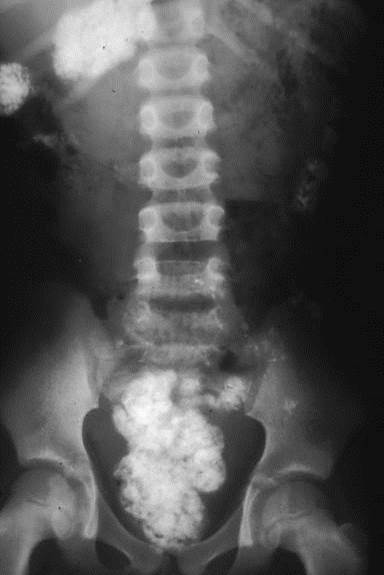
  • Radiografías abdominales para identificar obstrucción intestinal por bezoares
Geofagia

Radiografía abdominal de un paciente con pica:
Los pacientes con pica tienen una compulsión a ingerir material no nutritivo. Algunos pacientes tienen fijación con comer tierra, lo que puede provocar una obstrucción intestinal. Las radiografías abdominales pueden ayudar a identificar la sustancia extraña ingerida (material brillante que se ve en la pelvis del paciente).

Imagen: “Silica in the soil that has been eaten by a woman” por SuSanA Secretariat. Licencia: CC BY 2.0

Tratamiento

Prevención

  • Identificación de las personas en EN Erythema nodosum is an immune-mediated panniculitis (inflammation of the subcutaneous fat) caused by a type IV (delayed-type) hypersensitivity reaction. It commonly manifests in young women as tender, erythematous nodules on the shins. Erythema Nodosum riesgo
  • Retirar al AL Amyloidosis paciente de la zona de exposición
  • Proporcionar sustancias alimenticias con textura y color similares para sustituir el material no alimenticio ingerido

Tratamiento médico

  • Evaluar y tratar las deficiencias nutricionales subyacentes:
    • Anemia Anemia Anemia is a condition in which individuals have low Hb levels, which can arise from various causes. Anemia is accompanied by a reduced number of RBCs and may manifest with fatigue, shortness of breath, pallor, and weakness. Subtypes are classified by the size of RBCs, chronicity, and etiology. Anemia: Overview and Types ferropénica
    • Zinc Zinc A metallic element of atomic number 30 and atomic weight 65. 38. It is a necessary trace element in the diet, forming an essential part of many enzymes, and playing an important role in protein synthesis and in cell division. Zinc deficiency is associated with anemia, short stature, hypogonadism, impaired wound healing, and geophagia. It is known by the symbol zn. Trace Elements
    • Potasio
  • Psicoterapia:
    • Terapia cognitivo-conductual (terapia de 1era línea)
    • Rehabilitación nutricional
    • Terapia de aversión leve
  • Tratar las complicaciones:
    • Limpieza intestinal médica/quirúrgica
    • Terapia antiparasitaria
    • Tratar cualquier posible intoxicación.

Diagnóstico Diferencial

La pica Pica Pica is an eating disorder characterized by a desire or recurrent compulsion to eat substances that are nonnutritive and not food. These compulsions and ingested substances are inappropriate for age or culture. Pica se clasifica como un trastorno de la alimentación y puede tener características en EN Erythema nodosum is an immune-mediated panniculitis (inflammation of the subcutaneous fat) caused by a type IV (delayed-type) hypersensitivity reaction. It commonly manifests in young women as tender, erythematous nodules on the shins. Erythema Nodosum común con otros trastornos de este tipo.

  • Anorexia Anorexia The lack or loss of appetite accompanied by an aversion to food and the inability to eat. It is the defining characteristic of the disorder anorexia nervosa. Anorexia Nervosa nerviosa: trastorno de la alimentación caracterizado por un intenso miedo a ganar peso, hábitos dietéticos restrictivos y una imagen corporal distorsionada: generalmente, los LOS Neisseria pacientes afectados por la anorexia Anorexia The lack or loss of appetite accompanied by an aversion to food and the inability to eat. It is the defining characteristic of the disorder anorexia nervosa. Anorexia Nervosa nerviosa tienen un peso inferior al AL Amyloidosis normal y son reacios a buscar ayuda médica. El tratamiento consiste en EN Erythema nodosum is an immune-mediated panniculitis (inflammation of the subcutaneous fat) caused by a type IV (delayed-type) hypersensitivity reaction. It commonly manifests in young women as tender, erythematous nodules on the shins. Erythema Nodosum terapia cognitivo-conductual con medicamentos antidepresivos como complemento. Los LOS Neisseria casos extremos pueden requerir hospitalización.
  • Bulimia Bulimia Eating an excess amount of food in a short period of time, as seen in the disorder of bulimia nervosa. It is caused by an abnormal craving for food, or insatiable hunger also known as ‘ox hunger’. Bulimia Nervosa nerviosa: trastorno de la alimentación impulsado por la ansiedad que se define por episodios recurrentes de atracones acompañados de conductas compensatorias inapropiadas recurrentes (inducción del vómito, abuso de laxantes y ejercicio excesivo): el IMC de los LOS Neisseria pacientes con esta afección puede ser normal o incluso elevado. Los LOS Neisseria pacientes con bulimia Bulimia Eating an excess amount of food in a short period of time, as seen in the disorder of bulimia nervosa. It is caused by an abnormal craving for food, or insatiable hunger also known as ‘ox hunger’. Bulimia Nervosa nerviosa son más propensos a buscar ayuda. El tratamiento consiste en EN Erythema nodosum is an immune-mediated panniculitis (inflammation of the subcutaneous fat) caused by a type IV (delayed-type) hypersensitivity reaction. It commonly manifests in young women as tender, erythematous nodules on the shins. Erythema Nodosum una combinación de terapia cognitivo-conductual y medicamentos inhibidores selectivos de la recaptación de serotonina (ISRS).
  • Trastorno de atracones: trastorno de la alimentación caracterizado por episodios recurrentes de atracones sin una conducta compensatoria inadecuada: el trastorno de atracones da lugar a una fluctuación del peso corporal. Los LOS Neisseria episodios se producen al AL Amyloidosis menos semanalmente durante 3 meses. El tratamiento consiste en EN Erythema nodosum is an immune-mediated panniculitis (inflammation of the subcutaneous fat) caused by a type IV (delayed-type) hypersensitivity reaction. It commonly manifests in young women as tender, erythematous nodules on the shins. Erythema Nodosum una combinación de psicoterapia y farmacoterapia.
  • Trastorno de rumiación: regurgitación repetida de alimentos (que pueden volver a masticarse, deglutirse o escupirse) que no se debe a una afección médica general (e.g., ERGE): el tratamiento consiste en EN Erythema nodosum is an immune-mediated panniculitis (inflammation of the subcutaneous fat) caused by a type IV (delayed-type) hypersensitivity reaction. It commonly manifests in young women as tender, erythematous nodules on the shins. Erythema Nodosum múltiples técnicas de terapia cognitivo-conductual, incluida la psicoterapia de biofeedback Biofeedback The therapy technique of providing the status of one’s own autonomic nervous system function (e.g., skin temperature, heartbeats, brain waves) as visual or auditory feedback in order to self-control related conditions (e.g., hypertension, migraine headaches). Psychotherapy, así como medicamentos cuando sea apropiado (e.g., inhibidores de la bomba de protones).

Referencias

  1. American Psychiatric Association. (2013). Diagnostic and statistical manual of mental disorders (5th ed.). https://doi.org/10.1176/appi.books.9780890425596
  2. McNaughten B, Bourke T, Thompson A. (2017). Fifteen-minute consultation: the child with pica. Arch Dis Child Educ Pract Ed. https://pubmed.ncbi.nlm.nih.gov/28487433/
  3. Call NA, Simmons CA, Mevers JE, Alvarez JP. (2015). Clinical outcomes of behavioral treatments for pica in children with developmental disabilities. J Autism Dev Disord. https://pubmed.ncbi.nlm.nih.gov/25636679/
  4. Guarda, A. (2024). Eating disorders: Overview of epidemiology, clinical features, and diagnosis. In P. P. Roy-Byrne (Ed.). UpToDate. Retrieved April 1, 2025, from https://www.uptodate.com/contents/eating-disorders-overview-of-epidemiology-clinical-features-and-diagnosis

¡Crea tu cuenta gratis o inicia una sesión para seguir leyendo!

Regístrate ahora y obtén acceso gratuito a Lecturio con páginas de concepto, videos médicos y cuestionarios para tu educación médica.

User Reviews

Que tengas una sesión de estudio alegre y navideña 🎁 Ahorra 50% en todos los planes >>

Details