Domina Conceptos Médicos

Estudia para la escuela de medicina y tus examenes con Lecturio.

Osteosarcoma

El osteosarcoma Osteosarcoma Osteosarcoma is a primary malignant tumor of the bone characterized by the production of osteoid or immature bone by the tumor cells. The disease is most common in children and young adults and most frequently affects growth plates of the long bones, although it can involve any bone. Osteosarcoma es un tumor Tumor Inflammation maligno primario del hueso caracterizado por la producción de hueso osteoide o inmaduro por las células tumorales. La enfermedad es más frecuente en EN Erythema nodosum is an immune-mediated panniculitis (inflammation of the subcutaneous fat) caused by a type IV (delayed-type) hypersensitivity reaction. It commonly manifests in young women as tender, erythematous nodules on the shins. Erythema Nodosum niños y adultos jóvenes y afecta principalmente a las metáfisis de los LOS Neisseria huesos largos alrededor de la rodilla, aunque puede afectar a cualquier hueso. El osteosarcoma Osteosarcoma Osteosarcoma is a primary malignant tumor of the bone characterized by the production of osteoid or immature bone by the tumor cells. The disease is most common in children and young adults and most frequently affects growth plates of the long bones, although it can involve any bone. Osteosarcoma puede presentarse con dolor Dolor Inflammation, inflamación y una masa palpable y, a veces, con una fractura patológica. El diagnóstico se establece con imagenología y biopsia. El tratamiento incluye quimioterapia sistémica y resección quirúrgica. Se puede esperar una supervivencia a largo plazo con el tratamiento adecuado en EN Erythema nodosum is an immune-mediated panniculitis (inflammation of the subcutaneous fat) caused by a type IV (delayed-type) hypersensitivity reaction. It commonly manifests in young women as tender, erythematous nodules on the shins. Erythema Nodosum ausencia de enfermedad macrometastásica.

Last updated: Sep 29, 2026

Editorial responsibility: Stanley Oiseth, Lindsay Jones, Evelin Maza

Descripción General

Definición

El osteosarcoma Osteosarcoma Osteosarcoma is a primary malignant tumor of the bone characterized by the production of osteoid or immature bone by the tumor cells. The disease is most common in children and young adults and most frequently affects growth plates of the long bones, although it can involve any bone. Osteosarcoma, también llamado sarcoma osteogénico, es un tumor Tumor Inflammation óseo mesenquimatoso altamente maligno caracterizado por la producción directa de osteoide (hueso inmaduro) por parte de las células tumorales.
Epidemiología

  • Tumores óseos malignos primarios:
    • 6ta neoplasia más común en EN Erythema nodosum is an immune-mediated panniculitis (inflammation of the subcutaneous fat) caused by a type IV (delayed-type) hypersensitivity reaction. It commonly manifests in young women as tender, erythematous nodules on the shins. Erythema Nodosum niños
    • 3ra neoplasia más común en EN Erythema nodosum is an immune-mediated panniculitis (inflammation of the subcutaneous fat) caused by a type IV (delayed-type) hypersensitivity reaction. It commonly manifests in young women as tender, erythematous nodules on the shins. Erythema Nodosum adolescentes y adultos jóvenes
    • Aproximadamente 3 000 tumores óseos malignos primarios se diagnostican anualmente en EN Erythema nodosum is an immune-mediated panniculitis (inflammation of the subcutaneous fat) caused by a type IV (delayed-type) hypersensitivity reaction. It commonly manifests in young women as tender, erythematous nodules on the shins. Erythema Nodosum los LOS Neisseria Estados Unidos.
    • Aproximadamente 1 500 muertes son el resultado de tumores óseos malignos primarios al AL Amyloidosis año.
  • Osteosarcoma Osteosarcoma Osteosarcoma is a primary malignant tumor of the bone characterized by the production of osteoid or immature bone by the tumor cells. The disease is most common in children and young adults and most frequently affects growth plates of the long bones, although it can involve any bone. Osteosarcoma:
    • Neoplasia maligna primaria más común del hueso
    • 800–900 casos diagnosticados anualmente en EN Erythema nodosum is an immune-mediated panniculitis (inflammation of the subcutaneous fat) caused by a type IV (delayed-type) hypersensitivity reaction. It commonly manifests in young women as tender, erythematous nodules on the shins. Erythema Nodosum los LOS Neisseria Estados Unidos
    • Distribución de edad bimodal:
      • Se diagnostica con mayor frecuencia en EN Erythema nodosum is an immune-mediated panniculitis (inflammation of the subcutaneous fat) caused by a type IV (delayed-type) hypersensitivity reaction. It commonly manifests in young women as tender, erythematous nodules on the shins. Erythema Nodosum la 2da o 3ra década de la vida.
      • Segundo pequeño pico en EN Erythema nodosum is an immune-mediated panniculitis (inflammation of the subcutaneous fat) caused by a type IV (delayed-type) hypersensitivity reaction. It commonly manifests in young women as tender, erythematous nodules on the shins. Erythema Nodosum adultos > 65 años
    • Hombres > Mujeres

Etiología

  • Anomalías genéticas adquiridas de genes Genes A category of nucleic acid sequences that function as units of heredity and which code for the basic instructions for the development, reproduction, and maintenance of organisms. DNA Types and Structure supresores de tumores y oncogenes Oncogenes Genes whose gain-of-function alterations lead to neoplastic cell transformation. They include, for example, genes for activators or stimulators of cell proliferation such as growth factors, growth factor receptors, protein kinases, signal transducers, nuclear phosphoproteins, and transcription factors. A prefix of ‘v-‘ before oncogene symbols indicates oncogenes captured and transmitted by retroviruses; the prefix ‘c-‘ before the gene symbol of an oncogene indicates it is the cellular homolog (proto-oncogenes) of a v-oncogene. Carcinogenesis ( RB RB Chlamydia, TP53, INK4α, MDM2, CDK4)
  • Factores de riesgo:
    • Enfermedad de Paget de los LOS Neisseria huesos (generalmente en EN Erythema nodosum is an immune-mediated panniculitis (inflammation of the subcutaneous fat) caused by a type IV (delayed-type) hypersensitivity reaction. It commonly manifests in young women as tender, erythematous nodules on the shins. Erythema Nodosum adultos mayores)
    • Radioterapia previa
    • Infartos óseos ( anemia Anemia Anemia is a condition in which individuals have low Hb levels, which can arise from various causes. Anemia is accompanied by a reduced number of RBCs and may manifest with fatigue, shortness of breath, pallor, and weakness. Subtypes are classified by the size of RBCs, chronicity, and etiology. Anemia: Overview and Types de células falciformes)
    • Síndromes familiares:
      • Retinoblastoma Retinoblastoma Retinoblastoma is a rare tumor but the most common primary intraocular malignancy of childhood. It is believed that the condition arises from a neuronal progenitor cell. Retinoblastoma can be heritable or non-heritable. Retinoblastoma (riesgo 1000 veces mayor de osteosarcoma Osteosarcoma Osteosarcoma is a primary malignant tumor of the bone characterized by the production of osteoid or immature bone by the tumor cells. The disease is most common in children and young adults and most frequently affects growth plates of the long bones, although it can involve any bone. Osteosarcoma)
      • Síndrome de Li-Fraumeni (asociadas a mutaciones de TP53)
      • Síndrome de Rothmund-Thomson

Fisiopatología y Presentación Clínica

Fisiopatología

  • Célula de origen no establecida definitivamente; probablemente se origina a partir de células madre mesenquimales o células osteoprogenitoras tempranas comprometidas con el linaje osteoblástico
  • Se cree que surge de aberraciones del crecimiento normal y remodelación secundaria a mutaciones adquiridas
  • Ocurren con mayor frecuencia durante el período de crecimiento acelerado de la adolescencia y afectan las placas de crecimiento de los LOS Neisseria huesos de más rápido crecimiento
  • Por lo tanto, se observa con mayor frecuencia en EN Erythema nodosum is an immune-mediated panniculitis (inflammation of the subcutaneous fat) caused by a type IV (delayed-type) hypersensitivity reaction. It commonly manifests in young women as tender, erythematous nodules on the shins. Erythema Nodosum la metáfisis alrededor de la rodilla (fémur distal y tibia Tibia The second longest bone of the skeleton. It is located on the medial side of the lower leg, articulating with the fibula laterally, the talus distally, and the femur proximally. Knee Joint: Anatomy proximal).
  • Por lo general, tumores arenosos de color blanco grisáceo
  • Se disemina extensamente por el canal medular y puede extenderse a través de la cortical hacia los LOS Neisseria tejidos blandos adyacentes o invadir los LOS Neisseria espacios articulares.
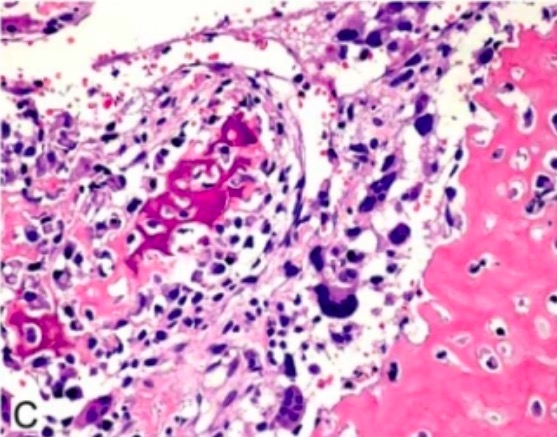
  • Características histológicas:
    • Grandes núcleos hipercromáticos
    • Células gigantes
    • Mitosis Mitosis A type of cell nucleus division by means of which the two daughter nuclei normally receive identical complements of the number of chromosomes of the somatic cells of the species. Cell Cycle frecuentes
    • Invasión vascular
  • Característica diagnóstica: formación de hueso nuevo inmaduro por las células tumorales
Osteosarcoma osteoblástico

Tinción con hematoxilina y eosina de osteosarcoma osteoblástico con depósito irregular de hueso inmaduro por células tumorales anaplásicas

Imagen: “Osteoblastic osteosarcoma” por Department of Orthopaedic Surgery, Graduate School of Medical Sciences, Kyushu University, 3-1-1, Higashi-ku, Maidashi, Fukuoka, 812-8582, Japan. Licencia: CC BY 2.5, editada por Lecturio.
Presentación Clínica

  • Dolor Dolor Inflammation:
    • Dolor Dolor Inflammation óseo profundo y localizado, de carácter progresivo, que típicamente empeora por la noche y con la actividad
    • Por lo general, de unos pocos meses de duración
    • A veces ocurre tras una lesión
    • Crece y mengua
  • Inflamación
  • Disminución del rango de movimiento
  • Masa de tejido blando sensible y palpable al AL Amyloidosis examen físico
  • Fracturas patológicas
  • Relativa ausencia de síntomas constitucionales
  • Sitios afectados ( en EN Erythema nodosum is an immune-mediated panniculitis (inflammation of the subcutaneous fat) caused by a type IV (delayed-type) hypersensitivity reaction. It commonly manifests in young women as tender, erythematous nodules on the shins. Erythema Nodosum orden decreciente de frecuencia):
    • Fémur distal
    • Tibia Tibia The second longest bone of the skeleton. It is located on the medial side of the lower leg, articulating with the fibula laterally, the talus distally, and the femur proximally. Knee Joint: Anatomy proximal
    • Húmero proximal
    • Fémur medio y proximal
    • Otros huesos
  • Metástasis:
    • Presente en EN Erythema nodosum is an immune-mediated panniculitis (inflammation of the subcutaneous fat) caused by a type IV (delayed-type) hypersensitivity reaction. It commonly manifests in young women as tender, erythematous nodules on the shins. Erythema Nodosum un 10%–20% al AL Amyloidosis momento de la presentación
    • Diseminación local al AL Amyloidosis mismo hueso o hueso adyacente
    • Propagación a distancia: más comúnmente a los LOS Neisseria pulmones

Diagnóstico

Antecedentes

  • Dolor Dolor Inflammation e inflamación persistentes más allá del tiempo normal asociado con el trauma
  • Antecedente familiar de enfermedades genéticas
  • Exposición a la radiación en EN Erythema nodosum is an immune-mediated panniculitis (inflammation of the subcutaneous fat) caused by a type IV (delayed-type) hypersensitivity reaction. It commonly manifests in young women as tender, erythematous nodules on the shins. Erythema Nodosum adultos mayores

Examen físico

  • Inflamación/masa localizada de las extremidades
  • Sensibilidad a la palpación

Estudios laboratoriales

  • ↑ Velocidad de eritrosedimentación (VES)
  • ↑ Fosfatasa alcalina
  • ↑ Lactato deshidrogenasa ( LDH LDH Osteosarcoma) (niveles más altos se correlacionan con un peor pronóstico)

Imagenología

  • Radiografía:
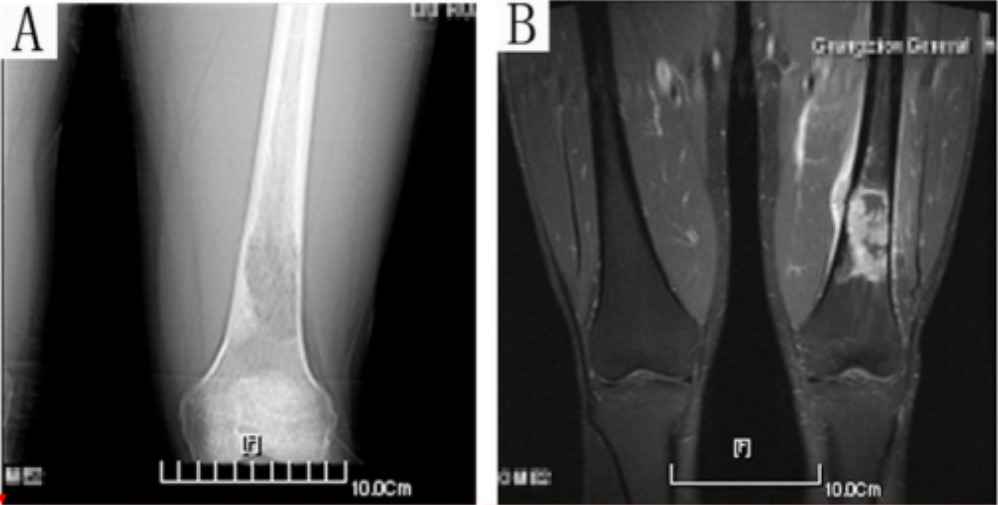
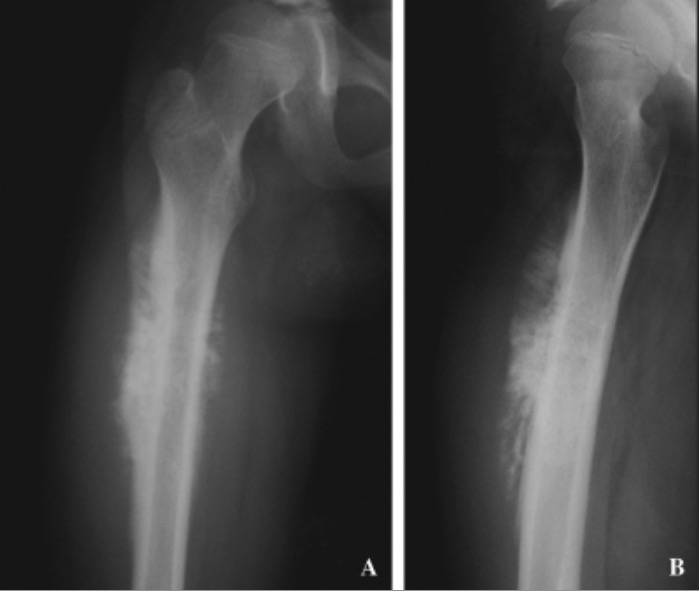
    • Triángulo de Codman: nuevo hueso subperióstico formado cuando el tumor Tumor Inflammation eleva el periostio separándolo de la cortical
    • Aspecto en “sol naciente” (sunburst) debido a la formación ósea espiculada que se irradia desde la cortical hacia los LOS Neisseria tejidos blandos.
  • TC:
    • Área primaria: para la evaluación de la extensión de la lesión y para la planificación quirúrgica
    • Tórax: para evaluar la presencia de metástasis pulmonares
  • RM:
    • La mejor modalidad para la evaluación prequirúrgica de la lesión primaria
    • Evalúa si están involucrados los LOS Neisseria tejidos blandos, articulares y neurovasculares
  • Gammagrafía ósea: para evaluar la presencia de enfermedad metastásica o multifocal Multifocal Retinoblastoma

Biopsia

  • Requerida para el diagnóstico definitivo
  • Exicisional, aguja gruesa o aguja fina

Estadificación de la Musculoskeletal Tumor Tumor Inflammation Society (Sociedad de Tumores músculoesqueléticos, MSTS, por sus siglas en EN Erythema nodosum is an immune-mediated panniculitis (inflammation of the subcutaneous fat) caused by a type IV (delayed-type) hypersensitivity reaction. It commonly manifests in young women as tender, erythematous nodules on the shins. Erythema Nodosum inglés)

  • Etapa Ⅰ (bajo grado):
    • A: intracompartimental (no se extiende a través de la corteza ósea)
    • B: extracompartimental (se extiende a través de la corteza ósea)
  • Etapa Ⅱ (alto grado):
    • A: intracompartimental
    • B: extracompartimental (mayoría de los LOS Neisseria tumores de alto grado)
  • Estadio Ⅲ: metástasis a distancia

Tratamiento

Quimioterapia

  • La mayoría de los LOS Neisseria pacientes tienen micrometástasis ocultas al AL Amyloidosis momento de la presentación.
  • Por lo tanto, la quimioterapia sistémica mejora los LOS Neisseria resultados.
  • En EN Erythema nodosum is an immune-mediated panniculitis (inflammation of the subcutaneous fat) caused by a type IV (delayed-type) hypersensitivity reaction. It commonly manifests in young women as tender, erythematous nodules on the shins. Erythema Nodosum el caso del osteosarcoma Osteosarcoma Osteosarcoma is a primary malignant tumor of the bone characterized by the production of osteoid or immature bone by the tumor cells. The disease is most common in children and young adults and most frequently affects growth plates of the long bones, although it can involve any bone. Osteosarcoma de alto grado, la quimioterapia suele iniciarse en EN Erythema nodosum is an immune-mediated panniculitis (inflammation of the subcutaneous fat) caused by a type IV (delayed-type) hypersensitivity reaction. It commonly manifests in young women as tender, erythematous nodules on the shins. Erythema Nodosum el contexto neoadyuvante (preoperatorio) antes de la resección quirúrgica amplia; también puede utilizarse quimioterapia adyuvante (postoperatoria).
  • No se ha HA Hemolytic anemia (HA) is the term given to a large group of anemias that are caused by the premature destruction/hemolysis of circulating red blood cells (RBCs). Hemolysis can occur within (intravascular hemolysis) or outside the blood vessels (extravascular hemolysis). Hemolytic Anemia demostrado ninguna ventaja clara de un método sobre el otro.
  • Los LOS Neisseria regímenes incluyen metotrexato, doxorrubicina y cisplatino.

Cirugía

  • La resección completa del tumor Tumor Inflammation (preservando la extremidad cuando se puedan obtener márgenes negativos y conservar la función) es la base del tratamiento.
  • Puede ser necesaria la amputación en EN Erythema nodosum is an immune-mediated panniculitis (inflammation of the subcutaneous fat) caused by a type IV (delayed-type) hypersensitivity reaction. It commonly manifests in young women as tender, erythematous nodules on the shins. Erythema Nodosum casos de afectación extensa de partes blandas, estructuras neurovasculares o la articulación.
  • Dependiendo de la ubicación del tumor Tumor Inflammation, puede resultar difícil lograr márgenes negativos (e.g., osteosarcomas de la columna).

Radiación

  • Los LOS Neisseria osteosarcomas no son muy radiosensibles.
  • A veces se usa radiación:
    • Como terapia primaria para un tumor Tumor Inflammation en EN Erythema nodosum is an immune-mediated panniculitis (inflammation of the subcutaneous fat) caused by a type IV (delayed-type) hypersensitivity reaction. It commonly manifests in young women as tender, erythematous nodules on the shins. Erythema Nodosum una ubicación difícil donde la cirugía causaría una morbilidad significativa
    • Como tratamiento adyuvante para tumores resecados de forma incompleta

Pronóstico

  • 60%–70% de supervivencia a 5 años sin macrometástasis
  • < 20% de supervivencia a 5 años con enfermedad metastásica a distancia

Diagnóstico Diferencial

  • Sarcoma de Ewing: neoplasia ósea primaria compuesta por células poco diferenciadas que afecta con mayor frecuencia a los LOS Neisseria adolescentes. El sarcoma de Ewing se presenta con dolor Dolor Inflammation e inflamación localizados. El diagnóstico se establece con imagenología y biopsia. El tratamiento se basa en EN Erythema nodosum is an immune-mediated panniculitis (inflammation of the subcutaneous fat) caused by a type IV (delayed-type) hypersensitivity reaction. It commonly manifests in young women as tender, erythematous nodules on the shins. Erythema Nodosum quimioterapia y resección quirúrgica.
  • Condrosarcoma: tumor Tumor Inflammation óseo maligno de células productoras de cartílago. Más común en EN Erythema nodosum is an immune-mediated panniculitis (inflammation of the subcutaneous fat) caused by a type IV (delayed-type) hypersensitivity reaction. It commonly manifests in young women as tender, erythematous nodules on the shins. Erythema Nodosum adultos mayores. Por lo general, se presenta como una masa de crecimiento lento asociada con un dolor Dolor Inflammation sordo y adolorido. Diagnosticado con imagenología y biopsia. El tratamiento consiste en EN Erythema nodosum is an immune-mediated panniculitis (inflammation of the subcutaneous fat) caused by a type IV (delayed-type) hypersensitivity reaction. It commonly manifests in young women as tender, erythematous nodules on the shins. Erythema Nodosum escisión quirúrgica amplia.
  • Metástasis óseas: lesiones óseas metastásicas de cánceres primarios que surgen en EN Erythema nodosum is an immune-mediated panniculitis (inflammation of the subcutaneous fat) caused by a type IV (delayed-type) hypersensitivity reaction. It commonly manifests in young women as tender, erythematous nodules on the shins. Erythema Nodosum otros sitios, más comúnmente la próstata, la mama y el pulmón. Se presentan con dolor Dolor Inflammation óseo, fracturas patológicas y síntomas constitucionales. El diagnóstico se basa en EN Erythema nodosum is an immune-mediated panniculitis (inflammation of the subcutaneous fat) caused by a type IV (delayed-type) hypersensitivity reaction. It commonly manifests in young women as tender, erythematous nodules on the shins. Erythema Nodosum la historia clínica y las imágenes. El tratamiento incluye quimioterapia sistémica, así como medidas de soporte destinadas a minimizar el dolor Dolor Inflammation y las fracturas patológicas.
  • Tumores óseos benignos: más frecuentes que los LOS Neisseria tumores óseos malignos; incluyen encondroma, osteocondroma, fibroma no osificante, condroblastoma, osteoma osteoide, osteoblastoma Osteoblastoma A benign, painful, tumor of bone characterized by the formation of osteoid tissue, primitive bone and calcified tissue. It occurs frequently in the spine of young persons. Benign Bone Tumors, condroma perióstico, tumor Tumor Inflammation de células gigantes y fibroma condromixoide, entre otros. Sin embargo, muchos tumores óseos benignos pueden presentar riesgo de transformación maligna.
  • Osteomielitis: infección ósea más comúnmente debida a bacterias piógenas en EN Erythema nodosum is an immune-mediated panniculitis (inflammation of the subcutaneous fat) caused by a type IV (delayed-type) hypersensitivity reaction. It commonly manifests in young women as tender, erythematous nodules on the shins. Erythema Nodosum el contexto de una lesión ortopédica o una herida crónica que no cicatriza y que erosiona el hueso. Se presenta con dolor Dolor Inflammation localizado, signos de inflamación/infección y fiebre; puede progresar a sepsis Sepsis Systemic inflammatory response syndrome with a proven or suspected infectious etiology. When sepsis is associated with organ dysfunction distant from the site of infection, it is called severe sepsis. When sepsis is accompanied by hypotension despite adequate fluid infusion, it is called septic shock. Sepsis and Septic Shock y pérdida de una extremidad. El tratamiento es terapia antibiótica agresiva con o sin desbridamiento quirúrgico.
  • Lesión ortopédica: esguinces, dolores de crecimiento, fracturas, etc ETC The electron transport chain (ETC) sends electrons through a series of proteins, which generate an electrochemical proton gradient that produces energy in the form of adenosine triphosphate (ATP). Electron Transport Chain (ETC)., son los LOS Neisseria eventos desencadenantes que atraen la atención clínica a los LOS Neisseria tumores óseos. Sin embargo, una lesión o proceso más inocente puede ser el culpable cuando se considera la posibilidad de una neoplasia ósea. Caracterizado por dolor Dolor Inflammation localizado e inflamación. El diagnóstico generalmente se hace HACE Altitude Sickness clínicamente y el tratamiento es de soporte.

Referencias

  1. Hornicek, F., McCarville, B., Agaram, N. (2020). Bone tumors: Diagnosis and biopsy techniques. Retrieved February 21, 2021, from https://www.uptodate.com/contents/bone-tumors-diagnosis-and-biopsy-techniques
  2. Janeway K.A., Maki R. (2021). Chemotherapy and radiation therapy in the management of osteosarcoma. Retrieved March 12, 2021, from https://www.uptodate.com/contents/chemotherapy-and-radiation-therapy-in-the-management-of-osteosarcoma
  3. Kasper, D., Fauci, A., Hauser, S., Longo, D., Jameson, J., Loscalzo, J. (2012). Harrison’s Principles of Internal Medicine (18th ed). New York: McGraw Hill Education.
  4. Mehlman C.T. (2020). Osteosarcoma. Retrieved February 26, 2021, from https://emedicine.medscape.com/article/1256857-overview
  5. Robbins and Cotran. (2015). Pathologic Basis of Disease (9th Edition). Pp. 1197–1203.
  6. Wang L.L., Gerbhardt M.C., Rainusso N. (2019). Osteosarcoma: Epidemiology, pathogenesis, clinical presentation, diagnosis, and histology. Retrieved March 12, 2021, from https://www.uptodate.com/contents/osteosarcoma-epidemiology-pathogenesis-clinical-presentation-diagnosis-and-histology

¡Crea tu cuenta gratis o inicia una sesión para seguir leyendo!

Regístrate ahora y obtén acceso gratuito a Lecturio con páginas de concepto, videos médicos y cuestionarios para tu educación médica.

User Reviews

Details