Domina Conceptos Médicos

Estudia para la escuela de medicina y tus examenes con Lecturio.

Molusco Contagioso

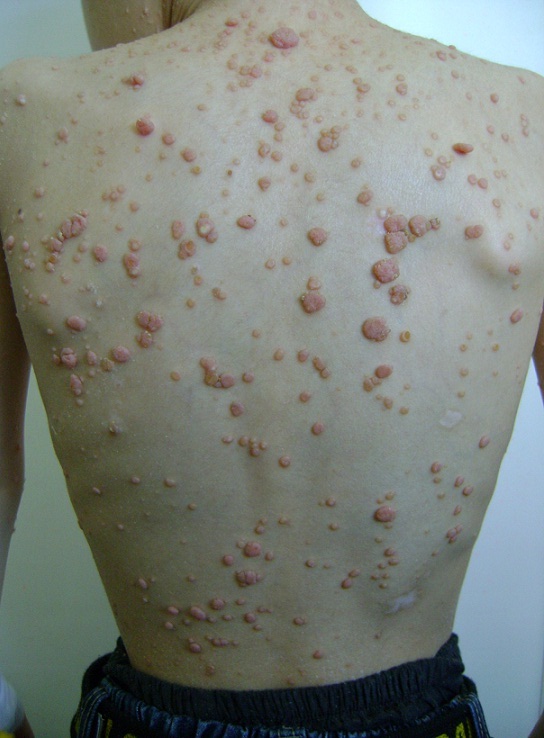
El molusco contagioso es una infección vírica limitada a la epidermis Epidermis The external, nonvascular layer of the skin. It is made up, from within outward, of five layers of epithelium: (1) basal layer (stratum basale epidermidis); (2) spinous layer (stratum spinosum epidermidis); (3) granular layer (stratum granulosum epidermidis); (4) clear layer (stratum lucidum epidermidis); and (5) horny layer (stratum corneum epidermidis). Skin: Structure and Functions, normalmente sin manifestaciones sistémicas. Esta infección es frecuente en EN Erythema nodosum is an immune-mediated panniculitis (inflammation of the subcutaneous fat) caused by a type IV (delayed-type) hypersensitivity reaction. It commonly manifests in young women as tender, erythematous nodules on the shins. Erythema Nodosum niños menores de 5 años, aunque también puede observarse en EN Erythema nodosum is an immune-mediated panniculitis (inflammation of the subcutaneous fat) caused by a type IV (delayed-type) hypersensitivity reaction. It commonly manifests in young women as tender, erythematous nodules on the shins. Erythema Nodosum adolescentes y adultos sanos, normalmente relacionada con deportes de contacto o, con lesiones en EN Erythema nodosum is an immune-mediated panniculitis (inflammation of the subcutaneous fat) caused by a type IV (delayed-type) hypersensitivity reaction. It commonly manifests in young women as tender, erythematous nodules on the shins. Erythema Nodosum los LOS Neisseria genitales, como infección de transmisión sexual (ITS). Las lesiones aparecen como pápulas agrupadas, de color piel, en EN Erythema nodosum is an immune-mediated panniculitis (inflammation of the subcutaneous fat) caused by a type IV (delayed-type) hypersensitivity reaction. It commonly manifests in young women as tender, erythematous nodules on the shins. Erythema Nodosum forma de cúpula, con umbilicación central. El molusco contagioso es leve en EN Erythema nodosum is an immune-mediated panniculitis (inflammation of the subcutaneous fat) caused by a type IV (delayed-type) hypersensitivity reaction. It commonly manifests in young women as tender, erythematous nodules on the shins. Erythema Nodosum pacientes inmunocompetentes y se resuelve por sí solo en EN Erythema nodosum is an immune-mediated panniculitis (inflammation of the subcutaneous fat) caused by a type IV (delayed-type) hypersensitivity reaction. It commonly manifests in young women as tender, erythematous nodules on the shins. Erythema Nodosum unos meses. Las personas inmunodeprimidas presentan lesiones extensas que requieren tratamiento. El molusco contagioso es altamente transmisible, por lo que la educación del paciente es clave en EN Erythema nodosum is an immune-mediated panniculitis (inflammation of the subcutaneous fat) caused by a type IV (delayed-type) hypersensitivity reaction. It commonly manifests in young women as tender, erythematous nodules on the shins. Erythema Nodosum su tratamiento. La crioterapia con nitrógeno líquido es el tratamiento de primera línea.

Last updated: Dec 15, 2025
Editorial responsibility: Stanley Oiseth, Lindsay Jones, Evelin Maza

Descripción General

Epidemiología

  • 1% de todos los LOS Neisseria trastornos cutáneos diagnosticados
  • Generalmente, se presenta en EN Erythema nodosum is an immune-mediated panniculitis (inflammation of the subcutaneous fat) caused by a type IV (delayed-type) hypersensitivity reaction. It commonly manifests in young women as tender, erythematous nodules on the shins. Erythema Nodosum niños < 5 años o adolescentes.
  • Mayor incidencia en EN Erythema nodosum is an immune-mediated panniculitis (inflammation of the subcutaneous fat) caused by a type IV (delayed-type) hypersensitivity reaction. It commonly manifests in young women as tender, erythematous nodules on the shins. Erythema Nodosum climas cálidos y húmedos
  • Ligero predominio en EN Erythema nodosum is an immune-mediated panniculitis (inflammation of the subcutaneous fat) caused by a type IV (delayed-type) hypersensitivity reaction. It commonly manifests in young women as tender, erythematous nodules on the shins. Erythema Nodosum varones
  • Más común en EN Erythema nodosum is an immune-mediated panniculitis (inflammation of the subcutaneous fat) caused by a type IV (delayed-type) hypersensitivity reaction. It commonly manifests in young women as tender, erythematous nodules on the shins. Erythema Nodosum pacientes con:

Etiología y transmisión

  • El virus Virus Viruses are infectious, obligate intracellular parasites composed of a nucleic acid core surrounded by a protein capsid. Viruses can be either naked (non-enveloped) or enveloped. The classification of viruses is complex and based on many factors, including type and structure of the nucleoid and capsid, the presence of an envelope, the replication cycle, and the host range. Virology del molusco contagioso es un poxvirus de ADN lineal de doble cadena.
  • Transmisión:
    • Exposición a personas infectadas (contacto piel con piel):
      • Transmisión sexual
      • Periparto
    • Fómites (e.g., toallas, juguetes, maquinillas de afeitar)
    • Autoinoculación (rascado)

Fisiopatología

  • Periodo de incubación entre 2 semanas y 6 meses
  • El virus Virus Viruses are infectious, obligate intracellular parasites composed of a nucleic acid core surrounded by a protein capsid. Viruses can be either naked (non-enveloped) or enveloped. The classification of viruses is complex and based on many factors, including type and structure of the nucleoid and capsid, the presence of an envelope, the replication cycle, and the host range. Virology infecta solo los LOS Neisseria queratinocitos → localizados en EN Erythema nodosum is an immune-mediated panniculitis (inflammation of the subcutaneous fat) caused by a type IV (delayed-type) hypersensitivity reaction. It commonly manifests in young women as tender, erythematous nodules on the shins. Erythema Nodosum la epidermis Epidermis The external, nonvascular layer of the skin. It is made up, from within outward, of five layers of epithelium: (1) basal layer (stratum basale epidermidis); (2) spinous layer (stratum spinosum epidermidis); (3) granular layer (stratum granulosum epidermidis); (4) clear layer (stratum lucidum epidermidis); and (5) horny layer (stratum corneum epidermidis). Skin: Structure and Functions.
  • Inhibe la inmunidad innata a través de la producción de proteínas antivirales → infección persistente.

Histopatología

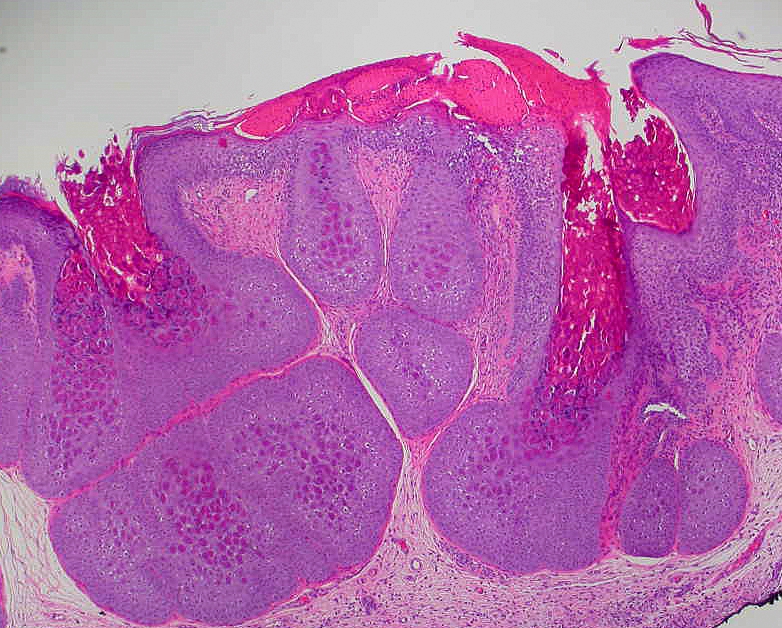
  • Hiperqueratosis ( epidermis Epidermis The external, nonvascular layer of the skin. It is made up, from within outward, of five layers of epithelium: (1) basal layer (stratum basale epidermidis); (2) spinous layer (stratum spinosum epidermidis); (3) granular layer (stratum granulosum epidermidis); (4) clear layer (stratum lucidum epidermidis); and (5) horny layer (stratum corneum epidermidis). Skin: Structure and Functions engrosada)
  • Proliferación epidérmica hacia la dermis Dermis A layer of vascularized connective tissue underneath the epidermis. The surface of the dermis contains innervated papillae. Embedded in or beneath the dermis are sweat glands; hair follicles; and sebaceous glands. Skin: Structure and Functions
  • Cuerpos de Henderson-Paterson: inclusiones visibles en EN Erythema nodosum is an immune-mediated panniculitis (inflammation of the subcutaneous fat) caused by a type IV (delayed-type) hypersensitivity reaction. It commonly manifests in young women as tender, erythematous nodules on the shins. Erythema Nodosum los LOS Neisseria queratinocitos de las capas basal, espinosa y granular de la epidermis Epidermis The external, nonvascular layer of the skin. It is made up, from within outward, of five layers of epithelium: (1) basal layer (stratum basale epidermidis); (2) spinous layer (stratum spinosum epidermidis); (3) granular layer (stratum granulosum epidermidis); (4) clear layer (stratum lucidum epidermidis); and (5) horny layer (stratum corneum epidermidis). Skin: Structure and Functions
Cuerpos de Henderson-Paterson

Cuerpos de Henderson-Paterson:
Rasgos histológicos característicos del molusco contagioso. Los cuerpos de Henderson-Paterson son inclusiones visibles en los queratinocitos de las capas basal, espinosa y granular de la epidermis.
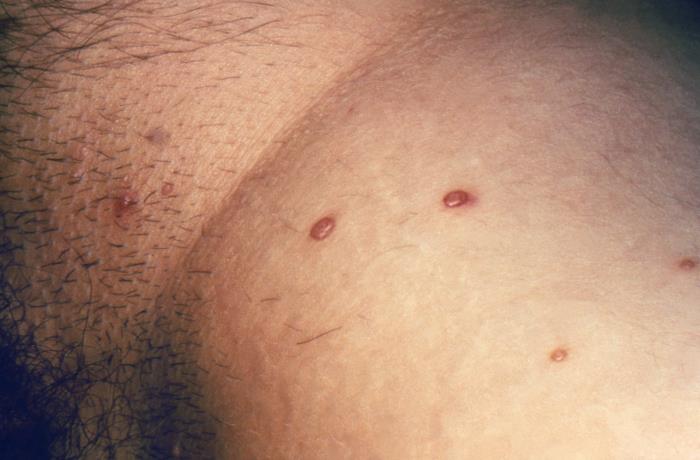
Imagen: “Molluscum Contagiosum 1” por Ed Uthman. Licencia: CC BY 2.0

Presentación Clínica y Diagnóstico

Presentación clínica de las lesiones

  • Generalmente, no hay síntomas sistémicos.
  • Características dermatológicas:
    • Forma y color:
      • Forma de cúpula
      • Pápulas nacaradas
      • Color carne
      • 2–6 mm MM Multiple myeloma (MM) is a malignant condition of plasma cells (activated B lymphocytes) primarily seen in the elderly. Monoclonal proliferation of plasma cells results in cytokine-driven osteoclastic activity and excessive secretion of IgG antibodies. Multiple Myeloma de diámetro
      • Umbilicación central
    • Generalmente, son múltiples y ocurren en EN Erythema nodosum is an immune-mediated panniculitis (inflammation of the subcutaneous fat) caused by a type IV (delayed-type) hypersensitivity reaction. It commonly manifests in young women as tender, erythematous nodules on the shins. Erythema Nodosum grupos.
    • Rara vez asociados con prurito o sensibilidad
    • Distribución:
      • Niños:
        • Cara
        • Tronco
        • Axila
        • Fosa antecubital
        • Fosa poplítea
      • Adultos:
        • Área anogenital
        • Abdomen
        • Muslos
      • Palmas y plantas no involucradas
  • Los LOS Neisseria individuos inmunocomprometidos pueden presentar erupciones generalizadas/difusas

Diagnóstico

  • El diagnóstico clínico es suficiente.
  • Análisis histopatológico para confirmar el diagnóstico
  • Lesiones en EN Erythema nodosum is an immune-mediated panniculitis (inflammation of the subcutaneous fat) caused by a type IV (delayed-type) hypersensitivity reaction. It commonly manifests in young women as tender, erythematous nodules on the shins. Erythema Nodosum región inguinal → panel de ITS para descartar ITS acompañantes

Tratamiento

Tratamiento

  • No es necesario ningún tratamiento para las personas sanas, ya que es una enfermedad autolimitante.
  • Educación del paciente:
    • La resolución completa puede tomar hasta 1 año.
    • Evitar compartir toallas y sábanas, no afeitar las lesiones
    • Cubrir las lesiones con un vendaje apretado
    • Practicar relaciones sexuales de manera segura
  • Tratamiento por razones cosméticas o para reducir la transmisión:
    • Extirpación física (tratamiento de 1ra línea):
      • Crioterapia (nitrógeno líquido)
      • Curetaje
      • Cantaridina (agente formador de ampollas tópico que debe aplicar únicamente un médico)
    • Tratamiento tópico (aplicado por el paciente):
      • Podofilotoxina
      • Hidróxido de potasio/ácido salicílico
      • Peróxido de benzoilo
      • Tretinoína
      • Imiquimod Imiquimod A topically-applied aminoquinoline immune modulator that induces interferon production. It is used in the treatment of external genital and perianal warts, superficial carcinoma, basal cell; and actinic keratosis. Hypertrophic and Keloid Scars tópico
      • Cimetidina oral
  • Pacientes inmunodeprimidos:
    • Terapia antirretroviral para pacientes con VIH
    • Interferón alfa o cidofovir Cidofovir An acyclic nucleoside phosphonate that acts as a competitive inhibitor of viral DNA polymerases. It is used in the treatment of retinitis caused by cytomegalovirus infections and may also be useful for treating herpesvirus infections. Antivirals for Herpes Virus

Pronóstico

  • Resolución espontánea en EN Erythema nodosum is an immune-mediated panniculitis (inflammation of the subcutaneous fat) caused by a type IV (delayed-type) hypersensitivity reaction. It commonly manifests in young women as tender, erythematous nodules on the shins. Erythema Nodosum 1 año en EN Erythema nodosum is an immune-mediated panniculitis (inflammation of the subcutaneous fat) caused by a type IV (delayed-type) hypersensitivity reaction. It commonly manifests in young women as tender, erythematous nodules on the shins. Erythema Nodosum individuos inmunocompetentes
  • Algunos casos pueden persistir durante 3-5 años

Complicaciones

  • Celulitis
  • Conjuntivitis (si está presente en EN Erythema nodosum is an immune-mediated panniculitis (inflammation of the subcutaneous fat) caused by a type IV (delayed-type) hypersensitivity reaction. It commonly manifests in young women as tender, erythematous nodules on the shins. Erythema Nodosum los LOS Neisseria párpados)
  • Abscesos
  • Cicatrización/hipopigmentación después de la crioterapia

Diagnóstico Diferencial

  • Carcinoma de células basales: Lesiones cutáneas nacaradas que pueden presentarse como una ulceración e imitar las lesiones del molusco contagioso. El carcinoma de células basales es común en EN Erythema nodosum is an immune-mediated panniculitis (inflammation of the subcutaneous fat) caused by a type IV (delayed-type) hypersensitivity reaction. It commonly manifests in young women as tender, erythematous nodules on the shins. Erythema Nodosum los LOS Neisseria ancianos. Las lesiones se encuentran en EN Erythema nodosum is an immune-mediated panniculitis (inflammation of the subcutaneous fat) caused by a type IV (delayed-type) hypersensitivity reaction. It commonly manifests in young women as tender, erythematous nodules on the shins. Erythema Nodosum áreas expuestas al AL Amyloidosis sol. Puede ser necesaria una biopsia para diferenciar entre el carcinoma de células basales y el molusco contagioso.
  • Condiloma acuminado: Lesiones pedunculadas de color carne secundarias a la infección por VPH. Las lesiones están presentes principalmente en EN Erythema nodosum is an immune-mediated panniculitis (inflammation of the subcutaneous fat) caused by a type IV (delayed-type) hypersensitivity reaction. It commonly manifests in young women as tender, erythematous nodules on the shins. Erythema Nodosum la región anogenital. El condiloma acuminado generalmente se transmite vía sexual y se puede prevenir mediante la vacunación. El tratamiento de las lesiones es similar al AL Amyloidosis abordaje utilizado para tratar el molusco contagioso.
  • Condiloma lata: Lesiones lisas parecidas a la piel, de color gris o blanco, localizadas en EN Erythema nodosum is an immune-mediated panniculitis (inflammation of the subcutaneous fat) caused by a type IV (delayed-type) hypersensitivity reaction. It commonly manifests in young women as tender, erythematous nodules on the shins. Erythema Nodosum el área vaginal, peniana o anal, que ocurren como consecuencia de una infección por sífilis. El condiloma lata es una ITS y el tratamiento de la sífilis primaria es con antibióticos. El tratamiento de las lesiones en EN Erythema nodosum is an immune-mediated panniculitis (inflammation of the subcutaneous fat) caused by a type IV (delayed-type) hypersensitivity reaction. It commonly manifests in young women as tender, erythematous nodules on the shins. Erythema Nodosum los LOS Neisseria condilomas lata es similar al AL Amyloidosis abordaje utilizado para tratar las lesiones en EN Erythema nodosum is an immune-mediated panniculitis (inflammation of the subcutaneous fat) caused by a type IV (delayed-type) hypersensitivity reaction. It commonly manifests in young women as tender, erythematous nodules on the shins. Erythema Nodosum el molusco contagioso. Los LOS Neisseria pacientes deben ser examinados en EN Erythema nodosum is an immune-mediated panniculitis (inflammation of the subcutaneous fat) caused by a type IV (delayed-type) hypersensitivity reaction. It commonly manifests in young women as tender, erythematous nodules on the shins. Erythema Nodosum busca de otras ITS.
  • Herpes: Una afección dolorosa con lesiones ulcerosas causadas por el virus Virus Viruses are infectious, obligate intracellular parasites composed of a nucleic acid core surrounded by a protein capsid. Viruses can be either naked (non-enveloped) or enveloped. The classification of viruses is complex and based on many factors, including type and structure of the nucleoid and capsid, the presence of an envelope, the replication cycle, and the host range. Virology herpes simple (VHS), que se presenta con síntomas sistémicos. Las lesiones son más pustulosas, ampollosas y eritematosas que las que se presentan en EN Erythema nodosum is an immune-mediated panniculitis (inflammation of the subcutaneous fat) caused by a type IV (delayed-type) hypersensitivity reaction. It commonly manifests in young women as tender, erythematous nodules on the shins. Erythema Nodosum el molusco contagioso. El tratamiento es de soporte, ya que la infección no se puede erradicar por completo. Los LOS Neisseria brotes se tratan con aciclovir.
  • Varicela zóster: Una infección causada por el virus Virus Viruses are infectious, obligate intracellular parasites composed of a nucleic acid core surrounded by a protein capsid. Viruses can be either naked (non-enveloped) or enveloped. The classification of viruses is complex and based on many factors, including type and structure of the nucleoid and capsid, the presence of an envelope, the replication cycle, and the host range. Virology de la varicela zóster. Las lesiones de color carne con umbilicación central se presentan con manifestaciones sistémicas de fiebre y coriza. Las lesiones son extremadamente pruriginosas. Las infecciones por varicela zóster son autolimitadas y de corta duración, y por lo general se tratan solo con cuidados de soporte en EN Erythema nodosum is an immune-mediated panniculitis (inflammation of the subcutaneous fat) caused by a type IV (delayed-type) hypersensitivity reaction. It commonly manifests in young women as tender, erythematous nodules on the shins. Erythema Nodosum individuos inmunocompetentes. Las infecciones se pueden prevenir mediante la vacunación.

Referencias

  1. Badri, T., Gandhi, GR (2020). Molluscum Contagiosum. StatPearls Publishing. https://www.ncbi.nlm.nih.gov/books/NBK441898/
  2. Isaacs, S. (2021). Molluscum contagiosum. UpToDate. Retrieved February 15, 2021, from https://www.uptodate.com/contents/molluscum-contagiosum
  3. Coloe, J., Morrell, DS (2009). Cantharidin use among pediatric dermatologists in the treatment of molluscum contagiosum. Pediatr Dermatol. 26 (4), 405–408. https://pubmed.ncbi.nlm.nih.gov/19689514/
  4. Braue, A., Ross, G., Varigos, G., Kelly, H. (2005). Epidemiology and impact of childhood molluscum contagiosum: A case series and critical review of the literature. Pediatr Dermatol. 22 (4), 287-294. https://pubmed.ncbi.nlm.nih.gov/16060861/
  5. Brown, J., Janniger, C.K., Schwartz, R.A., Silverberg, N.B. (2006). Childhood molluscum contagiosum. Int J Dermatol. 45 (2), 93–99. https://pubmed.ncbi.nlm.nih.gov/16445494/

¡Crea tu cuenta gratis o inicia una sesión para seguir leyendo!

Regístrate ahora y obtén acceso gratuito a Lecturio con páginas de concepto, videos médicos y cuestionarios para tu educación médica.

User Reviews

Que tengas una sesión de estudio alegre y navideña 🎁 Ahorra 50% en todos los planes >>

Details