Domina Conceptos Médicos

Estudia para la escuela de medicina y tus examenes con Lecturio.

Hormonas Gonadales

Las hormonas gonadales son producidas por las gónadas humanas: los LOS Neisseria testículos y los LOS Neisseria ovarios. Las principales hormonas producidas por estos órganos son los LOS Neisseria andrógenos, los LOS Neisseria estrógenos y los LOS Neisseria progestágenos. La testosterona es el andrógeno primario y desempeña un papel fundamental en EN Erythema nodosum is an immune-mediated panniculitis (inflammation of the subcutaneous fat) caused by a type IV (delayed-type) hypersensitivity reaction. It commonly manifests in young women as tender, erythematous nodules on the shins. Erythema Nodosum el desarrollo de los LOS Neisseria caracteres sexuales masculinos primarios y secundarios, así como en EN Erythema nodosum is an immune-mediated panniculitis (inflammation of the subcutaneous fat) caused by a type IV (delayed-type) hypersensitivity reaction. It commonly manifests in young women as tender, erythematous nodules on the shins. Erythema Nodosum la espermatogénesis. El estradiol Estradiol The 17-beta-isomer of estradiol, an aromatized C18 steroid with hydroxyl group at 3-beta- and 17-beta-position. Estradiol-17-beta is the most potent form of mammalian estrogenic steroids. Noncontraceptive Estrogen and Progestins y la progesterona son las principales hormonas femeninas, responsables del desarrollo de los LOS Neisseria óvulos, del ciclo menstrual y del desarrollo de las mamas. Las hormonas gonadales forman parte del eje hipotálamo-hipófisis-gonadal y están reguladas por las hormonas hipofisarias, la hormona foliculoestimulante ( FSH FSH A major gonadotropin secreted by the adenohypophysis. Follicle-stimulating hormone stimulates gametogenesis and the supporting cells such as the ovarian granulosa cells, the testicular sertoli cells, and leydig cells. Fsh consists of two noncovalently linked subunits, alpha and beta. Within a species, the alpha subunit is common in the three pituitary glycoprotein hormones (TSH, LH, and FSH), but the beta subunit is unique and confers its biological specificity. Menstrual Cycle) y la hormona luteinizante ( LH LH A major gonadotropin secreted by the adenohypophysis. Luteinizing hormone regulates steroid production by the interstitial cells of the testis and the ovary. The preovulatory luteinizing hormone surge in females induces ovulation, and subsequent luteinization of the follicle. Luteinizing hormone consists of two noncovalently linked subunits, alpha and beta. Within a species, the alpha subunit is common in the three pituitary glycoprotein hormones (TSH, LH, and FSH), but the beta subunit is unique and confers its biological specificity. Menstrual Cycle). A su vez, la FSH FSH A major gonadotropin secreted by the adenohypophysis. Follicle-stimulating hormone stimulates gametogenesis and the supporting cells such as the ovarian granulosa cells, the testicular sertoli cells, and leydig cells. Fsh consists of two noncovalently linked subunits, alpha and beta. Within a species, the alpha subunit is common in the three pituitary glycoprotein hormones (TSH, LH, and FSH), but the beta subunit is unique and confers its biological specificity. Menstrual Cycle y la LH LH A major gonadotropin secreted by the adenohypophysis. Luteinizing hormone regulates steroid production by the interstitial cells of the testis and the ovary. The preovulatory luteinizing hormone surge in females induces ovulation, and subsequent luteinization of the follicle. Luteinizing hormone consists of two noncovalently linked subunits, alpha and beta. Within a species, the alpha subunit is common in the three pituitary glycoprotein hormones (TSH, LH, and FSH), but the beta subunit is unique and confers its biological specificity. Menstrual Cycle están reguladas por la hormona liberadora de gonadotropina (GnRH) secretada por el hipotálamo.

Last updated: Dec 15, 2025

Editorial responsibility: Stanley Oiseth, Lindsay Jones, Evelin Maza

Descripción General

Definición

Hormonas gonadales:

Las hormonas gonadales son producidas por las gónadas humanas: los LOS Neisseria testículos y los LOS Neisseria ovarios. Estas hormonas incluyen:

  • Andrógenos, incluida la testosterona
  • Estrógenos
  • Progestinas

Terminología de género:

Reconociendo la complejidad y la naturaleza sensible en EN Erythema nodosum is an immune-mediated panniculitis (inflammation of the subcutaneous fat) caused by a type IV (delayed-type) hypersensitivity reaction. It commonly manifests in young women as tender, erythematous nodules on the shins. Erythema Nodosum torno a la terminología de género, a los LOS Neisseria efectos de este documento:

  • Los autores reconocen que existe un espectro (más que una división binaria) de identidades de género, órganos sexuales y características sexuales secundarias.
  • “Mujer” se utilizará para describir:
    • Hormonas estrogénicas
    • Individuos con ovarios que naturalmente producen mayores cantidades de estrógenos que de andrógenos
  • “Hombre” se utilizará para describir:
    • Hormonas androgénicas
    • Individuos con testículos que naturalmente producen mayores cantidades de andrógenos que de estrógenos

Eje hipotálamo-hipófisis-gonadal

Las hormonas secretadas por las gónadas son estimuladas por el eje hipotálamo-hipófisis-testicular (HHT) en EN Erythema nodosum is an immune-mediated panniculitis (inflammation of the subcutaneous fat) caused by a type IV (delayed-type) hypersensitivity reaction. It commonly manifests in young women as tender, erythematous nodules on the shins. Erythema Nodosum los LOS Neisseria hombres y el eje hipotálamo-hipófisis-ovario (HHO) en EN Erythema nodosum is an immune-mediated panniculitis (inflammation of the subcutaneous fat) caused by a type IV (delayed-type) hypersensitivity reaction. It commonly manifests in young women as tender, erythematous nodules on the shins. Erythema Nodosum las mujeres, y contribuyen a su regulación.

  • Hipotálamo:
    • Secreta la hormona liberadora de gonadotropina (GnRH).
    • La GnRH es secretada por los LOS Neisseria núcleos preóptico (primario) y supraóptico.
  • La pituitaria:
    • La GnRH estimula las células gonadotrópicas para que secreten la hormona estimulante del folículo ( FSH FSH A major gonadotropin secreted by the adenohypophysis. Follicle-stimulating hormone stimulates gametogenesis and the supporting cells such as the ovarian granulosa cells, the testicular sertoli cells, and leydig cells. Fsh consists of two noncovalently linked subunits, alpha and beta. Within a species, the alpha subunit is common in the three pituitary glycoprotein hormones (TSH, LH, and FSH), but the beta subunit is unique and confers its biological specificity. Menstrual Cycle) y la hormona luteinizante ( LH LH A major gonadotropin secreted by the adenohypophysis. Luteinizing hormone regulates steroid production by the interstitial cells of the testis and the ovary. The preovulatory luteinizing hormone surge in females induces ovulation, and subsequent luteinization of the follicle. Luteinizing hormone consists of two noncovalently linked subunits, alpha and beta. Within a species, the alpha subunit is common in the three pituitary glycoprotein hormones (TSH, LH, and FSH), but the beta subunit is unique and confers its biological specificity. Menstrual Cycle).
    • FSH FSH A major gonadotropin secreted by the adenohypophysis. Follicle-stimulating hormone stimulates gametogenesis and the supporting cells such as the ovarian granulosa cells, the testicular sertoli cells, and leydig cells. Fsh consists of two noncovalently linked subunits, alpha and beta. Within a species, the alpha subunit is common in the three pituitary glycoprotein hormones (TSH, LH, and FSH), but the beta subunit is unique and confers its biological specificity. Menstrual Cycle: estimula el desarrollo de los LOS Neisseria gametos.
    • LH LH A major gonadotropin secreted by the adenohypophysis. Luteinizing hormone regulates steroid production by the interstitial cells of the testis and the ovary. The preovulatory luteinizing hormone surge in females induces ovulation, and subsequent luteinization of the follicle. Luteinizing hormone consists of two noncovalently linked subunits, alpha and beta. Within a species, the alpha subunit is common in the three pituitary glycoprotein hormones (TSH, LH, and FSH), but the beta subunit is unique and confers its biological specificity. Menstrual Cycle:
      • Estimula la producción de andrógenos en EN Erythema nodosum is an immune-mediated panniculitis (inflammation of the subcutaneous fat) caused by a type IV (delayed-type) hypersensitivity reaction. It commonly manifests in young women as tender, erythematous nodules on the shins. Erythema Nodosum ambos sexos.
      • El pico de LH LH A major gonadotropin secreted by the adenohypophysis. Luteinizing hormone regulates steroid production by the interstitial cells of the testis and the ovary. The preovulatory luteinizing hormone surge in females induces ovulation, and subsequent luteinization of the follicle. Luteinizing hormone consists of two noncovalently linked subunits, alpha and beta. Within a species, the alpha subunit is common in the three pituitary glycoprotein hormones (TSH, LH, and FSH), but the beta subunit is unique and confers its biological specificity. Menstrual Cycle desencadena la ovulación en EN Erythema nodosum is an immune-mediated panniculitis (inflammation of the subcutaneous fat) caused by a type IV (delayed-type) hypersensitivity reaction. It commonly manifests in young women as tender, erythematous nodules on the shins. Erythema Nodosum las mujeres.
  • Gónadas: producen todas las hormonas gonadales:
    • Testosterona
    • Estradiol Estradiol The 17-beta-isomer of estradiol, an aromatized C18 steroid with hydroxyl group at 3-beta- and 17-beta-position. Estradiol-17-beta is the most potent form of mammalian estrogenic steroids. Noncontraceptive Estrogen and Progestins
    • Progesterona
  • Las secreciones de GnRH y FSH FSH A major gonadotropin secreted by the adenohypophysis. Follicle-stimulating hormone stimulates gametogenesis and the supporting cells such as the ovarian granulosa cells, the testicular sertoli cells, and leydig cells. Fsh consists of two noncovalently linked subunits, alpha and beta. Within a species, the alpha subunit is common in the three pituitary glycoprotein hormones (TSH, LH, and FSH), but the beta subunit is unique and confers its biological specificity. Menstrual Cycle/ LH LH A major gonadotropin secreted by the adenohypophysis. Luteinizing hormone regulates steroid production by the interstitial cells of the testis and the ovary. The preovulatory luteinizing hormone surge in females induces ovulation, and subsequent luteinization of the follicle. Luteinizing hormone consists of two noncovalently linked subunits, alpha and beta. Within a species, the alpha subunit is common in the three pituitary glycoprotein hormones (TSH, LH, and FSH), but the beta subunit is unique and confers its biological specificity. Menstrual Cycle están reguladas por:
    • Hormonas producidas por las gónadas
    • Estrés (especialmente desnutrición crónica y exceso de ejercicio)

Vía para la síntesis de hormonas sexuales

Todas las hormonas gonadales son esteroides, se producen a partir del colesterol mediante una serie de pasos enzimáticos. Los LOS Neisseria pasos en EN Erythema nodosum is an immune-mediated panniculitis (inflammation of the subcutaneous fat) caused by a type IV (delayed-type) hypersensitivity reaction. It commonly manifests in young women as tender, erythematous nodules on the shins. Erythema Nodosum la vía metabólica de las hormonas sexuales incluyen:
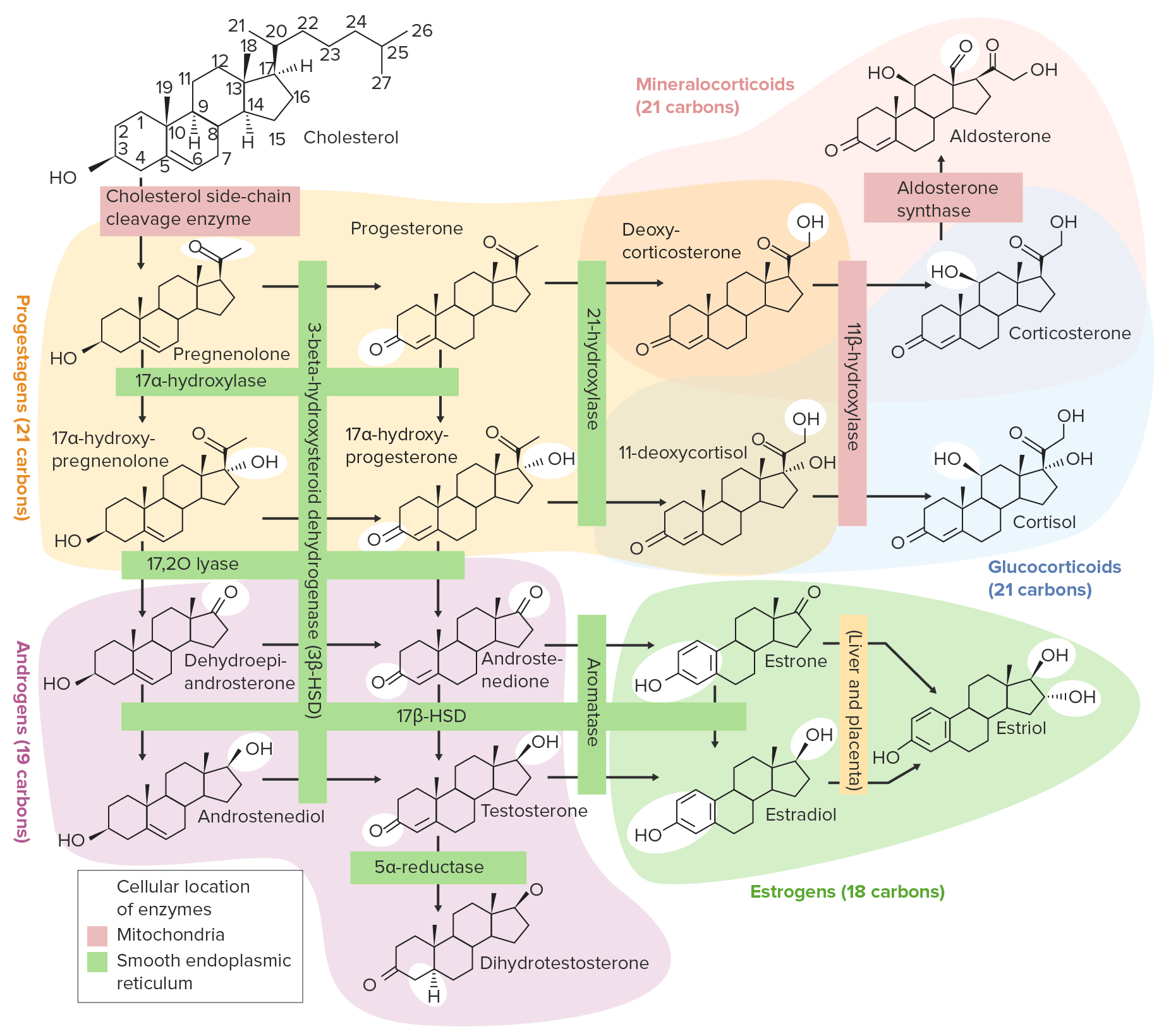
  • Colesterol →
  • Pregnenolona →
  • Progesterona →
  • 17α-hidroxiprogesterona (17α-OHP) →
  • La androstenediona, que puede convertirse en EN Erythema nodosum is an immune-mediated panniculitis (inflammation of the subcutaneous fat) caused by a type IV (delayed-type) hypersensitivity reaction. It commonly manifests in young women as tender, erythematous nodules on the shins. Erythema Nodosum
  • Testosterona o estrona ( E1 E1 An aromatized C18 steroid with a 3-hydroxyl group and a 17-ketone, a major mammalian estrogen. It is converted from androstenedione directly, or from testosterone via estradiol. In humans, it is produced primarily by the cyclic ovaries, placenta, and the adipose tissue of men and postmenopausal women. Noncontraceptive Estrogen and Progestins), ambas pueden convertirse en EN Erythema nodosum is an immune-mediated panniculitis (inflammation of the subcutaneous fat) caused by a type IV (delayed-type) hypersensitivity reaction. It commonly manifests in young women as tender, erythematous nodules on the shins. Erythema Nodosum
  • Estradiol Estradiol The 17-beta-isomer of estradiol, an aromatized C18 steroid with hydroxyl group at 3-beta- and 17-beta-position. Estradiol-17-beta is the most potent form of mammalian estrogenic steroids. Noncontraceptive Estrogen and Progestins (E2)
Overview of the steroidogenesis pathways

Resumen de las vías de la esteroidogénesis
HSD: Hidroxiesteroide deshidrogenasa

Imagen por Lecturio.

Transporte de hormonas gonadales en EN Erythema nodosum is an immune-mediated panniculitis (inflammation of the subcutaneous fat) caused by a type IV (delayed-type) hypersensitivity reaction. It commonly manifests in young women as tender, erythematous nodules on the shins. Erythema Nodosum la sangre

Derivadas del colesterol, las hormonas gonadales son lipofílicas, por lo que deben estar unidas a las proteínas para viajar en EN Erythema nodosum is an immune-mediated panniculitis (inflammation of the subcutaneous fat) caused by a type IV (delayed-type) hypersensitivity reaction. It commonly manifests in young women as tender, erythematous nodules on the shins. Erythema Nodosum la sangre. En EN Erythema nodosum is an immune-mediated panniculitis (inflammation of the subcutaneous fat) caused by a type IV (delayed-type) hypersensitivity reaction. It commonly manifests in young women as tender, erythematous nodules on the shins. Erythema Nodosum general, están unidas a:

  • Globulina fijadora de hormonas sexuales ( SHBG SHBG A glycoprotein migrating as a beta-globulin. Its molecular weight, 52, 000 or 95, 000-115, 000, indicates that it exists as a dimer. The protein binds testosterone, dihydrotestosterone, and estradiol in the plasma. Sex hormone-binding protein has the same amino acid sequence as androgen-binding protein. They differ by their sites of synthesis and post-translational oligosaccharide modifications. Gonadal Hormones): aproximadamente 40%
  • Otras proteínas (principalmente albúmina y globulina fijadora de corticosteroides): aproximadamente 54%-60%
  • Hormona libre (la única forma biológicamente activa): aproximadamente 2%

Receptores hormonales gonadales

  • Las hormonas gonadales son lipofílicas  → pueden atravesar libremente las membranas celulares para unirse a los LOS Neisseria receptores intracelulares.
  • Una vez unido a los LOS Neisseria receptores → translocación al AL Amyloidosis núcleo
  • El complejo hormona-receptor puede unirse al AL Amyloidosis ADN y afectar a la expresión génica.
Diagrama de los efectos de las hormonas gonadales

Diagrama que muestra cómo las hormonas gonadales ejercen sus efectos sobre las células, utilizando testosterona como un ejemplo.
DHT: dihidrotestosterona
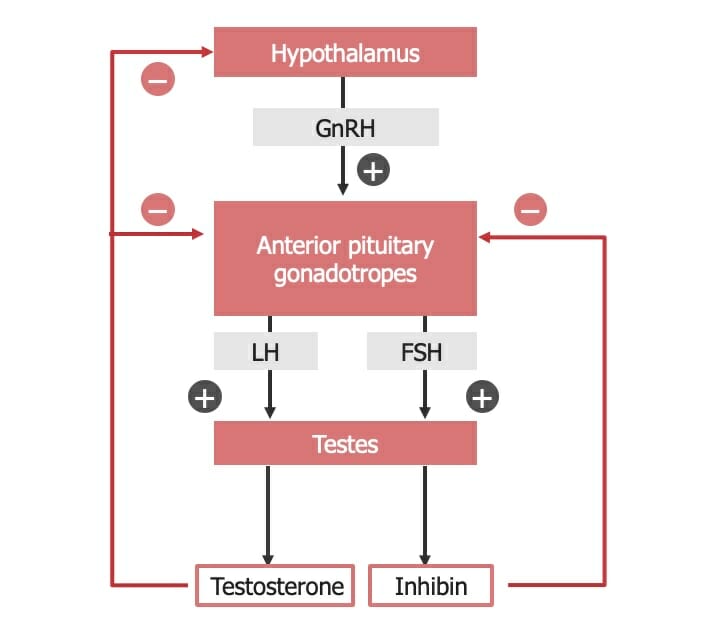
Imagen por Lecturio.

Endocrinología Reproductiva Masculina

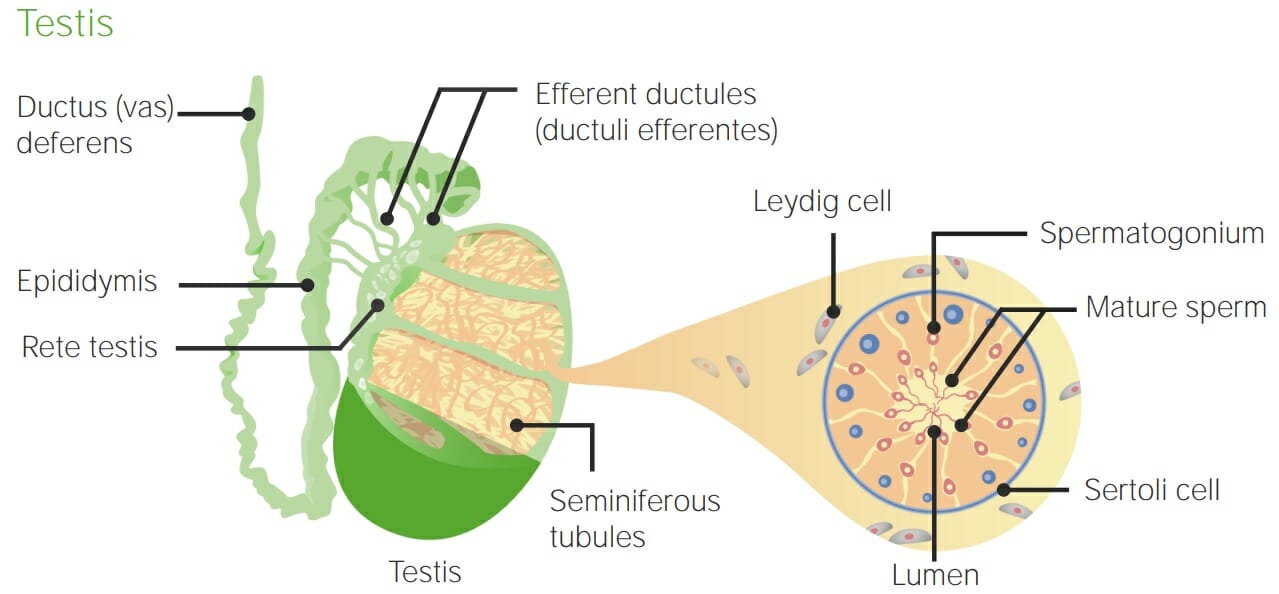
Anatomía de los LOS Neisseria túbulos seminíferos

  • Los LOS Neisseria espermatozoides se desarrollan en EN Erythema nodosum is an immune-mediated panniculitis (inflammation of the subcutaneous fat) caused by a type IV (delayed-type) hypersensitivity reaction. It commonly manifests in young women as tender, erythematous nodules on the shins. Erythema Nodosum los LOS Neisseria túbulos seminíferos de los LOS Neisseria testículos
  • Los LOS Neisseria túbulos incluyen 2 células primarias del cordón sexual
    • Células de Leydig: sintetizan la testosterona
    • Células de Sertoli: revestimiento interno de los LOS Neisseria túbulos

Visión general del eje hipotálamo-hipófisis-testicular

  • Las neuronas preópticas del hipotálamo secretan GnRH.
  • La GnRH estimula la liberación de la hipófisis anterior:
    • LH LH A major gonadotropin secreted by the adenohypophysis. Luteinizing hormone regulates steroid production by the interstitial cells of the testis and the ovary. The preovulatory luteinizing hormone surge in females induces ovulation, and subsequent luteinization of the follicle. Luteinizing hormone consists of two noncovalently linked subunits, alpha and beta. Within a species, the alpha subunit is common in the three pituitary glycoprotein hormones (TSH, LH, and FSH), but the beta subunit is unique and confers its biological specificity. Menstrual Cycle
    • FSH FSH A major gonadotropin secreted by the adenohypophysis. Follicle-stimulating hormone stimulates gametogenesis and the supporting cells such as the ovarian granulosa cells, the testicular sertoli cells, and leydig cells. Fsh consists of two noncovalently linked subunits, alpha and beta. Within a species, the alpha subunit is common in the three pituitary glycoprotein hormones (TSH, LH, and FSH), but the beta subunit is unique and confers its biological specificity. Menstrual Cycle
  • La LH LH A major gonadotropin secreted by the adenohypophysis. Luteinizing hormone regulates steroid production by the interstitial cells of the testis and the ovary. The preovulatory luteinizing hormone surge in females induces ovulation, and subsequent luteinization of the follicle. Luteinizing hormone consists of two noncovalently linked subunits, alpha and beta. Within a species, the alpha subunit is common in the three pituitary glycoprotein hormones (TSH, LH, and FSH), but the beta subunit is unique and confers its biological specificity. Menstrual Cycle y la FSH FSH A major gonadotropin secreted by the adenohypophysis. Follicle-stimulating hormone stimulates gametogenesis and the supporting cells such as the ovarian granulosa cells, the testicular sertoli cells, and leydig cells. Fsh consists of two noncovalently linked subunits, alpha and beta. Within a species, the alpha subunit is common in the three pituitary glycoprotein hormones (TSH, LH, and FSH), but the beta subunit is unique and confers its biological specificity. Menstrual Cycle estimulan las células de los LOS Neisseria testículos:
    • LH LH A major gonadotropin secreted by the adenohypophysis. Luteinizing hormone regulates steroid production by the interstitial cells of the testis and the ovary. The preovulatory luteinizing hormone surge in females induces ovulation, and subsequent luteinization of the follicle. Luteinizing hormone consists of two noncovalently linked subunits, alpha and beta. Within a species, the alpha subunit is common in the three pituitary glycoprotein hormones (TSH, LH, and FSH), but the beta subunit is unique and confers its biological specificity. Menstrual Cycle: afecta principalmente a las células testiculares de Leydig → estimula la producción de testosterona.
    • FSH FSH A major gonadotropin secreted by the adenohypophysis. Follicle-stimulating hormone stimulates gametogenesis and the supporting cells such as the ovarian granulosa cells, the testicular sertoli cells, and leydig cells. Fsh consists of two noncovalently linked subunits, alpha and beta. Within a species, the alpha subunit is common in the three pituitary glycoprotein hormones (TSH, LH, and FSH), but the beta subunit is unique and confers its biological specificity. Menstrual Cycle: afecta principalmente a las células testiculares de Sertoli:
      • Estimula la espermatogénesis
      • Sintetiza péptidos reguladores (incluyendo la inhibina) y varios factores de crecimiento
  • Parte de la testosterona se convierte a:
    • Dihidrotestosterona ( DHT DHT A potent androgenic metabolite of testosterone. It is produced by the action of the enzyme 3-oxo-5-alpha-steroid 4-dehydrogenase. Gonadal Hormones): vía 5α- reductasa
    • 17-cetosteroides
    • Estradiol Estradiol The 17-beta-isomer of estradiol, an aromatized C18 steroid with hydroxyl group at 3-beta- and 17-beta-position. Estradiol-17-beta is the most potent form of mammalian estrogenic steroids. Noncontraceptive Estrogen and Progestins:
      • A través de la aromatasa presente en EN Erythema nodosum is an immune-mediated panniculitis (inflammation of the subcutaneous fat) caused by a type IV (delayed-type) hypersensitivity reaction. It commonly manifests in young women as tender, erythematous nodules on the shins. Erythema Nodosum las células de Sertoli
      • Ayuda a las células de Leydig a producir más testosterona
  • Retroalimentación y regulación del eje HHT:
    • Testosterona: inhibe la secreción de GnRH, FSH FSH A major gonadotropin secreted by the adenohypophysis. Follicle-stimulating hormone stimulates gametogenesis and the supporting cells such as the ovarian granulosa cells, the testicular sertoli cells, and leydig cells. Fsh consists of two noncovalently linked subunits, alpha and beta. Within a species, the alpha subunit is common in the three pituitary glycoprotein hormones (TSH, LH, and FSH), but the beta subunit is unique and confers its biological specificity. Menstrual Cycle y LH LH A major gonadotropin secreted by the adenohypophysis. Luteinizing hormone regulates steroid production by the interstitial cells of the testis and the ovary. The preovulatory luteinizing hormone surge in females induces ovulation, and subsequent luteinization of the follicle. Luteinizing hormone consists of two noncovalently linked subunits, alpha and beta. Within a species, the alpha subunit is common in the three pituitary glycoprotein hormones (TSH, LH, and FSH), but the beta subunit is unique and confers its biological specificity. Menstrual Cycle.
    • Inhibina: inhibe selectivamente la FSH FSH A major gonadotropin secreted by the adenohypophysis. Follicle-stimulating hormone stimulates gametogenesis and the supporting cells such as the ovarian granulosa cells, the testicular sertoli cells, and leydig cells. Fsh consists of two noncovalently linked subunits, alpha and beta. Within a species, the alpha subunit is common in the three pituitary glycoprotein hormones (TSH, LH, and FSH), but the beta subunit is unique and confers its biological specificity. Menstrual Cycle.

Efectos de la hormona luteinizante y de la hormona estimulante del folículo en EN Erythema nodosum is an immune-mediated panniculitis (inflammation of the subcutaneous fat) caused by a type IV (delayed-type) hypersensitivity reaction. It commonly manifests in young women as tender, erythematous nodules on the shins. Erythema Nodosum los LOS Neisseria testículos

  • LH LH A major gonadotropin secreted by the adenohypophysis. Luteinizing hormone regulates steroid production by the interstitial cells of the testis and the ovary. The preovulatory luteinizing hormone surge in females induces ovulation, and subsequent luteinization of the follicle. Luteinizing hormone consists of two noncovalently linked subunits, alpha and beta. Within a species, the alpha subunit is common in the three pituitary glycoprotein hormones (TSH, LH, and FSH), but the beta subunit is unique and confers its biological specificity. Menstrual Cycle:
    • Activa la enzima de escisión lateral dentro de las células de Leydig, que inicia la conversión del colesterol en EN Erythema nodosum is an immune-mediated panniculitis (inflammation of the subcutaneous fat) caused by a type IV (delayed-type) hypersensitivity reaction. It commonly manifests in young women as tender, erythematous nodules on the shins. Erythema Nodosum testosterona.
    • La testosterona se acumula en EN Erythema nodosum is an immune-mediated panniculitis (inflammation of the subcutaneous fat) caused by a type IV (delayed-type) hypersensitivity reaction. It commonly manifests in young women as tender, erythematous nodules on the shins. Erythema Nodosum las células de Leydig → se desplaza a ambas:
      • Células de Sertoli vecinas
      • La sangre para el transporte por todo el cuerpo
  • FSH FSH A major gonadotropin secreted by the adenohypophysis. Follicle-stimulating hormone stimulates gametogenesis and the supporting cells such as the ovarian granulosa cells, the testicular sertoli cells, and leydig cells. Fsh consists of two noncovalently linked subunits, alpha and beta. Within a species, the alpha subunit is common in the three pituitary glycoprotein hormones (TSH, LH, and FSH), but the beta subunit is unique and confers its biological specificity. Menstrual Cycle:
    • Estimula la espermatogénesis en EN Erythema nodosum is an immune-mediated panniculitis (inflammation of the subcutaneous fat) caused by a type IV (delayed-type) hypersensitivity reaction. It commonly manifests in young women as tender, erythematous nodules on the shins. Erythema Nodosum las células de Sertoli.
    • La espermatogénesis requiere testosterona producida por las células de Leydig.
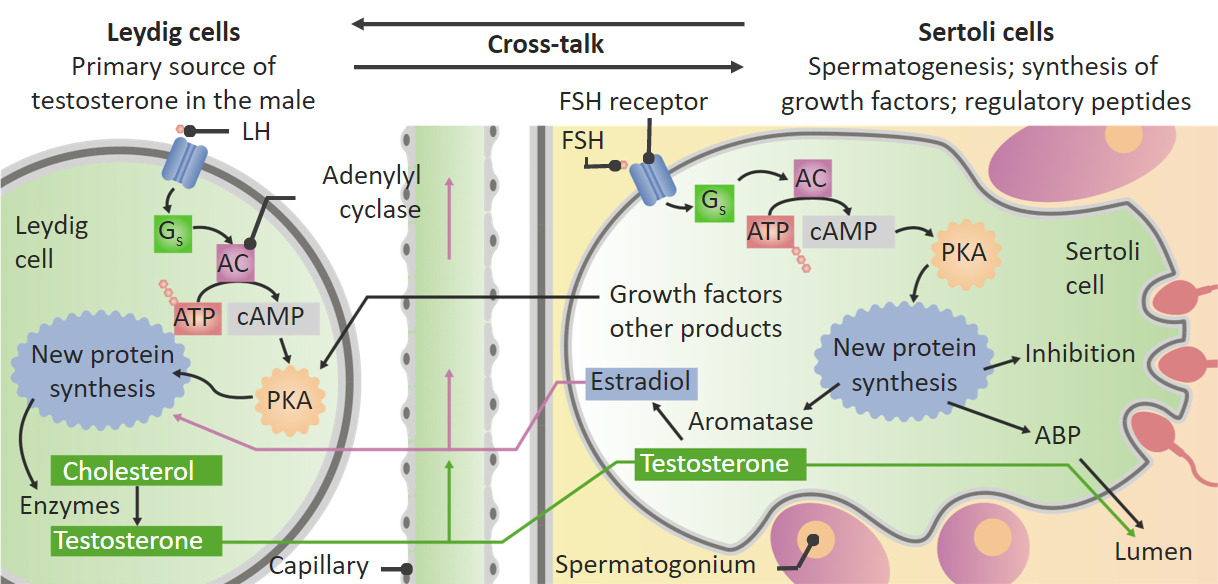
Acciones de la LH y la FSH en los testículos

Acciones de la hormona luteinizante (LH) y de la hormona estimulante del folículo (FSH) en los testículos. Dentro de las células de Leydig, la LH estimula la conversión del colesterol en testosterona. Esta testosterona pasa a las células de Sertoli, donde ayuda a estimular la espermatogénesis. La FSH estimula las células de Sertoli para que produzcan aromatasa, factores de crecimiento y otros péptidos reguladores, además de estimular la espermatogénesis. La aromatasa convierte parte de la testosterona en estrógeno. Parte del estrógeno y de los factores de crecimiento producidos en las células de Sertoli vuelven a pasar a las células de Leydig, donde estimulan a estas para que aumenten la producción de testosterona.

ABP: proteína de unión a andrógenos
PKA: proteína kinasa A

Imagen por Lecturio.

Efectos de la testosterona y otros andrógenos

La testosterona, y otros andrógenos, son responsables del desarrollo de las características sexuales masculinas primarias y secundarias.

  • Estimula el crecimiento de los LOS Neisseria órganos reproductores masculinos:
    • Agrandamiento del pene, testículos y del escroto
    • Desarrollo ductal y glandular del aparato reproductor masculino
  • Estimula la espermatogénesis; sin testosterona, los LOS Neisseria hombres se vuelven estériles.
  • Estimula el desarrollo de los LOS Neisseria caracteres sexuales secundarios:
    • Vello androgénico:
      • Vello púbico
      • Vello axilar
      • Vello facial (regiones de barba y bigote)
    • Cambios dermatológicos:
      • La piel se vuelve más oscura y gruesa.
      • ↑ Secreción de sebo → puede provocar acné.
      • ↑ Glándulas sudoríparas apocrinas
    • Crecimiento de la laringe → profundización de la voz
  • Efectos músculo-esqueléticos:
    • ↑ Crecimiento óseo
    • ↑ Masa muscular
    • ↑ Tejido conectivo

La secreción de testosterona a lo largo de la vida masculina

La secreción de testosterona varía a lo largo de la vida masculina:

  • Niveles máximos:
    • En EN Erythema nodosum is an immune-mediated panniculitis (inflammation of the subcutaneous fat) caused by a type IV (delayed-type) hypersensitivity reaction. It commonly manifests in young women as tender, erythematous nodules on the shins. Erythema Nodosum el útero
    • A partir de la pubertad y durante toda la vida adulta
  • Comienza a disminuir alrededor de los LOS Neisseria 60 años.
  • La testosterona se secreta en EN Erythema nodosum is an immune-mediated panniculitis (inflammation of the subcutaneous fat) caused by a type IV (delayed-type) hypersensitivity reaction. It commonly manifests in young women as tender, erythematous nodules on the shins. Erythema Nodosum pulsos a lo largo del día.
Concentraciones medias de testosterona

Concentraciones medias de testosterona a lo largo de la vida

Imagen por Lecturio.

Endocrinología Reproductiva Femenina

Estructura de los LOS Neisseria folículos en EN Erythema nodosum is an immune-mediated panniculitis (inflammation of the subcutaneous fat) caused by a type IV (delayed-type) hypersensitivity reaction. It commonly manifests in young women as tender, erythematous nodules on the shins. Erythema Nodosum desarrollo

  • El folículo en EN Erythema nodosum is an immune-mediated panniculitis (inflammation of the subcutaneous fat) caused by a type IV (delayed-type) hypersensitivity reaction. It commonly manifests in young women as tender, erythematous nodules on the shins. Erythema Nodosum desarrollo es un pequeño quiste que se forma alrededor de cada ovocito.
  • Rodeado por 2 células estromales primarias:
    • Células de la granulosa
    • Células de la teca
  • Las células del estroma producen las hormonas gonadales en EN Erythema nodosum is an immune-mediated panniculitis (inflammation of the subcutaneous fat) caused by a type IV (delayed-type) hypersensitivity reaction. It commonly manifests in young women as tender, erythematous nodules on the shins. Erythema Nodosum las mujeres.
Estructura del folículo ovárico primario

Estructura de un folículo antral

Imagen por Lecturio.
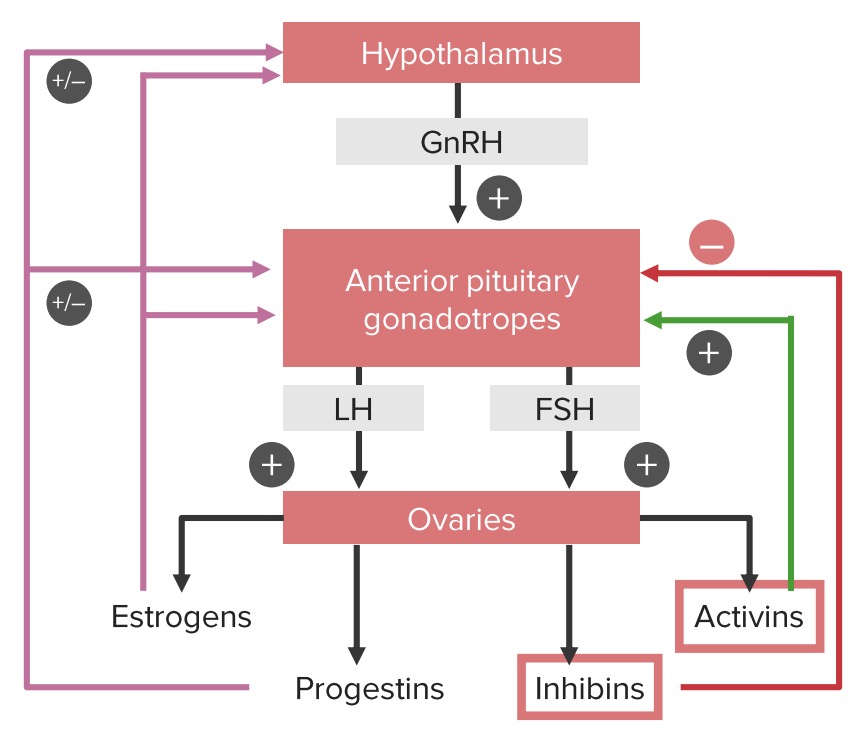
Visión general del eje hipotálamo-hipófisis-ovario

  • Las neuronas preópticas del hipotálamo secretan GnRH de forma pulsátil.
  • Los LOS Neisseria pulsos de GnRH, junto con otros ritmos biológicos, provocan la liberación de la hipófisis anterior:
    • FSH FSH A major gonadotropin secreted by the adenohypophysis. Follicle-stimulating hormone stimulates gametogenesis and the supporting cells such as the ovarian granulosa cells, the testicular sertoli cells, and leydig cells. Fsh consists of two noncovalently linked subunits, alpha and beta. Within a species, the alpha subunit is common in the three pituitary glycoprotein hormones (TSH, LH, and FSH), but the beta subunit is unique and confers its biological specificity. Menstrual Cycle:
      • Estimula el desarrollo folicular y la maduración del óvulo
      • Estimula las células de la granulosa del ovario para que produzcan E2
    • LH LH A major gonadotropin secreted by the adenohypophysis. Luteinizing hormone regulates steroid production by the interstitial cells of the testis and the ovary. The preovulatory luteinizing hormone surge in females induces ovulation, and subsequent luteinization of the follicle. Luteinizing hormone consists of two noncovalently linked subunits, alpha and beta. Within a species, the alpha subunit is common in the three pituitary glycoprotein hormones (TSH, LH, and FSH), but the beta subunit is unique and confers its biological specificity. Menstrual Cycle:
      • Estimula las células teca del ovario para que produzcan testosterona (la mayor parte de la cual se convierte en EN Erythema nodosum is an immune-mediated panniculitis (inflammation of the subcutaneous fat) caused by a type IV (delayed-type) hypersensitivity reaction. It commonly manifests in young women as tender, erythematous nodules on the shins. Erythema Nodosum E2 en EN Erythema nodosum is an immune-mediated panniculitis (inflammation of the subcutaneous fat) caused by a type IV (delayed-type) hypersensitivity reaction. It commonly manifests in young women as tender, erythematous nodules on the shins. Erythema Nodosum las células de la granulosa)
      • Una pico de LH LH A major gonadotropin secreted by the adenohypophysis. Luteinizing hormone regulates steroid production by the interstitial cells of the testis and the ovary. The preovulatory luteinizing hormone surge in females induces ovulation, and subsequent luteinization of the follicle. Luteinizing hormone consists of two noncovalently linked subunits, alpha and beta. Within a species, the alpha subunit is common in the three pituitary glycoprotein hormones (TSH, LH, and FSH), but the beta subunit is unique and confers its biological specificity. Menstrual Cycle a mitad del ciclo desencadena la ovulación.
  • Hormonas producidas por los LOS Neisseria ovarios:
    • Estrógenos:
      • E2: estrógeno primario producido en EN Erythema nodosum is an immune-mediated panniculitis (inflammation of the subcutaneous fat) caused by a type IV (delayed-type) hypersensitivity reaction. It commonly manifests in young women as tender, erythematous nodules on the shins. Erythema Nodosum las mujeres en EN Erythema nodosum is an immune-mediated panniculitis (inflammation of the subcutaneous fat) caused by a type IV (delayed-type) hypersensitivity reaction. It commonly manifests in young women as tender, erythematous nodules on the shins. Erythema Nodosum edad reproductiva
      • E1 E1 An aromatized C18 steroid with a 3-hydroxyl group and a 17-ketone, a major mammalian estrogen. It is converted from androstenedione directly, or from testosterone via estradiol. In humans, it is produced primarily by the cyclic ovaries, placenta, and the adipose tissue of men and postmenopausal women. Noncontraceptive Estrogen and Progestins: estrógeno más débil; estrógeno primario en EN Erythema nodosum is an immune-mediated panniculitis (inflammation of the subcutaneous fat) caused by a type IV (delayed-type) hypersensitivity reaction. It commonly manifests in young women as tender, erythematous nodules on the shins. Erythema Nodosum mujeres menopáusicas
      • Estriol Estriol A hydroxylated metabolite of estradiol or estrogen that has a hydroxyl group at C3, 16-alpha, and 17-beta position. Estriol is a major urinary estrogen. During pregnancy, a large amount of estriol is produced by the placenta. Isomers with inversion of the hydroxyl group or groups are called epiestriol. Noncontraceptive Estrogen and Progestins ( E3 E3 A hydroxylated metabolite of estradiol or estrogen that has a hydroxyl group at C3, 16-alpha, and 17-beta position. Estriol is a major urinary estrogen. During pregnancy, a large amount of estriol is produced by the placenta. Isomers with inversion of the hydroxyl group or groups are called epiestriol. Noncontraceptive Estrogen and Progestins): Se produce principalmente en EN Erythema nodosum is an immune-mediated panniculitis (inflammation of the subcutaneous fat) caused by a type IV (delayed-type) hypersensitivity reaction. It commonly manifests in young women as tender, erythematous nodules on the shins. Erythema Nodosum el embarazo.
    • Progestinas (solo se producen en EN Erythema nodosum is an immune-mediated panniculitis (inflammation of the subcutaneous fat) caused by a type IV (delayed-type) hypersensitivity reaction. It commonly manifests in young women as tender, erythematous nodules on the shins. Erythema Nodosum cantidades significativas después de la ovulación):
      • Progesterona
      • Compuestos similares a la progesterona (por ejemplo, 17α-OHP)
    • Inhibinas
    • Activinas
    • Andrógenos
  • Retroalimentación y regulación del eje hipotálamo-hipófisis-ovario:
    • Los LOS Neisseria estrógenos y la progesterona durante la mayor parte del ciclo menstrual inhiben:
      • Secreción hipofisaria de FSH FSH A major gonadotropin secreted by the adenohypophysis. Follicle-stimulating hormone stimulates gametogenesis and the supporting cells such as the ovarian granulosa cells, the testicular sertoli cells, and leydig cells. Fsh consists of two noncovalently linked subunits, alpha and beta. Within a species, the alpha subunit is common in the three pituitary glycoprotein hormones (TSH, LH, and FSH), but the beta subunit is unique and confers its biological specificity. Menstrual Cycle y LH LH A major gonadotropin secreted by the adenohypophysis. Luteinizing hormone regulates steroid production by the interstitial cells of the testis and the ovary. The preovulatory luteinizing hormone surge in females induces ovulation, and subsequent luteinization of the follicle. Luteinizing hormone consists of two noncovalently linked subunits, alpha and beta. Within a species, the alpha subunit is common in the three pituitary glycoprotein hormones (TSH, LH, and FSH), but the beta subunit is unique and confers its biological specificity. Menstrual Cycle
      • Secreción hipotalámica de GnRH
      • I.e., durante la mayor parte del ciclo menstrual, el estrógeno proporciona una retroalimentación negativa a la hipófisis.
    • Estradiol Estradiol The 17-beta-isomer of estradiol, an aromatized C18 steroid with hydroxyl group at 3-beta- and 17-beta-position. Estradiol-17-beta is the most potent form of mammalian estrogenic steroids. Noncontraceptive Estrogen and Progestins a mitad del ciclo:
      • Estimula la secreción de FSH FSH A major gonadotropin secreted by the adenohypophysis. Follicle-stimulating hormone stimulates gametogenesis and the supporting cells such as the ovarian granulosa cells, the testicular sertoli cells, and leydig cells. Fsh consists of two noncovalently linked subunits, alpha and beta. Within a species, the alpha subunit is common in the three pituitary glycoprotein hormones (TSH, LH, and FSH), but the beta subunit is unique and confers its biological specificity. Menstrual Cycle y LH LH A major gonadotropin secreted by the adenohypophysis. Luteinizing hormone regulates steroid production by the interstitial cells of the testis and the ovary. The preovulatory luteinizing hormone surge in females induces ovulation, and subsequent luteinization of the follicle. Luteinizing hormone consists of two noncovalently linked subunits, alpha and beta. Within a species, the alpha subunit is common in the three pituitary glycoprotein hormones (TSH, LH, and FSH), but the beta subunit is unique and confers its biological specificity. Menstrual Cycle de la hipófisis → resulta en EN Erythema nodosum is an immune-mediated panniculitis (inflammation of the subcutaneous fat) caused by a type IV (delayed-type) hypersensitivity reaction. It commonly manifests in young women as tender, erythematous nodules on the shins. Erythema Nodosum ↑ producción de estrógenos → aún más FSH FSH A major gonadotropin secreted by the adenohypophysis. Follicle-stimulating hormone stimulates gametogenesis and the supporting cells such as the ovarian granulosa cells, the testicular sertoli cells, and leydig cells. Fsh consists of two noncovalently linked subunits, alpha and beta. Within a species, the alpha subunit is common in the three pituitary glycoprotein hormones (TSH, LH, and FSH), but the beta subunit is unique and confers its biological specificity. Menstrual Cycle y LH LH A major gonadotropin secreted by the adenohypophysis. Luteinizing hormone regulates steroid production by the interstitial cells of the testis and the ovary. The preovulatory luteinizing hormone surge in females induces ovulation, and subsequent luteinization of the follicle. Luteinizing hormone consists of two noncovalently linked subunits, alpha and beta. Within a species, the alpha subunit is common in the three pituitary glycoprotein hormones (TSH, LH, and FSH), but the beta subunit is unique and confers its biological specificity. Menstrual Cycle.
      • I.e., el estrógeno se convierte en EN Erythema nodosum is an immune-mediated panniculitis (inflammation of the subcutaneous fat) caused by a type IV (delayed-type) hypersensitivity reaction. It commonly manifests in young women as tender, erythematous nodules on the shins. Erythema Nodosum un mecanismo de retroalimentación positiva sobre la hipófisis.
      • Provoca un pico de LH LH A major gonadotropin secreted by the adenohypophysis. Luteinizing hormone regulates steroid production by the interstitial cells of the testis and the ovary. The preovulatory luteinizing hormone surge in females induces ovulation, and subsequent luteinization of the follicle. Luteinizing hormone consists of two noncovalently linked subunits, alpha and beta. Within a species, the alpha subunit is common in the three pituitary glycoprotein hormones (TSH, LH, and FSH), but the beta subunit is unique and confers its biological specificity. Menstrual Cycle → desencadena la ovulación.
    • Inhibina: Inhibe selectivamente la secreción de FSH FSH A major gonadotropin secreted by the adenohypophysis. Follicle-stimulating hormone stimulates gametogenesis and the supporting cells such as the ovarian granulosa cells, the testicular sertoli cells, and leydig cells. Fsh consists of two noncovalently linked subunits, alpha and beta. Within a species, the alpha subunit is common in the three pituitary glycoprotein hormones (TSH, LH, and FSH), but the beta subunit is unique and confers its biological specificity. Menstrual Cycle.
    • Activina: Estimula la secreción de LH LH A major gonadotropin secreted by the adenohypophysis. Luteinizing hormone regulates steroid production by the interstitial cells of the testis and the ovary. The preovulatory luteinizing hormone surge in females induces ovulation, and subsequent luteinization of the follicle. Luteinizing hormone consists of two noncovalently linked subunits, alpha and beta. Within a species, the alpha subunit is common in the three pituitary glycoprotein hormones (TSH, LH, and FSH), but the beta subunit is unique and confers its biological specificity. Menstrual Cycle, especialmente en EN Erythema nodosum is an immune-mediated panniculitis (inflammation of the subcutaneous fat) caused by a type IV (delayed-type) hypersensitivity reaction. It commonly manifests in young women as tender, erythematous nodules on the shins. Erythema Nodosum la mitad del ciclo.
Eje hipotálamo-hipófisis-ovario

Circuitos de retroalimentación positiva y negativa del eje hipotálamo-hipófisis-ovario:
Hay que tener en cuenta que los estrógenos y los progestágenos pueden tener una influencia tanto positiva como negativa sobre el hipotálamo y la hipófisis, dependiendo de la fase del ciclo. Los estrógenos proporcionan una retroalimentación negativa hasta la mitad del ciclo. En ese momento, los estrógenos comienzan a estimular las células gonadotrópicas de la hipófisis, lo que provoca el aumento de la hormona luteinizante (LH), que desencadena la ovulación.


FSH: hormona foliculoestimulante
GnRH: hormona liberadora de gonadotropina

Imagen por Lecturio.

Pulsatilidad de las gonadotropinas

La GnRH se libera de forma pulsátil, siguiendo múltiples ritmos biológicos:
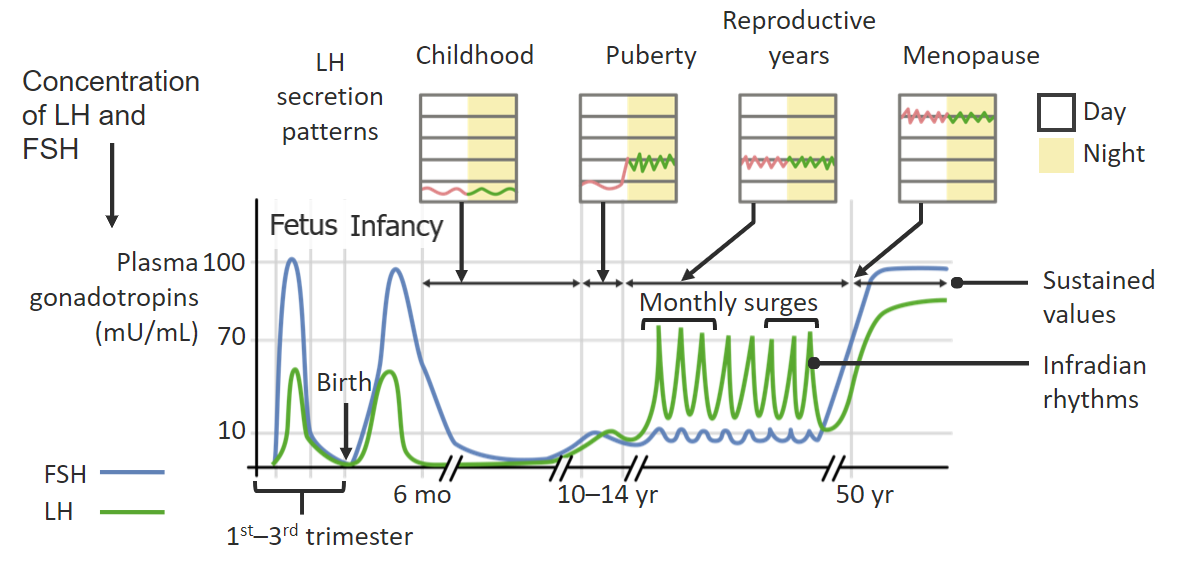
  • Principales etapas de crecimiento y desarrollo (por ejemplo, infancia → pubertad → años reproductivos → menopausia)
  • Ritmos circadianos: ciclos de 24 horas
  • Ritmos ultradianos: < ciclos de 24 horas
  • Ritmos infradianos: > ciclos de 24 horas (ritmos mensuales)

Cambios en la secreción pulsátil de la hormona folículo-estimulante (FSH) y la hormona luteinizante (LH) a lo largo del día y de la vida de la mujer:
La liberación pulsátil de FSH y LH desde la hipófisis se produce en respuesta a la liberación pulsátil de la hormona liberadora de gonadotropina (GnRH) desde el hipotálamo.

Imagen por Lecturio.

Síntesis de estradiol Estradiol The 17-beta-isomer of estradiol, an aromatized C18 steroid with hydroxyl group at 3-beta- and 17-beta-position. Estradiol-17-beta is the most potent form of mammalian estrogenic steroids. Noncontraceptive Estrogen and Progestins y progesterona

Revisión de la vía metabólica de las hormonas sexuales: colesterol → pregnenolona → progesterona → 17α-OHP → androstenediona → testosterona o E1 E1 An aromatized C18 steroid with a 3-hydroxyl group and a 17-ketone, a major mammalian estrogen. It is converted from androstenedione directly, or from testosterone via estradiol. In humans, it is produced primarily by the cyclic ovaries, placenta, and the adipose tissue of men and postmenopausal women. Noncontraceptive Estrogen and Progestins → E2
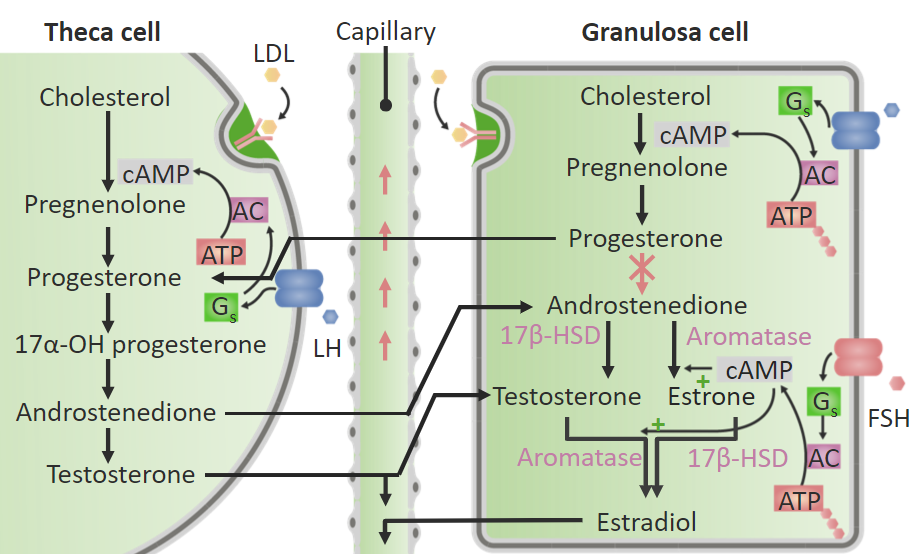
  • Células de la teca:
    • Contienen 17α-hidroxilasa: Convierte la progesterona en EN Erythema nodosum is an immune-mediated panniculitis (inflammation of the subcutaneous fat) caused by a type IV (delayed-type) hypersensitivity reaction. It commonly manifests in young women as tender, erythematous nodules on the shins. Erythema Nodosum 17α-OHP.
    • 17α-OHP es convertida a testosterona.
    • Estimulada por la LH LH A major gonadotropin secreted by the adenohypophysis. Luteinizing hormone regulates steroid production by the interstitial cells of the testis and the ovary. The preovulatory luteinizing hormone surge in females induces ovulation, and subsequent luteinization of the follicle. Luteinizing hormone consists of two noncovalently linked subunits, alpha and beta. Within a species, the alpha subunit is common in the three pituitary glycoprotein hormones (TSH, LH, and FSH), but the beta subunit is unique and confers its biological specificity. Menstrual Cycle.
  • Células de la granulosa:
    • Convierten el colesterol → progesterona ( en EN Erythema nodosum is an immune-mediated panniculitis (inflammation of the subcutaneous fat) caused by a type IV (delayed-type) hypersensitivity reaction. It commonly manifests in young women as tender, erythematous nodules on the shins. Erythema Nodosum las células de la granulosa no está presente la 17α hidroxilasa para que siga el camino hacia la testosterona)
    • Contienen aromatasa:
      • Convierten la testosterona producida por las células de la teca → E2
      • Convierten la androstenediona producida por las las células de la teca → E1 E1 An aromatized C18 steroid with a 3-hydroxyl group and a 17-ketone, a major mammalian estrogen. It is converted from androstenedione directly, or from testosterone via estradiol. In humans, it is produced primarily by the cyclic ovaries, placenta, and the adipose tissue of men and postmenopausal women. Noncontraceptive Estrogen and Progestins
      • La aromatasa es estimulada por la FSH FSH A major gonadotropin secreted by the adenohypophysis. Follicle-stimulating hormone stimulates gametogenesis and the supporting cells such as the ovarian granulosa cells, the testicular sertoli cells, and leydig cells. Fsh consists of two noncovalently linked subunits, alpha and beta. Within a species, the alpha subunit is common in the three pituitary glycoprotein hormones (TSH, LH, and FSH), but the beta subunit is unique and confers its biological specificity. Menstrual Cycle .
  • Resultados finales:
    • Las células de la teca producen testosterona (la mayor parte, pero no toda, se convierte en EN Erythema nodosum is an immune-mediated panniculitis (inflammation of the subcutaneous fat) caused by a type IV (delayed-type) hypersensitivity reaction. It commonly manifests in young women as tender, erythematous nodules on the shins. Erythema Nodosum E2).
    • Las células de la granulosa producen:
      • Estrógeno
      • Progesterona

Síntesis de estrógenos y testosterona en el ovario. En las células de la teca y de la granulosa están presentes diferentes enzimas. Las células de la teca contienen las enzimas necesarias para convertir el colesterol en testosterona; sin embargo, carecen de aromatasa, necesaria para convertir los andrógenos en estrógenos. Por lo tanto, los andrógenos (androstenediona y testosterona) pasan de las células de la teca a las células de la granulosa, que sí contienen aromatasa. Dentro de las células de la granulosa, la aromatasa convierte la testosterona en estradiol (E2) y la androstenediona en estrona (E1). Las células de la granulosa carecen de la enzima necesaria para convertir la progesterona en androstenediona, por lo que las células de la granulosa producen tanto progesterona como estrógenos.

AC: adenilil ciclasa
17β-HSD: 17β-hidroxiesteroide deshidrogenasa

Imagen por Lecturio.

Efectos de los LOS Neisseria estrógenos

Los LOS Neisseria estrógenos desempeñan un papel importante en EN Erythema nodosum is an immune-mediated panniculitis (inflammation of the subcutaneous fat) caused by a type IV (delayed-type) hypersensitivity reaction. It commonly manifests in young women as tender, erythematous nodules on the shins. Erythema Nodosum el desarrollo sexual de las mujeres y en EN Erythema nodosum is an immune-mediated panniculitis (inflammation of the subcutaneous fat) caused by a type IV (delayed-type) hypersensitivity reaction. It commonly manifests in young women as tender, erythematous nodules on the shins. Erythema Nodosum el ciclo menstrual; sin embargo, también existen numerosas funciones no reproductivas de los LOS Neisseria estrógenos.

  • Estimulan el crecimiento de los órganos reproductores femeninos:
    • Son responsables de la acumulación del revestimiento del endometrio cada mes durante el ciclo menstrual.
    • Crecimiento del miometrio
    • ↑ Fuerza/integridad del tejido vaginal
    • ↑ Lubricación vaginal
    • ↑ Crecimiento de los ovarios
  • Mamas:
    • Estimulan el desarrollo de las mamas.
    • ↓ Producción de leche
  • Producen el “físico femenino” debido a la deposición de grasa en EN Erythema nodosum is an immune-mediated panniculitis (inflammation of the subcutaneous fat) caused by a type IV (delayed-type) hypersensitivity reaction. It commonly manifests in young women as tender, erythematous nodules on the shins. Erythema Nodosum:
    • Mamas
    • Caderas, nalgas y muslos
    • Labios mayores y monte de Venus
  • Efectos endocrinos:
    • Inhiben la FSH FSH A major gonadotropin secreted by the adenohypophysis. Follicle-stimulating hormone stimulates gametogenesis and the supporting cells such as the ovarian granulosa cells, the testicular sertoli cells, and leydig cells. Fsh consists of two noncovalently linked subunits, alpha and beta. Within a species, the alpha subunit is common in the three pituitary glycoprotein hormones (TSH, LH, and FSH), but the beta subunit is unique and confers its biological specificity. Menstrual Cycle y la GnRH → los LOS Neisseria estrógenos son agentes anticonceptivos eficaces.
    • ↑ Receptores de LH LH A major gonadotropin secreted by the adenohypophysis. Luteinizing hormone regulates steroid production by the interstitial cells of the testis and the ovary. The preovulatory luteinizing hormone surge in females induces ovulation, and subsequent luteinization of the follicle. Luteinizing hormone consists of two noncovalently linked subunits, alpha and beta. Within a species, the alpha subunit is common in the three pituitary glycoprotein hormones (TSH, LH, and FSH), but the beta subunit is unique and confers its biological specificity. Menstrual Cycle en EN Erythema nodosum is an immune-mediated panniculitis (inflammation of the subcutaneous fat) caused by a type IV (delayed-type) hypersensitivity reaction. It commonly manifests in young women as tender, erythematous nodules on the shins. Erythema Nodosum las células de la granulosa
  • Efectos en EN Erythema nodosum is an immune-mediated panniculitis (inflammation of the subcutaneous fat) caused by a type IV (delayed-type) hypersensitivity reaction. It commonly manifests in young women as tender, erythematous nodules on the shins. Erythema Nodosum los LOS Neisseria huesos:
    • Promueven el crecimiento de los LOS Neisseria huesos:
      • Provocan el crecimiento acelerado en EN Erythema nodosum is an immune-mediated panniculitis (inflammation of the subcutaneous fat) caused by a type IV (delayed-type) hypersensitivity reaction. It commonly manifests in young women as tender, erythematous nodules on the shins. Erythema Nodosum la pubertad.
      • La osteoporosis Osteoporosis Osteoporosis refers to a decrease in bone mass and density leading to an increased number of fractures. There are 2 forms of osteoporosis: primary, which is commonly postmenopausal or senile; and secondary, which is a manifestation of immobilization, underlying medical disorders, or long-term use of certain medications. Osteoporosis se convierte en EN Erythema nodosum is an immune-mediated panniculitis (inflammation of the subcutaneous fat) caused by a type IV (delayed-type) hypersensitivity reaction. It commonly manifests in young women as tender, erythematous nodules on the shins. Erythema Nodosum un problema cuando los LOS Neisseria niveles de E2 disminuyen en EN Erythema nodosum is an immune-mediated panniculitis (inflammation of the subcutaneous fat) caused by a type IV (delayed-type) hypersensitivity reaction. It commonly manifests in young women as tender, erythematous nodules on the shins. Erythema Nodosum la menopausia.
    • Cierran las placas de crecimiento.
  • Efectos favorables en EN Erythema nodosum is an immune-mediated panniculitis (inflammation of the subcutaneous fat) caused by a type IV (delayed-type) hypersensitivity reaction. It commonly manifests in young women as tender, erythematous nodules on the shins. Erythema Nodosum los LOS Neisseria perfiles lipídicos
    • ↓ Colesterol total y LDL
    • ↑ HDL
    • Relevancia clínica:
      • Las mujeres premenopáusicas tienen un riesgo cardiovascular ↓ en EN Erythema nodosum is an immune-mediated panniculitis (inflammation of the subcutaneous fat) caused by a type IV (delayed-type) hypersensitivity reaction. It commonly manifests in young women as tender, erythematous nodules on the shins. Erythema Nodosum comparación con los LOS Neisseria hombres de la misma edad.
      • En EN Erythema nodosum is an immune-mediated panniculitis (inflammation of the subcutaneous fat) caused by a type IV (delayed-type) hypersensitivity reaction. It commonly manifests in young women as tender, erythematous nodules on the shins. Erythema Nodosum la menopausia, ↓ E2 → ↑ riesgo cardiovascular
  • Los LOS Neisseria factores de coagulación → los LOS Neisseria riesgos tromboembólicos son el principal riesgo de las terapias con estrógenos.

Efectos de las progestinas

La progesterona es producida principalmente por el cuerpo lúteo después de la ovulación.

  • Efectos uterinos:
    • ↑ Secreciones endometriales
    • Estabiliza y provoca la maduración del endometrio en EN Erythema nodosum is an immune-mediated panniculitis (inflammation of the subcutaneous fat) caused by a type IV (delayed-type) hypersensitivity reaction. It commonly manifests in young women as tender, erythematous nodules on the shins. Erythema Nodosum la 2ª mitad del ciclo menstrual → prepara el endometrio para la implantación.
    • Espesa el moco cervical (un moco cervical fino es necesario para el transporte de los LOS Neisseria espermatozoides al AL Amyloidosis útero).
    • La retirada de la progestina desencadena el sangrado menstrual.
  • Efectos en EN Erythema nodosum is an immune-mediated panniculitis (inflammation of the subcutaneous fat) caused by a type IV (delayed-type) hypersensitivity reaction. It commonly manifests in young women as tender, erythematous nodules on the shins. Erythema Nodosum los LOS Neisseria pechos:
    • ↑ Glándulas lácteas → puede causar sensibilidad en EN Erythema nodosum is an immune-mediated panniculitis (inflammation of the subcutaneous fat) caused by a type IV (delayed-type) hypersensitivity reaction. It commonly manifests in young women as tender, erythematous nodules on the shins. Erythema Nodosum las mamas antes de la menstruación.
    • ↓ Producción de leche → suprime la lactancia durante el embarazo.
  • ↑ Temperatura corporal basal → puede utilizarse para seguir la ovulación.
  • Necesario para el desarrollo de la placenta Placenta A highly vascularized mammalian fetal-maternal organ and major site of transport of oxygen, nutrients, and fetal waste products. It includes a fetal portion (chorionic villi) derived from trophoblasts and a maternal portion (decidua) derived from the uterine endometrium. The placenta produces an array of steroid, protein and peptide hormones (placental hormones). Placenta, Umbilical Cord, and Amniotic Cavity durante el embarazo

Resumen de la Comparación: Hombre/Mujer

Tabla: Comparación de estructuras y hormonas femeninas y masculinas
Hombre Mujer
Gónada Testículos Ovarios
Células germinales Espermatozoides Óvulos
Recubrimiento Túbulo seminífero Folículo
Células adyacentes Células de Sertoli Células de la granulosa
Productos de células adyacentes
  • Estradiol Estradiol The 17-beta-isomer of estradiol, an aromatized C18 steroid with hydroxyl group at 3-beta- and 17-beta-position. Estradiol-17-beta is the most potent form of mammalian estrogenic steroids. Noncontraceptive Estrogen and Progestins
  • Inhibina
  • Proteína de unión a andrógenos (ABP)
  • Factores de crecimiento
  • Estradiol Estradiol The 17-beta-isomer of estradiol, an aromatized C18 steroid with hydroxyl group at 3-beta- and 17-beta-position. Estradiol-17-beta is the most potent form of mammalian estrogenic steroids. Noncontraceptive Estrogen and Progestins
  • Progesterona
  • Inhibina
  • Activina
Intersticio Células de Leydig Células de la teca
Productos intersticiales Testosterona
  • Testosterona
  • Andrógenos
  • Progesterona
Tabla: Comparación entre estrógenos y andrógenos
Sistema de órganos Estrógenos Andrógenos
Órganos reproductores
  • ↑ Crecimiento y desarrollo de:
    • Endometrio
    • Miometrio
    • Vagina Vagina The vagina is the female genital canal, extending from the vulva externally to the cervix uteri internally. The structures have sexual, reproductive, and urinary functions and a rich blood supply, mainly arising from the internal iliac artery. Vagina, Vulva, and Pelvic Floor: Anatomy
    • Ovarios
  • ↑ Secreciones cervicales y vaginales → ↑ lubricación vaginal
  • ↑ Espermatogénesis
  • ↑ Crecimiento y desarrollo de:
    • Testículos
    • Próstata
    • Vesículas seminales
    • Pene
    • Clítoris en EN Erythema nodosum is an immune-mediated panniculitis (inflammation of the subcutaneous fat) caused by a type IV (delayed-type) hypersensitivity reaction. It commonly manifests in young women as tender, erythematous nodules on the shins. Erythema Nodosum las mujeres
  • ↑ Libido
Efectos dermatológicos ( en EN Erythema nodosum is an immune-mediated panniculitis (inflammation of the subcutaneous fat) caused by a type IV (delayed-type) hypersensitivity reaction. It commonly manifests in young women as tender, erythematous nodules on the shins. Erythema Nodosum todas las personas) Engrosamiento leve de la piel
  • ↑ Crecimiento de:
    • Vello facial
    • Vello axilar y púbico
  • ↑ Secreciones sebáceas → ↑ acné
  • Engrosamiento y oscurecimiento de la piel
Efectos músculo-esqueléticos
  • ↑ Crecimiento óseo
  • Cierra las placas de crecimiento.
  • Las caderas se ensanchan.
  • ↑ Crecimiento óseo
  • ↑ Masa muscular
  • ↑ Tejido conectivo
Otros efectos
  • Desarrollo del pecho
  • Depósitos de grasa:
    • Labios mayores y monte de Venus
    • Caderas, nalgas y muslos
  • ↑ Factores de coagulación
  • ↑ Proteínas de unión a esteroides
  • Efectos favorables sobre el perfil lipídico:
    • ↓ Total y LDL
    • ↑ HDL
  • ↑ Crecimiento de la laringe → profundización de la voz
  • ↑ Eritropoyesis
  • ↑ Proteínas de unión a esteroides

Relevancia Clínica

  • Anticonceptivos hormonales: Contienen una combinación de etinilestradiol y progestina o progestina sola. Estas hormonas sintéticas conllevan riesgos cardiovasculares ligeramente superiores a los del estradiol y la progesterona, pero tienen mejores efectos anticonceptivos. Los anticonceptivos hormonales están disponibles en muchas formas (por ejemplo, píldoras, dispositivos intrauterinos). Actúan inhibiendo la liberación de FSH (impidiendo el desarrollo folicular), y las progestinas también suprimen el desarrollo endometrial y la producción de moco cervical.
  • Terapia de reemplazo hormonal: Suele administrarse en forma de estradiol y progesterona “bioidénticos” debido a sus mejores perfiles de seguridad. La terapia hormonal sustitutiva está indicada en personas que sufren los síntomas causados por las fluctuaciones hormonales y la disminución de los niveles hormonales en la menopausia (por ejemplo, sofocos, cambios de humor). Otras indicaciones son la insuficiencia ovárica primaria (i.e., la menopausia prematura), el hipogonadismo masculino y la disforia de género.
  • Hipogonadismo: Condición caracterizada por la reducción o ausencia de producción de hormonas sexuales por parte de los testículos o los ovarios. El hipogonadismo puede deberse a un fallo de las gónadas o a defectos en las secreciones estimulantes hipotalámicas o hipofisarias. Los resultados incluyen infertilidad, mayor riesgo de osteoporosis, disfunción eréctil, disminución de la libido y regresión (o ausencia) de los caracteres sexuales secundarios. El diagnóstico requiere la evaluación de la historia clínica, el examen físico y las pruebas de laboratorio. El manejo es con terapia de reemplazo hormonal.
  • Insuficiencia ovárica primaria (IOP): Anteriormente denominada “insuficiencia ovárica prematura”, la IOP describe los LOS Neisseria casos de menopausia precoz, con el cese de la ovulación y la menstruación antes de los LOS Neisseria 40 años. El manejo requiere de la TRH para prevenir la osteoporosis Osteoporosis Osteoporosis refers to a decrease in bone mass and density leading to an increased number of fractures. There are 2 forms of osteoporosis: primary, which is commonly postmenopausal or senile; and secondary, which is a manifestation of immobilization, underlying medical disorders, or long-term use of certain medications. Osteoporosis temprana y las enfermedades cardiovasculares. Los LOS Neisseria problemas de fertilidad también deben abordarse según lo que desee el individuo.
  • Ginecomastia: Proliferación benigna del tejido mamario masculino glandular y ductal. Las causas pueden ser fisiológicas (debido a los LOS Neisseria desequilibrios de estrógenos y andrógenos que se producen con mayor frecuencia en EN Erythema nodosum is an immune-mediated panniculitis (inflammation of the subcutaneous fat) caused by a type IV (delayed-type) hypersensitivity reaction. It commonly manifests in young women as tender, erythematous nodules on the shins. Erythema Nodosum los LOS Neisseria neonatos, la pubertad y los LOS Neisseria hombres mayores) o pueden deberse a medicamentos, cirrosis, enfermedad renal crónica, hipogonadismo, hipertiroidismo, inanición y neoplasias testiculares. Cuando se presenta en EN Erythema nodosum is an immune-mediated panniculitis (inflammation of the subcutaneous fat) caused by a type IV (delayed-type) hypersensitivity reaction. It commonly manifests in young women as tender, erythematous nodules on the shins. Erythema Nodosum los LOS Neisseria hombres, debe diferenciarse del cáncer de mama.

Referencias

  1. Saladin, K.S., Miller, L. (2004). Anatomy and Physiology, 3rd ed., pp. 1030–1032, 1058–1060.
  2. Rosner, J. (2020). Physiology, female reproduction. StatPearls. Obtenido el 3 de agosto de 2021, de https://www.statpearls.com/articlelibrary/viewarticle/771/
  3. Gurung, P. (2021). Physiology, male reproductive system. StatPearls. Obtenido el 3 de agosto de 2021, de https://www.statpearls.com/articlelibrary/viewarticle/770/
  4. Braunstein, G.D., Anawalt, B.D. (2021). Management of gynecomastia. UpToDate. Obtenido el 3 de agosto de 2021, de https://www.uptodate.com/contents/management-of-gynecomastia
  5. Welt, C.K. (2020). Management of spontaneous primary ovarian insufficiency (premature ovarian failure). UpToDate. Obtenido el 3 de agosto de 2021, de https://www.uptodate.com/contents/management-of-spontaneous-primary-ovarian-insufficiency-premature-ovarian-failure

¡Crea tu cuenta gratis o inicia una sesión para seguir leyendo!

Regístrate ahora y obtén acceso gratuito a Lecturio con páginas de concepto, videos médicos y cuestionarios para tu educación médica.

User Reviews

Que tengas una sesión de estudio alegre y navideña 🎁 Ahorra 50% en todos los planes >>

Details