
Domina Conceptos Médicos

Estudia para la escuela de medicina y tus examenes con Lecturio.

Glucólisis

La glucólisis es una vía metabólica central responsable de la descomposición de la glucosa y juega un papel vital en EN Erythema nodosum is an immune-mediated panniculitis (inflammation of the subcutaneous fat) caused by a type IV (delayed-type) hypersensitivity reaction. It commonly manifests in young women as tender, erythematous nodules on the shins. Erythema Nodosum la generación de energía libre para la célula y metabolitos para una mayor degradación oxidativa. La glucosa está disponible principalmente en EN Erythema nodosum is an immune-mediated panniculitis (inflammation of the subcutaneous fat) caused by a type IV (delayed-type) hypersensitivity reaction. It commonly manifests in young women as tender, erythematous nodules on the shins. Erythema Nodosum la sangre como resultado de la descomposición del glucógeno o de su síntesis a partir de precursores distintos de los LOS Neisseria carbohidratos (gluconeogénesis) y se importa a las células mediante proteínas de transporte específicas. La glucólisis se produce en EN Erythema nodosum is an immune-mediated panniculitis (inflammation of the subcutaneous fat) caused by a type IV (delayed-type) hypersensitivity reaction. It commonly manifests in young women as tender, erythematous nodules on the shins. Erythema Nodosum el citoplasma y consta de 10 reacciones, cuyo resultado neto es la conversión de 1 molécula de glucosa C6 en EN Erythema nodosum is an immune-mediated panniculitis (inflammation of the subcutaneous fat) caused by a type IV (delayed-type) hypersensitivity reaction. It commonly manifests in young women as tender, erythematous nodules on the shins. Erythema Nodosum 2 moléculas de piruvato C3. La energía libre de este proceso se recolecta para producir adenosin trifosfato (ATP, por sus siglas en EN Erythema nodosum is an immune-mediated panniculitis (inflammation of the subcutaneous fat) caused by a type IV (delayed-type) hypersensitivity reaction. It commonly manifests in young women as tender, erythematous nodules on the shins. Erythema Nodosum inglés) y nicotinamida adenina dinucleótido hidruro (NADH, por sus siglas en EN Erythema nodosum is an immune-mediated panniculitis (inflammation of the subcutaneous fat) caused by a type IV (delayed-type) hypersensitivity reaction. It commonly manifests in young women as tender, erythematous nodules on the shins. Erythema Nodosum inglés), metabolitos clave que producen energía. La estequiometría general de la vía es: glucosa + 2 Pi + 2 adenosin difosfato (ADP, por sus siglas en EN Erythema nodosum is an immune-mediated panniculitis (inflammation of the subcutaneous fat) caused by a type IV (delayed-type) hypersensitivity reaction. It commonly manifests in young women as tender, erythematous nodules on the shins. Erythema Nodosum inglés) + 2 NAD NAD+ A coenzyme composed of ribosylnicotinamide 5'-diphosphate coupled to adenosine 5'-phosphate by pyrophosphate linkage. It is found widely in nature and is involved in numerous enzymatic reactions in which it serves as an electron carrier by being alternately oxidized (NAD+) and reduced (NADH). Pentose Phosphate Pathway+ > 2 piruvato + 2 ATP + 2 NADH + 2H+ + 2H2O (H+: ion hidrógeno, Pi: ion fosfato, NAD NAD+ A coenzyme composed of ribosylnicotinamide 5'-diphosphate coupled to adenosine 5'-phosphate by pyrophosphate linkage. It is found widely in nature and is involved in numerous enzymatic reactions in which it serves as an electron carrier by being alternately oxidized (NAD+) and reduced (NADH). Pentose Phosphate Pathway+: nicotinamida adenina dinucleótido).

Last updated: Apr 25, 2025

Editorial responsibility: Stanley Oiseth, Lindsay Jones, Evelin Maza

Pasos 1–5: 1ra Mitad de la Glucólisis

La 1ra mitad de la glucólisis requiere una inversión energética de 2 moléculas de ATP y sirve para convertir la glucosa hexosa en EN Erythema nodosum is an immune-mediated panniculitis (inflammation of the subcutaneous fat) caused by a type IV (delayed-type) hypersensitivity reaction. It commonly manifests in young women as tender, erythematous nodules on the shins. Erythema Nodosum 2 triosas. El proceso consta de 5 pasos:
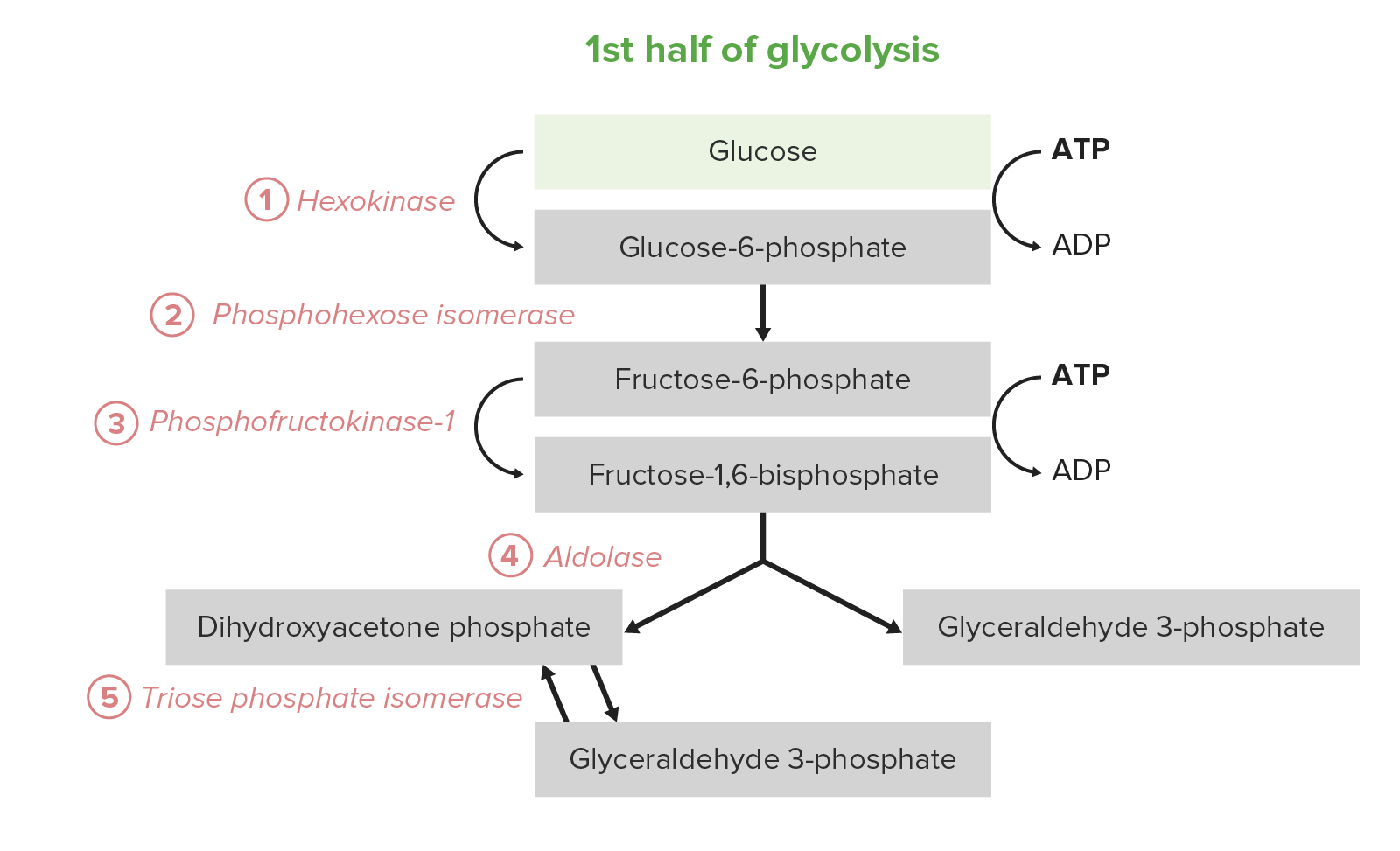
  1. Glucosa → glucosa 6-fosfato (G6P, por sus siglas en EN Erythema nodosum is an immune-mediated panniculitis (inflammation of the subcutaneous fat) caused by a type IV (delayed-type) hypersensitivity reaction. It commonly manifests in young women as tender, erythematous nodules on the shins. Erythema Nodosum inglés)
    • La hexoquinasa transfiere un grupo fosforilo del ATP al AL Amyloidosis 6to carbono de la glucosa para formar G6P.
      • Requiere magnesio (Mg2+) como cofactor
      • Requiere ATP
    • En EN Erythema nodosum is an immune-mediated panniculitis (inflammation of the subcutaneous fat) caused by a type IV (delayed-type) hypersensitivity reaction. It commonly manifests in young women as tender, erythematous nodules on the shins. Erythema Nodosum el hígado, este paso es catalizado por la glucoquinasa (una enzima con la misma función, pero con menor afinidad por la glucosa), lo que ayuda al AL Amyloidosis hígado a actuar como un “amortiguador” de la glucosa en EN Erythema nodosum is an immune-mediated panniculitis (inflammation of the subcutaneous fat) caused by a type IV (delayed-type) hypersensitivity reaction. It commonly manifests in young women as tender, erythematous nodules on the shins. Erythema Nodosum la sangre.
  2. G6P → fructosa-6-fosfato ( F6P F6P Glycolysis, por sus siglas en EN Erythema nodosum is an immune-mediated panniculitis (inflammation of the subcutaneous fat) caused by a type IV (delayed-type) hypersensitivity reaction. It commonly manifests in young women as tender, erythematous nodules on the shins. Erythema Nodosum inglés)
    • La fosfoglucosa isomerasa convierte G6P en EN Erythema nodosum is an immune-mediated panniculitis (inflammation of the subcutaneous fat) caused by a type IV (delayed-type) hypersensitivity reaction. It commonly manifests in young women as tender, erythematous nodules on the shins. Erythema Nodosum F6P F6P Glycolysis.
    • Isomeriza la aldosa glucosa a una cetosa fructosa
  3. F6P F6P Glycolysis → fructosa-1,6-bifosfato ( FBP FBP Glycolysis, por sus siglas en EN Erythema nodosum is an immune-mediated panniculitis (inflammation of the subcutaneous fat) caused by a type IV (delayed-type) hypersensitivity reaction. It commonly manifests in young women as tender, erythematous nodules on the shins. Erythema Nodosum inglés)
    • La fosfofructoquinasa (PFK, por sus siglas en EN Erythema nodosum is an immune-mediated panniculitis (inflammation of the subcutaneous fat) caused by a type IV (delayed-type) hypersensitivity reaction. It commonly manifests in young women as tender, erythematous nodules on the shins. Erythema Nodosum inglés) fosforila F6P F6P Glycolysis en EN Erythema nodosum is an immune-mediated panniculitis (inflammation of the subcutaneous fat) caused by a type IV (delayed-type) hypersensitivity reaction. It commonly manifests in young women as tender, erythematous nodules on the shins. Erythema Nodosum C1, produciendo FBP FBP Glycolysis.
    • Requiere Mg2+ como cofactor
    • Requiere ATP
    • Esta es una reacción determinante de la velocidad en EN Erythema nodosum is an immune-mediated panniculitis (inflammation of the subcutaneous fat) caused by a type IV (delayed-type) hypersensitivity reaction. It commonly manifests in young women as tender, erythematous nodules on the shins. Erythema Nodosum la glucólisis, por lo tanto, es un paso regulado
  4. FBP FBP Glycolysis → gliceraldehído 3-fosfato (GAP, por sus siglas en EN Erythema nodosum is an immune-mediated panniculitis (inflammation of the subcutaneous fat) caused by a type IV (delayed-type) hypersensitivity reaction. It commonly manifests in young women as tender, erythematous nodules on the shins. Erythema Nodosum inglés) + fosfato de dihidroxiacetona (DHAP, por sus siglas en EN Erythema nodosum is an immune-mediated panniculitis (inflammation of the subcutaneous fat) caused by a type IV (delayed-type) hypersensitivity reaction. It commonly manifests in young women as tender, erythematous nodules on the shins. Erythema Nodosum inglés)
    • La aldolasa escinde la FBP FBP Glycolysis de 6 carbonos en EN Erythema nodosum is an immune-mediated panniculitis (inflammation of the subcutaneous fat) caused by a type IV (delayed-type) hypersensitivity reaction. It commonly manifests in young women as tender, erythematous nodules on the shins. Erythema Nodosum 2 moléculas diferentes de 3 carbonos, GAP y DHAP.
    • La reacción es una escisión aldólica con un enolato intermediario estabilizado por resonancia.
  5. DHAP → GAP
    • La triosa-fosfato isomerasa interconvierte el DHAP y GAP para permitir que el DHAP continúe a través de la glucólisis.
Primera mitad de la glucólisis

Los primeros 5 pasos (primera mitad) de la vía de la glucólisis

Imagen por Lecturio.

Pasos 6–10: 2da Mitad de la Glucólisis

La 2da mitad de la glucólisis convierte la triosa GAP en EN Erythema nodosum is an immune-mediated panniculitis (inflammation of the subcutaneous fat) caused by a type IV (delayed-type) hypersensitivity reaction. It commonly manifests in young women as tender, erythematous nodules on the shins. Erythema Nodosum piruvato, con la generación concomitante de 4 ATP y 2 NADH por 2 GAP. Por lo tanto, la inversión en EN Erythema nodosum is an immune-mediated panniculitis (inflammation of the subcutaneous fat) caused by a type IV (delayed-type) hypersensitivity reaction. It commonly manifests in young women as tender, erythematous nodules on the shins. Erythema Nodosum energía de los LOS Neisseria pasos 1–5 se paga dos veces aquí. En EN Erythema nodosum is an immune-mediated panniculitis (inflammation of the subcutaneous fat) caused by a type IV (delayed-type) hypersensitivity reaction. It commonly manifests in young women as tender, erythematous nodules on the shins. Erythema Nodosum ciertos tipos y condiciones celulares, estos 5 pasos son la fuente predominante de ATP:

  1. GAP → 1,3-bisfosfoglicerato ( 1,3-BPG 1,3-BPG Glycolysis, por sus siglas en EN Erythema nodosum is an immune-mediated panniculitis (inflammation of the subcutaneous fat) caused by a type IV (delayed-type) hypersensitivity reaction. It commonly manifests in young women as tender, erythematous nodules on the shins. Erythema Nodosum inglés)
    • La gliceraldehído-3-fosfato deshidrogenasa cataliza la fosforilación y oxidación de GAP, produciendo 1,3-bifosfoglicerato ( 1,3-BPG 1,3-BPG Glycolysis).
    • El 1,3-BPG 1,3-BPG Glycolysis es el 1er intermediario de alta energía en EN Erythema nodosum is an immune-mediated panniculitis (inflammation of the subcutaneous fat) caused by a type IV (delayed-type) hypersensitivity reaction. It commonly manifests in young women as tender, erythematous nodules on the shins. Erythema Nodosum la glucólisis.
    • Produce 2 NADH a partir del NAD NAD+ A coenzyme composed of ribosylnicotinamide 5′-diphosphate coupled to adenosine 5′-phosphate by pyrophosphate linkage. It is found widely in nature and is involved in numerous enzymatic reactions in which it serves as an electron carrier by being alternately oxidized (NAD+) and reduced (NADH). Pentose Phosphate Pathway+ y un ion fosfato (Pi)
      • En EN Erythema nodosum is an immune-mediated panniculitis (inflammation of the subcutaneous fat) caused by a type IV (delayed-type) hypersensitivity reaction. It commonly manifests in young women as tender, erythematous nodules on the shins. Erythema Nodosum condiciones aeróbicas, la oxidación de NADH en EN Erythema nodosum is an immune-mediated panniculitis (inflammation of the subcutaneous fat) caused by a type IV (delayed-type) hypersensitivity reaction. It commonly manifests in young women as tender, erythematous nodules on the shins. Erythema Nodosum la cadena respiratoria regenera NAD NAD+ A coenzyme composed of ribosylnicotinamide 5′-diphosphate coupled to adenosine 5′-phosphate by pyrophosphate linkage. It is found widely in nature and is involved in numerous enzymatic reactions in which it serves as an electron carrier by being alternately oxidized (NAD+) and reduced (NADH). Pentose Phosphate Pathway+ y produce ATP adicional.
      • En EN Erythema nodosum is an immune-mediated panniculitis (inflammation of the subcutaneous fat) caused by a type IV (delayed-type) hypersensitivity reaction. It commonly manifests in young women as tender, erythematous nodules on the shins. Erythema Nodosum condiciones anaeróbicas, se requieren reacciones adicionales para regenerar NAD NAD+ A coenzyme composed of ribosylnicotinamide 5′-diphosphate coupled to adenosine 5′-phosphate by pyrophosphate linkage. It is found widely in nature and is involved in numerous enzymatic reactions in which it serves as an electron carrier by being alternately oxidized (NAD+) and reduced (NADH). Pentose Phosphate Pathway+.
  2. 1,3-BPG 1,3-BPG Glycolysis → 3-fosfoglicerato
    • La fosfoglicerato quinasa convierte el 1,3-BPG 1,3-BPG Glycolysis en EN Erythema nodosum is an immune-mediated panniculitis (inflammation of the subcutaneous fat) caused by a type IV (delayed-type) hypersensitivity reaction. It commonly manifests in young women as tender, erythematous nodules on the shins. Erythema Nodosum 3-fosfoglicerato (3PG, por sus siglas en EN Erythema nodosum is an immune-mediated panniculitis (inflammation of the subcutaneous fat) caused by a type IV (delayed-type) hypersensitivity reaction. It commonly manifests in young women as tender, erythematous nodules on the shins. Erythema Nodosum inglés).
    • Requiere de Mg2+ como cofactor
    • Produce ATP
    • Las reacciones de la gliceraldehído-3-fosfato deshidrogenasa y fosfoglicerato quinasa se acoplan para permitir que la reacción de la gliceraldehído-3-fosfato deshidrogenasa, energéticamente desfavorable, sea “empujada hacia adelante” por la reacción de la fosfoglicerato quinasa altamente favorable.
  3. 3PG → 2-fosfoglicerato
    • La fosfoglicerato mutasa convierte 3PG en EN Erythema nodosum is an immune-mediated panniculitis (inflammation of the subcutaneous fat) caused by a type IV (delayed-type) hypersensitivity reaction. It commonly manifests in young women as tender, erythematous nodules on the shins. Erythema Nodosum 2-fosfoglicerato (2PG, por sus siglas en EN Erythema nodosum is an immune-mediated panniculitis (inflammation of the subcutaneous fat) caused by a type IV (delayed-type) hypersensitivity reaction. It commonly manifests in young women as tender, erythematous nodules on the shins. Erythema Nodosum inglés) mediante la transferencia del grupo funcional fosfato de C3 a C2.
    • Genera un complejo enzimático de 2,3-bisfosfoglicerato (2,3-BPG)
  4. 2PG → fosfoenolpiruvato ( PEP PEP A monocarboxylic acid anion derived from selective deprotonation of the carboxy group of phosphoenolpyruvic acid. It is a metabolic intermediate in glycolysis; gluconeogenesis; and other pathways. Glycolysis, por sus siglas en EN Erythema nodosum is an immune-mediated panniculitis (inflammation of the subcutaneous fat) caused by a type IV (delayed-type) hypersensitivity reaction. It commonly manifests in young women as tender, erythematous nodules on the shins. Erythema Nodosum inglés)
    • La enolasa deshidrata 2PG a PEP PEP A monocarboxylic acid anion derived from selective deprotonation of the carboxy group of phosphoenolpyruvic acid. It is a metabolic intermediate in glycolysis; gluconeogenesis; and other pathways. Glycolysis.
    • PEP PEP A monocarboxylic acid anion derived from selective deprotonation of the carboxy group of phosphoenolpyruvic acid. It is a metabolic intermediate in glycolysis; gluconeogenesis; and other pathways. Glycolysis es el 2do intermediario de alta energía formado en EN Erythema nodosum is an immune-mediated panniculitis (inflammation of the subcutaneous fat) caused by a type IV (delayed-type) hypersensitivity reaction. It commonly manifests in young women as tender, erythematous nodules on the shins. Erythema Nodosum la glucólisis.
  5. PEP PEP A monocarboxylic acid anion derived from selective deprotonation of the carboxy group of phosphoenolpyruvic acid. It is a metabolic intermediate in glycolysis; gluconeogenesis; and other pathways. Glycolysis → piruvato
    • La piruvato quinasa convierte el PEP PEP A monocarboxylic acid anion derived from selective deprotonation of the carboxy group of phosphoenolpyruvic acid. It is a metabolic intermediate in glycolysis; gluconeogenesis; and other pathways. Glycolysis en EN Erythema nodosum is an immune-mediated panniculitis (inflammation of the subcutaneous fat) caused by a type IV (delayed-type) hypersensitivity reaction. It commonly manifests in young women as tender, erythematous nodules on the shins. Erythema Nodosum piruvato (Pyr), liberando una gran cantidad de energía, que se utiliza para impulsar la síntesis de ATP.
    • Produce ATP

Reacción neta: glucosa + 2 Pi + 2 ADP + 2 NAD NAD+ A coenzyme composed of ribosylnicotinamide 5′-diphosphate coupled to adenosine 5′-phosphate by pyrophosphate linkage. It is found widely in nature and is involved in numerous enzymatic reactions in which it serves as an electron carrier by being alternately oxidized (NAD+) and reduced (NADH). Pentose Phosphate Pathway+ → 2 piruvato + 2 ATP + 2 NADH + 2 H+ + 2 H2O
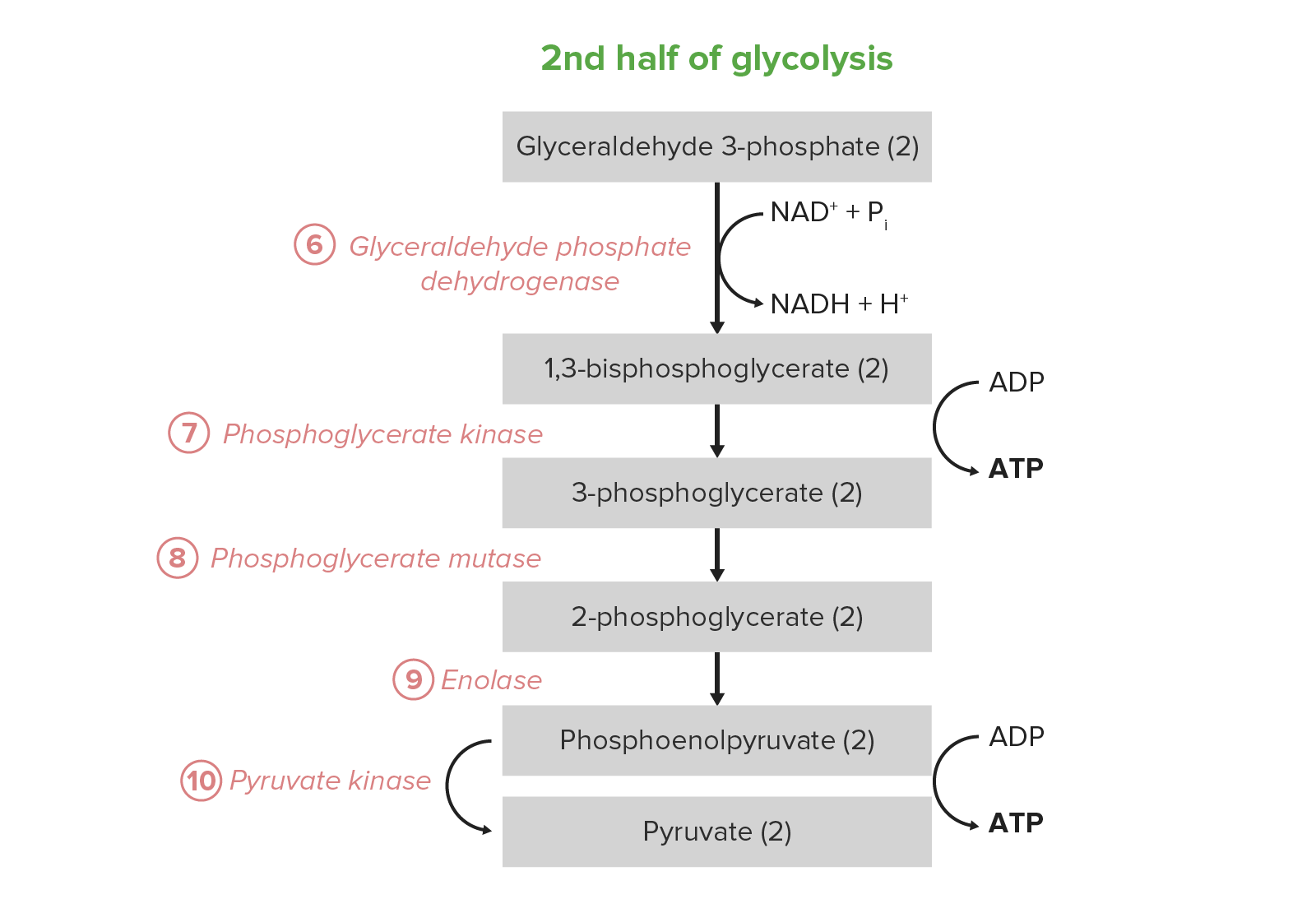
Segunda mitad de la glucólisis

Los últimos 5 pasos (última mitad) de la vía de la glucólisis.

Imagen por Lecturio.
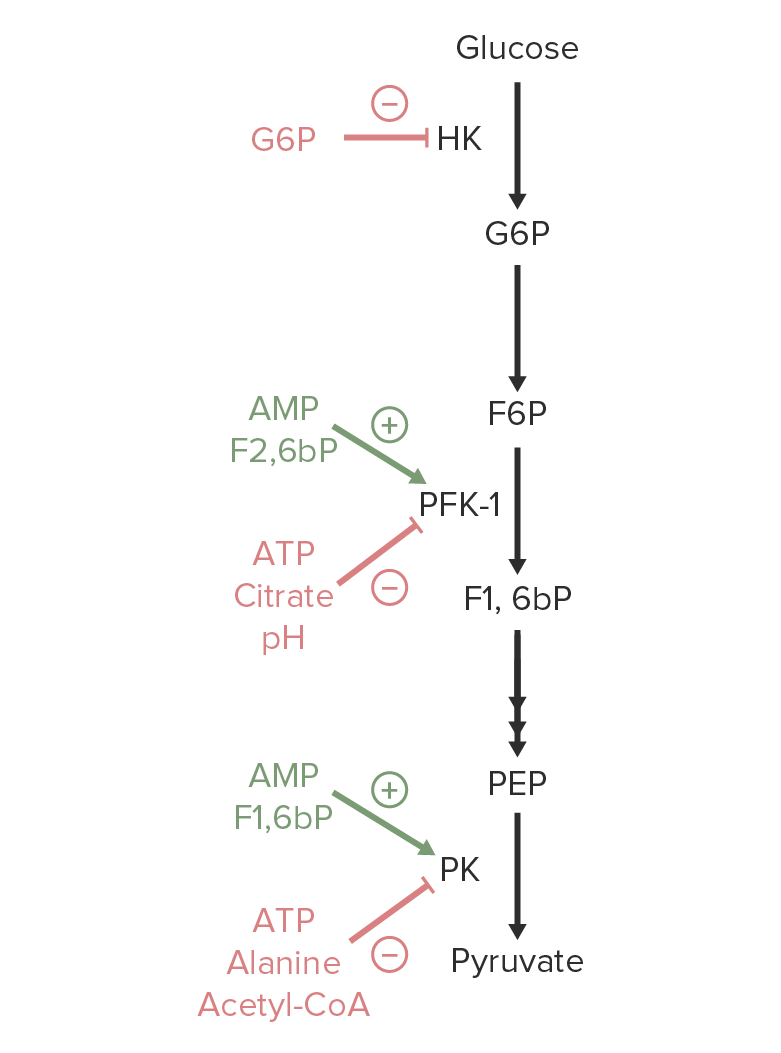
Regulación de la Glucólisis

  • La glucólisis opera de forma continua en EN Erythema nodosum is an immune-mediated panniculitis (inflammation of the subcutaneous fat) caused by a type IV (delayed-type) hypersensitivity reaction. It commonly manifests in young women as tender, erythematous nodules on the shins. Erythema Nodosum la mayoría de los LOS Neisseria tejidos, con un ritmo variable Variable Variables represent information about something that can change. The design of the measurement scales, or of the methods for obtaining information, will determine the data gathered and the characteristics of that data. As a result, a variable can be qualitative or quantitative, and may be further classified into subgroups. Types of Variables según las necesidades de la célula.
  • Los LOS Neisseria factores que inducen la glucólisis reprimen la gluconeogénesis (lo contrario de la glucólisis) y viceversa porque la gluconeogénesis se regula recíprocamente.
  • La insulina y el glucagón son las principales hormonas que controlan los LOS Neisseria flujos de la glucólisis y la gluconeogénesis.
  • La regulación óptima de la vía se logra controlando las reacciones con un gran cambio de energía libre negativa, de las cuales hay 3 en EN Erythema nodosum is an immune-mediated panniculitis (inflammation of the subcutaneous fat) caused by a type IV (delayed-type) hypersensitivity reaction. It commonly manifests in young women as tender, erythematous nodules on the shins. Erythema Nodosum la glucólisis.
Regulación de la glucólisis

Una visión general de la regulación de la glucólisis. Los activadores de hexoquinasa (HK, por sus siglas en inglés), fosfofructoquinasa-1 (PFK-1) o piruvato quinasa (PK, por sus siglas en inglés) están marcados en verde. Los metabolitos que inhiben estas enzimas están marcados en rojo.

Imagen por Lecturio.

Hexoquinasa (HK)

  • Regula el paso 1 de la vía
  • Regulada negativamente por el exceso de G6P
  • No es relevante cuando la glucosa se deriva del glucógeno, ya que la glucosa se libera del glucógeno como G6P

Fosfofructoquinasa

  • La PFK-1 es el punto de control de flujo primario para la glucólisis; regula el paso 3
  • FBPasa cataliza el paso inverso a PFK-1 en EN Erythema nodosum is an immune-mediated panniculitis (inflammation of the subcutaneous fat) caused by a type IV (delayed-type) hypersensitivity reaction. It commonly manifests in young women as tender, erythematous nodules on the shins. Erythema Nodosum la gluconeogénesis y las 2 enzimas se regulan recíprocamente.
    • Cuando se inhibe la PFK-1 y se activa la FBPasa, el flujo se desplaza de la glucólisis a la gluconeogénesis.
  • PFK-1 es inhibida alostéricamente por el ATP, un indicador de abundancia energética.
  • La PFK-1 es activada alostéricamente por el adenosin monofosfato (AMP, por sus siglas en EN Erythema nodosum is an immune-mediated panniculitis (inflammation of the subcutaneous fat) caused by a type IV (delayed-type) hypersensitivity reaction. It commonly manifests in young women as tender, erythematous nodules on the shins. Erythema Nodosum inglés) y el adenosin difosfato (ADP, por sus siglas en EN Erythema nodosum is an immune-mediated panniculitis (inflammation of the subcutaneous fat) caused by a type IV (delayed-type) hypersensitivity reaction. It commonly manifests in young women as tender, erythematous nodules on the shins. Erythema Nodosum inglés), indicadores de escasez energética.
  • El citrato inhibe alostéricamente a la PFK-1.
  • La PFK-1 es activada alostéricamente por la fructosa-2,6-bisfosfato (F2,6P, por sus siglas en EN Erythema nodosum is an immune-mediated panniculitis (inflammation of the subcutaneous fat) caused by a type IV (delayed-type) hypersensitivity reaction. It commonly manifests in young women as tender, erythematous nodules on the shins. Erythema Nodosum inglés).
    • F2,6P tiene el efecto opuesto en EN Erythema nodosum is an immune-mediated panniculitis (inflammation of the subcutaneous fat) caused by a type IV (delayed-type) hypersensitivity reaction. It commonly manifests in young women as tender, erythematous nodules on the shins. Erythema Nodosum el paso opuesto en EN Erythema nodosum is an immune-mediated panniculitis (inflammation of the subcutaneous fat) caused by a type IV (delayed-type) hypersensitivity reaction. It commonly manifests in young women as tender, erythematous nodules on the shins. Erythema Nodosum la gluconeogénesis.
    • F2,6P es sintetizada y degradada por una enzima bifuncional llamada PFK-2/FBPase-2, cuya actividad está controlada por muchas hormonas y efectores alostéricos.
    • F6P F6P Glycolysis promueve la síntesis de F2,6P, activando la glucólisis.
    • En EN Erythema nodosum is an immune-mediated panniculitis (inflammation of the subcutaneous fat) caused by a type IV (delayed-type) hypersensitivity reaction. It commonly manifests in young women as tender, erythematous nodules on the shins. Erythema Nodosum estado absortivo: la insulina estimula la desfosforilación de PFK-2/FBPase-2 → aumento de los LOS Neisseria niveles de F2,6P → aumento del flujo glucolítico
  • Las catecolaminas (a través del AMP cíclico) inhiben las enzimas glucolíticas HK, PFK-1, PFK-2 (que produce fructosa 2,6 bisfosfato) y PK.
    • Inducción de la síntesis de piruvato carboxilasa, PEP PEP A monocarboxylic acid anion derived from selective deprotonation of the carboxy group of phosphoenolpyruvic acid. It is a metabolic intermediate in glycolysis; gluconeogenesis; and other pathways. Glycolysis carboxiquinasa, FBPasa y G6Pasa

Piruvato quinasa (PK)

  • Regula el paso 10 (último) de la vía
  • Activada alostéricamente por la FBP FBP Glycolysis, lo que indica la acumulación de intermediarios glucolíticos regulados al AL Amyloidosis alza: da como resultado un “tirón” a través de la vía glucolítica
  • Inhibida alostéricamente por ATP, lo que indica abundante suministro energético
  • En EN Erythema nodosum is an immune-mediated panniculitis (inflammation of the subcutaneous fat) caused by a type IV (delayed-type) hypersensitivity reaction. It commonly manifests in young women as tender, erythematous nodules on the shins. Erythema Nodosum el hígado, es inhibida alostéricamente por la alanina, un precursor de la gluconeogénesis

Relevancia Clínica

  • Galactosemia Galactosemia Galactosemia is a disorder caused by defects in galactose metabolism. Galactosemia is an inherited, autosomal-recessive condition, which results in inadequate galactose processing and high blood levels of monosaccharide. The rare disorder often presents in infants with symptoms of lethargy, nausea, vomiting, diarrhea, and jaundice. Galactosemia: metabolismo defectuoso del azúcar galactosa. Las manifestaciones clínicas comienzan cuando se inicia la alimentación con leche. Los LOS Neisseria lactantes desarrollan letargo, ictericia, disfunción hepática progresiva, enfermedad renal, cataratas, pérdida de peso y susceptibilidad a infecciones bacterianas (especialmente E coli). Se puede desarrollar una discapacidad intelectual si el trastorno no se trata. El pilar del tratamiento es la exclusión de la galactosa de la dieta.
  • Intolerancia hereditaria a la fructosa: deficiencia de fructosa-1-fosfato aldolasa. Los LOS Neisseria síntomas inician después de la ingestión de fructosa (azúcar de la fruta) o sacarosa, por lo que se presentan más adelante en EN Erythema nodosum is an immune-mediated panniculitis (inflammation of the subcutaneous fat) caused by a type IV (delayed-type) hypersensitivity reaction. It commonly manifests in young women as tender, erythematous nodules on the shins. Erythema Nodosum la vida. Se presenta con falta de aumento de peso, vómitos, hipoglucemia, disfunción hepática y defectos renales. A los LOS Neisseria niños con este trastorno les va VA Ventilation: Mechanics of Breathing muy bien si evitan la fructosa y la sacarosa en EN Erythema nodosum is an immune-mediated panniculitis (inflammation of the subcutaneous fat) caused by a type IV (delayed-type) hypersensitivity reaction. It commonly manifests in young women as tender, erythematous nodules on the shins. Erythema Nodosum la dieta.
  • Deficiencia de fructosa 1,6-difosfatasa: asociada con alteración de la gluconeogénesis. Los LOS Neisseria síntomas incluyen hipoglucemia, intolerancia al AL Amyloidosis ayuno y hepatomegalia. Los LOS Neisseria pilares del tratamiento son el tratamiento emergente de los LOS Neisseria episodios de hipoglucemia con líquidos intravenosos ricos en EN Erythema nodosum is an immune-mediated panniculitis (inflammation of the subcutaneous fat) caused by a type IV (delayed-type) hypersensitivity reaction. It commonly manifests in young women as tender, erythematous nodules on the shins. Erythema Nodosum glucosa y evitar el ayuno. Los LOS Neisseria casos graves pueden requerir suplementos de glucosa para evitar la hipoglucemia.
  • Enfermedades por almacenamiento de glucógeno: deficiencia de enzimas responsables de la degradación del glucógeno. Dependiendo de qué enzima se vea afectada, estas condiciones pueden afectar el hígado, los LOS Neisseria músculos o ambos. Existen varias enfermedades de almacenamiento de glucógeno clínicamente significativas con diferentes presentaciones.
  • Deficiencia de glucosa 6-fosfato deshidrogenasa: un trastorno genético que ocurre casi exclusivamente en EN Erythema nodosum is an immune-mediated panniculitis (inflammation of the subcutaneous fat) caused by a type IV (delayed-type) hypersensitivity reaction. It commonly manifests in young women as tender, erythematous nodules on the shins. Erythema Nodosum hombres y afecta principalmente a los LOS Neisseria eritrocitos causando hemólisis y anemia Anemia Anemia is a condition in which individuals have low Hb levels, which can arise from various causes. Anemia is accompanied by a reduced number of RBCs and may manifest with fatigue, shortness of breath, pallor, and weakness. Subtypes are classified by the size of RBCs, chronicity, and etiology. Anemia: Overview and Types hemolítica. Los LOS Neisseria síntomas incluyen disnea, fatiga, taquicardia, orina oscura, palidez e ictericia. La anemia Anemia Anemia is a condition in which individuals have low Hb levels, which can arise from various causes. Anemia is accompanied by a reduced number of RBCs and may manifest with fatigue, shortness of breath, pallor, and weakness. Subtypes are classified by the size of RBCs, chronicity, and etiology. Anemia: Overview and Types hemolítica puede desencadenarse por infecciones, ciertos medicamentos (antibióticos, antipalúdicos) y después de comer frijoles.

Las siguientes son enzimas de la vía de la glucólisis que pueden estar involucradas en EN Erythema nodosum is an immune-mediated panniculitis (inflammation of the subcutaneous fat) caused by a type IV (delayed-type) hypersensitivity reaction. It commonly manifests in young women as tender, erythematous nodules on the shins. Erythema Nodosum los LOS Neisseria defectos enzimáticos congénitos:

  • Deficiencia de piruvato quinasa (más común)
  • Hexoquinasa de eritrocitos
  • Glucosa fosfato isomerasa
  • Fosfofructoquinasa

Estos defectos enzimáticos congénitos producen anemia Anemia Anemia is a condition in which individuals have low Hb levels, which can arise from various causes. Anemia is accompanied by a reduced number of RBCs and may manifest with fatigue, shortness of breath, pallor, and weakness. Subtypes are classified by the size of RBCs, chronicity, and etiology. Anemia: Overview and Types hemolítica.

Anemia Anemia Anemia is a condition in which individuals have low Hb levels, which can arise from various causes. Anemia is accompanied by a reduced number of RBCs and may manifest with fatigue, shortness of breath, pallor, and weakness. Subtypes are classified by the size of RBCs, chronicity, and etiology. Anemia: Overview and Types hemolítica: un grupo de anemias que se deben a la destrucción o eliminación prematura de los LOS Neisseria eritrocitos. Las anomalías intrínsecas de los LOS Neisseria eritrocitos conducen a la depuración esplénica (hemólisis extravascular). La destrucción crónica de los LOS Neisseria eritrocitos puede presentarse como ictericia, esplenomegalia, colelitiasis, hematuria Hematuria Presence of blood in the urine. Renal Cell Carcinoma y síntomas de anemia Anemia Anemia is a condition in which individuals have low Hb levels, which can arise from various causes. Anemia is accompanied by a reduced number of RBCs and may manifest with fatigue, shortness of breath, pallor, and weakness. Subtypes are classified by the size of RBCs, chronicity, and etiology. Anemia: Overview and Types (dificultad para respirar, fatiga, síncope y taquicardia).

Referencias

  1. Chen, M., Li, Y., Liang, J., Fu, M., Jin, H., Deng, H., Lei, L., Zeng, H., Fu, Q., Wu, L., Lin, S., Li, L., Tan, Z., Yang, X., & Wei, Y. (2024). Glycolysis modulation: New therapeutic strategies to improve pulmonary hypertension (Review). International Journal of Molecular Medicine, 54(6), 1–17. https://doi.org/10.3892/ijmm.2024.5439
  2. Kierans, S. J., & Taylor, C. T. (2024). Glycolysis: A multifaceted metabolic pathway and signaling hub. Journal of Biological Chemistry, 300(11), Article 107906. https://doi.org/10.1016/j.jbc.2024.107906
  3. Liu, Y., Guo, J., Chen, Y., Fan, F., Wu, X., & Liu, L. (2025). The impact of glycolysis on ischemic stroke: From molecular mechanisms to clinical applications. Frontiers in Neurology, 16, Article 1514394. https://doi.org/10.3389/fneur.2025.1514394
  4. Nelson, D. L., & Cox, M. M. (2021). Lehninger principles of biochemistry (8th ed.). W. H. Freeman and Company.
  5. Rojas-Pirela, M., Rodríguez-Durán, J., Ferreira, M. R., Verdi, C. M., Cáceres, A. J., Quiñones, W., & Concepción, J. L. (2025). Exploring glycolytic enzymes in disease: Potential biomarkers and therapeutic targets in neurodegeneration, cancer and parasitic infections. Open Biology, 15(2), Article 240239. https://doi.org/10.1098/rsob.240239
  6. Wang, H., Zhai, X., Chen, Y., Wang, Y., Shao, J., Zhou, L., & Li, X. (2024). Target modulation of glycolytic pathways as a new strategy for the treatment of neuroinflammatory diseases. Ageing Research Reviews, 101, Article 102472. https://doi.org/10.1016/j.arr.2024.102472

¡Crea tu cuenta gratis o inicia una sesión para seguir leyendo!

Regístrate ahora y obtén acceso gratuito a Lecturio con páginas de concepto, videos médicos y cuestionarios para tu educación médica.

User Reviews

Que tengas una sesión de estudio alegre y navideña 🎁 Ahorra 50% en todos los planes >>

Details