Domina Conceptos Médicos

Estudia para la escuela de medicina y tus examenes con Lecturio.

Gastrulación y Neurulación

Tanto la gastrulación como la neurulación son eventos críticos que ocurren durante la 3ra semana de desarrollo embrionario. La gastrulación es el proceso por el cual el disco bilaminar se diferencia en EN Erythema nodosum is an immune-mediated panniculitis (inflammation of the subcutaneous fat) caused by a type IV (delayed-type) hypersensitivity reaction. It commonly manifests in young women as tender, erythematous nodules on the shins. Erythema Nodosum un disco trilaminar, formado por las 3 capas germinales primarias: el ectodermo, mesodermo y endodermo. Durante este proceso, se forma una estructura llamada notocorda en EN Erythema nodosum is an immune-mediated panniculitis (inflammation of the subcutaneous fat) caused by a type IV (delayed-type) hypersensitivity reaction. It commonly manifests in young women as tender, erythematous nodules on the shins. Erythema Nodosum la línea media de la capa mesodérmica; la notocorda es fundamental para inducir la neurulación. La neurulación es el proceso por el cual parte del ectodermo en EN Erythema nodosum is an immune-mediated panniculitis (inflammation of the subcutaneous fat) caused by a type IV (delayed-type) hypersensitivity reaction. It commonly manifests in young women as tender, erythematous nodules on the shins. Erythema Nodosum el embrión trilaminar se convierte en EN Erythema nodosum is an immune-mediated panniculitis (inflammation of the subcutaneous fat) caused by a type IV (delayed-type) hypersensitivity reaction. It commonly manifests in young women as tender, erythematous nodules on the shins. Erythema Nodosum el tubo neural y las células de la cresta neural, que pasarán a formar todo el tejido neural del cuerpo. Este proceso se completa al AL Amyloidosis final de la 3ra semana.

Last updated: Dec 15, 2025

Editorial responsibility: Stanley Oiseth, Lindsay Jones, Evelin Maza

Revisión del Desarrollo Temprano

Mórula, blastocisto y disco bilaminar

  • Cigoto: célula diploide resultante de la fusión de 2 gametos haploides
  • Blastómeros: células individuales en EN Erythema nodosum is an immune-mediated panniculitis (inflammation of the subcutaneous fat) caused by a type IV (delayed-type) hypersensitivity reaction. It commonly manifests in young women as tender, erythematous nodules on the shins. Erythema Nodosum las etapas de 2, 4 y 8 células
  • Mórula: “bola de células” a partir de la etapa de 16 células
  • Blastocisto:
    • La mórula desarrolla una cavidad llamada blastocele.
    • Las “señales posicionales” (i.e., señales liberadas de diferentes células según su posición en EN Erythema nodosum is an immune-mediated panniculitis (inflammation of the subcutaneous fat) caused by a type IV (delayed-type) hypersensitivity reaction. It commonly manifests in young women as tender, erythematous nodules on the shins. Erythema Nodosum el blastocisto) desencadenan que las células se diferencien en EN Erythema nodosum is an immune-mediated panniculitis (inflammation of the subcutaneous fat) caused by a type IV (delayed-type) hypersensitivity reaction. It commonly manifests in young women as tender, erythematous nodules on the shins. Erythema Nodosum:
      • Masa celular externa: capa externa de células
      • Masa celular interna: un grupo de células dentro del caparazón junto al AL Amyloidosis blastocele
  • Zona pelúcida:
    • Capa de matriz extracelular que rodea al AL Amyloidosis embrión durante la etapa de blastocisto
    • Evita que el embrión se implante en EN Erythema nodosum is an immune-mediated panniculitis (inflammation of the subcutaneous fat) caused by a type IV (delayed-type) hypersensitivity reaction. It commonly manifests in young women as tender, erythematous nodules on the shins. Erythema Nodosum las trompas de Falopio (donde generalmente ocurre la fecundación)
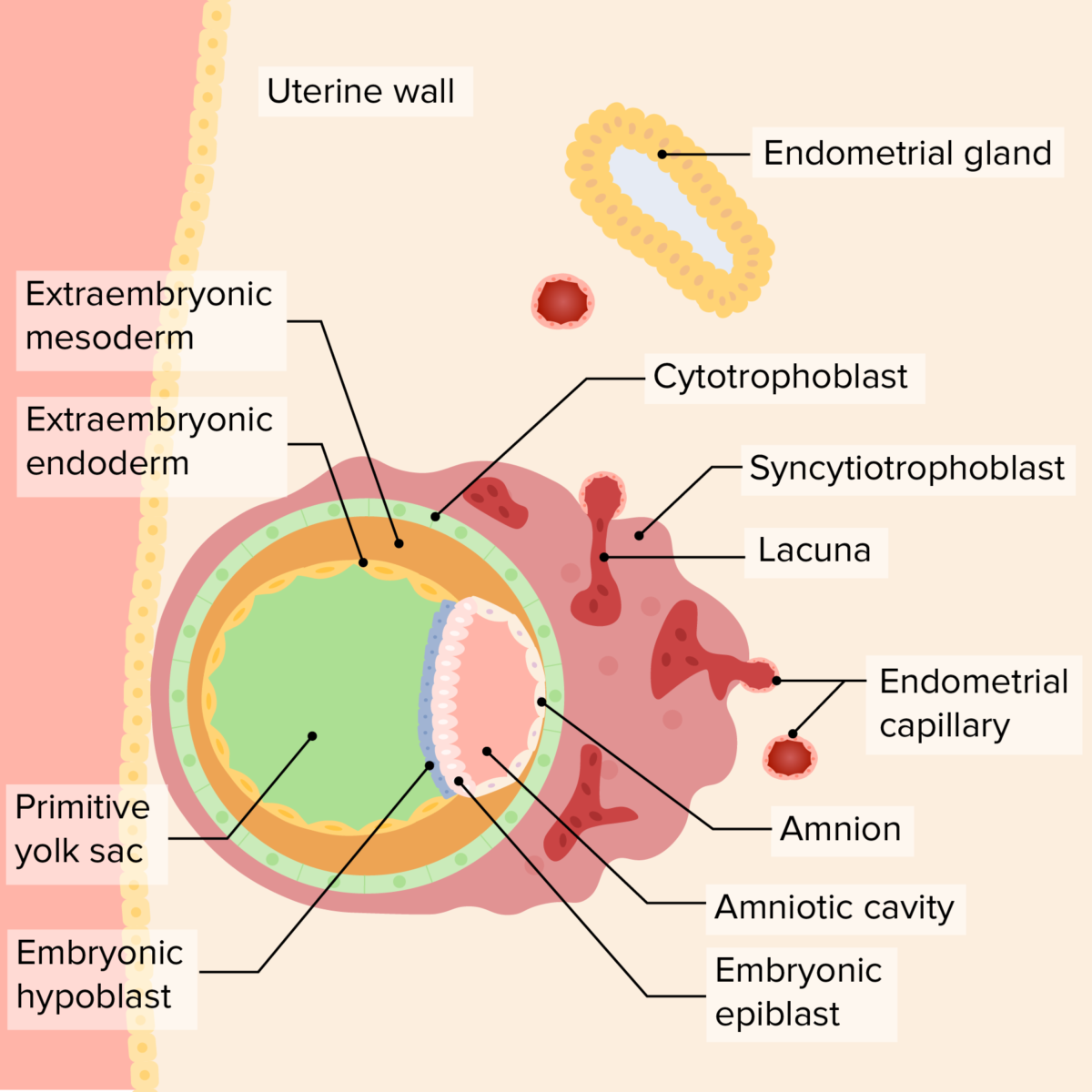
  • Masa de células externas → trofoblasto (citotrofoblasto y sincitiotrofoblasto) → placenta Placenta A highly vascularized mammalian fetal-maternal organ and major site of transport of oxygen, nutrients, and fetal waste products. It includes a fetal portion (chorionic villi) derived from trophoblasts and a maternal portion (decidua) derived from the uterine endometrium. The placenta produces an array of steroid, protein and peptide hormones (placental hormones). Placenta, Umbilical Cord, and Amniotic Cavity y membranas
  • Masa celular interna → embrioblasto → disco bilaminar:
    • Epiblasto: capa dorsal
    • Hipoblasto: capa ventral
  • Saco amniótico: cavidad de líquido que se desarrolla “por encima” del epiblasto (entre el epiblasto y el citotrofoblasto)
  • Saco vitelino primario: cavidad que se forma “debajo” del hipoblasto (entre el hipoblasto y el citotrofoblasto)

Implantación

  • Ocurre alrededor de los LOS Neisseria días 7–9 después de la fecundación
  • Citotrofoblasto: capa externa de células de blastocisto
  • Sincitiotrofoblasto:
    • Células de trofoblasto en EN Erythema nodosum is an immune-mediated panniculitis (inflammation of the subcutaneous fat) caused by a type IV (delayed-type) hypersensitivity reaction. It commonly manifests in young women as tender, erythematous nodules on the shins. Erythema Nodosum contacto con la pared uterina que han perdido sus membranas externas → simplemente “núcleos” flotando en EN Erythema nodosum is an immune-mediated panniculitis (inflammation of the subcutaneous fat) caused by a type IV (delayed-type) hypersensitivity reaction. It commonly manifests in young women as tender, erythematous nodules on the shins. Erythema Nodosum el citoplasma
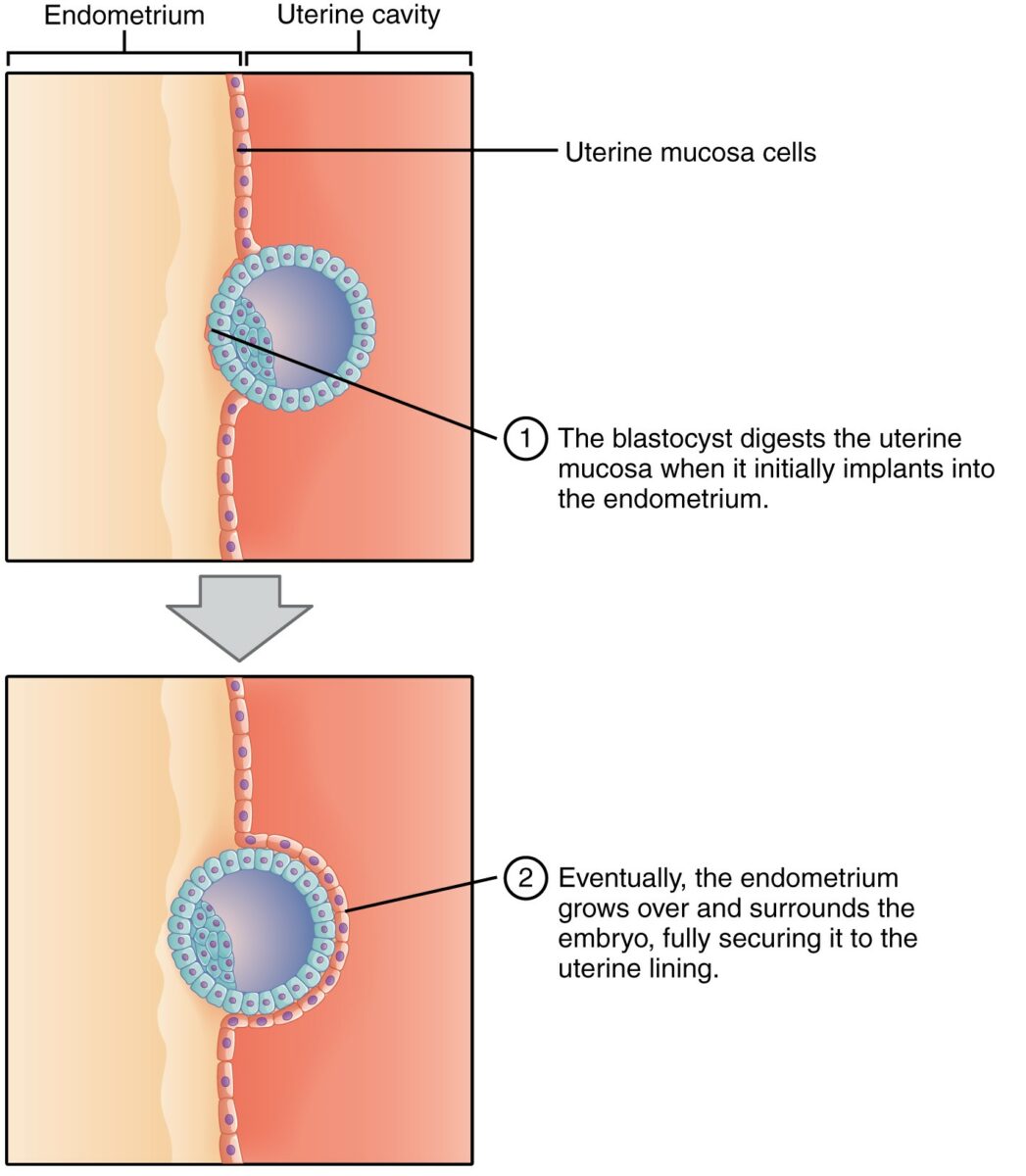
    • A medida que las membranas celulares se rompen, se liberan enzimas hidrolíticas, lo que permite que el embrión “ coma Coma Coma is defined as a deep state of unarousable unresponsiveness, characterized by a score of 3 points on the GCS. A comatose state can be caused by a multitude of conditions, making the precise epidemiology and prognosis of coma difficult to determine. Coma su camino” hacia la pared uterina.
  • Una capa de endometrio (decidua funcional) cubre el blastocisto invasor = implantación

Gastrulación

Descripción general de la gastrulación

  • Gastrulación es el proceso por el cual el disco bilaminar se convierte en EN Erythema nodosum is an immune-mediated panniculitis (inflammation of the subcutaneous fat) caused by a type IV (delayed-type) hypersensitivity reaction. It commonly manifests in young women as tender, erythematous nodules on the shins. Erythema Nodosum disco trilaminar.
  • Establece las 3 capas germinales primarias:
    • Ectodermo (dorsal)
    • Mesodermo (medio)
    • Endodermo (ventral)
  • Ocurre durante la 3ra semana (truco de memoria: 3ra semana = 3 capas)
  • El proceso comienza con la formación de la linea primitiva en EN Erythema nodosum is an immune-mediated panniculitis (inflammation of the subcutaneous fat) caused by a type IV (delayed-type) hypersensitivity reaction. It commonly manifests in young women as tender, erythematous nodules on the shins. Erythema Nodosum la superficie del epiblasto.
Proceso de gastrulación

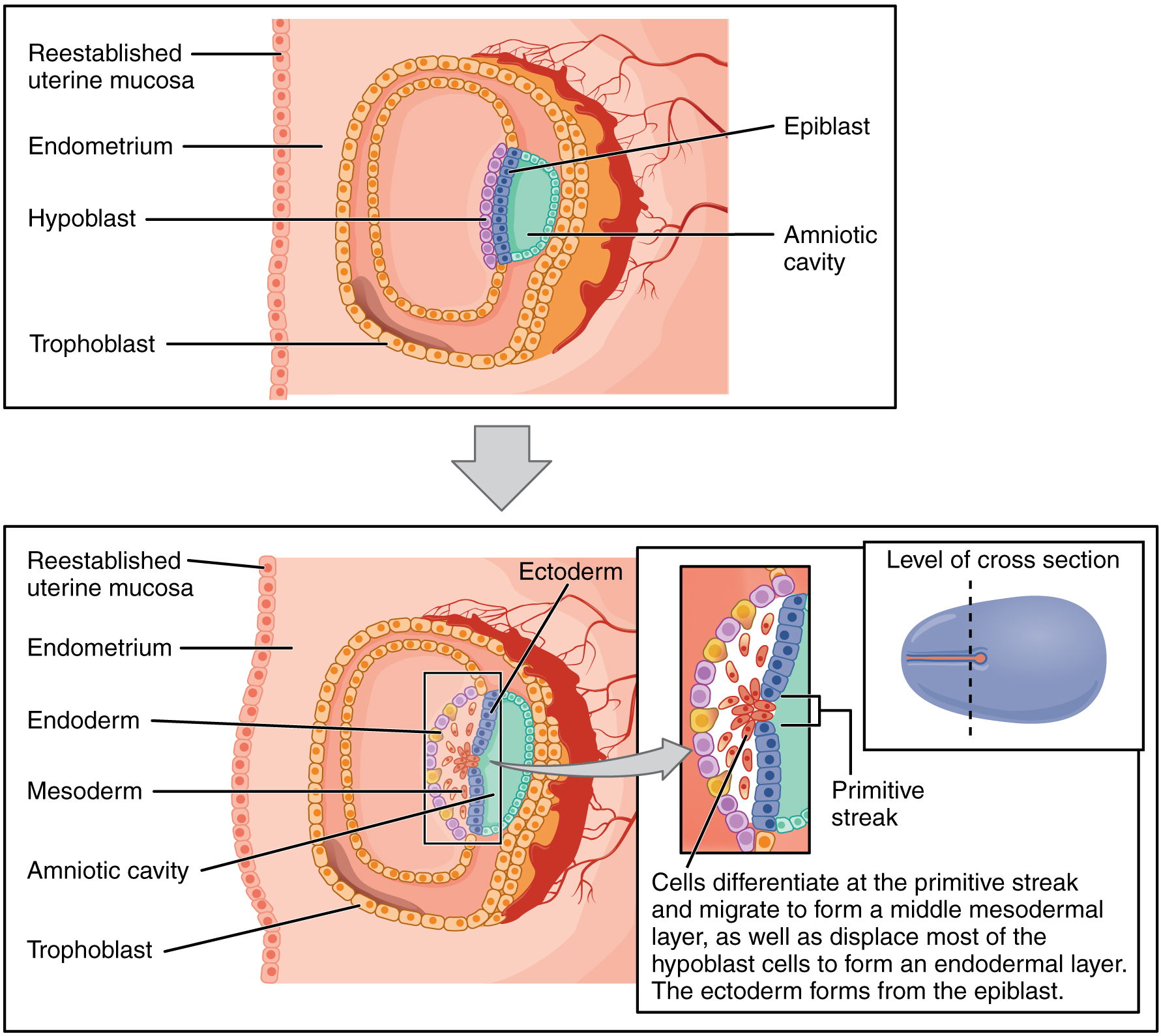
Proceso de gastrulación:
Las células del epiblasto migran hacia abajo a través de la línea primitiva y desplazan a la mayoría de las células hipoblásticas, convirtiéndose en el endodermo. Las células que quedan en el medio se convierten en mesodermo. Las células que permanecen en la capa del epiblasto se convierten en ectodermo.
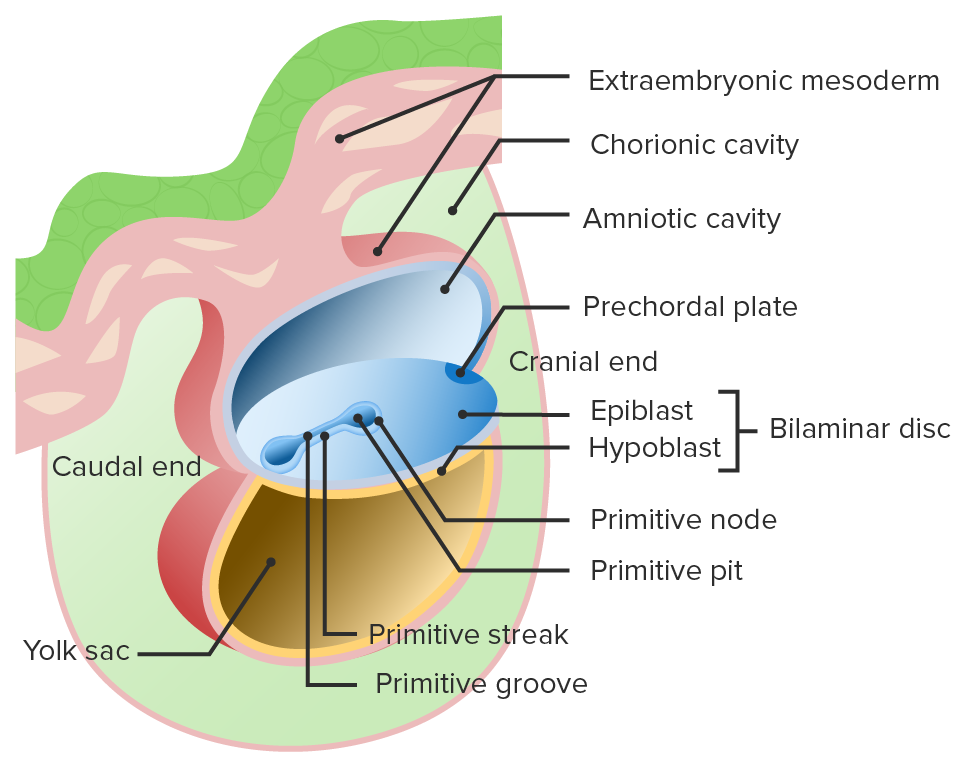
Imagen: “Germ Layers” por Phil Schatz. Licencia: CC BY 4.0

La línea primitiva y el surco primitivo

  • Línea primitiva: un área en EN Erythema nodosum is an immune-mediated panniculitis (inflammation of the subcutaneous fat) caused by a type IV (delayed-type) hypersensitivity reaction. It commonly manifests in young women as tender, erythematous nodules on the shins. Erythema Nodosum la línea media de la capa del epiblasto comienza a engrosarse:
    • Se forma alrededor del día 16 de desarrollo
    • Comienza en EN Erythema nodosum is an immune-mediated panniculitis (inflammation of the subcutaneous fat) caused by a type IV (delayed-type) hypersensitivity reaction. It commonly manifests in young women as tender, erythematous nodules on the shins. Erythema Nodosum el extremo caudal → se extiende hasta < de la mitad del embrión hacia el extremo craneal
    • Establece el eje principal del cuerpo:
      • Extremos craneales y caudales
      • Izquierda y derecha
    • Nódulo primitivo: área más prominente en EN Erythema nodosum is an immune-mediated panniculitis (inflammation of the subcutaneous fat) caused by a type IV (delayed-type) hypersensitivity reaction. It commonly manifests in young women as tender, erythematous nodules on the shins. Erythema Nodosum el extremo craneal de la línea primitiva
  • Surco primitivo: aparece como una pequeña depresión en EN Erythema nodosum is an immune-mediated panniculitis (inflammation of the subcutaneous fat) caused by a type IV (delayed-type) hypersensitivity reaction. It commonly manifests in young women as tender, erythematous nodules on the shins. Erythema Nodosum la línea primitiva
  • Fosa primitiva: depresión dentro del nódulo primitivo que se convertirá en EN Erythema nodosum is an immune-mediated panniculitis (inflammation of the subcutaneous fat) caused by a type IV (delayed-type) hypersensitivity reaction. It commonly manifests in young women as tender, erythematous nodules on the shins. Erythema Nodosum notocorda
  • Factor de crecimiento de fibroblastos 8:
    • Secretado por células en EN Erythema nodosum is an immune-mediated panniculitis (inflammation of the subcutaneous fat) caused by a type IV (delayed-type) hypersensitivity reaction. It commonly manifests in young women as tender, erythematous nodules on the shins. Erythema Nodosum la línea/surco primitivo
    • Inhibe la producción de moléculas de adhesión que mantienen unidas las células del epiblasto
    • Sin proteínas de adhesión → las células del epiblasto pueden migrar
  • Placa precordal: un área compacta en EN Erythema nodosum is an immune-mediated panniculitis (inflammation of the subcutaneous fat) caused by a type IV (delayed-type) hypersensitivity reaction. It commonly manifests in young women as tender, erythematous nodules on the shins. Erythema Nodosum el extremo craneal del embrión
Inicio de gastrulación

Inicio de la gastrulación:
La línea primitiva y el surco primitivo se forman en el disco bilaminar.

Imagen por Lecturio.

Migración del epiblasto

  • Las células del epiblasto migran hacia la línea primitiva → por el surco primitivo
  • Estas células se alargan hacia abajo, creando espacio entre el epiblasto y el hipoblasto
  • Estas células se desprenden del epiblasto y se deslizan debajo de él (invaginación)
  • Las células del epiblasto desprendidas reemplazan a las células hipoblásticas → se convierten en EN Erythema nodosum is an immune-mediated panniculitis (inflammation of the subcutaneous fat) caused by a type IV (delayed-type) hypersensitivity reaction. It commonly manifests in young women as tender, erythematous nodules on the shins. Erythema Nodosum el endodermo
  • Las células del epiblasto continúan migrando → se desprenden → invaginan → llenan el espacio entre el epiblasto y el endodermo → se convierten en EN Erythema nodosum is an immune-mediated panniculitis (inflammation of the subcutaneous fat) caused by a type IV (delayed-type) hypersensitivity reaction. It commonly manifests in young women as tender, erythematous nodules on the shins. Erythema Nodosum el mesodermo
  • Las células que permanecen en EN Erythema nodosum is an immune-mediated panniculitis (inflammation of the subcutaneous fat) caused by a type IV (delayed-type) hypersensitivity reaction. It commonly manifests in young women as tender, erythematous nodules on the shins. Erythema Nodosum la capa del epiblasto → se convierten en EN Erythema nodosum is an immune-mediated panniculitis (inflammation of the subcutaneous fat) caused by a type IV (delayed-type) hypersensitivity reaction. It commonly manifests in young women as tender, erythematous nodules on the shins. Erythema Nodosum ectodermo
  • La migración se completa a principios de la 4ta semana
Migración de células epiblasto.

Migración de las células del epiblasto a través del surco primitivo:
Estas células del epiblasto desplazan al hipoblasto para convertirse en el endodermo y crear una capa intermedia conocida como mesodermo. Las células del epiblasto que permanecen en la superficie dorsal se diferencian en ectodermo.
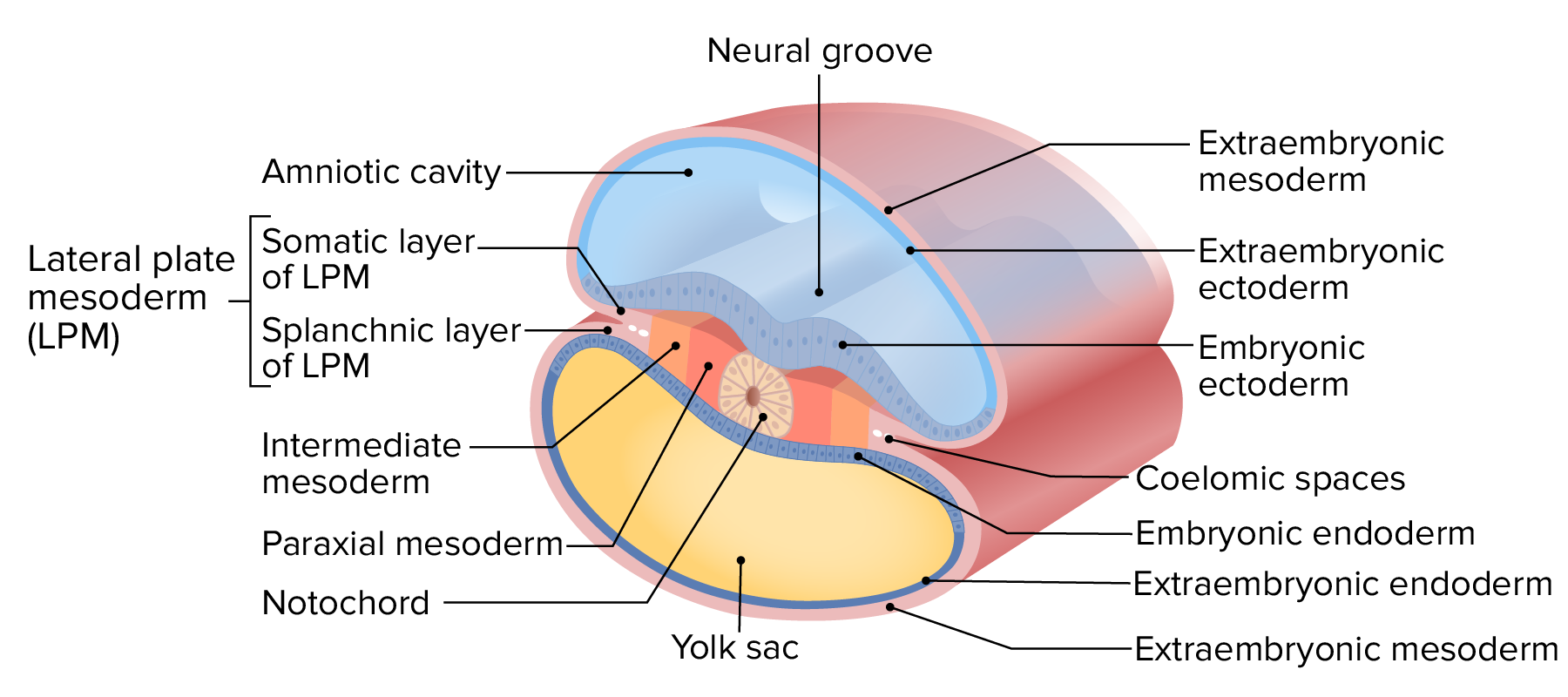
Imagen por Lecturio.

El disco trilaminar

  • Ectodermo: células que quedan en EN Erythema nodosum is an immune-mediated panniculitis (inflammation of the subcutaneous fat) caused by a type IV (delayed-type) hypersensitivity reaction. It commonly manifests in young women as tender, erythematous nodules on the shins. Erythema Nodosum la capa del epiblasto (continua con el amnios)
  • Mesodermo: células que invaginan debajo del epiblasto (capa intermedia)
    • Mesodermo paraxial
    • Mesodermo intermedio
    • Mesodermo de la placa lateral:
      • Capa somática
      • Capa esplácnica
    • Mesodermo extraembrionario:
      • Rodea la cavidad amniótica → continuo con la capa somática del mesodermo de la placa lateral
      • Rodea el saco vitelino → continuo con la capa esplácnica del mesodermo de la placa lateral
  • Endodermo: células que invaginaron debajo del epiblasto y reemplazaron al AL Amyloidosis hipoblasto:
    • El endodermo embrionario (generalmente llamado simplemente endodermo) → se convierte en EN Erythema nodosum is an immune-mediated panniculitis (inflammation of the subcutaneous fat) caused by a type IV (delayed-type) hypersensitivity reaction. It commonly manifests in young women as tender, erythematous nodules on the shins. Erythema Nodosum el tubo intestinal primitivo
    • Endodermo extraembrionario → bordea el saco vitelino secundario
  • Saco vitelino secundario: cavidad entre el endodermo embrionario y extraembrionario
Capas del disco trilaminar

Capas del disco trilaminar

Imagen por Lecturio.
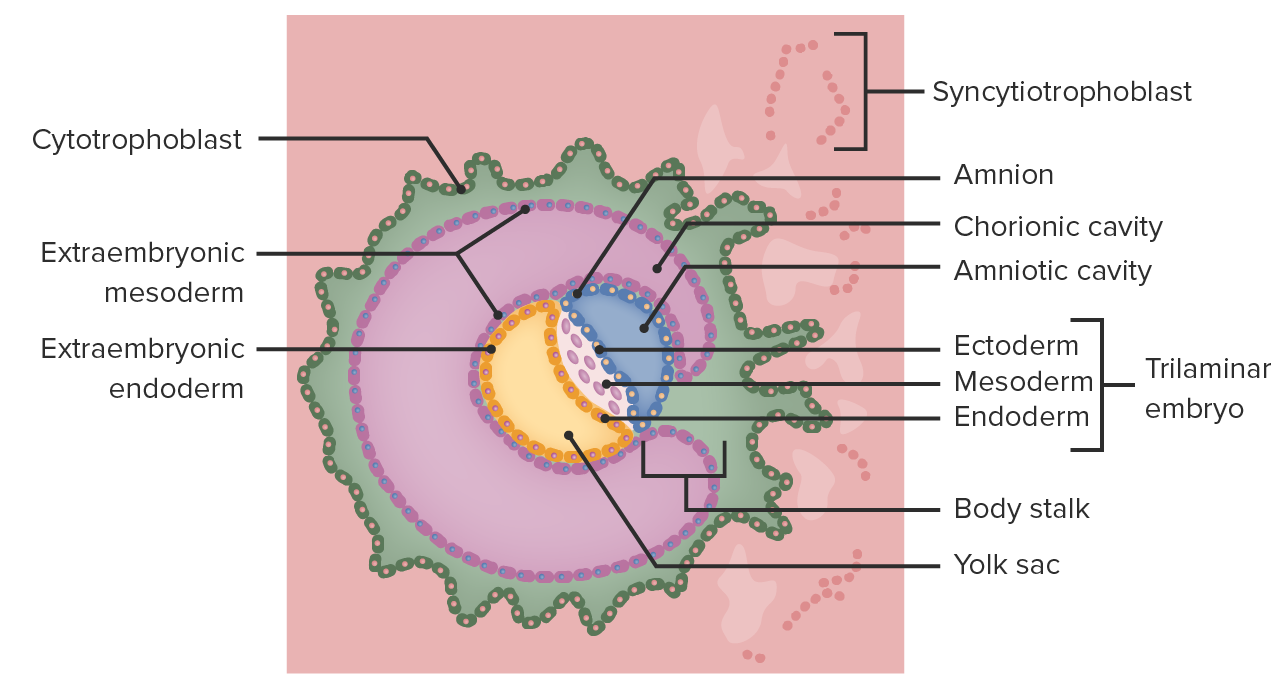
Formación de la cavidad coriónica

  • Cavidad coriónica:
    • Se desarrolla dentro del mesodermo extraembrionario
    • Rodea el saco vitelino de 1er grado, el embrioblasto y la cavidad amniótica
  • Tallo corporal: ancla el embrión a la pared uterina → se convierte en EN Erythema nodosum is an immune-mediated panniculitis (inflammation of the subcutaneous fat) caused by a type IV (delayed-type) hypersensitivity reaction. It commonly manifests in young women as tender, erythematous nodules on the shins. Erythema Nodosum cordón umbilical
Cavidad coriónica

Formación de la cavidad coriónica

Imagen por Lecturio.
Formación de la notocorda

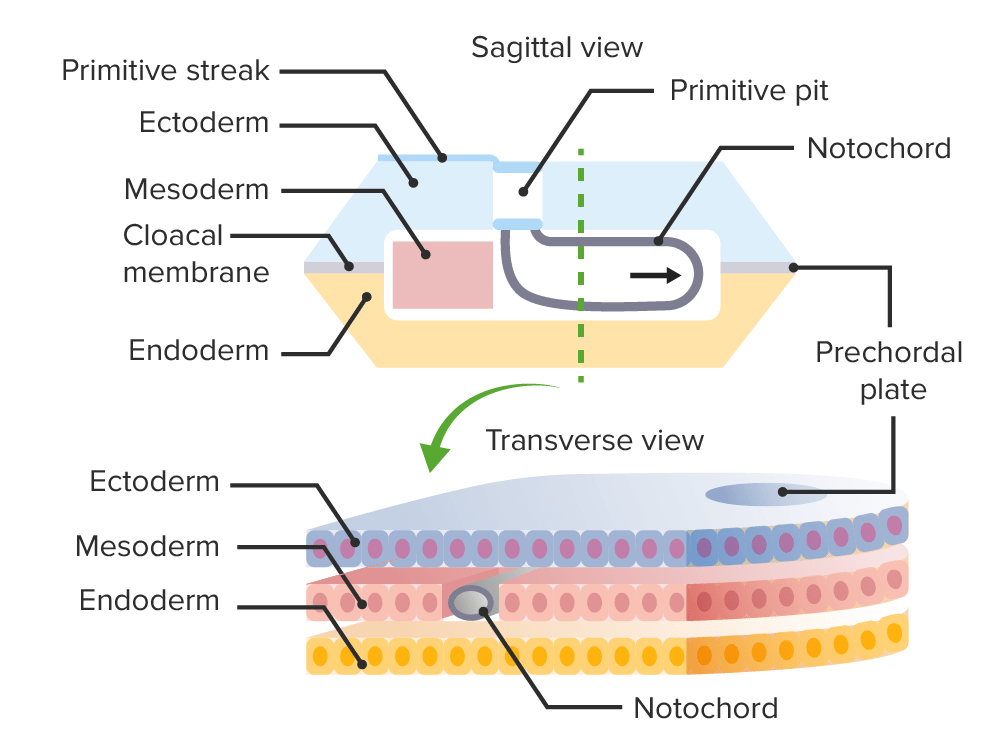
  • Notocorda: estructura en EN Erythema nodosum is an immune-mediated panniculitis (inflammation of the subcutaneous fat) caused by a type IV (delayed-type) hypersensitivity reaction. It commonly manifests in young women as tender, erythematous nodules on the shins. Erythema Nodosum forma de cuerda que corre a lo largo del embrión
  • Aparece en EN Erythema nodosum is an immune-mediated panniculitis (inflammation of the subcutaneous fat) caused by a type IV (delayed-type) hypersensitivity reaction. It commonly manifests in young women as tender, erythematous nodules on the shins. Erythema Nodosum la 3ra semana de desarrollo durante la gastrulación
  • Proceso de formación de la notocorda:
    • Las células ectodérmicas invaginan en EN Erythema nodosum is an immune-mediated panniculitis (inflammation of the subcutaneous fat) caused by a type IV (delayed-type) hypersensitivity reaction. It commonly manifests in young women as tender, erythematous nodules on the shins. Erythema Nodosum la fosa primitiva → células mesodérmicas
    • Las células mesodérmicas se mueven cranealmente en EN Erythema nodosum is an immune-mediated panniculitis (inflammation of the subcutaneous fat) caused by a type IV (delayed-type) hypersensitivity reaction. It commonly manifests in young women as tender, erythematous nodules on the shins. Erythema Nodosum la línea media hasta que alcanzan la placa precordal
    • Las células mesodérmicas crean una estructura en EN Erythema nodosum is an immune-mediated panniculitis (inflammation of the subcutaneous fat) caused by a type IV (delayed-type) hypersensitivity reaction. It commonly manifests in young women as tender, erythematous nodules on the shins. Erythema Nodosum forma de tubo
  • Función: induce al AL Amyloidosis ectodermo suprayacente a diferenciarse en EN Erythema nodosum is an immune-mediated panniculitis (inflammation of the subcutaneous fat) caused by a type IV (delayed-type) hypersensitivity reaction. It commonly manifests in young women as tender, erythematous nodules on the shins. Erythema Nodosum la placa neural (inicio de la neurulación)
  • Persiste postnatalmente como el núcleo pulposo (porción central gelatinosa blanda del disco intervertebral)
Formation of the notochord during gastrulation

Formación de la notocorda durante la gastrulación

Imagen por Lecturio.

Neurulación

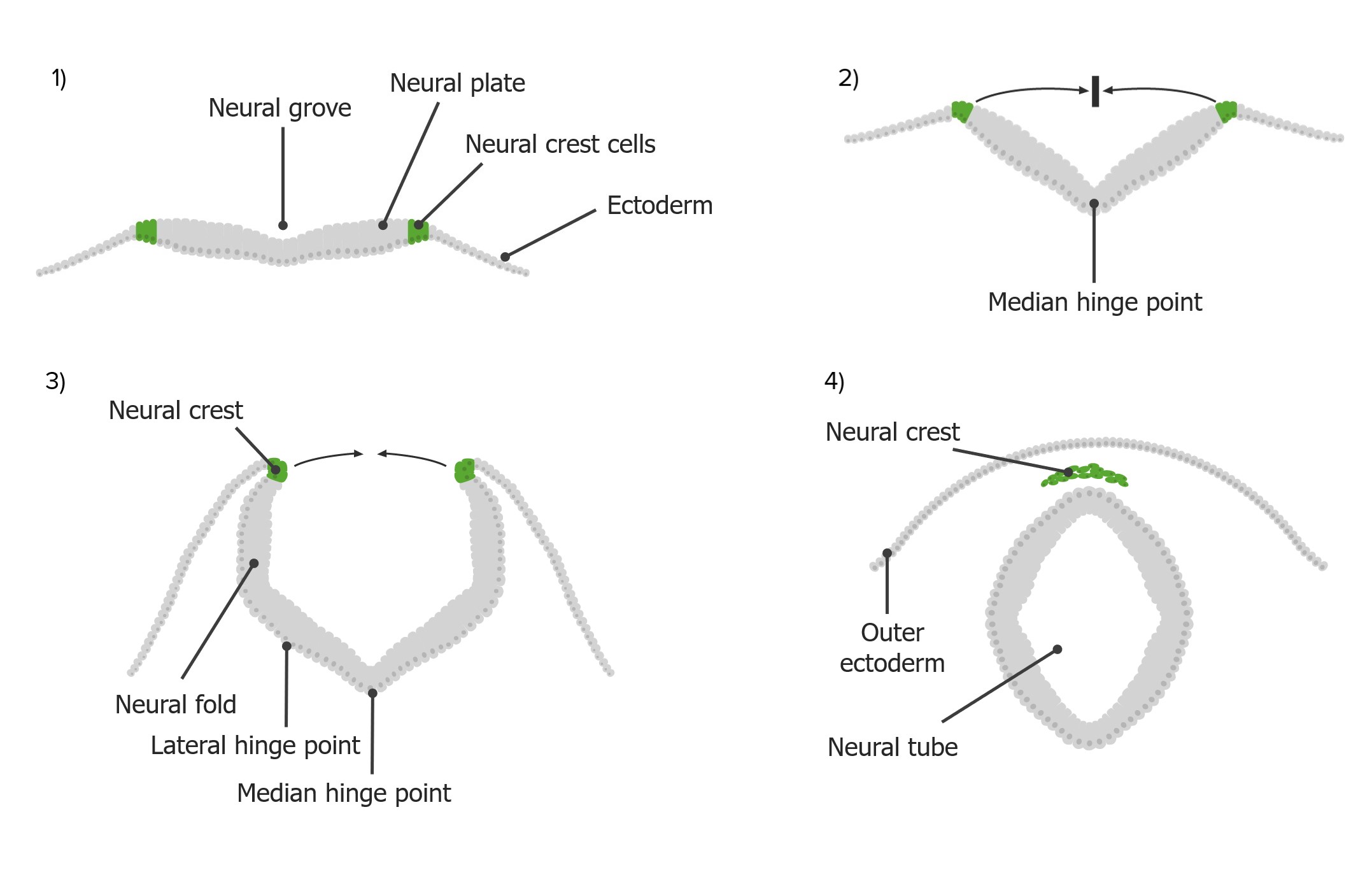
La neurulación es el proceso por el cual el ectodermo en EN Erythema nodosum is an immune-mediated panniculitis (inflammation of the subcutaneous fat) caused by a type IV (delayed-type) hypersensitivity reaction. It commonly manifests in young women as tender, erythematous nodules on the shins. Erythema Nodosum el embrión trilaminar se diferencia en EN Erythema nodosum is an immune-mediated panniculitis (inflammation of the subcutaneous fat) caused by a type IV (delayed-type) hypersensitivity reaction. It commonly manifests in young women as tender, erythematous nodules on the shins. Erythema Nodosum el tubo neural. A partir de la 3ra semana, un grupo de células ectodérmicas progresa a través de las siguientes estructuras:

  • Notocorda: induce la diferenciación de las células ectodérmicas superiores a ella para formar una placa neural
  • Placa neural: engrosamiento del ectodermo a lo largo de la línea media
  • Surco neural: se forma una depresión en EN Erythema nodosum is an immune-mediated panniculitis (inflammation of the subcutaneous fat) caused by a type IV (delayed-type) hypersensitivity reaction. It commonly manifests in young women as tender, erythematous nodules on the shins. Erythema Nodosum el centro de la placa neural
  • Pliegues neurales:
    • Consiste en EN Erythema nodosum is an immune-mediated panniculitis (inflammation of the subcutaneous fat) caused by a type IV (delayed-type) hypersensitivity reaction. It commonly manifests in young women as tender, erythematous nodules on the shins. Erythema Nodosum células que forman paredes laterales alrededor del surco neural, que se elevan ligeramente por encima del resto del ectodermo
    • Las células “superiores” de los LOS Neisseria pliegues neurales se diferencian en EN Erythema nodosum is an immune-mediated panniculitis (inflammation of the subcutaneous fat) caused by a type IV (delayed-type) hypersensitivity reaction. It commonly manifests in young women as tender, erythematous nodules on the shins. Erythema Nodosum células de la cresta neural, que forman varias estructuras nerviosas periféricas diferentes.
  • Tubo neural:
    • Los LOS Neisseria pliegues neurales circulan hacia arriba y se encuentran en EN Erythema nodosum is an immune-mediated panniculitis (inflammation of the subcutaneous fat) caused by a type IV (delayed-type) hypersensitivity reaction. It commonly manifests in young women as tender, erythematous nodules on the shins. Erythema Nodosum la línea media, formando un tubo
    • Este tubo se introduce por debajo de la capa exterior del ectodermo → ahora conocido como tubo neural
    • Las células de la cresta neural se separan y están ubicadas entre el tubo neural y el ectodermo.
    • Porción craneal del tubo neural: se agranda para convertirse en EN Erythema nodosum is an immune-mediated panniculitis (inflammation of the subcutaneous fat) caused by a type IV (delayed-type) hypersensitivity reaction. It commonly manifests in young women as tender, erythematous nodules on the shins. Erythema Nodosum el cerebro
    • Porción caudal del tubo neural: permanece tubular, se convierte en EN Erythema nodosum is an immune-mediated panniculitis (inflammation of the subcutaneous fat) caused by a type IV (delayed-type) hypersensitivity reaction. It commonly manifests in young women as tender, erythematous nodules on the shins. Erythema Nodosum la médula espinal

El desarrollo requiere folato; deficiencia de folato → defectos del tubo neural
El proceso de neurulación

El proceso de neurulación:
Las células de la cresta neural (verde) se derivan de la placa neural (gris), que se pliega hacia arriba y hacia adentro hacia la línea media para crear el tubo neural.
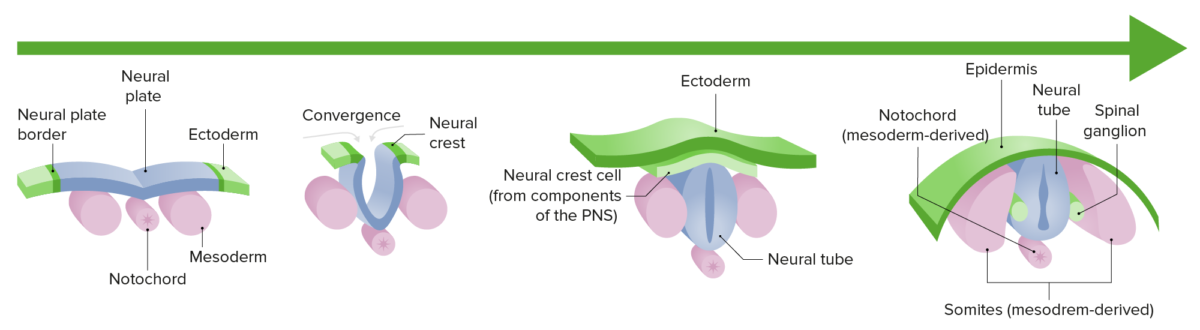
Imagen por Lecturio.

Derivados del Embrión Trilaminar

Derivados del ectodermo

  • Ectodermo de superficie (capa externa del ectodermo que queda después de la neurulación):
    • Piel, cabello y uñas
    • Adenohipófisis (hipófisis anterior)
    • Cristalino del ojo
    • Revestimientos epiteliales en EN Erythema nodosum is an immune-mediated panniculitis (inflammation of the subcutaneous fat) caused by a type IV (delayed-type) hypersensitivity reaction. It commonly manifests in young women as tender, erythematous nodules on the shins. Erythema Nodosum:
      • Cavidad oral
      • Canal anal debajo de la línea pectínea
      • Conducto auditivo externo
    • Glándulas:
      • Salivales
      • Sudoríparas
      • Mamarias
  • Tubo neural, sistema nervioso central (SNC):
    • Cerebro
    • Médula espinal
    • Retina Retina The ten-layered nervous tissue membrane of the eye. It is continuous with the optic nerve and receives images of external objects and transmits visual impulses to the brain. Its outer surface is in contact with the choroid and the inner surface with the vitreous body. The outermost layer is pigmented, whereas the inner nine layers are transparent. Eye: Anatomy
  • Células de la cresta neural, sistema nervioso periférico (SNP):
    • Sistema nervioso autónomo
    • Sistema nervioso entérico ( en EN Erythema nodosum is an immune-mediated panniculitis (inflammation of the subcutaneous fat) caused by a type IV (delayed-type) hypersensitivity reaction. It commonly manifests in young women as tender, erythematous nodules on the shins. Erythema Nodosum el tracto gastrointestinal)
    • Nervios craneales
    • Células de Schwann
    • Médula suprarrenal
    • Melanocitos
    • Tabique aorticopulmonar

Derivados del mesodermo

  • Músculo ( los LOS Neisseria 3 tipos):
    • Todos los LOS Neisseria músculos esqueléticos
    • Cardíaco: corazón
    • Todo el músculo liso (e.g., pared intestinal, paredes bronquiales, útero, paredes de los LOS Neisseria vasos)
  • Hueso, cartílago y tejido conectivo
  • Vasos sanguíneos y linfáticos
  • Sangre
  • Peritoneo, mesenterios y ligamentos de la cavidad abdominal
  • Órganos:
    • Riñones y uréteres
    • Corteza suprarrenal
    • Bazo
    • Gónadas (testículos y ovarios)
    • Vagina Vagina The vagina is the female genital canal, extending from the vulva externally to the cervix uteri internally. The structures have sexual, reproductive, and urinary functions and a rich blood supply, mainly arising from the internal iliac artery. Vagina, Vulva, and Pelvic Floor: Anatomy superior

Derivados del endodermo

  • Revestimiento endotelial del árbol respiratorio
  • Revestimiento endotelial y glándulas mucosas de todo el tracto gastrointestinal hasta la línea pectínea en EN Erythema nodosum is an immune-mediated panniculitis (inflammation of the subcutaneous fat) caused by a type IV (delayed-type) hypersensitivity reaction. It commonly manifests in young women as tender, erythematous nodules on the shins. Erythema Nodosum el canal anal (truco de memoria: el endodermo es la capa enteral)
  • Hígado
  • Vesícula biliar y árbol biliar
  • Páncreas
  • Vejiga y uretra
  • Vagina Vagina The vagina is the female genital canal, extending from the vulva externally to the cervix uteri internally. The structures have sexual, reproductive, and urinary functions and a rich blood supply, mainly arising from the internal iliac artery. Vagina, Vulva, and Pelvic Floor: Anatomy inferior
  • Timo

Relevancia Clínica

Gastrulación anormal

Aborto espontáneo (aborto): las anomalías de la gastrulación suelen dar lugar a múltiples anomalías congénitas. Estos embriones suelen ser incompatibles con la vida y el resultado es una pérdida espontánea del embarazo, generalmente en EN Erythema nodosum is an immune-mediated panniculitis (inflammation of the subcutaneous fat) caused by a type IV (delayed-type) hypersensitivity reaction. It commonly manifests in young women as tender, erythematous nodules on the shins. Erythema Nodosum el 1er trimestre.

Defectos del tubo neural

Defectos del tubo neural: causados por la falla del tubo neural para cerrarse correctamente durante el desarrollo embrionario, lo que puede resultar en EN Erythema nodosum is an immune-mediated panniculitis (inflammation of the subcutaneous fat) caused by a type IV (delayed-type) hypersensitivity reaction. It commonly manifests in young women as tender, erythematous nodules on the shins. Erythema Nodosum una protrusión del tejido neural. Los LOS Neisseria defectos del tubo neural pueden involucrar la médula espinal y/o el cráneo y pueden ser abiertos (involucrando las meninges Meninges The brain and the spinal cord are enveloped by 3 overlapping layers of connective tissue called the meninges. The layers are, from the most external layer to the most internal layer, the dura mater, arachnoid mater, and pia mater. Between these layers are 3 potential spaces called the epidural, subdural, and subarachnoid spaces. Meninges: Anatomy y/o tejido neural) o cerrados (involucrando la columna vertebral ósea). Es común el diagnóstico prenatal mediante ultrasonido y nivel de α-fetoproteína materna. El tratamiento de los LOS Neisseria defectos del tubo neural abiertos es principalmente quirúrgico.

  • Defectos abiertos del tubo neural de la médula espinal:
    • Meningocele Meningocele A congenital or acquired protrusion of the meninges, unaccompanied by neural tissue, through a bony defect in the skull or vertebral column. Neural Tube Defects: solo protruyen las meninges Meninges The brain and the spinal cord are enveloped by 3 overlapping layers of connective tissue called the meninges. The layers are, from the most external layer to the most internal layer, the dura mater, arachnoid mater, and pia mater. Between these layers are 3 potential spaces called the epidural, subdural, and subarachnoid spaces. Meninges: Anatomy
    • Meningomielocele: tanto las meninges Meninges The brain and the spinal cord are enveloped by 3 overlapping layers of connective tissue called the meninges. The layers are, from the most external layer to the most internal layer, the dura mater, arachnoid mater, and pia mater. Between these layers are 3 potential spaces called the epidural, subdural, and subarachnoid spaces. Meninges: Anatomy como la médula espinal sobresalen (defecto del tubo neural más común)
  • Defectos abiertos del tubo neural del cráneo:
    • Meningocele Meningocele A congenital or acquired protrusion of the meninges, unaccompanied by neural tissue, through a bony defect in the skull or vertebral column. Neural Tube Defects craneal: solo protruyen las meninges Meninges The brain and the spinal cord are enveloped by 3 overlapping layers of connective tissue called the meninges. The layers are, from the most external layer to the most internal layer, the dura mater, arachnoid mater, and pia mater. Between these layers are 3 potential spaces called the epidural, subdural, and subarachnoid spaces. Meninges: Anatomy
    • Encefalocele craneal: protruyen tanto las meninges Meninges The brain and the spinal cord are enveloped by 3 overlapping layers of connective tissue called the meninges. The layers are, from the most external layer to the most internal layer, the dura mater, arachnoid mater, and pia mater. Between these layers are 3 potential spaces called the epidural, subdural, and subarachnoid spaces. Meninges: Anatomy como el tallo cerebral/cerebelo/corteza cerebral
    • Anencefalia: falla completa del cierre del tubo neural cefálico, lo que resulta en EN Erythema nodosum is an immune-mediated panniculitis (inflammation of the subcutaneous fat) caused by a type IV (delayed-type) hypersensitivity reaction. It commonly manifests in young women as tender, erythematous nodules on the shins. Erythema Nodosum un cerebro fetal completamente expuesto (no compatible con la vida)
  • Defectos cerrados del tubo neural: defecto de la línea media de los LOS Neisseria cuerpos vertebrales sin protrusión de meninges Meninges The brain and the spinal cord are enveloped by 3 overlapping layers of connective tissue called the meninges. The layers are, from the most external layer to the most internal layer, the dura mater, arachnoid mater, and pia mater. Between these layers are 3 potential spaces called the epidural, subdural, and subarachnoid spaces. Meninges: Anatomy o tejido neural:

Referencias

  1. Carlson, B.M. (Ed.). (2018). Human Embryology and Developmental Biology, 6th ed. Elsevier.
  2. Sadler, T. W. (2018). Langman’s Medical Embryology, 14th ed. Lippincott Williams & Wilkins.
  3. Muhr, J. (2021). Embryology, gastrulation. StatPearls. Retrieved October 29, 2021, from https://www.statpearls.com/articlelibrary/viewarticle/22120/ 
  4. OpenStax College. (n.d.). Anatomy and physiology. OpenStax CNX. Retrieved October 29, 2021, from https://philschatz.com/anatomy-book/contents/m46319.html 

¡Crea tu cuenta gratis o inicia una sesión para seguir leyendo!

Regístrate ahora y obtén acceso gratuito a Lecturio con páginas de concepto, videos médicos y cuestionarios para tu educación médica.

User Reviews

Que tengas una sesión de estudio alegre y navideña 🎁 Ahorra 50% en todos los planes >>

Details