Domina Conceptos Médicos

Estudia para la escuela de medicina y tus examenes con Lecturio.

Botulismo

El botulismo es un síndrome neuroparalítico poco frecuente causado por el Clostridium botulinum Clostridium botulinum A species of anaerobic, gram-positive, rod-shaped bacteria in the family clostridiaceae that produces proteins with characteristic neurotoxicity. It is the etiologic agent of botulism in humans, wild fowl, horses; and cattle. Seven subtypes (sometimes called antigenic types, or strains) exist, each producing a different botulinum toxin (botulinum toxins). The organism and its spores are widely distributed in nature. Clostridia ( C. botulinum C. botulinum A species of anaerobic, gram-positive, rod-shaped bacteria in the family clostridiaceae that produces proteins with characteristic neurotoxicity. It is the etiologic agent of botulism in humans, wild fowl, horses; and cattle. Seven subtypes (sometimes called antigenic types, or strains) exist, each producing a different botulinum toxin (botulinum toxins). The organism and its spores are widely distributed in nature. Clostridia). Libera una neurotoxina mortal (toxina botulínica) que provoca diversos grados de parálisis muscular y distintos síndromes clínicos. Los LOS Neisseria tipos más comunes de botulismo son los LOS Neisseria transmitidos por alimentos y el infantil. El botulismo se presenta con visión borrosa, insuficiencia respiratoria y una parálisis flácida simétrica y descendente. La caracterización incluye el sensorio intacto, frecuencia cardíaca y presión arterial normales, ausencia de fiebre y ausencia de déficits sensoriales. El diagnóstico se realiza por motivos clínicos y puede confirmarse mediante el aislamiento de las bacterias o toxinas a partir de heces, muestras de las heridas o fuentes de alimentos. El enfoque del tratamiento de un caso de botulismo debe incluir el manejo rápido de la insuficiencia respiratoria, la administración de la antitoxina y los LOS Neisseria cuidados de soporte para la parálisis.

Last updated: Dec 15, 2025

Editorial responsibility: Stanley Oiseth, Lindsay Jones, Evelin Maza

Descripción General

Definición

El botulismo es un síndrome neuroparalítico poco frecuente causado por la bacteria Bacteria Bacteria are prokaryotic single-celled microorganisms that are metabolically active and divide by binary fission. Some of these organisms play a significant role in the pathogenesis of diseases. Bacteriology Clostridium botulinum Clostridium botulinum A species of anaerobic, gram-positive, rod-shaped bacteria in the family clostridiaceae that produces proteins with characteristic neurotoxicity. It is the etiologic agent of botulism in humans, wild fowl, horses; and cattle. Seven subtypes (sometimes called antigenic types, or strains) exist, each producing a different botulinum toxin (botulinum toxins). The organism and its spores are widely distributed in nature. Clostridia ( C. botulinum C. botulinum A species of anaerobic, gram-positive, rod-shaped bacteria in the family clostridiaceae that produces proteins with characteristic neurotoxicity. It is the etiologic agent of botulism in humans, wild fowl, horses; and cattle. Seven subtypes (sometimes called antigenic types, or strains) exist, each producing a different botulinum toxin (botulinum toxins). The organism and its spores are widely distributed in nature. Clostridia), que libera una neurotoxina mortal (toxina botulínica), que provoca diversos grados de parálisis muscular y distintos síndromes clínicos.
Epidemiología

  • Aproximadamente 200 casos al AL Amyloidosis año en EN Erythema nodosum is an immune-mediated panniculitis (inflammation of the subcutaneous fat) caused by a type IV (delayed-type) hypersensitivity reaction. It commonly manifests in young women as tender, erythematous nodules on the shins. Erythema Nodosum EE.UU. (enfermedad rara)
  • Puede ocurrir en EN Erythema nodosum is an immune-mediated panniculitis (inflammation of the subcutaneous fat) caused by a type IV (delayed-type) hypersensitivity reaction. It commonly manifests in young women as tender, erythematous nodules on the shins. Erythema Nodosum cualquier grupo de edad
  • No hay transmisión de persona a persona
  • C. botulinum C. botulinum A species of anaerobic, gram-positive, rod-shaped bacteria in the family clostridiaceae that produces proteins with characteristic neurotoxicity. It is the etiologic agent of botulism in humans, wild fowl, horses; and cattle. Seven subtypes (sometimes called antigenic types, or strains) exist, each producing a different botulinum toxin (botulinum toxins). The organism and its spores are widely distributed in nature. Clostridia se encuentra en EN Erythema nodosum is an immune-mediated panniculitis (inflammation of the subcutaneous fat) caused by a type IV (delayed-type) hypersensitivity reaction. It commonly manifests in young women as tender, erythematous nodules on the shins. Erythema Nodosum el suelo y sedimentos marinos a nivel mundial.
  • El tipo más común es el botulismo infantil.
  • El tipo menos común es la toxemia intestinal del adulto.

Etiología

  • Patógeno C. botulinum C. botulinum A species of anaerobic, gram-positive, rod-shaped bacteria in the family clostridiaceae that produces proteins with characteristic neurotoxicity. It is the etiologic agent of botulism in humans, wild fowl, horses; and cattle. Seven subtypes (sometimes called antigenic types, or strains) exist, each producing a different botulinum toxin (botulinum toxins). The organism and its spores are widely distributed in nature. Clostridia:
    • Bacilo Gram-positivo
    • Bacteria Bacteria Bacteria are prokaryotic single-celled microorganisms that are metabolically active and divide by binary fission. Some of these organisms play a significant role in the pathogenesis of diseases. Bacteriology anaerobia formadora de esporas
    • Se encuentra en EN Erythema nodosum is an immune-mediated panniculitis (inflammation of the subcutaneous fat) caused by a type IV (delayed-type) hypersensitivity reaction. It commonly manifests in young women as tender, erythematous nodules on the shins. Erythema Nodosum el suelo y sedimentos marinos a nivel mundial
    • 4 fenotipos distintos: I–IV
  • Toxina botulínica:
    • Proteína neurotóxica producida por C. botulinum C. botulinum A species of anaerobic, gram-positive, rod-shaped bacteria in the family clostridiaceae that produces proteins with characteristic neurotoxicity. It is the etiologic agent of botulism in humans, wild fowl, horses; and cattle. Seven subtypes (sometimes called antigenic types, or strains) exist, each producing a different botulinum toxin (botulinum toxins). The organism and its spores are widely distributed in nature. Clostridia
    • Clasificado en EN Erythema nodosum is an immune-mediated panniculitis (inflammation of the subcutaneous fat) caused by a type IV (delayed-type) hypersensitivity reaction. It commonly manifests in young women as tender, erythematous nodules on the shins. Erythema Nodosum 7 serotipos: A–G
    • A, B, E y F causan enfermedades en EN Erythema nodosum is an immune-mediated panniculitis (inflammation of the subcutaneous fat) caused by a type IV (delayed-type) hypersensitivity reaction. It commonly manifests in young women as tender, erythematous nodules on the shins. Erythema Nodosum los LOS Neisseria seres humanos.
    • A y B se utilizan de manera comercial y médicamente.
    • Bloquea la liberación del neurotransmisor acetilcolina ( ACh ACh A neurotransmitter found at neuromuscular junctions, autonomic ganglia, parasympathetic effector junctions, a subset of sympathetic effector junctions, and at many sites in the central nervous system. Receptors and Neurotransmitters of the CNS) en EN Erythema nodosum is an immune-mediated panniculitis (inflammation of the subcutaneous fat) caused by a type IV (delayed-type) hypersensitivity reaction. It commonly manifests in young women as tender, erythematous nodules on the shins. Erythema Nodosum la unión neuromuscular.
  • Condiciones favorables para el crecimiento del patógeno y la formación de esporas:
    • Bajo O2 o sin O2 (condiciones anaeróbicas)
    • pH pH The quantitative measurement of the acidity or basicity of a solution. Acid-Base Balance de 7 y mayor
    • Rango de temperatura ideal: 25℃–37℃
    • Sobrevive a temperaturas tan bajas como 4℃ y tan altas como 100℃
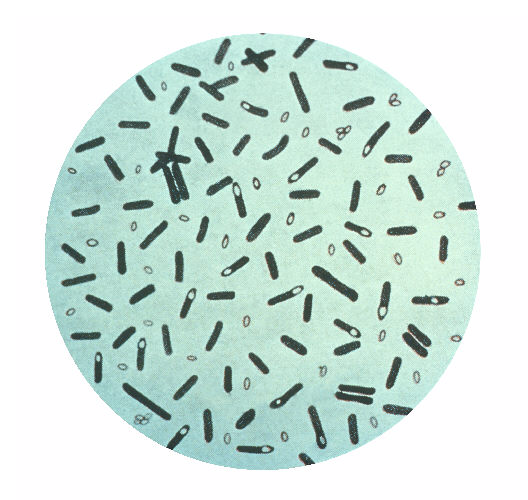
Clostridium botulinum

Una fotomicrografía de la bacteria C. botulinum

Imagen: “Clostridium botulinum” por CDC. Licencia: Dominio Público

Clasificación

Botulismo infantil

  • Modo de infección: ingestión de esporas de C. botulinum C. botulinum A species of anaerobic, gram-positive, rod-shaped bacteria in the family clostridiaceae that produces proteins with characteristic neurotoxicity. It is the etiologic agent of botulism in humans, wild fowl, horses; and cattle. Seven subtypes (sometimes called antigenic types, or strains) exist, each producing a different botulinum toxin (botulinum toxins). The organism and its spores are widely distributed in nature. Clostridia
  • La toxina se produce in vivo (las bacterias germinan en EN Erythema nodosum is an immune-mediated panniculitis (inflammation of the subcutaneous fat) caused by a type IV (delayed-type) hypersensitivity reaction. It commonly manifests in young women as tender, erythematous nodules on the shins. Erythema Nodosum el tracto gastrointestinal).
  • Es común en EN Erythema nodosum is an immune-mediated panniculitis (inflammation of the subcutaneous fat) caused by a type IV (delayed-type) hypersensitivity reaction. It commonly manifests in young women as tender, erythematous nodules on the shins. Erythema Nodosum los LOS Neisseria bebés < 6 meses de edad (las defensas naturales aún no se han desarrollado en EN Erythema nodosum is an immune-mediated panniculitis (inflammation of the subcutaneous fat) caused by a type IV (delayed-type) hypersensitivity reaction. It commonly manifests in young women as tender, erythematous nodules on the shins. Erythema Nodosum el intestino)
  • El producto más común que causa el botulismo infantil es la miel cruda.

Botulismo alimentario

  • Modo de infección: ingestión de alimentos contaminados con la toxina del C. botulinum C. botulinum A species of anaerobic, gram-positive, rod-shaped bacteria in the family clostridiaceae that produces proteins with characteristic neurotoxicity. It is the etiologic agent of botulism in humans, wild fowl, horses; and cattle. Seven subtypes (sometimes called antigenic types, or strains) exist, each producing a different botulinum toxin (botulinum toxins). The organism and its spores are widely distributed in nature. Clostridia
  • Se encuentra comúnmente en EN Erythema nodosum is an immune-mediated panniculitis (inflammation of the subcutaneous fat) caused by a type IV (delayed-type) hypersensitivity reaction. It commonly manifests in young women as tender, erythematous nodules on the shins. Erythema Nodosum alimentos inadecuadamente enlatados con bajo nivel de ácido y en EN Erythema nodosum is an immune-mediated panniculitis (inflammation of the subcutaneous fat) caused by a type IV (delayed-type) hypersensitivity reaction. It commonly manifests in young women as tender, erythematous nodules on the shins. Erythema Nodosum productos alimenticios ligeramente conservados (e.g., productos cárnicos fermentados, salados o ahumados)
  • Peligroso: puede infectar a muchas personas a la vez que consuman alimentos de la misma fuente

Botulismo en EN Erythema nodosum is an immune-mediated panniculitis (inflammation of the subcutaneous fat) caused by a type IV (delayed-type) hypersensitivity reaction. It commonly manifests in young women as tender, erythematous nodules on the shins. Erythema Nodosum las heridas

  • Modo de infección: Las esporas de C. botulinum C. botulinum A species of anaerobic, gram-positive, rod-shaped bacteria in the family clostridiaceae that produces proteins with characteristic neurotoxicity. It is the etiologic agent of botulism in humans, wild fowl, horses; and cattle. Seven subtypes (sometimes called antigenic types, or strains) exist, each producing a different botulinum toxin (botulinum toxins). The organism and its spores are widely distributed in nature. Clostridia entran en EN Erythema nodosum is an immune-mediated panniculitis (inflammation of the subcutaneous fat) caused by a type IV (delayed-type) hypersensitivity reaction. It commonly manifests in young women as tender, erythematous nodules on the shins. Erythema Nodosum una herida abierta y se desarrollan en EN Erythema nodosum is an immune-mediated panniculitis (inflammation of the subcutaneous fat) caused by a type IV (delayed-type) hypersensitivity reaction. It commonly manifests in young women as tender, erythematous nodules on the shins. Erythema Nodosum condiciones anaeróbicas.
  • Forma poco frecuente del botulismo
  • Puede ser el resultado de la contaminación de la herida por tierra, grava o fracturas abiertas tratadas inadecuadamente
  • Comúnmente asociado con el abuso de sustancias de la heroína en EN Erythema nodosum is an immune-mediated panniculitis (inflammation of the subcutaneous fat) caused by a type IV (delayed-type) hypersensitivity reaction. It commonly manifests in young women as tender, erythematous nodules on the shins. Erythema Nodosum su forma conocida como alquitrán negro

Botulismo iatrogénico

  • Modo de infección: inyecciones de la toxina botulínica con fines cosméticos o terapéuticos/médicos (e.g., migraña, contracturas, espasticidad)
  • Otra forma rara del botulismo
  • Una preparación altamente concentrada de la toxina puede causar botulismo iatrogénico.

Toxemia intestinal en EN Erythema nodosum is an immune-mediated panniculitis (inflammation of the subcutaneous fat) caused by a type IV (delayed-type) hypersensitivity reaction. It commonly manifests in young women as tender, erythematous nodules on the shins. Erythema Nodosum adultos

  • Modo de infección: ingestión de esporas de C. botulinum C. botulinum A species of anaerobic, gram-positive, rod-shaped bacteria in the family clostridiaceae that produces proteins with characteristic neurotoxicity. It is the etiologic agent of botulism in humans, wild fowl, horses; and cattle. Seven subtypes (sometimes called antigenic types, or strains) exist, each producing a different botulinum toxin (botulinum toxins). The organism and its spores are widely distributed in nature. Clostridia
  • Es la forma menos común de botulismo
  • Similar al AL Amyloidosis botulismo infantil, pero se da en EN Erythema nodosum is an immune-mediated panniculitis (inflammation of the subcutaneous fat) caused by a type IV (delayed-type) hypersensitivity reaction. It commonly manifests in young women as tender, erythematous nodules on the shins. Erythema Nodosum niños mayores y en EN Erythema nodosum is an immune-mediated panniculitis (inflammation of the subcutaneous fat) caused by a type IV (delayed-type) hypersensitivity reaction. It commonly manifests in young women as tender, erythematous nodules on the shins. Erythema Nodosum adultos con anomalías intestinales o alteración de la flora intestinal normal (e.g., enfermedad intestinal inflamatoria)

Botulismo por inhalación

  • No se produce de forma natural
  • Asociado a la liberación accidental o intencionada de la toxina en EN Erythema nodosum is an immune-mediated panniculitis (inflammation of the subcutaneous fat) caused by a type IV (delayed-type) hypersensitivity reaction. It commonly manifests in young women as tender, erythematous nodules on the shins. Erythema Nodosum aerosoles (botulismo asociado al AL Amyloidosis bioterrorismo)
  • La presentación clínica es similar a la del botulismo alimentario.
  • La dosis letal es de 2 ng/kg de peso corporal.

Fisiopatología

El medio de exposición a la toxina determinará el tipo de botulismo; la toxina no se absorbe a través de la piel intacta.

La exposición puede producirse a través de los LOS Neisseria siguientes mecanismos:

  • Ingestión de la toxina preformada
  • Inhalación de la toxina preformada
  • Producción de la toxina por C. botulinum C. botulinum A species of anaerobic, gram-positive, rod-shaped bacteria in the family clostridiaceae that produces proteins with characteristic neurotoxicity. It is the etiologic agent of botulism in humans, wild fowl, horses; and cattle. Seven subtypes (sometimes called antigenic types, or strains) exist, each producing a different botulinum toxin (botulinum toxins). The organism and its spores are widely distributed in nature. Clostridia en EN Erythema nodosum is an immune-mediated panniculitis (inflammation of the subcutaneous fat) caused by a type IV (delayed-type) hypersensitivity reaction. It commonly manifests in young women as tender, erythematous nodules on the shins. Erythema Nodosum el tracto gastrointestinal
  • Producción de la toxina por C. botulinum C. botulinum A species of anaerobic, gram-positive, rod-shaped bacteria in the family clostridiaceae that produces proteins with characteristic neurotoxicity. It is the etiologic agent of botulism in humans, wild fowl, horses; and cattle. Seven subtypes (sometimes called antigenic types, or strains) exist, each producing a different botulinum toxin (botulinum toxins). The organism and its spores are widely distributed in nature. Clostridia en EN Erythema nodosum is an immune-mediated panniculitis (inflammation of the subcutaneous fat) caused by a type IV (delayed-type) hypersensitivity reaction. It commonly manifests in young women as tender, erythematous nodules on the shins. Erythema Nodosum tejido desvitalizado en EN Erythema nodosum is an immune-mediated panniculitis (inflammation of the subcutaneous fat) caused by a type IV (delayed-type) hypersensitivity reaction. It commonly manifests in young women as tender, erythematous nodules on the shins. Erythema Nodosum el lugar de una herida
  • Exposición a la toxina por inyección con fines cosméticos o terapéuticos/médicos

Mecanismo de patogénesis:

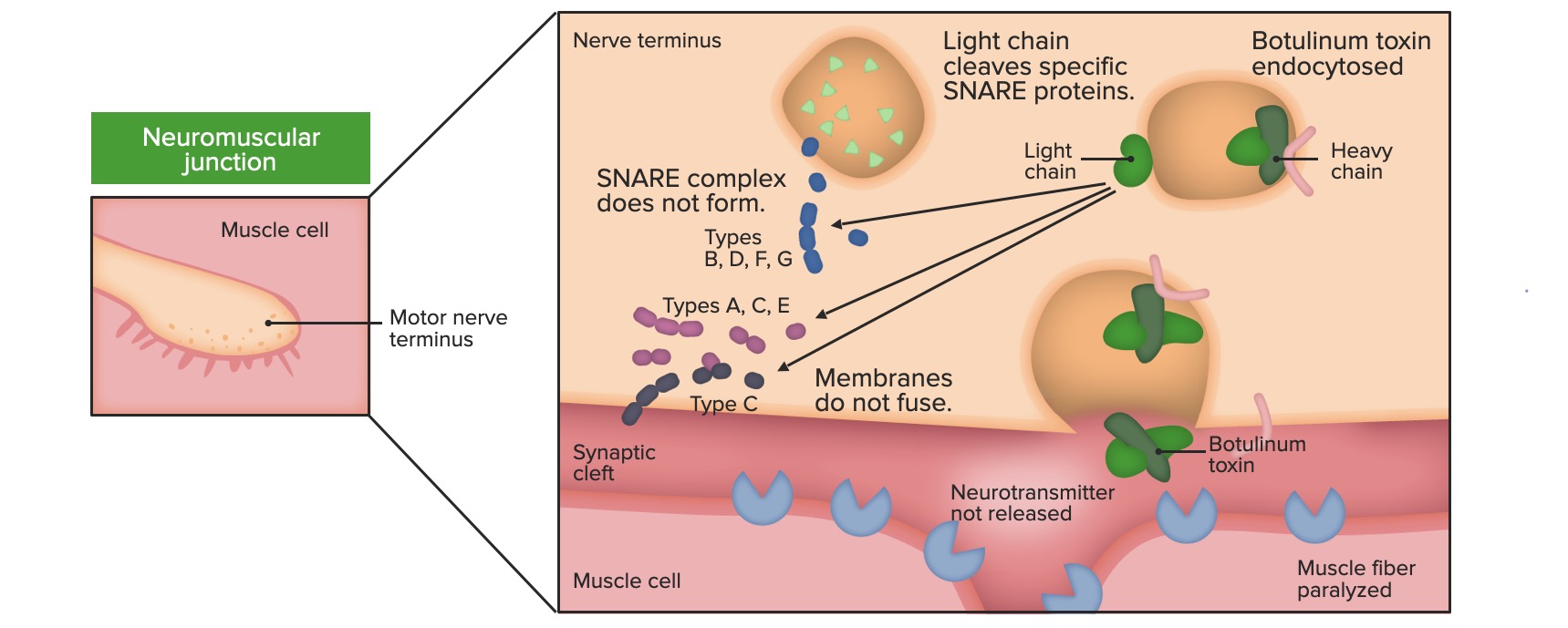
  • La toxina botulínica se activa por escisión proteolítica en EN Erythema nodosum is an immune-mediated panniculitis (inflammation of the subcutaneous fat) caused by a type IV (delayed-type) hypersensitivity reaction. It commonly manifests in young women as tender, erythematous nodules on the shins. Erythema Nodosum la circulación y se transporta hacia la unión neuromuscular.
  • La toxina botulínica existe en EN Erythema nodosum is an immune-mediated panniculitis (inflammation of the subcutaneous fat) caused by a type IV (delayed-type) hypersensitivity reaction. It commonly manifests in young women as tender, erythematous nodules on the shins. Erythema Nodosum la circulación como un polímero de una cadena ligera y una cadena pesada.
  • La cadena pesada de la toxina se une a los LOS Neisseria receptores de la neurona presináptica y entra en EN Erythema nodosum is an immune-mediated panniculitis (inflammation of the subcutaneous fat) caused by a type IV (delayed-type) hypersensitivity reaction. It commonly manifests in young women as tender, erythematous nodules on the shins. Erythema Nodosum ella a través de la endocitosis mediada por receptores.
  • Una vez dentro de las vesículas endocíticas de la neurona presináptica, la cadena ligera de la toxina atraviesa la membrana de la vesícula endocítica y entra en EN Erythema nodosum is an immune-mediated panniculitis (inflammation of the subcutaneous fat) caused by a type IV (delayed-type) hypersensitivity reaction. It commonly manifests in young women as tender, erythematous nodules on the shins. Erythema Nodosum el citoplasma.
  • Una vez en EN Erythema nodosum is an immune-mediated panniculitis (inflammation of the subcutaneous fat) caused by a type IV (delayed-type) hypersensitivity reaction. It commonly manifests in young women as tender, erythematous nodules on the shins. Erythema Nodosum el citoplasma, la cadena ligera se une a las proteínas SNARE/SNAP, que participan en EN Erythema nodosum is an immune-mediated panniculitis (inflammation of the subcutaneous fat) caused by a type IV (delayed-type) hypersensitivity reaction. It commonly manifests in young women as tender, erythematous nodules on the shins. Erythema Nodosum la liberación de ACh ACh A neurotransmitter found at neuromuscular junctions, autonomic ganglia, parasympathetic effector junctions, a subset of sympathetic effector junctions, and at many sites in the central nervous system. Receptors and Neurotransmitters of the CNS de las vesículas presinápticas donde se almacena.
  • La inhibición de la liberación de ACh ACh A neurotransmitter found at neuromuscular junctions, autonomic ganglia, parasympathetic effector junctions, a subset of sympathetic effector junctions, and at many sites in the central nervous system. Receptors and Neurotransmitters of the CNS impide que esta se una al AL Amyloidosis receptor Receptor Receptors are proteins located either on the surface of or within a cell that can bind to signaling molecules known as ligands (e.g., hormones) and cause some type of response within the cell. Receptors de ACh ACh A neurotransmitter found at neuromuscular junctions, autonomic ganglia, parasympathetic effector junctions, a subset of sympathetic effector junctions, and at many sites in the central nervous system. Receptors and Neurotransmitters of the CNS, lo que detiene la contracción muscular y provoca debilidad/parálisis.
Efectos de la toxina botulínica

Efecto de la toxina botulínica a nivel de la unión neuromuscular: inhibición de la liberación de ACh

Imagen por Lecturio.

Presentación Clínica

Características generales

La presentación clásica del botulismo incluye parálisis simétricas de los LOS Neisseria nervios craneales y parálisis descendente. Las 5 características clave del botulismo son:

  1. Ausencia de fiebre
  2. Déficits neurológicos simétricos: parálisis flácida simétrica y descendente de los LOS Neisseria músculos voluntarios (comienza como debilidad muscular proximal y progresa distalmente)
  3. Sensorio y estado mental intactos
  4. Ritmo cardíaco normal o lento y presión arterial normal
  5. No hay déficits sensoriales (excepto visión borrosa)

Las neuropatías craneales son comunes en EN Erythema nodosum is an immune-mediated panniculitis (inflammation of the subcutaneous fat) caused by a type IV (delayed-type) hypersensitivity reaction. It commonly manifests in young women as tender, erythematous nodules on the shins. Erythema Nodosum todos los LOS Neisseria tipos de botulismo. La presentación clásica incluye las “4 D” (síntomas bulbares):

  1. Diplopía: El primer síntoma/signo clínico suele ser la afectación extraocular.
  2. Disartria
  3. Disfonía
  4. Disfagia

El botulismo se presenta con hallazgos autonómicos:

  • Pupilar (pupilas dilatadas y fijas)
  • Disminución de la salivación
  • Disminución del lagrimeo
  • Íleo paralítico/estreñimiento grave
  • Dilatación gástrica
  • Distensión de la vejiga/retención urinaria
  • Hipotensión ortostática

Botulismo infantil

  • Periodo de incubación: 3–30 días después de la entrada de las esporas
  • Suele ocurrir en EN Erythema nodosum is an immune-mediated panniculitis (inflammation of the subcutaneous fat) caused by a type IV (delayed-type) hypersensitivity reaction. It commonly manifests in young women as tender, erythematous nodules on the shins. Erythema Nodosum bebés < 6 meses de edad
  • Estreñimiento: a menudo es el 1er signo
  • Babeo
  • Llanto débil
  • Irritabilidad
  • Convulsiones
  • Síndrome del bebé flácido:
    • Ptosis Ptosis Cranial Nerve Palsies bilateral
    • Pérdida de control de la cabeza, movimientos flojos/hipotonía
    • Debilidad generalizada/letargo
    • Mala alimentación (succión débil)
Síndrome del bebé flácido

Una presentación importante en el botulismo infantil: el síndrome del bebé flácido

Imagen por Lecturio.
Botulismo alimentario

  • Periodo de incubación: 12–36 horas después del consumo de la toxina
  • Síntomas prodrómicos:
    • Náuseas, vómitos, diarrea y calambres abdominales
    • La diarrea inicial (efecto directo de la toxina en EN Erythema nodosum is an immune-mediated panniculitis (inflammation of the subcutaneous fat) caused by a type IV (delayed-type) hypersensitivity reaction. It commonly manifests in young women as tender, erythematous nodules on the shins. Erythema Nodosum el endotelio gastrointestinal) progresa hacia el estreñimiento (mientras dominan las manifestaciones sistémicas de la unión neuromuscular).
  • Boca seca
  • Dificultad para tragar o hablar
  • Debilidad facial simétrica
  • Visión borrosa
  • Neuropatías craneales
  • Dificultad para respirar

Botulismo en EN Erythema nodosum is an immune-mediated panniculitis (inflammation of the subcutaneous fat) caused by a type IV (delayed-type) hypersensitivity reaction. It commonly manifests in young women as tender, erythematous nodules on the shins. Erythema Nodosum las heridas

  • El periodo de incubación resulta difícil de estimar (el momento de la exposición suele ser incierto)
  • Los LOS Neisseria síntomas son similares a los LOS Neisseria del botulismo alimentario, excepto que los LOS Neisseria síntomas prodrómicos están ausentes.
  • El botulismo causado por heridas se presenta con fiebre y leucocitosis en EN Erythema nodosum is an immune-mediated panniculitis (inflammation of the subcutaneous fat) caused by a type IV (delayed-type) hypersensitivity reaction. It commonly manifests in young women as tender, erythematous nodules on the shins. Erythema Nodosum alrededor del 50% de los LOS Neisseria casos; las otras formas de botulismo no suelen presentarse con fiebre
  • Dificultad para tragar o hablar
  • Debilidad facial simétrica
  • Visión borrosa o doble
  • Ptosis Ptosis Cranial Nerve Palsies
  • Dificultad para respirar
  • Parálisis descendente
  • Inflamación en EN Erythema nodosum is an immune-mediated panniculitis (inflammation of the subcutaneous fat) caused by a type IV (delayed-type) hypersensitivity reaction. It commonly manifests in young women as tender, erythematous nodules on the shins. Erythema Nodosum el sitio de la herida
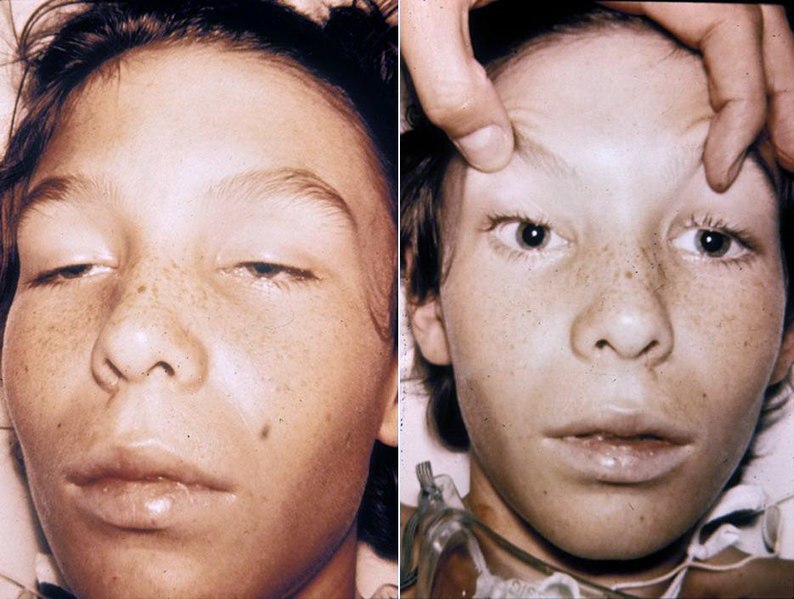
Ptosis en el botulismo

Ptosis en un niño con botulismo: El paciente está alerta y orientado.

Imagen: “Botulism1and2” por Herbert L. Fred, MD and Hendrik A. van Dijk. Licencia: CC BY 2.0

Botulismo iatrogénico

  • Tras la inyección de toxina botulínica con fines cosméticos o terapéuticos/médicos
  • Ptosis Ptosis Cranial Nerve Palsies
  • Dificultad para hablar
  • Parálisis de la cara
  • Lengua gruesa y débil
  • Disminución del reflejo nauseoso

Toxemia intestinal en EN Erythema nodosum is an immune-mediated panniculitis (inflammation of the subcutaneous fat) caused by a type IV (delayed-type) hypersensitivity reaction. It commonly manifests in young women as tender, erythematous nodules on the shins. Erythema Nodosum adultos

  • Similar al AL Amyloidosis botulismo infantil, pero se da en EN Erythema nodosum is an immune-mediated panniculitis (inflammation of the subcutaneous fat) caused by a type IV (delayed-type) hypersensitivity reaction. It commonly manifests in young women as tender, erythematous nodules on the shins. Erythema Nodosum niños mayores y adultos
  • Estreñimiento
  • Anorexia Anorexia The lack or loss of appetite accompanied by an aversion to food and the inability to eat. It is the defining characteristic of the disorder anorexia nervosa. Anorexia Nervosa
  • Letargo
  • Parálisis descendente
  • Ptosis Ptosis Cranial Nerve Palsies

Botulismo por inhalación

  • Los LOS Neisseria síntomas son similares a los LOS Neisseria del botulismo alimentario.
  • Puede desarrollarse en EN Erythema nodosum is an immune-mediated panniculitis (inflammation of the subcutaneous fat) caused by a type IV (delayed-type) hypersensitivity reaction. It commonly manifests in young women as tender, erythematous nodules on the shins. Erythema Nodosum forma aguda y evolucionar rápidamente hacia la insuficiencia respiratoria
  • Diarrea
  • Boca seca
  • Dificultad para tragar o hablar
  • Debilidad facial simétrica
  • Visión borrosa
  • Neuropatías craneales
  • Dificultad para respirar

Diagnóstico

Historia clínica

  • Consumo de alimentos enlatados
  • Síntomas similares en EN Erythema nodosum is an immune-mediated panniculitis (inflammation of the subcutaneous fat) caused by a type IV (delayed-type) hypersensitivity reaction. It commonly manifests in young women as tender, erythematous nodules on the shins. Erythema Nodosum individuos con una exposición similar
  • Antecedentes de abuso de drogas inyectables
  • Antecedente de uso cosmético/médico de la toxina botulínica
  • Aparición aguda de los LOS Neisseria síntomas del síndrome del bebé flácido
  • Antecedentes de consumo de miel en EN Erythema nodosum is an immune-mediated panniculitis (inflammation of the subcutaneous fat) caused by a type IV (delayed-type) hypersensitivity reaction. It commonly manifests in young women as tender, erythematous nodules on the shins. Erythema Nodosum los LOS Neisseria bebés

Examen físico

  • Inicio agudo de los LOS Neisseria síntomas de la neuropatía craneal
  • Debilidad simétrica descendente
  • Ausencia de fiebre
  • Paciente alerta y consciente con síntomas neurológicos

Confirmación del diagnóstico

  • Aislamiento de C. botulinum C. botulinum A species of anaerobic, gram-positive, rod-shaped bacteria in the family clostridiaceae that produces proteins with characteristic neurotoxicity. It is the etiologic agent of botulism in humans, wild fowl, horses; and cattle. Seven subtypes (sometimes called antigenic types, or strains) exist, each producing a different botulinum toxin (botulinum toxins). The organism and its spores are widely distributed in nature. Clostridia a partir de heces, muestras de heridas o alimentos
  • Detección de la toxina por enzimoinmunoanálisis de adsorción ( ELISA ELISA An immunoassay utilizing an antibody labeled with an enzyme marker such as horseradish peroxidase. While either the enzyme or the antibody is bound to an immunosorbent substrate, they both retain their biologic activity; the change in enzyme activity as a result of the enzyme-antibody-antigen reaction is proportional to the concentration of the antigen and can be measured spectrophotometrically or with the naked eye. Many variations of the method have been developed. St. Louis Encephalitis Virus, por sus siglas en EN Erythema nodosum is an immune-mediated panniculitis (inflammation of the subcutaneous fat) caused by a type IV (delayed-type) hypersensitivity reaction. It commonly manifests in young women as tender, erythematous nodules on the shins. Erythema Nodosum inglés) o reacción en EN Erythema nodosum is an immune-mediated panniculitis (inflammation of the subcutaneous fat) caused by a type IV (delayed-type) hypersensitivity reaction. It commonly manifests in young women as tender, erythematous nodules on the shins. Erythema Nodosum cadena de polimerasa ( PCR PCR Polymerase chain reaction (PCR) is a technique that amplifies DNA fragments exponentially for analysis. The process is highly specific, allowing for the targeting of specific genomic sequences, even with minuscule sample amounts. The PCR cycles multiple times through 3 phases: denaturation of the template DNA, annealing of a specific primer to the individual DNA strands, and synthesis/elongation of new DNA molecules. Polymerase Chain Reaction (PCR), por sus siglas en EN Erythema nodosum is an immune-mediated panniculitis (inflammation of the subcutaneous fat) caused by a type IV (delayed-type) hypersensitivity reaction. It commonly manifests in young women as tender, erythematous nodules on the shins. Erythema Nodosum inglés) en EN Erythema nodosum is an immune-mediated panniculitis (inflammation of the subcutaneous fat) caused by a type IV (delayed-type) hypersensitivity reaction. It commonly manifests in young women as tender, erythematous nodules on the shins. Erythema Nodosum suero, heces, vómitos o en EN Erythema nodosum is an immune-mediated panniculitis (inflammation of the subcutaneous fat) caused by a type IV (delayed-type) hypersensitivity reaction. It commonly manifests in young women as tender, erythematous nodules on the shins. Erythema Nodosum alimentos
  • Otras pruebas:
    • Resonancia magnética (RM) o tomografía computarizada (TC): para descartar otras razones de los LOS Neisseria síntomas neurológicos (e.g., un accidente cerebrovascular)
    • Examen del líquido cefalorraquídeo (LCR): para descartar una meningitis Meningitis Meningitis is inflammation of the meninges, the protective membranes of the brain, and spinal cord. The causes of meningitis are varied, with the most common being bacterial or viral infection. The classic presentation of meningitis is a triad of fever, altered mental status, and nuchal rigidity. Meningitis
    • Electromiografía (EMG): para la sospecha de botulismo infantil
    • Prueba de Tensilón:
      • Para descartar la miastenia gravis
      • No se realiza en EN Erythema nodosum is an immune-mediated panniculitis (inflammation of the subcutaneous fat) caused by a type IV (delayed-type) hypersensitivity reaction. It commonly manifests in young women as tender, erythematous nodules on the shins. Erythema Nodosum la actualidad (no está disponible en EN Erythema nodosum is an immune-mediated panniculitis (inflammation of the subcutaneous fat) caused by a type IV (delayed-type) hypersensitivity reaction. It commonly manifests in young women as tender, erythematous nodules on the shins. Erythema Nodosum Estados Unidos) debido a la alta incidencia de resultados falsos positivos

Tratamiento

Una historia clínica y un diagnóstico detallado son importantes en EN Erythema nodosum is an immune-mediated panniculitis (inflammation of the subcutaneous fat) caused by a type IV (delayed-type) hypersensitivity reaction. It commonly manifests in young women as tender, erythematous nodules on the shins. Erythema Nodosum el botulismo, ya que las pruebas tardan mucho tiempo. Si los LOS Neisseria antecedentes del caso son altamente sugestivos de botulismo, el tratamiento no debe retrasarse.

Enfoque general

  • Hospitalización
  • Vigilar los LOS Neisseria signos de insuficiencia respiratoria:
    • Oximetría de pulso
    • Espirometría
    • Medición de la gasometría arterial
    • Si la capacidad de las vías respiratorias superiores es inadecuada o empeora, o en EN Erythema nodosum is an immune-mediated panniculitis (inflammation of the subcutaneous fat) caused by a type IV (delayed-type) hypersensitivity reaction. It commonly manifests in young women as tender, erythematous nodules on the shins. Erythema Nodosum pacientes con una capacidad vital < 30%, está indicada la intubación rápida.
  • Para los LOS Neisseria cuidados de soporte, provea alimentación nasogástrica en EN Erythema nodosum is an immune-mediated panniculitis (inflammation of the subcutaneous fat) caused by a type IV (delayed-type) hypersensitivity reaction. It commonly manifests in young women as tender, erythematous nodules on the shins. Erythema Nodosum pequeñas cantidades para evitar la aspiración.
  • Administración de antitoxina

Antitoxina

La antitoxina es la piedra angular del tratamiento del botulismo. En EN Erythema nodosum is an immune-mediated panniculitis (inflammation of the subcutaneous fat) caused by a type IV (delayed-type) hypersensitivity reaction. It commonly manifests in young women as tender, erythematous nodules on the shins. Erythema Nodosum Estados Unidos existen dos presentaciones principales:

Antitoxina botulínica heptavalente:

  • Antitoxina heptavalente en EN Erythema nodosum is an immune-mediated panniculitis (inflammation of the subcutaneous fat) caused by a type IV (delayed-type) hypersensitivity reaction. It commonly manifests in young women as tender, erythematous nodules on the shins. Erythema Nodosum suero equino: contiene anticuerpos contra los LOS Neisseria 7 tipos de la toxina botulínica
  • Se une a las neurotoxinas circulantes e impide la unión en EN Erythema nodosum is an immune-mediated panniculitis (inflammation of the subcutaneous fat) caused by a type IV (delayed-type) hypersensitivity reaction. It commonly manifests in young women as tender, erythematous nodules on the shins. Erythema Nodosum la unión neuromuscular
  • La antitoxina no puede revertir la parálisis, pero puede prevenir su progresión.
  • Es preferible la administración de la antitoxina en EN Erythema nodosum is an immune-mediated panniculitis (inflammation of the subcutaneous fat) caused by a type IV (delayed-type) hypersensitivity reaction. It commonly manifests in young women as tender, erythematous nodules on the shins. Erythema Nodosum las 24 horas siguientes al AL Amyloidosis inicio de los LOS Neisseria síntomas.
  • Consideraciones sobre la dosificación:
    • Adultos: 1 vial
    • Niños de 1–17 años: 20%–100% de la dosis para adultos
    • Bebés < 1 año de edad: 10% de la dosis para adultos
  • La anafilaxia es un efecto adverso (la CDC no recomienda la realización de pruebas cutáneas antes de la administración).

Inmunoglobulina botulínica humana intravenosa (BIG-IV):

  • Tratamiento preferido para los LOS Neisseria bebés < 1 año diagnosticados con botulismo infantil
  • Administración intravenosa (IV)
  • Todavía no se han notificado efectos adversos graves.

Terapia específica de acuerdo al AL Amyloidosis tipo de botulismo

  • Botulismo alimentario: En EN Erythema nodosum is an immune-mediated panniculitis (inflammation of the subcutaneous fat) caused by a type IV (delayed-type) hypersensitivity reaction. It commonly manifests in young women as tender, erythematous nodules on the shins. Erythema Nodosum ausencia de íleo, se puede considerar la administración de laxantes y enemas para eliminar la toxina y aliviar el estreñimiento.
  • Botulismo infantil:
    • Administrar el BIG-IV lo antes posible.
    • Evitar estrictamente los LOS Neisseria antibióticos en EN Erythema nodosum is an immune-mediated panniculitis (inflammation of the subcutaneous fat) caused by a type IV (delayed-type) hypersensitivity reaction. It commonly manifests in young women as tender, erythematous nodules on the shins. Erythema Nodosum el botulismo infantil.
  • Botulismo en EN Erythema nodosum is an immune-mediated panniculitis (inflammation of the subcutaneous fat) caused by a type IV (delayed-type) hypersensitivity reaction. It commonly manifests in young women as tender, erythematous nodules on the shins. Erythema Nodosum las heridas:
    • Es importante el desbridamiento exhaustivo de la herida.
    • Si han pasado 5 años o más desde la última vacunación, se considera la posibilidad de aplicar el refuerzo de la vacuna antitetánica.
    • La penicilina G y el metronidazol son los LOS Neisseria antibióticos preferidos para las infecciones mixtas.
    • Se evitan los LOS Neisseria aminoglucósidos, las polimixinas y las tetraciclinas (pueden inducir un bloqueo neuromuscular).

Terapias experimentales

  • La piridostigmina y/o la guanidina inducen la liberación de ACh ACh A neurotransmitter found at neuromuscular junctions, autonomic ganglia, parasympathetic effector junctions, a subset of sympathetic effector junctions, and at many sites in the central nervous system. Receptors and Neurotransmitters of the CNS en EN Erythema nodosum is an immune-mediated panniculitis (inflammation of the subcutaneous fat) caused by a type IV (delayed-type) hypersensitivity reaction. It commonly manifests in young women as tender, erythematous nodules on the shins. Erythema Nodosum la unión neuromuscular.
  • Plasmaféresis

Fisioterapia

  • Ejercicios de respiración:
    • La insuficiencia respiratoria es la principal causa de muerte en EN Erythema nodosum is an immune-mediated panniculitis (inflammation of the subcutaneous fat) caused by a type IV (delayed-type) hypersensitivity reaction. It commonly manifests in young women as tender, erythematous nodules on the shins. Erythema Nodosum el botulismo.
    • Respiración controlada por el diafragma: mantiene el ciclo respiratorio
    • Respiración con los LOS Neisseria labios fruncidos: mejora la mezcla de gases en EN Erythema nodosum is an immune-mediated panniculitis (inflammation of the subcutaneous fat) caused by a type IV (delayed-type) hypersensitivity reaction. It commonly manifests in young women as tender, erythematous nodules on the shins. Erythema Nodosum reposo y evita el colapso prematuro de las vías respiratorias
  • Ejercicios de amplitud de movimiento: mantienen las articulaciones en EN Erythema nodosum is an immune-mediated panniculitis (inflammation of the subcutaneous fat) caused by a type IV (delayed-type) hypersensitivity reaction. It commonly manifests in young women as tender, erythematous nodules on the shins. Erythema Nodosum movimiento y conserva la función muscular
  • Ejercicios de fortalecimiento: mantienen la función de los LOS Neisseria músculos

Diagnóstico Diferencial

  • Miastenia gravis: trastorno neuromuscular autoinmune caracterizado por diversos grados de debilidad muscular en EN Erythema nodosum is an immune-mediated panniculitis (inflammation of the subcutaneous fat) caused by a type IV (delayed-type) hypersensitivity reaction. It commonly manifests in young women as tender, erythematous nodules on the shins. Erythema Nodosum brazos y piernas. La presentación también incluye ptosis Ptosis Cranial Nerve Palsies, disfagia, fatiga y disnea. El diagnóstico se realiza mediante una prueba de Tensilón y la detección de anticuerpos específicos. La miastenia gravis se trata médicamente con esteroides y quirúrgicamente mediante timectomía.
  • Síndrome de Lambert-Eaton: un síndrome neuromuscular autoinmune asociado a menudo a un carcinoma de pulmón de células pequeñas. Los LOS Neisseria síntomas incluyen ptosis Ptosis Cranial Nerve Palsies, sequedad de boca, cambios en EN Erythema nodosum is an immune-mediated panniculitis (inflammation of the subcutaneous fat) caused by a type IV (delayed-type) hypersensitivity reaction. It commonly manifests in young women as tender, erythematous nodules on the shins. Erythema Nodosum la vejiga y el intestino, disfunción eréctil, parestesia y debilidad muscular, que se alivia temporalmente con el esfuerzo. El diagnóstico incluye la detección de anticuerpos, EMG, radiografías y TC de pulmón. El tratamiento incluye la resolución de la causa subyacente y los LOS Neisseria inmunosupresores.
  • Síndrome de Guillain-Barré: trastorno del sistema nervioso periférico desencadenado por una infección bacteriana o vírica aguda. La presentación incluye parestesia inicial en EN Erythema nodosum is an immune-mediated panniculitis (inflammation of the subcutaneous fat) caused by a type IV (delayed-type) hypersensitivity reaction. It commonly manifests in young women as tender, erythematous nodules on the shins. Erythema Nodosum los LOS Neisseria pies y las piernas con progresión a parálisis ascendente. Otros síntomas son anomalías en EN Erythema nodosum is an immune-mediated panniculitis (inflammation of the subcutaneous fat) caused by a type IV (delayed-type) hypersensitivity reaction. It commonly manifests in young women as tender, erythematous nodules on the shins. Erythema Nodosum la marcha, fatiga, taquicardia, hipertensión y retención urinaria. El diagnóstico se realiza mediante análisis del LCR, EMG y estudios de la conducción nerviosa. El síndrome de Guillain-Barré se trata con plasmaféresis, terapia con inmunoglobulinas, analgésicos, anticoagulantes y fisioterapia.
  • Accidente cerebrovascular: una emergencia médica que causa daños en EN Erythema nodosum is an immune-mediated panniculitis (inflammation of the subcutaneous fat) caused by a type IV (delayed-type) hypersensitivity reaction. It commonly manifests in young women as tender, erythematous nodules on the shins. Erythema Nodosum el cerebro debido a la interrupción de la irrigación. La presentación incluye cefalea, disartria, visión borrosa, parálisis facial y adormecimiento de la cara, los LOS Neisseria brazos y las piernas. El accidente cerebrovascular se diagnostica mediante un examen físico, una TC, una RM, un angiograma cerebral o un ultrasonido carotídeo. El tratamiento depende del tipo de accidente cerebrovascular (isquémico o hemorrágico).
  • Parálisis por garrapatas: se produce debido a la inyección de una toxina por la picadura de una garrapata. Los LOS Neisseria síntomas aparecen en EN Erythema nodosum is an immune-mediated panniculitis (inflammation of the subcutaneous fat) caused by a type IV (delayed-type) hypersensitivity reaction. It commonly manifests in young women as tender, erythematous nodules on the shins. Erythema Nodosum un plazo de 2–7 días. La presentación clínica incluye entumecimiento y debilidad inicial en EN Erythema nodosum is an immune-mediated panniculitis (inflammation of the subcutaneous fat) caused by a type IV (delayed-type) hypersensitivity reaction. It commonly manifests in young women as tender, erythematous nodules on the shins. Erythema Nodosum ambas piernas con progresión a parálisis ascendente y dificultad respiratoria en EN Erythema nodosum is an immune-mediated panniculitis (inflammation of the subcutaneous fat) caused by a type IV (delayed-type) hypersensitivity reaction. It commonly manifests in young women as tender, erythematous nodules on the shins. Erythema Nodosum cuestión de horas. Los LOS Neisseria reflejos tendinosos profundos están disminuidos o ausentes. El diagnóstico se basa en EN Erythema nodosum is an immune-mediated panniculitis (inflammation of the subcutaneous fat) caused by a type IV (delayed-type) hypersensitivity reaction. It commonly manifests in young women as tender, erythematous nodules on the shins. Erythema Nodosum los LOS Neisseria síntomas y en EN Erythema nodosum is an immune-mediated panniculitis (inflammation of the subcutaneous fat) caused by a type IV (delayed-type) hypersensitivity reaction. It commonly manifests in young women as tender, erythematous nodules on the shins. Erythema Nodosum el hallazgo de una garrapata incrustada (normalmente en EN Erythema nodosum is an immune-mediated panniculitis (inflammation of the subcutaneous fat) caused by a type IV (delayed-type) hypersensitivity reaction. It commonly manifests in young women as tender, erythematous nodules on the shins. Erythema Nodosum el cuero cabelludo). La enfermedad se controla detectando y retirando la garrapata, limpiando el lugar de la picadura y vigilando si hay problemas respiratorios.

Referencias

  1. Harris, R. A., & Dabritz, H. A. (2024). Infant botulism: In search of Clostridium botulinum spores. Current Microbiology, 81(10), 306. https://www.google.com/search?q=https://doi.org/10.1007/s00284-024-03828-0
  2. Jin, J. (2023,). What is botulism? JAMA, 330(1), 90. Retrieved May 2, 2025, from https://doi.org/10.1001/jama.2023.8085
  3. Centers for Disease Control and Prevention. (2024). About botulism. Retrieved May 2, 2025, from https://www.cdc.gov/botulism/about/index.html
  4. WHO. (2023). Botulism. Retrieved May 2, 2025, from https://www.who.int/news-room/fact-sheets/detail/botulism
  5. Pegram, P. S., & Stone, S. M. (2025). Botulism. UpToDate. Retrieved May 2, 2025, from https://www.uptodate.com/contents/botulism
  6. Longo, Fauci, Kasper, Hauser, Jameson Loscalzo. (2011). Infectious diseases – diseases caused by gram-positive bacteria. (Pg 2544 – 2551). Harrison’s Principles of Internal medicine (18th edition).

¡Crea tu cuenta gratis o inicia una sesión para seguir leyendo!

Regístrate ahora y obtén acceso gratuito a Lecturio con páginas de concepto, videos médicos y cuestionarios para tu educación médica.

User Reviews

Que tengas una sesión de estudio alegre y navideña 🎁 Ahorra 50% en todos los planes >>

Details