A transcrição da informação genética é o primeiro passo na expressão génica. Transcrição é o processo pelo qual o DNA é usado como um modelo para fazer mRNA. Este processo é dividido em 3 etapas: iniciação, alongamento e finalização. A transcrição começa numa região conhecida como promotora. Uma enzima chamada RNA polimerase "lê" a cadeia de DNADNAA deoxyribonucleotide polymer that is the primary genetic material of all cells. Eukaryotic and prokaryotic organisms normally contain DNA in a double-stranded state, yet several important biological processes transiently involve single-stranded regions. DNA, which consists of a polysugar-phosphate backbone possessing projections of purines (adenine and guanine) and pyrimidines (thymine and cytosine), forms a double helix that is held together by hydrogen bonds between these purines and pyrimidines (adenine to thymine and guanine to cytosine).DNA Types and Structure modelo e cria o mRNAmRNARNA sequences that serve as templates for protein synthesis. Bacterial mRNAs are generally primary transcripts in that they do not require post-transcriptional processing. Eukaryotic mRNA is synthesized in the nucleus and must be exported to the cytoplasm for translation. Most eukaryotic mRNAs have a sequence of polyadenylic acid at the 3' end, referred to as the poly(a) tail. The function of this tail is not known for certain, but it may play a role in the export of mature mRNA from the nucleus as well as in helping stabilize some mRNA molecules by retarding their degradation in the cytoplasm.RNA Types and Structure. São necessárias proteínas adicionais, conhecidas como fatores de transcrição, para que a RNARNAA polynucleotide consisting essentially of chains with a repeating backbone of phosphate and ribose units to which nitrogenous bases are attached. RNA is unique among biological macromolecules in that it can encode genetic information, serve as an abundant structural component of cells, and also possesses catalytic activity.RNA Types and Structure polimerase se ligue à sequência promotora em eucariontes. Após iniciar a transcrição, a RNARNAA polynucleotide consisting essentially of chains with a repeating backbone of phosphate and ribose units to which nitrogenous bases are attached. RNA is unique among biological macromolecules in that it can encode genetic information, serve as an abundant structural component of cells, and also possesses catalytic activity.RNA Types and Structure polimerase alonga o mRNAmRNARNA sequences that serve as templates for protein synthesis. Bacterial mRNAs are generally primary transcripts in that they do not require post-transcriptional processing. Eukaryotic mRNA is synthesized in the nucleus and must be exported to the cytoplasm for translation. Most eukaryotic mRNAs have a sequence of polyadenylic acid at the 3' end, referred to as the poly(a) tail. The function of this tail is not known for certain, but it may play a role in the export of mature mRNA from the nucleus as well as in helping stabilize some mRNA molecules by retarding their degradation in the cytoplasm.RNA Types and Structure recém-formado até alcançar uma sequência de finalização.
Dogma central: Para expressar um geneGeneA category of nucleic acid sequences that function as units of heredity and which code for the basic instructions for the development, reproduction, and maintenance of organisms.Basic Terms of Genetics, o DNADNAA deoxyribonucleotide polymer that is the primary genetic material of all cells. Eukaryotic and prokaryotic organisms normally contain DNA in a double-stranded state, yet several important biological processes transiently involve single-stranded regions. DNA, which consists of a polysugar-phosphate backbone possessing projections of purines (adenine and guanine) and pyrimidines (thymine and cytosine), forms a double helix that is held together by hydrogen bonds between these purines and pyrimidines (adenine to thymine and guanine to cytosine).DNA Types and Structure é transcrito em RNARNAA polynucleotide consisting essentially of chains with a repeating backbone of phosphate and ribose units to which nitrogenous bases are attached. RNA is unique among biological macromolecules in that it can encode genetic information, serve as an abundant structural component of cells, and also possesses catalytic activity.RNA Types and Structure, sendo então traduzido numa proteína (ou num fragmento de proteína conhecido como polipéptido).
Transcrição é o processo pelo qual o DNADNAA deoxyribonucleotide polymer that is the primary genetic material of all cells. Eukaryotic and prokaryotic organisms normally contain DNA in a double-stranded state, yet several important biological processes transiently involve single-stranded regions. DNA, which consists of a polysugar-phosphate backbone possessing projections of purines (adenine and guanine) and pyrimidines (thymine and cytosine), forms a double helix that is held together by hydrogen bonds between these purines and pyrimidines (adenine to thymine and guanine to cytosine).DNA Types and Structure é usado como um modelo para fazer mRNAmRNARNA sequences that serve as templates for protein synthesis. Bacterial mRNAs are generally primary transcripts in that they do not require post-transcriptional processing. Eukaryotic mRNA is synthesized in the nucleus and must be exported to the cytoplasm for translation. Most eukaryotic mRNAs have a sequence of polyadenylic acid at the 3′ end, referred to as the poly(a) tail. The function of this tail is not known for certain, but it may play a role in the export of mature mRNA from the nucleus as well as in helping stabilize some mRNA molecules by retarding their degradation in the cytoplasm.RNA Types and Structure.
DNADNAA deoxyribonucleotide polymer that is the primary genetic material of all cells. Eukaryotic and prokaryotic organisms normally contain DNA in a double-stranded state, yet several important biological processes transiently involve single-stranded regions. DNA, which consists of a polysugar-phosphate backbone possessing projections of purines (adenine and guanine) and pyrimidines (thymine and cytosine), forms a double helix that is held together by hydrogen bonds between these purines and pyrimidines (adenine to thymine and guanine to cytosine).DNA Types and Structure
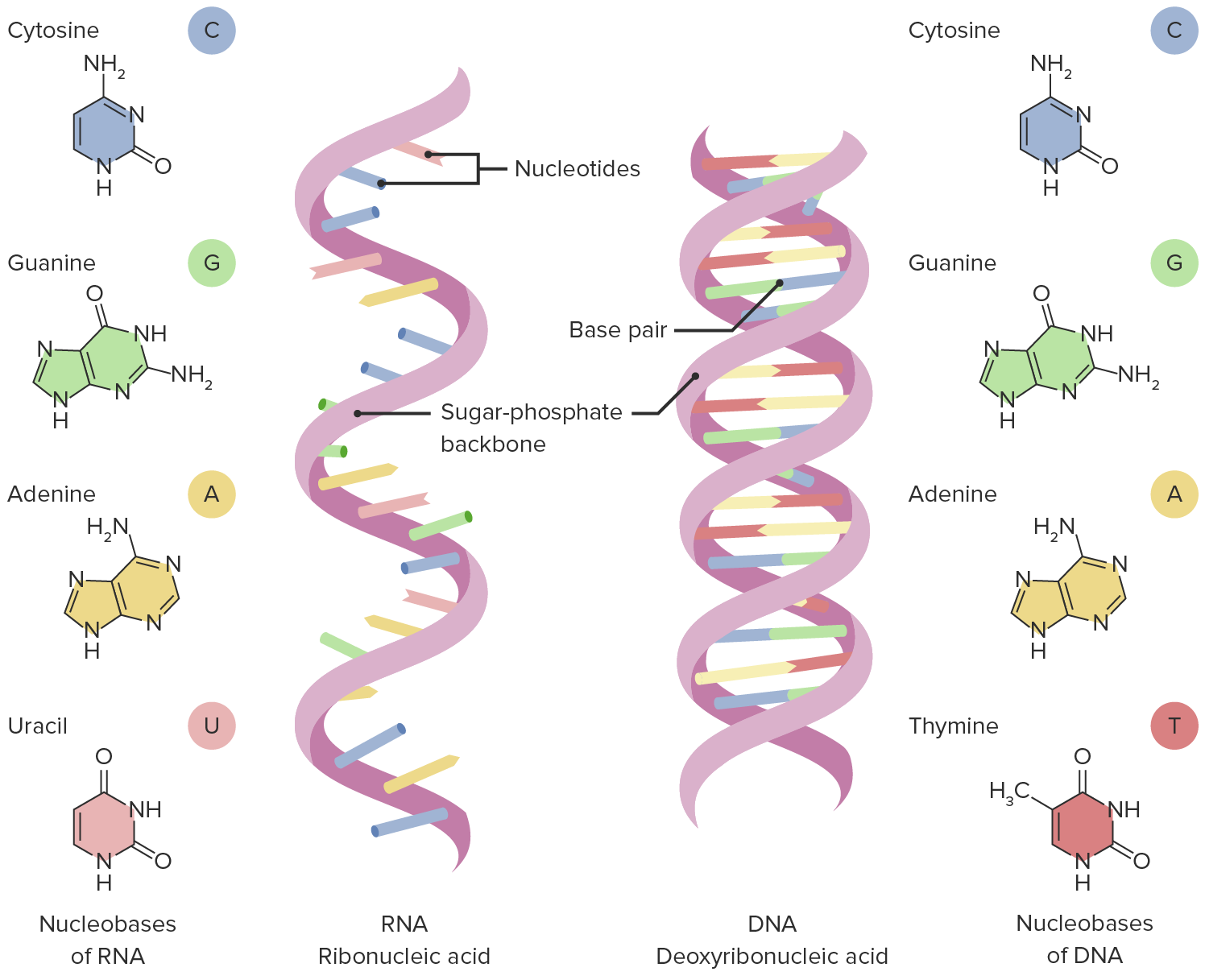
O DNADNAA deoxyribonucleotide polymer that is the primary genetic material of all cells. Eukaryotic and prokaryotic organisms normally contain DNA in a double-stranded state, yet several important biological processes transiently involve single-stranded regions. DNA, which consists of a polysugar-phosphate backbone possessing projections of purines (adenine and guanine) and pyrimidines (thymine and cytosine), forms a double helix that is held together by hydrogen bonds between these purines and pyrimidines (adenine to thymine and guanine to cytosine).DNA Types and Structure é uma molécula de dupla hélice composta por 2 cadeias antiparalelas. O DNADNAA deoxyribonucleotide polymer that is the primary genetic material of all cells. Eukaryotic and prokaryotic organisms normally contain DNA in a double-stranded state, yet several important biological processes transiently involve single-stranded regions. DNA, which consists of a polysugar-phosphate backbone possessing projections of purines (adenine and guanine) and pyrimidines (thymine and cytosine), forms a double helix that is held together by hydrogen bonds between these purines and pyrimidines (adenine to thymine and guanine to cytosine).DNA Types and Structure tem uma estrutura que se parece com uma escada entrelaçada.
Os “lados” de cada escada:
São compostos por moléculas alternadas de desoxirribose (um açúcar de 5 carbonos) e de fosfato
As ligações de fosfodiester ligam o carbono 3′ num açúcar ao carbono 5′ no seguinte.
Os “degraus” da escada são feitos de moléculas que contêm nitrogénio, chamadas nucleótidos, frequentemente apelidadas de “bases”.
Pares de base do DNADNAA deoxyribonucleotide polymer that is the primary genetic material of all cells. Eukaryotic and prokaryotic organisms normally contain DNA in a double-stranded state, yet several important biological processes transiently involve single-stranded regions. DNA, which consists of a polysugar-phosphate backbone possessing projections of purines (adenine and guanine) and pyrimidines (thymine and cytosine), forms a double helix that is held together by hydrogen bonds between these purines and pyrimidines (adenine to thymine and guanine to cytosine).DNA Types and Structure:
Guanina (G), citosina (C), adenina (A), e timina (T)
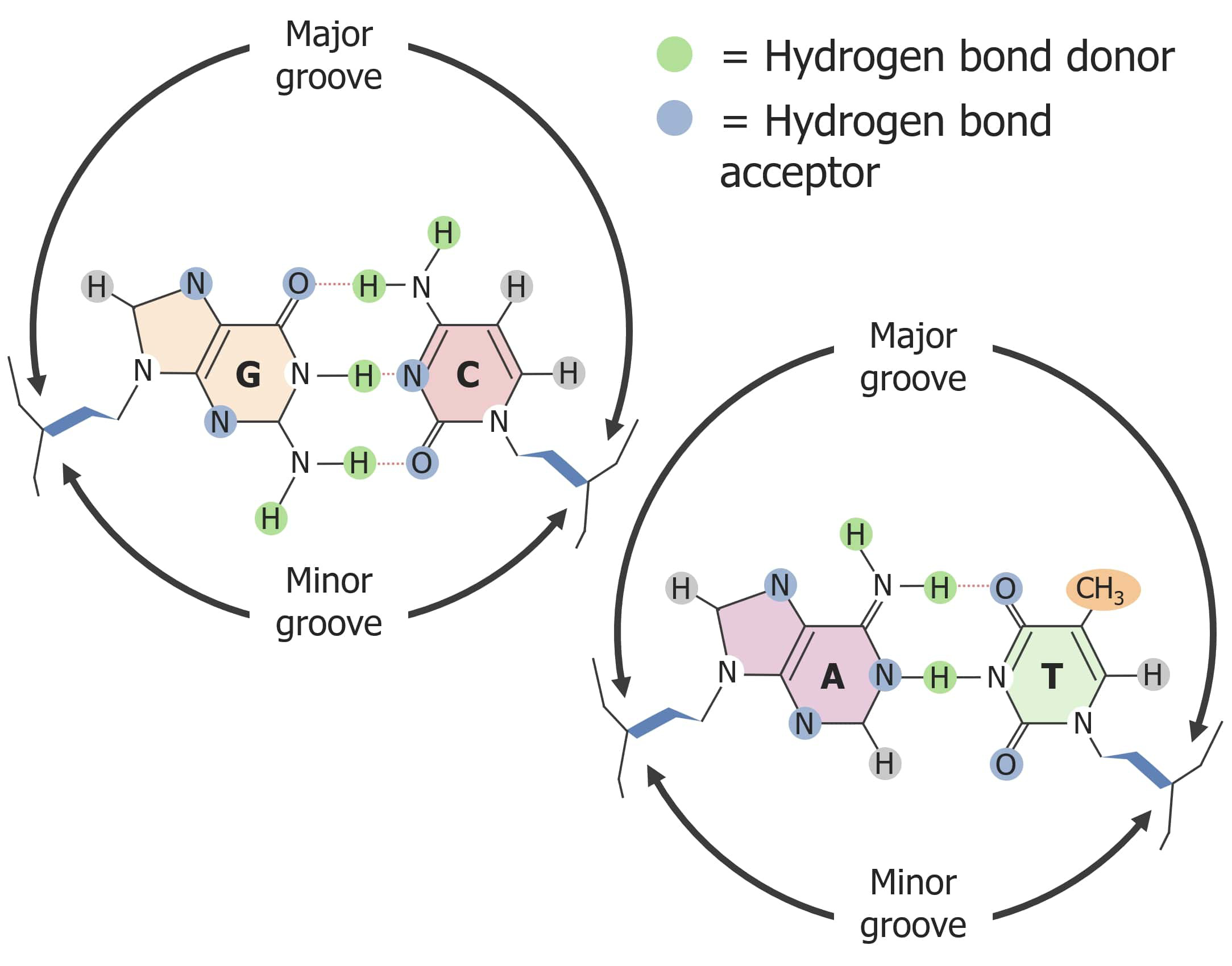
G emparelha-se com C (e vice-versa) através de 3 pontes de hidrogénio.
A emparelha-se com T (e vice-versa) através de 2 pontes de hidrogénio.
Estes pares de base podem ser “lidos” como uma sequência de letras (por exemplo, GTATCGA).
Esta sequência de letras é o “código”, ou manual de instruções, usado, em última análise, para criar proteínas.
Cadeias de DNADNAA deoxyribonucleotide polymer that is the primary genetic material of all cells. Eukaryotic and prokaryotic organisms normally contain DNA in a double-stranded state, yet several important biological processes transiently involve single-stranded regions. DNA, which consists of a polysugar-phosphate backbone possessing projections of purines (adenine and guanine) and pyrimidines (thymine and cytosine), forms a double helix that is held together by hydrogen bonds between these purines and pyrimidines (adenine to thymine and guanine to cytosine).DNA Types and Structure:
Devido à forma como os açúcares estão orientados, 1 cadeia vai na direção de 5′ → 3′ enquanto a outra vai na direção de 3′ → 5′.
Cadeia codificante: a cadeia que contém o código genético primário
Cadeia modelo:
A cadeia oposta à cadeia de codificação: contém os pares de bases “opostos” aos da cadeia codificante.
Esta é a cadeia que é lida durante a transcrição.
Vincos:
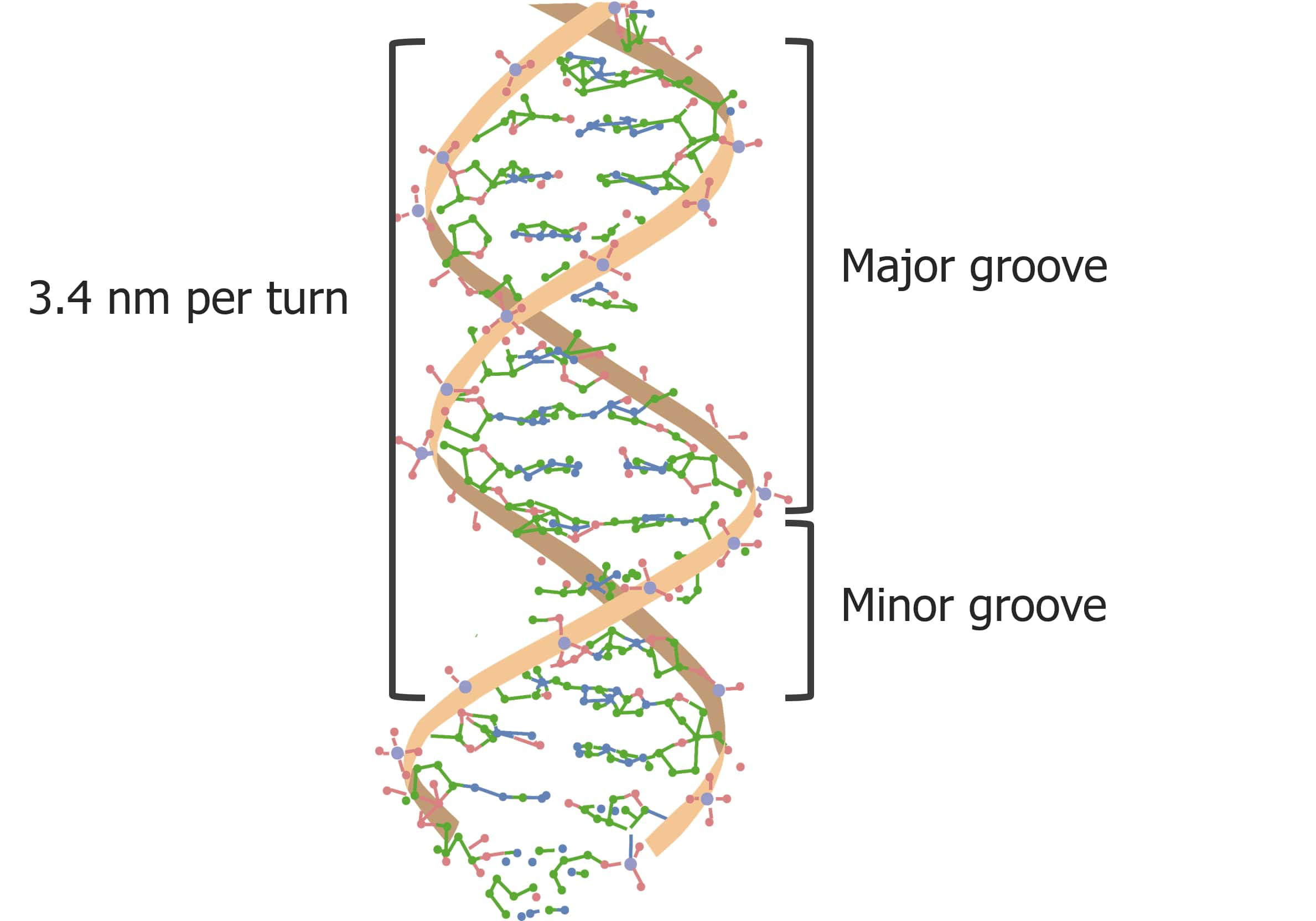
A hélice de DNADNAA deoxyribonucleotide polymer that is the primary genetic material of all cells. Eukaryotic and prokaryotic organisms normally contain DNA in a double-stranded state, yet several important biological processes transiently involve single-stranded regions. DNA, which consists of a polysugar-phosphate backbone possessing projections of purines (adenine and guanine) and pyrimidines (thymine and cytosine), forms a double helix that is held together by hydrogen bonds between these purines and pyrimidines (adenine to thymine and guanine to cytosine).DNA Types and Structure é assimétrica à medida que roda.
Esta rotação cria vincos maiores e menores entre espirais.
O vinco principal é suficientemente largo para que muitas proteínas reguladoras se possam ligar diretamente ao DNADNAA deoxyribonucleotide polymer that is the primary genetic material of all cells. Eukaryotic and prokaryotic organisms normally contain DNA in a double-stranded state, yet several important biological processes transiently involve single-stranded regions. DNA, which consists of a polysugar-phosphate backbone possessing projections of purines (adenine and guanine) and pyrimidines (thymine and cytosine), forms a double helix that is held together by hydrogen bonds between these purines and pyrimidines (adenine to thymine and guanine to cytosine).DNA Types and Structure através desse espaço.
O DNADNAA deoxyribonucleotide polymer that is the primary genetic material of all cells. Eukaryotic and prokaryotic organisms normally contain DNA in a double-stranded state, yet several important biological processes transiently involve single-stranded regions. DNA, which consists of a polysugar-phosphate backbone possessing projections of purines (adenine and guanine) and pyrimidines (thymine and cytosine), forms a double helix that is held together by hydrogen bonds between these purines and pyrimidines (adenine to thymine and guanine to cytosine).DNA Types and Structure é carregado negativamente (devido às moléculas de fosfato).
Estruturas de RNA e DNA
Image by Lecturio.
Os vincos maiores e menores no ADN:
A maioria das proteínas reguladoras liga-se ao vinco principal da hélice de DNA. O vinco principal dá acesso aos dadores de pontes de hidrogénio do nucleótido.
Image by Lecturio.
Os vincos maiores e menores do DNA: O vinco principal dá acesso aos dadores de pontes de hidrogénio do nucleótido.
Image by Lecturio.
RNARNAA polynucleotide consisting essentially of chains with a repeating backbone of phosphate and ribose units to which nitrogenous bases are attached. RNA is unique among biological macromolecules in that it can encode genetic information, serve as an abundant structural component of cells, and also possesses catalytic activity.RNA Types and Structure
Estrutura geral:
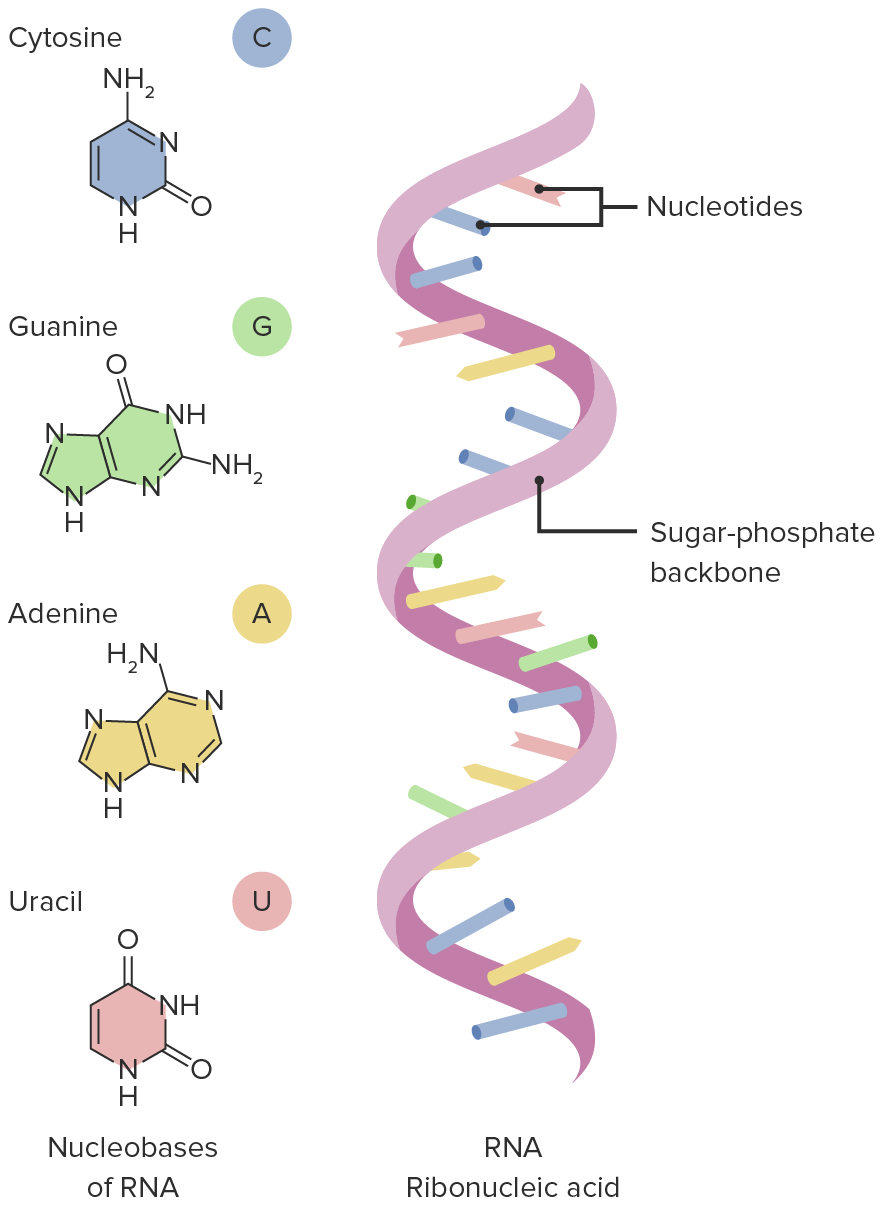
Uma molécula de cadeia simples composta por moléculas alternadas de riboseRiboseA pentose active in biological systems usually in its d-form.Nucleic Acids (um açúcar de 5-carbono) e fosfato
Cada riboseRiboseA pentose active in biological systems usually in its d-form.Nucleic Acids está ligada a um nucleótido de RNARNAA polynucleotide consisting essentially of chains with a repeating backbone of phosphate and ribose units to which nitrogenous bases are attached. RNA is unique among biological macromolecules in that it can encode genetic information, serve as an abundant structural component of cells, and also possesses catalytic activity.RNA Types and Structure:
Guanina (G), citosina (C), adenina (A), e uracilo (U)
Note-se que ao invés de timina, A liga-se a U (e vice-versa) através de 2 pontes de hidrogénio.
molécula de RNA
Image by Lecturio.
Tipos de RNARNAA polynucleotide consisting essentially of chains with a repeating backbone of phosphate and ribose units to which nitrogenous bases are attached. RNA is unique among biological macromolecules in that it can encode genetic information, serve as an abundant structural component of cells, and also possesses catalytic activity.RNA Types and Structure:
mRNAmRNARNA sequences that serve as templates for protein synthesis. Bacterial mRNAs are generally primary transcripts in that they do not require post-transcriptional processing. Eukaryotic mRNA is synthesized in the nucleus and must be exported to the cytoplasm for translation. Most eukaryotic mRNAs have a sequence of polyadenylic acid at the 3′ end, referred to as the poly(a) tail. The function of this tail is not known for certain, but it may play a role in the export of mature mRNA from the nucleus as well as in helping stabilize some mRNA molecules by retarding their degradation in the cytoplasm.RNA Types and Structure:
É criado durante a transcrição, a partir da cadeia modelo do DNADNAA deoxyribonucleotide polymer that is the primary genetic material of all cells. Eukaryotic and prokaryotic organisms normally contain DNA in a double-stranded state, yet several important biological processes transiently involve single-stranded regions. DNA, which consists of a polysugar-phosphate backbone possessing projections of purines (adenine and guanine) and pyrimidines (thymine and cytosine), forms a double helix that is held together by hydrogen bonds between these purines and pyrimidines (adenine to thymine and guanine to cytosine).DNA Types and Structure no núcleo.
Movimenta-se para o citosol para a tradução em polipéptidos por ribossomas
rRNArRNAThe most abundant form of RNA. Together with proteins, it forms the ribosomes, playing a structural role and also a role in ribosomal binding of mRNA and tRNAs. Individual chains are conventionally designated by their sedimentation coefficients. In eukaryotes, four large chains exist, synthesized in the nucleolus and constituting about 50% of the ribosome.RNA Types and Structure: um componente dos complexos ribossómicos responsáveis pela síntese de proteínas
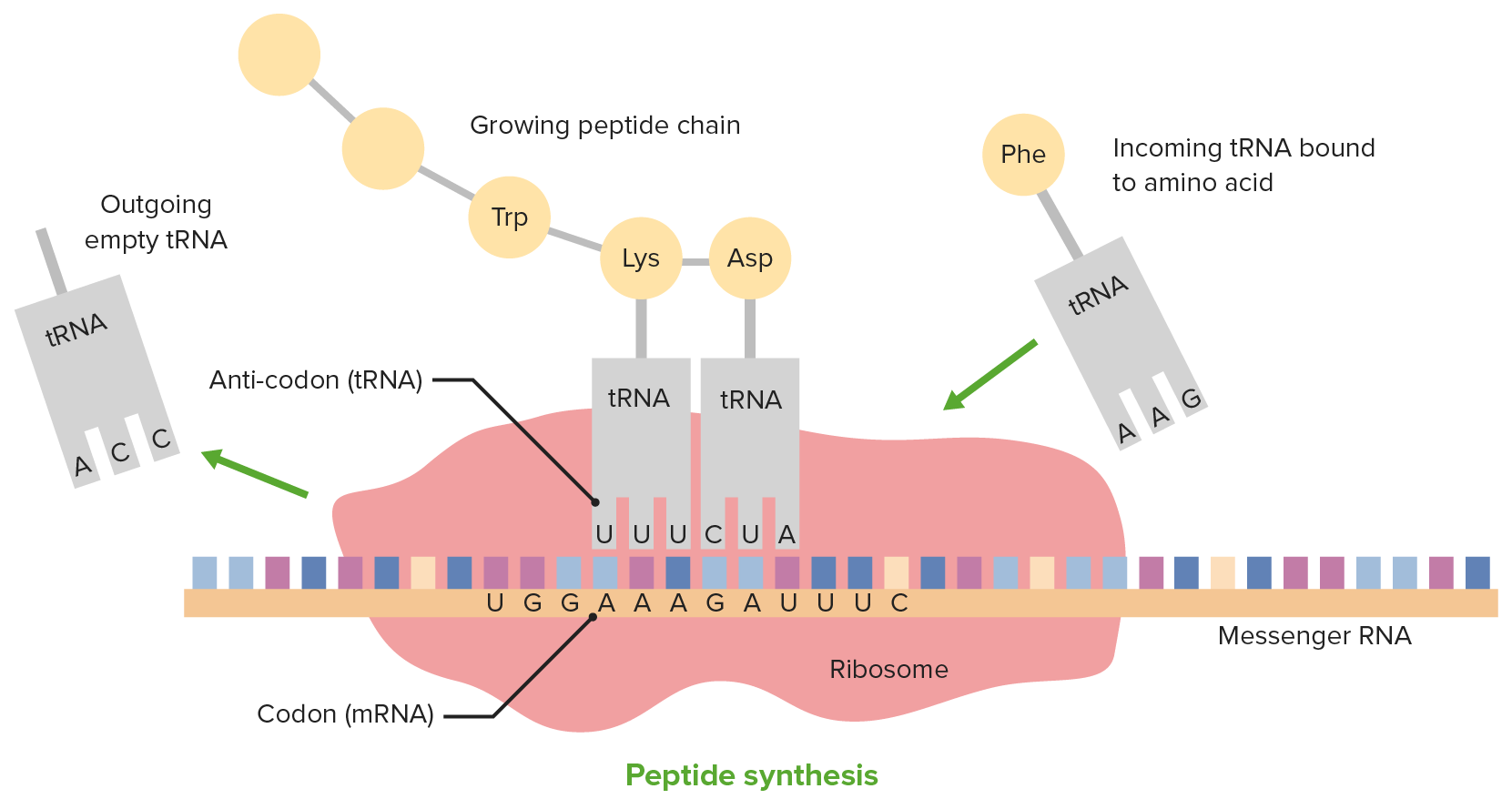
tRNAtRNAThe small RNA molecules, 73-80 nucleotides long, that function during translation (translation, genetic) to align amino acids at the ribosomes in a sequence determined by the mRNA (RNA, messenger). There are about 30 different transfer rnas. Each recognizes a specific codon set on the mRNA through its own anticodon and as aminoacyl trnas (RNA, transfer, amino Acyl), each carries a specific amino acid to the ribosome to add to the elongating peptide chains.RNA Types and Structure: transporta aminoácidos para o ribossoma, onde eles se ligam ao mRNAmRNARNA sequences that serve as templates for protein synthesis. Bacterial mRNAs are generally primary transcripts in that they do not require post-transcriptional processing. Eukaryotic mRNA is synthesized in the nucleus and must be exported to the cytoplasm for translation. Most eukaryotic mRNAs have a sequence of polyadenylic acid at the 3′ end, referred to as the poly(a) tail. The function of this tail is not known for certain, but it may play a role in the export of mature mRNA from the nucleus as well as in helping stabilize some mRNA molecules by retarding their degradation in the cytoplasm.RNA Types and Structure, alinhando os aminoácidos que se ligarão para formar o polipéptido
A interação entre mRNA, tRNA e aminoácidos durante a síntese do péptido (ou seja, a tradução)
A transcrição começa numa região conhecida como promotora. Uma enzima chamada RNARNAA polynucleotide consisting essentially of chains with a repeating backbone of phosphate and ribose units to which nitrogenous bases are attached. RNA is unique among biological macromolecules in that it can encode genetic information, serve as an abundant structural component of cells, and also possesses catalytic activity.RNA Types and Structure polimerase lê a cadeia de DNADNAA deoxyribonucleotide polymer that is the primary genetic material of all cells. Eukaryotic and prokaryotic organisms normally contain DNA in a double-stranded state, yet several important biological processes transiently involve single-stranded regions. DNA, which consists of a polysugar-phosphate backbone possessing projections of purines (adenine and guanine) and pyrimidines (thymine and cytosine), forms a double helix that is held together by hydrogen bonds between these purines and pyrimidines (adenine to thymine and guanine to cytosine).DNA Types and Structure modelo e cria o mRNAmRNARNA sequences that serve as templates for protein synthesis. Bacterial mRNAs are generally primary transcripts in that they do not require post-transcriptional processing. Eukaryotic mRNA is synthesized in the nucleus and must be exported to the cytoplasm for translation. Most eukaryotic mRNAs have a sequence of polyadenylic acid at the 3′ end, referred to as the poly(a) tail. The function of this tail is not known for certain, but it may play a role in the export of mature mRNA from the nucleus as well as in helping stabilize some mRNA molecules by retarding their degradation in the cytoplasm.RNA Types and Structure. São necessárias proteínas adicionais, conhecidas como fatores de transcrição, para que a RNARNAA polynucleotide consisting essentially of chains with a repeating backbone of phosphate and ribose units to which nitrogenous bases are attached. RNA is unique among biological macromolecules in that it can encode genetic information, serve as an abundant structural component of cells, and also possesses catalytic activity.RNA Types and Structure polimerase se ligue à sequência promotora em eucariontes.
Sequências promotoras
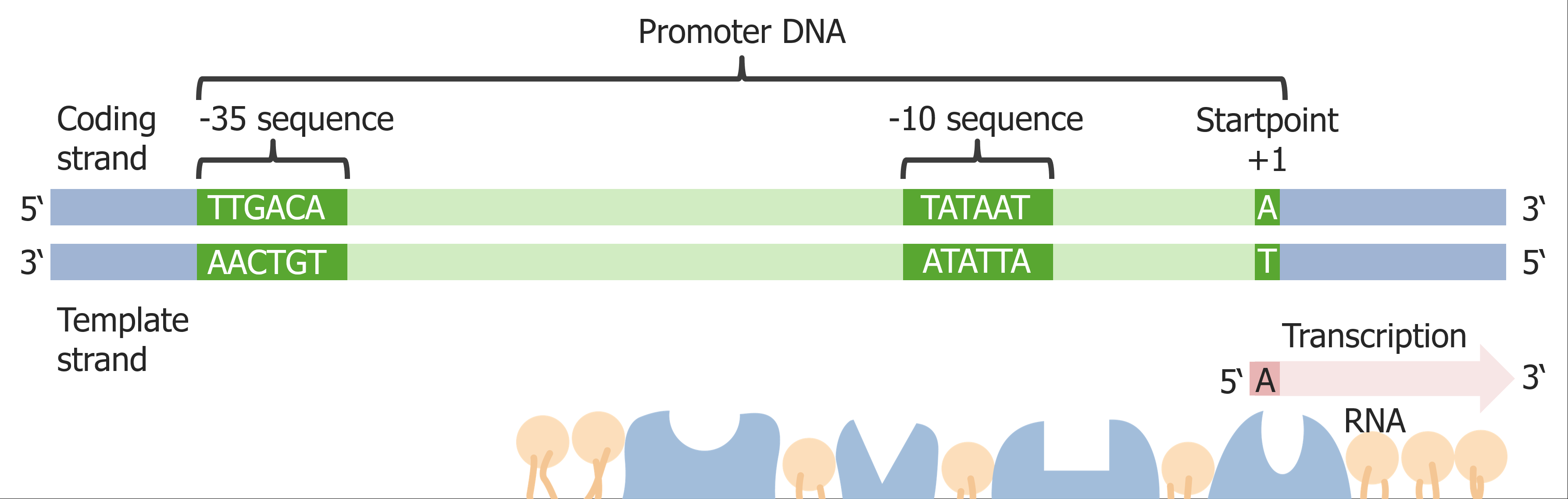
Os promotoressão regiões ricas em AT que sinalizam o ponto de partida para a transcrição:
Normalmente, imediatamente a montante do geneGeneA category of nucleic acid sequences that function as units of heredity and which code for the basic instructions for the development, reproduction, and maintenance of organisms.Basic Terms of Genetics alvo.
O local de ligação para a polimerase do RNARNAA polynucleotide consisting essentially of chains with a repeating backbone of phosphate and ribose units to which nitrogenous bases are attached. RNA is unique among biological macromolecules in that it can encode genetic information, serve as an abundant structural component of cells, and also possesses catalytic activity.RNA Types and Structure
Requer múltiplos fatores de transcrição em eucariontes
Requer apenas fator sigma em procariontes
Permite que a RNARNAA polynucleotide consisting essentially of chains with a repeating backbone of phosphate and ribose units to which nitrogenous bases are attached. RNA is unique among biological macromolecules in that it can encode genetic information, serve as an abundant structural component of cells, and also possesses catalytic activity.RNA Types and Structure polimerase determine qual é a cadeia codificante e qual é a cadeia modelo, com base na orientação da sequência
Mutações no promotor levam a uma transcrição reduzida.
Diagrama de uma sequência promotora:
Os -35 e -10 indicam que existem 35 e 10 bases, respetivamente, até o ponto de partida.
Image by Lecturio.
RNARNAA polynucleotide consisting essentially of chains with a repeating backbone of phosphate and ribose units to which nitrogenous bases are attached. RNA is unique among biological macromolecules in that it can encode genetic information, serve as an abundant structural component of cells, and also possesses catalytic activity.RNA Types and Structure polimerases
As RNARNAA polynucleotide consisting essentially of chains with a repeating backbone of phosphate and ribose units to which nitrogenous bases are attached. RNA is unique among biological macromolecules in that it can encode genetic information, serve as an abundant structural component of cells, and also possesses catalytic activity.RNA Types and Structure polimerases são enzimas que leem a cadeiamodelo do DNADNAA deoxyribonucleotide polymer that is the primary genetic material of all cells. Eukaryotic and prokaryotic organisms normally contain DNA in a double-stranded state, yet several important biological processes transiently involve single-stranded regions. DNA, which consists of a polysugar-phosphate backbone possessing projections of purines (adenine and guanine) and pyrimidines (thymine and cytosine), forms a double helix that is held together by hydrogen bonds between these purines and pyrimidines (adenine to thymine and guanine to cytosine).DNA Types and Structure e criam a cadeia de mRNAmRNARNA sequences that serve as templates for protein synthesis. Bacterial mRNAs are generally primary transcripts in that they do not require post-transcriptional processing. Eukaryotic mRNA is synthesized in the nucleus and must be exported to the cytoplasm for translation. Most eukaryotic mRNAs have a sequence of polyadenylic acid at the 3′ end, referred to as the poly(a) tail. The function of this tail is not known for certain, but it may play a role in the export of mature mRNA from the nucleus as well as in helping stabilize some mRNA molecules by retarding their degradation in the cytoplasm.RNA Types and Structure correspondente. São compostas por várias subunidades.
Células procarióticas:
Apenas têm 1 tipo de RNARNAA polynucleotide consisting essentially of chains with a repeating backbone of phosphate and ribose units to which nitrogenous bases are attached. RNA is unique among biological macromolecules in that it can encode genetic information, serve as an abundant structural component of cells, and also possesses catalytic activity.RNA Types and Structure polimerase
Requerem apenas uma única proteína, conhecida como fator sigma, para se ligar à sequência promotora
Células eucarióticas:
Existem 3 tipos:
A RNARNAA polynucleotide consisting essentially of chains with a repeating backbone of phosphate and ribose units to which nitrogenous bases are attached. RNA is unique among biological macromolecules in that it can encode genetic information, serve as an abundant structural component of cells, and also possesses catalytic activity.RNA Types and Structure polimerase I (pol I) sintetiza o rRNArRNAThe most abundant form of RNA. Together with proteins, it forms the ribosomes, playing a structural role and also a role in ribosomal binding of mRNA and tRNAs. Individual chains are conventionally designated by their sedimentation coefficients. In eukaryotes, four large chains exist, synthesized in the nucleolus and constituting about 50% of the ribosome.RNA Types and Structure.
A RNARNAA polynucleotide consisting essentially of chains with a repeating backbone of phosphate and ribose units to which nitrogenous bases are attached. RNA is unique among biological macromolecules in that it can encode genetic information, serve as an abundant structural component of cells, and also possesses catalytic activity.RNA Types and Structure polimerase II (pol II) sintetiza o mRNAmRNARNA sequences that serve as templates for protein synthesis. Bacterial mRNAs are generally primary transcripts in that they do not require post-transcriptional processing. Eukaryotic mRNA is synthesized in the nucleus and must be exported to the cytoplasm for translation. Most eukaryotic mRNAs have a sequence of polyadenylic acid at the 3′ end, referred to as the poly(a) tail. The function of this tail is not known for certain, but it may play a role in the export of mature mRNA from the nucleus as well as in helping stabilize some mRNA molecules by retarding their degradation in the cytoplasm.RNA Types and Structure.
A RNARNAA polynucleotide consisting essentially of chains with a repeating backbone of phosphate and ribose units to which nitrogenous bases are attached. RNA is unique among biological macromolecules in that it can encode genetic information, serve as an abundant structural component of cells, and also possesses catalytic activity.RNA Types and Structure polimerase III (pol III) sintetiza o tRNAtRNAThe small RNA molecules, 73-80 nucleotides long, that function during translation (translation, genetic) to align amino acids at the ribosomes in a sequence determined by the mRNA (RNA, messenger). There are about 30 different transfer rnas. Each recognizes a specific codon set on the mRNA through its own anticodon and as aminoacyl trnas (RNA, transfer, amino Acyl), each carries a specific amino acid to the ribosome to add to the elongating peptide chains.RNA Types and Structure.
São necessários múltiplos fatores de transcrição que se ligam ao DNADNAA deoxyribonucleotide polymer that is the primary genetic material of all cells. Eukaryotic and prokaryotic organisms normally contain DNA in a double-stranded state, yet several important biological processes transiently involve single-stranded regions. DNA, which consists of a polysugar-phosphate backbone possessing projections of purines (adenine and guanine) and pyrimidines (thymine and cytosine), forms a double helix that is held together by hydrogen bonds between these purines and pyrimidines (adenine to thymine and guanine to cytosine).DNA Types and Structure na sequência promotora (o RNARNAA polynucleotide consisting essentially of chains with a repeating backbone of phosphate and ribose units to which nitrogenous bases are attached. RNA is unique among biological macromolecules in that it can encode genetic information, serve as an abundant structural component of cells, and also possesses catalytic activity.RNA Types and Structure pol II não se pode ligar ao ADN por si só).
Fatores de transcrição
Os fatores de transcrição (TF pela sigla em inglês) são proteínas que se ligam à região promotora e são necessários para que a RNARNAA polynucleotide consisting essentially of chains with a repeating backbone of phosphate and ribose units to which nitrogenous bases are attached. RNA is unique among biological macromolecules in that it can encode genetic information, serve as an abundant structural component of cells, and also possesses catalytic activity.RNA Types and Structure pol II se ligue ao DNADNAA deoxyribonucleotide polymer that is the primary genetic material of all cells. Eukaryotic and prokaryotic organisms normally contain DNA in a double-stranded state, yet several important biological processes transiently involve single-stranded regions. DNA, which consists of a polysugar-phosphate backbone possessing projections of purines (adenine and guanine) and pyrimidines (thymine and cytosine), forms a double helix that is held together by hydrogen bonds between these purines and pyrimidines (adenine to thymine and guanine to cytosine).DNA Types and Structure em eucariontes.
Cada TF ajuda a regularRegularInsulin a expressão génica.
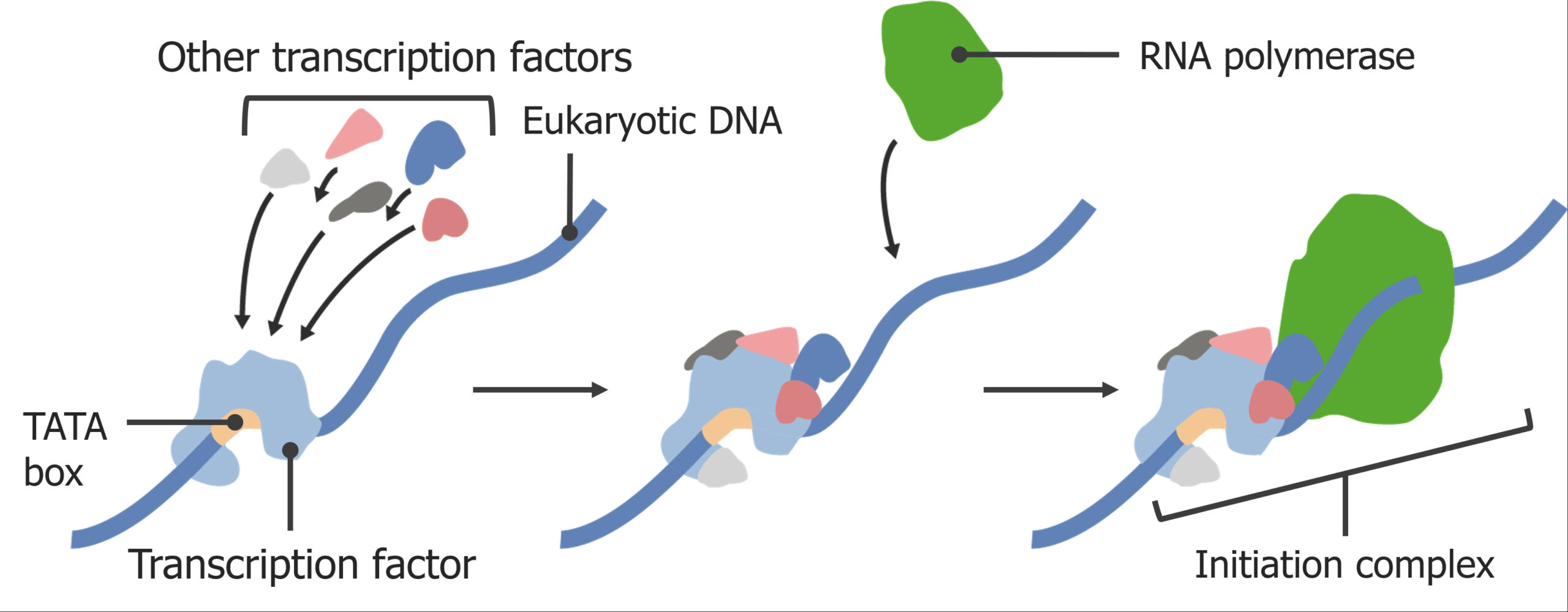
Complexo de iniciação: o complexo de fatores de transcrição e RNARNAA polynucleotide consisting essentially of chains with a repeating backbone of phosphate and ribose units to which nitrogenous bases are attached. RNA is unique among biological macromolecules in that it can encode genetic information, serve as an abundant structural component of cells, and also possesses catalytic activity.RNA Types and Structure pol II na sequência promotora
Assim que o complexo de iniciação for montado no promotor, a transcrição pode começar.
Montagem do complexo de iniciação:
Anexação de fatores de transcrição e RNA polimerase II à sequência promotora. Outros fatores de transcrição ligam-se para formar o complexo de iniciação. A RNA polimerase II junta-se, e a transcrição começa.
Após a montagem do complexo de iniciação no promotor, o alongamento da transcriçãopode começar. É nesta fase que o mRNAmRNARNA sequences that serve as templates for protein synthesis. Bacterial mRNAs are generally primary transcripts in that they do not require post-transcriptional processing. Eukaryotic mRNA is synthesized in the nucleus and must be exported to the cytoplasm for translation. Most eukaryotic mRNAs have a sequence of polyadenylic acid at the 3′ end, referred to as the poly(a) tail. The function of this tail is not known for certain, but it may play a role in the export of mature mRNA from the nucleus as well as in helping stabilize some mRNA molecules by retarding their degradation in the cytoplasm.RNA Types and Structure é criado.
Ocorre dentro da bolha de transcrição
Após a iniciação, os fatores de alongamento adicionais montam-se:
Proteínas adicionais que ajudam a “empurrar” a RNARNAA polynucleotide consisting essentially of chains with a repeating backbone of phosphate and ribose units to which nitrogenous bases are attached. RNA is unique among biological macromolecules in that it can encode genetic information, serve as an abundant structural component of cells, and also possesses catalytic activity.RNA Types and Structure pol II
Locais adicionais de regulação transcricional
Os nucleótidos correspondentes são trazidos para a RNARNAA polynucleotide consisting essentially of chains with a repeating backbone of phosphate and ribose units to which nitrogenous bases are attached. RNA is unique among biological macromolecules in that it can encode genetic information, serve as an abundant structural component of cells, and also possesses catalytic activity.RNA Types and Structure polimerase:
Estes nucleótidos “trazem a sua própria energia com eles”.
A enzima constrói um novo filamento de mRNAmRNARNA sequences that serve as templates for protein synthesis. Bacterial mRNAs are generally primary transcripts in that they do not require post-transcriptional processing. Eukaryotic mRNA is synthesized in the nucleus and must be exported to the cytoplasm for translation. Most eukaryotic mRNAs have a sequence of polyadenylic acid at the 3′ end, referred to as the poly(a) tail. The function of this tail is not known for certain, but it may play a role in the export of mature mRNA from the nucleus as well as in helping stabilize some mRNA molecules by retarding their degradation in the cytoplasm.RNA Types and Structure ao criar ligações fosfodiéster entre estes nucleótidos.
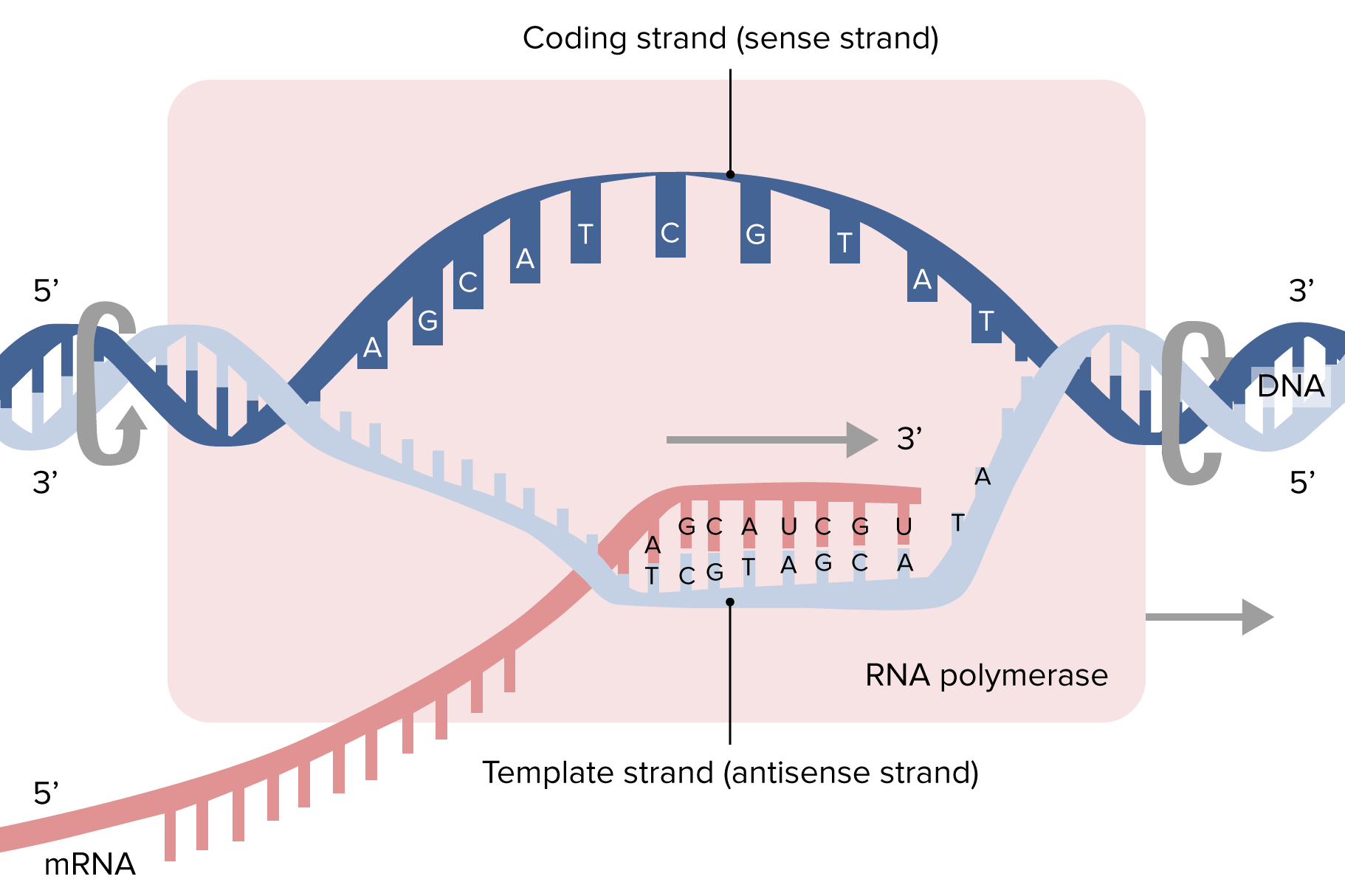
A RNARNAA polynucleotide consisting essentially of chains with a repeating backbone of phosphate and ribose units to which nitrogenous bases are attached. RNA is unique among biological macromolecules in that it can encode genetic information, serve as an abundant structural component of cells, and also possesses catalytic activity.RNA Types and Structure pol II lê o modelo de DNADNAA deoxyribonucleotide polymer that is the primary genetic material of all cells. Eukaryotic and prokaryotic organisms normally contain DNA in a double-stranded state, yet several important biological processes transiently involve single-stranded regions. DNA, which consists of a polysugar-phosphate backbone possessing projections of purines (adenine and guanine) and pyrimidines (thymine and cytosine), forms a double helix that is held together by hydrogen bonds between these purines and pyrimidines (adenine to thymine and guanine to cytosine).DNA Types and Structure de 3′ a 5′ → produz mRNAmRNARNA sequences that serve as templates for protein synthesis. Bacterial mRNAs are generally primary transcripts in that they do not require post-transcriptional processing. Eukaryotic mRNA is synthesized in the nucleus and must be exported to the cytoplasm for translation. Most eukaryotic mRNAs have a sequence of polyadenylic acid at the 3′ end, referred to as the poly(a) tail. The function of this tail is not known for certain, but it may play a role in the export of mature mRNA from the nucleus as well as in helping stabilize some mRNA molecules by retarding their degradation in the cytoplasm.RNA Types and Structure de 5′ a 3′
O RNARNAA polynucleotide consisting essentially of chains with a repeating backbone of phosphate and ribose units to which nitrogenous bases are attached. RNA is unique among biological macromolecules in that it can encode genetic information, serve as an abundant structural component of cells, and also possesses catalytic activity.RNA Types and Structure sintetizado de acordo com regras de emparelhamento de base: as purinas emparelham-se com as pirimidinas:
Adenina (purina) ↔ uracilo (pirimidina)
Guanina (purina) ↔ citosina (pirimidina)
Forma-se uma hélice temporária híbrida DNA-RNA.
A RNARNAA polynucleotide consisting essentially of chains with a repeating backbone of phosphate and ribose units to which nitrogenous bases are attached. RNA is unique among biological macromolecules in that it can encode genetic information, serve as an abundant structural component of cells, and also possesses catalytic activity.RNA Types and Structure pol II continua até que uma sequência de finalização de DNADNAA deoxyribonucleotide polymer that is the primary genetic material of all cells. Eukaryotic and prokaryotic organisms normally contain DNA in a double-stranded state, yet several important biological processes transiently involve single-stranded regions. DNA, which consists of a polysugar-phosphate backbone possessing projections of purines (adenine and guanine) and pyrimidines (thymine and cytosine), forms a double helix that is held together by hydrogen bonds between these purines and pyrimidines (adenine to thymine and guanine to cytosine).DNA Types and Structure seja encontrada pela maquinaria de transcrição.
A RNA polimerase lê a cadeia de DNA do modelo (azul-claro)
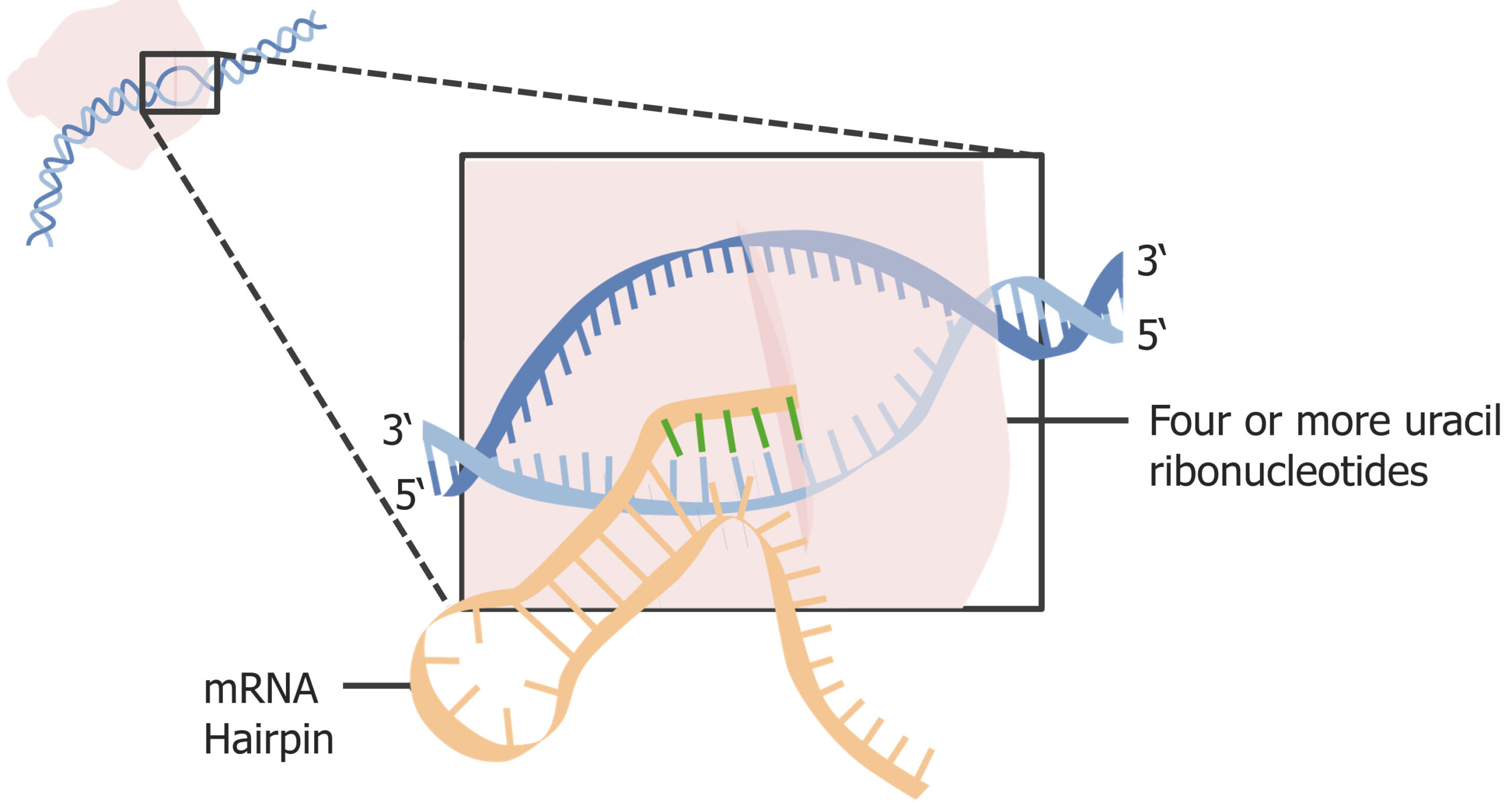
A finalização independente de fatores ocorre quando a maquinaria de transcrição atinge uma sequência de finalização.
Primeiro vem um palíndromo rico em GC:
Faz com que o RNARNAA polynucleotide consisting essentially of chains with a repeating backbone of phosphate and ribose units to which nitrogenous bases are attached. RNA is unique among biological macromolecules in that it can encode genetic information, serve as an abundant structural component of cells, and also possesses catalytic activity.RNA Types and Structure recentemente produzido forme um parPARThe PAR is the attributable risk for an entire population. It represents the fraction of cases that would not occur in a population if the exposure was eliminated.Measures of Risk de base consigo mesmo, criando uma estrutura em gancho de cabelo (hairpin)
A estrutura em gancho começa a desestabilizar o complexo DNA-RNA.
Estas ligações não conseguem manter o RNARNAA polynucleotide consisting essentially of chains with a repeating backbone of phosphate and ribose units to which nitrogenous bases are attached. RNA is unique among biological macromolecules in that it can encode genetic information, serve as an abundant structural component of cells, and also possesses catalytic activity.RNA Types and Structure no DNADNAA deoxyribonucleotide polymer that is the primary genetic material of all cells. Eukaryotic and prokaryotic organisms normally contain DNA in a double-stranded state, yet several important biological processes transiently involve single-stranded regions. DNA, which consists of a polysugar-phosphate backbone possessing projections of purines (adenine and guanine) and pyrimidines (thymine and cytosine), forms a double helix that is held together by hydrogen bonds between these purines and pyrimidines (adenine to thymine and guanine to cytosine).DNA Types and Structure → mRNAmRNARNA sequences that serve as templates for protein synthesis. Bacterial mRNAs are generally primary transcripts in that they do not require post-transcriptional processing. Eukaryotic mRNA is synthesized in the nucleus and must be exported to the cytoplasm for translation. Most eukaryotic mRNAs have a sequence of polyadenylic acid at the 3′ end, referred to as the poly(a) tail. The function of this tail is not known for certain, but it may play a role in the export of mature mRNA from the nucleus as well as in helping stabilize some mRNA molecules by retarding their degradation in the cytoplasm.RNA Types and Structure cai
Formação de uma estrutura em gancho no final da transcrição:
A RNA polimerase liberta o ADN assim que este chega à sequência finalizadora. O gancho de cabelo é formado por uma série de pares de base G-C seguidas por pares de base A-T.
Image by Lecturio.
Finalização dependente de Rho
A proteína Rho liga-se à cauda do novo RNARNAA polynucleotide consisting essentially of chains with a repeating backbone of phosphate and ribose units to which nitrogenous bases are attached. RNA is unique among biological macromolecules in that it can encode genetic information, serve as an abundant structural component of cells, and also possesses catalytic activity.RNA Types and Structure
Usando a energia da hidrólise do ATP, a proteína Rho “sobe” a cauda mais rapidamente do que o movimento da RNA polimerase e “alcança” a RNARNAA polynucleotide consisting essentially of chains with a repeating backbone of phosphate and ribose units to which nitrogenous bases are attached. RNA is unique among biological macromolecules in that it can encode genetic information, serve as an abundant structural component of cells, and also possesses catalytic activity.RNA Types and Structure polimerase no momento correto.
Causa a dissociação do RNARNAA polynucleotide consisting essentially of chains with a repeating backbone of phosphate and ribose units to which nitrogenous bases are attached. RNA is unique among biological macromolecules in that it can encode genetic information, serve as an abundant structural component of cells, and also possesses catalytic activity.RNA Types and Structure e da RNARNAA polynucleotide consisting essentially of chains with a repeating backbone of phosphate and ribose units to which nitrogenous bases are attached. RNA is unique among biological macromolecules in that it can encode genetic information, serve as an abundant structural component of cells, and also possesses catalytic activity.RNA Types and Structure polimerase do DNADNAA deoxyribonucleotide polymer that is the primary genetic material of all cells. Eukaryotic and prokaryotic organisms normally contain DNA in a double-stranded state, yet several important biological processes transiently involve single-stranded regions. DNA, which consists of a polysugar-phosphate backbone possessing projections of purines (adenine and guanine) and pyrimidines (thymine and cytosine), forms a double helix that is held together by hydrogen bonds between these purines and pyrimidines (adenine to thymine and guanine to cytosine).DNA Types and Structure modelo
Pode ocorrer em conjunto com a finalização causada pela sequência finalizadora
Após o mRNAmRNARNA sequences that serve as templates for protein synthesis. Bacterial mRNAs are generally primary transcripts in that they do not require post-transcriptional processing. Eukaryotic mRNA is synthesized in the nucleus and must be exported to the cytoplasm for translation. Most eukaryotic mRNAs have a sequence of polyadenylic acid at the 3′ end, referred to as the poly(a) tail. The function of this tail is not known for certain, but it may play a role in the export of mature mRNA from the nucleus as well as in helping stabilize some mRNA molecules by retarding their degradation in the cytoplasm.RNA Types and Structure ser sintetizado em eucariontes, ele é modificado para evitar a degradação imediata. Estas modificações incluem splicing, adição de cabeças/caudas e poliadenilação.
Splicing
Os intrões não codificantes são retirados por spliceossomas (complexos de ribonucleoproteínas enzimáticas)
Múltiplas proteínas diferentes podem ser feitas a partir de um único geneGeneA category of nucleic acid sequences that function as units of heredity and which code for the basic instructions for the development, reproduction, and maintenance of organisms.Basic Terms of Genetics com splicing diferencial
Adição de cabeças/caudas
Durante a adição de cabeças/caudas, uma guanosina metilada (m7G) é adicionada ao terminal 5′ do mRNAmRNARNA sequences that serve as templates for protein synthesis. Bacterial mRNAs are generally primary transcripts in that they do not require post-transcriptional processing. Eukaryotic mRNA is synthesized in the nucleus and must be exported to the cytoplasm for translation. Most eukaryotic mRNAs have a sequence of polyadenylic acid at the 3′ end, referred to as the poly(a) tail. The function of this tail is not known for certain, but it may play a role in the export of mature mRNA from the nucleus as well as in helping stabilize some mRNA molecules by retarding their degradation in the cytoplasm.RNA Types and Structure:
Impede que o mRNAmRNARNA sequences that serve as templates for protein synthesis. Bacterial mRNAs are generally primary transcripts in that they do not require post-transcriptional processing. Eukaryotic mRNA is synthesized in the nucleus and must be exported to the cytoplasm for translation. Most eukaryotic mRNAs have a sequence of polyadenylic acid at the 3′ end, referred to as the poly(a) tail. The function of this tail is not known for certain, but it may play a role in the export of mature mRNA from the nucleus as well as in helping stabilize some mRNA molecules by retarding their degradation in the cytoplasm.RNA Types and Structure seja ligado a outras cadeias de RNARNAA polynucleotide consisting essentially of chains with a repeating backbone of phosphate and ribose units to which nitrogenous bases are attached. RNA is unique among biological macromolecules in that it can encode genetic information, serve as an abundant structural component of cells, and also possesses catalytic activity.RNA Types and Structure
Protege o mRNAmRNARNA sequences that serve as templates for protein synthesis. Bacterial mRNAs are generally primary transcripts in that they do not require post-transcriptional processing. Eukaryotic mRNA is synthesized in the nucleus and must be exported to the cytoplasm for translation. Most eukaryotic mRNAs have a sequence of polyadenylic acid at the 3′ end, referred to as the poly(a) tail. The function of this tail is not known for certain, but it may play a role in the export of mature mRNA from the nucleus as well as in helping stabilize some mRNA molecules by retarding their degradation in the cytoplasm.RNA Types and Structure da degradação
Promove a translocação do mRNAmRNARNA sequences that serve as templates for protein synthesis. Bacterial mRNAs are generally primary transcripts in that they do not require post-transcriptional processing. Eukaryotic mRNA is synthesized in the nucleus and must be exported to the cytoplasm for translation. Most eukaryotic mRNAs have a sequence of polyadenylic acid at the 3′ end, referred to as the poly(a) tail. The function of this tail is not known for certain, but it may play a role in the export of mature mRNA from the nucleus as well as in helping stabilize some mRNA molecules by retarding their degradation in the cytoplasm.RNA Types and Structure do núcleo para o citoplasma
Facilita a ligação do mRNAmRNARNA sequences that serve as templates for protein synthesis. Bacterial mRNAs are generally primary transcripts in that they do not require post-transcriptional processing. Eukaryotic mRNA is synthesized in the nucleus and must be exported to the cytoplasm for translation. Most eukaryotic mRNAs have a sequence of polyadenylic acid at the 3′ end, referred to as the poly(a) tail. The function of this tail is not known for certain, but it may play a role in the export of mature mRNA from the nucleus as well as in helping stabilize some mRNA molecules by retarding their degradation in the cytoplasm.RNA Types and Structure ao ribossoma para iniciar a tradução
Poliadenilação
Durante a poliadenilação,uma cauda de moléculas de adenina é adicionada à extremidade 3′ do mRNAmRNARNA sequences that serve as templates for protein synthesis. Bacterial mRNAs are generally primary transcripts in that they do not require post-transcriptional processing. Eukaryotic mRNA is synthesized in the nucleus and must be exported to the cytoplasm for translation. Most eukaryotic mRNAs have a sequence of polyadenylic acid at the 3′ end, referred to as the poly(a) tail. The function of this tail is not known for certain, but it may play a role in the export of mature mRNA from the nucleus as well as in helping stabilize some mRNA molecules by retarding their degradation in the cytoplasm.RNA Types and Structure:
É referido como “cauda de poliA”.
Estabiliza o mRNAmRNARNA sequences that serve as templates for protein synthesis. Bacterial mRNAs are generally primary transcripts in that they do not require post-transcriptional processing. Eukaryotic mRNA is synthesized in the nucleus and must be exported to the cytoplasm for translation. Most eukaryotic mRNAs have a sequence of polyadenylic acid at the 3′ end, referred to as the poly(a) tail. The function of this tail is not known for certain, but it may play a role in the export of mature mRNA from the nucleus as well as in helping stabilize some mRNA molecules by retarding their degradation in the cytoplasm.RNA Types and Structure
Relevância Clínica
Envenenamento por cogumelos chapéu da morte: Estes cogumelos contêm uma toxina chamada α-amantina, que inibe a função da RNARNAA polynucleotide consisting essentially of chains with a repeating backbone of phosphate and ribose units to which nitrogenous bases are attached. RNA is unique among biological macromolecules in that it can encode genetic information, serve as an abundant structural component of cells, and also possesses catalytic activity.RNA Types and Structure polimerase II. O envenenamento com α-amantin é fatal.
Análogos nucleosídicos: inibidores competitivos dos nucleósidos, que causam a finalização do alongamento de uma cadeia nucleosídica quando incorporados pela polimerase: Os nucleósidos análogos são usados no tratamento do HIVHIVAnti-HIV Drugs (por exemplo, azidotimidina) e na quimioterapia.
Regulação da Transcrição:Existem milhares de fatores de transcrição, cofatores e reguladores de cromatina envolvidos na regulação da transcrição. Existem muitas doenças associadas à regulação anormal da transcrição, incluindo cancro, doenças autoimunes, doenças neurológicas, doenças cardiovasculares e obesidade, por exemplo.
Referências
Alberts, B., Heald, R., Johnson, A., Morgan, D., Raff, M., Roberts, K., Walter, P., & Wilson, J. (2022). Molecular biology of the cell (7th ed.). W.W. Norton & Company.
Friedman, M. J., Wagner, T., Lee, H., Rosenfeld, M. G., & Oh, S. (2024). Enhancer–promoter specificity in gene transcription: Molecular mechanisms and disease associations. Experimental & Molecular Medicine, 56, 772–787. https://doi.org/10.1038/s12276-024-01233-y
Hwang, D.-W., Maekiniemi, A., & Sato, H. (2024). Real-time single-molecule imaging of transcriptional regulatory networks in living cells. Nature Reviews Genetics, 25(4), 272–285. https://doi.org/10.1038/s41576-023-00684-9
Nitta, K. R., Jariwala, M., Sokolov, I., Osmala, M., & Taipale, J. (2025). DNA-guided transcription factor interactions extend human gene regulatory lexicon. Nature, 625(7990), 101–109. https://doi.org/10.1038/s41586-025-08844-z
Shah, S. Z., Younis, I., Akhtar, S., & Zhang, Y. (2025). Structural insights into distinct mechanisms of RNA polymerase II and III recruitment to snRNA promoters. Nature Communications, 16, Article 141. https://doi.org/10.1038/s41467-024-55553-8
Wagh, K., Jang, S., & Zheng, S. (2023). Dynamic switching of transcriptional regulators between two distinct low-mobility chromatin states. Science Advances, 9(24), eade1122. https://doi.org/10.1126/sciadv.ade1122
A Lecturio Medical complementa o teu estudo através de métodos de ensino baseados em evidência, vídeos de palestras, perguntas e muito mais – tudo combinado num só lugar e fácil de usar.
User Reviews
Details
×
Obtenha Premium para testar os seus conhecimentos
Lecturio Premium dá-lhe acesso total a todos os conteúdos e características
Obtenha Premium para ver todos os vídeos
Verifique agora o seu e-mail para obter um teste gratuito.
Crie uma conta gratuita para testar os seus conhecimentos
Lecturio Premium dá-lhe acesso total a todos os conteúdos e características - incluindo o Qbank de Lecturio com perguntas actualizadas ao estilo do board-.