

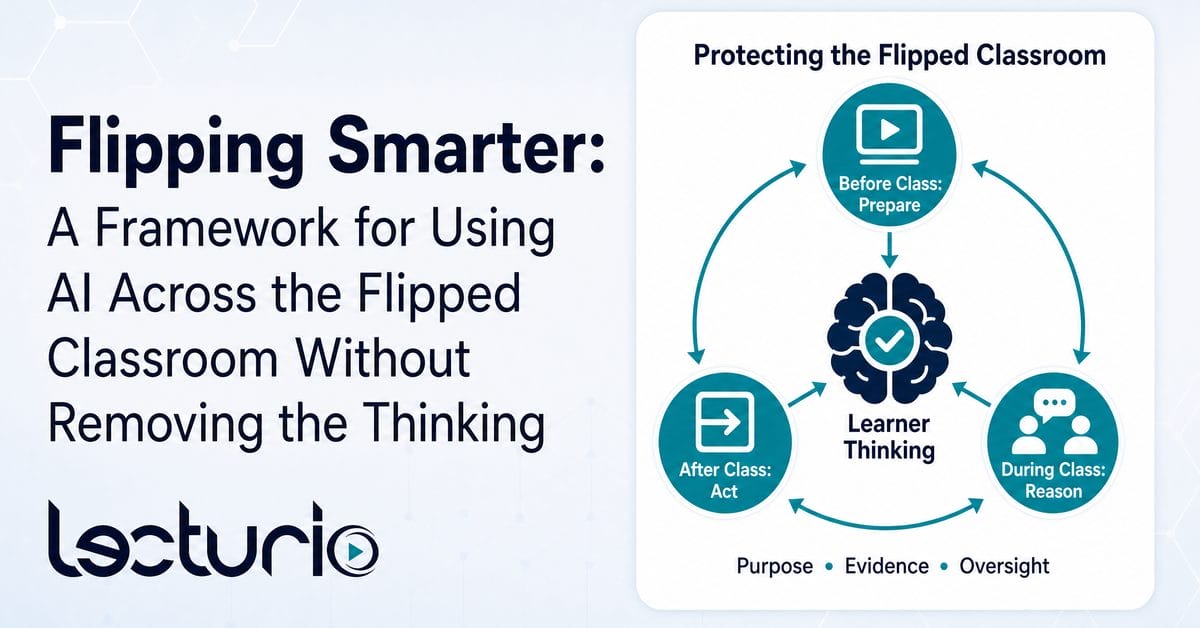
At a glance: AI can strengthen a flipped classroom when it reduces friction around preparation, feedback, and follow-up without removing the cognitive work learners need to do themselves. The key is to design separately for the three stages of the flip: before class, during contact time, and after class. At each stage, educators should ask what AI can support, what thinking must remain with the learner, and what evidence will show that learning actually occurred.
Most flipped-classroom troubleshooting starts with the wrong question. “Which AI tool should I use” assumes the problem is a missing capability. More often, the real question is which of three transitions is actually breaking: encounter to readiness, participation to cognitive work, or feedback to next action.
A Flip Succeeds or Fails at Three Transitions
A flipped classroom isn’t defined by the existence of a video. It’s a deliberately designed learning sequence: before class, learners prepare in a way that benefits from the interaction to follow; during class, they apply, compare, and reason; after class, the next step responds to evidence generated during learning. Moving a lecture online without redesigning any of that is just a change in delivery format, not a pedagogical transformation.
The flip succeeds or fails at three transitions. Did learners merely encounter the content, or come ready to use it? Did they merely participate in class, or perform meaningful cognitive work? AI can strengthen each transition, but it can also remove the very thinking the flip was designed to create.
The evidence base deserves a nuanced reading. A 2023 review of undergraduate health professions education found generally positive effects on performance and satisfaction, but judged the certainty of evidence to be low (Naing et al., 2023). A larger 2025 meta-analysis likewise found improved knowledge outcomes and satisfaction across medical education, although with substantial heterogeneity between studies (Spaic et al., 2025). The takeaway is not that moving content outside class automatically improves learning. It is that well-designed flipped sequences can, particularly when preparation is purposeful, active learning is preserved during contact time, and feedback informs what happens next.
Why Flips Fail: Six Reasons That Form a Chain
Flips rarely fail for six unrelated reasons. More often, they fail as a chain. Preparation may be too long, poorly aligned, or mismatched to learners’ prior knowledge and self-regulation. Completion may then be mistaken for readiness, even though opening a video is not the same as engaging with it. Uneven preparation leads faculty to reteach during class, reducing time for reasoning. Activities become busy rather than cognitively demanding, and feedback arrives without a clear next action. The solution is not adding another resource; it is repairing the transitions between preparation, contact time, and follow-up.
The AI Double Edge: Genuine Affordance or Shortcut
AI has genuine educational affordances in a flipped sequence. It can clarify confusion, generate additional practice, provide timely coaching, surface patterns across learners, and support differentiated follow-up. Used well, this is a real upside.
The same capability becomes a shortcut just as easily. It can summarize instead of requiring preparation. It can solve a case before a learner reasons through it. It can create an illusion of mastery, the feeling of understanding without doing the retrieval work that produces durable learning. A 2026 OECD synthesis on generative AI in education draws a sharp distinction that’s worth building policy around: generative AI can improve performance on a task without producing any actual learning gains, and that apparent advantage can fully disappear, or even reverse, once access to the tool is removed (OECD, 2026).
Let AI reduce navigation, searching, delayed low-stakes feedback, repetitive production, pattern identification, and generic routing. Preserve retrieval, explanation, comparison, clinical judgment, decision-making, reflection, and self-assessment for the learner. These are not inefficiencies to optimize away; they are part of the learning process.
Before Class: Prepare for Readiness, Not Just Access
A simple framework can keep pre-class work focused: Know, Do, Bring.
- Know: What foundational concepts are essential before class?
- Do: What brief retrieval or application task demonstrates readiness?
- Bring: What question, uncertainty, prediction, or preliminary judgment should the learner bring into the session?
The operative principle is minimum viable preparation. The goal is not to assign an entire digital library because it is available, but to assign the smallest amount of preparation that enables the next, more valuable activity.
The safeguard is simple: AI should respond to a learner’s thinking, not eliminate the need to think first. Ask learners to retrieve, predict, answer, or explain something before AI support becomes available.
Where AI helps faculty, it can generate questions aligned to the learning objective, offer guided Socratic clarification, create alternative explanations, and identify patterns across pre-class responses that faculty can use to adapt the coming session. A Socratic-style AI tutor can support this design by asking learners to articulate and work through their reasoning rather than immediately supplying an answer. Lesson-plan and question-generation tools follow the same logic here, faculty already have dedicated Lecturio resources for both, so we won’t re-cover that ground.
During Class: Protect Contact Time for Cognitive and Social Work
The value of the flip is not that faculty lecture less. It is that educator and peer presence is protected for work that benefits from interaction: handling ambiguity, applying concepts to cases, comparing reasoning, receiving challenge, making and defending decisions, and correcting misconceptions.
A five-step active learning sequence structures that time well: Commit, Explain, Challenge, Reconsider, Debrief. Consider a patient presenting with fever, dry cough, and worsening shortness of breath, elevated heart rate and respiratory rate, dropping oxygen saturation. Learners commit to an initial differential (pneumonia or viral respiratory infection is a reasonable first call) and explain their reasoning. Then comes the challenge: new findings arrive, pleuritic chest pain after a long flight, a swollen calf. Learners reconsider, and the differential shifts toward pulmonary embolism. A debrief closes the loop by comparing learners’ initial and revised reasoning, peer perspectives, relevant AI generated feedback, and faculty interpretation. The safeguard matters here: no AI should enter before a learner’s first committed answer, or the learner’s original reasoning, and any disagreement worth discussing, becomes invisible.
A useful golden rule for faculty: if AI makes the room quieter, or hands everyone the same polished answer too early, it’s probably weakening the active learning design rather than supporting it.
Readiness data should be used to adapt teaching, not punish unreadiness. If many learners share a misconception, faculty might offer a brief targeted explanation. If prior knowledge varies substantially, they might adjust starting complexity, group strategically, or provide a temporary scaffold. Analytics should inform teaching decisions—not become surveillance or a mechanism for labelling individual learners.
After Class: Personalize What Comes Next
Sending every learner home with identical homework ignores the evidence already generated during preparation and class. This is a version of the classic scalability problem in education: how does group instruction approach the learning benefits of one-to-one tutoring (Bloom, 1984)? AI doesn’t solve that problem outright, but timely, structured, individualized support can extend some of what one-to-one tutoring offers, at a scale that might be difficult to provide through faculty contact alone. The supporting evidence here comes with a necessary qualifier. A 2025 randomized trial in an undergraduate physics course found that a carefully scaffolded AI tutor produced higher post-test performance than a comparison in-class active learning lesson, with students completing the AI-tutored lesson in less time than the classroom version (Kestin, Miller, Klales, Milbourne, & Ponti, 2025). The qualifier “carefully scaffolded” is doing real work in that sentence, the tutor used structured sequencing, worked solutions, and research-informed prompting. This is evidence for intentional design, not for replacing educators or contact time, and it comes from physics rather than health professions education, so treat it as a cross-disciplinary signal rather than a like-for-like result.
Feedback only becomes useful when it answers three questions: what gap was identified, what should the learner do next, and what new evidence will demonstrate improvement. AI can prompt reflection, asking a learner what they changed their mind about and why, but it shouldn’t write the reflection for them. Personalization also assumes access, time, language proficiency, digital literacy, and familiarity with the platform. A supposedly personalized pathway can unintentionally increase workload for learners who already need more support. Personalize the next step, not the expected standard—and monitor whether the design is widening or narrowing inequities.
A Governance Checklist Before Deploying AI Anywhere in the Flip
Five questions cover most of what matters before deploying AI at any stage:
- Purpose: what learning problem are we actually solving, and why AI specifically?
- Cognitive work: what must the learner still do despite AI’s involvement?
- Evidence: how will we know preparation or learning actually occurred?
- Oversight: where must faculty review, learner verification, or human judgement remain?
- Governance: what data, privacy, transparency, and equity considerations apply?
Governance here operates on two levels: institutional (ethics, access, safety, the kind of faculty-in-the-loop governance model Lecturio has covered in depth) and classroom-level (what an individual educator or department deploys day to day). Both matter, and the second doesn’t work without the first.
Three rules, one per phase, summarize the whole framework. Before class: preparation must produce evidence of thinking. During class: no AI before the learner’s first thought. After class: feedback must change the learner’s next action.
From Ungoverned AI Use to a Protected Flipped Classroom
| Dimension | Poorly calibrated AI use | AI calibrated to protect the flip |
| Pre-class preparation | Completion or access treated as evidence of readiness | Learners demonstrate retrieval, application, or explanation before class |
| In-class AI timing | AI is available before learners articulate an initial view | Learners commit to and explain an initial answer before AI support |
| Feedback | Generic or disconnected from the learner’s performance | Feedback identifies a specific gap and a clear next action |
| Readiness data | Used primarily to identify who is “behind” | Used to adapt teaching and prompt proportionate support |
| After-class support | Identical follow-up regardless of demonstrated need | Next steps are individualized while expected standards remain common |
| Cognitive work | AI substitutes for retrieval, judgment, or reflection | AI reduces friction while protecting productive cognitive effort |
| Governance | AI use is introduced without explicit safeguards | Purpose, cognitive work, evidence, oversight, privacy, and equity are considered explicitly |
None of this requires choosing between AI adoption and protected contact time. It requires identifying which transition is weak—before class, during class, or after class—and using AI selectively to strengthen that transition without allowing it to replace the thinking learners need to do themselves.
Lecturio can support each stage through structured preparation, guided reasoning, clinical cases, formative assessment, and targeted follow-up, while faculty retain responsibility for the design of the learning sequence and the decisions that follow from it. Schedule a Demo with the Lecturio team today.
Frequently Asked Questions
What makes a flipped classroom fail, and can AI make it worse?
Flipped designs can become less effective when preparation is poorly aligned or insufficient, leaving learners unevenly ready for contact time. Faculty may then need to reteach foundational material, reducing time for application and reasoning. AI can worsen this if it allows learners to bypass the preparation or cognitive work the sequence was designed to create.
Should students have access to AI during in-class case discussions?
For activities designed to surface learners’ own reasoning, a useful rule is to delay AI support until learners have committed to an initial answer and explained their reasoning. This preserves the thinking that faculty and peers need to see, compare, and discuss.
How much pre-class preparation should faculty assign in a flipped classroom?
The smallest preparation that enables the next, more valuable in-class activity, not the entire available library of materials. A simple check is whether the assignment produces evidence of thinking (a prediction, a brief application task) rather than just evidence that a resource was opened.
Can AI tutors really replace in-class active learning?
Current evidence doesn’t support blanket replacement. A carefully scaffolded AI tutor outperformed an in-class active learning lesson in one physics RCT, but that result depended on deliberate instructional design and came from outside health professions education. It’s a signal for intentional design, not a case for removing contact time.
What’s the difference between using readiness data to teach versus to surveil students?
Using readiness data to teach means asking what the information suggests about the design of the upcoming session: Is there a widespread misconception? Does starting complexity need adjustment? Would some learners benefit from additional scaffolding? Using the same data primarily to label individual students as “behind,” without contextual interpretation or a meaningful support response, shifts analytics toward surveillance rather than teaching.