

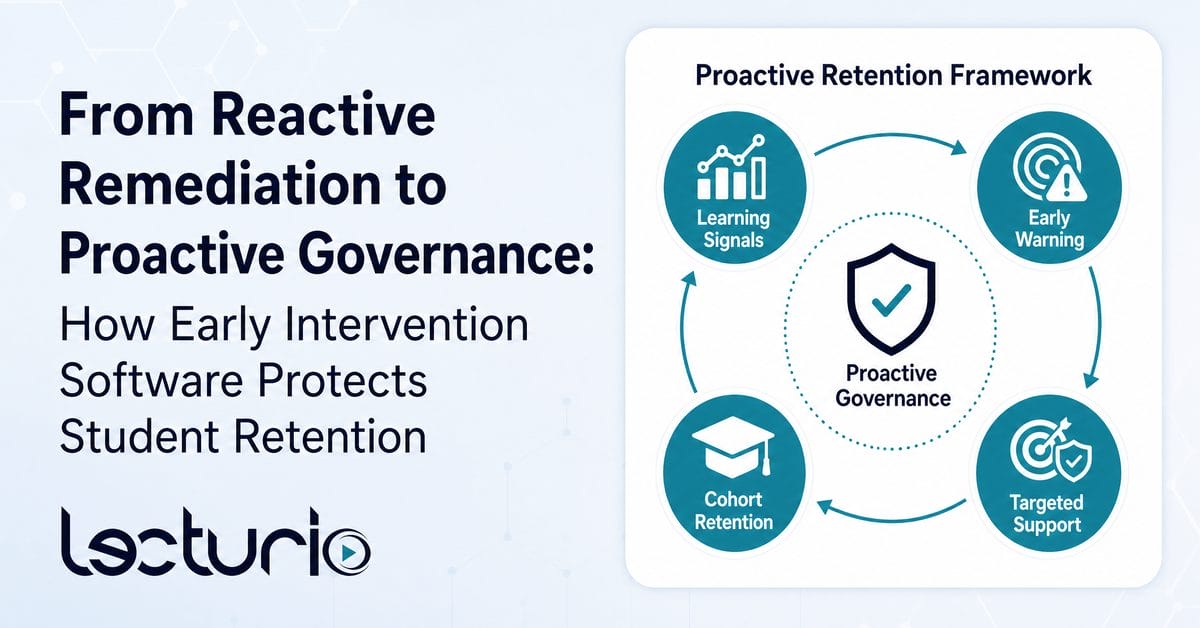
At a glance: Early intervention tools use formative assessment data, engagement patterns, and other learning signals to help educators identify students who may benefit from additional support before difficulties become high stakes. When used transparently and interpreted by faculty, learning analytics can complement existing advising and remediation processes by making emerging patterns more visible and enabling earlier, individualized follow-up.
The Administrative Blindspot: Why Login Metrics Miss the Real Risk Signal
Login frequency and platform activity are easy to measure, but they provide limited information about learning. A student may engage frequently with a platform while still struggling with a particular concept or reasoning process. More useful analytics combine multiple formative signals—such as assessment performance, patterns of errors, and changes over time—to help educators decide when additional follow-up may be appropriate.
The Hidden Cost of Late Detection
In many programs, additional support becomes most visible only after a midterm or comprehensive examination identifies a concern. At that point, educators and learners may have less time to understand the difficulty and respond before the next high-stakes assessment.
Learning analytics may help move some of that support earlier by identifying patterns that warrant attention before final outcomes are known. Hernández-de-Menéndez et al. (2022) describe the use of learning analytics to support earlier identification of students who may be experiencing academic difficulty and enable more timely intervention. These approaches have been used in institutional retention strategies, although their effectiveness depends on the quality of the data, model, intervention, and local implementation
Executive takeaway: Activity data show whether learners are using a platform. Learning analytics can provide additional information about how they are progressing, but interpretation still requires educational context and faculty judgment
Building an Early Support System: From Learning Signals to Faculty Follow-Up
An early-support system is only as useful as the data it uses and the decisions made from those data. Rather than waiting for a final examination, institutions can combine formative performance and other learning indicators to identify patterns that may warrant earlier review.
Using formative learning indicators
Formative activity may offer useful contextual information before a final grade is available. Wong et al. (2024), for example, found a moderate association between total submissions and examination performance in first-year medical students. Such findings suggest that engagement patterns may contribute to a broader picture of learner progression, but they should not be interpreted in isolation as evidence that a student is struggling
Lower platform activity does not necessarily indicate lower motivation or academic risk. Learners may use other resources, study offline, or engage differently depending on their learning strategies. Engagement data are therefore most useful as prompts for conversation rather than standalone judgments
The Midterm Advantage: Multi-Week Lead Time
Al Hashmi et al. (2025) found that machine-learning models using midterm data showed strong predictive performance within the health sciences cohort studied. This illustrates the potential value of mid-course data for earlier identification, but predictive accuracy will vary across institutions, populations, and datasets. Models therefore require local validation and ongoing monitoring before they are used to guide learner-support decisions
Institutions should also examine whether predictive models perform similarly across learner groups. A model that appears accurate overall may still produce disproportionate false-positive or false-negative alerts for particular populations. Periodic review of model performance, fairness, and unintended consequences should therefore be part of implementation
Operationalizing Student Retention Solutions at Scale
Predictive alerts are useful only if they support rather than expand faculty workload. Centralized dashboards can reduce the need to reconcile multiple spreadsheets or manually review every learner record, but they can also create new monitoring responsibilities if poorly designed.
The goal should therefore be selective, actionable visibility: helping faculty identify patterns that merit review while minimizing unnecessary alerts and administrative noise
Alrazeeni et al. (2026) describe several administrative applications of AI in nursing education, including chatbots, predictive models, and decision-support tools. These findings suggest potential efficiency benefits, but the effect on faculty workload will depend on implementation, alert volume, and how much additional review each system requires
Closing the Loop: From analytics to individualized learner support
A predictive alert is only half the job. What happens next determines whether the system actually changes an outcome or simply produces another report.
Diagnostic Precision over Mass Remediation
A signal that a learner may be struggling is only the beginning of the support process. Similar performance patterns can arise from very different causes, including gaps in knowledge, study strategy, self-regulation, confidence, wellbeing, assessment familiarity, or contextual pressures.
Rashid et al. (2022) identified several factors associated with academic difficulty among medical students, including procrastination, low self-efficacy, and cognitive overload. These findings reinforce the need for individualized follow-up rather than assuming that one automated learning path will address every learner’s needs
Supporting progression and quality improvement
Early learner support can contribute to broader institutional goals around progression, educational quality, and continuous improvement. Simulation and other structured learning activities may also provide additional opportunities to practise clinical judgment when a specific need has been identified.
These interventions should not be presented as automatically improving licensure outcomes or satisfying accreditation requirements. Their value lies in providing educators with additional options for timely, targeted support
Executive takeaway: Effective early support is not one-size-fits-all. Learning analytics can help identify patterns that merit attention, but the intervention should be based on the learner’s specific needs and interpreted within a broader educational context
Institutional Predictive Analytics Maturity Matrix
Use this matrix to assess where your program sits on the path from reactive to proactive governance:
| Governance pillar | Predominantly reactive approach | More proactive, learner-support approach |
| Identification | Concerns become visible mainly after major assessments | Multiple formative signals may prompt earlier faculty review |
| Data visibility | Information is dispersed across courses and systems | Relevant learner data are brought together for contextual interpretation |
| Faculty workflow | Faculty manually compile and review records | Automated alerts may reduce some screening work when thresholds are well designed |
| Support strategy | Intervention may begin only after significant difficulty is demonstrated | Faculty can offer earlier, individualized support before difficulties escalate |
| Learner relationship | Support may feel associated primarily with failure | Early help-seeking is normalized as part of learning and professional development |
| Governance | Established academic-support processes | Requires additional safeguards for privacy, transparency, fairness, and model performance |
Responsible Use of Learner Analytics
Predictive systems should operate within clear institutional governance. Learners should understand what data are collected, how those data may be used, who can access them, and how automated alerts contribute to support decisions. Institutions should also define retention periods, escalation criteria, processes for correcting inaccurate data, and mechanisms for reviewing potential bias or unintended consequences.
Ready to see what a predictive early warning dashboard looks like across your own programs? Schedule a Demo with the Lecturio team today.
Frequently Asked Questions
What is early intervention software in higher education?
Early intervention tools use formative assessment results, engagement patterns, and other learning indicators to help educators identify students who may benefit from additional support. These signals are most useful when interpreted alongside faculty observations, learner conversations, and other contextual information.
How early can learning analytics predict at-risk health science students?
Some studies have shown that mid-course data can predict later academic outcomes with useful accuracy within the populations studied. How early and how reliably a system can identify concern will vary by curriculum, cohort, data quality, and model performance, so institutions should validate predictive approaches locally before relying on them for decisions.
Does an early warning system replace faculty judgment in remediation?
No. The system’s role is to identify patterns that may warrant attention. Faculty and academic advisors still determine what those patterns mean, whether intervention is needed, and what form of support is most appropriate.
How can predictive analytics support preparation for high-stakes assessments?
Predictive analytics may help educators identify emerging academic difficulties earlier, creating more time for targeted review and support before high-stakes examinations. Whether this improves licensure performance depends on the accuracy of the signal, the cause of the difficulty, and the quality of the intervention that follows.
Does centralizing student risk data increase faculty workload?
Centralized dashboards may reduce some manual data assembly and course-by-course tracking, but they do not automatically reduce workload. Their value depends on whether alerts are meaningful, thresholds are well calibrated, and faculty are not overwhelmed by unnecessary monitoring tasks.