

Simplify Teaching and Assessing Clinical Reasoning

An innovative approach that demystifies clinical reasoning

Healer header how it works min

The clinical reasoning process using Healer

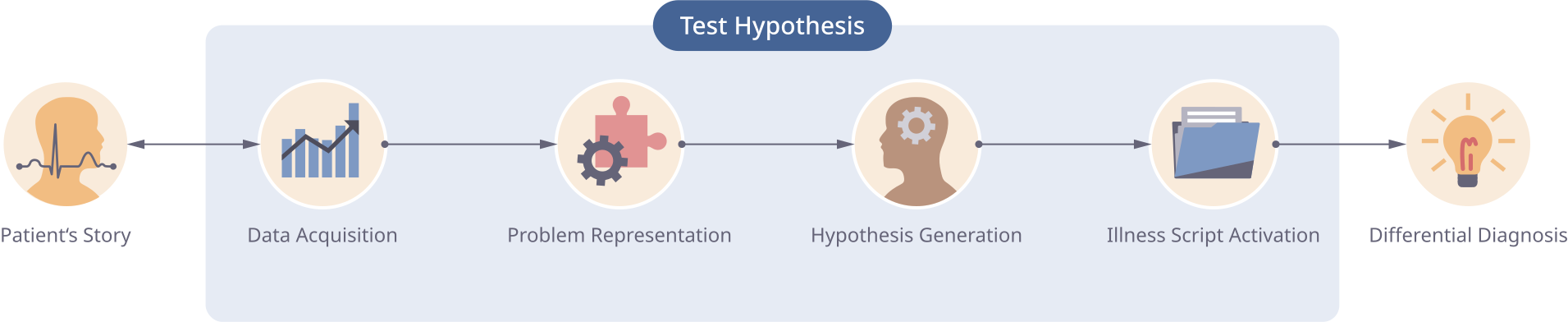
Clinical reasoning is a multi-step, iterative process, often opaque and difficult to convey

Healer offers a new way to explicitly teach and assess these cognitive steps. It makes clinical reasoning easier for educators to teach and for learners to master, helping to improve patient diagnosis, management, and outcomes.

Healer demystifies clinical reasoning for learners and educators alike by breaking down the key elements of this complex process into discrete, but related skills of data acquisition, problem representation, hypothesis generation, and differential diagnosis. Healer offers a granular approach to practicing these skills while journeying through the stages of a clinical encounter, allowing learners to understand the reasoning process at a deep level while also yielding detailed and meaningful feedback for the learner and assessment insights for educators.

Through deliberate practice involving many clinical scenarios and disease processes, learners can use Healer to increase their self-awareness and their confidence, build and refine their clinical knowledge, and learn to apply sound clinical reasoning to any patient case they may encounter.

Nejm healer clinical reasoning process

Derived from the best available evidence

Healer draws on current models of how clinical reasoning works, based on cognitive science. Case-based deliberate practice is central to the development of expertise as discussed by K. Anders Ericsson (Acad Med. 2015 Nov;90(11):1471-86). We’ve pulled from multiple sources to create the learning and assessments in Healer, central to which is illness script theory. These educational strategies are succinctly addressed by Dr. Judith L. Bowen’s powerful review article, Educational Strategies to Promote Clinical Diagnostic Reasoning (N Engl J Med 2006; 355:2217-2225). Dr. Bowen and other authors have recently updated and annotated this article with fresh perspective drawn from the intervening years of research on this topic. Download the article here.

Features

Introducing the most advanced way to teach, practice, and assess clinical reasoning skills

Data acquisition

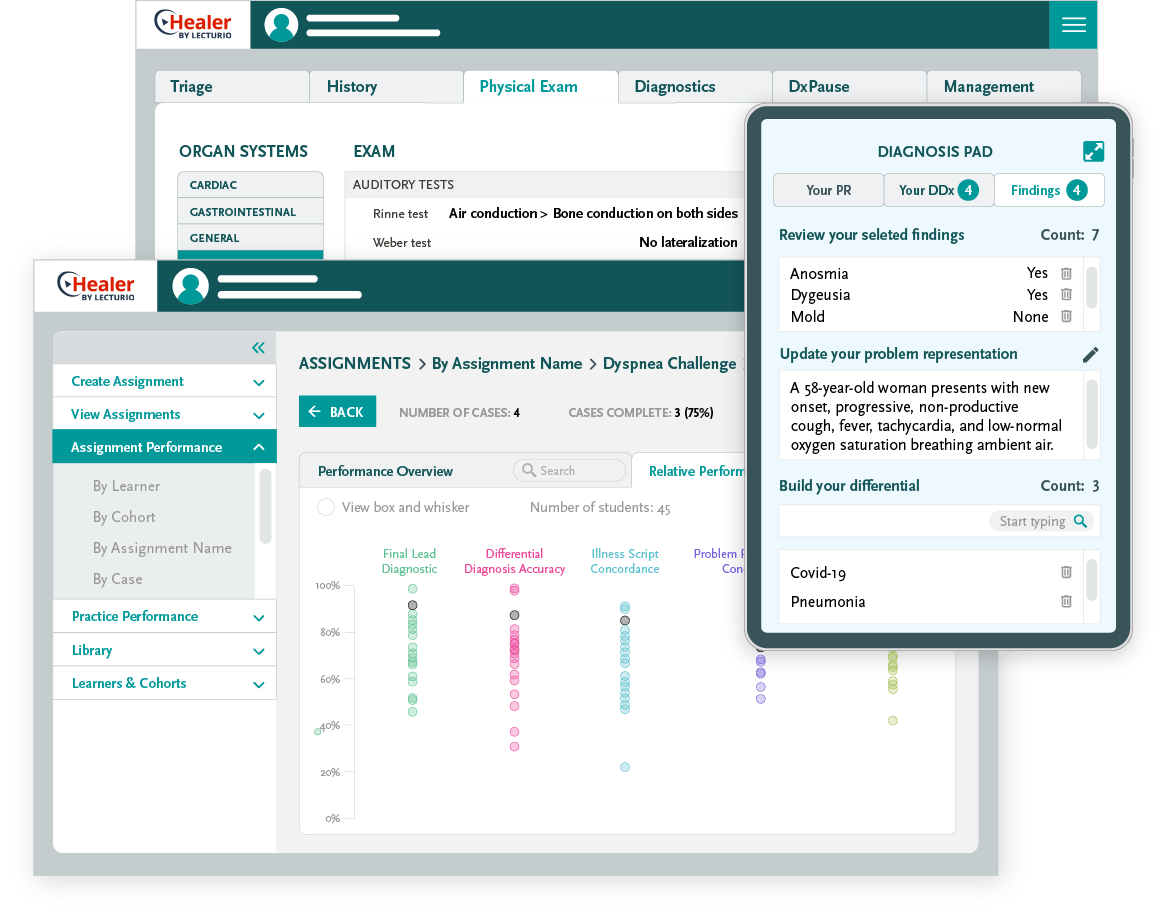
Healer facilitates deliberate practice in data acquisition, requiring learners to gather clinical findings and justify clinically indicated exams and tests. Healer requires learners to gather clinical findings that they will use to justify their differential diagnosis during illness script building. Just like in the real world, there are lots of individual data points to sift through and lots of important follow-up questions to ask. Healer teaches the learner, in context, what questions are worth asking, what exams are worth performing, and what tests are worth ordering.

Problem representation and hypothesis-generation: The diagnosis pad

While the learner is reviewing data, they can do the work of reasoning in their Diagnosis Pad, where they can see the data they’ve selected as most important, create and modify their problem representation, and build their differential. As these are updated from stage to stage, they are saved for assessment and feedback in order to provide unique insights into the learner’s reasoning as it occurs.

Illness script building and differential diagnosis: The diagnostic pause

The Diagnostic Pause is an exercise utilizing illness script theory to help students cognitively differentiate between likely diseases on a differential. Once the learner has gathered the data, created their own problem representations and ranked their differential, they pause and build illness scripts for three diseases based on the expert’s selected data. Here, they reflect on which data in the case support or refute particular diseases and are able to see what questions, exams, and tests are crucial and which findings help to discriminate among likely diseases on the differential.

Performance assessment and feedback

Healer improves the evaluation of clinical reasoning with a proprietary, quantitative assessment that provides formative and summary performance scoring and detailed feedback on the learners’ clinical reasoning process and clinical knowledge. At a glance, learners receive objective assessment across 6 separate skills and perform informed self-assessment for two others. In the process, they can access the equivalent of hours’ worth of expert insight. The entire experience is self-directed, interactive, and engaging, motivating learners through focused repetition until they achieve mastery.

Experience a patient encounter yourself

Deliberate practice for developing sound clinical reasoning and achieving diagnostic excellence

Combining knowledge with deliberate practice

What makes a good doctor? What predicts real success?
It’s a combination of applied knowledge and solid clinical reasoning.

Because Healer exposes what and how experts think at each stage of the encounter, learners get the opportunity to experience and absorb the explicit and iterative steps of clinical reasoning while engaging in deliberate practice over time. They develop and improve their clinical knowledge, data acquisition, differential diagnostic abilities, and illness script instantiation all in the same platform, saving time for resource-strapped educators.

Gold-standard illness scripts and diagnostic schemas

Building illness scripts

Clinical expertise develops as clinicians combine experience with a particular disease and fundamental knowledge into their own illness scripts. Despite their central role in predicting diagnostic accuracy, illness scripts are rarely taught formally.

Working through each case, learners build illness scripts for a set of diseases on the expert’s differential, discovering which questions, exams, and tests are essential for a particular case. The exercise pushes learners to reflect on which data are most useful in differentiating one disease on their differential from others as well as the power of pertinent negatives.

Research

Experts call for improved clinical reasoning training in all phases of medical education

Experience a patient encounter yourself

Schedule a Healer demonstration and see how easy it is to integrate science-based clinical reasoning curriculum development and assessment into your program.

Frequently Asked Questions about
the clinical reasoning process using Healer

Diagnostic reasoning is the specific cognitive process used to identify a patient’s disease, while clinical reasoning is the broader framework that includes diagnosis, management, and ethical decision-making. Healer is designed to bridge these two by requiring learners to externalize their thought process.

The most effective clinical reasoning assessment tools evaluate the process of thought, not just the final answer. Methods that track data acquisition, hypothesis generation, and problem representation provide much more accurate data on a student’s cognitive readiness.

An illness script is a mental framework used by experienced clinicians to organize knowledge about specific diseases. Healer helps students build these scripts by requiring them to link clinical findings directly to pathophysiology.

Teaching clinical reasoning involves making the opaque steps of a clinician’s mind visible. It is best taught through deliberate practice, forcing learners to move beyond rote memorization to justify their clinical decisions step-by-step.

Because Healer tracks the exact cognitive pathway a student takes, faculty can pinpoint the exact origin of a diagnostic reasoning deficit (e.g., failed data acquisition vs. failed hypothesis generation) and apply highly targeted remediation.

Try a case