

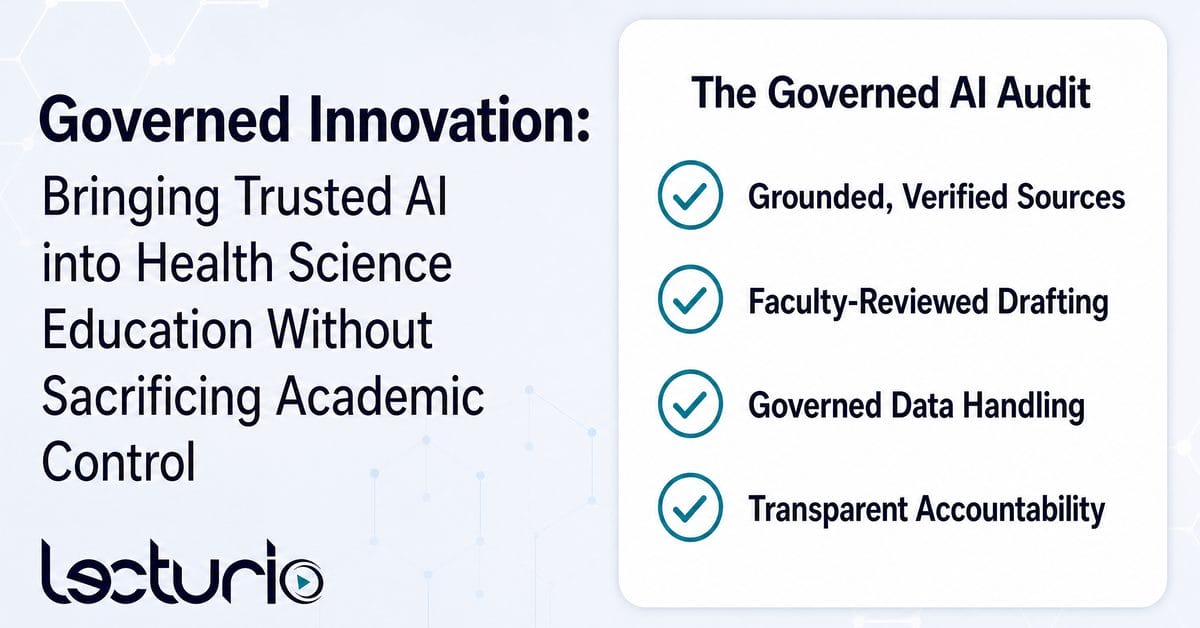
At a glance: Governed AI in health science education uses AI to support drafting, mapping, and administrative tasks, while keeping faculty responsible for clinical accuracy, educational quality, academic integrity, and final approval. The goal is not to automate teaching, but to reduce repetitive work within clear institutional guardrails.
The Executive Dilemma: Balancing AI Efficiency With Institutional Governance
Health science leaders are balancing two legitimate pressures. Faculty face increasing administrative demands from syllabus revision, blueprint alignment, item-bank maintenance, and curriculum documentation. At the same time, introducing AI without institutional governance can create risks related to clinical accuracy, data privacy, intellectual property, and academic integrity.
Deans therefore do not need to choose between rejecting AI and adopting it without guardrails. A more credible path is governed adoption: using AI where it adds efficiency while preserving faculty authority, institutional accountability, and appropriate oversight.
The Hidden Hazards of Generic Consumer AI in Health Education
General-purpose language models are designed for broad use rather than for a single clinical curriculum or accreditation framework. Without appropriate grounding, review, and governance, their outputs may include inaccurate clinical content, fabricated references, or material that does not align with local educational objectives. Research published in NPJ Digital Medicine on the governance and regulatory dimensions of generative AI in medical education identifies data privacy, intellectual property, and trustworthiness as core concerns institutions must address through structured governance (Tran et al., 2025).
The Faculty-in-the-Loop Imperative
The core governance principle is simple: AI can accelerate drafting, but faculty retain full authority to edit, reject, or approve anything that is published or assessed. Research published in Advances in Medical Education and Practice on AI’s role in medical education reinforces that these tools function best as a complement to human judgment rather than a substitute for it, particularly where clinical decision-making is involved (Saroha, 2025).. Nursing faculty echo this same conditional openness, though with more hesitation than enthusiasm. A study published in SAGE Open Nursing on nursing educators’ perspectives on AI integration found recognition of tools like adaptive learning platforms and predictive analytics, tempered by significant barriers, like insufficient training, infrastructural limitations, and ethical concerns around data privacy and algorithmic bias (Rony et al., 2025). These findings reinforce the need for governance that addresses faculty development, infrastructure, privacy, bias, transparency, and oversight alongside the technology itself.
Executive takeaway: In health professions education, speed without accuracy adds risk rather than value. The opportunity for deans is not to automate teaching, but to use governed AI workflows that reduce repetitive work while preserving the academic standards, review processes, and institutional accountability required for high-quality education
Operationalizing Faculty-in-the-Loop Assessment: The Psychometric Case Against Autonomous AI
A common assumption is that AI can generate a complete, exam-ready item bank on autopilot. AI can support item drafting, but a review-ready question is not automatically a high-quality assessment item. Item quality depends on content accuracy, blueprint alignment, cognitive demand, distractor quality, standard setting, and post-administration psychometric performance (Knight et al., 2026). Distractor quality also favored human-authored items. The takeaway isn’t that AI item generation lacks value, it’s that raw AI output benefits from expert review before it enters a high-stakes exam, since item quality is one of the factors that feeds into strong licensure exam preparation.
Current assessment theory is moving in the same direction. A framework published in Perspectives on Medical Education, applying Van der Vleuten’s Assessment Utility Index to GenAI-assisted item writing, argues that the greatest gains in validity, reliability, and cost-efficiency come from treating AI as a collaborative drafting partner within a structured review pipeline, rather than as an independent item author (Al-Shawee et al., 2026). A defensible workflow therefore combines domain-grounded drafting with faculty review, blueprint checks, and psychometric quality assurance before an item enters an approved bank
Eliminating Curriculum Friction: AI-Assisted Syllabus Mapping and Lesson Planning
Much of the administrative load faculty describe isn’t teaching, it’s reformatting. Reworking syllabi, remapping learning objectives to updated licensure blueprints, and rebuilding weekly lesson plans take time that could otherwise go toward mentorship and active teaching. Himang et al. (2026) found that AI-supported workflows were often associated with improved administrative efficiency across the studies reviewed, although the magnitude of benefit varied considerably by task and implementation context. One included analysis reported a substantial reduction in faculty administrative workload, illustrating the potential gains when AI is integrated into redesigned workflows rather than simply added on top of existing processes.
That pattern holds in nursing-specific contexts too. A study published in Nurse Education Today on nursing faculty members’ experiences using ChatGPT found that the tool meaningfully improved time management and instructional material preparation for theoretical content (Durmuş Sarıkahya et al., 2025), while faculty also flagged information accuracy and critical-thinking considerations as reasons the tool works best with oversight rather than uncritical use. That combination, real efficiency gains alongside thoughtful caution, is the case for a governed model rather than an ungoverned one.
The ROI narrative is not about reducing faculty headcount. It is about reclaiming time from repetitive administrative work and redirecting it toward mentorship, feedback, curriculum review, scholarship, and clinical teaching
Safeguarding Institutional Integrity: Grounded Architectures vs. Generic Hallucinations
The technical root of AI hallucination is straightforward: general-purpose models predict the next plausible word based on internet-wide statistics, with no built-in mechanism for verifying clinical accuracy. Grounded institutional systems can reduce risk by restricting or prioritizing approved knowledge sources and linking AI outputs to curated educational content. This makes verification easier and can reduce unsupported generation, but grounding does not itself guarantee clinical accuracy. Faculty review, source transparency, update processes, and local validation remain necessary. The governance research cited earlier converges on the same conclusion here: protecting proprietary student and institutional data isn’t a side concern bolted onto GenAI governance, it’s one of its core requirements (Tran et al., 2025; Saroha, 2025), alongside clear policies for how AI-assisted materials are disclosed and reviewed.
Executive takeaway: Academic integrity is strengthened when AI use is transparent, governed, grounded in appropriate sources, and subject to expert review. Grounding can improve traceability and reduce unsupported output, but clinical defensibility still depends on faculty verification and institutional quality assurance
Institutional AI Readiness & Governance Audit
Use this matrix to evaluate any AI vendor or tool against institutional standards before deployment:
| Evaluation dimension | Higher-risk implementation | More governed institutional approach |
| Knowledge sources | Outputs generated without clear source constraints or traceability | Approved content sources, transparent grounding, and faculty verification |
| Assessment workflow | AI-generated items used with limited review | AI-supported drafting followed by faculty review, blueprint checks, and psychometric quality assurance |
| Curriculum mapping | Generic outputs not verified against local objectives | AI-assisted mapping that faculty validate against institutional curricula and competency frameworks |
| Data governance | Unclear data handling, retention, or training use | Defined privacy, access, retention, consent, and vendor-governance policies |
| Academic integrity | No clear expectations for disclosure or acceptable use | Transparent institutional policies for AI-assisted work and review |
| Faculty role | AI positioned as autonomous decision-maker | AI positioned as a drafting and administrative support tool under faculty authority |
| Implementation readiness | Technology introduced without adequate training or evaluation | Faculty development, pilot evaluation, governance review, and ongoing monitoring |
Governance Requires Accountability, Not Just Oversight
A faculty-in-the-loop model is only meaningful when responsibility is clear. Institutions should define who is accountable for reviewing AI-generated materials, approving their use, responding to errors, monitoring model performance, and updating content when clinical guidance changes.
Governance should also include mechanisms for reporting problems, auditing high-risk workflows, and reassessing tools when evidence, regulations, or institutional needs evolve.
Ready to see what a faculty-in-the-loop AI workflow looks like inside your own curriculum? Schedule a Demo with the Lecturio team today.
Frequently Asked Questions
How does governed AI improve faculty workload without replacing faculty judgment?
Governed AI can support first-draft work such as syllabus restructuring, objective mapping, lesson planning, or item drafting. Faculty retain responsibility for reviewing, revising, and approving outputs before they are used in teaching or assessment.
Can AI-generated exam questions be used without faculty review?
AI-generated exam items should not be used in high-stakes assessment without expert review. Comparative studies suggest that unreviewed AI items may perform less well on some psychometric dimensions. Faculty review, blueprinting, standard setting, and post-administration item analysis remain essential.
What makes an AI tool “grounded” versus a generic consumer chatbot?
A grounded AI system uses defined, institutionally approved knowledge sources to inform or constrain its outputs, making verification and traceability easier. This can reduce unsupported generation, but grounding does not eliminate the need for expert review or current source maintenance.
Does adopting AI for administrative tasks create academic integrity risk?
AI use can create academic integrity risks when expectations, disclosure, data handling, and review processes are unclear. Institutions can reduce these risks through clear policies, appropriate data governance, faculty oversight, and transparent expectations for acceptable use
What is the educational value of reducing administrative workload with AI?
Reducing repetitive administrative work may create more faculty capacity for activities that require human expertise, including feedback, mentorship, curriculum evaluation, learner support, and clinical teaching. Whether these efficiencies translate into better learner outcomes depends on how institutions choose to reinvest the time saved