

At a glance: AI-supported learning tools can extend access to formative practice and guided reasoning beyond scheduled faculty contact. Combined with adaptive learning and faculty oversight, they may help learners identify knowledge gaps earlier and give educators additional information for targeted follow-up. Used appropriately, these tools can complement formal remediation while preserving faculty involvement in diagnosing learning needs, coaching students, and making progression decisions.
The Administrative Bottleneck of Traditional Student Remediation
Academic support teams face the challenge of providing timely, individualized support within finite faculty capacity. In many programs, additional support becomes most intensive only after a learner performs poorly on a major assessment. By that point, faculty and students may be working within a compressed timeframe to understand the problem, develop a plan, and demonstrate improvement.
The challenge is therefore not simply how to provide more remediation, but how to identify emerging learning needs earlier and create accessible opportunities for learners to seek help before difficulties become high stakes.
One-to-one faculty support is valuable, but relying on it as the only mechanism for academic support is difficult to scale across large cohorts. The bottleneck stems from the systemic reality that manual 1-on-1 tutoring cannot scale across expanding cohorts. When academic support relies entirely on unassisted human hours, institutions encounter operational friction. Remediation literature also highlights a broader challenge: struggling learners are heterogeneous, and effective support often requires individualized diagnosis rather than a single standardized intervention (Al-Sheikhly et al., 2020).
Unaddressed knowledge gaps jeopardize student retention and delay cohort progression. To satisfy accreditation guidelines, institutions require a sustainable framework. Scaling personalized student support across complex health professions cohorts represents a core pillar within The 4 Dimensions of an AI-Ready Health Professions Institution: From Pilot to Practice. Implementing an integrated student success platform enables programs to transition from reactive firefighting to proactive, scalable support.
Effective remediation begins with understanding the nature of the difficulty. Similar assessment results can arise from very different causes: gaps in foundational knowledge, ineffective study strategies, unfamiliar assessment formats, difficulties with clinical reasoning, language or communication challenges, wellbeing concerns, or contextual pressures outside the curriculum. Digital data can help identify patterns, but determining what those patterns mean remains an educational and often relational task.
Socratic AI Guidance: Moving Beyond Direct-Answer Chatbots
As generative AI becomes more common in health professions education, educators have raised legitimate concerns about how students use direct-answer tools. When learners rely on AI primarily to obtain solutions rather than work through problems, opportunities for retrieval, explanation, and clinical reasoning may be reduced.
A Socratic approach offers a different interaction model: instead of immediately presenting a solution, the tutor can ask learners to explain their reasoning, identify relevant clinical information, consider alternatives, and justify a proposed answer before receiving additional guidance.
Emerging research suggests that the way AI interaction is structured matters. Huang (2026), for example, reported improvements in clinical reasoning and self-directed learning among nursing students using a structured reflective ChatGPT framework compared with standard use. Although this does not establish equivalent outcomes for every Socratic AI tutor, it supports the educational rationale for designing AI interactions around questioning, explanation, and reflection rather than direct answer provision
Supporting Active Practice and Self-Regulated Learning
Re-reading and passive review can create familiarity, but durable learning generally benefits from retrieval practice, feedback, and opportunities to revisit material over time. Adaptive tools can support these processes by helping learners practise areas they find difficult and return to concepts at appropriate intervals.
These tools may also support self-regulated learning when learners are encouraged to monitor their progress, set goals, select appropriate strategies, and reflect on their performance. Importantly, personalization should not mean that an algorithm makes every learning decision on the student’s behalf; learners still need opportunities to develop agency over how they learn.
When students interact with adaptive spaced retrieval, micro-learning video lectures, and practice questions, they engage in continuous active recall tailored to their specific learning needs. Research shows that nursing students’ perceptions of a supportive, structured learning environment are positively correlated with self-directed learning ability and self-management skills (Tang et al., 2022). Furthermore, a quasi-experimental evaluation of mobile learning tools in medical education found that strategic, exam-oriented engagement was associated with stronger examination performance, underscoring the value of adaptive tools that help students engage purposefully rather than passively (Holzhäuer et al., 2026).
Adaptive Learning Pathways Across Disciplines
- Medical Domain: Automatically adjusting spaced retrieval question sequences focused on high-yield organ systems (e.g., Cardiology, Renal, Neurology) based on individual diagnostic error logs.
- Nursing Domain: Dynamically surfacing micro-learning video modules and NGN-style case studies targeting weak cognitive steps (e.g., Evaluating Outcomes or Prioritizing Hypotheses).
From Late Remediation to Earlier Learner Support
A more sustainable approach to academic support creates opportunities to identify emerging difficulties before a learner reaches a major progression point. Formative assessments, practice-question performance, and patterns of resource use can provide useful signals that additional support may be helpful.
Hassan (2023) reported improved academic outcomes following a structured remedial examination strategy in the nursing cohort studied and noted that learners with more substantial difficulties may require continued support beyond a single intervention. This reinforces the value of viewing remediation as a process that may require monitoring and adjustment rather than a one-time event.
Institutional Governance: Using Learning Data Responsibly
Detailed AI interaction logs may be educationally useful, but institutions should be explicit about what is monitored, who has access, how long data are retained, and whether learners understand how their interactions may inform support decisions
Faculty dashboards can provide useful information about assigned activities, formative performance, and recurring concept-level difficulties. However, more data are not automatically better. Institutions should define which information genuinely supports educational decision-making, who can access it, how learners are informed about its use, and how privacy and proportionality are protected.
Where AI-tutor interactions are available for faculty review, they should be used selectively and transparently rather than treated as continuous surveillance. The purpose of these data should be to support learners and inform appropriate follow-up, not to infer motivation, professionalism, or competence from isolated digital behaviours
Crucially, 24/7 Socratic tutoring operates under direct faculty supervision via comprehensive conversation audit logs. Always-available digital support may absorb some routine factual questions and provide additional practice between faculty interactions. This can allow scheduled faculty time to focus more heavily on complex reasoning, feedback, coaching, and individualized support. Whether workload is actually reduced, however, depends on how the tool is implemented and whether new monitoring responsibilities are introduced. A 2025 survey of nursing faculty found they generally view AI chatbots as enhancing their teaching experience and supporting students’ independent learning, though they also flagged the importance of maintaining faculty-student interaction and oversight, reinforcing why audit trails and supervision remain central to this model rather than optional (Saleh et al., 2025).
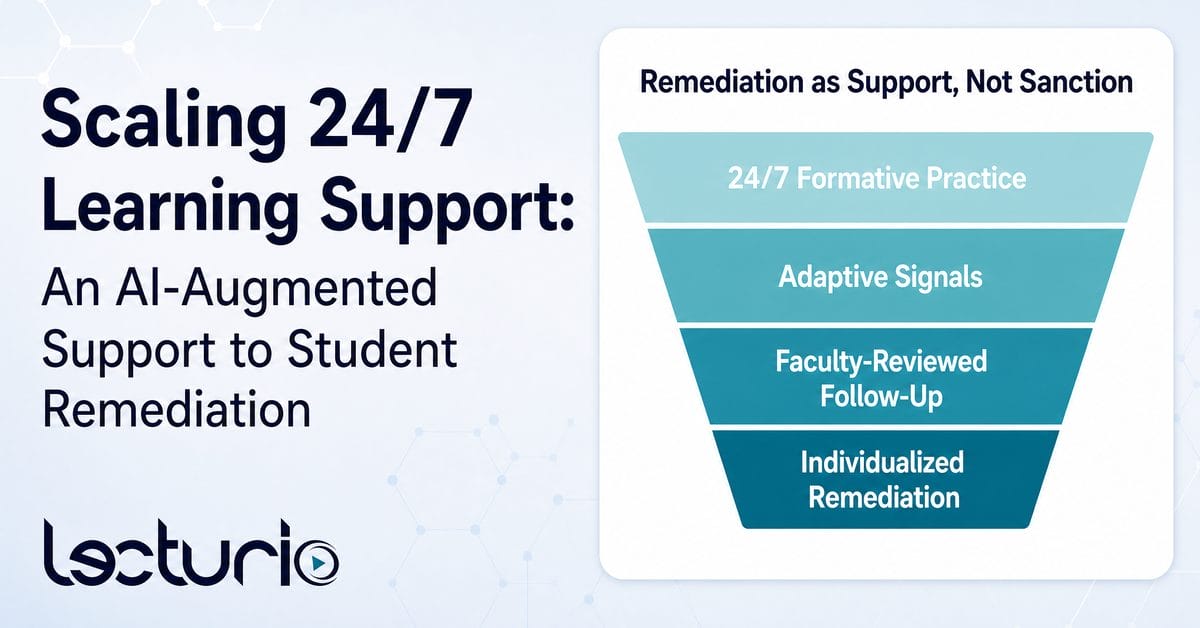
Remediation as Support, Not Sanction
Remediation works best when learners can engage with support without stigma. If every low score automatically produces an “at-risk” label or formal remediation pathway, students may become less willing to disclose uncertainty or seek help early. Institutions should therefore distinguish routine formative support from formal remediation and create psychologically safe pathways in which asking for help is understood as part of professional learning rather than evidence of failure.
Digital tools can contribute to this culture by making low-stakes practice and feedback continuously available, while faculty ensure that escalation to formal remediation remains proportionate, transparent, and individualized.
Comparative Analysis Table & Executive Conclusion
Student Remediation Workflows: Current Manual Standard vs. AI-Augmented Socratic Workflow
| Dimension | Predominantly faculty-dependent model | AI-augmented support model |
| Timing of support | Additional support may become concentrated around major assessments or identified difficulties | Digital practice can provide earlier signals and additional support between scheduled faculty interactions |
| Availability | Faculty and peer support are limited by schedules and capacity | AI-supported practice can be available outside scheduled teaching hours |
| Learning interaction | Quality varies according to activity and available support | Socratic prompting can encourage explanation and reasoning when appropriately designed |
| Practice and review | Learners select from available study resources and faculty recommendations | Adaptive tools can suggest targeted retrieval practice based on previous performance |
| Faculty role | Faculty provide assessment, coaching, feedback, and remediation directly | Faculty retain these roles while digital tools supplement routine practice and formative support |
| Learner data | Faculty draw on assessment results, observation, and learner conversations | Additional digital performance data may inform follow-up when interpreted in context |
| Governance | Established institutional academic-support processes | Requires additional policies for AI oversight, privacy, transparency, and appropriate use of learner analytics |
Integrating 24/7 Socratic AI tutoring gives academic support teams a scalable force-multiplier. Integrating Socratic AI tutoring and adaptive practice can extend access to learning support beyond scheduled faculty contact. Used within a well-designed academic support system, these tools may help learners practise reasoning, recognize emerging learning needs, and seek help earlier while allowing faculty to focus their time where professional judgment and human interaction add the greatest value.
Lecturio’s AI Tutor can contribute to this broader support ecosystem through guided questioning, verified educational content, adaptive practice, and faculty-visible learning data, while educators remain responsible for interpreting learner needs and determining appropriate support
Ready to scale 24/7 personalized remediation across your medical or nursing program while supporting faculty bandwidth? Explore Lecturio’s AI Tutor and request an institutional walkthrough today.
Frequently Asked Questions
How can Socratic AI encourage active reasoning rather than direct answer-seeking?
Rather than immediately presenting a solution, a Socratic tutor can ask learners to identify relevant information, explain their reasoning, consider alternatives, and justify a conclusion before receiving additional guidance. Structured AI interactions of this kind may create more opportunities for active reasoning than simple answer delivery, although their effectiveness still depends on how learners engage with the tool
Can an AI student success platform support both medical (USMLE) and nursing (NCLEX) curricula?
Institutional learning platforms can support discipline-specific content and assessment frameworks, including medical curricula aligned with USMLE-style clinical reasoning and nursing curricula using NGN-style clinical judgment activities. Local faculty should still determine how these resources fit their curriculum and learner-support strategy
How should AI tutoring complement faculty support?
AI tutoring works best as a supplement to faculty involvement, not a replacement. By handling routine, factual questions and structured practice outside scheduled hours, it can free faculty time for coaching, complex reasoning feedback, and remediation decisions, while faculty retain responsibility for diagnosing learning needs and interpreting AI-surfaced data in context.
How do adaptive learning tools improve self-directed learning in health science students?
Adaptive learning tools can help learners identify areas for further practice and provide structured opportunities for retrieval and feedback. They may support self-regulated learning when students remain actively involved in setting goals, interpreting their progress, and choosing learning strategies. Simply personalizing content algorithmically does not, by itself, create self-directed learners