
Domina Conceptos Médicos

Estudia para la escuela de medicina y tus examenes con Lecturio.

Trastornos del Metabolismo de la Fructosa

El metabolismo de la fructosa es una cascada compleja en EN Erythema nodosum is an immune-mediated panniculitis (inflammation of the subcutaneous fat) caused by a type IV (delayed-type) hypersensitivity reaction. It commonly manifests in young women as tender, erythematous nodules on the shins. Erythema Nodosum la que intervienen varias enzimas. Las enzimas pueden ser deficientes o causar un procesamiento anormal y enfermedades. La fructosuria esencial, la intolerancia hereditaria a la fructosa y la intolerancia intestinal a la fructosa son 3 de los LOS Neisseria distintos trastornos. La presentación puede variar desde asintomática hasta quejas de vómitos, distensión abdominal, flatulencia y diarrea. El tratamiento es variado y, a menudo, se centra en EN Erythema nodosum is an immune-mediated panniculitis (inflammation of the subcutaneous fat) caused by a type IV (delayed-type) hypersensitivity reaction. It commonly manifests in young women as tender, erythematous nodules on the shins. Erythema Nodosum la modificación de la dieta. En EN Erythema nodosum is an immune-mediated panniculitis (inflammation of the subcutaneous fat) caused by a type IV (delayed-type) hypersensitivity reaction. It commonly manifests in young women as tender, erythematous nodules on the shins. Erythema Nodosum la intolerancia hereditaria a la fructosa pueden ocurrir complicaciones graves como insuficiencia renal e incluso la muerte.

Last updated: Apr 25, 2025

Editorial responsibility: Stanley Oiseth, Lindsay Jones, Evelin Maza

Descripción General

Definición

El metabolismo de la fructosa es una cascada enzimática que provoca la descomposición de la fructosa, un monosacárido, para la producción de energía. El proceso complejo se basa en EN Erythema nodosum is an immune-mediated panniculitis (inflammation of the subcutaneous fat) caused by a type IV (delayed-type) hypersensitivity reaction. It commonly manifests in young women as tender, erythematous nodules on the shins. Erythema Nodosum una serie de enzimas (ausentes en EN Erythema nodosum is an immune-mediated panniculitis (inflammation of the subcutaneous fat) caused by a type IV (delayed-type) hypersensitivity reaction. It commonly manifests in young women as tender, erythematous nodules on the shins. Erythema Nodosum algunas personas) y puede causar 3 trastornos distintos: fructosuria esencial, intolerancia hereditaria a la fructosa e intolerancia intestinal a la fructosa.

Fructolisis normal

La fructólisis es la 1ra porción del metabolismo de la fructosa:
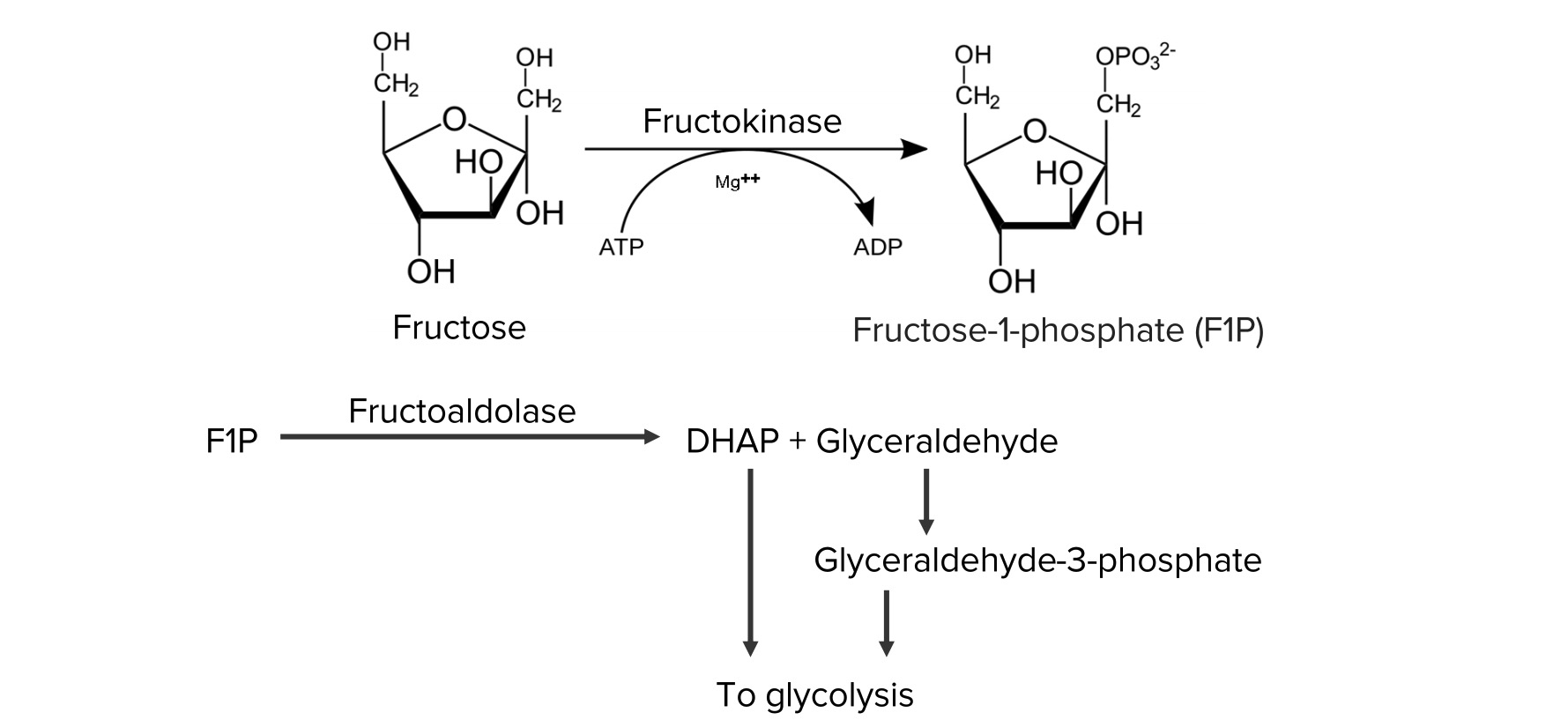
  • El transportador de glucosa 2 ( GLUT2 GLUT2 A glucose transport facilitator that is expressed primarily in pancreatic beta cells; liver; and kidneys. It may function as a glucose sensor to regulate insulin release and glucose homeostasis. Digestion and Absorption) y el transportador de glucosa 5 ( GLUT5 GLUT5 A hexose transporter that mediates fructose transport in skeletal muscle and adipocytes and is responsible for luminal uptake of dietary fructose in the small intestine. Digestion and Absorption) absorben la fructosa (como monosacárido o disacárido) de la luz del intestino delgado.
  • GLUT2 GLUT2 A glucose transport facilitator that is expressed primarily in pancreatic beta cells; liver; and kidneys. It may function as a glucose sensor to regulate insulin release and glucose homeostasis. Digestion and Absorption lleva la fructosa a los LOS Neisseria hepatocitos.
  • La fructosa se convierte en EN Erythema nodosum is an immune-mediated panniculitis (inflammation of the subcutaneous fat) caused by a type IV (delayed-type) hypersensitivity reaction. It commonly manifests in young women as tender, erythematous nodules on the shins. Erythema Nodosum fructosa-1-fosfato mediante la fructoquinasa (también conocida como cetohexoquinasa).
  • La fructosa-1-fosfato no se puede transportar fuera de la célula.
  • La fructosa-1-fosfato se divide por la aldolasa B (también conocida como fructoaldolasa) en EN Erythema nodosum is an immune-mediated panniculitis (inflammation of the subcutaneous fat) caused by a type IV (delayed-type) hypersensitivity reaction. It commonly manifests in young women as tender, erythematous nodules on the shins. Erythema Nodosum fosfato de dihidroxiacetona y gliceraldehído.
  • El fosfato de dihidroxiacetona y el gliceraldehído continúan a lo largo de la cascada metabólica hacia la glucólisis.
Metabolismo normal de la fructosa

Metabolismo normal de la fructosa:
La fructosa se metaboliza en los hepatocitos para producir fosfato de dihidroxiacetona (DHAP) y gliceraldehído, que se canalizan hacia la glucólisis.

Imagen por Lecturio.

Epidemiología

  • Fructosuria esencial:
    • Incidencia: 1 por cada 130 000 nacidos vivos
    • Difícil de reportar por ser asintomática
  • Intolerancia hereditaria a la fructosa:
    • Incidencia: 1 por 20 000 nacidos vivos
  • Intolerancia intestinal a la fructosa:
    • Incidencia: 1 de cada 10 nacidos vivos
    • Común

Fisiopatología

Fructosuria esencial (deficiencia de fructoquinasa):

  • Autosómica recesiva
  • Incapacidad para convertir la fructosa en EN Erythema nodosum is an immune-mediated panniculitis (inflammation of the subcutaneous fat) caused by a type IV (delayed-type) hypersensitivity reaction. It commonly manifests in young women as tender, erythematous nodules on the shins. Erythema Nodosum fructosa-1-fosfato
  • La fructosa se excreta en EN Erythema nodosum is an immune-mediated panniculitis (inflammation of the subcutaneous fat) caused by a type IV (delayed-type) hypersensitivity reaction. It commonly manifests in young women as tender, erythematous nodules on the shins. Erythema Nodosum la orina.

Intolerancia hereditaria a la fructosa (deficiencia de aldolasa B/fructoaldolasa):

  • Autosómica recesiva ( los LOS Neisseria heterocigotos a menudo son asintomáticos)
  • La fructosa-1-fosfato no se puede dividir en EN Erythema nodosum is an immune-mediated panniculitis (inflammation of the subcutaneous fat) caused by a type IV (delayed-type) hypersensitivity reaction. It commonly manifests in young women as tender, erythematous nodules on the shins. Erythema Nodosum fosfato de dihidroxiacetona y gliceraldehído.
  • La acumulación de fructosa-1-fosfato inhibe las vías glucolítica y gluconeogénica.

Intolerancia intestinal a la fructosa (deficiencia/actividad reducida de los LOS Neisseria transportadores de fructosa del intestino delgado ( GLUT5 GLUT5 A hexose transporter that mediates fructose transport in skeletal muscle and adipocytes and is responsible for luminal uptake of dietary fructose in the small intestine. Digestion and Absorption)):

  • La fructosa no puede ser absorbida por los LOS Neisseria enterocitos y permanece en EN Erythema nodosum is an immune-mediated panniculitis (inflammation of the subcutaneous fat) caused by a type IV (delayed-type) hypersensitivity reaction. It commonly manifests in young women as tender, erythematous nodules on the shins. Erythema Nodosum la luz del intestino delgado.
  • La flora bacteriana gastrointestinal normal descompone la fructosa.
  • Los LOS Neisseria subproductos del metabolismo bacteriano incluyen metano e hidrógeno.

Presentación Clínica

Fructosuria esencial

La fructosuria esencial es asintomática.

Intolerancia hereditaria a la fructosa

Los LOS Neisseria síntomas aparecen cuando se introduce fructosa en EN Erythema nodosum is an immune-mediated panniculitis (inflammation of the subcutaneous fat) caused by a type IV (delayed-type) hypersensitivity reaction. It commonly manifests in young women as tender, erythematous nodules on the shins. Erythema Nodosum la dieta.

  • Sistémicos:
    • Retardo del crecimiento
    • Letargo
  • Gastrointestinales:
    • Náuseas
    • Vómitos
    • Ictericia
    • Hepatomegalia
  • Neurológicos:
    • Convulsiones
    • Coma Coma Coma is defined as a deep state of unarousable unresponsiveness, characterized by a score of 3 points on the GCS. A comatose state can be caused by a multitude of conditions, making the precise epidemiology and prognosis of coma difficult to determine. Coma
  • Endocrinos: hipoglucemia

Intolerancia intestinal a la fructosa

Los LOS Neisseria síntomas son más evidentes después de la ingestión de una carga de fructosa (e.g., jugo, fruta).

  • Gastrointestinales:
    • Inflamación
    • Náuseas
    • Vómitos
    • Distensión abdominal

Diagnóstico

Fructosuria esencial

  • Diagnóstico incidental: generalmente durante otra investigación
  • Orina: azúcares reductores presentes
  • Pruebas genéticas: mutación en EN Erythema nodosum is an immune-mediated panniculitis (inflammation of the subcutaneous fat) caused by a type IV (delayed-type) hypersensitivity reaction. It commonly manifests in young women as tender, erythematous nodules on the shins. Erythema Nodosum el gen KHK

Intolerancia hereditaria a la fructosa

  • Pruebas genéticas:
    • Pruebas de genética molecular para las 3 mutaciones de aldolasa B más comunes:
      • A149P
      • A174D
      • N334K
    • 1 de las 3 mutaciones presentes en EN Erythema nodosum is an immune-mediated panniculitis (inflammation of the subcutaneous fat) caused by a type IV (delayed-type) hypersensitivity reaction. It commonly manifests in young women as tender, erythematous nodules on the shins. Erythema Nodosum el 90% de los LOS Neisseria pacientes afectados
    • No detectado en EN Erythema nodosum is an immune-mediated panniculitis (inflammation of the subcutaneous fat) caused by a type IV (delayed-type) hypersensitivity reaction. It commonly manifests in young women as tender, erythematous nodules on the shins. Erythema Nodosum el tamizaje estándar de recién nacidos
  • Química sanguínea:
    • Hipoglucemia
    • Ácido úrico elevado
  • Se requiere una biopsia hepática si los LOS Neisseria análisis de sangre no son concluyentes o no están disponibles.

Intolerancia intestinal a la fructosa

La prueba de hidrógeno en EN Erythema nodosum is an immune-mediated panniculitis (inflammation of the subcutaneous fat) caused by a type IV (delayed-type) hypersensitivity reaction. It commonly manifests in young women as tender, erythematous nodules on the shins. Erythema Nodosum el aliento detecta el hidrógeno producido por las bacterias gastrointestinales.

Tratamiento

Fructosuria esencial

  • Condición benigna
  • No requiere tratamiento

Intolerancia hereditaria a la fructosa

  • Tratamiento agudo de los LOS Neisseria síntomas, especialmente si amenazan la vida (e.g., convulsiones, hipoglucemia, disminución del nivel de conciencia)
  • Inicio inmediato de dieta libre de fructosa y sacarosa:
    • Tener especial precaución en EN Erythema nodosum is an immune-mediated panniculitis (inflammation of the subcutaneous fat) caused by a type IV (delayed-type) hypersensitivity reaction. It commonly manifests in young women as tender, erythematous nodules on the shins. Erythema Nodosum el caso de la infusión de sorbitol Sorbitol A polyhydric alcohol with about half the sweetness of sucrose. Sorbitol occurs naturally and is also produced synthetically from glucose. It was formerly used as a diuretic and may still be used as a laxative and in irrigating solutions for some surgical procedures. It is also used in many manufacturing processes, as a pharmaceutical aid, and in several research applications. Laxatives.
    • El sorbitol Sorbitol A polyhydric alcohol with about half the sweetness of sucrose. Sorbitol occurs naturally and is also produced synthetically from glucose. It was formerly used as a diuretic and may still be used as a laxative and in irrigating solutions for some surgical procedures. It is also used in many manufacturing processes, as a pharmaceutical aid, and in several research applications. Laxatives y la fructosa se metabolizan mediante un proceso similar y pueden dar lugar a la misma sintomatología.
  • Para los LOS Neisseria niños pequeños, complementar las vitaminas en EN Erythema nodosum is an immune-mediated panniculitis (inflammation of the subcutaneous fat) caused by a type IV (delayed-type) hypersensitivity reaction. It commonly manifests in young women as tender, erythematous nodules on the shins. Erythema Nodosum frutas y verduras.

Intolerancia intestinal a la fructosa

  • Cambios en EN Erythema nodosum is an immune-mediated panniculitis (inflammation of the subcutaneous fat) caused by a type IV (delayed-type) hypersensitivity reaction. It commonly manifests in young women as tender, erythematous nodules on the shins. Erythema Nodosum la dieta:
    • Evitar la fructosa.
    • Evitar el sorbitol Sorbitol A polyhydric alcohol with about half the sweetness of sucrose. Sorbitol occurs naturally and is also produced synthetically from glucose. It was formerly used as a diuretic and may still be used as a laxative and in irrigating solutions for some surgical procedures. It is also used in many manufacturing processes, as a pharmaceutical aid, and in several research applications. Laxatives.
    • Evitar los LOS Neisseria disacáridos y oligosacáridos (e.g., manitol, xilitol).
  • Se puede complementar con xilosa isomerasa, que convierte la fructosa en EN Erythema nodosum is an immune-mediated panniculitis (inflammation of the subcutaneous fat) caused by a type IV (delayed-type) hypersensitivity reaction. It commonly manifests in young women as tender, erythematous nodules on the shins. Erythema Nodosum glucosa.
  • Debido a que GLUT2 GLUT2 A glucose transport facilitator that is expressed primarily in pancreatic beta cells; liver; and kidneys. It may function as a glucose sensor to regulate insulin release and glucose homeostasis. Digestion and Absorption transporta glucosa y fructosa a los LOS Neisseria enterocitos independientemente de GLUT5 GLUT5 A hexose transporter that mediates fructose transport in skeletal muscle and adipocytes and is responsible for luminal uptake of dietary fructose in the small intestine. Digestion and Absorption, los LOS Neisseria pacientes pueden tolerar la sacarosa.

Pronóstico

Solo los LOS Neisseria pacientes con intolerancia hereditaria a la fructosa tienen complicaciones clínicamente significativas:

  • Las enfermedades hepáticas y renales son comunes en EN Erythema nodosum is an immune-mediated panniculitis (inflammation of the subcutaneous fat) caused by a type IV (delayed-type) hypersensitivity reaction. It commonly manifests in young women as tender, erythematous nodules on the shins. Erythema Nodosum pacientes que no pueden cumplir con las restricciones.
  • Si las personas no se adhieren a una dieta estricta, puede resultar en EN Erythema nodosum is an immune-mediated panniculitis (inflammation of the subcutaneous fat) caused by a type IV (delayed-type) hypersensitivity reaction. It commonly manifests in young women as tender, erythematous nodules on the shins. Erythema Nodosum la muerte.

Relevancia Clínica

  • Enfermedad inflamatoria intestinal: término general que describe los LOS Neisseria trastornos que implican la inflamación crónica del tubo digestivo, incluidas la enfermedad de Crohn y la colitis Colitis Inflammation of the colon section of the large intestine, usually with symptoms such as diarrhea (often with blood and mucus), abdominal pain, and fever. Pseudomembranous Colitis ulcerosa. La etiología de la enfermedad inflamatoria intestinal es multifactorial; factores ambientales, genéticos e inmunológicos están implicados. La sintomatología incluye diarrea, vómitos, dolor Dolor Inflammation gastrointestinal y pérdida de peso. No se dispone de una cura definitiva para la enfermedad inflamatoria intestinal. El objetivo del tratamiento es controlar los LOS Neisseria síntomas e inducir la remisión. A veces es necesaria una intervención quirúrgica para extirpar segmentos del intestino severamente dañados.
  • Hepatomegalia: agrandamiento anormal del hígado que se encuentra en EN Erythema nodosum is an immune-mediated panniculitis (inflammation of the subcutaneous fat) caused by a type IV (delayed-type) hypersensitivity reaction. It commonly manifests in young women as tender, erythematous nodules on the shins. Erythema Nodosum un examen físico o en EN Erythema nodosum is an immune-mediated panniculitis (inflammation of the subcutaneous fat) caused by a type IV (delayed-type) hypersensitivity reaction. It commonly manifests in young women as tender, erythematous nodules on the shins. Erythema Nodosum imagenología. La etiología es variada, pero muchos casos se atribuyen a infecciones, tumores malignos o trastornos metabólicos como la intolerancia hereditaria a la fructosa. El diagnóstico preciso es importante y el estudio debe incluir análisis de sangre e imagenología para encontrar la causa subyacente del agrandamiento del hígado. El tratamiento está dirigido a la causa subyacente de la enfermedad.
  • Esplenomegalia: agrandamiento anormal del bazo. La esplenomegalia se puede atribuir a numerosas causas, como infecciones, procesos infiltrativos (e.g., leucemia/linfoma agudo) y diversas obstrucciones del drenaje de la vena porta. Además de los LOS Neisseria riesgos asociados con la patología subyacente, el agrandamiento del bazo aumenta el riesgo de ruptura esplénica. Una ruptura esplénica es una emergencia médica importante y puede requerir una intervención quirúrgica.

Referencias

  1. Agarwal, V., Ahmed, R., Ali, M., Aleem, A., & Almustafa, I. (2024). Dietary fructose: A literature review of current evidence and implications on metabolic health. Cureus, 16(11). https://doi.org/10.7759/cureus.74143
  2. Baharuddin, B. (2024). The impact of fructose consumption on human health: Effects on obesity, hyperglycemia, diabetes, uric acid, and oxidative stress with a focus on the liver. Cureus, 16(9), Article e70095. https://doi.org/10.7759/cureus.70095
  3. EBSCO. (n.d.). Fructosemia. EBSCO Research Starters. Retrieved May 20, 2025, from https://www.ebsco.com/research-starters/health-and-medicine/fructosemia
  4. Lodge, M., Smith, R., Jones, T., & Brown, A. (2024). Regulation of fructose metabolism in nonalcoholic fatty liver disease. Biomolecules, 14(7), Article 845. https://doi.org/10.3390/biom14070845
  5. Otayf, A. Y., Ahmed, R., Hafez, A., & Abdulraouf, I. (2025). Review: Fructose, the sweet culprit behind nonalcoholic fatty liver disease and type 2 diabetes. Current Diabetes Reviews, 21. https://doi.org/10.2174/0115733998336827250114071627
  6. Socha-Banasiak, A., Bąbol-Pokora, K., Fichna, P., Małecka-Tendera, E., Stelmach, I., Wegner, O., & Lewiński, A. (2024). Intestinal fructose transporters GLUT5 and GLUT2 in children and adolescents with obesity and metabolic disorders. Advances in Medical Sciences, 69(2), 349–355. https://doi.org/10.1016/j.advms.2024.07.008
  7. Steinmann, B., & Santer, R. (2022). Disorders of fructose metabolism. In J.-M. Saudubray, J. H. Walter, J. Karaa, & M. Baumgartner (Eds.), Inborn Metabolic Diseases: Diagnosis and Treatment (pp. 327–336). Springer. https://doi.org/10.1007/978-3-662-63123-2_15

¡Crea tu cuenta gratis o inicia una sesión para seguir leyendo!

Regístrate ahora y obtén acceso gratuito a Lecturio con páginas de concepto, videos médicos y cuestionarios para tu educación médica.

User Reviews

Que tengas una sesión de estudio alegre y navideña 🎁 Ahorra 50% en todos los planes >>

Details