
Domina Conceptos Médicos

Estudia para la escuela de medicina y tus examenes con Lecturio.

Trastorno Disfórico Premenstrual

El trastorno disfórico premenstrual (TDPM) se refiere a un grupo de síntomas del estado de ánimo, somáticos y conductuales que siguen un patrón cíclico experimentado por algunas mujeres antes de la menstruación. A diferencia del síndrome premenstrual (SPM), el TDPM se caracteriza por una angustia significativa y/o un deterioro funcional. El diagnóstico se realiza clínicamente con la historia clínica y el examen físico. El tratamiento es doble: a través de la modificación del estilo de vida y la farmacoterapia con inhibidores de la recaptación de serotonina o anticonceptivos orales.

Last updated: Dec 15, 2025

Editorial responsibility: Stanley Oiseth, Lindsay Jones, Evelin Maza

Descripción General

Definición

El trastorno disfórico premenstrual ( PMDD PMDD Premenstrual dysphoric disorder (PMDD) refers to a group of mood, somatic, and behavioral symptoms that follow a cyclical pattern experienced by some women prior to menstruation. Unlike premenstrual syndrome (PMS), pmdd is characterized by significant distress and/or functional impairment. Premenstrual Dysphoric Disorder por sus siglas en EN Erythema nodosum is an immune-mediated panniculitis (inflammation of the subcutaneous fat) caused by a type IV (delayed-type) hypersensitivity reaction. It commonly manifests in young women as tender, erythematous nodules on the shins. Erythema Nodosum inglés) es una forma grave del síndrome premenstrual (PMS por sus siglas en EN Erythema nodosum is an immune-mediated panniculitis (inflammation of the subcutaneous fat) caused by a type IV (delayed-type) hypersensitivity reaction. It commonly manifests in young women as tender, erythematous nodules on the shins. Erythema Nodosum inglés) que se caracteriza por una combinación de síntomas conductuales, afectivos y somáticos que reaparecen con la menstruación. A diferencia del PMS, el PMDD PMDD Premenstrual dysphoric disorder (PMDD) refers to a group of mood, somatic, and behavioral symptoms that follow a cyclical pattern experienced by some women prior to menstruation. Unlike premenstrual syndrome (PMS), pmdd is characterized by significant distress and/or functional impairment. Premenstrual Dysphoric Disorder se caracteriza por síntomas de ira, irritabilidad y tensión interna.

Epidemiología

  • Entre el 5 y el 8% de las mujeres sufren síntomas del síndrome premenstrual.
  • También se estima que aproximadamente del 3% – 8% de las mujeres con síndrome premenstrual cumplen los LOS Neisseria criterios para el síndrome disfórico premenstrual.
  • Muchas mujeres (aproximadamente el 80%) informan ≥ 1 síntoma físico o psiquiátrico durante la menstruación que no causa un deterioro significativo.

Factores de riesgo

  • Antecedentes de eventos traumáticos.
  • Trastornos de ansiedad comórbidos
  • Bajo nivel educativo
  • Tabaquismo
  • Obesidad

Fisiopatología

Fisiología normal

El ciclo menstrual se divide en EN Erythema nodosum is an immune-mediated panniculitis (inflammation of the subcutaneous fat) caused by a type IV (delayed-type) hypersensitivity reaction. It commonly manifests in young women as tender, erythematous nodules on the shins. Erythema Nodosum 2 fases reguladas hormonalmente: ovárica y endometrial.
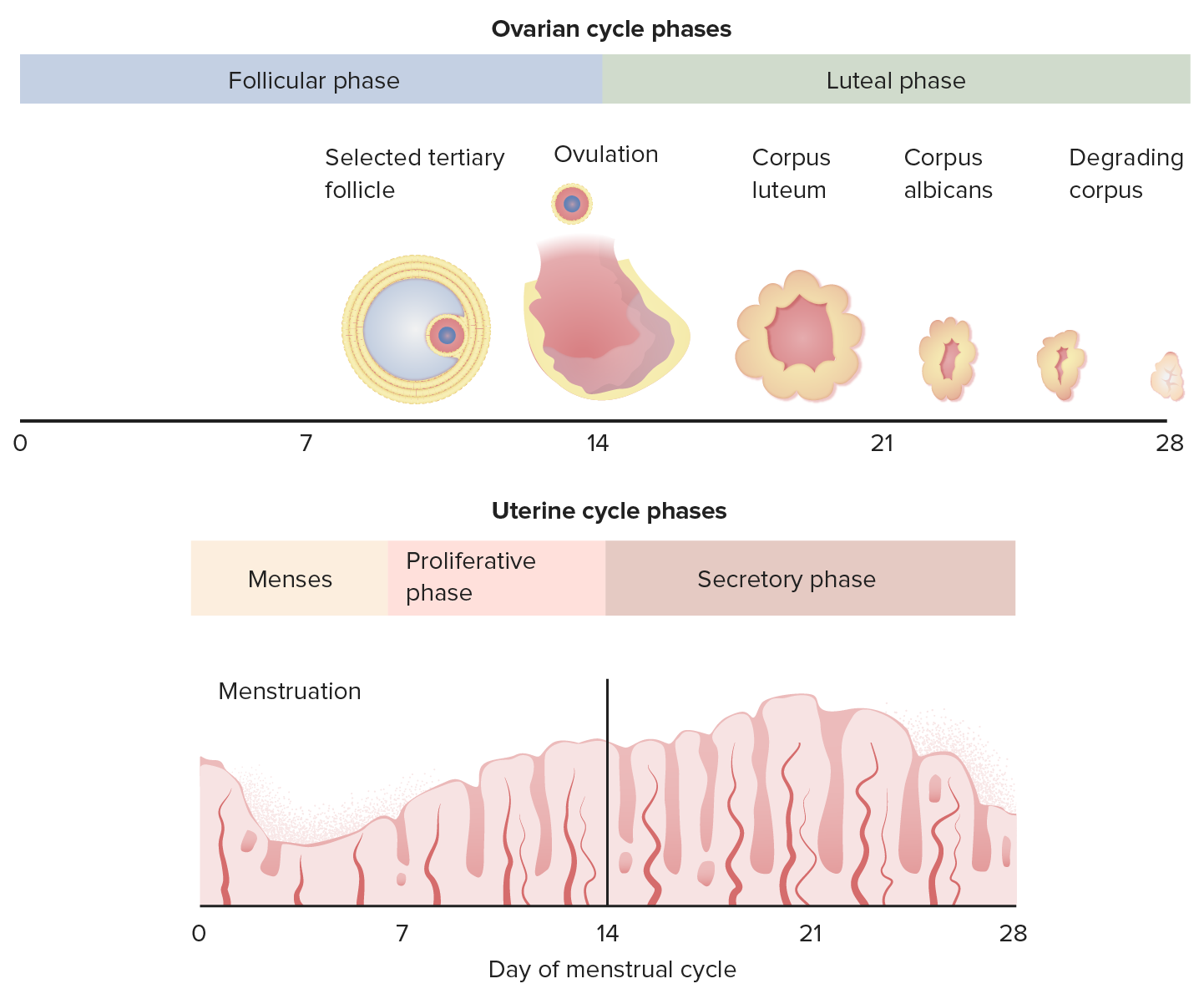
  • Ciclo menstrual adulto promedio: 28–35 días
  • Los LOS Neisseria intervalos de los LOS Neisseria ciclos suelen permanecer constantes hasta la perimenopausia, cuando las fases foliculares se vuelven más cortas y frecuentes.
  • Fase ovárica:
    • Fase folicular:
      • Se extiende desde el inicio de la menstruación (día 1) hasta el día anterior al AL Amyloidosis aumento de la luteinización ( LH LH A major gonadotropin secreted by the adenohypophysis. Luteinizing hormone regulates steroid production by the interstitial cells of the testis and the ovary. The preovulatory luteinizing hormone surge in females induces ovulation, and subsequent luteinization of the follicle. Luteinizing hormone consists of two noncovalently linked subunits, alpha and beta. Within a species, the alpha subunit is common in the three pituitary glycoprotein hormones (TSH, LH, and FSH), but the beta subunit is unique and confers its biological specificity. Menstrual Cycle) que conduce a la ovulación.
      • Duración: 14–21 días
    • Fase lútea
      • Se extiende desde el día del pico de LH LH A major gonadotropin secreted by the adenohypophysis. Luteinizing hormone regulates steroid production by the interstitial cells of the testis and the ovary. The preovulatory luteinizing hormone surge in females induces ovulation, and subsequent luteinization of the follicle. Luteinizing hormone consists of two noncovalently linked subunits, alpha and beta. Within a species, the alpha subunit is common in the three pituitary glycoprotein hormones (TSH, LH, and FSH), but the beta subunit is unique and confers its biological specificity. Menstrual Cycle hasta el inicio de la siguiente menstruación
      • Duración: 15 días
  • Fase endometrial:
    • Descamación: desprendimiento del revestimiento endometrial (menstruación)
    • Fase proliferativa: proliferación endometrial con glándulas tubulares rectas
    • Fase secretora: preparación de las arterias espirales y las glándulas endometriales para la posible implantación de ovocitos

Fisiopatología

  • Se desconoce el mecanismo fisiopatológico exacto del PMDD PMDD Premenstrual dysphoric disorder (PMDD) refers to a group of mood, somatic, and behavioral symptoms that follow a cyclical pattern experienced by some women prior to menstruation. Unlike premenstrual syndrome (PMS), pmdd is characterized by significant distress and/or functional impairment. Premenstrual Dysphoric Disorder.
  • Variables que pueden desempeñar un papel importante en EN Erythema nodosum is an immune-mediated panniculitis (inflammation of the subcutaneous fat) caused by a type IV (delayed-type) hypersensitivity reaction. It commonly manifests in young women as tender, erythematous nodules on the shins. Erythema Nodosum la fisiopatología del PMDD PMDD Premenstrual dysphoric disorder (PMDD) refers to a group of mood, somatic, and behavioral symptoms that follow a cyclical pattern experienced by some women prior to menstruation. Unlike premenstrual syndrome (PMS), pmdd is characterized by significant distress and/or functional impairment. Premenstrual Dysphoric Disorder:
    • Genética
    • Diferencias en EN Erythema nodosum is an immune-mediated panniculitis (inflammation of the subcutaneous fat) caused by a type IV (delayed-type) hypersensitivity reaction. It commonly manifests in young women as tender, erythematous nodules on the shins. Erythema Nodosum la función y estructura del cerebro.
    • Antecedentes traumáticos previos
    • Fluctuaciones de los LOS Neisseria niveles de:
      • Progesterona
      • Estrógeno
      • Factor neurotrófico derivado del cerebro
      • Serotonina
Fisiología normal del ciclo menstrual.

Fisiología normal del ciclo menstrual:
un diagrama que muestra la correlación entre el ciclo ovárico y el ciclo endometrial

Imagen por Lecturio.

Presentación Clínica

Los LOS Neisseria síntomas del PMS pueden ser tanto físicos como conductuales.

  • Momento de presentación de los LOS Neisseria síntomas:
    • Los LOS Neisseria síntomas empeoran aproximadamente 5 días antes del inicio de la menstruación.
    • Los LOS Neisseria síntomas mejoran unos días después del inicio de la menstruación.
    • Los LOS Neisseria síntomas se resuelven después de la menstruación.
    • Los LOS Neisseria siguientes síntomas deben estar presentes durante ≥ 2 ciclos menstruales consecutivos.
Tabla: Síntomas afectivos del PMDD PMDD Premenstrual dysphoric disorder (PMDD) refers to a group of mood, somatic, and behavioral symptoms that follow a cyclical pattern experienced by some women prior to menstruation. Unlike premenstrual syndrome (PMS), pmdd is characterized by significant distress and/or functional impairment. Premenstrual Dysphoric Disorder
Síntomas Descripción de la mujer
Inestabilidad afectiva/estado de ánimo Tristeza repentina, rápidos cambios de humor Humor Defense Mechanisms, aumento del llanto
Irritabilidad, frustración, aumento de conflictos interpersonales Menor capacidad para controlar la ira y puede volverse más conflictiva
Depresión Duda de sí misma, pensamientos negativos, sentimientos de desesperanza
Ansiedad o tensión Sensación de estar “ al AL Amyloidosis límite”
Tabla: Síntomas conductuales o cognitivos del PMDD PMDD Premenstrual dysphoric disorder (PMDD) refers to a group of mood, somatic, and behavioral symptoms that follow a cyclical pattern experienced by some women prior to menstruation. Unlike premenstrual syndrome (PMS), pmdd is characterized by significant distress and/or functional impairment. Premenstrual Dysphoric Disorder
Síntomas Descripción de la mujer
Disminución del interés en EN Erythema nodosum is an immune-mediated panniculitis (inflammation of the subcutaneous fat) caused by a type IV (delayed-type) hypersensitivity reaction. It commonly manifests in young women as tender, erythematous nodules on the shins. Erythema Nodosum las actividades diarias ( anhedonia Anhedonia Inability to experience pleasure due to impairment or dysfunction of normal psychological and neurobiological mechanisms. It is a symptom of many psychotic disorders (e.g., depressive disorder, major; and schizophrenia). Schizophrenia) Ya no encuentra alegría o placer en EN Erythema nodosum is an immune-mediated panniculitis (inflammation of the subcutaneous fat) caused by a type IV (delayed-type) hypersensitivity reaction. It commonly manifests in young women as tender, erythematous nodules on the shins. Erythema Nodosum pasatiempos, escuela, trabajo, círculo social
Alteraciones en EN Erythema nodosum is an immune-mediated panniculitis (inflammation of the subcutaneous fat) caused by a type IV (delayed-type) hypersensitivity reaction. It commonly manifests in young women as tender, erythematous nodules on the shins. Erythema Nodosum la concentración Disminución de la capacidad para permanecer enfocada en EN Erythema nodosum is an immune-mediated panniculitis (inflammation of the subcutaneous fat) caused by a type IV (delayed-type) hypersensitivity reaction. It commonly manifests in young women as tender, erythematous nodules on the shins. Erythema Nodosum el trabajo, las conversaciones, la lectura
Disminución de la energía o aumento de la fatiga Informa estar constantemente cansada o “No quiero levantarme de la cama”.
Cambios en EN Erythema nodosum is an immune-mediated panniculitis (inflammation of the subcutaneous fat) caused by a type IV (delayed-type) hypersensitivity reaction. It commonly manifests in young women as tender, erythematous nodules on the shins. Erythema Nodosum el apetito Antojos de comida, comer en EN Erythema nodosum is an immune-mediated panniculitis (inflammation of the subcutaneous fat) caused by a type IV (delayed-type) hypersensitivity reaction. It commonly manifests in young women as tender, erythematous nodules on the shins. Erythema Nodosum exceso
Trastornos del sueño Aumento del sueño (hipersomnia) o dificultad para dormir (insomnio)
Sensación de estar fuera de control o abrumada “Ya no puedo hacer esto.”
Síntomas somáticos Sensibilidad o congestión de las mamas, dolor Dolor Inflammation en EN Erythema nodosum is an immune-mediated panniculitis (inflammation of the subcutaneous fat) caused by a type IV (delayed-type) hypersensitivity reaction. It commonly manifests in young women as tender, erythematous nodules on the shins. Erythema Nodosum las articulaciones o los LOS Neisseria músculos, sensación de sentirse “hinchada”, aumento de peso
Tabla: Diferencias entre el PMS y el PMDD PMDD Premenstrual dysphoric disorder (PMDD) refers to a group of mood, somatic, and behavioral symptoms that follow a cyclical pattern experienced by some women prior to menstruation. Unlike premenstrual syndrome (PMS), pmdd is characterized by significant distress and/or functional impairment. Premenstrual Dysphoric Disorder
PMS PMDD PMDD Premenstrual dysphoric disorder (PMDD) refers to a group of mood, somatic, and behavioral symptoms that follow a cyclical pattern experienced by some women prior to menstruation. Unlike premenstrual syndrome (PMS), pmdd is characterized by significant distress and/or functional impairment. Premenstrual Dysphoric Disorder
Duración de los LOS Neisseria síntomas Los LOS Neisseria síntomas se presentan inmediatamente antes de la menstruación e incluyen fatiga, hinchazón, irritabilidad, depresión y terminan inmediatamente después de que comienza la menstruación. Incluyen cambios de humor Humor Defense Mechanisms y comportamiento que están presentes casi a diario, incluidos problemas para desenvolverse en EN Erythema nodosum is an immune-mediated panniculitis (inflammation of the subcutaneous fat) caused by a type IV (delayed-type) hypersensitivity reaction. It commonly manifests in young women as tender, erythematous nodules on the shins. Erythema Nodosum el hogar y el trabajo y que terminan unos días después de que comienza la menstruación.
Confirmación del diagnóstico Los LOS Neisseria síntomas deben estar presentes 5 días antes del inicio de la menstruación durante 3 ciclos menstruales consecutivos. Los LOS Neisseria síntomas generalmente deben estar presentes 7 días antes del inicio de la menstruación para la mayoría de los LOS Neisseria ciclos menstruales durante un período de 1 año.
Interferencia con las actividades diarias Moderada Extrema

Diagnóstico

  • Criterios de diagnóstico clínico
    • Deben estar presentes ≥ 5 de los LOS Neisseria síntomas enumerados en EN Erythema nodosum is an immune-mediated panniculitis (inflammation of the subcutaneous fat) caused by a type IV (delayed-type) hypersensitivity reaction. It commonly manifests in young women as tender, erythematous nodules on the shins. Erythema Nodosum las tablas anteriores.
    • Los LOS Neisseria síntomas comienzan en EN Erythema nodosum is an immune-mediated panniculitis (inflammation of the subcutaneous fat) caused by a type IV (delayed-type) hypersensitivity reaction. It commonly manifests in young women as tender, erythematous nodules on the shins. Erythema Nodosum los LOS Neisseria días inmediatamente anteriores al AL Amyloidosis inicio de la menstruación, mejoran unos días después del inicio de la menstruación y luego se resuelven dentro de una semana después de la menstruación.
    • Debe estar presente ≥ 1 de los LOS Neisseria siguientes 4 síntomas afectivos (según la 1ra tabla):
      • Labilidad afectiva
      • Aumento de la irritabilidad
      • Depresión
      • Ansiedad o tensión
    • Debe estar presente ≥ 1 de los LOS Neisseria siguientes 4 síntomas cognitivos (según la 2da tabla):
      • Anhedonia Anhedonia Inability to experience pleasure due to impairment or dysfunction of normal psychological and neurobiological mechanisms. It is a symptom of many psychotic disorders (e.g., depressive disorder, major; and schizophrenia). Schizophrenia
      • Dificultad para concentrarse
      • Fatiga
      • Cambios en EN Erythema nodosum is an immune-mediated panniculitis (inflammation of the subcutaneous fat) caused by a type IV (delayed-type) hypersensitivity reaction. It commonly manifests in young women as tender, erythematous nodules on the shins. Erythema Nodosum el apetito
      • Trastornos del sueño
      • Sensación de estar abrumado
      • Síntomas somáticos
  • Una historia médica detallada y un examen físico para cumplir con los LOS Neisseria criterios de diagnóstico son suficientes.
  • Los LOS Neisseria estudios de imagenología y de laboratorio pueden indicarse para descartar diagnósticos alternativos, pero no son necesarios.
  • El diario de síntomas compilado por la paciente y los LOS Neisseria cuestionarios prospectivos también tienen valor diagnóstico.

Tratamiento

  • Farmacológico:
    • Los LOS Neisseria antidepresivos serotoninérgicos son la terapia farmacológica de elección.
      • Inhibidor selectivo de la recaptación de serotonina (SSRI por sus siglas en EN Erythema nodosum is an immune-mediated panniculitis (inflammation of the subcutaneous fat) caused by a type IV (delayed-type) hypersensitivity reaction. It commonly manifests in young women as tender, erythematous nodules on the shins. Erythema Nodosum inglés): citalopram Citalopram A furancarbonitrile that is one of the serotonin uptake inhibitors used as an antidepressant. The drug is also effective in reducing ethanol uptake in alcoholics and is used in depressed patients who also suffer from tardive dyskinesia in preference to tricyclic antidepressants, which aggravate dyskinesia. Serotonin Reuptake Inhibitors and Similar Antidepressants, escitalopram Escitalopram Serotonin Reuptake Inhibitors and Similar Antidepressants, fluoxetina, sertralina
      • Inhibidor de la recaptura de serotonina-norepinefrina (SNRI por sus siglas en EN Erythema nodosum is an immune-mediated panniculitis (inflammation of the subcutaneous fat) caused by a type IV (delayed-type) hypersensitivity reaction. It commonly manifests in young women as tender, erythematous nodules on the shins. Erythema Nodosum inglés): venlafaxina, duloxetina
    • Intervenciones hormonales:
      • Anticonceptivos orales
      • Agonista de la hormona liberadora de gonadotropina (GnRH)
    • Suplementos dietéticos y vitaminas
  • Cambios en EN Erythema nodosum is an immune-mediated panniculitis (inflammation of the subcutaneous fat) caused by a type IV (delayed-type) hypersensitivity reaction. It commonly manifests in young women as tender, erythematous nodules on the shins. Erythema Nodosum el estilo de vida:
    • Actividad física: ejercicio
    • Cambios en EN Erythema nodosum is an immune-mediated panniculitis (inflammation of the subcutaneous fat) caused by a type IV (delayed-type) hypersensitivity reaction. It commonly manifests in young women as tender, erythematous nodules on the shins. Erythema Nodosum la dieta: dieta saludable
    • Evitar los LOS Neisseria desencadenantes: fumar, alcohol, estrés
  • Terapia cognitiva conductual:
    • Los LOS Neisseria ejercicios basados en EN Erythema nodosum is an immune-mediated panniculitis (inflammation of the subcutaneous fat) caused by a type IV (delayed-type) hypersensitivity reaction. It commonly manifests in young women as tender, erythematous nodules on the shins. Erythema Nodosum la atención plena, así como la terapia cognitiva conductual basada en EN Erythema nodosum is an immune-mediated panniculitis (inflammation of the subcutaneous fat) caused by a type IV (delayed-type) hypersensitivity reaction. It commonly manifests in young women as tender, erythematous nodules on the shins. Erythema Nodosum la aceptación, están relacionados con la reducción de los LOS Neisseria síntomas.
    • Se cree que es útil para tratar los LOS Neisseria cambios disruptivos relacionados con el estado de ánimo.

Diagnóstico Diferencial

  • Trastornos de ansiedad: Grupo de condiciones psiquiátricas que presentan varios síntomas, incluyendo cambios de humor Humor Defense Mechanisms, irritabilidad, fatiga y falta de concentración. El síntoma de ansiedad puede ser provocado por cualquier evento desencadenante. Los LOS Neisseria síntomas de ansiedad pueden presentarse como trastorno de ansiedad generalizada, como trastornos de pánico o como parte de una depresión mayor o síndrome premenstrual en EN Erythema nodosum is an immune-mediated panniculitis (inflammation of the subcutaneous fat) caused by a type IV (delayed-type) hypersensitivity reaction. It commonly manifests in young women as tender, erythematous nodules on the shins. Erythema Nodosum mujeres. El diagnóstico se realiza clínicamente y el tratamiento de primera línea es una combinación de farmacoterapia (SSRI) y terapia cognitiva conductual.
  • Trastornos de la tiroides: Tanto el hipertiroidismo como el hipotiroidismo pueden tener cambios de humor Humor Defense Mechanisms con una constelación de varios síntomas somáticos. El diagnóstico se realiza mediante pruebas de función tiroidea y, en EN Erythema nodosum is an immune-mediated panniculitis (inflammation of the subcutaneous fat) caused by a type IV (delayed-type) hypersensitivity reaction. It commonly manifests in young women as tender, erythematous nodules on the shins. Erythema Nodosum casos seleccionados, es posible que se requiera un ultrasonido. El tratamiento consiste en EN Erythema nodosum is an immune-mediated panniculitis (inflammation of the subcutaneous fat) caused by a type IV (delayed-type) hypersensitivity reaction. It commonly manifests in young women as tender, erythematous nodules on the shins. Erythema Nodosum suplementos de hormona tiroidea en EN Erythema nodosum is an immune-mediated panniculitis (inflammation of the subcutaneous fat) caused by a type IV (delayed-type) hypersensitivity reaction. It commonly manifests in young women as tender, erythematous nodules on the shins. Erythema Nodosum el hipotiroidismo y supresión de la actividad tiroidea en EN Erythema nodosum is an immune-mediated panniculitis (inflammation of the subcutaneous fat) caused by a type IV (delayed-type) hypersensitivity reaction. It commonly manifests in young women as tender, erythematous nodules on the shins. Erythema Nodosum el hipertiroidismo.
  • Síndrome del intestino irritable: Trastorno funcional caracterizado por síntomas gastrointestinales con alteración de los LOS Neisseria hábitos intestinales y dolor Dolor Inflammation abdominal asociado. Este síndrome es muy común en EN Erythema nodosum is an immune-mediated panniculitis (inflammation of the subcutaneous fat) caused by a type IV (delayed-type) hypersensitivity reaction. It commonly manifests in young women as tender, erythematous nodules on the shins. Erythema Nodosum mujeres, en EN Erythema nodosum is an immune-mediated panniculitis (inflammation of the subcutaneous fat) caused by a type IV (delayed-type) hypersensitivity reaction. It commonly manifests in young women as tender, erythematous nodules on the shins. Erythema Nodosum quienes los LOS Neisseria síntomas pueden presentarse antes del ciclo menstrual. Los LOS Neisseria cambios de humor Humor Defense Mechanisms pueden coexistir con estos síntomas. El síndrome del intestino irritable es un diagnóstico de exclusión y el tratamiento se basa en EN Erythema nodosum is an immune-mediated panniculitis (inflammation of the subcutaneous fat) caused by a type IV (delayed-type) hypersensitivity reaction. It commonly manifests in young women as tender, erythematous nodules on the shins. Erythema Nodosum la modificación de la dieta y el control de los LOS Neisseria síntomas.

Referencias

  1. Hofmeister, S., Bodden, S. (2016). Premenstrual syndrome and premenstrual dysphoric disorder. American Family Physician 94.3:236–240.
  2. Pearlstein, T., Steiner, M. (2012). Premenstrual dysphoric disorder: burden of illness and treatment update. Focus 10(1):90–101.
  3. Yonkers, K. A., O’Brien, P. S., Eriksson, E. (2008). Premenstrual syndrome. Lancet 371:1200–1210. https://doi.org/10.1016/s0140-6736(08)60527-9
  4. Kwan, I., Onwude, J. L. (2015). Premenstrual syndrome. BMJ Clinical Evidence 2015:0806. https://www.ncbi.nlm.nih.gov/pmc/articles/PMC4548199/
  5. University of Oxford. (2024). New data shows prevalence of premenstrual dysphoric disorder. University of Oxford. https://www.ox.ac.uk/news/2024-01-30-new-data-shows-prevalence-premenstrual-dysphoric-disorder
  6. Mishra, S., Elliott, H., & Marwaha, R. (2023). Premenstrual Dysphoric Disorder. In NCBI Bookshelf. National Library of Medicine. Retrieved March 7, 2025, from https://www.ncbi.nlm.nih.gov/books/NBK532307/

¡Crea tu cuenta gratis o inicia una sesión para seguir leyendo!

Regístrate ahora y obtén acceso gratuito a Lecturio con páginas de concepto, videos médicos y cuestionarios para tu educación médica.

User Reviews

Que tengas una sesión de estudio alegre y navideña 🎁 Ahorra 50% en todos los planes >>

Details