Domina Conceptos Médicos

Estudia para la escuela de medicina y tus examenes con Lecturio.

Tipos y Estructura de ADN

La molécula de ácido desoxirribonucleico (ADN) es el depósito de la información genética heredable. En EN Erythema nodosum is an immune-mediated panniculitis (inflammation of the subcutaneous fat) caused by a type IV (delayed-type) hypersensitivity reaction. It commonly manifests in young women as tender, erythematous nodules on the shins. Erythema Nodosum los LOS Neisseria humanos, el ADN está contenido en EN Erythema nodosum is an immune-mediated panniculitis (inflammation of the subcutaneous fat) caused by a type IV (delayed-type) hypersensitivity reaction. It commonly manifests in young women as tender, erythematous nodules on the shins. Erythema Nodosum 23 pares de cromosomas dentro del núcleo. La molécula proporciona la plantilla básica para la replicación de la información genética, la transcripción de ácido ribonucleico (ARN) y la biosíntesis de proteínas para promover la función celular y la supervivencia.

Last updated: Dec 15, 2025

Editorial responsibility: Stanley Oiseth, Lindsay Jones, Evelin Maza

Estructura del ADN

El ADN es el material hereditario, compuesto de un polímero de nucleótidos de doble cadena:
  • Organización del ADN:
    • En EN Erythema nodosum is an immune-mediated panniculitis (inflammation of the subcutaneous fat) caused by a type IV (delayed-type) hypersensitivity reaction. It commonly manifests in young women as tender, erythematous nodules on the shins. Erythema Nodosum las células eucariotas, el ADN se encuentra en EN Erythema nodosum is an immune-mediated panniculitis (inflammation of the subcutaneous fat) caused by a type IV (delayed-type) hypersensitivity reaction. It commonly manifests in young women as tender, erythematous nodules on the shins. Erythema Nodosum el núcleo celular y en EN Erythema nodosum is an immune-mediated panniculitis (inflammation of the subcutaneous fat) caused by a type IV (delayed-type) hypersensitivity reaction. It commonly manifests in young women as tender, erythematous nodules on the shins. Erythema Nodosum las mitocondrias:
      • El cromosoma es la unidad organizadora del ADN.
      • En EN Erythema nodosum is an immune-mediated panniculitis (inflammation of the subcutaneous fat) caused by a type IV (delayed-type) hypersensitivity reaction. It commonly manifests in young women as tender, erythematous nodules on the shins. Erythema Nodosum humanos: 46 cromosomas homólogos (23 pares)
      • Información de codificación contenida dentro de segmentos de cromosomas llamados genes Genes A category of nucleic acid sequences that function as units of heredity and which code for the basic instructions for the development, reproduction, and maintenance of organisms. DNA Types and Structure
    • En EN Erythema nodosum is an immune-mediated panniculitis (inflammation of the subcutaneous fat) caused by a type IV (delayed-type) hypersensitivity reaction. It commonly manifests in young women as tender, erythematous nodules on the shins. Erythema Nodosum los LOS Neisseria procariotas, el ADN se encuentra en EN Erythema nodosum is an immune-mediated panniculitis (inflammation of the subcutaneous fat) caused by a type IV (delayed-type) hypersensitivity reaction. It commonly manifests in young women as tender, erythematous nodules on the shins. Erythema Nodosum el citoplasma en EN Erythema nodosum is an immune-mediated panniculitis (inflammation of the subcutaneous fat) caused by a type IV (delayed-type) hypersensitivity reaction. It commonly manifests in young women as tender, erythematous nodules on the shins. Erythema Nodosum forma de plásmido o cromosoma.
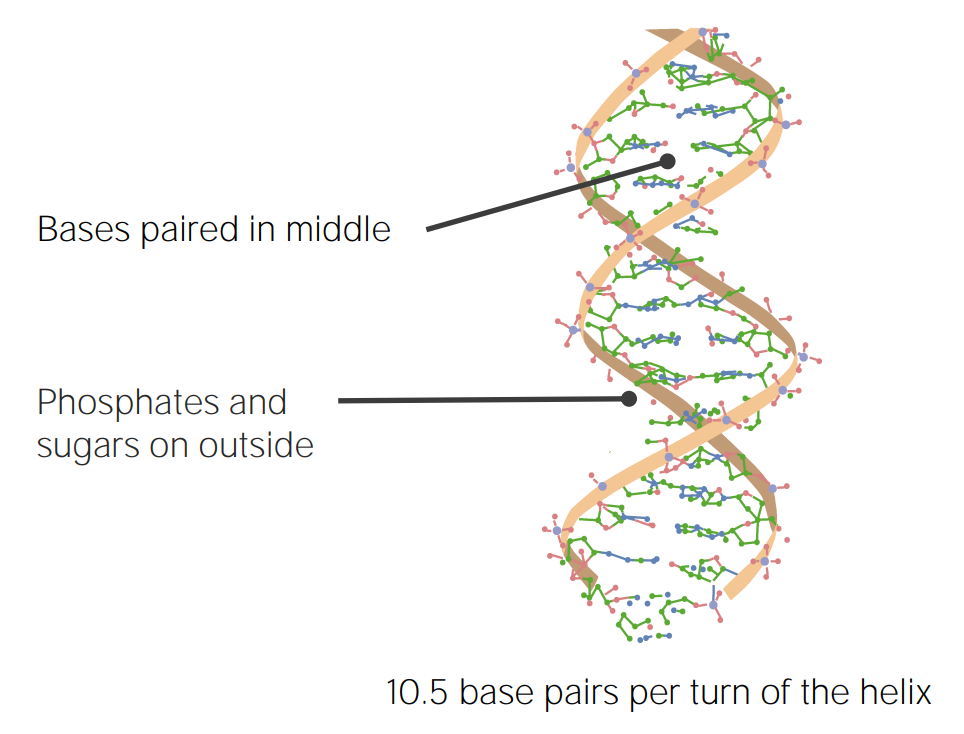
  • Estructura del ADN:
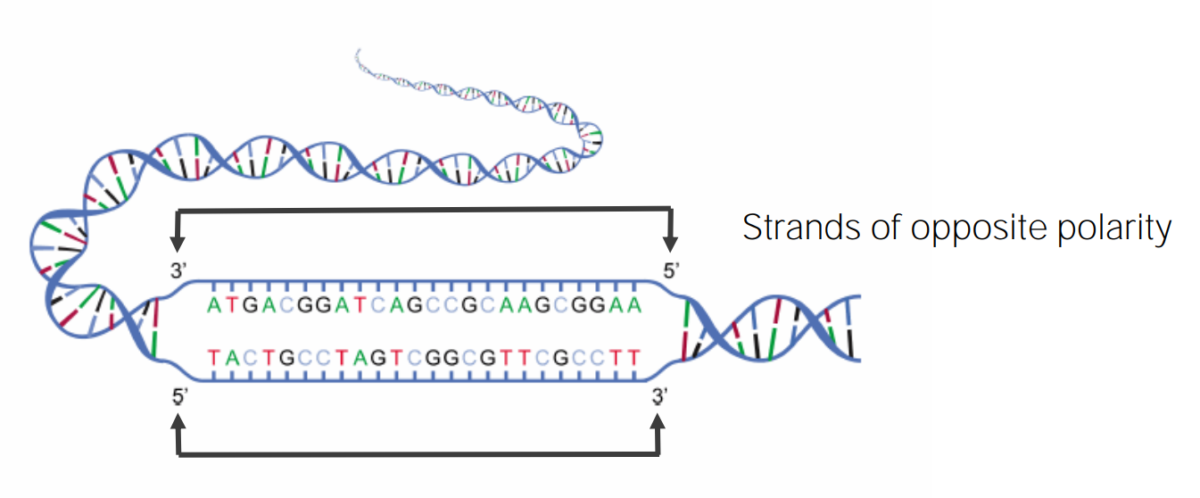
    • 2 cadenas antiparalelas (polaridad opuesta) formando una doble hélice: 10,5 pares de bases Bases Usually a hydroxide of lithium, sodium, potassium, rubidium or cesium, but also the carbonates of these metals, ammonia, and the amines. Acid-Base Balance por vuelta de hélice
    • La columna vertebral formada por un azucar-fosfato cargado negativamente
    • Cadenas complementarias que se mantiene unidas por:
      • Puentes de hidrógeno
      • Fuerzas de Van der Waals
      • Interacciones hidrofóbicas entre pares de bases Bases Usually a hydroxide of lithium, sodium, potassium, rubidium or cesium, but also the carbonates of these metals, ammonia, and the amines. Acid-Base Balance
    • En EN Erythema nodosum is an immune-mediated panniculitis (inflammation of the subcutaneous fat) caused by a type IV (delayed-type) hypersensitivity reaction. It commonly manifests in young women as tender, erythematous nodules on the shins. Erythema Nodosum cada hebra existen carbonos terminales libres 5’–3’ 
    • Descrita por James Watson y Francis Crick (ganadores del Premio Nobel de Fisiología y Medicina en EN Erythema nodosum is an immune-mediated panniculitis (inflammation of the subcutaneous fat) caused by a type IV (delayed-type) hypersensitivity reaction. It commonly manifests in young women as tender, erythematous nodules on the shins. Erythema Nodosum 1962)
    • El trabajo de Rosalind Franklin con cristalografía de rayos X fue esencial para el descubrimiento de la estructura del ADN.
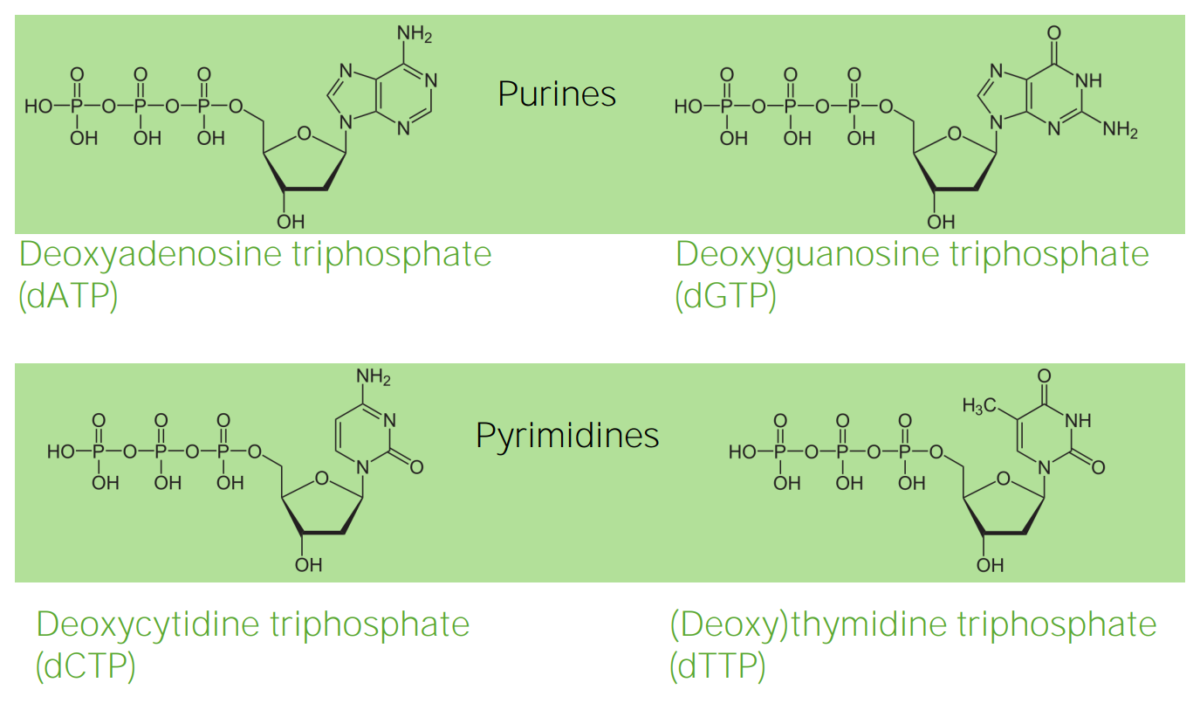
  • Los LOS Neisseria nucleótidos son los LOS Neisseria monómeros que forman el ADN:
    • Nucleótidos en EN Erythema nodosum is an immune-mediated panniculitis (inflammation of the subcutaneous fat) caused by a type IV (delayed-type) hypersensitivity reaction. It commonly manifests in young women as tender, erythematous nodules on the shins. Erythema Nodosum el ADN (desoxirribonucleótidos):
      • Trifosfato de desoxiadenosina (dATP, por sus siglas en EN Erythema nodosum is an immune-mediated panniculitis (inflammation of the subcutaneous fat) caused by a type IV (delayed-type) hypersensitivity reaction. It commonly manifests in young women as tender, erythematous nodules on the shins. Erythema Nodosum inglés)
      • Trifosfato de desoxiguanosina (dGTP, por sus siglas en EN Erythema nodosum is an immune-mediated panniculitis (inflammation of the subcutaneous fat) caused by a type IV (delayed-type) hypersensitivity reaction. It commonly manifests in young women as tender, erythematous nodules on the shins. Erythema Nodosum inglés)
      • Trifosfato de desoxicitidina (dCTP, por sus siglas en EN Erythema nodosum is an immune-mediated panniculitis (inflammation of the subcutaneous fat) caused by a type IV (delayed-type) hypersensitivity reaction. It commonly manifests in young women as tender, erythematous nodules on the shins. Erythema Nodosum inglés)
      • Trifosfato de desoxitimidina (dTTP, por sus siglas en EN Erythema nodosum is an immune-mediated panniculitis (inflammation of the subcutaneous fat) caused by a type IV (delayed-type) hypersensitivity reaction. It commonly manifests in young women as tender, erythematous nodules on the shins. Erythema Nodosum inglés)
    • Los LOS Neisseria nucleótidos están unidos a través de enlaces fosfodiéster 3’–5′:
      • La energía para la síntesis proviene de la liberación de 2 fosfatos (dATP → monofosfato de desoxiadenosina (dAMP, por sus siglas en EN Erythema nodosum is an immune-mediated panniculitis (inflammation of the subcutaneous fat) caused by a type IV (delayed-type) hypersensitivity reaction. It commonly manifests in young women as tender, erythematous nodules on the shins. Erythema Nodosum inglés)).
      • La síntesis ocurre en EN Erythema nodosum is an immune-mediated panniculitis (inflammation of the subcutaneous fat) caused by a type IV (delayed-type) hypersensitivity reaction. It commonly manifests in young women as tender, erythematous nodules on the shins. Erythema Nodosum la dirección 5’–3′.
      • Las purinas se emparejan con las pirimidinas:
        • Adenina (purina) ↔ timina (pirimidina)
        • Guanina (purina) ↔ citosina (pirimidina)

Organización y Empaquetamiento del ADN en el Núcleo Celular

  • En EN Erythema nodosum is an immune-mediated panniculitis (inflammation of the subcutaneous fat) caused by a type IV (delayed-type) hypersensitivity reaction. It commonly manifests in young women as tender, erythematous nodules on the shins. Erythema Nodosum el núcleo, las proteínas nucleicas condensan el ADN en EN Erythema nodosum is an immune-mediated panniculitis (inflammation of the subcutaneous fat) caused by a type IV (delayed-type) hypersensitivity reaction. It commonly manifests in young women as tender, erythematous nodules on the shins. Erythema Nodosum cromosomas.
  • Orden de condensación del ADN: ADN de doble cadena (ADNsd) → nucleosomas → hebra de solenoide → bucles de cromatina → cromosomas
    • El ADNsd cargado negativamente se envuelve alrededor de octámeros de histonas cargados positivamente para formar nucleosomas.
    • Las histonas sufren modificaciones que afectan el acceso al AL Amyloidosis ADN y, por lo tanto, la transcripción:
      • Acetilación (aumenta la transcripción)
      • Metilación (aumenta o disminuye la transcripción, epigenética → heredable)
      • Fosforilación (aumenta o disminuye la transcripción)
      • Ubiquitilación
      • ADP-ribosilación
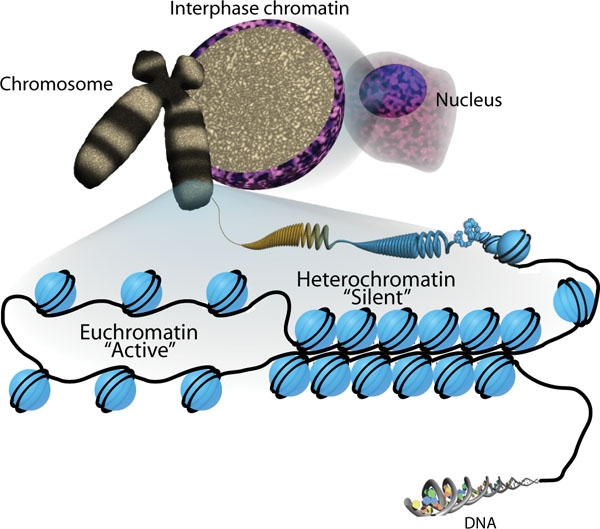
  • Formas de cromatina:
    • Eucromatina (forma descondensada): transcripcionalmente activa
    • Heterocromatina (forma condensada): transcripcionalmente inactiva
Empaquetamiento del ADN y los dos estados de la cromatina.

Empaquetamiento del ADN y los 2 estados de la cromatina:
Eucromatina (activa) donde el ADN se replica o transcribe; y heterocromatina (silenciosa), donde el ADN no se replica ni se transcribe.

Imagen: “The basic unit of chromatin organization is the nucleosome, which comprises 147 bp of DNA wrapped ar” por Sha, K. and Boyer, L. A. Licencia: CC BY 3.0

ADN Mitocondrial

  • El ADN mitocondrial (ADNmt) representa el 1% del ADN celular.
  • Solo se hereda de la madre (herencia no mendeliana)
  • Características del ADNmt humano:
    • Circular, de doble hebra, compuesto de cadenas pesadas y ligeras
    • Contiene 16 569 pares de bases Bases Usually a hydroxide of lithium, sodium, potassium, rubidium or cesium, but also the carbonates of these metals, ammonia, and the amines. Acid-Base Balance
    • Codifica ARN ribosómicos, ARNt y subunidades de proteínas necesarias para la fosforilación oxidativa (producción de adenosin trifosfato (ATP, por sus siglas en EN Erythema nodosum is an immune-mediated panniculitis (inflammation of the subcutaneous fat) caused by a type IV (delayed-type) hypersensitivity reaction. It commonly manifests in young women as tender, erythematous nodules on the shins. Erythema Nodosum inglés)
    • Alta tasa de mutación (5–10 veces la del ADN nuclear)
  • La presencia de ADNmt condujo a la teoría de la endosimbiosis:
    • Mitocondrias
    • Microbios procariotas que alguna vez vivieron independientes
    • ADN circular
    • Replicación por fusión binaria

Relevancia Clínica

  • Miopatías mitocondriales: causadas por enfermedades mitocondriales en EN Erythema nodosum is an immune-mediated panniculitis (inflammation of the subcutaneous fat) caused by a type IV (delayed-type) hypersensitivity reaction. It commonly manifests in young women as tender, erythematous nodules on the shins. Erythema Nodosum las que se observan fibras musculares “rojas rasgadas” mediante biopsia. La miopatía se asemeja a la acumulación de glucógeno y lípidos neutros, lo que puede estar relacionado con una mayor reactividad para la succinato deshidrogenasa y una menor reactividad para la citocromo c oxidasa. Tanto las mutaciones del ADN mitocondrial como el nuclear son la base de la miopatía mitocondrial.
  • Mutaciones genéticas: errores en EN Erythema nodosum is an immune-mediated panniculitis (inflammation of the subcutaneous fat) caused by a type IV (delayed-type) hypersensitivity reaction. It commonly manifests in young women as tender, erythematous nodules on the shins. Erythema Nodosum el ADN que a veces provocan una función anormal de las proteínas. Hay varios tipos de categorías y subcategorías de mutaciones, incluidas mutaciones cromosómicas, puntuales, de cambio de marco y de expansión. Las mutaciones puntuales incluyen mutaciones de sentido erróneo, sin sentido, simples y silenciosas.

Referencias

  1. Alberts, B., Heald, R., Johnson, A., Morgan, D., Raff, M., Roberts, K., Walter, P., & Wilson, J. (2022). Molecular biology of the cell (7th ed.). W.W. Norton & Company.
  2. Huang, R., & Zhou, P.-K. (2021). DNA damage repair: Historical perspectives, mechanistic pathways and clinical translation for targeted cancer therapy. Signal Transduction and Targeted Therapy, 6(1), 1–35. https://doi.org/10.1038/s41392-021-00648-7
  3. Jumper, J., Evans, R., Pritzel, A. et al. Highly accurate protein structure prediction with AlphaFold. Nature 596, 583–589 (2021). https://doi.org/10.1038/s41586-021-03819-2
  4. Kopinski, P. K., Park, H. J., Tainer, J. A., & Kim, S. H. (2021). Mitochondrial DNA variation and cancer. Nature Reviews Cancer, 21(7), 431–445. https://doi.org/10.1038/s41568-021-00358-w
  5. Lien, D. (2025). The role of DNA nanotechnology in medical sensing. Analytical Methods, 17(5), 1148–1159. https://doi.org/10.1039/D4AY01803F
  6. McKie, S. J., Neuman, K. C., & Maxwell, A. (2021). DNA topoisomerases: Advances in understanding of cellular roles and multi-protein complexes via structure–function analysis. BioEssays, 43(4), 2000286. https://doi.org/10.1002/bies.202000286
  7. Petermann, E., González-Buendía, M., & Cortez, D. (2022). Sources, resolution and physiological relevance of R-loops and RNA–DNA hybrids. Nature Reviews Molecular Cell Biology, 23(8), 521–540. https://doi.org/10.1038/s41580-022-00474-x
  8. Stoccoro, A., & Coppedè, F. (2021). Mitochondrial DNA methylation and human diseases. International Journal of Molecular Sciences, 22(9), 4594. https://doi.org/10.3390/ijms22094594
  9. Tunyasuvunakool, K., Adler, J., Wu, Z., Green, T., Zielinski, M., Žídek, A., … & Hassabis, D. (2021). Highly accurate protein structure prediction for the human proteome. Nature, 596(7873), 590–596. https://doi.org/10.1038/s41586-021-03828-1
  10. Wang, G., & Vasquez, K. M. (2023). Dynamic alternative DNA structures in biology and disease. Nature Reviews Genetics, 24(4), 211–234. https://doi.org/10.1038/s41576-022-00539-9
  11. Zhang, X., Li, Y., & Zhao, Q. (2022). Identification of the new type of G-quadruplex with multiple vacant sites in human telomeric DNA. CCS Chemistry, 4(9), 3023–3035. https://doi.org/10.31635/ccschem.021.202101436

¡Crea tu cuenta gratis o inicia una sesión para seguir leyendo!

Regístrate ahora y obtén acceso gratuito a Lecturio con páginas de concepto, videos médicos y cuestionarios para tu educación médica.

User Reviews

Details