
Domina Conceptos Médicos

Estudia para la escuela de medicina y tus examenes con Lecturio.

Síndrome de Swyer

El síndrome de Swyer es un trastorno del desarrollo sexual causado por un defecto en EN Erythema nodosum is an immune-mediated panniculitis (inflammation of the subcutaneous fat) caused by a type IV (delayed-type) hypersensitivity reaction. It commonly manifests in young women as tender, erythematous nodules on the shins. Erythema Nodosum el gen SRY del cromosoma Y. El síndrome se caracteriza por una disgenesia testicular completa en EN Erythema nodosum is an immune-mediated panniculitis (inflammation of the subcutaneous fat) caused by a type IV (delayed-type) hypersensitivity reaction. It commonly manifests in young women as tender, erythematous nodules on the shins. Erythema Nodosum un individuo que tiene un cariotipo 46,XY y es fenotípicamente femenino. La presentación del síndrome de Swyer es la de una mujer alta con una infancia y un desarrollo normales hasta la pubertad, que se caracteriza por amenorrea primaria y el no desarrollo de los LOS Neisseria caracteres sexuales secundarios. El tratamiento incluye la terapia de sustitución hormonal y la gonadectomía.

Last updated: Dec 15, 2025

Editorial responsibility: Stanley Oiseth, Lindsay Jones, Evelin Maza

Epidemiología y Etiología

Sinónimos

  • Disgenesia gonadal completa 46,XY ( CGD CGD Chronic granulomatous disease (CGD), as the name implies, is a chronic disorder that is characterized by granuloma formation. This disorder is a consequence of defective phagocytic cells that are unable to produce bactericidal superoxide because of a defect in nicotinamide adenine dinucleotide phosphate (NADPH), the oxidase responsible for the respiratory burst in phagocytic leukocytes. Chronic Granulomatous Disease, por sus siglas en EN Erythema nodosum is an immune-mediated panniculitis (inflammation of the subcutaneous fat) caused by a type IV (delayed-type) hypersensitivity reaction. It commonly manifests in young women as tender, erythematous nodules on the shins. Erythema Nodosum inglés)
  • Disgenesia gonadal, tipo XY femenino

Epidemiología

  • 1 de cada 80.000100.000 nacidos vivos
  • Los LOS Neisseria pacientes tienen un mayor riesgo de desarrollar gonadoblastoma o disgerminoma en EN Erythema nodosum is an immune-mediated panniculitis (inflammation of the subcutaneous fat) caused by a type IV (delayed-type) hypersensitivity reaction. It commonly manifests in young women as tender, erythematous nodules on the shins. Erythema Nodosum comparación con la población general.

Etiología

El cariotipo de un individuo con síndrome de Swyer es 46 XY.

El síndrome de Swyer puede estar causado por diversas anomalías genéticas:
  • Mutación del gen de la región determinante del sexo Y (SRY)
    • Ocurre en EN Erythema nodosum is an immune-mediated panniculitis (inflammation of the subcutaneous fat) caused by a type IV (delayed-type) hypersensitivity reaction. It commonly manifests in young women as tender, erythematous nodules on the shins. Erythema Nodosum el 20% de los LOS Neisseria casos.
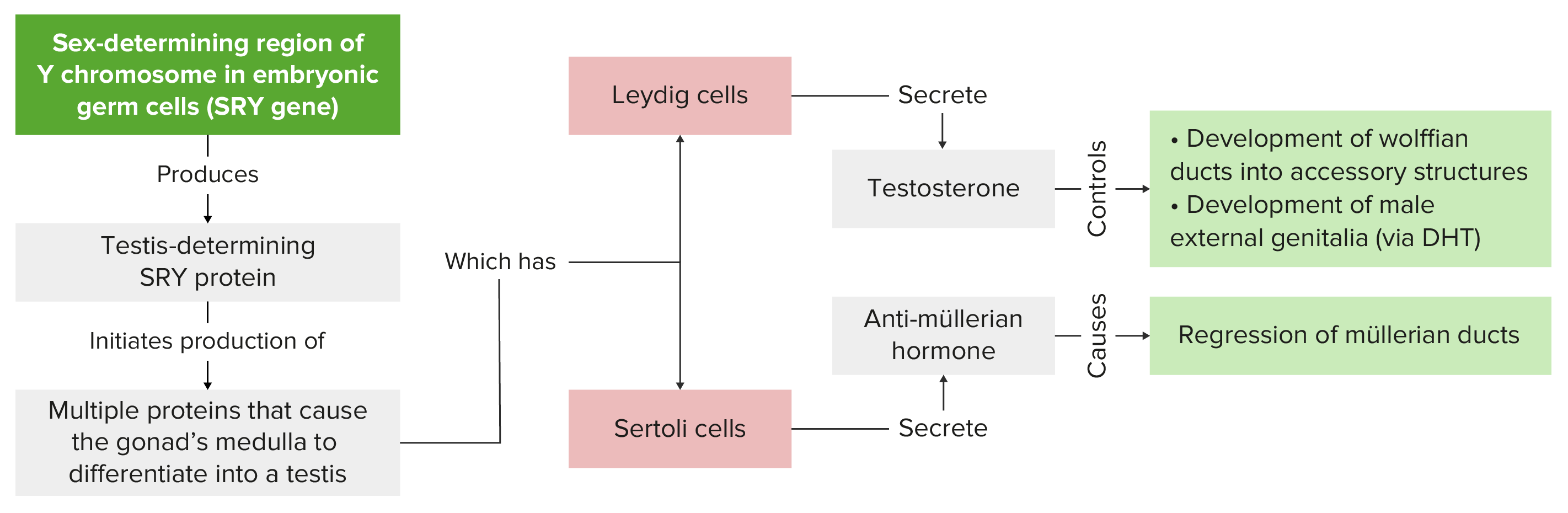
    • El gen SRY desempeña un papel vital en EN Erythema nodosum is an immune-mediated panniculitis (inflammation of the subcutaneous fat) caused by a type IV (delayed-type) hypersensitivity reaction. It commonly manifests in young women as tender, erythematous nodules on the shins. Erythema Nodosum la determinación del sexo masculino al AL Amyloidosis desencadenar la transformación del tejido gonadal en EN Erythema nodosum is an immune-mediated panniculitis (inflammation of the subcutaneous fat) caused by a type IV (delayed-type) hypersensitivity reaction. It commonly manifests in young women as tender, erythematous nodules on the shins. Erythema Nodosum testículos.
    • La mutación suele ser una pequeña deleción en EN Erythema nodosum is an immune-mediated panniculitis (inflammation of the subcutaneous fat) caused by a type IV (delayed-type) hypersensitivity reaction. It commonly manifests in young women as tender, erythematous nodules on the shins. Erythema Nodosum la región de unión al AL Amyloidosis ADN del gen SRY del cromosoma Y.
  • Mutación del gen Map3K1
    • Ocurre en EN Erythema nodosum is an immune-mediated panniculitis (inflammation of the subcutaneous fat) caused by a type IV (delayed-type) hypersensitivity reaction. It commonly manifests in young women as tender, erythematous nodules on the shins. Erythema Nodosum el 18% de los LOS Neisseria casos.
    • Codifica una proteína que ayuda a determinar los LOS Neisseria caracteres sexuales durante la gestación.
    • Las mutaciones reducen la expresión de los LOS Neisseria genes Genes A category of nucleic acid sequences that function as units of heredity and which code for the basic instructions for the development, reproduction, and maintenance of organisms. DNA Types and Structure SOX9 y SRY y activan la expresión de genes Genes A category of nucleic acid sequences that function as units of heredity and which code for the basic instructions for the development, reproduction, and maintenance of organisms. DNA Types and Structure específicos de la mujer (WNT, beta-catenina y FOXL2).
  • Mutación del gen NR5A1
    • Ocurre en EN Erythema nodosum is an immune-mediated panniculitis (inflammation of the subcutaneous fat) caused by a type IV (delayed-type) hypersensitivity reaction. It commonly manifests in young women as tender, erythematous nodules on the shins. Erythema Nodosum el 9% de los LOS Neisseria casos.
    • Codifica para el receptor Receptor Receptors are proteins located either on the surface of or within a cell that can bind to signaling molecules known as ligands (e.g., hormones) and cause some type of response within the cell. Receptors nuclear del factor-1 esteroidogénico, una proteína importante para la producción de hormonas sexuales/diferenciación.
  • Mutación del gen SOX9
    • Suele inhibir la creación del sistema reproductor femenino, permitiendo el desarrollo de los LOS Neisseria órganos reproductores masculinos.

Fisiopatología y Presentación Clínica

Fisiopatología

  • Desarrollo normal hasta la octava semana de gestación
  • Se produce una mutación del gen SRY → las gónadas primordiales no se desarrollan en EN Erythema nodosum is an immune-mediated panniculitis (inflammation of the subcutaneous fat) caused by a type IV (delayed-type) hypersensitivity reaction. It commonly manifests in young women as tender, erythematous nodules on the shins. Erythema Nodosum testículos → no se segrega la hormona antimülleriana (HAM) ni la testosterona → genitales masculinos no desarrollados + desarrollo del útero y la vagina Vagina The vagina is the female genital canal, extending from the vulva externally to the cervix uteri internally. The structures have sexual, reproductive, and urinary functions and a rich blood supply, mainly arising from the internal iliac artery. Vagina, Vulva, and Pelvic Floor: Anatomy
Importance of the SRY gene

Imagen que muestra la importancia del SRY en el desarrollo genital masculino normal
DHT: dihidrotestosterona
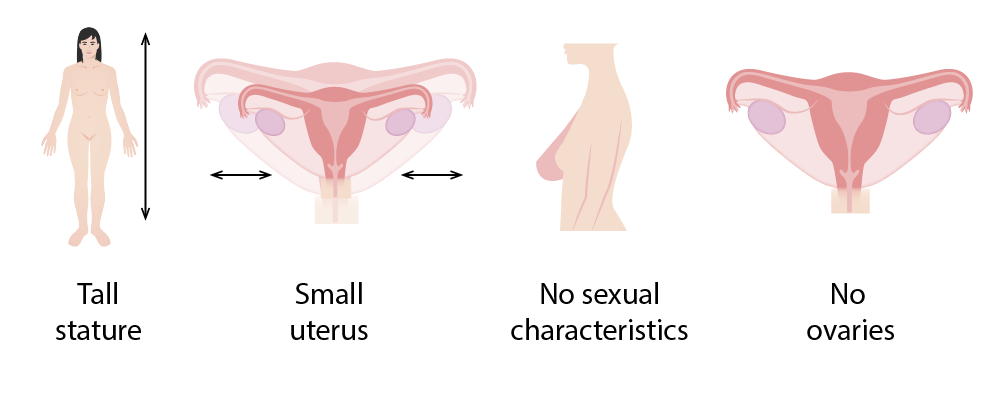
Imagen por Lecturio.

Presentación clínica

  • Fenotipo femenino
  • Desarrollo prepuberal normal
  • Estatura alta (10–12 cm más alto que los LOS Neisseria que no tienen el síndrome de Swyer (comparación de edad y sexo))
  • Cognición/inteligencia: normal
  • Fenotipo conductual: normal
  • Desarrollo sexual/fecundidad:
    • Amenorrea primaria
    • Infertilidad por falta de funcionamiento de los LOS Neisseria ovarios (el embarazo es posible con la donación de óvulos)
    • ↓ Estrógeno debido a ovarios no funcionales (estrías gonadales)
  • Asociaciones: ↑ riesgo de formación de tumores en EN Erythema nodosum is an immune-mediated panniculitis (inflammation of the subcutaneous fat) caused by a type IV (delayed-type) hypersensitivity reaction. It commonly manifests in young women as tender, erythematous nodules on the shins. Erythema Nodosum las gónadas anormales (gonadoblastoma o disgerminoma)
Clinical manifestations of Swyer syndrome

Manifestaciones clínicas del síndrome de Swyer:
Estatura alta, útero pequeño, ausencia de caracteres sexuales secundarios y ausencia de ovarios (en su lugar tendrá gónadas en forma de estrías)

Imagen por Lecturio.

Diagnóstico y Tratamiento

Diagnóstico

  • Principalmente clínico, basado en EN Erythema nodosum is an immune-mediated panniculitis (inflammation of the subcutaneous fat) caused by a type IV (delayed-type) hypersensitivity reaction. It commonly manifests in young women as tender, erythematous nodules on the shins. Erythema Nodosum la falta de pubertad y de los LOS Neisseria caracteres sexuales secundarios
    • Retraso en EN Erythema nodosum is an immune-mediated panniculitis (inflammation of the subcutaneous fat) caused by a type IV (delayed-type) hypersensitivity reaction. It commonly manifests in young women as tender, erythematous nodules on the shins. Erythema Nodosum el desarrollo de las mamas o ausencia de estas
    • Falta de vello púbico
    • Amenorrea
  • Confirmado mediante pruebas de cariotipo:
    • 46,XY: síndrome de Swyer
    • 46,XX: fallo ovárico primario
    • 45,XO: síndrome de Turner
  • Estudios de laboratorio
    • Niveles elevados de la hormona foliculoestimulante ( FSH FSH A major gonadotropin secreted by the adenohypophysis. Follicle-stimulating hormone stimulates gametogenesis and the supporting cells such as the ovarian granulosa cells, the testicular sertoli cells, and leydig cells. Fsh consists of two noncovalently linked subunits, alpha and beta. Within a species, the alpha subunit is common in the three pituitary glycoprotein hormones (TSH, LH, and FSH), but the beta subunit is unique and confers its biological specificity. Menstrual Cycle, por sus siglas en EN Erythema nodosum is an immune-mediated panniculitis (inflammation of the subcutaneous fat) caused by a type IV (delayed-type) hypersensitivity reaction. It commonly manifests in young women as tender, erythematous nodules on the shins. Erythema Nodosum inglés) y luteinizante ( LH LH A major gonadotropin secreted by the adenohypophysis. Luteinizing hormone regulates steroid production by the interstitial cells of the testis and the ovary. The preovulatory luteinizing hormone surge in females induces ovulation, and subsequent luteinization of the follicle. Luteinizing hormone consists of two noncovalently linked subunits, alpha and beta. Within a species, the alpha subunit is common in the three pituitary glycoprotein hormones (TSH, LH, and FSH), but the beta subunit is unique and confers its biological specificity. Menstrual Cycle, por sus siglas en EN Erythema nodosum is an immune-mediated panniculitis (inflammation of the subcutaneous fat) caused by a type IV (delayed-type) hypersensitivity reaction. It commonly manifests in young women as tender, erythematous nodules on the shins. Erythema Nodosum inglés)
    • Para identificar el gonadoblastoma o el disgerminoma deben analizarse los LOS Neisseria marcadores tumorales: alfa-fetoproteína, gonadotropina coriónica humana beta, lactato deshidrogenasa y fosfatasa alcalina placentaria.
  • Estudios complementarios
    • Pruebas genéticas y secuenciación para determinar el gen defectuoso (no afecta el plan de tratamiento)
    • Ultrasonido pélvico transabdominal
      • Evalúa el estado de las estructuras müllerianas y de los LOS Neisseria ovarios.
      • Muestra las gónadas en EN Erythema nodosum is an immune-mediated panniculitis (inflammation of the subcutaneous fat) caused by a type IV (delayed-type) hypersensitivity reaction. It commonly manifests in young women as tender, erythematous nodules on the shins. Erythema Nodosum estrías y las estructuras müllerianas normales.
    • Biopsia gonadal:
      • Puede realizarse mediante laparoscopia o biopsia con aguja.
      • Ayuda a confirmar la presencia de estrías gonadales y descartar tejido gonadal tumoral o funcional.

Tratamiento

  • Terapia de sustitución hormonal (para inducir la pubertad femenina normal y el desarrollo de los LOS Neisseria caracteres sexuales secundarios normales):
    • Terapia estrogénica
    • Terapia de sustitución cíclica de estrógenos y progestágenos (durante 50 años)
  • Gonadectomía: indicada en EN Erythema nodosum is an immune-mediated panniculitis (inflammation of the subcutaneous fat) caused by a type IV (delayed-type) hypersensitivity reaction. It commonly manifests in young women as tender, erythematous nodules on the shins. Erythema Nodosum todos los LOS Neisseria pacientes con síndrome de Swyer debido al AL Amyloidosis riesgo de neoplasia en EN Erythema nodosum is an immune-mediated panniculitis (inflammation of the subcutaneous fat) caused by a type IV (delayed-type) hypersensitivity reaction. It commonly manifests in young women as tender, erythematous nodules on the shins. Erythema Nodosum las gónadas con estrías anormales
  • Psicoterapia
  • Tratamiento de fertilidad
    • La única opción de embarazo es el uso de óvulos de donante
    • Como la mayoría de las pacientes con síndrome de Swyer tienen un útero hipotrófico, necesitarán una cesárea electiva a las 36 semanas para evitar la rotura uterina durante el parto.

Diagnóstico Diferencial

Las siguientes condiciones son diagnósticos diferenciales para el síndrome de Swyer:

  • Hiperplasia suprarrenal congénita: Grupo de enfermedades raras autosómicas recesivas caracterizadas por defectos en EN Erythema nodosum is an immune-mediated panniculitis (inflammation of the subcutaneous fat) caused by a type IV (delayed-type) hypersensitivity reaction. It commonly manifests in young women as tender, erythematous nodules on the shins. Erythema Nodosum las enzimas de las glándulas suprarrenales que intervienen en EN Erythema nodosum is an immune-mediated panniculitis (inflammation of the subcutaneous fat) caused by a type IV (delayed-type) hypersensitivity reaction. It commonly manifests in young women as tender, erythematous nodules on the shins. Erythema Nodosum la síntesis de cortisol Cortisol Glucocorticoids, andrógenos y aldosterona. Los LOS Neisseria pacientes pueden presentar una amplia gama de síntomas, incluida virilización en EN Erythema nodosum is an immune-mediated panniculitis (inflammation of the subcutaneous fat) caused by a type IV (delayed-type) hypersensitivity reaction. It commonly manifests in young women as tender, erythematous nodules on the shins. Erythema Nodosum las mujeres, pérdida de sal, que conduce a la hipotensión y otras anomalías electrolíticas, y finalización prematura del crecimiento, que da lugar a la baja estatura.
  • Síndrome de insensibilidad completa a los LOS Neisseria andrógenos: Enfermedad ligada al AL Amyloidosis cromosoma X en EN Erythema nodosum is an immune-mediated panniculitis (inflammation of the subcutaneous fat) caused by a type IV (delayed-type) hypersensitivity reaction. It commonly manifests in young women as tender, erythematous nodules on the shins. Erythema Nodosum la que una mutación genética provoca una resistencia completa a la testosterona. Como resultado, los LOS Neisseria individuos con este trastorno son genotípicamente varones con cariotipo 46,XY, pero sin masculinización de los LOS Neisseria genitales externos o virilización. No perjudica significativamente el desarrollo genital o sexual de la mujer.
  • Disgenesia ovárica hipergonadotrópica: También conocida como 46,XX disgenesia ovárica, es un defecto primario del desarrollo del ovario que provoca un fallo ovárico prematuro en EN Erythema nodosum is an immune-mediated panniculitis (inflammation of the subcutaneous fat) caused by a type IV (delayed-type) hypersensitivity reaction. It commonly manifests in young women as tender, erythematous nodules on the shins. Erythema Nodosum mujeres con un cariotipo normal (46,XX). El fracaso del desarrollo gonadal se debe a la resistencia a la estimulación de las gonadotrofinas.

Referencias

  1. Agarwal, A., & Agarwal, S. (2017). Swyer syndrome with gonadoblastoma: A clinicoradiological approach. PubMed Central (PMC). https://www.ncbi.nlm.nih.gov/pmc/articles/PMC5405651/
  2. Harry Ostrer, M. D. (2019). Swyer syndrome. NORD. Retrieved January 15, 2025, from https://rarediseases.org/rare-diseases/swyer-syndrome/
  3. Michala, L., Goswami, D., Creighton, S. M., & Conway, G. S. (2008). Swyer syndrome: Presentation and outcomes. BJOG: An International Journal of Obstetrics and Gynaecology, 115(6), 737–741. https://doi.org/10.1111/j.1471-0528.2008.01703.x
  4. Mohnach, L., Fechner, P. Y., & Keegan, C. E. (2022). Nonsyndromic disorders of testicular development overview. In GeneReviews® [Internet]. National Center for Biotechnology Information (NCBI). https://www.ncbi.nlm.nih.gov/books/NBK1547/
  5. Swyer Syndrome. (2022). NIH, Genetics Home Reference. https://ghr.nlm.nih.gov/condition/swyer-syndrome#statistics
  6. Uda, M., Tonegawa, K., & Taniguchi, K. (2022). The role of gonadal dysgenesis in disorders of sexual development: An overview. Journal of Clinical Endocrinology & Metabolism, 108(5), 1234-1245. https://doi.org/10.1210/clinem/dgac012
  7. Dávila Báez, D. A., et al. (2023). Swyer Syndrome: An in-depth exploration of phenotypic and genotypic features in 46, XY disorders of sex development. International Journal of Medical Science and Clinical Research Studies, 3(10), 2451–2455. https://doi.org/10.47191/ijmscrs/v3-i10-62

¡Crea tu cuenta gratis o inicia una sesión para seguir leyendo!

Regístrate ahora y obtén acceso gratuito a Lecturio con páginas de concepto, videos médicos y cuestionarios para tu educación médica.

User Reviews

Que tengas una sesión de estudio alegre y navideña 🎁 Ahorra 50% en todos los planes >>

Details