
La hiperbilirrubinemia neonatal es un término amplio que se refiere a varias afecciones que pueden causar la acumulación de bilirrubina durante los LOS Neisseria primeros días después del nacimiento. La afección se observa a menudo por la coloración amarilla visible de la piel y la esclerótica secundaria a la deposición de bilirrubina. Dado que la hiperbilirrubinemia surge de los LOS Neisseria procesos fisiológicos que acompañan al AL Amyloidosis nacimiento, es generalmente un hallazgo esperado. Sin embargo, la hiperbilirrubinemia en EN Erythema nodosum is an immune-mediated panniculitis (inflammation of the subcutaneous fat) caused by a type IV (delayed-type) hypersensitivity reaction. It commonly manifests in young women as tender, erythematous nodules on the shins. Erythema Nodosum el neonato también puede tener etiologías patológicas, como la relacionada con la lactancia, la isoinmunización del grupo sanguíneo, los LOS Neisseria trastornos metabólicos y las infecciones. Independientemente de la etiología, el objetivo principal del tratamiento de la ictericia neonatal es prevenir el efecto neurotóxico de la bilirrubina indirecta, principalmente el kernicterus Kernicterus A term used pathologically to describe bilirubin staining of the basal ganglia; brain stem; and cerebellum and clinically to describe a syndrome associated with hyperbilirubinemia. Clinical features include athetosis, muscle spasticity or hypotonia, impaired vertical gaze, and deafness. Nonconjugated bilirubin enters the brain and acts as a neurotoxin, often in association with conditions that impair the blood-brain barrier (e.g., sepsis). This condition occurs primarily in neonates, but may rarely occur in adults. Hyperbilirubinemia of the Newborn. Cuando está indicado, el tratamiento incluye principalmente la fototerapia y la exanguinotransfusión.
Last updated: Dec 15, 2025
La hiperbilirrubinemia neonatal se define como una coloración amarilla de la piel y la esclerótica del recién nacido, generalmente debida al AL Amyloidosis depósito tisular de bilirrubina no conjugada, el producto final del catabolismo de las hemoproteínas.
Prueba de Coombs positiva: isoinmunización
Prueba de Coombs negativa

El nomograma de Buthani que identifica el riesgo subsecuente al nivel de bilirrubina sérica total basado en el nivel de bilirrubina específico por hora en recién nacidos con ≥ 35 semanas de gestación
Imagen por Lecturio.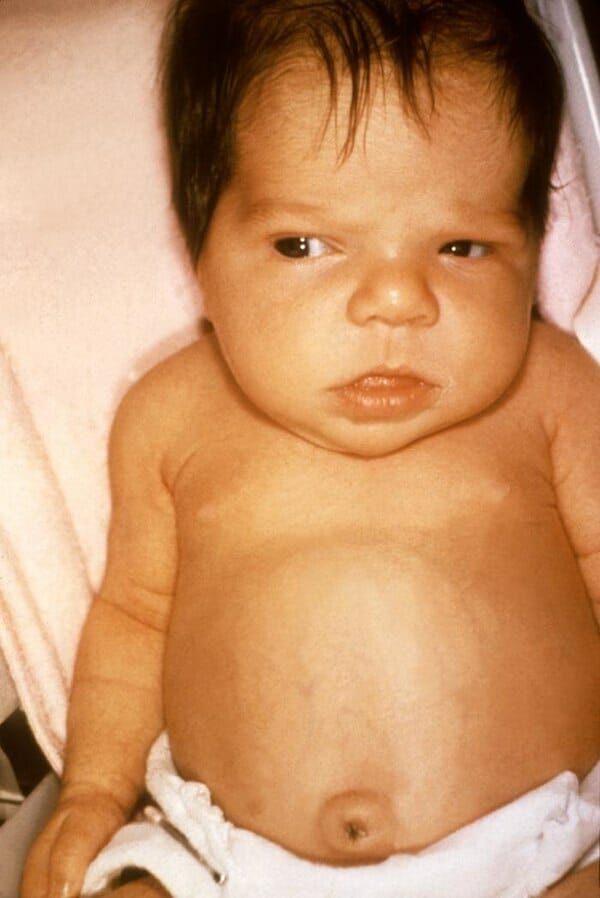
Una niña de 6 semanas con síntomas de ictericia por hipotiroidismo
Imagen: “Jaundice in newborn” por Dr. Hudson (CDC). Licencia: Dominio Público| Tipo de bilirrubina | Pico de bilirrubina (mg/dL) | Aumento de la bilirrubina (mg/dL/día) | Comentarios/enfermedades | |
|---|---|---|---|---|
| Puede aparecer en EN Erythema nodosum is an immune-mediated panniculitis (inflammation of the subcutaneous fat) caused by a type IV (delayed-type) hypersensitivity reaction. It commonly manifests in young women as tender, erythematous nodules on the shins. Erythema Nodosum las 1ras 24 horas | ||||
| Hemolítica/ hematoma Hematoma A collection of blood outside the blood vessels. Hematoma can be localized in an organ, space, or tissue. Intussusception (duración: variable Variable Variables represent information about something that can change. The design of the measurement scales, or of the methods for obtaining information, will determine the data gathered and the characteristics of that data. As a result, a variable can be qualitative or quantitative, and may be further classified into subgroups. Types of Variables) | Indirecta | Ilimitado | < 5 |
|
| Hemolítica + hepatotóxica (duración: variable Variable Variables represent information about something that can change. The design of the measurement scales, or of the methods for obtaining information, will determine the data gathered and the characteristics of that data. As a result, a variable can be qualitative or quantitative, and may be further classified into subgroups. Types of Variables) | Indirecta/directa | Ilimitado | < 5 |
|
| Puede aparecer en EN Erythema nodosum is an immune-mediated panniculitis (inflammation of the subcutaneous fat) caused by a type IV (delayed-type) hypersensitivity reaction. It commonly manifests in young women as tender, erythematous nodules on the shins. Erythema Nodosum 2–4 días | ||||
| Fisiológica (desaparece en EN Erythema nodosum is an immune-mediated panniculitis (inflammation of the subcutaneous fat) caused by a type IV (delayed-type) hypersensitivity reaction. It commonly manifests in young women as tender, erythematous nodules on the shins. Erythema Nodosum 4–9 días) | Indirecta | 10–15 | < 5 | La duración/severidad incrementa con el grado de prematuridad |
| Metabólica (duración variable Variable Variables represent information about something that can change. The design of the measurement scales, or of the methods for obtaining information, will determine the data gathered and the characteristics of that data. As a result, a variable can be qualitative or quantitative, and may be further classified into subgroups. Types of Variables) | Indirecta | > 12–15 | < 5 |
|
| Daño hepatocelular (duración: variable Variable Variables represent information about something that can change. The design of the measurement scales, or of the methods for obtaining information, will determine the data gathered and the characteristics of that data. As a result, a variable can be qualitative or quantitative, and may be further classified into subgroups. Types of Variables) | Indirecta/directa | Ilimitado | < 5 |
|
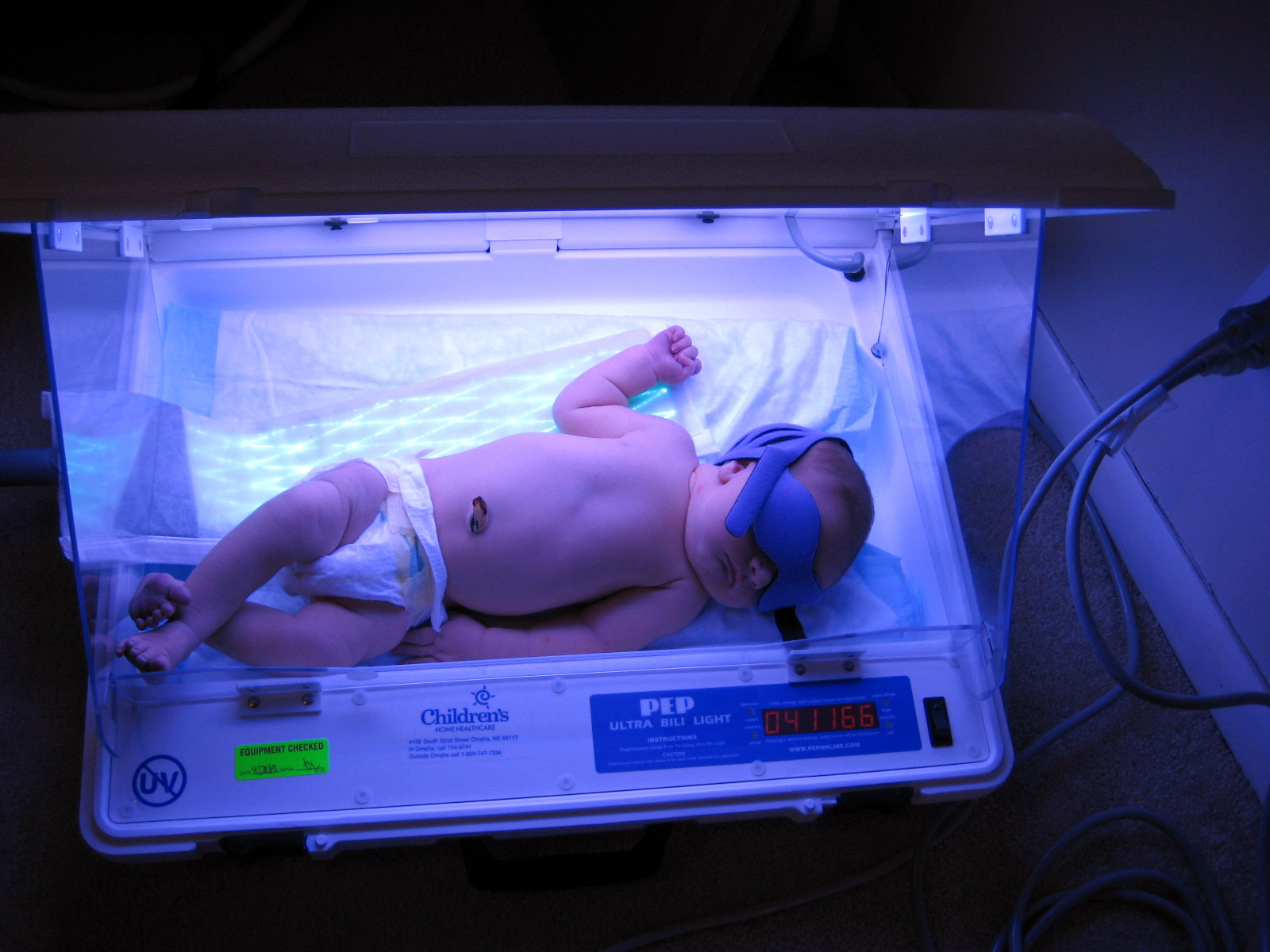
Un niño recibiendo fototerapia
Imagen: “Baked Bean” por shannonpatrick17. Licencia: CC BY 2.0Disfunción neurológica inducida por la bilirrubina: